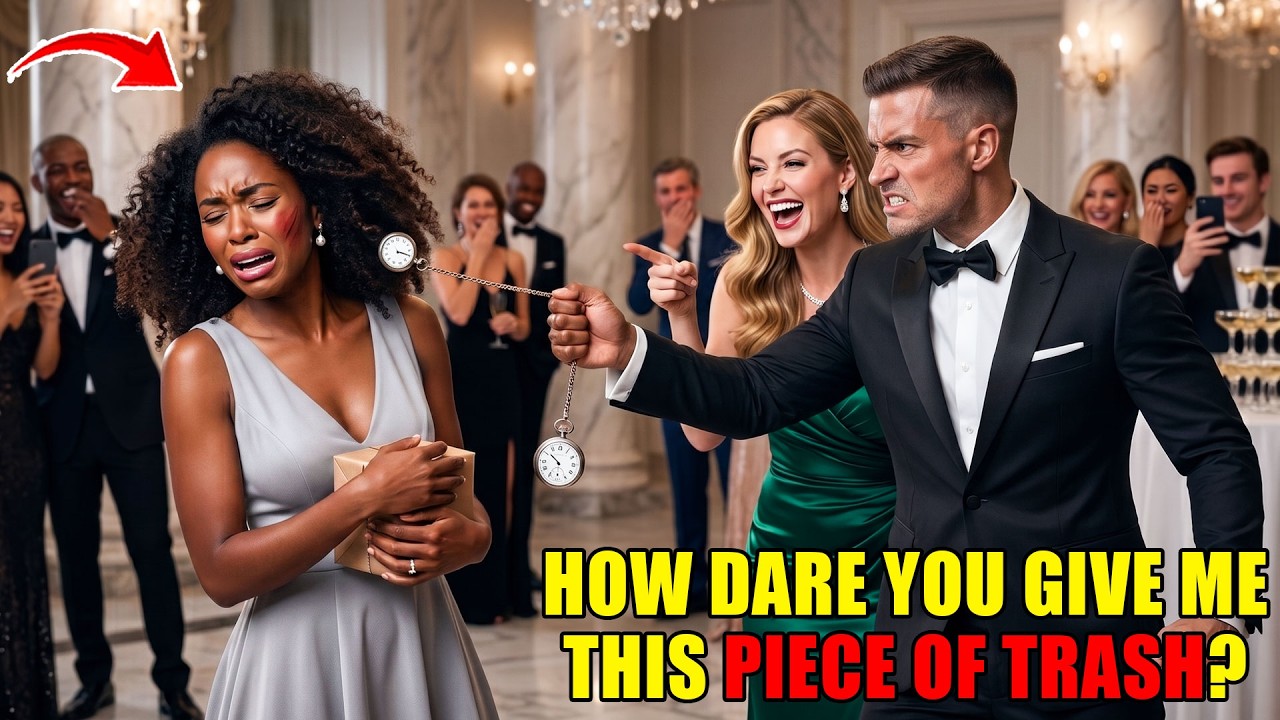
The laughter began before Amara Brooks reached the center of the ballroom.
It started near the champagne tower, passed through a cluster of venture capitalists, and spread toward the stage where Ethan Carter stood beneath a wall of white orchids with one hand around a crystal glass.
Nearly two hundred guests had gathered at the Harrington Grand for his thirty-eighth birthday.
There were investors, reporters, celebrities, and executives who had learned that being seen at Ethan’s parties was often as useful as attending his meetings.
Everything had been designed for display.
A twelve-piece band played beneath suspended lights. A photographer moved between tables. The walls carried projections of Ethan’s company milestones as though his life were a corporate anniversary.
Amara stood at the edge of it all in a simple gray dress.
She held a small wooden box with both hands.
The dress had cost less than some of the floral arrangements. Her handbag showed signs of use. She had taken the subway because traffic was heavy and she did not want to arrive late.
Vanessa Hail noticed every detail.
Vanessa stood beside Ethan in a red silk gown, close enough to suggest intimacy but not so close that anyone could accuse her of disrespecting his current relationship.
She had dated Ethan years earlier.
Now she described herself as a business partner.
Amara had never believed the title.
Vanessa’s eyes moved over the gray dress.
“You look comfortable,” she said.
The word landed exactly as intended.
Amara smiled politely.
“It has been a long day.”
“At the gallery?”
“Yes.”
Vanessa glanced toward the crowd.
“That must be peaceful. Working somewhere so small.”
Amara did not answer.
For two years, she had listened to remarks like that.
Sometimes Vanessa mentioned Amara’s clothes.
Sometimes her neighborhood.
Sometimes the fact that she worked at a modest gallery in Manhattan instead of a company with glass offices and global press coverage.
The cruelty was always clean enough to deny.
Ethan heard most of it.
He usually looked away.
That night, Amara had hoped he would be different.
She had spent three months preparing his gift.
Inside the wooden box was an antique pocket watch that had belonged to her father.
The watch had stopped working when Amara was a child. Its case was scratched, its chain broken, and one of the internal gears had rusted.
She found a restoration specialist in Brooklyn and visited the workshop every Saturday.
She selected replacement pieces from the same period.
She approved the repair of the enamel face.
She asked the restorer to preserve one small dent near the hinge because her father had made it while carrying the watch during a camping trip.
On the inside cover, Amara had added a short inscription.
Time reveals what attention overlooks.
The watch was not expensive by the standards of Ethan’s party.
It was valuable by hers.
Amara’s life looked ordinary because she had chosen to keep it that way.
She worked at the gallery because she loved art, especially the quiet moment when someone stood before a painting and forgot to perform.
She lived above a bakery in a modest apartment where the smell of bread rose through the floor each morning.
She bought groceries without assistance and carried her own bags.
What almost no one knew was that she was the only granddaughter of Richard Brooks.
Richard Brooks had built a private empire through logistics, commercial property, energy holdings, and investment funds. He avoided interviews, declined awards, and rarely allowed photographs.
Financial publications estimated his wealth in the tens of billions.
When Amara’s parents died, Richard raised her.
He taught her to read balance sheets before she entered high school.
He also taught her to greet janitors before executives, to return shopping carts, and to leave large tips without creating a performance around generosity.
“Money is loud,” he once told her. “Character is what remains audible after it leaves the room.”
Richard died eight months before Ethan’s party.
His will transferred nearly everything to Amara.
The inheritance included controlling shares in Brooks Corporation, real estate holdings, an art collection, charitable foundations, and investment accounts large enough to alter markets.
But the estate was still moving through a complicated legal process.
At Amara’s request, the details remained private.
Grief was part of the reason.
The other reason was Ethan.
She wanted to know whether he loved the woman who worked in a gallery and rode the subway.
She planned to tell him the truth after his birthday.
Two years, she thought, should be long enough to know someone.
That night would prove otherwise.
The gift table near the stage had become part of the entertainment.
A technology founder presented Ethan with a limited-edition watch worth more than most homes.
A real estate developer gave him keys to a vintage sports car.
Vanessa announced that she had secured him a membership at a private club with a ten-year waiting list.
Guests applauded each reveal.
Then Vanessa looked toward Amara.
“What did you bring him?”
Amara held the wooden box closer.
“It’s personal.”
“That sounds mysterious.”
“It isn’t meant for everyone.”
Vanessa’s smile widened.
“Ethan, you should open Amara’s gift next.”
Amara looked toward him.
He could have said no.
He could have crossed the room, taken the box quietly, and opened it later.
Instead, he noticed the cameras.
He noticed the guests waiting.
He noticed Vanessa smiling beside him.
“Bring it up,” he said.
The crowd shifted to make a path.
Amara walked toward the stage.
The gray dress seemed plainer beneath the lights. The wooden box seemed smaller beside the luxury packaging piled across the gift table.
She handed it to Ethan.
“I wanted you to have something that meant something to me.”
He opened the lid.
For one brief second, his face softened.
Then someone near the front laughed.
Vanessa leaned closer.
“Is that used?”
More laughter followed.
Ethan looked down at the restored pocket watch.
“What is this?”
“It belonged to my father.”
He lifted it by the chain.
The watch swung beneath the stage lights.
“A pocket watch?”
“I had it restored.”
Vanessa covered a smile with her champagne glass.
Amara continued.
“He carried it for years. I thought you might understand what it meant for me to give it to you.”
Ethan looked toward the expensive gifts beside him.
Then toward the crowd.
His expression changed.
Not because he disliked the watch.
Because he had become aware of how it looked.
“You brought this here?” he asked.
Amara’s voice became quieter.
“Yes.”
“To this party?”
“Yes.”
Someone whispered that it looked like something from a flea market.
Ethan heard it.
The man Amara loved had a choice.
He could protect what was private.
Or protect his public image.
He chose the room.
“You knew what kind of event this was,” he said.
“I knew it was your birthday.”
“You could have made an effort.”
“I did.”
Vanessa laughed softly.
Ethan placed the watch back in the box with more force than necessary.
The hinge cracked.
The box fell from his hand.
It struck the edge of the stage and opened on the marble floor.
The watch rolled beneath a table.
A few guests gasped.
Most remained silent.
Amara looked at Ethan.
He did not apologize.
Instead, he seemed encouraged by the attention.
“This is what I keep trying to explain,” he said. “You never understand the world I live in.”
Vanessa stood beside him with the stillness of someone enjoying a scene she had helped create.
Ethan continued.
“Look at this room. Look at the people here. And you arrive dressed like that, carrying some broken family object as though sentiment is enough.”
The words reached every corner of the ballroom.
Amara felt something inside her become completely clear.
Not broken.
Clear.
She looked at the man she had spent two years defending in private.
The man whose sharpness she had called ambition.
Whose vanity she had called insecurity.
Whose silence beside Vanessa she had called discomfort.
Now there was nothing left to reinterpret.
Ethan pointed toward the entrance.
“Maybe it’s better if you leave.”
The room became quieter.
Amara glanced at the security officers near the doors.
Ethan saw the movement.
“Please escort her out.”
One guard hesitated.
Amara saved him from choosing.
“That won’t be necessary.”
She stepped down from the stage.
Then she crouched beneath the table and retrieved the watch.
The glass had cracked.
One hand had stopped between the numbers seven and eight.
Amara placed it carefully inside the broken box.
She did not cry.
She did not ask Ethan to reconsider.
She did not explain that her father had worn the watch on the last morning she saw him alive.
She walked toward the doors while two hundred people watched.
Some looked ashamed.
Others merely looked curious.
Vanessa lifted her glass.
Ethan wore the expression of a man who believed he had regained control.
Amara reached the entrance.
Before she could touch the door, it opened from the other side.
Six people in dark suits entered.
Three carried legal portfolios.
Two were private security officers.
The man leading them was Jonathan Brooks, general counsel of Brooks Corporation and Richard’s nephew.
He scanned the ballroom.
Then he saw Amara.
“Ms. Brooks.”
His tone carried urgency and respect.
The room went still.
Jonathan stepped toward her.
“We have been trying to reach you.”
“My phone is in my bag.”
“The probate court entered the final order an hour ago.”
Amara closed her eyes briefly.
She had known the decision was close.
She had not expected it that night.
Behind her, Ethan stepped down from the stage.
“Who are you?”
Jonathan looked past Amara.
“Jonathan Brooks. General counsel for Brooks Corporation.”
The name moved through the room.
Several investors straightened.
A banking executive near the bar lowered his drink.
Ethan frowned.
“This is a private event.”
Jonathan’s eyes shifted to the broken box in Amara’s hands.
“We were told Ms. Brooks might be here.”
Ethan glanced at Amara.
“She was just leaving.”
Jonathan studied him.
“Did you ask Amara Brooks to leave?”
Ethan’s pride made the answer sharper than it should have been.
“She created an embarrassing scene.”
Jonathan looked around the ballroom.
“She did?”
“She brought an inappropriate gift and refused to understand the situation.”
Amara said nothing.
Jonathan opened the portfolio he was carrying.
“Then perhaps I should clarify her situation.”
Ethan’s expression tightened.
Jonathan removed a sealed court order and a copy of Richard Brooks’s will.
“Richard Brooks named Amara Elise Brooks as his sole beneficiary.”
The first murmur began near the rear tables.
Jonathan continued.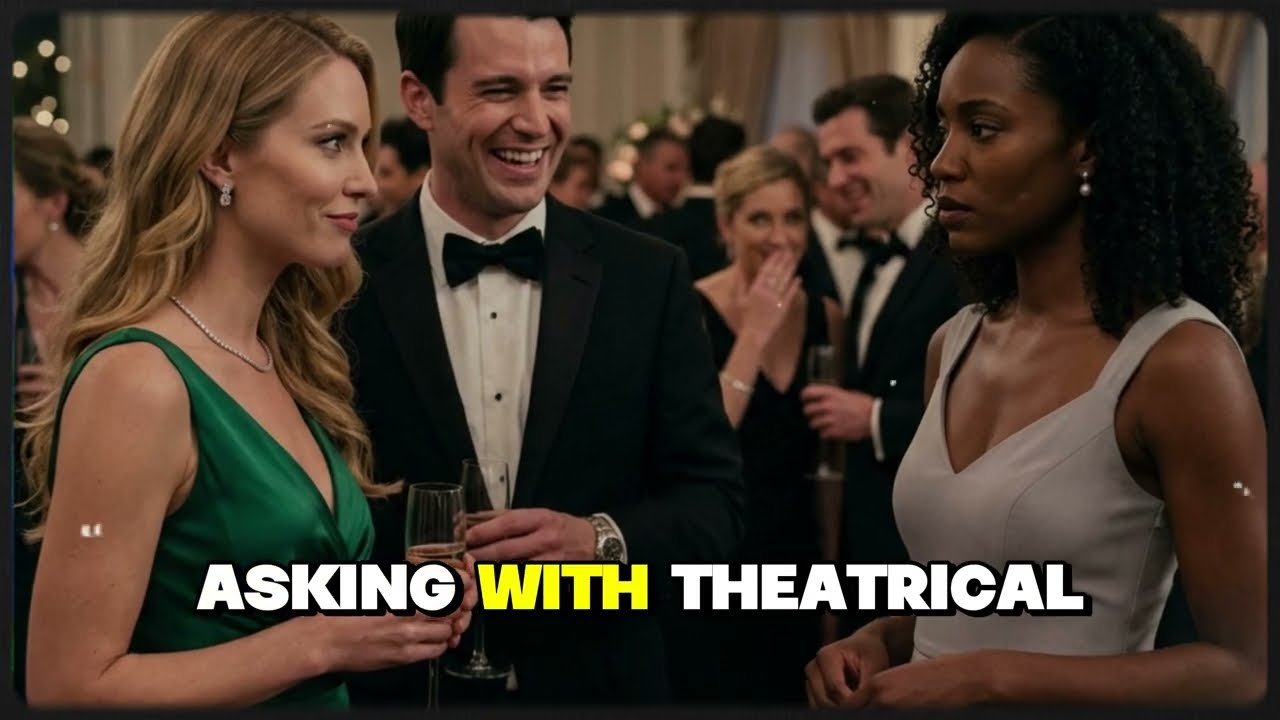
“The final probate order transfers controlling ownership of Brooks Corporation, its domestic and international subsidiaries, the Brooks investment portfolio, the family’s real estate holdings, its private art collection, and the Brooks Foundation to Ms. Brooks.”
No one laughed now.
Vanessa’s face lost color.
Ethan looked at Amara, then at Jonathan.
“Richard Brooks?”
“The Richard Brooks,” Jonathan said.
A venture capitalist near the stage whispered an estimate to the man beside him.
More than thirty billion.
Possibly closer to forty.
Ethan’s eyes moved to Amara’s gray dress.
The worn handbag.
The cracked wooden box.
Nothing had changed.
That was what made the moment unbearable.
She had possessed value when he humiliated her.
The paperwork had only given the room language it respected.
Jonathan handed Amara the court order.
“The board is waiting for your instructions.”
Amara accepted it.
Ethan looked as though he had forgotten how to breathe.
“You never told me.”
Amara met his eyes.
“I was going to.”
“When?”
“Tomorrow.”
The answer struck him visibly.
Vanessa stepped backward.
Her heel caught the edge of a chair.
She reached for the table to steady herself.
Around her, guests who had laughed minutes earlier were avoiding Amara’s gaze.
One woman set down her champagne glass as though holding it had become inappropriate.
Jonathan noticed the watch.
“Is that your father’s?”
Amara nodded.
His face changed.
He had seen it many times.
Richard kept the watch in his desk after Amara’s father died. Years later, he gave it to her and told her that the only things worth inheriting were the things that reminded a person who they had been before the world started rewarding them.
Jonathan looked toward Ethan.
Understanding spread across his face.
He did not need an explanation.
“Would you like the car brought around?” he asked Amara.
“Yes.”
Amara walked through the open doors.
No one stopped her.
Behind her, the ballroom remained silent beneath thousands of dollars’ worth of flowers.
Ethan began calling before she reached the hotel entrance.
Amara did not answer.
He called again while she sat in the back of the waiting car.
He sent messages through the night.
Please let me explain.
I was under pressure.
Vanessa pushed the situation.
I didn’t understand what the watch meant.
We need to talk.
Amara read none of them.
Ethan went to her apartment the following morning.
The woman who owned the bakery downstairs told him Amara had not returned.
At the gallery, he learned that she had resigned by email shortly after midnight.
By afternoon, her attorney informed him that all communication had to pass through the Brooks legal office.
For the first time in his adult life, Ethan encountered a door he could not charm, pressure, or purchase open.
He began revisiting the relationship.
Amara had always paid her share.
She never asked him for expensive gifts.
When he complained about her apartment, she said she liked hearing the bakery begin work before dawn.
She rarely spoke about her family, but when she mentioned her grandfather, her voice held respect rather than awe.
Ethan had assumed Richard was a retired teacher or shopkeeper.
He had never asked.
That realization became the first honest thing he admitted to himself.
He had not known Amara because he had never listened long enough to become curious.
People who knew her filled in the history.
Her parents had died when she was young.
Richard raised her.
He sent her to public school at her request and allowed her to work ordinary jobs.
He taught her that wealth distorted every relationship it entered unless a person was careful.
Amara had hidden the inheritance because she feared becoming an opportunity instead of a human being.
Ethan slowly understood that the birthday had not exposed her secret.
It had answered her question.
Two weeks later, a letter arrived at his office.
The handwriting was Amara’s.
Ethan,
I was not hurt because you disliked the gift.
You were allowed to dislike it.
I was hurt because you needed a room full of people to tell you what it was worth.
You watched their faces before deciding how to treat mine.
For two years, I believed your silence was uncertainty. At your party, I learned it was a choice.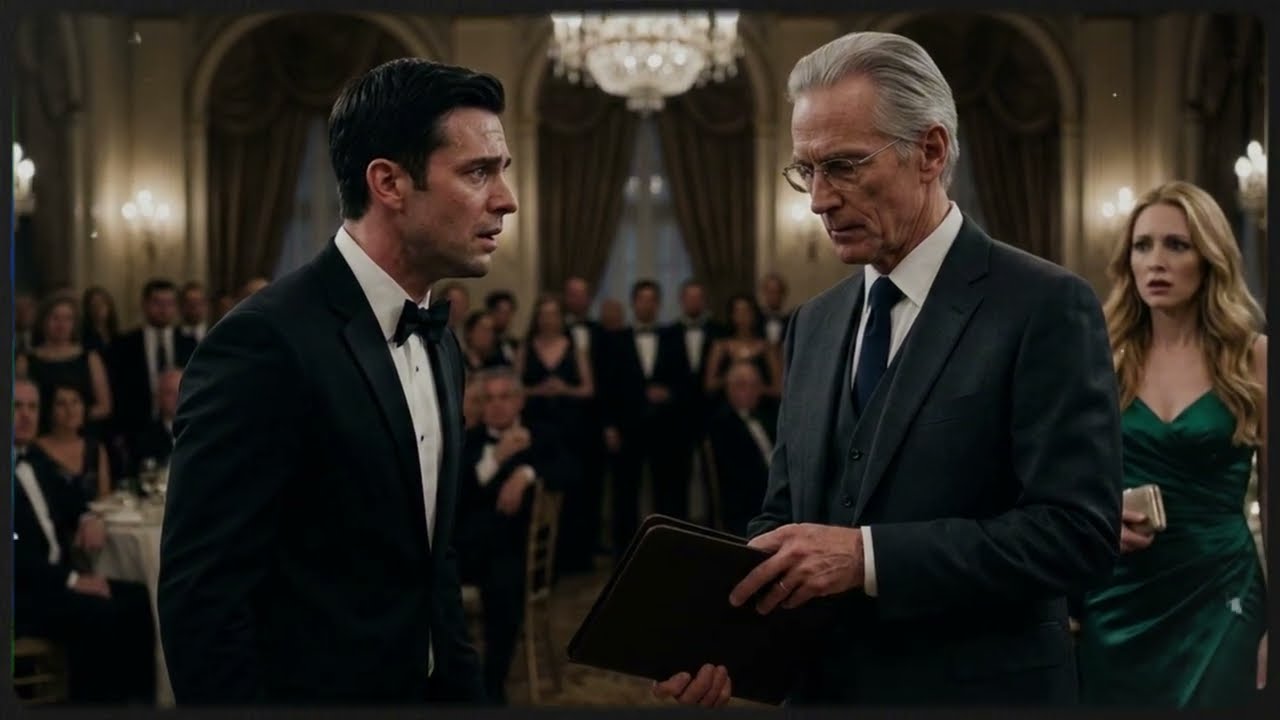
My grandfather taught me that money can reveal character, but the absence of money reveals it faster. You believed I had none, and that belief gave you permission to make me small.
The watch belonged to my father. Giving it to you was my way of placing something irreplaceable in your care.
You did not reject an object.
You showed me what you do with things that have value but do not impress an audience.
I had planned to tell you everything the next morning.
Now I am grateful I learned the truth before I did.
Do not contact me again.
Amara
Ethan read the letter three times.
There was no accusation he could dismiss.
No exaggeration he could correct.
Only a sequence of choices he remembered making.
The video appeared online that afternoon.
Someone at the party had recorded the entire exchange.
Within hours, millions of people had watched Ethan hold up the watch, mock Amara’s dress, and order security to remove her.
The identity reveal made the story spread faster.
But the part that damaged Ethan most was not that Amara was wealthy.
It was how comfortable he had seemed when he believed she was not.
Business partners postponed meetings.
Two investors withdrew from an international expansion plan.
The company board called an emergency session to discuss reputational risk and executive judgment.
Clients asked whether Ethan’s behavior reflected the organization’s culture.
Vanessa issued a statement through a publicist.
She described herself as an old friend who had attended the event in a professional capacity.
She denied playing any meaningful role.
Ethan read the statement alone.
The people who had laughed with him disappeared quickly.
They stopped inviting him to dinners.
They declined photographs.
They returned calls through assistants.
The social world he had valued so highly treated him exactly as he had treated Amara when she became inconvenient.
Months passed.
Amara assumed the role of chair of the Brooks Foundation.
She expanded scholarship programs into six additional cities.
She created grants for students studying art conservation, teaching, nursing, and public-interest law.
The family’s private collection began rotating through public museums with free admission.
Amara read scholarship applications herself.
She learned the names of receptionists and drivers.
She continued living simply, though security made the apartment above the bakery impractical.
Money did not transform her.
It gave her existing character a larger field in which to act.
Ethan sold what remained of his company after the board removed him from daily leadership.
He moved outside the city and accepted a position with a smaller firm where few people knew his name.
The repaired watch remained in his desk drawer.
He had paid a specialist to restore the cracked glass.
The stopped hand could be fixed.
The broken hinge could be replaced.
What the watch represented could not.
Ethan began volunteering at a community center on Saturdays.
He did not tell anyone why.
He helped with job applications, carried boxes, and cleaned tables after events.
At first, part of him believed these actions might become evidence that he had changed.
Eventually, he understood that change performed for an invisible judge was still performance.
So he stopped keeping count.
Nearly a year after the party, Ethan attended the opening of a public art exhibition at the invitation of a former colleague.
He did not know the exhibition had been funded by the Brooks Foundation.
He saw Amara near the far wall.
She stood before a painting in a dark blue dress, listening as a student described the work.
For a moment, she looked exactly as she had in the small gallery where he first met her.
Calm.
Attentive.
Fully present.
She turned and saw him.
Neither moved.
There was no anger in her expression.
No invitation either.
Ethan gave a small nod.
Amara returned it.
Then she smiled politely and walked toward another group of guests.
He did not follow.
That was the one respectful thing left for him to do.
Amara continued through the gallery without looking back.
The night of Ethan’s birthday would remain part of her history, but it would not become the title of her life.
She had once knelt on a marble floor while strangers laughed and gathered the broken pieces of something precious.
She had risen without asking the room to recognize her value.
That was the detail Ethan would remember longest.
Not the lawyers.
Not the inheritance.
Not the billions.
The woman in the gray dress had been worthy of respect before anyone opened a will.
And the clearest measure of character will always be how a person treats someone standing in front of them before they know whether that person can change their life.