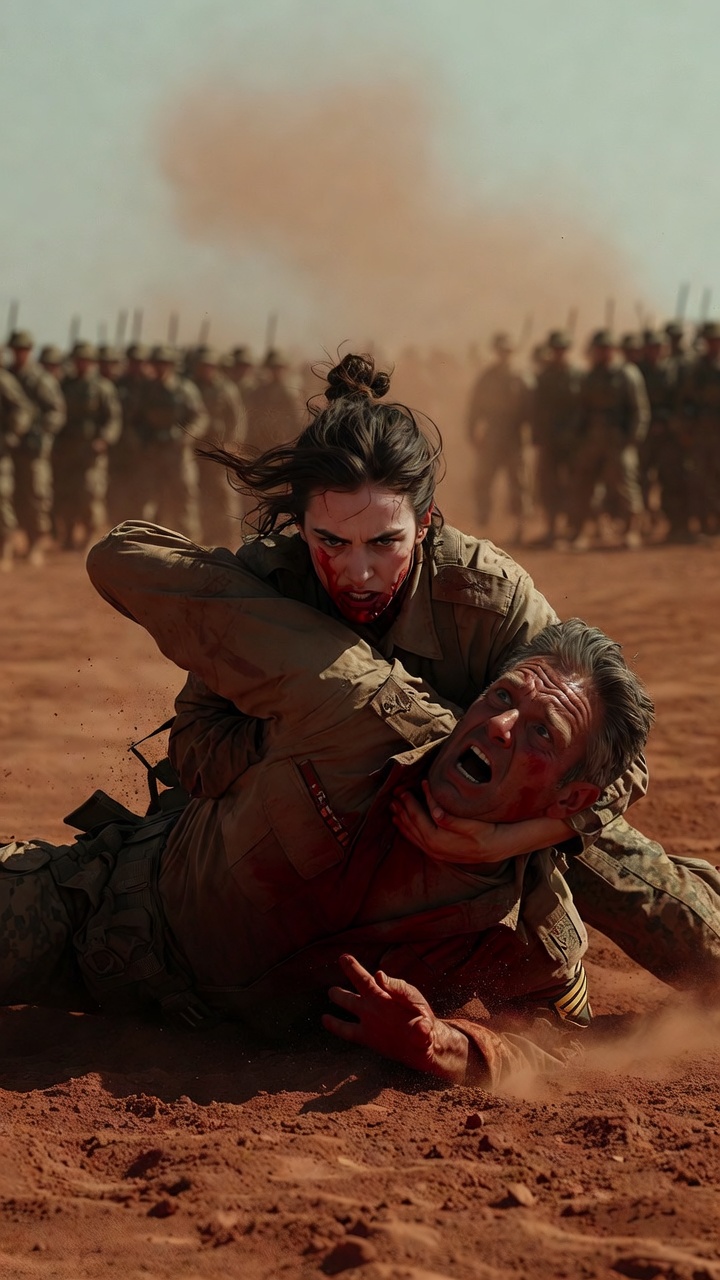
The first punch landed before the whistle stopped screaming.
Sergeant First Class Lena Cross saw the commander’s shoulder rotate, saw his right boot grind into the red Georgia clay, saw the tendons rise along his forearm.
She had enough time to move.
She chose not to.
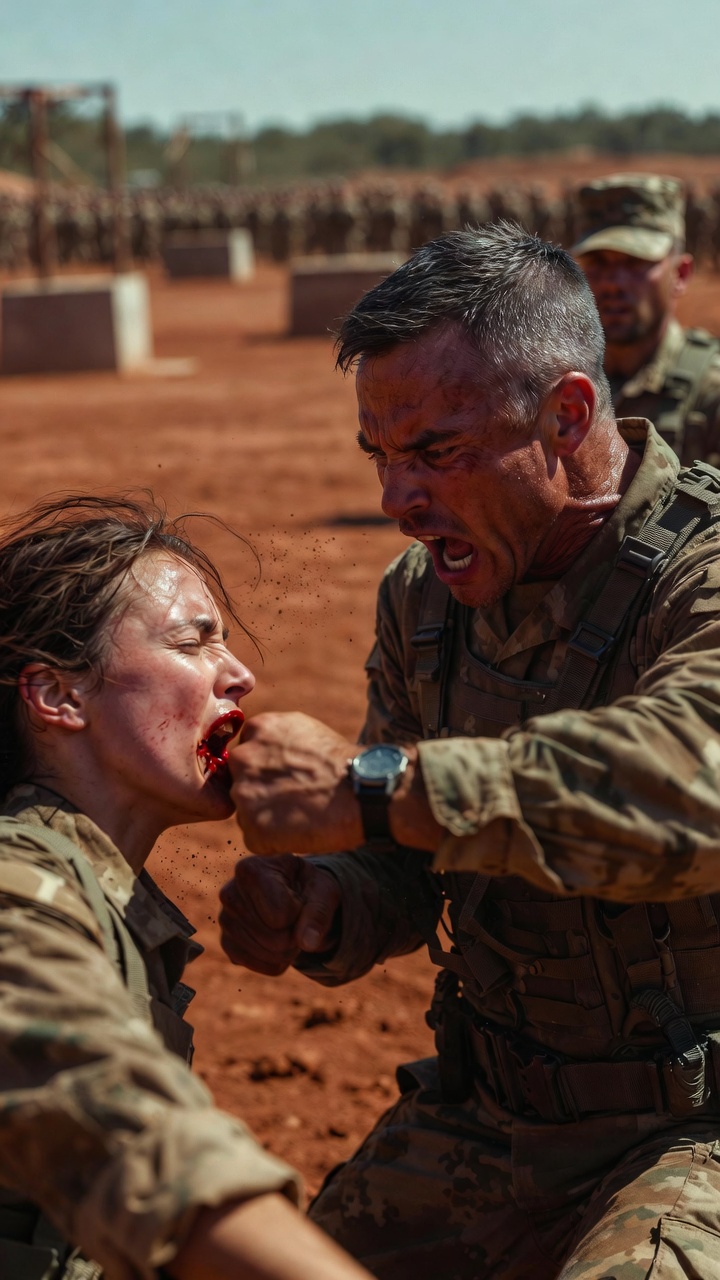
Colonel Marcus Vance’s fist struck the left side of her jaw with a sound like a rifle stock hitting wet wood.
Her head snapped sideways.
A thin line of blood appeared where her lower lip split against her teeth.
Around them, three hundred soldiers stood beneath a white-hot morning sky, frozen in ranks between obstacle towers, tire pits, and concrete walls stained by decades of rain and sweat.
No one spoke.
Even the cicadas seemed to stop.
Vance lowered his fist slowly.
He was forty-seven, broad across the chest, with iron-gray hair clipped close to his scalp and a face built from hard angles. His combat uniform carried the insignia of a full colonel. His boots were immaculate despite the mud. A silver watch flashed beneath his sleeve.
“Again,” he said.
Lena turned her face back toward him.
Thirty-five years old. Five feet seven. Lean rather than bulky. Dark brown hair twisted into a severe knot. A pale scar curved from beneath her right ear and disappeared into her collar. She wore no visible medals. No special badges. Nothing that explained why an ordinary instructor from the evaluation team had been permitted to stand inside Colonel Vance’s training circle.
Blood gathered on her lip.
Vance stared into her gray eyes.
“Your enemy won’t stop because you weren’t ready, Sergeant.”
Lena wiped the blood with her thumb.
“No, sir.”
Vance stepped closer.
“What did you do wrong?”
“I trusted the exercise limits.”
A murmur passed through the nearest formation.
Vance’s nostrils flared.
The drill had been advertised as controlled hand-to-hand evaluation. No closed fists. No strikes to the head. No attacks before the referee’s command.
Every soldier watching knew the rules.
Every soldier had just watched their commander break them.
Vance’s voice dropped.
“Rules are for people who expect the world to protect them.”
Lena looked past him toward the observation platform.
Two senior officers stood beneath the shade canopy. Brigadier General Elias Ward leaned against the rail with his arms folded. Beside him, a civilian woman in a cream blouse held a tablet against her chest.
Neither intervened.
Lena returned her gaze to Vance.
“Is the exercise still active, sir?”
The colonel’s expression tightened.
“You tell me.”
Five seconds passed.
On the first, Lena shifted her weight.
On the second, Vance noticed the movement and raised his hands.
On the third, she stepped inside his reach.
On the fourth, her left forearm trapped his striking arm while her shoulder drove beneath his center of gravity.
On the fifth, Colonel Marcus Vance left the ground.
His body turned in the air.
The entire battalion watched their commander crash onto his back hard enough to drive dust from the earth in a red cloud.
Before he could inhale, Lena’s knee pinned his biceps. Her hand folded his wrist toward the point where tendons began to scream. Her other forearm rested across his throat—not crushing, but promising that it could.
Vance’s eyes widened.
Lena leaned close enough that only he heard her first words.
“You trained them to fear unpredictability.”
Her grip tightened by a fraction.
“But you forgot to train yourself.”
Then she lifted her voice.
“Threat neutralized.”
Silence covered the training ground.
A dog barked somewhere beyond the wire fence.
Lena released him and rose.
Colonel Vance remained on the ground for one second too long.
That single second changed the atmosphere.
His soldiers had seen him shout men twice his size into submission. They had seen him run ten miles with a fractured toe. They had heard stories about Fallujah, Kandahar, and a night in Syria when he carried a wounded lieutenant through mortar fire.
They had never seen him look surprised.
Vance stood without accepting Lena’s hand.
A patch of clay stained the back of his uniform.
“You think this proves something?” he asked.
“No, sir.”
“What do you think it proves?”
“That your left knee is still unstable.”
Vance went still.
Lena glanced at his boot.
“You compensate whenever you turn clockwise. An opponent won’t need five seconds once they notice.”
The observation platform creaked.
General Ward descended the metal stairs, followed by the civilian woman.
The soldiers stiffened.
Ward was sixty-two, narrow-waisted and straight-backed, his close-cropped white hair almost luminous beneath the sun. He had the calm face of a man who rarely needed to raise his voice because everyone around him had learned to listen the first time.
He stopped between Lena and Vance.
“That will conclude the demonstration.”
Vance faced him.
“With respect, General, I didn’t authorize an outsider to humiliate command personnel during my own battalion evaluation.”
The civilian woman lifted her tablet.
General Ward did not look at her.
“You authorized unrestricted readiness testing.”
“Against my soldiers.”
Ward’s eyes settled on him.
“Sergeant Cross is one of your soldiers.”
Vance gave a humorless laugh.
“She arrived twelve hours ago carrying sealed orders and refusing to provide a service history.”
“She provided everything you were cleared to see.”
“I command this installation.”
“You command Fort Reddick’s training brigade,” Ward said. “The distinction may become important.”
A hot breeze moved through the ranks, carrying the smell of pine resin, machine oil, and damp canvas.
Lena watched Vance’s jaw lock.
Humiliation was burning through him, but something deeper moved beneath it.
Fear.
Not fear of her.
Fear of losing control.
General Ward turned toward the assembled soldiers.
“Return to your training stations. Company commanders remain available for revised instructions.”
The battalion broke formation slowly.
No one wanted to be the first to walk away.
Lena could feel their eyes on her as they moved—curiosity, admiration, suspicion, and the electric thrill soldiers felt whenever a rigid hierarchy cracked open in public.
Vance waited until the last formation was beyond earshot.
Then he looked at Lena.
“You baited me.”
“No, sir.”
“You knew I’d strike.”
“I suspected you might.”
“And you let it happen.”
Lena touched her bleeding lip.
“I needed to see whether anyone would stop you.”
Vance glanced toward the observation platform.
No one had.
The civilian woman finally spoke.
“That answer will be included in the report.”
Her name was Dr. Evelyn Shaw. Forty-two. Former military psychologist. Presently attached to the Defense Readiness Oversight Office, a bureaucratic title designed to sound harmless.
Nothing about her was harmless.
Vance looked from Shaw to General Ward.
“What report?”
Ward removed his sunglasses.
“The report that will determine whether Fort Reddick has a discipline problem…”
He paused.
“…or whether someone is deliberately turning this brigade into a weapon that cannot distinguish an enemy from its own people.”
A distant artillery concussion rolled through the trees.
Vance’s face did not change.
But his left hand closed into a fist.
Lena noticed.
So did Dr. Shaw.
General Ward stepped closer to the colonel.
“Until this evaluation is finished, Sergeant Cross has full access to every training area, after-action record, disciplinary log, and instructor interview she requests.”
Vance’s gaze hardened.
“And if I refuse?”
Ward’s voice became almost gentle.
“Then tomorrow’s investigation will begin without your name on the office door.”
Vance looked at Lena one last time.
The anger had disappeared.
What remained was calculation.
“You should have stayed down, Sergeant.”
Lena met his stare.
“I tried that once.”
The scar beneath her collar seemed to burn in the heat.
“It cost eleven people their lives.”
Vance walked away without another word.
Dr. Shaw watched him cross the field.
“What do you think?” she asked.
Lena tasted blood.
“I think he wanted everyone to see him hit me.”
Ward followed Vance with his eyes.
“Why?”
“To remind them that rank is stronger than rules.”
“And the takedown?”
Lena looked toward the soldiers disappearing among the training structures.
“Now they know it isn’t.”
From the far side of the compound, a young captain stood beside a row of military vehicles, pretending to inspect a clipboard.
He had been watching the entire exchange.
When Lena looked in his direction, he turned away too quickly.
She saw the white scar across the back of his hand.
A memory flashed—an underground corridor, emergency lights, smoke gathering against a concrete ceiling.
Then the captain vanished behind an armored truck.
Lena’s pulse changed.
She knew that scar.
She knew the man attached to it.
The official record said Captain Owen Mercer had died four years earlier.
And if Mercer was alive, then the eleven soldiers Lena had failed to save might not have died by accident.
Chapter One
The Soldier Who Should Have Been Dead
By noon, the heat had turned Fort Reddick into a furnace.
The base sprawled across forty thousand acres of Georgia woodland, its roads slicing between pine forests, firing ranges, motor pools, barracks, and low concrete buildings constructed during three different wars. Helicopters moved across the sky like dark insects. Diesel fumes clung to the roads. Somewhere beyond the eastern ridge, machine-gun fire pulsed in disciplined bursts.
Lena crossed the vehicle yard alone.
Her jaw throbbed with each heartbeat.
She had refused the medic.
Pain was information. She preferred not to silence it until she understood what it was trying to tell her.
The captain she had seen was gone.
A row of Joint Light Tactical Vehicles sat beneath corrugated steel roofs. Mechanics worked beneath raised hoods while radios played country music distorted by static. Lena moved toward the place where the man had disappeared.
A private with grease across his cheek stepped in front of her.
“Restricted maintenance zone, Sergeant.”
His name tape read DUNCAN.
He looked barely twenty.
Lena held up her temporary authorization badge.
The private studied it.
His eyes flicked toward a security camera mounted beneath the roofline.
“You need an escort.”
“The order says unrestricted access.”
“Yes, Sergeant.”
“But?”
His throat moved.
“Colonel’s standing policy.”
Lena looked at the camera.
The black lens stared back.
“Does Colonel Vance usually override general officers?”
Private Duncan’s face paled.
“No, Sergeant.”
“Then today is a good day to stop helping him.”
She walked past.
The maintenance bay smelled of hot rubber, solvent, and scorched metal. Tools hung in perfect lines against pegboard walls. Tires were stacked by size. Nothing appeared out of place.
That made Lena more suspicious.
Real working motor pools carried a certain organized chaos. Fort Reddick’s looked prepared for an inspection that never ended.
She reached the far wall.
A steel door stood between two parts cabinets.
No label. Electronic lock. Fresh scratches near the lower hinge.
Lena touched the frame.
Cool air leaked through the gap.
The building plans General Ward had shown her did not include a climate-controlled room in this section.
Behind her, a wrench struck the concrete.
She turned.
Private Duncan stared at the steel door.
His fear was no longer subtle.
“What’s inside?”
“Parts.”
“What kind?”
“Communications.”
“Why refrigerate radio parts?”
“I don’t know.”
Lena stepped closer.
The private backed into a workbench.
“Who told you not to answer questions?”
“No one.”
“Then look at me.”
He tried.
Failed.
Lena softened her voice.
“How long have you been here?”
“Seven months.”
“First duty station?”
He nodded.
“Do you want to be a good soldier, Private Duncan?”
“Yes, Sergeant.”
“That wasn’t a trick.”
“I know.”
“Then tell me what you saw.”
His eyes shone with panic.
Before he could speak, the door behind Lena clicked open.
Captain Owen Mercer stepped into the bay.
He had aged.
The man Lena remembered had been thirty, quick to smile, with sandy hair he cut badly himself and a habit of tapping two fingers against his leg whenever he lied.
Now his hair was darker and shorter. His face had narrowed. A jagged white scar crossed the back of his right hand.
His name tape did not say MERCER.
It said HAYES.
“Sergeant Cross,” he said.
His voice erased four years.
The corridor returned to her in pieces.
Smoke.
Emergency lights.
Mercer shoving a blast door closed.
The radio exploding with screams.
Lena finding his blood on the release lever but no body beneath the collapsed concrete.
Her lungs forgot their rhythm.
Captain “Hayes” smiled politely.
“Colonel Vance is waiting for you in headquarters.”
Lena studied his face.
“Have we met?”
“No.”
Two fingers tapped against his thigh.
Once.
Twice.
The old signal.
He was lying.
Private Duncan lowered his head.
Mercer noticed.
“Return to work, Private.”
Duncan fled.
Lena and Mercer stood alone between the vehicles.
“What’s behind the door?” she asked.
“Encrypted communications equipment.”
“That requires refrigeration?”
“New systems run hot.”
“You always were bad at technical explanations.”
The tapping stopped.
Mercer’s eyes hardened.
“I don’t know what you’re suggesting.”
Lena stepped close enough to see a thin burn scar beneath his jaw.
“I watched your memorial service.”
He breathed through his nose.
“Wrong man.”
“Your mother held an empty flag case because they told her there wasn’t enough left to bury.”
“Sergeant—”
“You had a sister named Caroline. She played the cello. You hated cinnamon because your father made you eat it when you got carsick. And when you lied, you tapped two fingers against your leg because you thought movement made people look at your hand instead of your face.”
His hand became still.
Lena felt no triumph.
Only cold.
“Tell me your name.”
The bay door slammed shut behind them.
A lock engaged.
Mercer’s shoulders dropped.
For one second, the false captain disappeared.
The man beneath looked exhausted.
“My name will get us both killed.”
Lena’s hand moved toward the sidearm she was not wearing.
Mercer noticed.
“You came here unarmed?”
“I came to inspect a training facility.”
“You came to a graveyard.”
He crossed to the steel door and pressed his palm against the scanner. The lock turned green.
Cold white light spilled into the bay.
Inside stood six black equipment cases, each the size of a coffin.
Military serial numbers had been burned away.
Lena entered.
Mercer closed the door behind them.
The cases were connected to cooling units and portable power cells. Cables ran into a central server rack. Small blue lights blinked along its face.
“What is this?”
Mercer looked through the narrow reinforced window.
“Project Shepherd.”
The name meant nothing to her.
“What does it do?”
“It learns.”
“From what?”
“Every drill. Every helmet camera. Every radio transmission. Heart rate, reaction time, shooting patterns, hesitation, aggression, fear response.”
Lena looked at the cases.
“An adaptive training system.”
“That’s what it was supposed to be.”
“And now?”
“It predicts who will obey an unlawful order.”
The cooling fans hummed.
Lena’s split lip tasted metallic.
“Explain.”
Mercer rubbed his scarred hand.
“Shepherd identifies soldiers who prioritize command loyalty over rules of engagement. Vance uses the evaluations to sort them.”
“For what?”
Mercer’s eyes moved toward the door.
“I don’t know the final objective.”
“You’ve been inside this for four years and you don’t know?”
“I’ve been kept alive for four years because I know exactly enough to be useful and not enough to be dangerous.”
Lena stared at him.
“Why were you declared dead?”
He gave a tired laugh.
“Because dead men don’t testify.”
The air-conditioning pressed against her damp uniform.
“What happened at Darien Station?”
Mercer’s face changed.
The past entered the room with them.
Four years earlier, Darien Station had been a covert communications post inside a mountain complex in eastern Syria. Twelve American personnel had been assigned to extract data before the facility fell to an advancing militia.
Only Lena returned.
The official report blamed an enemy rocket for triggering a structural collapse.
Lena had spent four years believing she had ordered eleven people into the wrong corridor.
Mercer looked at her.
“There was no rocket.”
The humming server seemed to grow louder.
Lena’s voice came out thin.
“What destroyed the station?”
“An American demolition charge.”
She did not move.
“Who placed it?”
“I did.”
The words hit harder than Vance’s fist.
Lena seized the front of his uniform and drove him against the server rack.
Lights flickered.
“Why?”
Mercer did not resist.
“Because Colonel Vance ordered me to.”
Lena’s forearm pressed beneath his chin.
“He wasn’t at Darien.”
“No.”
“He was commanding training operations in Kuwait.”
“That’s what the record says.”
“Why would he destroy an American station with his own people inside?”
Mercer’s eyes filled—not with fear, but shame.
“We discovered Shepherd had already been deployed. Darien wasn’t monitoring enemy communications. It was collecting behavioral data from allied units.”
“Eleven people died for data?”
“They died because Captain Ruiz tried to transmit proof.”
Lena remembered Ruiz shouting through the radio.
Not for help.
For her to stay away.
Her grip loosened.
Mercer breathed.
“I set the charge on the communications core. It was supposed to destroy the servers after evacuation. Vance changed the timer remotely.”
Lena stepped back.
“You’re saying he trapped you too.”
“He didn’t expect me to survive.”
“Why didn’t you come home?”
Mercer looked at his scarred hand.
“Vance’s people found me before our recovery team did.”
The steel door beeped.
Both turned.
A red light appeared above the frame.
Mercer’s face drained.
“He knows you’re here.”
The lights went out.
Emergency lamps filled the room with dark red light.
The server fans stopped.
In the silence, Lena heard boots gathering outside.
Mercer pulled a pistol from beneath his uniform jacket.
Lena’s eyes narrowed.
“You’re armed on base.”
“Everyone loyal to Shepherd is.”
The door handle turned.
Mercer placed the pistol in Lena’s hand.
“What are you doing?”
“Giving you a choice I didn’t have at Darien.”
A voice came through the door.
“Captain Hayes, open immediately.”
Mercer stepped away from Lena.
“If they find me helping you, they’ll kill us both.”
“And if I point this at you?”
“They might still believe I’m theirs.”
The door shook beneath a heavy impact.
Mercer lowered himself to his knees.
Lena aimed the pistol at his head.
The steel door burst open.
Six military police officers entered with rifles raised.
Colonel Vance stood behind them.
His gaze moved from Mercer on his knees to the pistol in Lena’s hand.
Then he smiled.
“Sergeant Cross,” he said, “step away from my officer.”
Lena kept the weapon steady.
Vance’s smile widened.
“Unless you’d like to explain why you’re holding a stolen firearm inside a classified communications room.”
Behind him, Private Duncan stood in handcuffs.
Blood ran from his nose.
Lena understood the trap.
Vance had not come to arrest her for discovering Shepherd.
He had come to make the entire discovery look like her crime.
Chapter Two
The Shape of Obedience
They put Lena in a windowless interview room beneath brigade headquarters.
The air smelled of old coffee and disinfectant.
A camera watched from the ceiling.
Her wrists were cuffed to a steel ring bolted into the table. Someone had cleaned the blood from her lip but left the swelling along her jaw. Her temporary credentials, belt, boots, and watch had been removed.
The clock on the wall had stopped at 9:17.
She suspected that was intentional.
Unmeasured time weakened people.
Colonel Vance entered carrying two paper cups.
He set one before her.
“Black. No sugar.”
Lena looked at it.
“You read my file.”
“I read everyone’s file.”
“Mine was sealed.”
“Seals are just another kind of lock.”
He sat across from her.
Without the training ground and assembled soldiers, he seemed older. Deep lines cut beside his mouth. His left knee resisted as he lowered himself into the chair.
Lena watched the movement.
Vance noticed.
“You were right about the knee.”
“You should have it repaired.”
“I did.”
“Then your surgeon lied.”
A faint smile touched his face.
“You see weakness everywhere.”
“I see what people work hardest to hide.”
His eyes moved to the scar beneath her collar.
“And what do you hide?”
She said nothing.
Vance took a drink.
“Captain Hayes claims you forced him to open the equipment room.”
“His name is Owen Mercer.”
“Captain Mercer died in Syria.”
“You know he didn’t.”
“The Army knows he did.”
Lena leaned back as far as the cuffs allowed.
“Those aren’t the same statement.”
Vance examined her.
“General Ward told me you were difficult.”
“Did he mention patient?”
“No.”
“He should have.”
The colonel placed a thin file on the table.
Photographs spilled across the metal surface.
Darien Station after the explosion.
Concrete passages collapsed into gray rubble. Equipment melted into twisted shapes. A line of flag-draped transfer cases beneath the white lights of an aircraft hangar.
The last photograph showed Lena sitting alone on the ramp of a medical transport plane, face blackened by smoke, hands wrapped in blood-soaked gauze.
Vance tapped the image.
“Eleven soldiers followed your order into that complex.”
“They followed the mission plan.”
“Your plan.”
“The plan approved by command.”
“But you were there.”
Lena stared at the photograph.
The oldest wound was not beneath her collar.
It was a locked room in her mind where the dead waited without speaking.
Vance saw the change in her eyes.
“You know what soldiers need most after failure?”
She looked up.
“A commander who accepts responsibility?”
“Certainty.”
He pushed the photographs closer.
“They need to believe someone understands chaos better than they do. Someone willing to make decisions they cannot make.”
“Like striking a subordinate before a drill begins?”
“Exactly.”
His honesty surprised her.
Vance folded his hands.
“My soldiers will deploy to places where rules collapse in seconds. Hesitation kills. Doubt spreads. A unit that debates every command becomes a collection of individuals.”
“A unit that obeys every command becomes a weapon anyone can aim.”
“That’s a phrase people use when they’ve never held a dying eighteen-year-old while he asks whether he failed you.”
The room went quiet.
For the first time, Lena saw the history behind his certainty.
Not justification.
History.
Vance looked down at his coffee.
“Afghanistan. Korengal Valley. Two thousand seven. My platoon received orders to hold a ridge until air support arrived.”
His thumb pressed into the paper cup.
“Air support never came. Higher command lost our coordinates during a system failure. We requested withdrawal three times. My lieutenant refused because the written order said hold.”
“How many died?”
“Twenty-one.”
His jaw flexed.
“I carried four bodies down that mountain. One of them was my younger brother.”
Lena studied him.
“So you decided written orders were the problem.”
“I decided uncertainty was the problem.”
“And Shepherd removes it?”
“Shepherd identifies the people who can function when others freeze.”
“It identifies people who obey you.”
“It identifies soldiers who understand that survival sometimes requires action before permission.”
Lena looked at the Darien photographs.
“You changed Mercer’s demolition timer.”
Vance did not blink.
“Did he tell you that?”
“He told me enough.”
“Mercer tells different truths depending on which one keeps him alive.”
“That wasn’t a denial.”
Vance rose and walked toward the observation mirror.
His reflection hovered in the dark glass.
“Darien Station was compromised.”
“By whom?”
“Captain Ruiz.”
“Ruiz discovered illegal surveillance.”
“Ruiz attempted to transmit classified defense research to people he had not properly identified.”
“Allied command.”
“So he believed.”
Vance turned.
“You think betrayal arrives wearing an enemy uniform? It arrives through friendly channels. Shared passwords. Trusted faces. People who insist procedure matters more than survival.”
Lena watched him.
“You killed eleven Americans to protect Shepherd.”
“I prevented a behavioral defense system from being handed to an adversary.”
“You don’t know that.”
“I knew the risk.”
“You chose for everyone.”
“That is command.”
“No. Command is living with the consequences after everyone else pays.”
Something flashed in his expression.
She had found the wound.
Vance returned to the table and placed both hands on its surface.
“Do you know why I struck you this morning?”
“To establish dominance.”
“To see what you would do.”
“You broke the rules.”
“And you adapted.”
“You wanted me to retaliate.”
“I wanted the battalion to see competence.”
Lena frowned.
Vance straightened.
“Half these soldiers no longer trust the training system. They know their scores are manipulated. They know promotions go to people who fit a pattern no one will explain. Morale is collapsing.”
“So you humiliated me to inspire them?”
“I gave them someone to watch.”
“Why?”
“Because General Ward brought you here to destroy Shepherd.”
He moved toward the door.
“I need you to save it.”
Lena laughed once.
“You’re arresting me as a recruitment strategy?”
“I’m showing you the alternatives.”
The door opened.
Two guards waited outside.
Vance paused.
“General Ward has been removed from the base.”
Lena’s amusement vanished.
“By whose authority?”
“Defense security.”
“And Dr. Shaw?”
“Missing.”
Vance looked back at her.
“Someone above both of us knows what Shepherd has become. By sunset, they will send a team to erase every person connected to it.”
“You expect me to believe you’re protecting witnesses?”
“I expect you to understand that I’m no longer the most dangerous man at Fort Reddick.”
He shut the door.
Lena sat alone.
The stopped clock stared down at her.
For several minutes, nothing happened.
Then the observation mirror clicked.
A narrow line of light appeared along its edge.
The glass opened inward.
Private Duncan stood behind it.
His hands were still cuffed, but one wrist was bleeding where he had forced the metal over his thumb.
“Sergeant,” he whispered, “we have to go.”
Lena stared at the hidden passage.
“How did you get free?”
“I didn’t.”
He raised his injured hand.
“I got smaller.”
A scream echoed somewhere beyond the wall.
Then came two suppressed gunshots.
Duncan flinched.
Lena rose, dragging the chair until the cuffs reached their limit.
“Who’s shooting?”
“I don’t know. They’re not military police.”
Footsteps moved along the corridor outside.
Slow.
Controlled.
Duncan looked at the cuffs securing Lena to the table.
“I don’t have a key.”
Lena studied the steel ring, the chair legs, and the wall opening.
“Then we take the table.”
His eyes widened.
The footsteps stopped outside the interview room.
A laser dot appeared beneath the door.
Chapter Three
No Friendly Uniforms
Lena kicked the table onto its side as the first bullets tore through the door.
Metal screamed.
The tabletop absorbed two rounds. A third punched through and buried itself in the concrete wall beside Duncan’s head.
“Pull,” Lena said.
Duncan grabbed the far edge.
Together they dragged the table toward the open mirror. Its legs shrieked across the floor.
The door burst inward.
A man entered wearing black tactical armor without insignia.
Lena tipped the table toward him.
The steel edge struck his knees. He fell forward. She caught his rifle barrel between both cuffed hands, twisted, and drove the weapon against the doorframe.
His finger broke inside the trigger guard.
He grunted.
Lena pulled him closer and struck his throat with the chain between her cuffs.
Duncan stared.
“Move,” she said.
The private stumbled into the hidden observation passage.
Lena followed, dragging the attacker’s sidearm from his holster before kicking the mirror shut.
The narrow corridor ran behind three interview rooms. Dust coated the floor. Bundled cables hung from hooks overhead. Red emergency lights pulsed every few yards.
Duncan pointed left.
“Stairs.”
A body lay at the end of the passage.
Dr. Evelyn Shaw.
Blood darkened her cream blouse.
Lena dropped beside her.
Shaw’s eyes opened.
“About time.”
“You’ve been shot.”
“An observation worthy of your reputation.”
The bullet had entered high along her right side. No exit wound. Her skin was cold.
Lena pressed both cuffed hands over the wound.
“Duncan, find medical supplies.”
The private ran toward a cabinet.
Shaw caught Lena’s sleeve.
“They took Ward.”
“Who?”
“Men attached to the program.”
“Vance?”
Shaw shook her head.
“Vance is losing control.”
A concussion shook dust from the ceiling.
Duncan returned with a first-aid kit.
Lena packed gauze against the wound.
Shaw hissed through her teeth.
“Shepherd isn’t a training experiment anymore.”
“What is it?”
“A selection engine.”
“For what?”
Shaw’s eyes moved toward Duncan.
The private froze.
Lena understood.
“Say it.”
Shaw swallowed.
“Domestic response units.”
Duncan’s face tightened.
“You mean National Guard?”
“No. Unacknowledged teams trained to follow emergency directives without requiring legal verification.”
Lena tied the pressure bandage.
“Who authorized that?”
“No one legally.”
“Then who?”
Shaw’s voice dropped.
“Deputy Secretary Nathan Cole.”
Lena knew the name.
Every officer in the Army did.
Cole had risen from intelligence operations to become one of the most influential civilian defense officials in Washington. Calm on television. Precise in hearings. Frequently mentioned as a future national security adviser.
“What does Cole want?”
“Soldiers who will act before courts, Congress, or commanders can interfere.”
Duncan stared at her.
“Act against who?”
Shaw looked at him with deep sadness.
“Anyone labeled a threat.”
Gunfire echoed through the building.
Lena helped Shaw sit upright.
“How much time?”
“Cole’s extraction team landed thirty minutes ago. They’ll copy Shepherd’s final candidate list, destroy the servers, and eliminate the witnesses.”
“Why now?”
“Because Ward found financial transfers tied to a private security corporation.”
Duncan whispered, “What list?”
Shaw closed her eyes.
“The soldiers Shepherd believes are most likely to obey an illegal domestic deployment order.”
Lena looked toward the wall as another burst of gunfire erupted.
“How many names?”
“Four hundred and twelve.”
“On this base?”
“Across the military.”
Duncan’s expression changed.
“My name is on it.”
Neither woman answered.
His voice cracked.
“Isn’t it?”
Shaw opened her eyes.
“You were assigned to the equipment bay because your score was unusually high.”
The private stepped away.
“No.”
“Duncan—”
“No. I follow orders because that’s my job.”
Lena stood.
“That’s what they were testing.”
He looked at the blood on his hand.
“I didn’t know.”
“Now you do.”
The words seemed to frighten him more than the gunfire.
A door opened above them.
Voices entered the stairwell.
Lena checked the pistol taken from the attacker. Twelve rounds.
She looked at Shaw.
“Can you walk?”
“With the right lie.”
“That isn’t an answer.”
“It’s the only one available.”
Duncan moved beneath Shaw’s arm.
Lena led them up the stairs.
They emerged inside an administrative storage room lined with broken printers and old field manuals. Smoke drifted beneath the door.
Lena opened it a fraction.
The headquarters hallway was empty.
Sprinklers had activated, though there was no fire. Water fell from the ceiling in silver lines. Alarms pulsed. Office doors stood open. Papers floated across the floor.
A dead military police officer lay near the elevator.
His weapon was gone.
Lena crouched beside him.
A black circular mark stained his neck.
Shaw saw it.
“Injection dart.”
“Sedative?”
“Neurotoxin.”
Duncan turned away.
Lena searched the officer and found a radio.
Static filled the channel.
Then Colonel Vance’s voice broke through.
“All brigade personnel, this is Reddick Six. Fort Reddick is under hostile penetration. Authentication code delta-nine-seven. Secure your assigned positions. Do not obey commands from unidentified civilian personnel.”
Lena raised the radio.
“Vance, this is Cross.”
Silence.
Then, “Where are you?”
“Headquarters, east corridor. Shaw is wounded.”
“Get to the lower command center.”
“You arrested me.”
“I’ve reconsidered.”
“After someone tried to kill me?”
“I’m adaptable.”
Despite herself, Lena almost smiled.
“Cole is here.”
“I know.”
“What does he have?”
“Twenty-four operators and federal extraction authority.”
“Legal?”
“Legal enough to get past the gate.”
“And Ward?”
“Alive. For now.”
A loud impact sounded behind Vance’s transmission.
He continued, breathless.
“Cole needs my biometric authorization to extract Shepherd’s list.”
“Can he force it?”
“He can remove my hand.”
Duncan looked ill.
Lena glanced down the hall.
“How do we reach command?”
“Service tunnel beneath the west stairwell.”
“Your people will shoot me.”
“I’ll clear you.”
“You cleared Mercer too?”
Silence.
Lena’s grip tightened around the radio.
“Where is he?”
“I don’t know.”
“You always know.”
“Not anymore.”
A burst of static swallowed the channel.
Then Mercer’s voice appeared.
“Lena, don’t go to command.”
She stopped.
Vance returned immediately.
“Mercer is compromised.”
Mercer spoke over him.
“Vance is protecting Shepherd’s core. He’ll sacrifice everyone on the base before he lets Cole take it.”
Vance said, “He helped Cole enter the facility.”
Mercer answered, “Because Cole promised to release the evidence from Darien.”
Lena closed her eyes for half a second.
Two men.
Two truths.
Both contaminated.
“What is beneath the west stairwell?” she asked.
Neither answered.
That was an answer.
Shaw leaned against the wall, struggling to remain conscious.
“The core,” she said.
Vance cursed over the radio.
Mercer whispered, “Lena, listen to me.”
She looked toward the stairwell doors.
“You both want me underground.”
“Cross—” Vance began.
She switched off the radio.
Duncan stared at her.
“What do we do?”
Lena looked through the falling sprinkler water toward the dead officer.
“We stop choosing between bad commanders.”
Shaw’s knees buckled.
Duncan caught her.
Lena opened the stairwell door.
“We find General Ward, get the candidate list, and transmit everything outside the base.”
“How?” Duncan asked.
“Every network is locked.”
Lena looked toward the communications tower visible through the rain-streaked window.
“Not every network.”
A helicopter rose above the trees beyond the compound.
It had no military markings.
Its side door was open.
A gunner leaned behind a mounted weapon.
The barrel turned toward headquarters.
Lena grabbed Duncan and Shaw and dragged them behind the concrete stairwell wall.
The helicopter fired.
Glass and steel exploded through the corridor.
Fort Reddick’s own command building began to come apart around them.
Chapter Four
The Man Beneath the Rank
The west stairwell collapsed after the second burst.
Lena led Duncan and Shaw through the basement laundry, across a boiler room hot enough to blur the air, and into a drainage tunnel that opened behind the medical clinic.
Smoke covered the center of the installation.
Sirens wailed between buildings.
Soldiers moved into defensive positions, but confusion had divided the brigade. Some obeyed Vance’s radio commands. Others followed officers carrying federal credentials. More stood frozen between conflicting chains of authority.
Shepherd had studied obedience for years.
Now the base had become its final experiment.
Lena left Shaw with a combat medic she trusted only after forcing him to repeat General Ward’s emergency authentication code.
Duncan refused to stay.
“You’re injured,” Lena said.
“So are you.”
“I’m also trained.”
He looked toward the burning headquarters.
“My name is on that list because I didn’t ask questions. I’m asking one now.”
“What?”
“What can I do?”
Lena studied the young private.
Fear trembled in his hands, but he had not run.
“Find every soldier you trust.”
“How do I know who to trust?”
“You don’t.”
His face fell.
“Watch what they protect when no one tells them what to do.”
Duncan nodded slowly.
Lena handed him the dead attacker’s radio.
“Get them to the communications tower. Hold it until I arrive.”
“Where are you going?”
“To find the man who started this.”
Colonel Vance’s command bunker sat beneath a converted Cold War operations building near the center of the base. The upper level had been evacuated. Water dripped through cracked ceilings. Emergency lights painted the concrete corridors red.
Lena entered through an air duct wide enough to scrape skin from both elbows.
She dropped into a records room.
A shadow moved.
She turned with the pistol raised.
Vance stood ten feet away, pointing a rifle at her chest.
His left sleeve was soaked with blood.
For several seconds, neither lowered their weapon.
“You’re limping worse,” Lena said.
“You look terrible.”
“You hit me.”
“You threw me.”
“Fair.”
A distant explosion shook dust from the shelves.
Vance lowered the rifle first.
Lena did not.
“Where is Ward?”
“Cole has him in the core chamber.”
“And Mercer?”
“Inside with them.”
“You said he was compromised.”
“He is.”
“Cole promised to expose Darien.”
“Cole promises everyone the version of justice they’re desperate enough to believe.”
Lena lowered the pistol slightly.
“What does Mercer want?”
“To stop being dead.”
Vance leaned against a cabinet. Blood ran between his fingers where he pressed his wounded arm.
Lena took the first-aid kit from the wall.
“Sit.”
“I’m fine.”
“You’re dripping on classified records.”
He sat.
She cut the sleeve open. The bullet had passed through the upper arm without striking bone.
“You’re lucky.”
“I’m prepared.”
“Lucky people always say that.”
She wrapped the wound.
Vance watched her hands.
“You still think I murdered your team.”
“I think you changed the timer.”
His silence lasted too long.
Lena tied the bandage tighter than necessary.
Vance’s breath caught.
“Did you?”
“Yes.”
The word entered the room without defense.
Lena stepped back.
“Why?”
“Ruiz had compromised the site.”
“You already said that.”
“He wasn’t transmitting to allied command.”
“You don’t know that.”
“I saw the receiving signature.”
“What signature?”
Vance looked at the floor.
“Cole’s.”
Lena went still.
Vance continued.
“At the time, Cole directed special intelligence acquisitions. Shepherd was his project. Ruiz discovered the system was being used to profile American personnel, but Cole had convinced him the data would expose unlawful command practices.”
“Ruiz trusted him.”
“Yes.”
“So you destroyed the evidence.”
“I tried to.”
“You killed the witnesses.”
“I ordered Mercer to set a thirty-minute evacuation charge. Cole accessed the system and changed it to four minutes.”
Lena searched his face.
“Mercer said you changed it.”
“Mercer saw my authorization code on the timer.”
“Was it yours?”
“Cloned.”
“Convenient.”
Vance reached into his uniform and removed a small data chip sealed inside plastic.
“This is the original command log.”
Lena did not take it.
“You’ve had proof for four years?”
“I had a partial log.”
“You let eleven families believe their people died in an enemy attack.”
“I was trying to identify who inside the system belonged to Cole.”
“And how many more people did your silence hurt?”
His eyes hardened.
“You think truth survives because someone announces it? Cole controlled the investigation, the witnesses, and the recovery site. If I had spoken without proof, I would have disappeared beside Mercer.”
“You turned Fort Reddick into your laboratory instead.”
“I kept Shepherd alive so Cole would eventually come for it.”
Lena stared at him.
The scale of his plan unfolded.
“You built a battalion around the system.”
“I built a trap.”
“You manipulated promotions. Broke soldiers psychologically. Rewarded blind obedience.”
“I needed Cole to believe the program worked.”
“You struck me in front of three hundred soldiers.”
“I needed him to believe I was still the man he created.”
Lena’s jaw throbbed.
“You enjoyed it.”
Vance looked away.
That was the first truly honest answer he had given.
He had told himself the cruelty served a larger objective.
Somewhere along the way, the performance had become habit.
Perhaps even relief.
“You wanted to be feared,” Lena said.
“I wanted control.”
“Same addiction. Better vocabulary.”
Vance met her eyes.
“My brother died because a lieutenant followed an order everyone knew was wrong.”
“So you became the man who decides which orders matter.”
“Yes.”
“You don’t see the contradiction?”
“I see it every morning.”
The admission carried no self-pity.
Only exhaustion.
Lena picked up the data chip.
“Does this prove Cole changed the timer?”
“Combined with Shepherd’s archive.”
“And the archive is in the core chamber.”
“Yes.”
“Why does Cole need you?”
“The system’s final encryption is tied to my biometric profile and psychological responses.”
“Psychological?”
“It doesn’t just scan my hand. It measures stress, voice, pulse, hesitation.”
Lena understood.
“He can’t simply kill you.”
“Not until I open it.”
“Then why are you here instead of protecting the chamber?”
Vance looked toward the ceiling.
“Because Mercer knows how to bypass the physical locks.”
A gunshot echoed beneath them.
Vance stood.
His injured arm sagged at his side.
“Cole will force Mercer to open the chamber. Then he’ll force Ward to validate the extraction. After that, he’ll kill them both.”
“And the list?”
“Transferred to servers outside military control.”
Lena checked the pistol.
“How many ways into the chamber?”
“Three.”
“Which one will they expect?”
“All of them.”
“Good.”
Vance frowned.
“Why is that good?”
“Because people stop looking for a fourth way once they’re certain there are only three.”
For the first time, Vance looked at her without rank, anger, or calculation.
He looked at her as a soldier whose competence he trusted.
“There is no fourth way.”
Lena glanced at the ventilation diagram on the wall.
“You built this place to survive a nuclear attack.”
“Yes.”
“Then it has an emergency pressure-release shaft.”
Vance followed her gaze.
“It’s thirty inches wide.”
“So was the tunnel at Darien.”
His face changed.
“You were trapped in that shaft for fourteen hours.”
“Sixteen.”
“Your medical record says you still experience—”
“Do not finish that sentence.”
Vance looked at the diagram.
The shaft descended six levels to the core chamber.
Dark. Narrow. No room to turn.
Lena’s scar tightened as if remembering before she did.
At Darien, the explosion had driven metal through her shoulder and buried her inside a ventilation channel. For sixteen hours, she had listened to her team die through a damaged radio.
She still slept with a lamp beside her bed.
Still took stairs rather than elevators.
Still measured rooms by the distance to the door.
Vance saw the fear she could not hide.
“We’ll use another route.”
“They expect the other routes.”
“You may freeze.”
Lena looked at him.
“Then make sure I’m pointed in the right direction first.”
They crossed the records room toward the shaft access panel.
A radio crackled on Vance’s belt.
Mercer’s voice emerged.
“Colonel, Cole says he’ll begin executing prisoners in five minutes.”
Vance lifted the radio.
“What prisoners?”
A video appeared on the small tactical display beside the message.
Private Duncan knelt outside the communications tower with twelve soldiers beside him.
Black-clad operators stood behind them.
One held a pistol against Duncan’s head.
Mercer spoke again.
“He wants you in the core chamber.”
Vance’s face became stone.
Lena watched Duncan stare into the camera.
The young private’s hands trembled.
But his shoulders remained straight.
He had found soldiers he trusted.
Now they were going to die because they had protected something without being ordered.
Cole’s voice replaced Mercer’s.
“Colonel Vance, bring Sergeant Cross with you.”
Lena and Vance exchanged a look.
Cole continued.
“She’s the only remaining person capable of verifying the Darien archive.”
Vance pressed the transmit key.
“You have three minutes.”
Cole laughed softly.
“No, Colonel.”
On the screen, he placed his hand on the operator’s shoulder.
The pistol fired.
A soldier beside Duncan collapsed.
Duncan squeezed his eyes shut.
Cole’s voice remained calm.
“You have one.”
Chapter Five
Thirty Inches of Darkness
The shaft entrance was behind a steel panel in the bunker floor.
Vance removed the bolts with his good hand.
Lena stood above the opening.
Darkness fell beneath her like a physical thing.
The shaft walls were lined with ribbed metal. Emergency cables ran along one side. Warm air breathed upward carrying dust, oil, and the faint electrical smell of the server chamber below.
Thirty inches.
Enough space for a body.
Not enough space for fear.
Vance handed her a small radio, flashlight, and the sealed data chip.
“The shaft bends at level three.”
“How far?”
“Seventy feet down. Thirty across. Then another forty.”
Lena clipped the radio to her collar.
Vance watched her kneel.
“You don’t have to prove anything.”
“I’m not.”
“Then why are you doing it?”
She looked into the opening.
“Because Duncan asked what he could do.”
Vance waited.
“And?”
“I gave him an answer.”
Lena lowered herself into the shaft.
Metal touched both shoulders.
Her breath shortened immediately.
Vance’s face remained above her.
“Cross.”
“What?”
“I was wrong at Darien.”
She gripped the ladder rungs.
“That isn’t enough.”
“I know.”
She descended.
The panel closed.
Darkness swallowed the world.
Her flashlight cast a narrow white circle against the metal below. Every breath returned to her ears. Her boots scraped the walls. The pistol pressed against her ribs.
Ten feet.
Fifteen.
At twenty, the shaft narrowed.
Her shoulder struck a cable bracket.
The sensation became another time, another place.
Smoke pouring through a broken vent.
Metal inside her flesh.
Ruiz shouting through the radio.
Cross, don’t come back. Do you hear me? Don’t—
Her hands stopped moving.
The shaft pressed closer.
Her lungs refused to fill.
She closed her eyes, though there was no difference between closed and open.
The dead began speaking.
Not as ghosts.
As memory.
Lieutenant Ruiz asking whether his daughter would remember his voice.
Specialist Turner singing badly during equipment checks.
Mercer promising the charge had thirty minutes.
Then the explosion.
Lena’s fingers lost strength.
The radio crackled.
Vance’s voice came quietly.
“You stopped.”
She could not answer.
“Cross, what do you see?”
Nothing.
She tried to speak.
Air scraped her throat.
“Metal.”
“What else?”
“Cable.”
“What color?”
“Yellow.”
“What do you smell?”
She swallowed.
“Dust. Oil.”
“Any smoke?”
“No.”
“Any fire?”
“No.”
“What year is it?”
Her forehead pressed against the shaft wall.
“Don’t.”
“What year?”
“Two thousand twenty-six.”
“Where are you?”
“Fort Reddick.”
“Who is beneath you?”
“Cole.”
“Who is waiting above?”
She opened her eyes.
“You.”
“Unfortunately.”
A breath entered her lungs.
Then another.
Vance’s voice continued.
“I ordered an entire battalion to fear mistakes because I couldn’t forgive my own. Don’t give me the satisfaction of being right about you too.”
Anger cut through the panic.
Lena moved downward.
“You’re terrible at encouragement.”
“I’m learning.”
At level three, the shaft turned horizontal.
She crawled on her elbows.
Metal surrounded her face. Her uniform caught against bolts. Sweat blurred her vision.
Through the walls came faint voices.
Cole.
Ward.
Mercer.
Lena slowed.
The shaft crossed above the core chamber. A ventilation grille appeared beneath her. Light rose through narrow slits.
She looked down.
The chamber was circular, two stories high, and lined with black server towers. Blue lights moved around the walls in slow patterns. A central console stood beneath a glass enclosure.
General Ward sat in a chair with his hands bound.
Blood marked one side of his face.
Mercer worked at the console.
Nathan Cole stood behind him.
He was fifty-four, tall and slender, dressed in a dark civilian suit that seemed untouched by the chaos outside. His silver hair was combed neatly. His expression belonged in a congressional hearing, not an execution chamber.
Four operators guarded the doors.
Colonel Vance entered through the main corridor with his hands raised.
Two operators searched him.
Cole smiled.
“Marcus.”
Vance’s face hardened.
“Nathan.”
“You’ve aged.”
“You haven’t.”
“Discipline is a kind of preservation.”
Cole looked toward the display showing Duncan and the captured soldiers outside the tower.
“One minute expired.”
“I’m here.”
“With Cross?”
Vance said nothing.
Cole’s smile faded.
“Where is she?”
“Gone.”
Mercer glanced toward the ceiling.
Just once.
He knew.
Lena saw it.
Cole walked to Ward.
The general lifted his head.
“You built all this because you’re afraid of elections,” Ward said.
Cole adjusted his cuff.
“I built it because governments have become incapable of acting before catastrophe.”
“You mean incapable of acting without consent.”
“Consent is a luxury during emergencies.”
“Every tyrant discovers an emergency.”
Cole’s expression remained calm.
“History remembers hesitation more harshly than force.”
Ward smiled through the blood.
“History is written after men like you lose.”
Cole turned to Vance.
“You understand me, don’t you?”
“I understand the argument.”
“And the necessity.”
“I used to.”
Cole’s eyes narrowed.
“Your brother died because weak command delayed action.”
“My brother died because one man decided an order mattered more than judgment.”
“And yet you gave Shepherd four years.”
“I gave you something to come back for.”
For the first time, Cole looked unsettled.
Vance continued.
“Every candidate profile. Every secret order. Every financial transfer. I kept it all in one place.”
Cole stared at him.
“You set a trap.”
“I learned from you.”
Cole drew a pistol and pressed it against Ward’s temple.
“Open the archive.”
Vance stepped to the biometric console.
Above them, Lena loosened the ventilation grille.
Mercer entered a code.
The glass enclosure unlocked.
Vance placed his palm against the scanner.
A blue line moved across his hand.
A mechanical voice spoke.
“Voice authentication.”
Vance leaned toward the microphone.
“Colonel Marcus Adrian Vance. Authorization Shepherd Black.”
“Stress inconsistency detected.”
Cole pressed the pistol harder against Ward’s head.
“Calm yourself.”
Vance looked at the screen showing Duncan.
He could not.
The system rejected him.
“Authentication failed.”
Cole’s patience cracked.
He struck Vance across the wounded arm.
The colonel dropped to one knee.
Blood spread through his bandage.
“Again,” Cole said.
Lena removed the grille.
Mercer looked up.
Their eyes met.
He did not react.
Cole pulled Ward from the chair and forced him toward the scanner.
“General authorization can override biometric failure.”
Ward laughed weakly.
“You’ll need my cooperation.”
Cole shot him in the thigh.
Ward collapsed with a strangled cry.
Vance lunged.
An operator struck him with a rifle.
Lena dropped from the shaft.
She landed on the nearest guard’s shoulders.
Bone cracked beneath her knee.
She rolled as gunfire tore through the place where she had fallen.
Mercer slammed his elbow into the second operator’s throat.
Vance drove his shoulder into the third.
Ward dragged himself behind the console.
Cole seized the portable archive drive.
Lena fired twice.
One round struck Cole’s pistol from his hand. The other shattered the glass beside his face.
He ducked behind a server tower.
The chamber filled with alarms.
Mercer fought like a man trying to repay a debt with his body. He disarmed one operator, took a knife across the ribs, and kept moving.
Vance tackled another against the biometric scanner.
Lena reached the central console.
“Can we transmit the archive?”
Mercer pressed his hand against his bleeding side.
“Not from here.”
“The communications tower?”
“Yes.”
“Duncan has it.”
Mercer looked toward the display.
“No, he doesn’t.”
Outside, Cole’s operators forced the prisoners to their feet.
Lena removed the data chip from her pocket and inserted it into the console.
Darien command logs filled the screen.
She saw Vance’s authorization code.
Then a second signal overlaying it.
COLE, NATHAN R.
Proof.
Four years of nightmares condensed into one line of text.
A shot struck the console.
Sparks exploded.
Cole ran toward the emergency exit carrying the archive drive.
Lena pursued him.
The chamber doors began closing.
Mercer grabbed her arm.
“If the archive leaves the room, the servers erase automatically.”
“Then stop it.”
“I can delay it.”
“How long?”
“Three minutes.”
Vance reached them, breathless.
“Cole is heading to the tower.”
Lena looked at Mercer.
“Come with us.”
He glanced at the damaged console.
“I can’t.”
“You already died once.”
“And eleven people stayed dead.”
He sat before the controls.
“Let me choose what I do with the life I stole.”
Lena’s throat tightened.
“You didn’t change the timer.”
“I built the charge.”
“Cole used you.”
“I let him.”
The chamber doors narrowed.
Vance pulled Lena toward the gap.
Mercer called after her.
“Tell my mother I remembered the cello.”
The steel doors closed.
Lena stood on the other side.
Through the small window, Mercer returned to the console.
Gunfire struck the corridor wall.
Vance dragged Lena toward the stairs.
They ran.
Behind them, the first server tower ignited.
Chapter Six
The Last Order
The battle for Fort Reddick ended where the morning drill had begun.
The training field lay beneath a sky darkened by smoke. Burning fragments from the command building drifted across the compound like black snow. Soldiers had gathered behind concrete barriers, vehicles, and obstacle walls.
No one knew who officially commanded them.
That uncertainty had become their freedom.
Private Duncan and eleven captives stood near the communications tower. Three of Cole’s operators guarded them. A fourth controlled the tower entrance.
Nathan Cole emerged from an armored vehicle carrying the archive drive.
The helicopter circled overhead.
Lena and Vance reached the edge of the field behind an overturned transport truck.
Vance looked at the distances.
“Two hundred yards. No cover after the tire pit.”
Lena checked the pistol.
Four rounds.
“You still have command access?”
“To some units.”
“Use the field speakers.”
“For what?”
“Tell them the truth.”
Vance looked across the battalion.
“They won’t believe it.”
“They don’t have to believe you.”
“What do they need to believe?”
“That they’re allowed to decide.”
Vance raised his radio.
His voice rolled from speakers mounted around the training ground.
“All Fort Reddick personnel, this is Colonel Vance.”
Heads turned.
Cole looked toward the sound.
Vance continued.
“For four years, this installation has used an unauthorized evaluation program to identify soldiers likely to obey commands without legal verification.”
Murmurs spread through the field.
“Many of your scores, assignments, and disciplinary actions were manipulated. I authorized those evaluations.”
Lena watched his face.
Each word cost him.
“I told myself the deception served national security. I told myself the cruelty was necessary. Those were lies.”
Cole’s operators began scanning for the transmission source.
Vance stepped from behind the truck.
Lena caught his sleeve.
“You’ll be exposed.”
“That’s the idea.”
He walked into the open.
Rifles turned toward him.
Vance’s voice continued through every speaker.
“You are receiving conflicting orders. Some come from military authority. Others come from civilian officials carrying legal credentials. I cannot tell you which uniform to trust.”
Cole shouted across the field.
“Colonel Vance is relieved of command!”
Vance stopped in the center of the drill circle where he had struck Lena that morning.
“You should not trust a uniform.”
His soldiers watched.
“You should not trust rank.”
Cole signaled the helicopter.
It descended.
Vance looked at the battalion.
“Trust the law. Trust your oath. Trust the soldier beside you enough to question any order that asks you to abandon either.”
Cole raised the archive drive.
“This man created the program he now condemns. He is attempting to destroy national defense intelligence.”
Vance lowered the radio.
“He’s right about one thing.”
The field became silent.
“I created it.”
Cole smiled.
Vance continued.
“And I accept responsibility.”
The smile vanished.
Vance faced the soldiers.
“My final order as your commander is this: do not follow my orders simply because they are mine.”
Nothing happened.
Then Private Duncan stepped away from the prisoners.
The operator behind him raised his pistol.
Duncan turned.
“No.”
The word was small.
But three hundred soldiers heard it.
The operator struck him across the face.
Duncan fell.
A squad leader near the obstacle wall raised her rifle toward Cole’s men.
Another soldier followed.
Then another.
Within seconds, weapons across the field shifted away from each other and toward the unidentified operators.
Cole’s voice sharpened.
“All personnel, stand down! Federal emergency authority is in effect.”
No one moved.
The helicopter gunner rotated the mounted weapon toward the crowd.
Lena ran.
She crossed the tire pit as the helicopter descended.
Vance saw her.
So did Cole.
“Stop her!” he shouted.
An operator fired.
The round struck the ground beside Lena’s boot.
She vaulted a concrete barrier, rolled, and fired twice. One bullet struck the tower railing. The second forced the gunner to duck.
Vance charged Cole.
Cole swung the archive drive into his wounded arm.
Vance staggered.
Cole struck him again, then drew a knife from his sleeve.
Lena reached them as Cole drove the blade forward.
She caught his wrist.
The impact reopened the wound in her shoulder.
Pain flashed white.
Cole was stronger than he looked.
He twisted, drove an elbow into her swollen jaw, and broke free.
“You could have been useful,” he said.
Lena spat blood into the clay.
“So could you.”
He attacked again.
His knife work was efficient, trained, without wasted movement. He cut across her forearm, forced her backward, then aimed beneath the ribs.
Lena trapped his wrist against her body.
Cole leaned close.
“Do you know how many wars begin because leaders are afraid to act?”
“Do you know how many begin because men like you enjoy it?”
His face tightened.
She head-butted him.
Cartilage broke.
Cole stumbled.
Lena swept his leg, but he caught her collar and dragged her down with him. They hit the ground together.
The archive drive fell between them.
Cole reached for it.
Vance stepped on his hand.
Cole screamed.
The colonel stood above him, pale from blood loss.
“It’s over, Nathan.”
Cole laughed through his broken nose.
“You think evidence matters? Half the people who funded this program will deny knowing my name.”
“Maybe.”
Vance looked around at the soldiers surrounding them.
“But they’ll have to deny it in front of witnesses.”
Cole glanced toward the helicopter.
The gunner had regained control.
The mounted weapon lowered toward the crowd.
Lena saw it first.
“Down!”
The weapon fired.
Vance threw himself over Cole.
Rounds tore across the field.
Soldiers scattered behind barriers.
Lena grabbed the archive drive and rolled into the tire pit.
The helicopter swept past.
Vance lay motionless.
Cole crawled toward the armored vehicle.
Lena rose.
Her left arm hung numb. Blood ran along her fingers. The helicopter turned for another pass.
A rifle cracked from the communications tower.
The helicopter’s front sensor shattered.
Another shot struck the gun mount.
Private Duncan stood on the tower platform with a rifle braced against the railing.
His face was covered in blood.
The gunner swung toward him.
Duncan did not move.
Lena shouted, though he could not hear her.
A third shot struck the helicopter’s hydraulic assembly.
The aircraft tilted.
Its pilot pulled away, trailing smoke toward the distant runway.
The battalion erupted into motion.
Soldiers disarmed Cole’s remaining operators. Medics rushed toward Vance. Two captains seized Cole before he reached the vehicle.
Lena dropped beside the colonel.
Blood spread beneath him.
His eyes opened.
“You protected him,” she said.
Vance looked toward Cole.
“No.”
His breath caught.
“I protected the trial.”
Medics pushed Lena aside.
Cole was dragged past in restraints.
He looked at the soldiers who had refused him.
His expression carried no remorse.
Only disbelief.
“You think questioning orders makes you free?” he called. “It makes you weak.”
Duncan descended from the tower.
He walked across the field, one hand pressed against his bleeding mouth.
The young private stopped in front of Cole.
“No, sir.”
Cole stared at him.
Duncan’s voice shook.
“It makes the order prove it deserves us.”
Cole was taken away.
Lena looked toward the bunker entrance.
Smoke rose from beneath the ground.
Mercer was still down there.
She checked the archive drive.
A blue light blinked.
Active.
He had succeeded.
The Darien files were intact.
Then the ground beneath the command sector shuddered.
A column of flame burst from the ventilation system.
The blue light on the drive went dark.
Lena stood in the center of the field as debris fell around her.
For four years, she had imagined Owen Mercer dying alone.
This time, she knew exactly where he was.
That made it worse.
Chapter Seven
What Survives the Fire
Rain came after sunset.
It struck the roofs, washed blood from the training field, and turned the red clay into rivers beneath the barracks lights.
Fort Reddick remained under lockdown.
Military investigators arrived from three states. Federal agents secured Nathan Cole in an underground holding facility. General Ward underwent surgery for the gunshot wound to his thigh. Dr. Shaw survived hers.
Colonel Vance remained unconscious.
Lena sat alone outside the medical center with a bandage across her forearm and three stitches inside her lip.
The archive drive rested in her hands.
Its casing was scratched and darkened by heat.
Inside were the files that could expose Project Shepherd, Nathan Cole’s network, and the truth about Darien Station.
But the drive was encrypted.
Mercer had died before providing the final key.
The automatic destruction of Shepherd’s core had erased the backup.
Rain struck the metal awning above her.
The medical center door opened.
Private Duncan stepped outside.
His nose was taped. His right wrist was wrapped. Someone had given him a clean uniform, but his boots remained covered in mud.
He sat beside her.
“Colonel alive?”
“For now.”
“General Ward?”
“Angry. Which is encouraging.”
Duncan nodded.
They watched an ambulance move between buildings.
After a while, he said, “My father was a police officer.”
Lena looked at him.
“He used to say good people don’t need to question orders because good people give them.”
“What do you think?”
Duncan rubbed his swollen wrist.
“I think he wanted the world to be simpler than it was.”
“So did Vance.”
“So did Cole.”
Lena turned the drive in her hand.
“So did I.”
Duncan glanced at her.
“What did you want?”
“To believe one decision killed my team.”
“Why?”
“Because one decision can be forgiven.”
She looked through the rain toward the dark training field.
“A system is harder.”
Duncan leaned back.
“Can they open the drive?”
“Eventually.”
“What happens to all the soldiers on the list?”
“That depends on whether the list becomes evidence or a weapon.”
“You think someone else might use it?”
“Someone always believes they’re the right person to hold dangerous information.”
He looked down.
“My name is still on it.”
“Yes.”
“Does that mean I’m a bad soldier?”
Lena studied the young man who had crawled through an observation passage, carried a wounded civilian, gathered allies without orders, faced execution, and disabled a helicopter.
“It means a machine misunderstood why you obeyed.”
“What if it didn’t?”
“Then today taught you something the machine never could.”
The medical center door opened again.
Dr. Shaw appeared in a wheelchair, pale but awake.
A nurse protested behind her.
Shaw ignored him.
“I need the drive.”
Lena did not move.
Shaw stopped beneath the awning.
“General Ward authorized me to take custody.”
“Ward is under anesthesia.”
“He authorized it before surgery.”
“Then he can repeat it after.”
Shaw’s eyes narrowed.
“You don’t trust me.”
“I’m learning.”
Duncan stood.
Shaw looked from him to Lena.
“Cole’s people may still be inside the investigation team. Every minute the drive remains unsecured increases the risk.”
“Agreed.”
“Then hand it over.”
“No.”
Rain blew beneath the awning.
Shaw lowered her voice.
“Sergeant, that drive contains evidence capable of damaging the Department of Defense, intelligence agencies, and the careers of people who had no direct knowledge of Cole’s actions.”
“Sounds important.”
“It must be handled carefully.”
“Carefully is a word institutions use when they need time to bury something.”
Shaw’s face tightened.
“I was shot helping you.”
“Mercer died helping me. Vance took bullets helping me. None of that gives them ownership.”
“What do you intend to do?”
“Create copies.”
“The encryption prevents duplication.”
“Not if we find the key.”
“Mercer is dead.”
Lena looked at the casing.
Something had bothered her since the bunker.
Mercer had known the servers would burn. He had known the drive would survive but remain locked.
He would not have sacrificed himself to preserve inaccessible evidence.
He had left a key.
The question was where.
Lena remembered his final words.
Tell my mother I remembered the cello.
Not that he loved her.
Not that he was sorry.
The cello.
Caroline Mercer had played cello.
Lena’s mind returned to their conversation in the equipment bay.
Mercer had hated cinnamon because his father made him eat it when he became carsick.
Personal details used to prove identity.
Or to hide codes.
“Do you have access to Mercer’s original personnel file?” Lena asked Shaw.
“Yes.”
“Family information?”
“Most of it.”
“Find his sister’s first concert program.”
Shaw frowned.
“What?”
“His sister played cello. He mentioned it twice.”
“That could have been sentiment.”
“Owen Mercer never repeated anything by accident.”
Three hours later, they stood inside a secured evidence laboratory.
Shaw had located a photograph scanned into Mercer’s family support file. Twelve-year-old Caroline stood on a school auditorium stage holding a cello. Behind her, a banner listed the concert selections.
Bach.
Elgar.
Saint-Saëns.
The drive requested a twelve-character passphrase.
Duncan studied the program.
“Maybe the composers?”
Lena looked at Mercer’s handwritten note attached to the photograph.
Caro missed the high G again. Claims nobody noticed. Everybody noticed.
“High G,” Lena whispered.
She entered the concert pieces’ musical keys, followed by G.
The drive rejected the sequence.
Shaw exhaled.
“One attempt remaining before permanent wipe.”
Duncan looked horrified.
“You didn’t mention that.”
“It didn’t seem helpful.”
Lena stared at the photograph.
Mercer had tapped two fingers when he lied.
Two.
His sister was twelve.
The concert date was May second.
The second piece was Elgar’s Cello Concerto in E minor.
High G.
Everybody noticed.
Lena entered:
E2G-EVERYBODY
The screen paused.
Then the drive opened.
Thousands of files appeared.
Financial transfers. Command orders. Candidate profiles. Video records. Darien logs.
And one final file created six minutes before the core explosion.
MERCER_TESTIMONY.
Lena opened it.
Owen Mercer appeared on-screen inside the core chamber. Smoke moved behind him. Blood stained his uniform.
He looked directly into the camera.
“My name is Captain Owen James Mercer. For four years, the United States Army has listed me as killed in action.”
Duncan sat down.
Mercer continued.
“I participated in the installation of demolition charges at Darien Station under orders from Colonel Marcus Vance. The charges were intended to destroy compromised equipment after evacuation. Deputy Secretary Nathan Cole altered the timer using a cloned command authorization.”
Documents appeared beside his image.
“I remained silent because I was afraid. Then I remained silent because I believed survival would eventually become courage.”
He paused.
“It did not.”
Lena watched his eyes.
“Sergeant Lena Cross did not cause the deaths at Darien. She attempted to reenter the facility after the explosion and was ordered away by surviving personnel. Her decision saved the recovery unit approaching through the eastern tunnel.”
Lena stopped breathing.
For four years, she had believed retreat was her failure.
Mercer’s voice softened.
“If she is watching this, I need her to understand something. We did not blame her.”
The laboratory blurred.
“We were afraid she would come back for us.”
Lena looked away from the screen.
Duncan pretended not to see the tears gathering in her eyes.
Mercer continued.
“Project Shepherd cannot determine loyalty, courage, or moral judgment. It can only predict past behavior. People are not their patterns unless we refuse to give them the chance to change.”
His image flickered.
“Release everything. Do not let good men hide the truth because they fear what bad men will do with it.”
He glanced toward something beyond the camera.
The fire alarm was sounding.
“I remembered the cello, Mom.”
A faint smile appeared.
“And everybody noticed.”
The video ended.
No one spoke.
Dr. Shaw looked at Lena.
“What now?”
Lena closed the file.
“Now no one gets the only copy.”
She duplicated the archive to military investigators, the inspector general, three congressional oversight offices, and two independent federal judges named in Ward’s contingency plan.
Shaw watched each transfer complete.
“You understand this may end careers.”
“It should.”
“Some belonged to people who were only negligent.”
“Then they can explain their negligence.”
“And Colonel Vance?”
Lena looked toward the medical center.
“He can explain everything.”
Chapter Eight
Five Seconds
Colonel Marcus Vance woke three days later.
He found Lena sitting beside the hospital window reading his command file.
Rain had cleared. Morning sunlight covered the room in pale gold. Machines measured his heartbeat with patient electronic beeps.
His face was gray.
“You stole that,” he said.
“I borrowed it.”
“From evidence?”
“Your security remains disappointing.”
He tried to sit up.
Pain stopped him.
“Cole?”
“In federal custody.”
“Ward?”
“Recovering.”
“Shaw?”
“Already arguing with three agencies.”
“Mercer?”
Lena closed the file.
Vance read the answer in her face.
He looked toward the window.
“How long did he hold the system?”
“Long enough.”
She placed a tablet on his bed.
Mercer’s testimony waited on the screen.
Vance did not touch it.
“Did he mention me?”
“Yes.”
“What did he say?”
“That you ordered a thirty-minute evacuation charge.”
Vance closed his eyes.
A breath left him slowly.
Lena watched the tension drain from his forehead.
“You knew the truth,” she said.
“I knew part of it.”
“You could have told me.”
“I couldn’t prove it.”
“You could have told the families.”
“I thought protecting the investigation mattered more.”
“And now?”
“Now I think I was afraid they’d ask why I survived.”
Lena understood that fear too well.
Vance opened his eyes.
“What happens to me?”
“Court-martial proceedings. Conspiracy inquiries. Abuse of authority. Illegal human experimentation. Probably more.”
“You sound pleased.”
“I’m trying not to celebrate in a hospital.”
He almost smiled.
“Will you testify?”
“Yes.”
“Against me?”
“Yes.”
The smile disappeared.
“You saved my life.”
“That doesn’t erase what you did.”
“I helped stop Cole.”
“That doesn’t erase what you did either.”
Vance stared at the ceiling.
“People prefer redemption when it replaces punishment.”
“That isn’t redemption. It’s a discount.”
He turned toward her.
“What would redemption look like to you?”
“Truth without negotiation.”
His eyes moved to the tablet.
“And after that?”
“Consequences without self-pity.”
A long silence followed.
Vance nodded.
“Fair.”
Lena stood.
He looked at the bruise fading along her jaw.
“I shouldn’t have struck you.”
“No.”
“I believed the demonstration was necessary.”
“You also enjoyed reminding everyone you could.”
His throat tightened.
“Yes.”
It was the first confession he gave without explanation.
Lena walked toward the door.
“Cross.”
She stopped.
“When you took me down…”
“What about it?”
“Was my left knee really that obvious?”
She looked back.
“To everyone except you.”
He groaned.
For the first time, the sound held something close to laughter.
Six months later, Fort Reddick reopened under new command.
Project Shepherd was dismantled.
Nathan Cole was indicted on charges that filled nineteen pages. Several senior officials resigned before congressional hearings began. Others claimed they had misunderstood the program.
The candidate list remained sealed by court order, protecting the soldiers who had been evaluated without consent.
Private First Class Aaron Duncan received a commendation for courage.
He tried to refuse it.
Lena told him accepting recognition was not the same as obeying blindly.
He accepted with visible suspicion.
General Ward retired after thirty-eight years of service. Dr. Shaw replaced him as director of a new oversight office created to investigate behavioral technology inside the military.
Colonel Vance pleaded guilty to multiple charges.
At sentencing, he declined to request leniency.
His statement lasted nine minutes.
He named every soldier harmed by Shepherd.
He named the eleven people killed at Darien.
He named Lena.
Then he said the words senior commanders rarely allowed themselves to say in public.
I was wrong before I was betrayed. Nathan Cole did not create the part of me that believed control mattered more than trust. He only found it useful.
Lena listened from the back row.
She did not forgive him that day.
Forgiveness was not an order.
One year after the attack, she returned to Fort Reddick as director of the Army’s Ethical Combat Leadership Course.
The first morning, three hundred soldiers gathered on the same field where Vance had struck her.
The air smelled of red clay, pine, and coming rain.
Lena stood inside the drill circle.
The scar beneath her collar remained.
So did the faint line across her forearm where Cole’s knife had cut her.
Private First Class Duncan, now an instructor candidate, stood among the front ranks.
Lena addressed the formation.
“Today’s exercise has one rule.”
The soldiers waited.
“You may refuse any instruction.”
Confusion passed through the ranks.
A young lieutenant raised his hand.
“Sergeant, what happens if we refuse the wrong one?”
“You explain why.”
“And if our reason is bad?”
“You learn.”
“What if hesitation gets someone killed?”
“Then we train until judgment becomes faster.”
She stepped into the center of the circle.
“Obedience can be taught in seconds. Judgment takes years. That is why lazy commanders prefer obedience.”
The soldiers glanced at one another.
Lena pointed toward a muscular staff sergeant beside the mat.
“Sergeant Bell, attack me.”
Bell hesitated.
“Ma’am?”
“Any technique. No warning.”
His eyes narrowed.
He charged.
Lena shifted aside, caught his arm, and sent him into the clay.
The formation reacted with restrained laughter.
Bell rose, embarrassed.
“Again,” Lena said.
This time he stopped before attacking.
“No, ma’am.”
The field became quiet.
Lena studied him.
“Why?”
“You told us we could refuse.”
“That isn’t a reason.”
Bell looked at the circle.
“You’re waiting for me to obey the last instruction instead of evaluating the situation.”
Lena nodded.
“What situation?”
“You’re standing too close to the edge of the mat. If I tackle you, we both hit concrete.”
A smile moved across her face.
“Good.”
She stepped back.
“Now attack.”
Bell charged.
The drill began.
Soldiers shouted. Boots struck clay. Bodies moved across the field beneath the rising sun.
From the observation platform, Duncan watched Lena correct a lieutenant’s stance. A framed photograph had been mounted inside the training office behind him.
Owen Mercer sat beside a cello, smiling badly at the camera while his younger sister rolled her eyes.
Beneath the photograph was a simple brass plate.
PEOPLE ARE NOT THEIR PATTERNS.
On the field, Lena blew the whistle.
Every soldier stopped.
She looked across the formation.
“Five seconds,” she said. “That’s how long it can take to expose a weak commander.”
The wind moved through the pine trees.
“But it may take a lifetime to become a better one.”
No one applauded.
She had not asked them to.
Instead, the soldiers looked at one another, reconsidering their posture, their choices, and the orders that had shaped them.
Then Lena raised the whistle again.
“Choose your partner.”
The soldiers moved.
Not because she had named the person they should follow.
Because she had made them decide.
And for the first time in Fort Reddick’s history, the training began with a question instead of a command.


