THE APPALLING END OF ILSE KOCH — THE NAZI “QUEEN OF BUCHENWALD” WHO DISCOVERED THAT POWER COULD NOT FOLLOW HER INTO A PRISON CELL
On the morning of September 1, 1967, guards at Aichach women’s prison in West Germany approached the cell of one of the most infamous women of the Nazi era.
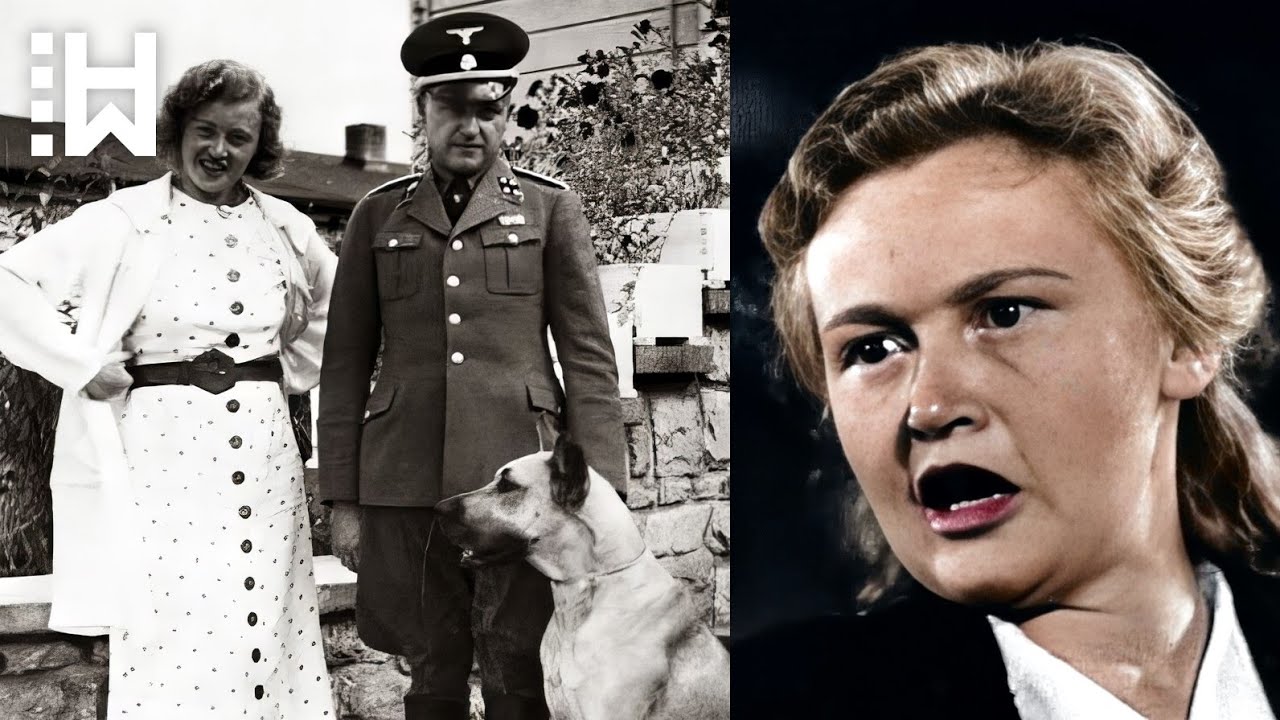
For years, Ilse Koch had lived behind locked doors, serving a life sentence for her role in the violence surrounding Buchenwald concentration camp.
She had once occupied a villa overlooking thousands of prisoners.
Now her entire world consisted of a narrow bed, bare walls and a door that could only be opened from the outside.
When the guards entered, they found the 60-year-old prisoner dead.
She had torn a bedsheet into strips and hanged herself during the night.
The woman once portrayed as the untouchable “Queen of Buchenwald” had died alone in a prison cell, nearly twenty years after a courtroom first heard survivors describe the terror associated with her name.
But the story of Ilse Koch is more disturbing than the manner of her death.
It is the story of an ordinary secretary who entered the Nazi system, married into power and discovered how easily cruelty could become a form of privilege.
It is also a warning about how sensational myths can sometimes obscure crimes that were already horrifying enough.
Ilse Köhler was born in Dresden in 1906. Before the Nazi rise to power, there was little in her early life to suggest that her name would one day become internationally notorious.
She worked as a secretary.
Then, in 1932, she joined the Nazi Party.
Four years later, she married Karl-Otto Koch, an SS officer whose career was advancing through the expanding concentration-camp system. Karl became commandant of Sachsenhausen and, in 1937, was assigned to establish a new camp near Weimar.
Its name was Buchenwald.
The camp stood on the wooded Ettersberg hill, not far from a city celebrated for German literature and culture.
Inside the fences, culture meant nothing.
Prisoners were stripped of their names, their rights and often their lives. Political opponents, Jews, Roma, Soviet prisoners of war, homosexuals, Jehovah’s Witnesses and countless others were subjected to forced labor, beatings, starvation, disease and murder.
While prisoners struggled to survive, the Koch family lived inside the protected SS settlement.
Their comfort was built within sight of human misery.
Ilse was not the commandant. She did not hold the same formal authority as her husband.
But witnesses later testified that she understood exactly what power her position gave her.
Prisoners described her riding through areas around the camp, accompanied by SS personnel. Some testified that she struck inmates or reported them for punishment. Others said that a gesture or complaint from her could lead to a beating whose outcome was impossible to predict.
In a place where guards could kill with near impunity, even a casual accusation could become a death sentence.
That was the particular terror of Ilse Koch.
She did not need an official execution order.
She lived close enough to the machinery of violence to activate it.
Former inmates testified after the war that she had assaulted prisoners and incited SS personnel to punish them. Her later West German conviction rested not on rumor, but on findings that she had encouraged murder, attempted murder and serious bodily harm.
Her extravagance made the cruelty even more grotesque.
While prisoners performed exhausting labor on inadequate food, Koch commissioned an expensive indoor riding arena. Prisoners were forced to build it, and accounts indicate that men died during its construction.
The arena reportedly cost more than 250,000 Reichsmarks.
To Koch, it was a luxury.
To the prisoners carrying stone and timber, it was another place where human life could be consumed for the pleasure of the commandant’s wife.
Yet the Koch household was not merely brutal.
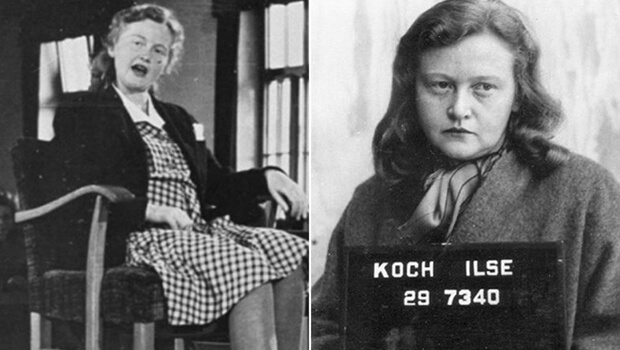
It was corrupt.
Karl-Otto Koch stole money and valuables taken from prisoners. He exploited the camp not only as an instrument of Nazi persecution, but as a personal criminal enterprise.
Eventually, even the SS began investigating him.
That fact revealed something monstrous about the Nazi system.
Karl Koch was not investigated because prisoners were being abused or murdered. Violence against prisoners was built into the concentration-camp system.
He attracted attention because he was stealing from the SS and killing inmates who could expose his corruption.
In 1943, Karl and Ilse Koch were arrested during an internal SS investigation. Karl was accused of embezzlement and of murdering prisoners to prevent them from speaking.
Ilse was accused of benefiting from stolen property.
An SS court acquitted her, but convicted Karl.
In April 1945, as the Third Reich collapsed and American forces approached, Karl-Otto Koch was taken back to Buchenwald as a prisoner.
The former commandant, who had once ruled the camp, was executed there by the SS.
The system he had served finally turned on him.
Days later, on April 11, 1945, American forces reached Buchenwald.
What they found shocked even battle-hardened soldiers.
There were starving survivors, piles of corpses and physical evidence of a camp designed to reduce people to disposable labor and then death.
More than 50,000 prisoners died at Buchenwald and its subcamps during the camp’s existence.
The liberation exposed a world that the Koch family had watched from the privileged side of the fence.
Ilse Koch initially tried to disappear into defeated Germany.
But on June 30, 1945, a former Buchenwald prisoner recognized her on a street in Ludwigsburg.
The balance of power shifted in a single moment.
Once, prisoners had been forced to lower their eyes when members of the Koch household passed.
Now a survivor could point at her openly.
American authorities arrested her.
In 1947, she stood trial at Dachau with thirty other Buchenwald defendants. The prosecution accused them of participating in a shared system of war crimes.
The courtroom became an international spectacle.
Survivors described beatings, punishments and the atmosphere of terror that surrounded Koch. Newspapers focused obsessively on allegations that she had selected tattooed prisoners to be killed and had objects made from human skin.
Those allegations created the image that followed her for the rest of her life: the sadistic, sexually predatory “Witch of Buchenwald.”
But an important distinction must be made.
Objects made from human skin were found in Buchenwald’s pathology collection, and the camp unquestionably engaged in the grotesque mistreatment of human remains. However, investigators did not establish conclusively that Koch personally ordered tattooed prisoners killed or possessed the infamous human-skin lampshades attributed to her.
Modern historians have emphasized that these specific claims were widely circulated but insufficiently proven.
The uncertainty does not make Koch innocent.
It reveals something more unsettling.
The lurid stories became so famous that they sometimes overshadowed the crimes supported by stronger evidence: her assaults, her use of prisoner labor, her participation in a murderous system and her willingness to send vulnerable men into the hands of guards she knew could beat them to death.
On August 14, 1947, the American military court found her guilty.
She was sentenced to life imprisonment.
She escaped a possible death sentence in part because she was pregnant. In October, while imprisoned, she gave birth to a son, Uwe.
For the woman who had once enjoyed the privileges of Buchenwald’s commandant household, the judgment appeared final.
But then came a decision that stunned survivors.
General Lucius D. Clay, the American military governor in Germany, reviewed the case. He concluded that some of the most sensational accusations—particularly those concerning objects made from human skin—had not been proved sufficiently.
Koch’s sentence was reduced from life to four years.
By 1949, she was due to walk free.
The announcement caused international outrage.
Former prisoners had testified about a woman who had lived comfortably amid mass suffering. Now they watched as questions surrounding the most lurid allegations threatened to erase the conduct that had been more firmly documented.
Koch appeared to have survived the collapse of the Third Reich, an SS investigation and an American life sentence.
Then, as she left American custody on October 17, 1949, West German authorities were waiting for her.
She was arrested again before she could reclaim an ordinary life.
This time, the case would not depend on the broad American charge of participating in a common criminal enterprise. German prosecutors focused on specific acts committed against German and Austrian prisoners.
The Augsburg trial opened in November 1950.
Approximately 250 witnesses were heard.
Koch denied wrongdoing. She claimed she had not witnessed anything at Buchenwald that could be considered inhumane.
The statement must have sounded extraordinary to men who had carried bodies, watched friends beaten and lived beneath the windows of the SS settlement.
For weeks, testimony accumulated.
The image of the powerful commandant’s wife began to disappear. In its place sat a defendant surrounded not by obedient guards, but by judges, prosecutors, reporters and survivors who could finally speak without fear of retaliation.
On January 15, 1951, the court delivered its judgment.
Ilse Koch was convicted of incitement to murder, attempted murder and serious bodily injury.
She was sentenced to life imprisonment.
At that moment, the woman who had spent years denying that she had seen anything inhumane at Buchenwald had nowhere left to direct her authority.
No prisoner stood at attention.
No SS guard waited for her signal.
No husband commanded the camp behind her.
The courtroom remained outside her control, and the survivors remained standing.
She was taken to Aichach prison, where she would spend the rest of her life.
The years passed.
The headlines faded.
The identity that had once protected her became the reason the prison doors never opened.
Her children grew up away from her. Her son Uwe, born during her first imprisonment, did not learn her identity until he was older. He eventually began writing to her and visited her in prison in the 1960s.
By then, the “Queen of Buchenwald” was an aging inmate.
According to accounts based on her prison records, Koch became increasingly disturbed and fearful. She reportedly believed that former concentration-camp prisoners would somehow enter her cell and punish her.
Whether this terror came from mental illness, guilt or a lifelong refusal to accept reality cannot be known with certainty.
But the reversal was impossible to miss.
At Buchenwald, prisoners had lived every day knowing that someone might enter their barracks and drag them away.
Now Koch sat behind a locked door, imagining that the people once placed at her mercy were coming for her.
On August 31, 1967, she ate her final meal.
During the night, she wrote a farewell message to Uwe. Then she used a bedsheet to take her own life.
The following morning, guards found her body.
There was no public execution.
No crowd.
No final display of Nazi ceremony.
Only a locked cell and the stillness left behind by a woman who had once believed that rank, marriage and political power placed her above the suffering of others.
Ilse Koch’s death should not be treated as the most important tragedy in her story.
The real tragedy belonged to the thousands who entered Buchenwald and never left alive.
It belonged to the prisoners forced to build luxuries for their captors.
It belonged to the men punished because someone with power found their existence inconvenient.
And it belonged to the survivors who had to spend years proving that what happened behind the camp’s fences was real.
Koch’s appalling end was not justice by itself.
Justice had already begun when a former prisoner recognized her in the street.
It continued when survivors entered courtrooms and spoke her name without lowering their voices.
It became permanent when the power she had borrowed from uniforms, guards and barbed wire was stripped away, leaving her with nothing but the consequences of the choices she had made.
Because history’s most dangerous monsters are not always supernatural creatures.
Sometimes they are ordinary people who discover that a cruel system rewards them—and decide to enjoy the privileges instead of resisting the cruelty.