The Paralyzed SEAL Had Given Up on Life—Until the Rookie Nurse Showed Him Her Combat Scars
The first thing Caleb Henderson threw at the new nurse was a stainless-steel cup.
It missed her face by less than six inches, struck the wall, and rolled beneath the radiator in Room 412.
The nurse did not flinch.
She looked at the cup, then at the man lying rigid beneath the white hospital blanket.
“Are you finished?” she asked.
Caleb stared at her.
Most nurses raised their voices when he became difficult. Some tried kindness. Others called security before entering his room. This one simply stood beside the door, holding a medication tray as if nothing unusual had happened.
“Get out,” Caleb said.
“No.”
The answer was so calm that it confused him.
For six months, Caleb had lived inside a body that no longer obeyed him. Before Kunar Province, he had been Chief Petty Officer Caleb Henderson, a Navy SEAL who could swim through black water, climb a mountain carrying eighty pounds of equipment, and make decisions under gunfire without hesitation.
Now he could not scratch his own nose.
An improvised explosive device had detonated beneath his team’s vehicle on a narrow road in eastern Afghanistan. The blast killed the driver, Petty Officer Thomas Miller, instantly.
Caleb survived.
The doctors called that a miracle.
Caleb called it bad luck.
The explosion shattered two vertebrae and severed his spinal cord at C6. When he woke in Germany, he could move his head and parts of his shoulders, but nothing below them. At Walter Reed National Military Medical Center in Bethesda, specialist after specialist explained what “complete spinal cord injury” meant.
Caleb heard only one sentence.

You will never be the man you were.
By the time he reached Room 412, the hospital no longer felt like a place of recovery. It felt like a polished, fluorescent grave.
He refused medication. He rejected physical therapy. He spat food at an orderly. He told one nurse he would have her fired and threatened another until she left the room crying.
Three staff members requested reassignment.
Dr. Gregory Mitchell, the rehabilitation physician, stopped pretending the situation was temporary.
“He’s driving everyone away,” Mitchell told Brenda Collins, the unit supervisor. “And he knows exactly what he’s doing.”
Brenda folded her arms. “The experienced nurses won’t take him.”
“Then we need someone he hasn’t defeated yet.”
Brenda looked through the glass window in the corridor. Inside Room 412, Caleb stared at the ceiling.
“There is one person,” she said.
Sarah Jenkins had been working at Walter Reed for two weeks.
She had completed orientation on Friday.
She was quiet, observant, and so new that several staff members still mistook her for a nursing student. She wore no colorful badge reels, no inspirational pins, and no practiced smile.
When Brenda assigned her to Caleb, one of the senior nurses laughed.

“You’re giving Henderson to the rookie?”
Sarah checked the chart. “Is the information in here accurate?”
“Yes.”
“Then I have what I need.”
She entered Room 412 at 7:03 on Monday morning.
At 7:04, the metal cup hit the wall.
Sarah retrieved it, placed it on the counter, and returned to his bedside.
“Your medication is due.”
“I said get out.”
“And I said no.”
Caleb narrowed his eyes. “You have no idea who you’re talking to.”
Sarah looked at the name printed on his chart.
“Caleb Henderson. Thirty-eight. C6 complete injury. Recurrent infections. Pressure wound risk. Refusing medication and therapy.”
His jaw tightened.
“You forgot Chief Petty Officer.”
“No,” she said. “I didn’t.”
She adjusted the tray and lifted his pills.
“I’m not taking them.”
“That’s your choice.”
He had expected an argument.
Sarah placed the cup of water beside him.
“But I’m documenting the refusal. I’m also noting that you understand the infection may worsen.”
“Do whatever you want.”
“I usually do.”
Caleb almost laughed, but stopped himself.
Sarah returned the next morning.
And the next.
She never tried to inspire him. She never told him everything happened for a reason. She did not call him brave or thank him for his service.
She cleaned the room, checked his skin, monitored his breathing, and spoke to him like a man rather than a symbol.
That irritated him more than pity.
On Thursday, she arrived with a physical therapist named Marco.
Caleb saw the transfer equipment and immediately became hostile.
“No.”
Marco remained near the door.
Sarah checked Caleb’s blood pressure.
“You have been in this bed too long.”
“I’m not getting into that chair.”
“The chair is not asking for your permission.”
Caleb’s voice rose. “Touch me and I’ll have both of you removed.”
Marco glanced at Sarah.
She did not move.
“You can threaten me,” she said. “You can insult me. You can refuse every treatment in this building. But you don’t get to pretend refusing is the same as fighting.”
The words struck harder than Caleb expected.
His face darkened.
“You think I’m not fighting?”
“I think you stopped six months ago.”
The room went silent.
Caleb stared at her with open hatred.
“Get out.”
Sarah nodded to Marco.
They left.
That afternoon, Caleb filed a formal complaint.
He accused Sarah of disrespect, emotional harassment, and operating beyond her experience. Brenda read the complaint twice, then called Sarah into her office.
“Did you tell him he stopped fighting?”
“Yes.”
“Why?”
“Because he did.”
Brenda lowered her voice. “You’ve been here two weeks.”
Sarah remained standing.
“He’s been allowed to confuse cruelty with control. Every time someone leaves, he proves to himself that he can still affect the world.”
“That’s a dangerous interpretation.”
“It’s also accurate.”
Brenda studied her.
There was something unusual about Sarah’s stillness. It did not come from inexperience. It came from discipline.
“Be careful,” Brenda said.
Sarah returned to Room 412 that evening.
Caleb turned his head toward the window.
“I filed a complaint.”
“I know.”
“You’ll probably be gone by tomorrow.”
“Probably not.”
He looked back at her. “Why are you still here?”
“Because you need your catheter checked.”
“That’s not what I asked.”
Sarah pulled on gloves.
“It’s the answer you’re getting.”
Over the next three weeks, their conflict became part of the unit’s daily rhythm.
Caleb refused breakfast. Sarah returned at lunch.
He rejected his breathing exercises. She placed the device within view and came back an hour later.
He cursed at her during repositioning. She completed the task without reacting.
Once, he knocked a bowl of soup from the tray with the side of his wrist. It spilled across the floor.
Sarah looked down at the mess.
Then she placed the call button near his head.
“You’ll need that.”
She walked out.
No lecture. No anger.
A maintenance worker cleaned the floor while Caleb watched in silence.
The following day, he ate half his lunch.
The staff noticed small changes.
He began taking antibiotics without an argument. He allowed Marco to raise the bed. He tolerated ten minutes in a supported sitting position before demanding to stop.
Sarah never praised him.
She simply recorded the progress.
But the anger remained.
It erupted whenever anyone mentioned his former team.
A framed photograph sat facedown in the bedside drawer. It showed Caleb and seven SEALs standing beside an armored vehicle, their uniforms covered in dust.
Thomas Miller stood on Caleb’s left, smiling with one hand raised behind Caleb’s head.
Thomas had been twenty-nine.
He had a wife named Emily and a daughter he had never met. Emily was five months pregnant when he deployed.
Caleb had chosen the route that morning.
He had reviewed the intelligence.
He had ordered Thomas to drive.
The investigation found no negligence. The explosive had been buried beneath reinforced concrete and triggered remotely. No reconnaissance method available to the team would have identified it.
The report cleared Caleb.
He did not clear himself.
One night, Sarah entered and found him staring at the photograph.
“Put it back,” he said.
She had not touched it.
“Who is he?”
Caleb looked toward the window. “None of your business.”
Sarah studied the image from a distance.
“The driver?”
His head snapped toward her.
“How do you know that?”
“Vehicle crews often stand in the same order when they take photographs.”
“That isn’t in my medical chart.”
“No.”
“Then stop digging into my life.”
Sarah replaced the water pitcher.
“I didn’t dig.”
“You nurses love this, don’t you? Collecting broken soldiers and pretending you understand us.”
Her hands stopped.
It was the first time Caleb saw a change in her expression.
Not pain.
Restraint.
“You don’t know anything about that road,” he continued. “You don’t know what burning metal smells like. You don’t know what it sounds like when someone beside you is alive one second and gone the next.”
Sarah slowly turned toward him.
“You’re right,” she said.
Then she left.
For the first time, Caleb wondered if he had gone too far.
The next morning, another nurse entered Room 412.
“Where’s Jenkins?” Caleb asked.
The nurse looked surprised. “Training day.”
“What training?”
“I don’t know.”
Caleb complained about everything she did.
The water was too warm. The lights were too bright. She repositioned his arm incorrectly.
By noon, the nurse left and told Brenda she would not return.
Sarah came back the following day.
Caleb said nothing when she entered.
She checked his temperature.
“You ran off another nurse,” she said.
“She was incompetent.”
“She has been here eleven years.”
“Then she’s been incompetent for eleven years.”
Sarah almost smiled.
It disappeared quickly.
That afternoon, Marco returned with the transfer chair.
Caleb stared at it.
“How long?”
“Ten minutes,” Sarah said.
“Five.”
“Eight.”
“Six.”
“Seven.”
He exhaled. “Fine.”
The transfer took twenty minutes. Caleb hated every second of it.
The straps made him feel like cargo. His head felt too heavy. Sweat formed along his hairline as Marco and Sarah adjusted his position.
When they finally rolled him toward the window, Caleb saw the courtyard below.
Autumn leaves covered the pavement. A young Marine moved slowly between parallel bars while his father walked beside him. A woman pushed a stroller near the fountain.
Caleb had not looked outside from a seated position in months.
“Seven minutes,” Sarah said.
He stayed for twelve.
That evening, Dr. Mitchell visited Sarah at the nurses’ station.
“He sat up.”
“Yes.”
“He asked about an adaptive control system for the television.”
“Yes.”
Mitchell smiled. “What did you do?”
Sarah closed the chart.
“I stopped asking him to feel hopeful.”
Caleb’s progress continued, but it was fragile.
Then a letter arrived from Emily Miller.
It had been forwarded through Naval Special Warfare Command. The envelope contained a photograph of Thomas’s daughter, now six months old.
Her name was Grace.
Emily had written three pages.
Caleb read only the first paragraph before losing control.
He knocked the letter to the floor. He shouted until his voice became hoarse. When Sarah entered, he demanded that she remove the photograph.
“Take it away.”
Sarah picked it up.
The baby had Thomas’s eyes.
“Put it in the trash,” Caleb said.
Sarah held the picture beside the bed.
“No.”
“It’s mine.”
“Then you can decide what to do with it when you’re calm.”
“I gave an order.”
“You are not my commanding officer.”
“I killed her father!”
His shout echoed into the corridor.
Two nurses stopped outside the door. Marco approached, but Sarah raised one hand, telling them to stay back.
Caleb’s breathing became shallow.
“I chose that route,” he said. “I put Miller in that seat. He had a child coming, and I put him in that seat.”
Sarah placed the photograph on the table.
“The investigation cleared you.”
“I don’t care.”
“He followed the same mission you did.”
“I was responsible for him.”
“You were responsible for the mission.”
“He died.”
“And you think dying with him would have made you loyal?”
Caleb’s face twisted.
“You think this is living?”
Sarah stepped closer.
“I think you’ve spent six months punishing everyone because the wrong man survived.”
His eyes became wet.
“Get out.”
“No.”
“Get out!”
Sarah did not move.
Caleb turned his face away.
His voice dropped to a whisper.
“You have no idea what it costs to come home when someone else doesn’t.”
That was when Sarah closed the door.
She lowered the privacy blind.
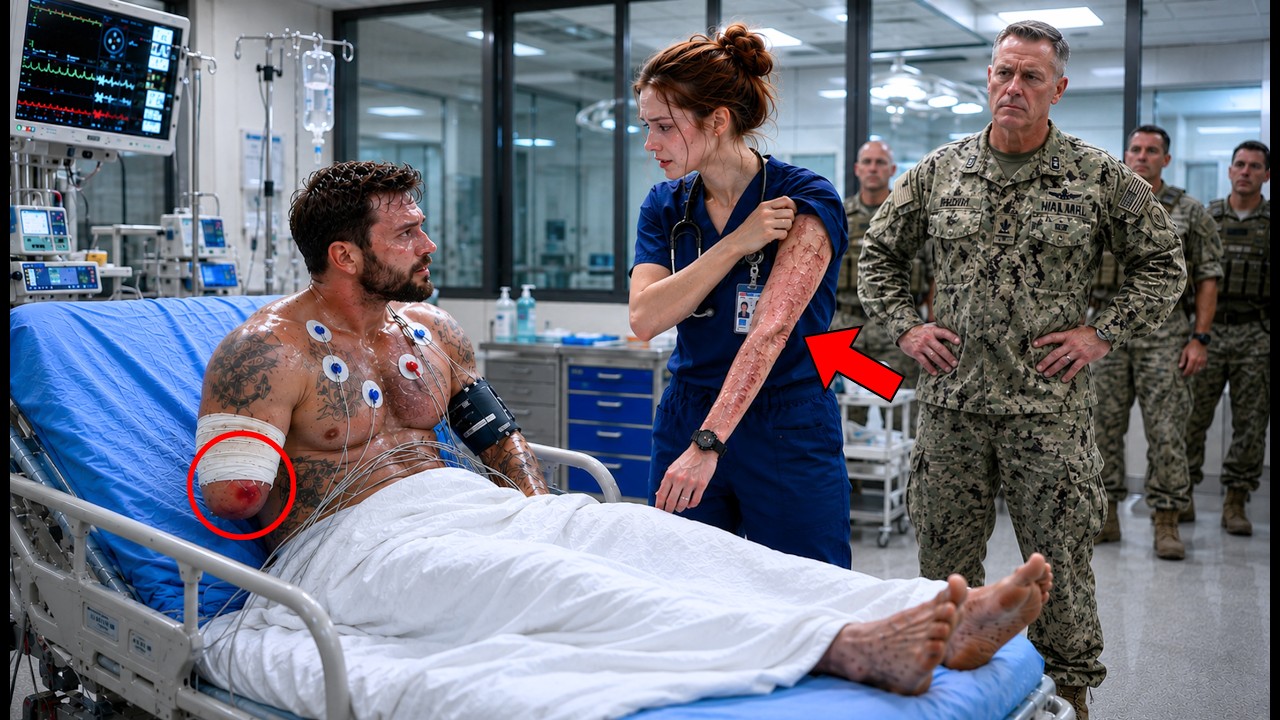
Then, without saying anything, she removed her scrub jacket.
Caleb frowned.
Beneath it, she wore a short-sleeved undershirt. She reached across her body, lifted the hem along her left side, and exposed a web of thick scar tissue running from her ribs toward her back.
The skin was uneven and discolored, marked by burns and surgical lines.
Caleb stopped breathing.
Sarah turned slightly.
More scars crossed her shoulder blade. One curved beneath her arm where shrapnel had entered. Another disappeared beneath the waistband of her scrubs.
“These are from an aircraft fire,” she said.
Caleb stared at her.
Sarah lowered the shirt but did not put the jacket back on.
“Six months ago, my evacuation team was called to a road in Kunar Province. An armored vehicle had been hit by an IED.”
Caleb’s eyes widened.
Sarah continued in the same controlled voice she used when checking medication.
“The driver was dead. The team leader had no pulse when we reached him. His spinal cord was exposed. There was fuel burning along the passenger side, and ammunition was cooking off inside the vehicle.”
Caleb’s lips parted.
“No.”
“I performed the first airway procedure on you.”
The room seemed to tilt.
Sarah’s expression remained steady, but her right hand trembled once before she closed it into a fist.
“Our helicopter took fire after extraction. We made it off the ground, but a fuel line ruptured. I stayed over you because your blood pressure kept collapsing.”
Caleb stared at the scars on her arm.
“You were there.”
“Yes.”
“The medic…”
“Staff Sergeant Sarah Jenkins. Army flight medic.”
He looked at her uniform, confused.
“You’re a nurse.”
“Now.”
She pulled a chair beside the bed.
“The fire ended my flight career. I spent four months in treatment. Two skin grafts. Three surgeries. I still can’t fully raise my left arm.”
Caleb’s eyes moved to her shoulder. Suddenly, he noticed the stiffness he had mistaken for nervousness. The way she always reached for equipment with her right hand. The way she stood slightly angled rather than square.
“You said you didn’t know that road.”
“I said you were right.”
“You let me say all those things to you.”
“Yes.”
“Why didn’t you tell me?”
“Because you would have turned me into another person you owed.”
The words silenced him.
Sarah leaned forward.
“You don’t owe me your life, Caleb. And you don’t owe Thomas your death.”
His face changed.
For weeks, the staff had seen anger, contempt, and defiance.
Now they saw recognition.
Caleb looked toward Sarah’s scars again. His mouth opened, but no sound came. The muscles in his jaw tightened. His eyes filled, and for the first time since arriving at Walter Reed, he did not turn away before someone could see him break.
“I remember a voice,” he whispered.
Sarah said nothing.
“In the helicopter. Someone kept telling me to breathe.”
“That was me.”
“You said Miller’s name.”
“I found his identification tag.”
Caleb closed his eyes.
A tear moved toward his ear.
“I couldn’t save him.”
“No,” Sarah said. “Neither could I.”
For several minutes, the only sound in Room 412 came from the monitor beside the bed.
Then Caleb asked the question he had been avoiding for six months.
“Why did you save me?”
Sarah looked at him carefully.
“Because you were still alive.”
It was not dramatic.
It was not comforting.
It was simply true.
The following morning, Caleb asked Marco to bring the transfer chair.
Marco assumed he had heard incorrectly.
“How long do you want to sit?”
“Twenty minutes.”
Sarah stood near the window, wearing her scrub jacket.
She did not smile.
But she opened the blinds.
The changes came slowly.
Caleb began occupational therapy. He learned to operate a powered wheelchair using a control near his chin. He practiced directing his own care without humiliating the people providing it.
He apologized to the nurse he had made cry.
She accepted, but did not pretend the damage had never happened.
He apologized to the orderly whose shirt he had ruined with food.
The orderly handed him a cleaning bill as a joke.
Caleb paid it anyway.
Dr. Mitchell arranged counseling for survivor’s guilt. Caleb attended the first session in silence. During the second, he spoke Thomas Miller’s name.
During the third, he brought the photograph of Grace.
Two months later, Emily Miller visited Walter Reed.
Sarah offered to remain in the room.
Caleb said no.
“This is mine.”
Emily entered carrying Grace against her chest. For several seconds, she and Caleb simply looked at each other.
Then Emily placed the baby carefully in the space beside his arm.
Caleb could not hold her.
So Emily rested Grace’s tiny hand against his wrist.
“I’m sorry,” Caleb said.
Emily’s eyes filled.
“Thomas knew what he was doing,” she replied. “He trusted you.”
Caleb looked down at the child.
“I should have brought him home.”
“You did,” Emily said. “You brought back every story I can tell her about who her father was.”
Outside the room, Sarah leaned against the wall.
Brenda stood beside her.
“You knew the entire time,” Brenda said.
“Yes.”
“That was why you accepted the assignment.”
Sarah watched through the narrow glass panel as Caleb spoke to Emily.
“No.”
Brenda waited.
Sarah’s voice softened.
“I accepted because everyone else had decided his anger was the most important thing about him.”
Six months later, Caleb left Walter Reed in a powered wheelchair.
The entire rehabilitation team gathered near the entrance. Marco handed him a folded Navy flag. Dr. Mitchell shook his hand by placing his palm beneath Caleb’s.
Sarah remained behind the group.
Caleb maneuvered the chair toward her.
“You’re still a terrible nurse,” he said.
“You still complain too much.”
He looked at the scar visible below her sleeve.
“Thank you.”
Sarah shook her head. “You already thanked me.”
“No. I thanked you for saving my life.”
He glanced back at the hospital doors, then at the people who had refused to let him disappear inside them.
“This is for making me live it.”
Sarah’s eyes shone, but her voice stayed steady.
“Don’t waste it.”
Caleb did not.
He later began mentoring newly injured service members, especially those who refused visitors and therapy. He never told them to be grateful. He never promised that life would return to normal.
He told them normal was gone.
Then he showed them what could still be built.
In his office, Caleb kept two photographs on the wall.
One showed Thomas Miller standing beside an armored vehicle in Afghanistan.
The other showed Sarah Jenkins at her nursing graduation, her left arm raised only halfway as she held her certificate.
Between them was a photograph of Grace Miller on her first day of school.
Caleb once believed survival was the cruelest thing that had happened to him.
He eventually understood that survival was not the ending.
It was an assignment.
And sometimes, the person who refuses to let you surrender is not someone who escaped the fire—but someone who walked through it first and came back to show you the way out.