Chapter 1 — The Woman Behind the “Desk Job”
The first thing I felt was his hand around my wrist.
Not the music.
Not the applause.
Not the hundreds of conversations flowing beneath the crystal chandeliers.
His hand.
Firm. Trained. Immediate.
The kind of grip that came from years of reacting before thinking.
“ID. Now.”
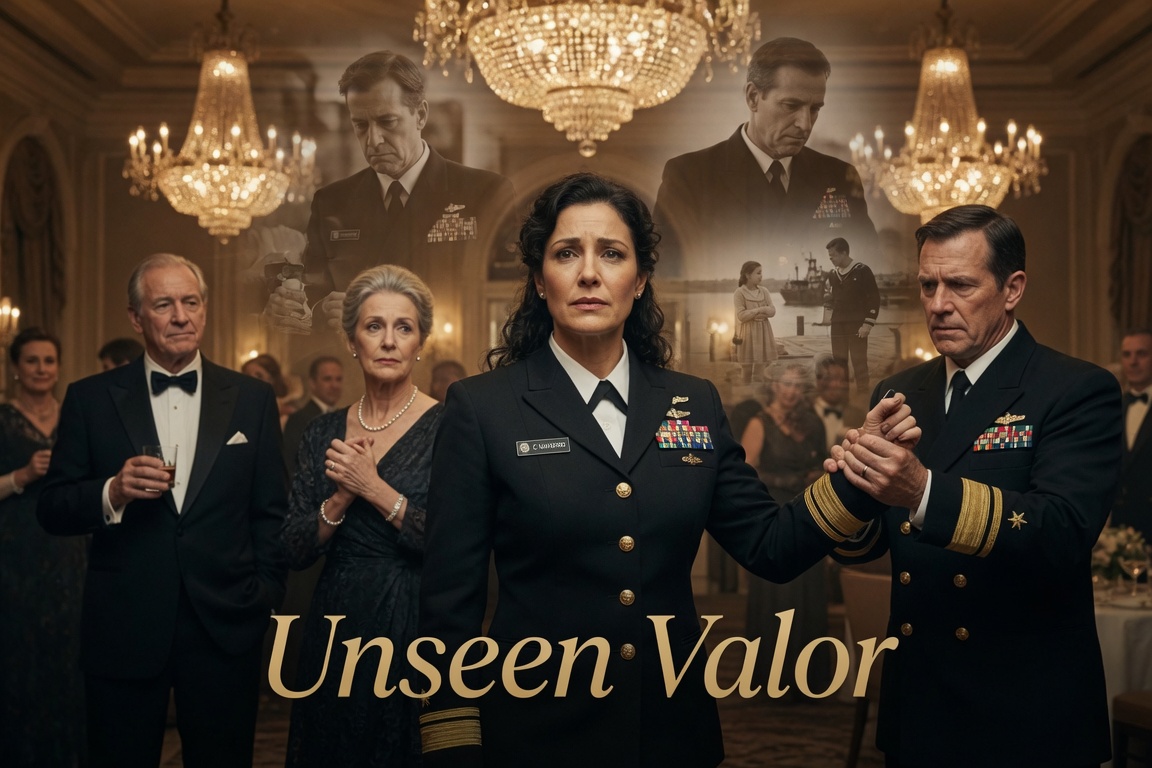
Captain Ethan Mercer’s voice cut through the entrance hall of the Naval Heritage Foundation Gala like a command on a battlefield.
I stopped.
Not because I was afraid.
Because I was trying to understand.
The man standing in front of me wore a Navy dress uniform covered with ribbons, polished insignia, and the confidence of someone accustomed to being obeyed.
Behind him, two security officers watched carefully.
Around us, guests slowed.
A few people turned.
A few whispered.
A Navy captain stopping a woman in a simple black dress at the entrance of one of the most prestigious military events in the country was not exactly subtle.
Especially when that woman had been invited.
Especially when her name was printed on the guest list.
I looked down at his hand.
Then back at him.
“Captain.”
The single word made his eyes narrow.
Not because I had challenged him.
Because I knew his rank.
“Your identification,” he repeated.
His fingers remained around my wrist.
Not painful.
But unnecessary.
I looked past him toward the ballroom.
I could see my mother and stepfather near the entrance table.
My mother, Elaine, wore the blue dress I had helped her choose three weeks earlier.
My stepfather, Colonel Richard Hayes, stood beside her in his Army dress uniform.
Twenty-two years of military service had taught me how to read posture.
My mother was confused.
My stepfather was embarrassed.
Not for me.
For the situation.
He hated scenes.
Especially scenes where someone might question authority.
I looked back at Captain Mercer.
“I believe there is a misunderstanding.”
His expression did not change.
“Ma’am, identification.”
I almost smiled.
Almost.
Because after twenty-two years in Navy intelligence, I had learned something important.
The people who know the least often demand proof the loudest.
I reached into my purse.
Slowly.
Carefully.
Not because I needed permission.
Because everyone around me was watching.
I removed my identification wallet.
Before I opened it, his radio crackled.
A burst of static.
Then a voice.
“Captain Mercer.”
He immediately released my wrist.
The change was instant.
The room did not hear the words.
But they heard the tone.
Something had changed.
His hand dropped.
His posture shifted.
“Sir?”
The radio responded.
“Release her. Now.”
Silence.
Not complete silence.
The orchestra was still playing inside the ballroom.
Glasses were still clinking.
People were still laughing.
But around us, the air changed.
Captain Mercer stared at me.
Then at his radio.
Then back at me.
The security officers exchanged a glance.
My stepfather slowly turned his head.
Because he recognized something everyone else did not.
The voice.
Not the person.
The authority.
“Sir,” Mercer said quietly.
The radio answered.
“I said release her.”
The captain stepped back.
Immediately.
The hand that had stopped me moments earlier now rested at his side.
“I apologize, ma’am.”
I looked at him.
The apology was genuine.
That mattered.
“Accepted.”
He hesitated.
Like he wanted to ask something.
But he didn’t.
Good.
Discipline included knowing when curiosity became intrusion.
I walked past him into the ballroom.
Only then did I allow myself to breathe.
Because the hardest part was not being stopped.
The hardest part was knowing why.
Someone had flagged my name.
Someone had made a Navy captain question my identity.
And after twenty-two years of protecting secrets for my country…
Someone had just brought one of mine into the open.
The ballroom of the Naval Heritage Foundation was exactly what people imagined when they thought of military prestige.
Old money.
Old victories.
Old photographs lining dark wooden walls.
The ceiling stretched three stories above us, covered in gold details and massive chandeliers that reflected across polished marble floors.
The air smelled like expensive perfume, champagne, and the faint scent of military uniforms pressed with perfect precision.
Tonight was supposed to be simple.
A celebration.
The Distinguished Service Award ceremony.
My directorate had been selected for recognition after years of intelligence work that most people would never know existed.
That was normal.
The Navy had always rewarded results more than visibility.
I understood that.
What I did not expect was my own family not understanding it.
My stepfather approached first.
Richard Hayes was sixty-two, a retired Army colonel with silver hair, broad shoulders, and the kind of presence that made people stand straighter without realizing it.
For fourteen years, he had been my father figure.
He had also spent those fourteen years introducing me incorrectly.
“My stepdaughter works for Navy intelligence.”
That was the sentence.
Always.
Not:
“My stepdaughter leads intelligence analysis.”
Not:
“My stepdaughter has spent decades protecting national security.”
Just:
“She works for Navy intelligence.”
A harmless sentence.
That was the problem.
Sometimes people do not erase you through cruelty.
Sometimes they erase you through simplification.
“You made it,” he said.
I smiled.
“Of course I did.”
His eyes moved around the ballroom.
Proud.
Nervous.
“Your mother is excited.”
“I know.”
He lowered his voice.
“I still can’t believe they selected your office.”
I looked at him.
“My office?”
He smiled.
“Your department.”
I let the correction pass.
Old habits.
Hard to break.
“You know,” he said, “I told some people you were involved with the award.”
Involved.
Not leading.
Not responsible.
Involved.
I nodded.
“What did they say?”
He laughed.
“They were impressed.”
“Were they?”
“Of course.”
I looked across the ballroom.
At admirals.
Commanders.
Intelligence officers.
People who knew exactly what my title meant.
People who knew exactly what my team had done.
Then I looked back at Richard.
A good man.
A decent man.
A man who had never intentionally hurt me.
But a man who had never truly asked what I did.
And sometimes that hurt more.
Because hatred means someone noticed you.
Indifference means they never looked.
Chapter 2 — The Life Nobody Asked About
I was twenty-three years old when I learned that secrecy changes relationships.
Not because you become dishonest.
Because you become incomplete.
When I joined Navy intelligence, my family celebrated.
My mother cried.
Richard bought me a watch.
He said:
“Just promise me you won’t disappear.”
I promised.
I failed.
Not intentionally.
The first time I missed Thanksgiving, I told them there was a scheduling conflict.
The second time, I said training.
The third time, my mother stopped asking.
She learned the military had doors she could not open.
She learned there were answers I could not give.
Richard learned something else.
He learned it was easier to tell people I had a normal job.
At first, I understood.
Security.
Privacy.
Protection.
Then years passed.
And the explanation became the identity.
At family gatherings, relatives asked:
“So you’re still doing paperwork?”
I smiled.
“Yes.”
Technically.
Intelligence was paperwork.
Reports.
Analysis.
Briefings.
But paperwork did not describe the nights spent decoding threats.
The meetings where one sentence from an intercepted message changed an operation.
The moments when a decision had to be made before all the information existed.
People imagine intelligence officers as people who know everything.
The truth is different.
We are people who make decisions while knowing we never will.
My career was built in rooms without windows.
My victories were names removed from danger.
My failures were names added to memorial walls.
And nobody at home knew.
Because I had chosen that.
Or at least, I thought I had.
Until tonight.
The ceremony began at 8:00.
Captain Mercer stood near the stage.
He avoided looking at me.
Professional.
Good.
My mother sat beside me.
She leaned closer.
“What happened earlier?”
I looked at her.
“What do you mean?”
“The captain.”
I smiled faintly.
“You noticed?”
She touched my arm.
“I notice you.”
The words surprised me.
Because I wasn’t sure I believed them.
“He was doing his job.”
“He embarrassed you.”
“No.”
I looked toward Mercer.
“He corrected himself.”
My mother studied my face.
“You always defend people.”
“That’s not always a good thing.”
“No.”
She smiled sadly.
“It’s just who you are.”
Before I could answer, the lights dimmed.
The room quieted.
The foundation president stepped onto the stage.
Then Admiral Thomas Whitaker.
Four stars.
Forty years of service.
A man whose name appeared in history books.
He approached the podium.
“Tonight, we recognize a directorate whose work has remained largely unseen.”
My stepfather sat straighter.
The admiral continued.
“The reason we can celebrate publicly is because others worked privately.”
The screen behind him changed.
A photograph appeared.
Not of a ship.
Not of aircraft.
Not of a battlefield.
A simple operations room.
Then a name appeared.
NAVAL INTELLIGENCE DIRECTORATE — STRATEGIC ANALYSIS GROUP
My mother looked at me.
Richard looked at the screen.
The admiral continued.
“And tonight, I want to recognize the person who led this group through the most complex intelligence disruption of the decade.”
The room became still.
I knew before he said it.
Because I saw Captain Mercer straighten.
Because I saw the security officers look toward me.
Because I saw Richard’s face change.
“Commander Rebecca Hayes.”
My mother inhaled.
Richard froze.
The screen changed.
My photograph.
My actual military profile.
Not hidden.
Not simplified.
Not reduced.
Twenty-two years of service.
Multiple commendations.
Operational leadership.
Classification markings.
The room erupted in applause.
I did not move.
Because suddenly, the secret I had protected for decades was no longer mine.
It belonged to the room.
The admiral looked directly at me.
“Commander Hayes, please join me.”
I stood.
Slowly.
My heels crossed the marble.
Every step sounded louder than it should.
I passed Captain Mercer.
He lowered his head slightly.
Not apology.
Respect.
On the stage, Admiral Whitaker shook my hand.
Then turned toward the audience.
“There are people who spend their careers chasing recognition.”
He looked at me.
“And there are people who spend their careers making sure others come home.”
Silence.
“Commander Hayes belongs to the second group.”
My mother was crying.
Richard was staring at the screen.
Not angry.
Not ashamed.
Just seeing me.
Maybe for the first time.
After the ceremony, he approached.
For once, he had no introduction ready.
No explanation.
No simple sentence.
Just:
“Rebecca.”
I waited.
“I didn’t know.”
I looked at him.
“I know.”
His jaw tightened.
“That sounds worse than if you were angry.”
“It is.”
He looked down.
The colonel who had commanded thousands suddenly looked like a man who had missed something important inside his own home.
“I should have asked.”
“Yes.”
One word.
Enough.
He nodded.
“I’m sorry.”
I believed him.
But forgiveness was not the same as pretending nothing happened.
Before I could answer, Captain Mercer approached.
“Commander.”
I turned.
“Yes, Captain?”
He hesitated.
“The incident at the entrance.”
“Yes?”
He looked embarrassed.
“I should have recognized the clearance marker.”
I shook my head.
“No.”
His eyes lifted.
“No?”
“You followed procedure.”
“But I grabbed your arm.”
“Yes.”
A pause.
“Next time, use words first.”
A small smile appeared.
“Yes, Commander.”
Then his radio crackled.
Everyone near us heard it this time.
“Captain Mercer.”
He answered immediately.
“Sir?”
The voice came through.
“Tell Commander Hayes we need her in the operations room.”
The ballroom went quiet again.
Captain Mercer looked at me.
Then smiled slightly.
“Apparently, ma’am, your evening is not over.”
I looked around the room.
At my family.
At the people who had finally seen what had always been there.
Then I looked toward the exit.
Twenty-two years.
Thousands of decisions.
A lifetime of silence.
And now, one simple truth.
I had never been invisible.
They had just never learned how to see me.
I followed Captain Mercer out of the ballroom.
Behind me, the applause continued.
But for the first time…
I wasn’t walking away from recognition.
I was walking toward the next mission.