Chapter 1 — The Woman Everyone Ignored
The tray hit the floor before I did.
Metal slammed against concrete.
A cup of coffee flipped sideways, spilling across my uniform boots.
The entire mess hall went quiet.
Not because the sound was loud.
Because everyone saw who had caused it.
Sergeant Cole Maddox stood in front of me, his hand still extended from the shove.
A hundred Marines stopped eating.
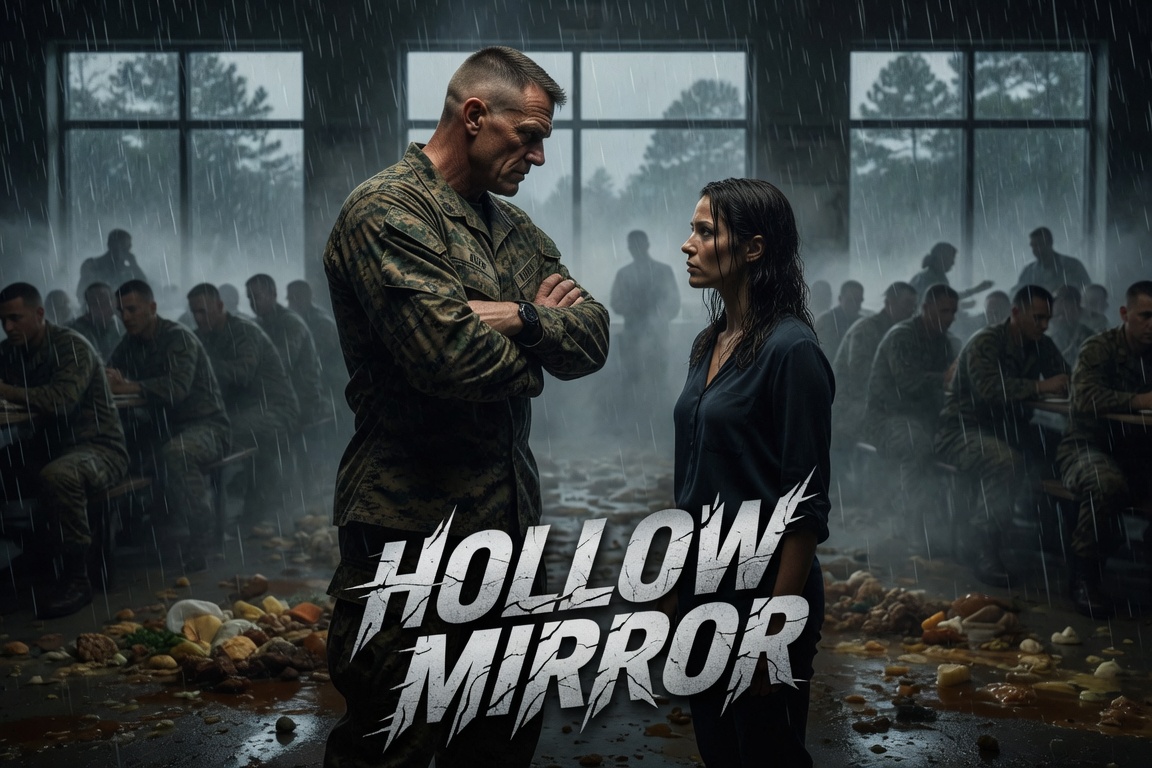
Forks froze.
Conversations died.
The smell of coffee, grilled chicken, and industrial-strength cleaner suddenly felt heavier than the silence filling the room.
“You need to learn where you belong.”
His voice was calm.
That was the part that bothered me.
Anger was easy to understand.
Contempt was colder.
I looked down at the coffee spreading across the floor.
Then at my sleeve.
A small brown stain on a uniform I had worn through three continents.
Twenty-three years of service.
And a Marine sergeant had just pushed me because he thought I was someone who did not matter.
“Are you finished?” I asked.
A few Marines exchanged looks.
Maddox smiled.
That smile belonged to someone who had never been challenged by the person standing in front of him.
“You’re not even going to apologize?”
The room became even quieter.
I studied him.
Twenty-eight years old.
Excellent physical scores.
Good reputation among junior Marines.
Average understanding of the world outside his own experience.
He was not a monster.
That would have been easier.
Monsters are simple.
People who believe they are right are harder.
“I asked if you were finished.”
His smile disappeared.
“You civilians come onto base and think you can walk around like you own the place.”
There it was.
The assumption.
Civilian.
I looked at the identification badge clipped inside my jacket pocket.
I could have pulled it out.
One second.
One movement.
The entire room would have changed.
But I didn’t.
Because after twenty-three years in military intelligence, I had learned something important.
The truth does not become stronger when you rush to prove it.
Sometimes you let people reveal exactly who they are first.
“I’m not a civilian,” I said.
Maddox laughed.
“Sure.”
Behind him, someone whispered.
“Just let it go.”
Another Marine said quietly:
“She’s probably a contractor.”
A contractor.
Not a soldier.
Not leadership.
Not someone whose decisions had sent aircraft into hostile airspace.
Not someone whose signature had approved operations they would never hear about.
Just a woman standing in a mess hall.
Invisible.
Again.
Maddox stepped closer.
“You should leave before you embarrass yourself.”
I looked at him.
Then at the tray on the ground.
Then at the Marines watching.
“Pick it up.”
He blinked.
“What?”
“The tray.”
His eyebrows lifted.
“You’re ordering me?”
“No.”
I paused.
“I’m giving you a chance.”
The room changed.
Not much.
Enough.
Maddox looked around.
He realized people were watching him now.
His pride had become the audience.
And pride hates losing control.
“You have no idea who you’re talking to.”
I almost smiled.
The sentence was familiar.
I had heard it from politicians.
Contractors.
Foreign officers.
People who believed titles were shields.
The difference was simple.
Real authority rarely announces itself.
The fake kind always does.
Maddox stepped forward again.
Then the mess hall doors opened.
Nobody noticed the first man.
That was how professionals moved.
No announcement.
No dramatic entrance.
Just presence.
A Marine captain entered wearing a dark service uniform, followed by three other officers.
The conversations stopped one by one.
Not because someone ordered silence.
Because everyone recognized something.
Rank.
Experience.
Authority.
The four officers walked straight through the mess hall.
And then they saw me.
The captain stopped.
His face changed.
Not confusion.
Recognition.
The kind that comes when someone sees a person they thought they would never see again.
“Ma’am.”
One word.
Quiet.
Respectful.
Maddox turned.
The captain walked toward me.
Then something happened that nobody in that mess hall expected.
He saluted.
Not casually.
Not politely.
Perfectly.
The other three officers followed.
Four generals.
Four senior commanders.
Standing in the middle of the mess hall.
Saluting me.
Nobody breathed.
Maddox slowly lowered his hands.
The color disappeared from his face.
Because suddenly the woman he had pushed was no longer the woman he thought she was.
The captain spoke.
“General Hayes.”
The name landed harder than any shout.
The room froze.
Maddox stared.
“General?”
I looked down at my stained uniform.
Then back at him.
“Yes.”
The captain turned toward Maddox.
His voice remained calm.
That made it worse.
“Sergeant, would you like to explain why you put your hands on the woman who commanded the Pacific Intelligence Operations Group?”
Nobody moved.
The mess hall had become a courtroom.
And everyone was waiting for the verdict.
Chapter 2 — The General Without a Shadow
My full name is Katherine Hayes.
For most of my career, people knew me as General Katherine Hayes.
Outside military circles, almost nobody knew me.
That was intentional.
The military celebrates visible heroes.
But intelligence creates invisible ones.
My work was not about standing in front of cameras.
It was about making sure cameras never captured what they shouldn’t.
For twenty-three years, I built a career around information.
Who knew what.
Who lied.
Who moved.
Who disappeared.
The smallest details often mattered most.
A shipping document.
A changed password.
A phone call made thirty seconds too late.
A person who suddenly stopped asking questions.
That was how I became successful.
By noticing what other people ignored.
Which was ironic.
Because my family had spent most of my life ignoring me.
My father wanted a traditional daughter.
Someone who married young.
Someone who came home every holiday.
Someone who told stories people could repeat.
Instead, I became someone whose best stories could never be told.
My mother used to say:
“You always seem far away.”
She was right.
But distance was part of the job.
You cannot protect secrets while living inside them.
My younger brother never understood.
“Kat, you just sit in offices.”
He said it during Thanksgiving dinner three years before.
Everyone laughed.
I smiled.
Because explaining would have broken my oath.
And because I had learned something:
People who already decided you are ordinary will often reject extraordinary evidence.
So I let them believe.
I became the woman nobody looked twice at.
The woman who arrived quietly.
The woman who left before anyone noticed.
The woman who carried the weight and let others carry the recognition.
Until that mess hall.
Until Sergeant Maddox.
Captain Nathaniel Brooks waited until the others left.
He stood beside the table where my tray had fallen.
“Are you injured?”
“No.”
“Ma’am.”
I looked at him.
He corrected himself.
“General.”
A small smile appeared.
“You can call me Katherine.”
He nodded.
“Still impossible.”
“Still dramatic.”
He laughed.
The tension finally broke.
Nathan had been one of my best field commanders.
Not because he was fearless.
Because he understood fear.
The best leaders usually do.
“You knew this would happen?” I asked.
He looked away.
“That depends.”
“On?”
“Whether you mean the incident or the reason we’re here.”
I stopped.
“What reason?”
He placed a folder on the table.
Black.
Classified.
My expression changed.
“What happened?”
Nathan opened it.
Inside was a photograph.
A Marine unit.
A supply warehouse.
And one missing person.
My stomach tightened.
“Who is he?”
“Captain Daniel Cross.”
I knew the name.
Everyone in intelligence did.
Decorated.
Respected.
Missing for fourteen days.
Officially listed as AWOL.
I knew better.
“Someone took him.”
Nathan nodded.
“We think so.”
“Why?”
He slid another photograph across the table.
A symbol had been painted on the warehouse wall.
A black fox.
My old symbol.
My old enemy.
I looked at Nathan.
“No.”
“Yes.”
“Impossible.”
He didn’t answer.
Because we both knew what that meant.
Someone was using my past.
Chapter 3 — The Enemy Who Knew My Name
The investigation moved quickly.
Too quickly.
That was the first warning.
Fast investigations often mean someone already knows where the truth is buried.
The warehouse was abandoned.
The evidence was clean.
Too clean.
Someone wanted us to find it.
Nathan stood beside me inside the empty building.
Rain hit the metal roof.
The air smelled like rust and oil.
“You think it’s a trap.”
“Yes.”
“But you’re here.”
“Yes.”
He smiled slightly.
“You haven’t changed.”
“I have.”
“How?”
I looked around.
“I’m more tired.”
That made him laugh.
Then the lights went out.
Darkness.
Complete.
Every instinct woke.
My hand moved automatically.
Not toward a weapon.
Toward information.
Where.
Why.
Who benefits.
A voice came through the darkness.
“General Hayes.”
I froze.
Not because of fear.
Because the voice was familiar.
Too familiar.
“Who are you?”
A pause.
Then:
“You taught me how to disappear.”
The lights returned.
Nobody stood there.
Only a screen.
A message.
A name.
Evan Maddox.
My eyes narrowed.
Not Sergeant Cole Maddox.
Different Maddox.
His father.
A former intelligence officer.
A man I had exposed fifteen years earlier.
A man everyone believed was dead.
Nathan looked at me.
“You know him.”
“Yes.”
“Who is he?”
I stared at the screen.
“The reason I stopped trusting people who look harmless.”
Chapter 4 — The Family Secret
Evan Maddox was not a villain.
Not originally.
That was what made him dangerous.
He believed he had been betrayed.
Fifteen years earlier, he worked in intelligence analysis.
Brilliant.
Disciplined.
Respected.
Then he discovered corruption inside a private military contractor.
He reported it.
The investigation failed.
His career collapsed.
And somewhere along the way, he stopped believing justice was slow.
He started believing justice was something you forced.
The problem with that belief is simple.
Eventually, you become the thing you hated.
I was the officer who found his illegal network.
I was the one who signed the report.
I was the one who ended his career.
He blamed me.
Not the people who corrupted the system.
Not the officials who ignored him.
Me.
Because anger needs a face.
And I had been the face.
The next message arrived at midnight.
One sentence.
Your people will stand for you. Your family never did.
I stared at the screen.
Because that was the part that bothered me.
Not the threat.
The truth hidden inside it.
He knew about my family.
He knew how invisible I had become.
And he was using it.
Chapter 5 — Four Generals and One Truth
The final confrontation happened three days later.
Not on a battlefield.
Not overseas.
At the Marine command center.
Maddox had planned everything around one assumption.
That people only respected what they could see.
He leaked information suggesting I had covered up the original corruption case.
He expected doubt.
He expected hesitation.
He expected the military to question me.
Instead, four generals walked into the briefing room.
The same four from the mess hall.
Admiral Nathan Brooks.
General Marcus Hill.
General Laura Bennett.
General Thomas Reed.
They stood behind me.
Not because I needed protection.
Because they understood leadership.
Maddox’s recorded message played.
“You erased me.”
The room listened.
“You destroyed my life.”
Silence.
Then General Hill spoke.
“No.”
Everyone turned.
“You destroyed your own life when you decided being wronged gave you permission to hurt others.”
Maddox appeared on the screen.
His face was older.
Tired.
Angry.
“You don’t understand.”
I looked at him.
“You’re right.”
A pause.
“I don’t.”
His expression changed.
Because he expected an argument.
Not honesty.
“I don’t understand why someone intelligent enough to recognize corruption chose to become part of it.”
The room was silent.
Maddox looked away.
For the first time, he looked less like an enemy.
More like a man who had spent years defending a wound.
Chapter 6 — The Salute
After everything ended, I returned to the mess hall.
The same place.
The same tables.
The same smell of coffee and food.
Sergeant Cole Maddox was there.
He stood immediately.
“General.”
I nodded.
He looked uncomfortable.
Good.
Growth usually is.
“I owe you an apology.”
“Yes.”
He blinked.
I continued.
“You were wrong.”
His shoulders lowered.
“Yes, ma’am.”
“But you admitted it.”
He nodded.
“That matters.”
He looked surprised.
“You’re not angry?”
“I was.”
A pause.
“But anger is not a leadership strategy.”
The room was quiet.
Then he asked:
“Why didn’t you tell me who you were?”
I looked at the Marines around us.
The young ones.
The ones who still believed rank explained everything.
“Because if respect only appears after someone sees your title, it was never respect.”
Nobody spoke.
I picked up my tray.
The same place where it had fallen days earlier.
Different meaning now.
Outside, the wind moved across the base.
Flags snapped.
Aircraft moved overhead.
The world continued.
Most people think recognition is the reward at the end.
It isn’t.
The real reward is becoming someone who no longer needs it.
For years, people ignored me because I was quiet.
They mistook silence for weakness.
They mistook humility for lack of power.
They mistook absence from the spotlight for absence of impact.
Then one day, four generals walked into a mess hall and saluted first.
Not because I demanded it.
Because they knew.
The woman they thought was invisible had been carrying the weight of their victories all along.
And sometimes…
the loudest proof of who you are
is not what you say.
It is who stands when you enter the room.


