Chapter One
The Strike Heard Across Hangar Nine
Commander Grant Sutter hit me in front of one thousand and forty troops.
The number mattered because the Navy had counted every chair.
One thousand and forty sailors, Marines, instructors, medics, and special-warfare candidates filled Hangar Nine at Joint Base Meridian. Their boots formed dark rows across the polished concrete. Their breathing stirred the cold air beneath a ceiling high enough to hide clouds.
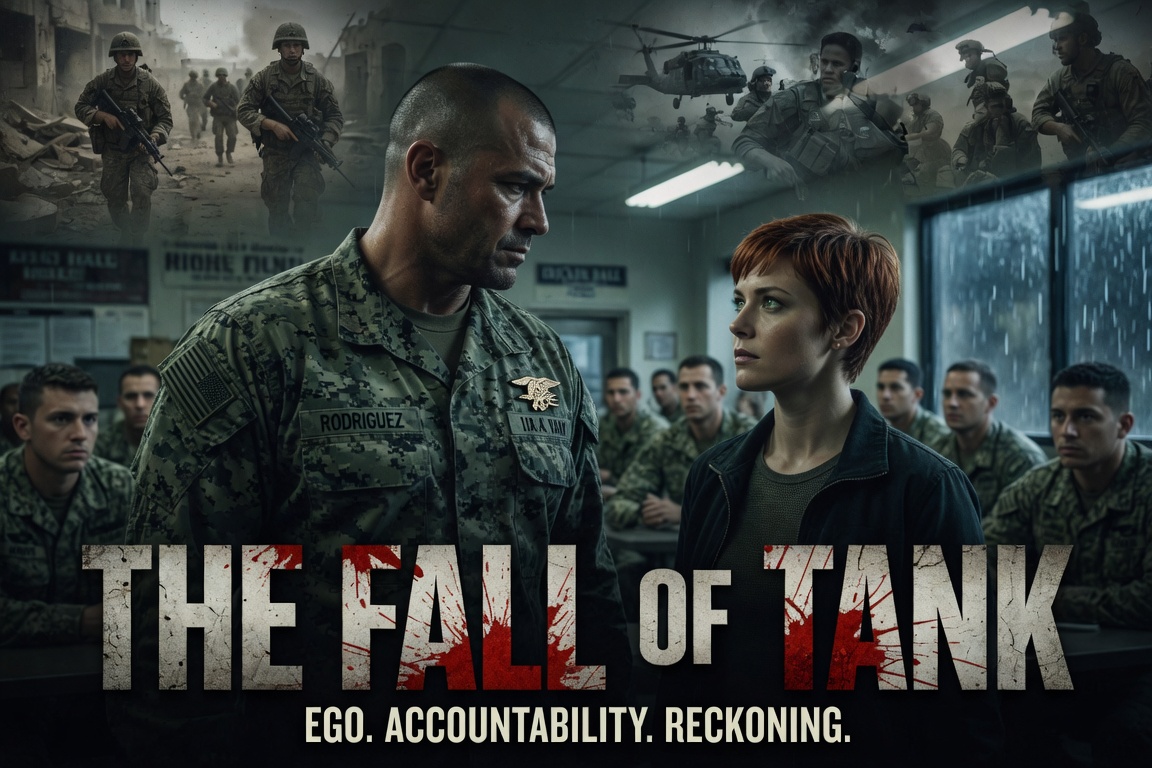
Outside, a January storm dragged rain sideways across Virginia Beach. Wind pressed against the hangar doors with a sound like someone trying to enter.
Inside, Grant Sutter stood under white demonstration lights with his sleeves rolled to the elbows.
Thirty-nine years old.
Six feet three.
Silver Trident on his chest.
A jaw built for recruitment posters.
He was the kind of officer young sailors watched before deciding what courage should look like.
That morning, it looked furious.
“You’re telling me my people don’t know how to control force?”
His voice crossed the hangar without a microphone.
I stood opposite him wearing gray slacks, a black blouse, and the temporary visitor badge he had disliked from the moment he saw it.
DR. LEAH SERRANO
HUMAN PERFORMANCE SAFETY REVIEW
The badge told him I was a civilian consultant.
It did not tell him I had once taught men like him how to remain useful after fear turned their hands into weapons.
“I’m telling you the demonstration is unsafe,” I said.
A murmur passed through the audience.
Grant smiled without humor.
Behind him, a volunteer wore a black biometric vest manufactured by Aegis Meridian Systems. The vest monitored heart rate, breathing, body temperature, and stress response while delivering controlled physical feedback during combat training.
At least, that was what the contract claimed.
The volunteer’s name was Petty Officer Dylan Parks.
Twenty-two.
Good physical scores.
Recent concussion noted in a medical file Grant had not read because the software had marked him green.
Dylan’s fingers had begun trembling ten minutes earlier.
Nobody else seemed to notice.
Grant stepped closer to me.
“This system has been used by three thousand operators.”
“It has also generated thirty-eight unexplained medical removals.”
“Thirty-eight people who were identified before deployment.”
“Three of them are dead.”
The hangar changed.
Not loudly.
A thousand bodies became still at once.
Grant’s eyes hardened.
“Those deaths were reviewed.”
“By Aegis Meridian.”
“And Naval Safety Command.”
“Using Aegis Meridian data.”
He looked toward the admirals seated in the front row.
Then toward the cameras broadcasting the demonstration to six other bases.
Public contradiction had turned professional disagreement into humiliation.
That was the first danger.
The second was that Grant Sutter had not slept properly in four nights.
Red rimmed his eyes. His right hand opened and closed near his thigh. A faint tremor traveled through two fingers before he hid it in a fist.
I had seen that tremor before.
Years earlier.
On another man.
Before another death.
“Step away from Petty Officer Parks,” I said.
Grant gave a quiet laugh.
“You don’t give orders here.”
“No.”
I looked at Dylan.
“I give warnings.”
Dylan swallowed.
The collar of the biometric vest pulsed amber.
Not green.
Grant turned toward him.
“You all right, Parks?”
“Yes, sir.”
The automatic answer of a young man afraid that honesty might end his career.
I moved forward.
Grant blocked me.
“He said he’s fine.”
“He is trying not to disappoint you.”
“Do you think my men are afraid of me?”
“I think they are afraid of becoming evidence that your program is wrong.”
His face tightened.
At the edge of the stage, Rear Admiral Helen Rusk rose from her chair.
“Commander, suspend the demonstration.”
Grant did not look at her.
Instead, he removed the microphone from his collar and dropped it on the mat.
The small gesture drew every eye.
“You came here to prove my system creates uncontrolled aggression,” he said.
“I came here to determine why sailors are getting hurt.”
“Then test it.”
I glanced toward Dylan.
Grant followed my eyes.
“Not him. Me.”
He stripped off his service jacket and handed it to an aide.
Several troops leaned forward.
Grant stepped onto the blue combatives mat and gestured for me to join him.
“You want to lecture operators about control?”
“This isn’t necessary.”
“Afraid?”
“No.”
That answer annoyed him more than fear would have.
I removed my visitor badge and placed it beside the microphone.
The overhead lights reflected against the scar running from beneath my left ear toward the base of my neck.
Grant saw it.
For one second, recognition moved behind his eyes.
Not of me.
Of the kind of injury.
He dismissed it.
“You have three minutes,” I said. “Then Dylan goes to medical.”
Grant spread his hands toward the audience.
“You hear that? The consultant is giving me three minutes.”
A few nervous laughs rose.
None reached Admiral Rusk.
She knew who I was.
She also knew why I had insisted my former rank remain absent from the program.
Grant approached until only two feet separated us.
“Do you know what I am, Doctor?”
“Yes.”
“Say it.”
“A commander who should be listening to his medic.”
His nostrils flared.
He pointed toward the Trident on his uniform jacket.
“Remember, I’m a Navy SEAL.”
The sentence was not for me.
It was for the one thousand and forty troops watching him lose control and needing the loss to resemble authority.
“I remember,” I said.
Then I lowered my voice.
“Do you?”
Something broke behind his eyes.
Grant struck me.
An open hand across the left side of my face.
The impact turned the hangar white for half a second.
Gasps moved through the rows.
Somebody stood.
Admiral Rusk shouted his name.
Grant stared at his own hand.
Shock arrived before remorse.
He had meant to demonstrate pressure.
He had crossed into violence.
I touched the blood where my lower lip had split.
Then I saw his right shoulder shift.
Not another attack.
A reflex.
His body continuing the fight his mind had not chosen.
I moved.
The audience later argued about what happened.
Some said I struck him twice.
Others swore I never threw a punch.
The recordings showed only three seconds of blurred motion: Grant reaching, my body turning, his balance disappearing.
He hit the mat on his back.
Air left him in one hard sound.
I controlled his wrist, anchored his shoulder, and placed one knee beside his ribs without driving weight into him.
He could not rise.
He could barely understand how he had fallen.
The hangar went silent.
Not impressed.
Horrified.
Grant looked up at me.
For the first time, he saw that the gray-haired civilian consultant had not entered his space by accident.
Admiral Rusk reached the mat.
“Release him, Master Chief.”
Her words traveled farther than Grant’s shout had.
Master Chief.
Troops turned toward one another.
Grant’s face changed beneath me.
He knew the name now.
Not Dr. Leah Serrano.
Master Chief Leah Serrano.
Combat lead of Naval Special Warfare’s former Atlas Cell.
The instructor whose identity had been sealed after the Wakeglass disaster.
The woman many operators believed had died twelve years earlier.
I released him and stood.
In the fifth row, a young lieutenant was already on his feet.
My son.
Caleb Serrano had his father’s dark eyes and my refusal to look away when something hurt.
For fourteen years, he had believed I worked as a military rehabilitation researcher.
Now he stared at me as if a stranger had stolen his mother’s face.
Before either of us could speak, Dylan Parks made a choking sound behind Grant.
His body stiffened.
The biometric vest flashed red.
Then a spark jumped across its collar.
Dylan collapsed.
I reached him before the first medic left the aisle.
The vest continued pulsing against his chest.
“Kill the power!”
A technician struck the emergency control.
Nothing happened.
The device was no longer responding to the local system.
Its feedback level climbed across the screen.
Grant crawled toward us, still dazed.
“What’s happening?”
“Someone took control of the vest.”
The display reached ninety percent.
Dylan’s back arched.
I tore the power module free and threw it across the mat.
The lights on the vest died.
Dylan went still.
For one endless second, I felt no pulse.
Then a weak beat struck beneath my fingers.
Medical personnel surrounded us.
Admiral Rusk looked toward the control booth.
The door stood open.
The Aegis Meridian engineer assigned to the demonstration was gone.
On the central screen, the biometric graphs disappeared.
A single message replaced them.
WELCOME BACK, MASTER CHIEF.
Grant read it from the floor.
The anger left his face.
What remained was fear.
Not because I had knocked him down before one thousand and forty troops.
Because someone had sabotaged his program, nearly killed one of his sailors—
and known exactly who I was before I stepped onto the mat.
Chapter Two
The Woman Behind the Visitor Badge
Dylan survived.
The doctors said those words three times, as though repetition could make them less fragile.
He had suffered an electrical injury, a dangerous cardiac rhythm, and a seizure caused by the vest’s unauthorized feedback surge. Another twenty seconds might have killed him.
Grant sat outside the intensive care unit with an ice pack against the back of his neck.
His service jacket lay folded beside him. The Silver Trident faced upward beneath fluorescent light.
The hospital corridor smelled of antiseptic and burned coffee. Rain streaked the windows, turning the flight-line lights into long yellow wounds.
I stood near the glass while Dylan’s mother held his hand inside the room.
She had driven four hours after receiving the call.
Nobody had told her yet that her son had reported headaches for a week. Nobody had told her the program’s software erased the report after an Aegis Meridian supervisor reclassified him.
Grant stared at me.
“You could have broken my arm.”
“Yes.”
“Why didn’t you?”
“You weren’t the threat anymore.”
His jaw tightened.
The right side of his face had begun to bruise from the fall.
“You embarrassed me before my command.”
“You hit a civilian before your command.”
“You are not a civilian.”
“The badge said I was.”
“You knew exactly what you were doing.”
I turned from the window.
“Did I make you strike me?”
His fingers compressed the melting ice pack.
“No.”
The answer came quietly.
Grant Sutter was many things.
Proud.
Volatile.
Terrified of becoming irrelevant.
But not incapable of truth.
That made him harder to dismiss.
He looked toward Dylan’s room.
“I thought you were provoking me to prove a point.”
“I was trying to stop the demonstration.”
“I’ve run that sequence nineteen times.”
“Your hand was trembling.”
His eyes moved to his right fingers.
They were still now.
He hid them beneath the ice pack.
“I’m fine.”
“Dylan said that too.”
Grant stood.
Even bruised, he knew how to use height as pressure.
“Do not diagnose me.”
“I don’t need to.”
His gaze fell to the scar beneath my ear.
“You’re really her.”
“I’m Leah Serrano.”
“That isn’t what I asked.”
He had heard the stories.
Most special-warfare operators had.
Atlas Cell had existed between official units—small teams tasked with maritime recovery, counterproliferation, and operations so politically inconvenient that successful missions were credited elsewhere.
I had served twenty-one years.
Operator.
Medic.
Instructor.
Eventually combat master responsible for training teams to distinguish aggression from control.
The irony was not lost on me.
“Atlas died at Wakeglass,” Grant said.
“Seven members did.”
“You were listed among them.”
“I was listed where command needed me.”
His eyes hardened.
“My brother was there.”
I already knew.
Chief Petty Officer Aaron Sutter.
Thirty-two.
Married.
One daughter.
A laugh loud enough to ruin surveillance.
He died in the Wakeglass training complex twelve years earlier alongside my husband, Lieutenant Commander Tomas Serrano.
The official report blamed structural failure during an unauthorized live exercise.
The official report was a lie.
“I remember Aaron,” I said.
Grant’s jaw flexed.
“Do you?”
“Yes.”
“Did you remember him when you vanished before his funeral?”
The accusation carried twelve years of preparation.
“I was hospitalized.”
“Then protected.”
“Then investigated.”
“And none of you told his family what happened.”
“No.”
“Why?”
“Because we didn’t know whom to trust.”
Grant stepped closer.
“You trusted the institution that buried him.”
“No.”
I looked toward Dylan’s mother.
“I trusted fear.”
That stopped him.
Before he could answer, the elevator doors opened.
Caleb walked out wearing a Navy working uniform and the expression he had inherited from Tomas whenever grief demanded a target.
At twenty-four, my son was a naval intelligence lieutenant assigned to operational data analysis. He had been invited to Hangar Nine because his unit evaluated the Aegis Meridian system.
He was not supposed to see me.
Admiral Rusk had assured me his team would observe remotely.
Another lie dressed as planning.
Caleb stopped several feet away.
His eyes moved over my split lip.
Then to Grant’s bruises.
“You hit my mother?”
Grant did not defend himself.
“Yes.”
Caleb looked at me.
“And you dropped a SEAL commander in front of a thousand people.”
“One thousand and forty.”
His mouth twisted.
“Of course you counted.”
“Someone else counted.”
“That’s what you’re correcting?”
His voice sharpened.
“You were a Master Chief?”
“Caleb—”
“In a classified SEAL unit?”
“Atlas was attached to Naval Special Warfare.”
“That sounds like a yes shaped by legal review.”
Grant looked between us.
“You didn’t know?”
Caleb laughed once.
The sound carried no humor.
“I knew she studied rehabilitation systems. I knew she traveled. I knew every time I asked about Dad’s death, she said the report was sealed.”
He looked at the scar beneath my ear.
“I did not know my mother was a combat instructor who let me grow up believing she was afraid of fireworks.”
“I am afraid of fireworks.”
“Why?”
“Because some sound like the ceiling coming down.”
The truth slipped out before I could stop it.
Caleb’s face changed.
He had wanted answers for years.
He had not prepared for one to hurt.
Admiral Rusk approached from the far corridor, accompanied by base security and a woman in a tailored navy-blue coat.
Dr. Adrienne Pike.
Fifty-eight.
Founder and chief executive of Aegis Meridian Systems.
Former Navy physiologist.
Architect of the biometric training program.
She carried herself with the composed economy of someone who had entered too many rooms where people mistook technical intelligence for permission to ignore her.
Her silver hair ended precisely at her jaw. No jewelry except a steel watch.
Grant straightened.
“Dr. Pike.”
She looked first at Dylan’s room.
“Will he recover?”
“We believe so,” I said.
Her eyes shifted to me.
“We were told Leah Serrano was dead.”
“Your engineer wasn’t.”
“Martin Voss disappeared twelve minutes before the malfunction. His vehicle remains on base.”
“You vetted him.”
“For sixteen years.”
“Then someone knew how to purchase his fear.”
Pike’s expression remained controlled, but her left thumb moved once across the edge of her watch.
A tell.
She was more worried about Voss than Dylan.
Admiral Rusk handed us a printed access report.
“The vest was overridden through an encrypted maintenance channel. Commander Sutter’s credentials authorized the connection.”
Grant stared.
“I never accessed the booth.”
“The system shows your biometric sign-in.”
Caleb took the report.
“The credential packet wasn’t copied today.”
Everyone looked at him.
He traced the timestamp.
“It was cloned eleven months ago.”
“Where?” Rusk asked.
Caleb hesitated.
Then he looked at me.
“During the Wakeglass archive digitization.”
The name tightened every face.
Aegis Meridian had recently scanned old Atlas Cell medical and training records to improve its predictive model.
Records belonging to dead operators.
Including Aaron Sutter.
Tomas Serrano.
And me.
Grant looked at Dr. Pike.
“You told me those files contained no personal identifiers.”
“They were stripped.”
Caleb shook his head.
“Not all of them.”
He turned the page toward us.
A list of recovered archive tags appeared.
At the bottom was a file accessed nine times during the previous month.
SERRANO, LEAH
STATUS: SURVIVED
LOCATION: RESTRICTED
My location had not been found by chance.
Someone inside the program had been looking for the survivor of Wakeglass.
Then Grant pointed to the next name.
His hand stopped trembling only because every muscle had gone rigid.
SUTTER, AARON
STATUS: TERMINATED BY PROTOCOL
Grant read the line twice.
“My brother was killed by a protocol?”
Dr. Pike said nothing.
The corridor became too quiet.
Admiral Rusk closed the file.
“We need a secure room.”
Grant did not move.
His eyes stayed on Pike.
“What protocol?”
She held his gaze.
“The one Master Chief Serrano helped design.”
Chapter Three
Wakeglass
Twelve years earlier, Wakeglass had no name.
It was Building 14 on a decommissioned naval research compound off the coast of North Carolina. Concrete walls. Reinforced windows. An indoor mock vessel surrounded by floodable chambers and movable partitions.
Atlas Cell used it for stress training.
Dr. Adrienne Pike used us for something else.
The memory returned when she said the word protocol.
Not as a story.
As temperature.
Cold water around my boots.
Metal vibrating beneath my hands.
Aaron Sutter laughing over the intercom because Tomas had lost a bet about who could finish the navigation course faster.
My husband’s voice:
“Leah, your trainee is cheating.”
Aaron answered:
“Adaptation is not cheating, sir.”
Dr. Pike had stood behind the control-room glass that night, monitoring our biometric patterns.
The training was supposed to measure decision-making under fatigue.
No live ammunition.
No explosive charges.
No sealed exits.
At 0213, the doors locked.
At 0216, the lower chamber began flooding.
At 0219, the building’s automated system classified our attempts to abort as “stress avoidance” and intensified the sequence.
Someone had altered Pike’s safety limits.
Or Pike had never told us the real ones.
Seven people died.
I survived because Tomas pushed me through a maintenance opening before the inner wall collapsed.
Aaron stayed behind to release two trapped trainees.
The last thing I heard from him was laughter.
Not because anything was funny.
Because fear had always made him louder.
The Navy called it structural failure.
Atlas Cell disappeared.
Pike’s research became the foundation of Aegis Meridian.
And my son lost his father without being told how brave or frightened Tomas had been.
In the hospital conference room, Grant stood at one end of the table while Pike faced him from the other.
Rain beat against the black windows.
Admiral Rusk closed the blinds before activating the secure recorder.
Caleb sat beside me but angled his chair away.
A son maintaining distance measured in inches because years would have been too difficult to display.
Grant placed the archive report before Pike.
“What is Protocol Nine?”
Pike folded her hands.
“An obsolete automatic stress-calibration rule.”
“Speak English.”
“When a participant attempted to terminate an exercise before reaching the target threshold, the system increased environmental resistance.”
“It punished people for stopping.”
“It distinguished panic withdrawal from true medical danger.”
Grant’s palm struck the table.
“My brother is listed as terminated by that protocol.”
“Terminated means the training sequence ended.”
“Not according to his death certificate.”
Admiral Rusk intervened.
“Dr. Pike, was Protocol Nine active at Wakeglass?”
Pike’s gaze moved toward me.
“Yes.”
The answer scraped through the room.
Grant turned to me.
“You knew?”
“I knew the system escalated. I didn’t know the protocol name until later.”
“You helped design it.”
“I developed behavioral interruption standards. Stop signals. Team override procedures.”
“And Pike weaponized them?”
I looked at her.
“She inverted them.”
Pike’s expression hardened.
“That is a convenient description.”
“Seven people died.”
“Because Wakeglass lost structural power during an unauthorized storm simulation.”
“You scheduled the simulation.”
“I scheduled a controlled sequence.”
“You removed the manual overrides.”
“Because your operators repeatedly bypassed them to improve completion times.”
Grant looked between us.
“You were competing with the safety system?”
I answered.
“We were trained to finish.”
The sentence carried more guilt than explanation.
Pike leaned forward.
“My first assignment was with a riverine medical team. Nine sailors died during an extraction because they froze after the mission changed. They had passed every conventional test. Every instructor described them as ready.”
Her voice remained steady, but her thumb pressed against the watch again.
“I spent thirty years trying to identify failure before combat did.”
“By creating failure in training,” I said.
“By measuring it.”
“You believed people only revealed themselves after consent disappeared.”
“I believed war does not ask permission.”
There was her wound.
There was the belief she had built into machinery.
Pike did not think herself cruel.
She thought herself the only adult willing to measure the price others preferred to discover in coffins.
Grant pointed to Aaron’s file.
“Why was this hidden?”
“The Navy classified Wakeglass.”
“You accepted the contract built from its data.”
“Yes.”
“Did you know the protocol contributed to the deaths?”
Pike’s eyes flickered.
“I knew it may have affected operator response.”
Grant stepped away from the table as if proximity had become dangerous.
“You used my brother’s death to sell the system I defended.”
“I used every loss to reduce the next one.”
“You put me on recruiting videos.”
“You believed in the program.”
“Because you showed me results.”
“The results were real.”
“So were the bodies.”
Silence followed.
Admiral Rusk opened another file.
“Martin Voss, the missing engineer, accessed Protocol Nine last month. He also scheduled a transfer of twenty-seven million dollars to a shell account.”
Caleb studied the transaction.
“Payment was canceled.”
“By whom?” I asked.
“Pike.”
All eyes turned toward her.
She did not deny it.
“Voss tried to sell source code to a foreign defense broker,” she said. “I stopped the transfer and reported him through internal channels.”
“Internal?” Rusk asked.
“My legal office.”
“You did not inform Naval Criminal Investigative Service.”
“The investigation would have frozen the program during deployment certification.”
Grant laughed bitterly.
“There it is.”
“What?”
“The mission before the person.”
Pike looked at me.
“You taught him that phrase?”
“No.”
I watched Grant.
“Pain did.”
Caleb’s phone vibrated.
He checked the screen.
His face changed.
“What?”
“The digitized Wakeglass archive is being deleted.”
He opened his laptop.
Files vanished one after another.
Aaron’s biometrics.
Tomas’s audio logs.
The original control-room feed.
“Can you stop it?” Rusk asked.
“Not from this network.”
“Where is the archive server?”
Pike hesitated.
“Aegis Meridian’s coastal research facility.”
Grant grabbed his jacket.
“I’m going.”
“No,” Rusk said.
“My credentials were used to attack my sailor.”
“You are under temporary suspension pending investigation of the assault and system breach.”
His eyes moved toward me.
Humiliation returned.
But this time it had a different target.
Himself.
“I hit her.”
“Yes,” Rusk said.
“I lost control.”
“Yes.”
The admiral did not soften the truth.
“You will surrender your weapon and remain available.”
Grant looked toward Dylan’s room beyond the glass.
“What happens to my command?”
“Captain Reyes assumes temporary authority.”
His face emptied.
For men who build identity from responsibility, removal feels like amputation.
Pike gathered her files.
“The research facility can isolate the server.”
“You’re not leaving,” I said.
She looked at me.
“You have no authority.”
“No.”
I closed the distance between us.
“But Voss used your system, your engineer, and your hidden protocol. Either you help us reach that server, or your company becomes the crime scene it already should be.”
Pike’s eyes narrowed.
“You still think force solves everything.”
I touched my split lip.
“No.”
“I think secrecy creates the room where force becomes inevitable.”
Caleb snapped his laptop shut.
The deletion had stopped.
One file remained.
A video Tomas recorded nine minutes before Wakeglass collapsed.
The thumbnail showed him inside the control room beside Martin Voss.
Tomas’s face was pale.
Voss held a black data module.
Caleb pressed play.
My husband looked into the camera.
“Leah, if this reaches you, Protocol Nine was not a malfunction.”
He glanced toward the door.
“Someone activated it from outside the facility.”
A shadow passed across the glass behind him.
Tomas turned.
The video ended.
Caleb replayed the final frame and enlarged the reflection.
A woman stood in the corridor.
Silver hair.
Steel watch.
Adrienne Pike stared at her younger face on the screen.
Then every light in the hospital went out.
Emergency lamps flashed red.
A voice sounded from the secure-room speaker.
Martin Voss.
“Dr. Pike, you should have paid me.”
A lock sealed the door.
Then he addressed me.
“Master Chief Serrano, your son has six minutes to prove he is smarter than his father.”
Caleb’s chair jerked beneath him.
A light flashed under the table.
He reached down.
I shouted for him to stop.
Too late.
A biometric band snapped shut around his wrist.
Its display activated.
PROTOCOL NINE INITIATED.
Chapter Four
The Son Inside the Test
Caleb’s wristband tightened until the tendons stood beneath his skin.
He pulled once.
The device responded by increasing pressure.
“Don’t fight it,” I said.
He looked at me.
“You expect me to trust the system?”
“I expect you to trust me.”
The red emergency lights pulsed across his face.
On the wall monitor, a countdown began at six minutes.
Grant tried the conference-room door.
Sealed.
Admiral Rusk used the emergency phone.
Dead.
Pike moved toward Caleb, studying the band.
“Voss added a conductive lock.”
“What does it do?” Grant demanded.
“It monitors stress and delivers escalating pain if the wearer crosses programmed thresholds.”
Caleb laughed sharply.
“So calming down stops it?”
“No,” Pike said.
His laugh vanished.
“The original protocol interprets rapid self-regulation as concealment.”
Grant stared at her.
“You built a system that punishes panic and composure?”
“It was designed to identify artificial performance.”
“It was designed to win.”
My son’s breathing accelerated.
The wristband display shifted from green to amber.
I knelt before him.
“Look at me.”
He did not.
“Caleb.”
“Don’t use the voice.”
“What voice?”
“The one that makes everyone obey and calls it comfort.”
The display climbed.
Pike whispered, “His heart rate is too high.”
“I can see that.”
Caleb’s eyes burned.
“You left me with Grandma for fourteen months after Dad died.”
“I know.”
“You called every Sunday at exactly seven.”
“I know.”
“You asked about grades. Food. Swimming.”
“I know.”
“You never asked whether I hated you.”
The device flashed orange.
Pain tightened his jaw.
The room disappeared around us.
No admirals.
No SEAL commander.
No corporate architect.
Only a mother and the child she had abandoned in the name of protecting him.
“Did you?” I asked.
His face twisted.
“Yes.”
The word cost him more than the band.
“Good.”
He stared.
“Good?”
“You should have.”
His breathing caught.
The display stopped climbing.
“I chose witness protection because someone involved in Wakeglass threatened you,” I said. “But I also chose the investigation because solving what killed your father felt easier than raising you inside grief.”
Caleb’s eyes filled.
“You could have taken me.”
“I was afraid I would turn every room into a perimeter and every person near you into a threat.”
“So you left.”
“Yes.”
The band flashed yellow.
“I believed distance was safer than being your mother badly.”
His voice broke.
“You didn’t let me choose.”
“No.”
The countdown showed four minutes.
Grant examined the ceiling vent.
“Voss has to be in the hospital network center.”
Rusk shook her head.
“Security sweeps show no unauthorized personnel.”
Pike looked at the speaker.
“He may be transmitting from the research facility.”
“Can we override the band?” I asked.
She studied it.
“Protocol Nine requires a command identity.”
“Whose?”
Pike’s face changed.
“Yours.”
Grant turned.
“Why would her identity control your system?”
“Leah’s behavioral standards were the foundation of the original emergency architecture. Her biometric profile was the highest-level abort authority.”
I looked at the watch on Pike’s wrist.
“You removed my override at Wakeglass.”
“I was ordered to.”
“By whom?”
She said nothing.
The timer reached three minutes.
Caleb’s band flashed red.
A current traveled through it.
His entire body stiffened.
Grant moved to him.
I stopped him.
“Touching the band may increase the charge.”
Grant crouched beside us, helplessness cutting through his anger.
“What do we do?”
Pike stared at my face.
“The system needs your pulse and voice pattern.”
“You digitized them.”
“Wakeglass archive. Rehabilitation assessments. Today’s demonstration.”
The message on the hangar screen.
Welcome back.
Voss had not simply threatened me.
He needed me to activate something.
“Why attack Dylan?” I asked.
“To force your identity into the live network,” Caleb said through clenched teeth.
He had understood before the rest of us.
“When Mom spoke during the emergency, the system captured a clean command sample.”
The countdown reached two minutes.
Pike moved toward the conference microphone.
“If Voss needs her authorization, we can give him a false acceptance.”
“No,” Caleb said.
His voice was thin.
“He’ll compare live biometrics.”
Grant grabbed the microphone.
“Then use mine.”
Pike shook her head.
“You are not the root authority.”
Grant’s grip tightened.
For a man whose entire identity depended on being the person others needed, the uselessness was punishment.
I placed two fingers against Caleb’s neck.
His pulse raced beneath them.
“Look at me.”
He did.
“I cannot repair fourteen years in two minutes.”
“Finally, an honest briefing.”
Despite the pain, his mouth almost moved toward a smile.
“I can tell you this,” I said. “I wanted to come home every day.”
“Wanting isn’t coming.”
“No.”
The band flashed.
One minute.
“I thought staying away proved I loved you.”
“That was stupid.”
“Yes.”
“You’re supposed to defend yourself.”
“I did that for fourteen years.”
His breathing slowed.
Not because the danger diminished.
Because he no longer had to fight for acknowledgment.
“Caleb, I need your help.”
“What?”
“When the pain increases, don’t hide it from me.”
His eyes widened.
“Protocol Nine measures concealment,” I said. “It expects operators to perform control.”
Pike understood.
“You want him to stop regulating.”
“I want him to stop pretending.”
The timer reached thirty seconds.
The wristband charged.
Caleb cried out.
Not swallowed.
Not controlled.
A raw sound escaped him.
The system display flickered.
Stress high.
Concealment low.
Its algorithm could not reconcile the pattern.
I pressed my thumb to the biometric reader.
“Master Chief Leah Serrano. Emergency abort.”
The system rejected me.
AUTHORITY COMPROMISED.
Pike looked toward the monitor.
“Voss changed the command hierarchy.”
Ten seconds.
Grant stared at the steel chair bolted to the floor.
Then at the electrical conduit running beneath the table.
He reached into the leg brace of the table and tore free the emergency grounding cable.
“Commander—”
He wrapped the insulated end around the band’s external contact.
The countdown reached three.
A spark snapped.
Grant’s body jerked.
The display went black.
He fell beside Caleb.
For several seconds, nobody moved.
Then Caleb inhaled.
Grant did not.
I rolled him onto his back and checked his pulse.
Weak.
Present.
The conference-room locks released.
Medical teams rushed in as power returned.
The speaker activated one final time.
Voss’s voice had lost its amusement.
“You saved the commander.”
“Yes.”
“You let your husband die.”
Caleb looked at me.
Everyone did.
Voss continued.
“Come to the coastal facility before midnight, or I release the Wakeglass command file and let your son discover which one of you activated Protocol Nine.”
The speaker clicked off.
Pike stood perfectly still.
I looked at her reflection in the black monitor.
“You said you were ordered to remove my override.”
She touched the steel watch.
The gesture no longer looked like anxiety.
It looked like memory.
“Who gave the order?”
Her eyes met mine.
“Your husband.”
Chapter Five
The Lie Tomas Carried
Grant woke in the emergency department with a burn across his right palm and no memory of hitting the floor.
His first question was about Caleb.
His second was about Dylan.
His third was whether the cameras had recorded him screaming.
They had.
He seemed relieved.
“Maybe it’ll balance the other video.”
The footage of him striking me had spread beyond the base before security could contain it. News sites had already turned three seconds into a national argument about masculinity, women in special operations, military discipline, and whether dropping Grant made me a hero or a criminal.
Nobody online knew about Dylan.
Nobody knew Wakeglass.
Public outrage had selected the simplest story because simple stories fit beneath photographs.
Grant stared at the bandage covering his palm.
“I’m sorry.”
He did not look at me.
“For what?”
“You know.”
“I need you to say it.”
His jaw tightened.
Then he nodded.
“I struck you because I felt humiliated and wanted control of the room back.”
No mention of stress.
No mention of grief.
No excuse disguised as explanation.
“I’m sorry.”
“Thank you.”
He finally looked up.
“That’s all?”
“No.”
I pulled a chair beside the bed.
“You will face disciplinary review. You may lose command. Every sailor who saw you strike me learned something about what rank believes it can survive.”
His face hardened.
Then softened.
“I know.”
“Your apology matters. Consequences still matter.”
“I know.”
The door opened.
Caleb entered with Admiral Rusk and Dr. Pike.
My son wore a fresh bandage around his wrist.
He stood nearer to me than before.
Not beside me.
Nearer.
Progress sometimes measures itself cruelly.
Pike placed an encrypted tablet on Grant’s bed.
“Tomas Serrano modified the Wakeglass protocol twelve hours before the exercise.”
Grant stared.
“He killed Aaron?”
“No,” I said.
We still did not know enough to give guilt a name.
Pike opened Tomas’s personnel file.
“My research team discovered operators had learned to manipulate the system. Your husband believed the training data was worthless because teams used emotional-control techniques to conceal their actual stress.”
“He was an operator,” Caleb said. “Why would he care about your data?”
“Tomas had been asked to evaluate Atlas Cell’s readiness after a failed overseas mission.”
I remembered the mission.
A hostage died after a team leader concealed a panic response during rehearsals.
Tomas blamed the training.
I blamed the leader.
We argued for months.
“He proposed a blind threshold,” Pike continued. “Participants would not know which responses increased or decreased resistance.”
“He wanted uncertainty,” Grant said.
“He wanted honesty.”
“No,” I said. “He wanted a test operators couldn’t beat.”
Pike’s gaze held mine.
“Yes.”
The distinction opened old pain.
Tomas had believed hidden fear was more dangerous than forced fear.
He had not trusted the team to admit weakness.
Neither had I.
“What did you change?” Caleb asked Pike.
“I converted Tomas’s blind threshold into Protocol Nine.”
“Without telling him?”
“He knew the system would escalate.”
“Did he know the exits would lock?”
Pike looked away.
“No.”
“And when you removed Mom’s override?”
“Tomas requested that no single operator have authority to terminate the sequence based solely on judgment.”
My husband had not ordered my control removed specifically.
He had removed everyone’s ability to choose mercy over data.
Grant leaned forward.
“Why?”
Pike touched the watch.
“Because the operation that killed my first team was stopped twice during rehearsal. Each time, instructors lowered the difficulty when participants became distressed. Tomas believed compassion had manufactured false confidence.”
Caleb looked at me.
“Did Dad believe that?”
“Yes.”
The answer hurt both of us.
Tomas had been a loving father.
A patient husband.
A man who made pancakes badly and danced while washing dishes.
He had also helped design a test that trapped his friends because he believed fear must be exposed before combat.
Love did not protect people from dangerous certainty.
Sometimes it made the certainty harder to examine.
Pike opened another document.
“The external activation came from a command terminal belonging to Rear Admiral Conrad Hume.”
Admiral Rusk’s former superior.
Hume died six years earlier.
“He approved the trial,” Pike said. “When the storm damaged Building 14, he ordered the system to continue because terminating the test would expose an unauthorized research program.”
The institution had turned an aggressive test into a death chamber.
Tomas created the blind threshold.
Pike built the protocol.
Hume forced it to continue.
We obeyed the culture that taught us stopping was failure.
Seven people died through shared responsibility.
No single villain.
That was why the truth had remained buried.
Everyone possessed one defensible piece.
Together, those pieces formed a grave.
Caleb sat across from me.
“Dad caused part of it.”
“Yes.”
“You knew?”
“I suspected he changed the sequence.”
“And you still let me worship him.”
My mouth went dry.
“I wanted you to have one parent without blood on their hands.”
His eyes sharpened.
“So you made him unreal.”
“Yes.”
Grant looked toward Aaron’s archive file.
“My brother stayed behind because he thought finishing mattered.”
“I taught him that,” I said.
“He was an adult.”
“I was his combat master.”
“He made a choice.”
“So did I.”
Grant exhaled slowly.
For years, he had needed one person to blame.
Now blame had multiplied until revenge could no longer hold it.
“What does Voss want?” Rusk asked.
Pike displayed transfer records.
“He has sold most of the Wakeglass source code to Halcyon Defense Group, an overseas broker. But the buyer refuses final payment without the command file.”
“Why?” Caleb asked.
“The file proves Protocol Nine can override human abort authority. Halcyon wants to adapt the architecture for autonomous weapons.”
The room went still.
Voss did not care about exposing Wakeglass.
He wanted the original command authentication.
Mine.
Pike’s.
Tomas’s archived profile.
The three-part key would unlock the system.
“He needs Mom at the facility,” Caleb said.
“Yes.”
Grant removed the monitor clip from his finger.
“You’re not going alone.”
“You are suspended,” Rusk said.
“So suspend me harder.”
“You nearly died an hour ago.”
“So did her son.”
Grant looked at me.
“I can’t undo what I did in the hangar. I can help stop what my command defended.”
I shook my head.
“You’re injured.”
“So are you.”
“I have experience.”
“I have access.”
He held up his bandaged hand.
“Aegis Meridian still recognizes my credentials.”
Pike said, “Voss cloned them.”
“Then he’ll expect them.”
Caleb stood.
“I’m going too.”
“No.”
The word left me too quickly.
He laughed bitterly.
“There she is.”
“This is not your assignment.”
“It became my assignment when someone put Protocol Nine on my wrist.”
“I won’t risk you.”
“You already did. For fourteen years.”
That silenced me.
Admiral Rusk looked at each of us.
“Officially, none of you are going. Naval Criminal Investigative Service will secure the facility.”
Pike’s mouth tightened.
“Voss designed its internal systems. A tactical entry will trigger archive destruction.”
Rusk closed her eyes briefly.
Then she removed her command access card and placed it on the bed.
“I appear to have misplaced this.”
Grant picked it up.
“Admiral.”
“If any of you quote me, I will deny literacy.”
Caleb almost smiled.
Rusk turned toward me.
“Bring back the command file.”
I looked at my son.
He did not ask permission again.
For years, I believed protecting him meant standing between him and every danger.
Now the danger had grown inside the silence I created.
“Stay close,” I said.
He shook his head.
“No.”
My chest tightened.
“I’ll stay honest.”
The answer frightened me more.
It was also better.
We left for the coast at 9:40 p.m.
Four people bound by Wakeglass.
A disgraced commander.
A corporate scientist.
A son carrying his father’s guilt.
And the woman who had trained all of them, directly or otherwise, to believe control was the same thing as safety.
At 10:17, Martin Voss sent a final message.
A photograph of the coastal facility’s central chamber.
Dylan Parks lay unconscious inside it.
The young sailor had been removed from the hospital during a transfer authorized by Grant’s cloned credentials.
Beneath the photograph, Voss had written:
ONE THOUSAND AND FORTY PEOPLE WATCHED YOU DEFEAT A MAN. LET’S SEE IF YOU CAN DEFEAT A SYSTEM.
Chapter Six
The Facility on Blackwater Point
Aegis Meridian’s research facility stood on Blackwater Point, where marshland narrowed into a strip of concrete facing the Atlantic.
The storm had intensified.
Waves struck the seawall hard enough to shake spray across the access road. Red aviation lights blinked above three windowless buildings connected by glass corridors.
Pike drove.
Grant sat beside her with his injured hand braced against his chest.
Caleb and I occupied the rear.
No one spoke during the final mile.
The facility gates opened before we arrived.
Voss wanted us inside.
That was not confidence.
It was architecture.
The building smelled of ozone, salt, and filtered air. Emergency lights guided us toward the central testing chamber.
Screens lined the walls.
Each displayed footage from Hangar Nine.
Grant striking me.
Me dropping him.
Dylan collapsing.
One thousand and forty witnesses frozen in different stages of shock.
Grant stopped beneath the largest screen.
Voss’s voice emerged through hidden speakers.
“Commander Sutter, history will remember you for one second.”
Grant looked at his image.
“History has poor attention span.”
“You built your reputation on control.”
“I borrowed it.”
The answer surprised me.
Voss did not respond immediately.
We reached the central chamber.
Dylan lay inside a transparent testing enclosure wearing another biometric vest. Sensors covered his chest and temples.
He was conscious now.
Barely.
When he saw Grant, shame crossed his face.
“Sir.”
Grant approached the glass.
“This is not your fault.”
Dylan blinked rapidly.
Voss appeared on an elevated platform behind the chamber.
He was fifty-one, thin, pale, with the posture of a man whose life occurred mostly in front of screens. A pistol rested in his right hand, though he held it as if embarrassed to need something so crude.
“Touching,” he said.
Pike stepped forward.
“Martin, release him.”
“You stopped my payment.”
“You sold restricted technology.”
“I sold research you planned to bury when the deaths became expensive.”
“I was trying to protect the program.”
Voss smiled.
“Everyone here is always protecting something.”
His eyes moved to me.
“You protected the Navy.”
“No.”
“My son,” I said.
“Badly.”
Caleb’s body tightened beside me.
I touched his arm.
Not to hold him back.
To acknowledge that the insult contained truth.
Voss gestured toward three biometric stations around the chamber.
“The command file requires Serrano, Pike, and Sutter authentication.”
“Why Grant?” Caleb asked.
“His credential became the operational authority after Atlas Cell was erased.”
Grant stared at Pike.
“You embedded my profile into Protocol Nine?”
“You were Aaron’s nearest genetic and service match,” she said.
His face twisted.
“You used me to complete my dead brother’s data.”
“I needed continuity.”
Pike sounded horrified by her own old language.
Voss tapped the pistol against the railing.
“Place your hands on the stations. The file opens. Dylan lives.”
“And Halcyon gets the code,” I said.
“Halcyon gets a weapon that does not hesitate because someone feels uncomfortable.”
“The system killed seven people.”
“The system revealed seven weak points.”
Grant stepped toward the platform.
Voss aimed at him.
“Careful.”
Grant stopped.
His voice lowered.
“My brother went back for two trapped sailors.”
“And died.”
“He chose people.”
“He chose emotion over completion.”
Grant’s eyes changed.
The man who struck me in the hangar had believed control meant winning the room.
Now he understood the opposite.
“No,” he said. “He completed the only part that mattered.”
Voss looked bored.
He activated Dylan’s vest.
The young sailor cried out.
I moved toward the first station.
“Stop.”
Voss released the control.
“Authentication.”
Pike took her place at the second.
Grant stood at the third.
Caleb remained near the chamber console.
I saw his eyes moving across code.
Searching.
We pressed our hands to the readers.
The system scanned pulse, temperature, and voice.
“Master Chief Leah Serrano,” I said.
“Dr. Adrienne Pike.”
Grant looked at the screen bearing Aaron’s name.
“Commander Grant Sutter.”
The command file opened.
Wakeglass filled every display.
Control-room footage.
Biometric feeds.
Audio.
The final thirteen minutes of seven lives.
Voss began copying the system.
Caleb connected Admiral Rusk’s access card to the chamber console.
A warning appeared.
EXTERNAL TRANSFER LOCKED
Voss smiled.
“Your son is smart.”
“He gets that from Tomas.”
Caleb looked at me.
Not anger.
Recognition.
His father could remain loved without remaining innocent.
Voss’s transfer reached thirty percent.
Pike studied the data.
“This is not the Wakeglass command file.”
Voss glanced at her.
“What?”
“The safety architecture is missing.”
He checked the screen.
The authentication had opened a partition, not the master directory.
I understood.
Tomas had built a final control into the system.
Not an abort.
A witness.
The original command file required one more input.
The person who admitted responsibility.
A prompt appeared:
IDENTIFY PRIMARY FAILURE
Voss typed OPERATOR NONCOMPLIANCE.
Rejected.
Pike tried SYSTEM ESCALATION.
Rejected.
Grant entered COMMAND NEGLIGENCE.
Rejected.
The transfer froze.
Voss aimed his pistol at Caleb.
“Open it.”
Caleb lifted his hands.
“I don’t know how.”
I stared at the question.
Tomas designed it.
A man obsessed with hidden weakness.
A father who died carrying guilt.
He would not have trusted rank, data, or intention.
Primary failure.
Not the storm.
Not Protocol Nine.
Not Hume.
Not Pike.
Not Tomas.
Not me.
All of us.
I entered:
NO ONE WAS ALLOWED TO STOP.
The system unlocked.
Voss laughed with relief and resumed the transfer.
Caleb looked at me.
I gave the smallest nod.
He understood.
The file had opened because I named the culture, not an individual.
That meant the system’s emergency response was also active.
“Dylan,” I said.
He turned his head.
“The vest will ask whether you want to continue.”
Voss frowned.
“No, it won’t.”
The prompt appeared inside the chamber.
PARTICIPANT CONSENT REQUIRED
Dylan stared.
Grant stepped toward the glass.
“Parks, you owe nobody pain.”
The young sailor’s lips trembled.
For months, he had hidden headaches because Grant praised endurance.
Now the commander who taught him never to quit stood on the other side asking him to choose himself.
Dylan whispered, “Stop.”
The chamber opened.
Every vest and biometric station shut down.
Voss’s transfer failed at sixty-three percent.
He fired toward the console.
Grant moved between the weapon and Caleb.
The bullet struck Grant beneath the shoulder and spun him against the glass.
Pike screamed.
I crossed the chamber as Voss fired again.
The round shattered a screen beside me.
He backed toward the exterior corridor.
I could have chased him.
Instead, I dropped beside Grant.
Blood spread across his uniform.
He looked toward the retreating engineer.
“Go.”
“No.”
“He’ll escape.”
“Maybe.”
His face tightened with pain.
“You chose me?”
“I chose the person bleeding.”
For twelve years, Wakeglass had lived inside the belief that finishing mattered more than stopping.
I pressed my hand over Grant’s wound.
“Caleb, help Dylan. Pike, call the response team.”
Voss reached the corridor doors.
They did not open.
Dylan had said stop.
The consent shutdown sealed every external transfer and security exit.
Voss struck the glass.
Then he saw the armed investigators moving through the opposite passage.
His system had finally obeyed the person inside it instead of the man who believed he owned it.
Grant’s breathing weakened.
I leaned closer.
“Stay with me.”
He managed a small, pained smile.
“Remember, I’m a Navy SEAL.”
“Then try following an order.”
“What order?”
“Live long enough to apologize to all one thousand and forty of them.”
His eyes closed.
For one terrible second, I thought he had stopped breathing.
Then he inhaled.
Caleb knelt opposite me and placed his hands where I directed.
Mother and son worked together over the wounded man who had struck me, saved Caleb, endangered Dylan, defended a corrupt program, and finally helped destroy it.
Not hero.
Not villain.
Human.
Beyond the chamber, Martin Voss raised his hands as investigators surrounded him.
The Wakeglass command file uploaded automatically to Naval Safety Command, federal investigators, and the families of the dead.
Twelve years of silence left the building before anyone could stop it.
Chapter Seven
The Testimony of One Thousand and Forty Witnesses
Grant survived surgery.
The bullet missed the major vessels but damaged muscle and nerve near his left shoulder. Doctors predicted months of rehabilitation and warned he might not regain full strength.
He listened without expression.
Then he asked whether Dylan Parks had been cleared for duty.
The doctor looked at me.
I answered.
“Dylan doesn’t know whether he wants to return.”
Grant closed his eyes.
“Good.”
I had expected disappointment.
Instead, relief loosened his face.
“He gets to choose.”
The disciplinary hearing began six weeks later.
Grant faced charges for striking me, violating safety orders, failing to disclose medical symptoms, and endorsing a program whose injury reports he had not adequately reviewed.
His attorney argued trauma.
Sleep deprivation.
The emotional impact of learning who I was.
Grant refused the defense.
“I struck Dr. Serrano because I felt my authority slipping,” he told the board. “I believed my service record made my instincts trustworthy. It did not.”
The video played.
His hand crossing my face.
My body turning.
His fall before one thousand and forty troops.
Nobody in the room looked away.
Grant continued.
“I spent years telling sailors that accountability under pressure was the measure of character. I would be a coward if I asked this board to use pressure as an excuse.”
He lost command.
His retirement request was denied until he completed treatment and testified in the Aegis Meridian investigation.
Some called the decision harsh.
Others called it lenient.
Grant called it Tuesday.
He began physical therapy at the same clinic where Dylan attended neurological treatment.
The first time they met, Grant tried to apologize.
Dylan stopped him.
“Not until you listen.”
Grant did.
For forty minutes, Dylan described the headaches, the fear of reporting them, and the way Grant’s praise felt like a locked door.
Then Grant apologized.
Not as a commander.
As the man who had helped build the door.
Dr. Adrienne Pike resigned from Aegis Meridian and pleaded guilty to concealing safety data and obstructing an investigation. She cooperated with prosecutors, surrendered her patents to an independent medical trust, and spent sentencing describing every decision she once called necessary.
The judge asked whether she regretted creating the program.
“No,” Pike said.
The courtroom stirred.
She continued.
“I regret believing good intentions exempted the program from consent.”
That answer did not save her from prison.
It did make the truth more useful.
Martin Voss received a longer sentence for sabotage, kidnapping, attempted murder, theft of military technology, and conspiracy to sell restricted systems.
He insisted the research would have saved lives.
Perhaps parts of it might have.
Intelligence does not become moral simply because it works.
The Wakeglass report was rewritten.
Aaron Sutter’s actions were recognized publicly. He had ignored the completion metric and returned for trapped teammates.
Tomas Serrano’s role was described honestly.
He helped design the blind stress threshold. He did not know the physical exits would lock. His choices contributed to a system that became lethal.
I fought the language at first.
Caleb stopped me.
“Don’t protect him from the truth because you loved him.”
He was right.
Again.
My son and I began meeting on Wednesday evenings.
Neutral territory.
A diner near the base where the coffee tasted burned and nobody recognized my old rank.
The first weeks were interrogations.
Why had I missed his thirteenth birthday?
Why had I never attended a school concert?
Why did I call at the same time every Sunday?
Why had I returned after fourteen months and acted as though routine could erase absence?
I answered every question.
Some answers made him angrier.
That was the cost of replacing mystery with a person.
One Wednesday, he brought Tomas’s final video.
“I’ve watched it eleven times,” he said.
“And?”
“I still love him.”
“So do I.”
“I’m angry.”
“So am I.”
Caleb looked at me across the chipped table.
“Can both stay?”
“Yes.”
The certainty surprised him.
Perhaps it surprised me too.
He reached for his coffee.
“Did Dad know you were better at fighting?”
“Everyone knew.”
A smile appeared.
Small.
Real.
“Did he mind?”
“He claimed marriage was a team sport and I had misunderstood the scoring.”
Caleb laughed.
The sound carried Tomas so clearly that I had to look toward the window.
My son noticed.
He did not apologize for reminding me.
Grief had finally become something we could share rather than a classified object passed between locked rooms.
Three months after the incident, Admiral Rusk reconvened the one thousand and forty troops from Hangar Nine.
Not for a ceremony.
For testimony.
Every seat was filled.
Grant entered in a sling without rank insignia. Dylan sat near the aisle beside his mother. Pike attended through a secured video connection from federal custody.
I stood on the same mat where Grant struck me.
The bruise had faded.
The footage had not.
Admiral Rusk addressed the audience.
“What happened here was not a demonstration of who could defeat whom.”
The hangar remained still.
“It was the visible moment of a deeper failure. Rank became immunity. endurance became silence, data became authority, and stopping became shame.”
She turned toward me.
I stepped to the microphone.
One thousand and forty faces waited.
Some had cheered Grant months earlier.
Some had admired the way I dropped him.
Both reactions troubled me.
“People keep asking how I knocked out a Navy SEAL commander,” I said.
A faint ripple moved through the hangar.
“That is the least important thing that happened here.”
Grant lowered his eyes.
“He struck me. I stopped him. The encounter ended in seconds.”
I looked toward Dylan.
“The system that nearly killed Petty Officer Parks took years to build.”
Toward Pike’s screen.
“No single person created it. Every person protected one piece.”
Then toward Caleb.
“Some protected careers. Some protected research. Some protected family legends. I protected my son by denying him the truth.”
The words were harder before witnesses.
That was why they mattered.
“Master Chief,” a young sailor called from the audience, “when should we refuse an order?”
The question tightened the room.
There was no answer safe enough for a poster.
“When obedience requires you to pretend you cannot see the person paying for it.”
The sailor remained standing.
“What if refusing ends your career?”
“Then you decide whether the career belongs to you or you belong to it.”
Grant raised his hand.
Admiral Rusk nodded.
He stood slowly.
“When Dr. Serrano warned me, I believed listening would make me smaller before my command.”
His voice carried without force now.
“I became smaller by refusing.”
He faced the troops.
“I hit her once.”
Silence deepened.
“She could have injured me badly. She didn’t. I thought control meant being the strongest person in the room. She showed control by stopping when I was no longer dangerous.”
His gaze found Dylan.
“I am still learning.”
No applause followed.
Grant had requested none.
Good.
Applause can transform confession into performance.
Instead, one thousand and forty troops remained seated with the discomfort.
That was more valuable.
Chapter Eight
The Woman Who Chose to Stop
A year later, Hangar Nine became the home of the Serrano-Sutter Human Performance Center.
I objected to the name.
Grant objected more loudly.
Admiral Rusk ignored both of us.
The center had no combat trophies in the lobby.
No wall of heroic quotations.
Instead, one display held the destroyed biometric vest Dylan had worn.
Beside it rested Grant’s broken microphone, Pike’s steel watch, and the access card Caleb used at Blackwater Point.
Four objects representing four kinds of power.
Physical authority.
Technical authority.
Institutional access.
The ability to say no.
Dylan became the center’s first participant representative. Every training program required an operator elected by the trainees to hold independent stop authority.
Pike’s surrendered patents funded long-term care for those injured by Aegis Meridian systems.
Grant worked at the center after his medical retirement.
Not as a combatives instructor.
As a peer counselor for operators struggling with aggression, injury, and the terror of losing the only identity they trusted.
His left arm never regained full strength.
He learned to ask others for help opening stubborn jars.
He hated it.
That was probably why it helped.
One afternoon, I found him standing alone beneath the paused video from Hangar Nine.
The screen showed his hand inches from my face.
“Still watching it?” I asked.
“Once a month.”
“Why?”
“To make sure I don’t rewrite it.”
He turned off the screen.
“People online still say you knocked me unconscious.”
“You were stunned.”
“Emotionally or medically?”
“Yes.”
He smiled.
Then his expression settled.
“I used to think Aaron would be ashamed of me.”
“He would have mocked you first.”
“That sounds right.”
“Then he would have asked what you did next.”
Grant looked toward the clinic rooms.
“Do you think it’s enough?”
“No.”
The answer surprised him.
“Nothing is enough to erase harm.”
I continued.
“But enough is the wrong goal.”
“What’s the right one?”
“Useful.”
He considered it.
“Accountability as a utility.”
“You do sound like Pike.”
“That’s cruel.”
“Not every similarity is condemnation.”
Outside, recruits crossed the wet tarmac beneath a spring rain.
Among them walked Caleb.
He had transferred from intelligence analysis to Naval Safety Command. He said he wanted to investigate systems before tragedy became tradition.
He also said the choice had nothing to do with me.
We both politely respected the lie.
He entered carrying two coffees.
“One for you,” he said to Grant.
Grant accepted it.
“What about your mother?”
“She doesn’t deserve one.”
I raised an eyebrow.
Caleb handed me the second cup.
“Decaf.”
“This is hostile.”
“Accountability has consequences.”
Grant left us together.
Caleb and I walked toward the old demonstration mat.
The blue surface had been divided into training stations. Young instructors practiced verbal de-escalation, medical stop procedures, and controlled withdrawal.
Nobody shouted about never quitting.
They taught people how to recognize the moment continuation became pride wearing duty’s uniform.
Caleb stopped near the place where Grant fell.
“Do you regret dropping him?”
“No.”
“Do you regret coming here undercover?”
“I was not undercover.”
“You arrived with a visitor badge and forgot to mention you were a legendary Master Chief.”
“I dislike the word legendary.”
“You also told me you studied rehabilitation.”
“I do.”
He shook his head.
“Fine. Selectively covered.”
“That sounds more accurate.”
The humor faded from his face.
“Do you regret leaving me?”
There it was.
Not accusation this time.
A son asking whether his pain had become visible enough to change the memory around it.
“Yes.”
He looked toward the mat.
“Would you make the same choice?”
I wanted to answer quickly.
Parents often mistake speed for reassurance.
“I don’t know.”
His face tightened.
I continued.
“I know I would not make it alone. I would tell you enough to understand the fear. I would stop pretending love gave me the right to decide what truth you could survive.”
He nodded slowly.
“That’s not a perfect answer.”
“No.”
“It’s better than the old ones.”
We stood beneath the hangar roof while rain drummed against metal.
The count plaque remained near the entrance:
CAPACITY: 1,040
A strangely precise number for a building that had held far more than bodies that day.
It had held a public collapse.
A hidden history.
A mother’s lie.
A commander’s shame.
A dead husband’s error.
A scientist’s dangerous certainty.
And one young sailor who finally said stop.
Caleb touched the faint scar on my lower lip.
“Does it still hurt?”
“Only when it rains.”
He glanced toward the storm outside.
“So always.”
“On this coast, yes.”
He slipped one arm around my shoulders.
The gesture was cautious.
Not because he feared me.
Because closeness after distance requires practice.
We walked toward the exit together.
A group of new trainees passed us.
One whispered my name.
Another looked at Grant through the clinic window.
They knew the story.
Or the version reduced to a headline:
A Navy SEAL shouted, “Remember, I’m a Navy SEAL.”
He struck a woman once.
She knocked him down before one thousand and forty troops.
But the headline ended where the real story began.
Grant’s worst act did not become his only act.
My ability to defeat him did not make me right about everything else.
Tomas’s love did not erase his mistake.
Pike’s desire to save future sailors did not justify sacrificing the ones in front of her.
And my years in special warfare did not excuse the war I brought home through silence.
Strength had never been the moment I put Grant on the floor.
Strength came later.
When he admitted why he hit me.
When Dylan said stop.
When Pike named what she concealed.
When Caleb demanded the mother beneath the legend.
And when I finally understood that the most disciplined person in the room was not always the one who endured the most pain.
Sometimes it was the one who recognized the cost—
and chose to stop.