On the morning of April 9, 1945, Major General Hans Oster was ordered to remove his clothes.
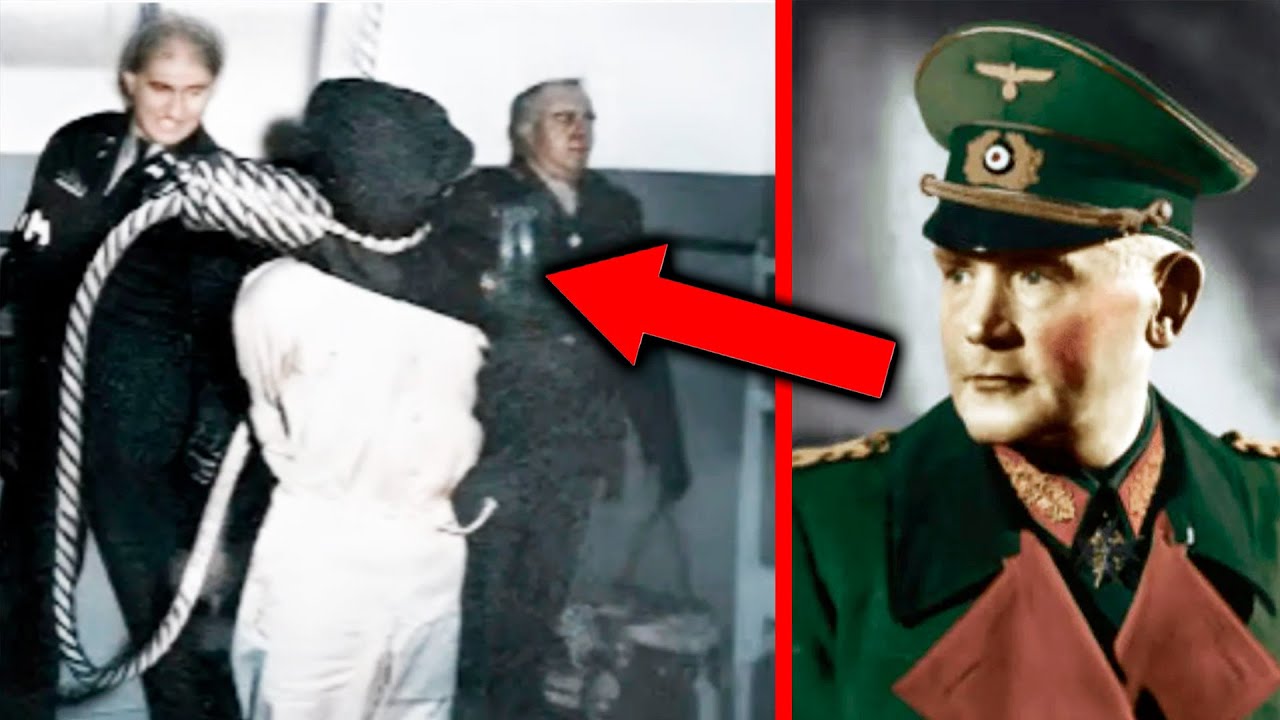
There would be no uniform.
No medals.
No final salute for a man who had served Germany through one world war and most of another.
The guards led him into the execution courtyard of Flossenbürg concentration camp with several other condemned prisoners. Among them were Admiral Wilhelm Canaris, military jurist Karl Sack, resistance fighter Ludwig Gehre, and the theologian Dietrich Bonhoeffer.
Later accounts describe the prisoners being marched naked to the gallows as a final act of humiliation. Some retellings claim thin cord or piano wire was used. The official records of the Flossenbürg Memorial and the United States Holocaust Memorial Museum confirm that Oster and the others were hanged, but do not specify the material placed around their necks.
The distinction matters to historians.
But it would not have mattered to Hans Oster.
By then, he already understood what the Nazis were trying to do.
They did not merely want to kill him.
They wanted to strip away every visible sign that he had once been a German general. They wanted his final image to be one of helplessness and disgrace.
They wanted history to remember him as a traitor.
Instead, history would remember why Adolf Hitler had become so desperate to silence him.
Hans Paul Oster had been born in Dresden in 1887, the son of a Protestant pastor. He entered the German Army as a young man, served during the First World War, and built the kind of career that depended on discipline, discretion, and obedience.
He was not a public rebel.
He did not stand in crowded streets shouting against Hitler.
He did not publish manifestos under his own name.
He worked quietly, behind office doors, inside one of the most sensitive organizations in Nazi Germany.
And that made him far more dangerous.
Oster became a senior officer in the Abwehr, Germany’s military intelligence service, serving under Admiral Wilhelm Canaris. From the outside, he appeared to be part of Hitler’s military machine.
Inside the organization, he was helping to construct a network against the regime.
The transformation did not happen in a single dramatic moment. Like many conservative officers, Oster had initially believed that Hitler might restore Germany’s strength after the humiliation and instability that followed the First World War.
Then he watched the regime more closely.
He saw law being replaced by personal loyalty.
He saw professional officers destroyed through manufactured scandals.
He saw political opponents disappear.
He saw antisemitic persecution become government policy.
And he saw Hitler steering Germany toward a war that could consume Europe.
By 1938, Oster was no longer asking whether Hitler was dangerous.
He was asking how he could be removed.
During the Sudeten crisis, Oster worked with senior military figures including Ludwig Beck, Franz Halder, and Erwin von Witzleben on plans to stop Hitler’s march toward war. The conspirators believed that if Hitler issued an order for an invasion that threatened to trigger a European conflict, elements of the army might move against him.
Everything depended on Hitler appearing reckless and isolated.
Then Britain and France accepted the Munich Agreement.
Hitler gained the Sudeten territories without a major war. His popularity rose. The generals who had considered resisting him lost their nerve.
The coup collapsed before it began.
For Oster, the lesson was devastating.
Powerful men would whisper about resistance in private, but retreat when action became dangerous.
He did not retreat.
When Germany prepared to attack Western Europe, Oster obtained information about the invasion plans. He passed warnings concerning German operations against the Netherlands, Belgium, and Denmark to foreign contacts, hoping the threatened countries would prepare themselves.
From the Nazi regime’s perspective, this was treason.
From Oster’s perspective, allowing Hitler to achieve a rapid victory would only strengthen the dictatorship and prolong the war.
He knew German soldiers could die because of the information he disclosed. That knowledge weighed heavily on him. But he believed a swift Nazi victory would lead to even greater destruction.
It was an impossible moral calculation.
Oster made it anyway.
The warnings were not always believed. German attack dates changed repeatedly, and foreign officials sometimes suspected the information was part of a deception operation.
But the warnings were real.
A German intelligence officer was risking his life to warn the countries his own government intended to invade.
Meanwhile, the pressure inside Germany grew.
Oster and his allies continued planning for a government that might replace Hitler. They developed contacts among officers, diplomats, lawyers, and religious figures. Within the Abwehr, official intelligence work provided cover for meetings and travel that would otherwise have attracted immediate suspicion.
Oster recruited people he trusted.
One of them was Hans von Dohnanyi, a lawyer who carefully collected evidence of Nazi crimes. Another was Dietrich Bonhoeffer, whose position within the Abwehr helped him travel and communicate with contacts outside Germany.
These men were not identical in their politics or motives.
Some were conservatives who feared national catastrophe.
Some acted from Christian conviction.
Some were appalled by the destruction of the law.
What united them was the conclusion that serving Germany no longer meant obeying its government.
It meant resisting it.
Their resistance moved beyond conversations.
In 1942, members of the Abwehr network carried out a secret rescue operation known as Operation Seven. Jewish men and women threatened with deportation were disguised as intelligence agents and helped across the border into neutral Switzerland.
Money was transferred to support them.
Documents were created.
Official channels were manipulated.
Every signature created another trail that investigators might someday follow.
For the people escaping, those papers meant life.
For Oster and his colleagues, they could mean the gallows.
The Gestapo eventually began pulling at the threads.
In April 1943, Oster was forced out of his position following an investigation involving foreign currency and the rescue network. He came under surveillance, his freedom narrowed, and his ability to coordinate resistance was severely reduced.
The regime did not yet understand the full scale of what he had done.
But it was getting closer.
Oster had spent years living with the possibility that a telephone call, an intercepted message, or one frightened confession could expose everyone.
Now the walls were closing in.
Still, plans to overthrow Hitler continued around him.
On July 20, 1944, Colonel Claus von Stauffenberg carried a bomb into Hitler’s military headquarters. The explosion tore through the conference room, but Hitler survived.
The attempted coup in Berlin collapsed within hours.
Stauffenberg and several immediate conspirators were shot that night. Thousands of suspects and relatives were arrested in the purge that followed.
Hans Oster was taken into custody the next day.
For months, the Nazis had suspicions.
Now they wanted proof.
Oster was transferred through the prison system while the Gestapo interrogated members of the resistance and searched captured offices. Men who had once spoken confidently in military headquarters were dragged before investigators, tortured, isolated, or placed before courts whose verdicts had already been decided.
The regime published images of defendants humiliated before Nazi judge Roland Freisler.
Executions followed.
Hitler wanted the resistance erased so completely that no one would mistake its members for honorable Germans.
But even after Oster’s arrest, the Nazis still had not uncovered everything.
Then, in April 1945, with Soviet troops closing on Berlin and American forces moving deeper into Germany, investigators discovered hidden records connected to Admiral Canaris and the Abwehr resistance.
The documents exposed years of conspiracy.
The quiet meetings.
The secret contacts.
The efforts to overthrow Hitler.
The intelligence passed to Germany’s enemies.
The network Oster had helped build inside the regime’s own military intelligence service.
That was the moment of recognition.
Hitler had believed that men like Oster were servants whose authority existed only because he permitted it.
The files revealed something intolerable.
For years, while Hitler issued orders and celebrated victories, Oster had been using his office, his contacts, and the regime’s own machinery against him.
The betrayal was not sudden.
It had been living inside the system.
Reports describe Hitler reacting with fury and ordering that the remaining conspirators be killed. The war was visibly lost, yet the dictator still devoted time and authority to revenge against prisoners who could no longer threaten his rule.
Hans Oster was brought to Flossenbürg concentration camp.
By then, the camp system was collapsing into chaos. Prisoners were starving. The SS was preparing forced evacuations as Allied forces approached. Tens of thousands of people had already died within the Flossenbürg system through forced labor, disease, abuse, execution, and death marches.
Yet the Nazi state still created the appearance of legal procedure.
On April 8, an SS summary court assembled inside the camp. Otto Thorbeck acted as judge. Walter Huppenkothen represented the prosecution.
There was no meaningful defense.
No independent court.
No genuine opportunity to challenge the accusations.
The verdict was death.
The proceeding was not justice.
It was paperwork placed in front of murder.
The following morning, the condemned men were taken into the courtyard of the detention building.
Hans Oster was 57 years old.
The uniform was gone now.
So were the office, the documents, the secret telephones, and the colleagues who had once entered his room believing that Germany could still be pulled back from catastrophe.
The regime had reduced everything to a prisoner standing before a gallows.
But the humiliation failed in one important way.
The SS could remove his clothes.
It could not change the reason he was there.
Oster had not been sentenced for participating in genocide.
He had not been condemned for directing aggressive war.
He was being killed by the Nazi regime because he had tried to obstruct it.
Because he had warned intended victims.
Because he had helped build plans to overthrow Hitler.
Because people connected to his network had helped Jews escape.
Because he had decided that obedience was no longer honorable.
One by one, the executions were carried out.
There is no reliable, detailed record of Oster’s final words. No complete transcript preserves the last exchange in the courtyard.
Perhaps that silence is appropriate.
His final statement had already been written across years of action.
The man who looked like a loyal officer had chosen conscience over career long before the rope was prepared.
Fourteen days later, on April 23, 1945, American soldiers entered and liberated Flossenbürg. They found roughly 1,500 desperately ill and weakened prisoners who had been left behind after the SS evacuated most of the camp.
Hans Oster had missed liberation by two weeks.
Adolf Hitler died in Berlin seven days after the camp was liberated.
Nazi Germany surrendered in May.
The regime that had stripped Oster naked in an effort to erase his dignity survived him by less than a month.
Today, a memorial at Flossenbürg honors the resistance members murdered there on April 9, 1945. Its message remembers those who gave their lives opposing dictatorship and terror in the name of freedom, justice, and human dignity.
Hans Oster was not a flawless man.
He had served institutions that helped make Hitler’s rise possible. He had once hoped authoritarian rule might restore Germany. Like many members of the conservative resistance, he took time to understand the full nature of the system around him.
But once he understood, he acted.
Not after the war.
Not when resistance became safe.
Not when everyone could see that Hitler was defeated.
He acted while Hitler was winning.
He acted when most officers remained silent.
He acted while wearing the uniform of the government he was secretly trying to destroy.
That is what made his resistance so dangerous.
And that is why the Nazis needed his death to look degrading.
They wanted the naked prisoner in the courtyard to erase the general who had defied them.
Instead, the courtyard revealed the truth.
A uniform can make obedience look honorable. A courtroom can make murder look legal. A dictatorship can call courage treason and demand that everyone repeat the lie.
But power does not decide who possessed dignity.
Character does.
The Nazis controlled Hans Oster’s final morning.
They never controlled what that morning would mean.