The women are laughing.
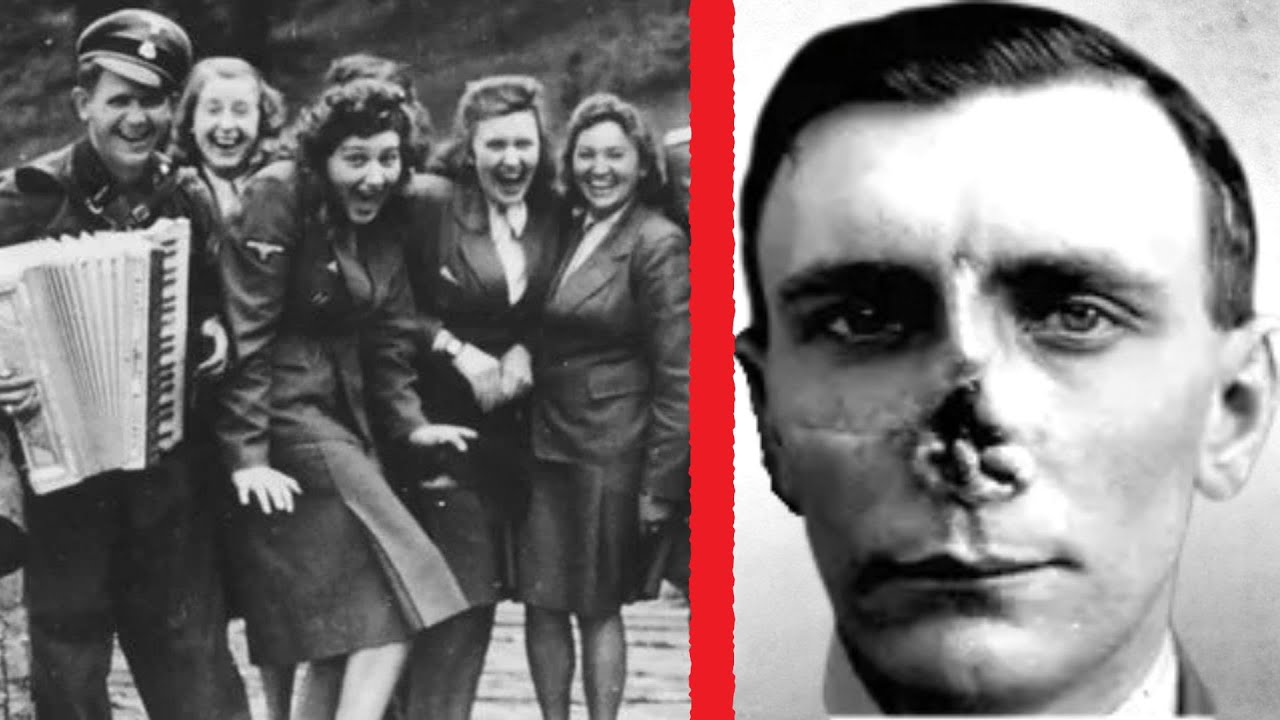
One holds a bowl of blueberries in her lap. Another leans toward her friend as if sharing a joke. Their sleeves are rolled neatly. Their hair is carefully arranged. Behind them, a man plays an accordion while the forest rises peacefully around the wooden terrace.
At first glance, the photograph looks like a harmless company picnic.
There are no starving prisoners in the frame. No barbed wire. No gas chambers. No smoke. No bodies.
That absence is precisely what makes the image so unbearable.
The photograph was taken in July 1944 at Solahütte, an SS retreat roughly twenty miles south of Auschwitz. The young women were SS auxiliaries visiting with Karl Höcker, adjutant to the commandant of Auschwitz. Other photographs from the same retreat show senior camp personnel singing, socializing and enjoying the countryside.
Only a short distance away, Auschwitz-Birkenau was operating as one of the largest killing centers in human history.
At that exact stage of the war, deportation trains carrying Jewish families from Hungary were arriving in enormous numbers. People stepped onto the railway platform with luggage, children and whatever hope they still possessed. SS personnel separated them into lines. Most were sent directly toward the gas chambers.
And at Solahütte, the accordion continued playing.
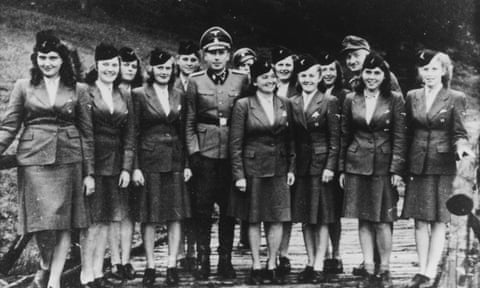
The women raised their bowls for the camera.
Someone pressed the shutter.
For decades, that moment remained hidden inside a photo album.
Then, in December 2006, a retired American Army officer contacted the United States Holocaust Memorial Museum. He had served in the Counter Intelligence Corps after the war and had found the album in an abandoned apartment in Frankfurt in 1946. He had carried it home without fully understanding what it contained.
The first page bore an inscription: “Auschwitz 21.6.1944.”
Museum researchers authenticated the materials and identified the album’s owner as Karl Höcker. In January 2007, the collection entered the Museum’s archives. Its 116 photographs documented Auschwitz personnel between May 1944 and January 1945—not while committing crimes, but during ceremonies, hunting trips, Christmas celebrations, hospital openings and days off.
That was what shocked historians.
The world already knew the photographs of Auschwitz’s victims: shaved heads, striped uniforms, skeletal bodies and frightened families standing on the selection ramp.

But here was the other album.
The perpetrators’ album.
They did not photograph the people whose lives they destroyed. They photographed one another eating, drinking, singing and smiling.
The album exposed a truth more disturbing than any image of a screaming monster: the people helping to operate mass murder did not spend every waking hour looking evil.
They had friendships.
They told jokes.
They celebrated birthdays.
They complained about work.
They took weekend trips.
Then they returned to Auschwitz.
For years, the popular image of the Holocaust perpetrator was overwhelmingly male: an SS officer in black boots, a camp commandant, a doctor making selections, a soldier holding a rifle.
Women were often placed outside that picture. They were imagined as wives waiting at home, secretaries who knew nothing or passive witnesses trapped inside a male dictatorship.
The historical record tells a different story.
By the end of the war, approximately 3,700 women had served as guards in the Nazi camp system. Technically, these female supervisors were not full SS members because the SS was an all-male organization. They belonged to the female SS support structure and signed contracts placing them under camp authority.
That legal distinction did not make their power less real.
Inside the camps, they controlled prisoners’ movement, work, punishment and daily survival. A woman did not need formal SS membership to order an exhausted prisoner to stand for hours, to beat someone who had fallen, or to help select sick women for death.
Many came from ordinary working-class backgrounds.
They were seamstresses, factory workers, domestic servants or young women with limited education. The positions required few qualifications and offered something that could appear attractive during wartime: regular public-service wages, accommodation, uniforms and a degree of social status.
For some, becoming a guard meant earning far more than they could in a factory. For others, it meant holding authority for the first time in their lives.
The advertisements did not need to say, “Come participate in mass murder.”
They presented employment.
A respectable position.
Service to Germany.
A chance to move upward.
The transformation did not happen in secret.
Ravensbrück, the largest concentration camp for women inside the German Reich, became the main training center for female guards. Candidates received theoretical and practical instruction. They learned camp rules, categories of punishment, methods for identifying resistance or “sham work,” and techniques for controlling groups of prisoners.
An experienced guard supervised their practical training. Afterward, candidates entered a probationary period before being assigned to Ravensbrück, Auschwitz or another camp.
Cruelty was not simply an uncontrolled personality defect that suddenly appeared at the gate.
It was organized.
Taught.
Observed.
Corrected.
Rewarded.
Once inside the system, female guards supervised forced labor, conducted roll calls, searched prisoners and imposed punishments. Prisoner drawings and testimony preserved scenes of guards striking women who were already lying on the ground.
At Auschwitz, report leaders participated in internal selections in which sick prisoners considered unable to work were chosen for the gas chambers. Other punishments included additional evening roll calls during which women were forced to kneel with their hands raised for hours. Some fainted. Some died where they stood.
The names behind this system eventually became public.
Johanna Langefeld was the first chief female supervisor at the Auschwitz women’s camp. She has sometimes been portrayed as a comparatively restrained figure because some former prisoners recalled occasions when she behaved less brutally than others.
But “less brutal” is not the same as innocent.
Research by the Ravensbrück Memorial describes Langefeld as a committed National Socialist and antisemite who was directly involved in the camp system, including the transfer of prisoners connected to the murderous operation known as Aktion 14f13. Her occasional restraint did not remove her from the machinery. It showed that a person could recognize suffering in isolated moments and still continue serving the institution producing it.
Maria Mandl replaced her in the Auschwitz hierarchy.
Prisoners remembered Mandl as one of the most feared female authorities in the camp. She rose to become chief supervisor of the women’s section, exercising power over subordinate guards and thousands of prisoners. The Auschwitz Memorial identifies her among the most brutal female supervisors.
After the war, a Polish court convicted her and sentenced her to death.
Elisabeth Volkenrath also climbed through the camp hierarchy, serving at Ravensbrück, Auschwitz and later Bergen-Belsen. She eventually became a senior supervisor. When British forces liberated Bergen-Belsen, they found catastrophic conditions and tens of thousands of prisoners suffering from starvation and disease.
Volkenrath stood trial with Irma Grese and camp commandant Josef Kramer. The British military court convicted all three and sentenced them to death.
Irma Grese became the most infamous female defendant in that courtroom.
She had been young, striking and photographed repeatedly by the press. That combination encouraged newspapers to turn her into a sensational symbol—the “beautiful beast,” the exceptional woman whose appearance seemed to contradict the accusations against her.
But the focus on her looks created a dangerous distraction.
The true question was never how someone who appeared ordinary could be cruel.
The question was why anyone expected cruelty to have a particular face.
Hertha Bothe, another guard tried after Bergen-Belsen, received a ten-year prison sentence rather than execution. She was released in 1951. The different verdicts reflected the evidence presented against individual defendants, but the courtroom created an unmistakable reversal of power.
Photographs from the Belsen Trial show the accused seated behind numbered placards.
That image carries its own terrible symmetry.
Inside the camps, guards had helped reduce human beings to categories, work units and prisoner numbers. Now the guards sat under observation. Their names were called. Their conduct was examined. Their authority was gone.
The uniforms no longer protected them.
The prisoners they had once expected to remain silent became witnesses.
And the recognition visible in that courtroom was not necessarily remorse. For many defendants, no sincere repentance ever appeared. It was the recognition of consequence—the moment they understood that they no longer controlled the room.
But here is the detail most viral captions leave out.
The smiling women with the blueberries in Karl Höcker’s album have not been identified as the notorious guards from the trials.
The Museum identifies them as Helferinnen—female SS auxiliaries who worked primarily as communications specialists. The photographs do not prove that every woman in that group personally beat or tortured prisoners.
To claim that the camera caught those specific women “smiling while they tortured” would be historically careless.
The photograph shows no torture.
And that is the real plot twist.
The women in the picture may not have wielded whips. They may have transmitted messages, handled communications or performed support work. But they belonged to the social and administrative community surrounding Auschwitz. They traveled with Höcker. They relaxed at an SS retreat. They shared food and music with men intimately involved in mass murder.
The album does not merely reveal a collection of individual sadists.
It reveals an entire workplace culture.
A killing center required more than executioners.
It required schedules, transport orders, telephone systems, payrolls, housing, supplies, reports, medical staff, clerks, guards and people willing to make the institution function.
Some participants committed direct physical violence. Others created the conditions in which that violence could continue efficiently. Still others accepted the rewards of belonging while refusing to look beyond the edge of the photograph.
That wider reality is harder to process because it removes the comforting boundary between “monsters” and “normal people.”
A monster is easy to reject.
A colleague is not.
A smiling young woman eating blueberries looks familiar. She resembles someone who might sit beside us at work, complain about her supervisor, laugh during lunch and pose for a group photograph.
That familiarity is what gives the album its power.
We cannot diagnose a person’s mind from a smile. The photograph cannot tell us exactly what each woman knew, believed or felt.
But psychology helps explain how people can participate in destructive systems without experiencing themselves as villains.
Albert Bandura used the term “moral disengagement” to describe processes through which people separate harmful conduct from their normal moral restraints. Responsibility is shifted upward. Harm is minimized. Victims are blamed or stripped of humanity. Cruel actions are renamed as duty, discipline, security or service to a supposedly noble cause.
Nazi propaganda had spent years portraying Jews and other targeted groups not as neighbors with families and inner lives, but as threats, contaminants and enemies. Once people accepted that language, violence could be reframed as necessary work.
Group culture strengthened the effect.
When everyone around you treats cruelty as normal, refusing to participate begins to feel abnormal. When supervisors reward hardness, compassion can appear weak. When friends laugh after work, the laughter reassures everyone that nothing is wrong.
The picnic was not separate from the system.
It helped sustain the people operating it.
The music restored their energy. The group photographs reinforced belonging. The comfortable housing, steady salaries and social outings told them they were valued members of a successful organization.
Ordinary motives—money, ambition, obedience, friendship, conformity and fear of exclusion—did not make their actions less criminal.
They made the danger more universal.
The United States Holocaust Memorial Museum notes that ordinary people participated for many different reasons, ranging from ideological hatred to opportunism, greed, social pressure and deference to authority. Not everyone needed to be a fanatical antisemite. A regime of persecution could also use people who wanted advancement, approval or a quiet life.
After the war, only a small number of the nearly two hundred female supervisors who served at Auschwitz faced punishment.
Some were executed.
Some served prison terms.
Many were never tried.
Others returned to ordinary neighborhoods, held jobs, grew older and lived among people who did not know—or did not ask—what they had done.
The Höcker album could easily have disappeared with them.
Instead, it survived.
Today, its photographs are used not because they show the physical violence of Auschwitz, but because they show what physical violence looked like when it was off duty.
A man passes out blueberries.
Young women laugh.
An accordion opens and closes.
The forest is bright.
And beyond the frame, a machinery built by human decisions continues to consume human lives.
That is why these photographs still disturb us.
They deny us the comforting belief that people who commit or support terrible crimes must look terrible every moment of the day. They remind us that organized evil can coexist with clean uniforms, affectionate friendships, career plans and pleasant weekends.
It can speak politely.
It can follow procedure.
It can finish work, wash its hands and join the others for dinner.
The most dangerous face of evil is not always twisted with rage—it is often the relaxed face of someone who has decided that another person’s suffering is no longer their concern.


