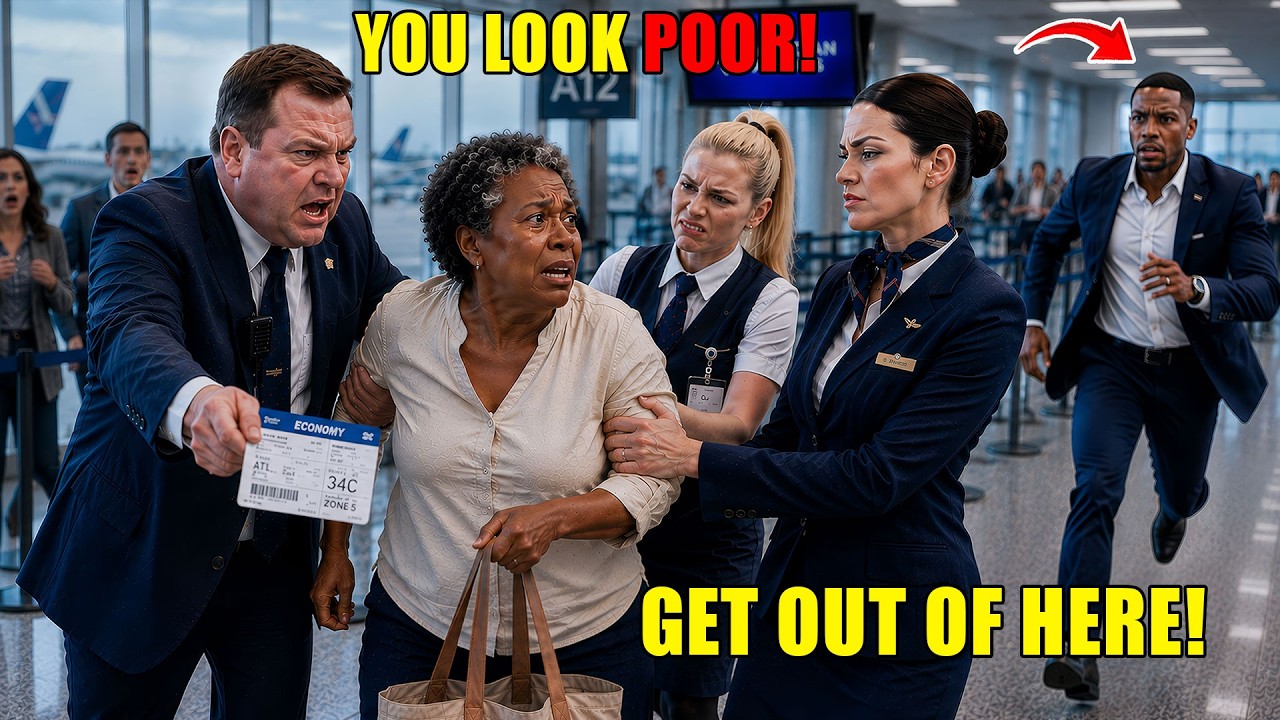
At 7:42 on a cold autumn morning, a woman carrying a faded canvas bag was told she did not belong in the business-class line.
Her ticket said otherwise.
But no one behind the counter seemed interested in reading it carefully.
Hartsfield-Jackson Atlanta International Airport was already moving at full speed. Boarding announcements echoed through the terminal. Suitcase wheels rattled over polished floors. Travelers stared at phones, rushed toward security, and argued quietly over delayed connections.
Behind the Meridian Airways business-class counter, Brittany Cole had checked in nearly forty passengers without incident.
Then Angela Carter stepped forward.
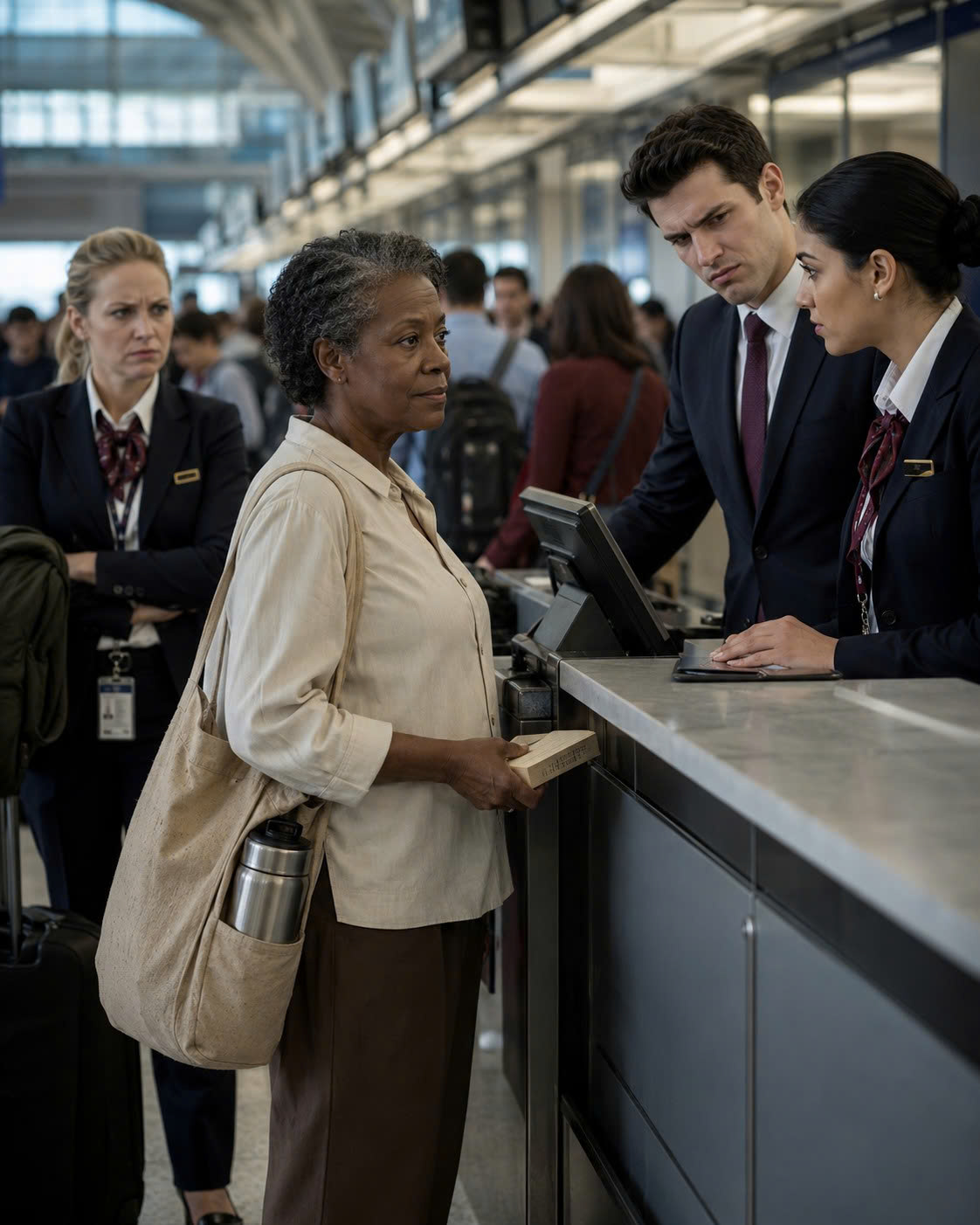
Angela was sixty-two. She wore a pale blue shirt beneath a simple beige cardigan, dark trousers, and a pair of brown leather shoes that had been polished many times but were clearly old.
She had no designer luggage.
No gold watch.
No assistant trailing behind her.
Just a canvas shoulder bag, a paperback novel, and a printed confirmation for the 9:15 flight to New York.
“Good morning,” Angela said, placing her identification on the counter. “I’m checking in for Flight 214.”
Brittany looked at the canvas bag first.
Then at Angela.
Then at the business-class sign hanging above them.
Her smile changed.
It did not disappear completely. It simply became thinner.
“Economy check-in is two sections down,” she said.
Angela glanced at the sign, then back at Brittany.
“I’m booked in business class.”
At the next station, Derek Mills paused while attaching a luggage tag to another passenger’s suitcase. He looked over at Angela, then exchanged a quick glance with Brittany.
It lasted less than a second.
But Angela saw it.
People who had spent years being underestimated learned to notice the smallest changes in a room.
Brittany picked up Angela’s identification and typed slowly.
“Do you have your confirmation number?”
Angela handed her the printed page.
“It should all be there.”
Brittany examined it longer than necessary.
“Did someone else make this reservation for you?”
“My son arranged the ticket.”
“And did he use his own account?”
“I believe so.”
Brittany typed again. Her eyebrows lifted slightly.
“That may be the problem.”
“What problem?”
“The reservation isn’t processing correctly.”
Angela leaned forward just enough to see the screen, but Brittany tilted it away.
“My name is on the booking,” Angela said. “The flight number is correct. The seat is listed as 3A.”
“I understand what the paper says.”
The words were polite.
The tone was not.
Derek stepped closer.
“Could be one of those upgrade errors,” he said quietly.
Brittany nodded as though he had confirmed something important.
Angela looked from one employee to the other.
“What upgrade error?”
“Sometimes,” Brittany said, “passengers receive an incorrect cabin assignment when a reservation is made through a third-party account.”
“It wasn’t made through a third party.”
“Ma’am, I’m trying to help you.”
Angela had not raised her voice.
She had not interrupted.
Still, Brittany spoke as if Angela were already becoming difficult.
A businessman waiting behind her shifted impatiently and checked his watch. A woman in a camel-colored coat looked Angela up and down, then turned away.
Brittany placed the confirmation on the counter.
“I need you to step aside while we verify this.”
“My flight leaves in less than two hours.”
“We’re aware of the departure time.”
Angela gathered her papers and moved to the end of the counter.
Ten minutes passed.
Then fifteen.
Passengers who had arrived after her checked in and left. Several received warm greetings, directions to the lounge, and reminders about priority boarding.
No one updated Angela.
At 8:06, she returned to the counter.
“Excuse me. Has the reservation been verified?”
Brittany sighed before looking up.
“We’re still reviewing it.”
“With whom?”
“Our supervisor.”
“May I speak with him?”
Before Brittany could answer, a broad-shouldered man in a navy suit approached from the staff area. His name badge read GARY HOLT — CUSTOMER OPERATIONS SUPERVISOR.
Gary did not introduce himself.
He picked up Angela’s printed confirmation, scanned it, and looked at her shoes.
“What seems to be the issue?” he asked Brittany.
“Possible invalid premium assignment.”
Angela watched him carefully.
“The assignment is not invalid,” she said. “My reservation was confirmed three days ago.”
Gary held up one finger without looking at her.
“I’ll speak with you in a moment.”
He and Brittany stepped two feet away.
They lowered their voices, but not enough.
“The fare code doesn’t match the profile,” Brittany said.
“Did she purchase it herself?”
“She says her son did.”
Gary glanced back.
“Probably transferred miles.”
Angela heard every word.
So did several people nearby.
A flight attendant in uniform had just arrived at the counter carrying a coffee. Her badge identified her as Cassandra Bell. She listened for a few seconds, then gave Angela a bright, practiced smile.
“These premium counters can be confusing,” Cassandra said. “Economy is just around the corner.”
Angela met her eyes.
“I am not confused.”
Cassandra’s smile tightened.
“Of course.”
Then she took a sip of coffee and turned to Gary.
“She doesn’t exactly look like one of our regular business travelers, does she?”
Derek laughed under his breath.
A passenger near the rope barrier smiled.
Someone else shook his head as though Angela had created an embarrassing scene by standing where her ticket told her to stand.
Angela felt the heat rise into her face.
But her hands remained still.
She had learned long ago that anger made some people feel justified. They could insult you for ten minutes, then point to your reaction as proof that their judgment had been correct.
So she waited.
Gary finally approached.
“Mrs. Carter, the best solution is to reissue your boarding pass in economy. You can contact customer service after the flight regarding any fare difference.”
Angela stared at him.
“That is not a solution.”
“It gets you on the aircraft.”
“I already have a seat on the aircraft.”
“The business cabin is nearly full.”
“My assigned seat is 3A.”
Gary’s jaw tightened.
“Ma’am, I’m trying to prevent you from missing your flight.”
“No,” Angela said quietly. “You are trying to make your mistake easier for yourself.”
The words landed harder because she did not raise her voice.
For the first time, Brittany looked uncomfortable.
Gary did not.
“Your options are economy or a later departure while we conduct a complete review.”
Angela looked at the clock.
Then at her confirmation.
Then at the people waiting behind her, some annoyed, some curious, none willing to speak.
She was expected in New York that afternoon. Missing the flight would mean missing an important family gathering.
“Give me the economy boarding pass,” she said.
Gary nodded, satisfied.
Brittany printed it.
Seat 28C.
A middle seat.
She slid it across the counter without apologizing.
Angela folded the pass and placed it inside her canvas bag.
As she walked away, Cassandra leaned toward Brittany and said, “Some people think a printed piece of paper can get them anywhere.”
Angela kept walking.
She had spent most of her life doing exactly that—keeping herself moving while other people tried to decide where she belonged.
When her son, Marcus, was four years old, Angela became his only parent.
She worked mornings in a medical billing office and evenings at a grocery store. Some nights, she returned home after midnight, placed her shoes beside the door, and sat at the kitchen table checking Marcus’s homework while eating dinner from a plastic container.
She saved money in envelopes.
Rent.
Electricity.
School clothes.
Emergency.
Marcus never remembered her buying anything for herself.
But he remembered her polishing the same pair of shoes before every parent-teacher meeting.
He remembered how she ironed his shirts on Sunday evenings.
He remembered what she told him whenever someone laughed at their old car or small apartment.
“Never let another person’s imagination become the limit of your life.”
Marcus carried that sentence into adulthood.
He studied hard, worked harder, and eventually reached a level of success Angela rarely discussed with strangers.
She was proud of him.
But she refused to live as an advertisement for his achievements.
When he offered to send a driver that morning, she declined.
When he suggested new luggage, she told him her canvas bag still worked.
And when he arranged the business-class ticket, she accepted only because he insisted she should arrive rested.
She had not expected the seat to change how people saw her.
She had been alive long enough to know better.
At Gate B7, Angela stood in the economy boarding group while passengers with premium tickets entered first.
Cassandra was now part of the flight crew.
When she saw Angela, she looked down at the boarding pass and gave a small nod.
“There we go,” she said. “All sorted out.”
Angela said nothing.
Inside the aircraft, she found 28C between two passengers.
The man by the window introduced himself as Terrence Brooks. He was in his thirties, dressed in a maintenance uniform, and traveling to New York for a certification course.
When Angela struggled to place her canvas bag under the seat, he bent down to help her.
“Let me get that for you.”
“Thank you.”
He noticed the old boarding pass sticking from her book.
“Were you moved from business class?”
Angela paused.
“Yes.”
“That’s a long move.”
“So it seems.”
Terrence looked toward the front of the plane.
“Did they explain why?”
“They explained many things,” Angela said. “None of them made sense.”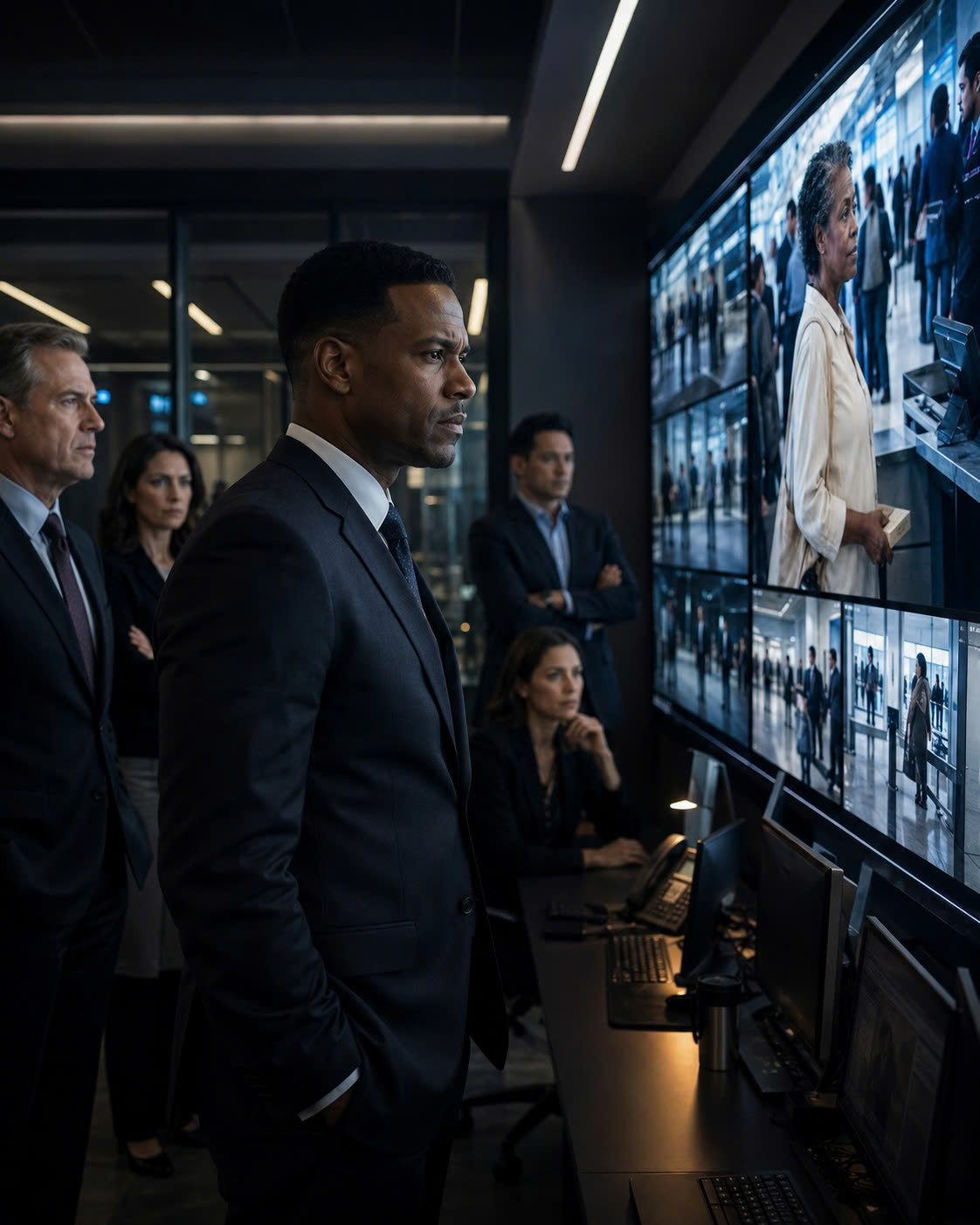
He did not ask further.
He simply offered her the window seat.
“You can take mine. It’s more comfortable.”
Angela smiled for the first time that morning.
“That’s very kind, but you should keep it.”
“No trouble at all.”
She accepted.
Sometimes dignity returned through the smallest gestures.
Across the city, on the twenty-second floor of Meridian Airways’ operations headquarters, twelve executives were studying a customer-experience dashboard.
The airline had recently introduced a monitoring system designed to flag unusual delays, repeated ticket changes, and potential service failures at major airports.
At 8:41, a yellow alert appeared on the Atlanta terminal feed.
PREMIUM PASSENGER REASSIGNED AFTER MANUAL OVERRIDE.
The meeting continued until one executive leaned forward.
“Open that alert,” he said.
The live footage appeared on the wall.
First, the business-class counter.
Then the camera angle shifted.
The executive stopped breathing for a moment.
He recognized the beige cardigan.
He recognized the canvas bag he had offered to replace at least six times.
He recognized the way the woman stood perfectly still when she was hurt.
“Go back,” he said.
The analyst rewound the footage.
The room watched Brittany direct Angela away from the counter.
They watched Derek laugh.
They watched Gary interrupt her.
They watched Cassandra lean over her coffee and make a comment.
There was no audio on the first feed, but a second security stream had captured it.
“She doesn’t exactly look like one of our regular business travelers, does she?”
The room went silent.
“Everyone except legal and operations, leave,” the executive said.
No one asked why.
When the door closed, he replayed the entire sequence.
He watched his mother wait while other passengers were served.
He watched her hand over valid documents.
He watched employees search for reasons not to believe what was in front of them.
And he watched her accept seat 28C.
Not because they had proven her wrong.
Because they had exhausted her options.
The executive’s name was Marcus Carter.
And he was the chief executive officer of Meridian Airways.
Marcus did not shout.
He did not strike the table.
That would have made the moment about his anger.
Instead, he turned to the head of operations.
“Preserve every recording. Lock the employee access logs. Pull the original reservation, every keystroke, and every manual override.”
Then he looked at the departure board.
Flight 214 had begun boarding.
“Hold the aircraft.”
At Gate B7, the agent’s screen flashed red.
DEPARTURE HOLD — EXECUTIVE OPERATIONS ORDER.
Gary arrived two minutes later.
“What happened?”
The gate agent shook her head.
“I don’t know. The order came from headquarters.”
Donna Reeves, the station manager, hurried toward them with her phone in hand.
“Operations wants Gary, Brittany, and Cassandra at the gate immediately.”
Gary’s face changed.
“Why?”
Donna looked at him.
“They didn’t say.”
A black company vehicle stopped outside the secured operations entrance.
Marcus entered the terminal with the chief legal officer, the director of customer operations, and two members of corporate security.
Employees recognized him as he passed.
Conversations stopped.
At the gate, Gary straightened his jacket.
Brittany went pale.
Marcus did not speak to either of them.
He walked onto the aircraft.
Passengers turned as he moved through the business cabin and continued toward economy.
When he reached row 28, Angela was sitting by the window with her book open.
She looked up.
For the first time all morning, surprise broke through her calm expression.
“Marcus?”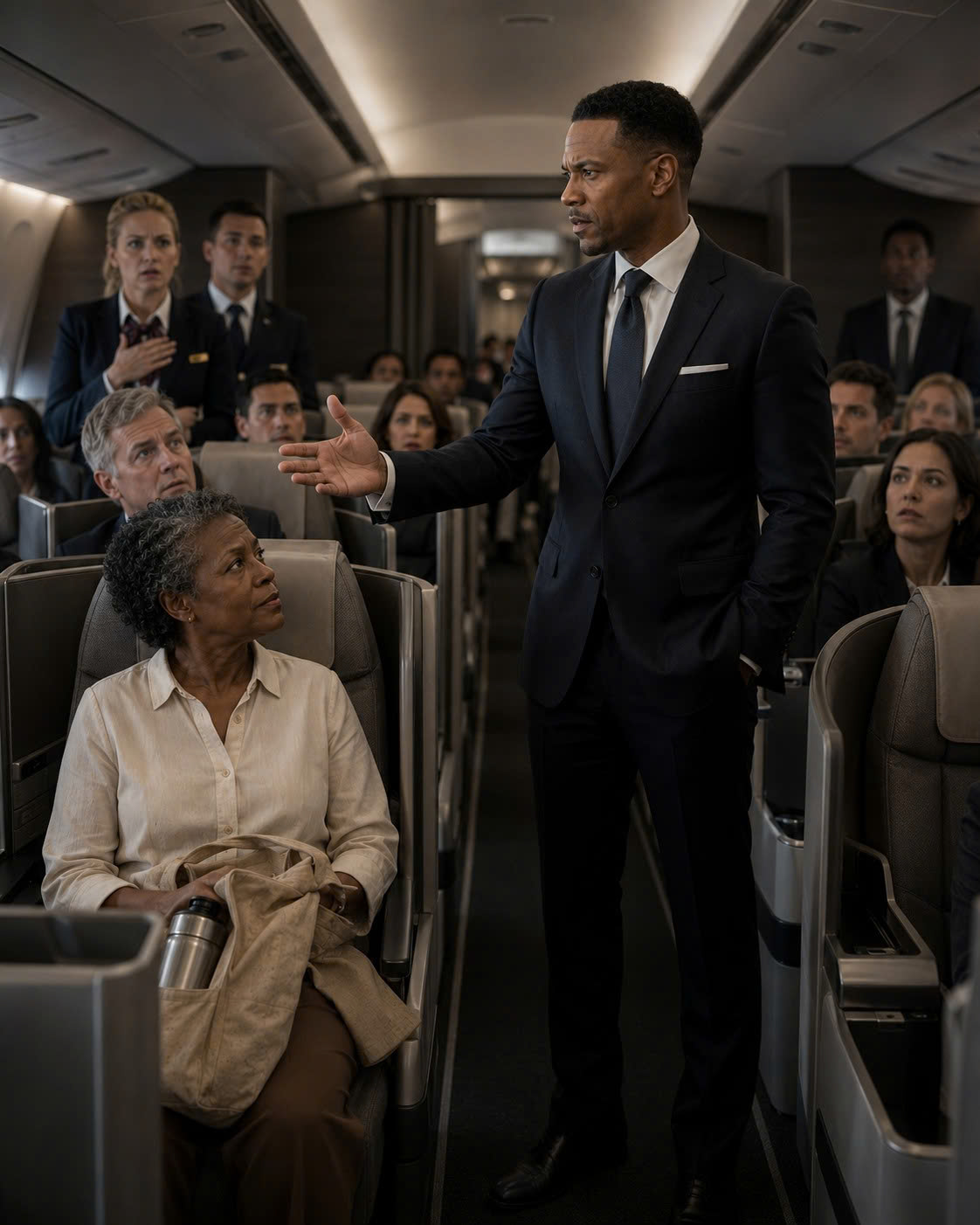
He crouched beside her seat.
“Mom.”
The word traveled through the cabin faster than any announcement.
Cassandra, standing near the galley, froze.
Gary’s lips parted, but no sound came out.
Brittany gripped the edge of the seat beside her.
Angela closed her book.
“You didn’t have to come here.”
“Yes,” Marcus said. “I did.”
He helped her into the aisle.
Then he turned to the passengers.
“My name is Marcus Carter. I am the CEO of Meridian Airways.”
The cabin became completely still.
“This morning, my mother arrived at our business-class counter with a valid reservation, valid identification, and a confirmed seat in 3A.”
He paused.
“She was questioned, delayed, mocked, and moved to economy—not because of an error in her booking, but because several of our employees decided she did not look like someone who belonged in business class.”
Gary took one step forward.
“Mr. Carter, we were following verification protocol.”
Marcus looked at him.
“Protocol required you to verify the booking. You verified it.”
Gary’s eyes moved toward Donna.
Marcus continued.
“Protocol did not require contempt. It did not require jokes. It did not require you to ignore the information on your screen until you found an outcome that matched your assumption.”
No one moved.
Marcus nodded to the technology manager at the front of the cabin.
The seatback screens lit up.
The video began to play.
Passengers watched Brittany inspect Angela’s bag before her ticket.
They watched Derek smirk.
They heard Cassandra say Angela did not look like a regular business traveler.
They watched Gary offer economy as the “best solution.”
Then they saw themselves.
A few passengers had laughed.
Others had stared.
Most had remained silent.
The woman in the camel-colored coat lowered her head.
The businessman who had checked his watch looked toward the window.
Cassandra’s face had gone rigid. The confidence was gone from her eyes. Her shoulders drew inward as her own voice filled the cabin.
“She doesn’t exactly look like one of our regular business travelers, does she?”
When the screen went dark, no one spoke.
Marcus turned to the employees.
“Mr. Holt, Ms. Bell, and Ms. Cole, you are suspended effective immediately pending formal investigation.”
Gary swallowed.
“Sir, I have worked here for eleven years.”
“Then you had eleven years to understand our standards.”
Marcus looked toward Donna.
“The station’s supervisory practices will also be reviewed. Preserve all staffing records and prior complaints.”
A young gate employee standing near the aircraft door raised her hand slightly.
“I saw what happened,” she said. “I knew it felt wrong. I’m sorry I didn’t say anything.”
Marcus studied her for a moment.
“Speaking up is always a choice,” he said. “Sometimes it is a costly one. But silence has a cost too, and someone else usually pays it.”
He turned back to Angela.
“Your seat is ready.”
A flight attendant who had not been involved escorted her to 3A.
Terrence handed Angela her canvas bag.
“I think this belongs up front,” he said.
Angela touched his arm.
“Thank you for treating me kindly before you knew who my son was.”
Terrence shook his head.
“That shouldn’t matter.”
“No,” she said. “It shouldn’t.”
Before leaving the aircraft, Marcus asked for Terrence’s name.
Not because Terrence had performed some heroic act.
Because basic decency had become the clearest contrast in the room.
Angela settled into 3A.
A different flight attendant brought her hot tea and breakfast. This time, no one questioned whether she belonged there.
She opened her book again.
There was no smile of triumph on her face.
No satisfaction in seeing employees escorted away.
Only the steady calm of someone who had survived harder things than public humiliation.
Marcus stood beside her for a moment.
“Are you all right?”
“I am.”
“I’m sorry.”
“You didn’t do it.”
“It happened in my company.”
Angela looked at him over the top of her glasses.
“Then change the company. Don’t just punish the people.”
“They need consequences.”
“Yes,” she said. “But consequences without understanding only teach people to hide their behavior better.”
Marcus was quiet.
Angela placed one hand over his.
“Most cruelty begins with a failure of imagination. People look at someone and cannot imagine a life beyond what they see.”
Marcus nodded slowly.
“I’ll remember that.”
“Good. Now get off this plane before you delay everyone any longer.”
He almost smiled.
“Yes, ma’am.”
Flight 214 departed Atlanta twenty-seven minutes late.
Before the plane reached cruising altitude, Marcus returned to headquarters and began writing an email to every Meridian Airways employee.
He did not identify Angela as his mother until the final paragraph.
First, he described the facts.
A passenger had arrived with a valid premium reservation.
Employees had judged her appearance.
They had used procedure as camouflage for prejudice.
They had changed a correct booking to fit an incorrect assumption.
Then Marcus wrote:
“This incident would be unacceptable if the passenger were someone I had never met. The fact that she is my mother did not make the behavior worse. It only made it impossible for leadership to look away.”
He ended the message with one question:
“Who are we when we believe no one important is watching?”
At thirty-five thousand feet, Angela drank her tea and looked through the window at the bright morning sky.
Behind her sat passengers who now knew her connection to power.
But her value had not changed when Marcus entered the aircraft.
She had been the same woman at the counter.
The same woman in seat 28C.
The same woman carrying an old canvas bag.
The only thing that had changed was everyone else’s ability to see her.
Angela had no designer suitcase, no expensive jewelry, and no interest in proving that she belonged.
She carried something far rarer: dignity that did not depend on recognition, kindness that did not depend on status, and self-respect no stranger could take from her.
The poorest people in that airport had judged wealth by appearances.
The richest woman on the plane had never needed them to know her name.