The first thing anyone noticed at Forward Operating Base Viper wasn’t the helicopters.
It was the constant hum.
Generators. Radios. Air filtration units fighting an endless battle against Syrian dust. Somewhere beyond the Hesco barriers, artillery echoed like distant thunder. Inside the wire, Marines hurried between briefing tents, mechanics wrestled with armored vehicles, and medics prepared for casualties that could arrive without warning.
Everyone moved with purpose.
Except, it seemed, the newest corpsman.
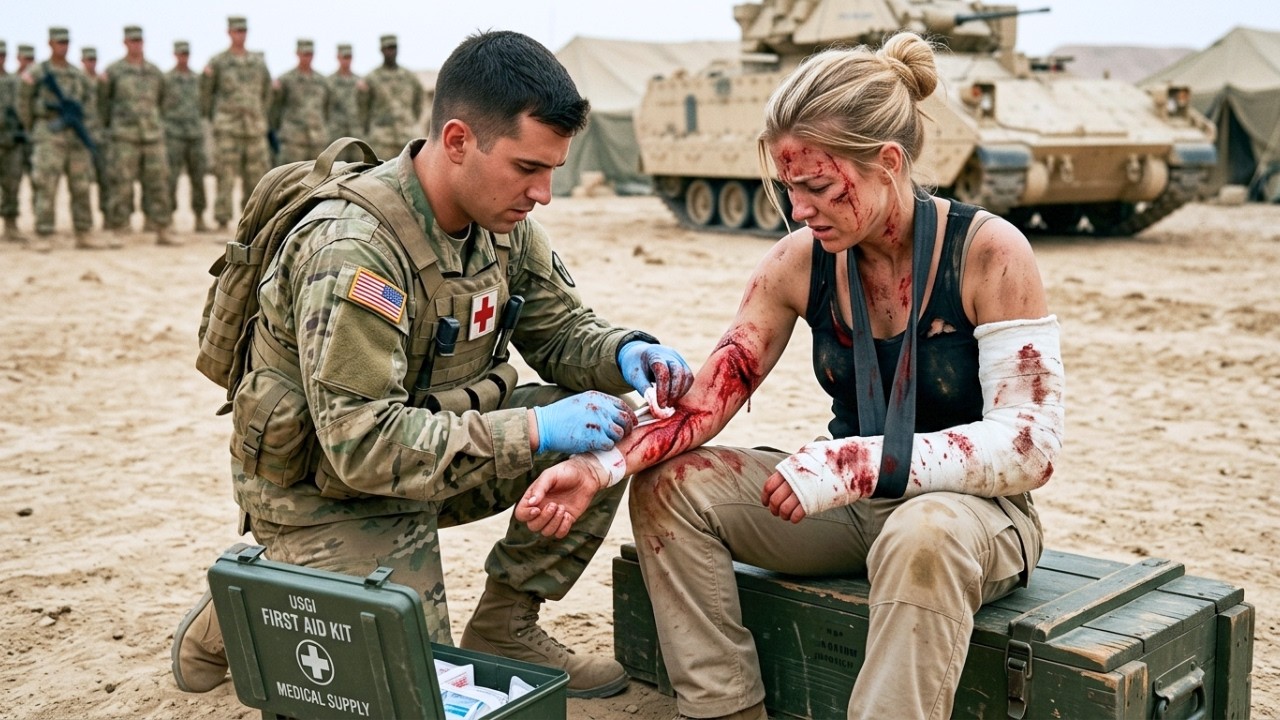
Hospital Corpsman Sloan Remington looked almost invisible.
Five-foot-four.
Lean.
Quiet.
She rarely spoke unless someone asked her a direct question. She kept her sleeves neatly rolled, boots polished despite the dust, and every medical pouch on her plate carrier arranged in exactly the same order every morning.
If someone borrowed a tourniquet, she’d replace it before sunset.
If an IV kit was moved two inches to the left, she’d notice.
The Marines joked she probably alphabetized trauma shears.
No one laughed harder than Staff Sergeant Owen Beckett.
“That’s our miracle worker?” he muttered while watching Sloan inspect a litter for the third time. “She looks like she’d apologize to a mosquito before swatting it.”
Several Marines chuckled.
Sloan didn’t react.
She simply finished checking the stretcher, signed the equipment log, and walked toward the aid station.
Master Chief Ethan Hayes watched the exchange from across the compound.
Unlike Beckett, he didn’t laugh.
Hayes had spent more than twenty years around special operations.
He’d learned that truly dangerous people rarely announced themselves.
Still…
There was something about Sloan that didn’t fit.
Not her medical qualifications. Those were excellent.
Not her discipline. It bordered on obsessive.

It was something smaller.
The way she constantly mapped exits whenever she entered a room.
How her eyes swept rooftops before greeting anyone.
How she instinctively stood where walls protected her blind side.
Most corpsmen learned those habits after months in combat.
She already had them.
Commander Lucas Brennan noticed the same thing.
He’d reviewed Sloan’s personnel file twice before she arrived.
Everything appeared ordinary.
Decorated field medic.
Outstanding evaluations.
Advanced trauma certifications.
But every few pages, sections had been replaced with black bars.
“CLASSIFIED.”
Entire deployments.
Missing assignments.
No explanations.
Brennan had requested clarification.
The reply was short.
Need-to-know.
Apparently, he didn’t.
That bothered him.
Because commanders hated surprises.
Especially in Syria.
By noon, the temperature pushed well over one hundred degrees.
The medical tent smelled of antiseptic, diesel fuel, and hot canvas.
Sloan moved quietly from patient to patient, treating dehydration, replacing dressings, checking antibiotics, never rushing.
Her hands never shook.
Never hesitated.
Never wasted motion.
Even Hayes found himself watching.
Every movement looked practiced.
Not rehearsed.
Experienced.
There was a difference.
“Remington.”
She turned immediately.
“Yes, Master Chief?”
“What would you do if a casualty rolled in with bilateral chest trauma, airway compromised, and evacuation delayed twenty minutes?”
Beckett smirked.
Pop quiz.
Perfect chance to embarrass the new medic.
Sloan answered without thinking.
“Needle decompression if indicated. Establish airway. Massive hemorrhage control first. Blood if available. Continuous reassessment every thirty seconds. Prepare for surgical airway if oxygenation fails.”
Hayes didn’t nod.
He simply changed the scenario.
“Night operation. No lights.”
“I work by touch.”
“Enemy still firing.”
“I keep treating.”
“No helicopter.”
“Then we become the hospital.”
Silence.
Even Beckett stopped smiling.
The answer hadn’t sounded memorized.
It sounded remembered.
At 1438 hours, the radios exploded.
“Troops in contact!”
Every head inside the command tent snapped toward the operations desk.
Another transmission crashed through the static.
“Vehicle struck an IED!”
“Multiple casualties!”
“Grid follows—”
Coordinates flooded the room.
Brennan was already moving.
Hayes grabbed his rifle.
Beckett sprinted toward the vehicles.
Sloan was faster.
She had her medical bag over one shoulder before anyone gave the order.
Then another voice interrupted.
Gunfire.
Heavy breathing.
Someone screaming.
“We’ve got one Marine unconscious!”
Another voice shouted over him.
“I think his lung’s collapsed!”
Panic spread across the radio.
Young.
Uncontrolled.
Exactly how people sounded when they’d never watched a friend bleed out before.
Brennan reached for the handset.
Sloan gently stopped him.
“Sir.”
He looked at her.
“Let me.”
For half a second, nobody moved.
Then Brennan handed her the radio.
The entire command post became quiet.
Sloan pressed the transmit button.
Her voice never rose.
“Listen carefully.”
The shouting eased.
“I need the team leader to answer me.”
A strained voice responded.
“I’m here.”
“Good. Stay with me.”
She closed her eyes briefly, mentally building the battlefield from nothing but voices.
“Describe his breathing.”
“It’s… uneven.”
“Which side?”
“…Right.”
“Any bubbling chest wound?”
“…Negative.”
“Trachea?”
“I—I can’t tell.”
“You don’t need to.”
Her tone remained calm.
“You said the right side isn’t moving?”
“Correct.”
“I want you to expose the chest. Find the second intercostal space—or if you’re trained, use the fifth intercostal space at the anterior axillary line. Confirm landmarks before you insert the needle. Tell me when you’ve found it.”
The Marine’s breathing grew steadier.
Not because the situation had improved.
Because someone finally sounded completely in control.
Hayes watched Sloan closely.
She wasn’t reading a checklist.
She was listening.
Counting breaths.
Timing pauses.
Interpreting background sounds.
The crack of distant rifles.
The muffled engine.
The direction voices turned when they shouted.
It was as though she could see the battlefield.
Minutes later, the Marine came back over the radio.
“We’ve decompressed.”
A pause.
Then—
“He’s breathing better.”
Another pause.
Longer this time.
Then the words that rippled through the command post.
“He’s alive.”
Nobody celebrated.
Not yet.
There were still wounded waiting for evacuation.
But the atmosphere had changed.
Brennan looked at Sloan.
Hayes looked at Brennan.
Neither spoke.
Because both had reached the same conclusion.
That hadn’t been textbook medicine.
That had sounded like someone who had performed the procedure under fire before.
More than once.
Sloan quietly handed the radio back.
“Casualty should be reassessed every few minutes,” she said. “If respiratory distress returns, be prepared to repeat the intervention if clinically indicated.”
Brennan accepted the handset without taking his eyes off her.
“How many times have you done that?”
For the first time all day, Sloan hesitated.
Only for a heartbeat.
“Enough to know panic spreads faster than bleeding, sir.”
Then she picked up another trauma kit and walked toward the landing zone as the distant thump of approaching helicopters rolled across the desert.
Behind her, Hayes continued watching.
His expression hadn’t changed.
But one thought refused to leave his mind.