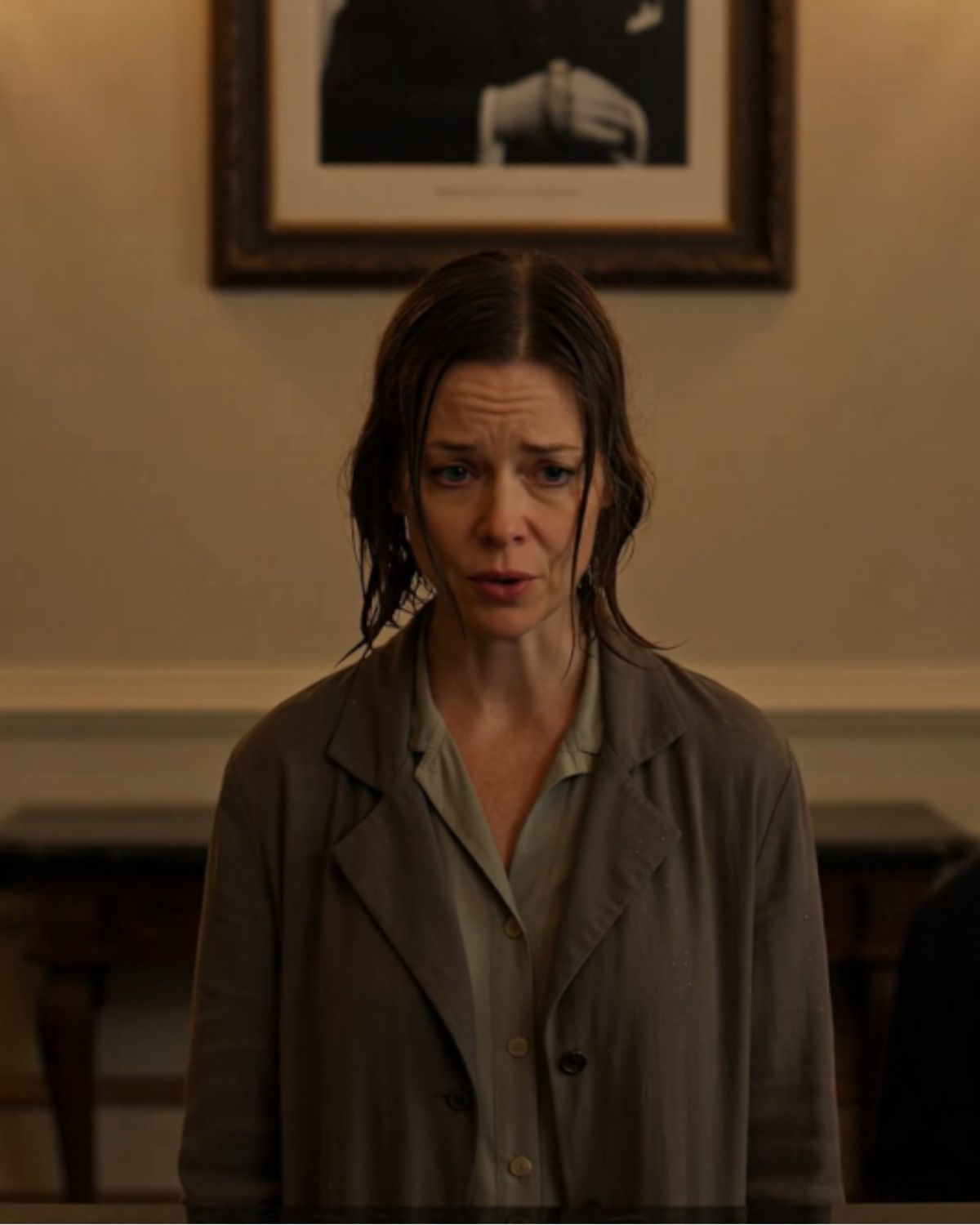
The woman stood in the rain for nearly ten minutes before she found the courage to enter the hotel.
Her coat was thin.
Her shoes were soaked.
A plastic bag protected the documents pressed against her chest, but nothing protected her from the cold water running down her hair and into the collar of her faded blouse.
Above her, the entrance of the Ashbourne Grand Hotel glowed beneath a wide glass canopy.
Black cars stopped at the curb.
Drivers opened doors for guests in tailored suits.
Bellmen carried polished luggage across the marble steps.
The woman watched them from the sidewalk.
Then she looked down at the small silver bracelet around her wrist.
It was old, scratched and far too loose.
She touched it once.
Then she walked inside.
Warm air struck her face.
The lobby was enormous.
Golden lights hung from a ceiling painted with clouds. Fresh lilies stood in tall crystal vases. A pianist played quietly near a curved staircase while guests moved between leather chairs and the reception desk.
For a moment, the woman stopped.
She had seen the building before.
But never like this.
Not with polished stone.
Not with cameras above the doors.
Not with employees wearing matching navy uniforms.
She looked toward the back of the lobby, searching for a sign.
RESTROOMS.
She saw one near the elevators.
Relief crossed her face.
She had been traveling since five that morning. Two buses had been delayed. The public restroom at the train station had been closed for repairs.
All she needed was five minutes.
She approached the reception desk.
The receptionist looked up.
Her name tag read EMILY.
She was young, perfectly groomed and busy checking messages on a tablet.
The woman waited.
Emily continued reading.
“Excuse me,” the woman said softly.
Emily looked at her coat.
Then at the water dripping from its hem.
“Yes?”
“May I please use the restroom?”
Emily’s expression changed slightly.
Not enough to be called rude.
Just enough to make the woman feel that she had asked for something unreasonable.
“Are you staying at the hotel?”
“No.”
“Do you have a reservation?”
“No. I’m sorry. I’ve been traveling, and the station facilities were closed.”
Emily looked toward the lobby entrance.
“Sorry, this is for hotel guests only.”
The woman glanced at the restroom sign.
“I’ll only be a moment.”
“We have a guest-only policy.”
“I understand. I really would not ask unless—”
“There’s a café two blocks east.”
The woman turned toward the glass doors.
Outside, rain struck the pavement in heavy silver lines.
“I came from that direction,” she said. “The café is closed.”
Emily gave a small professional smile.
“I’m afraid I can’t help.”
A couple waiting nearby looked toward the woman.
The man leaned closer to his wife and whispered something.
The woman lowered her eyes.
She had spent enough years being looked at to recognize the difference between curiosity and suspicion.
Emily shifted a small bowl of wrapped chocolates farther from the edge of the desk.
The movement was subtle.
But the woman saw it.
Her fingers tightened around the plastic bag.
“I’m not asking for anything else,” she said.
Emily’s smile disappeared.
“And I’ve explained the policy.”
The woman nodded.
“All right.”
She stepped away from the desk.
Her legs were trembling now.
Not only from the long journey.
Not only from the cold.
There was a kind of humiliation that arrived quietly.
It did not need shouting.
It could be delivered through a careful tone, a guarded expression or an object moved out of reach.
The woman walked toward a chair near the entrance.
She did not sit.
Her wet clothes might damage the fabric.
Instead, she stood beside a marble column and waited for the dizziness to pass.
At the reception desk, Emily returned to her tablet.
A bellman named Victor had watched the entire exchange.
He looked toward the restroom.
Then toward Emily.
“You could have let her through,” he said quietly.
Emily did not look up.
“And if management saw?”
“She asked to use a restroom.”
“She isn’t a guest.”
“She looks exhausted.”
“She also walked in carrying a plastic bag and no luggage.”
Victor frowned.
“What does that have to do with anything?”
Emily lowered her voice.
“We’ve had incidents.”
“What incidents?”
“People enter, use the facilities, then stay in the lobby.”
Victor glanced toward the woman.
She stood with one hand against the column.
“She isn’t causing trouble.”
“Not yet.”
Victor stared at Emily.
Then the elevator doors opened.
The hotel’s operations manager stepped into the lobby.
His name was Jonathan Reed.
He was fifty-three and had worked at the Ashbourne Grand for almost twenty-nine years.
He had begun as a night porter.
Then he became a front desk supervisor, duty manager and eventually head of hotel operations.
Jonathan knew every service corridor, every emergency exit and every stain the ballroom carpet had collected through the decades.
He also knew when something in the lobby felt wrong.
He saw the woman immediately.
She did not fit the rhythm of the room.
Everyone else was moving with purpose.
She stood still.
Her hair was wet.
Her face was pale.
One hand held the plastic bag against her chest.
The other rested on the marble column.
Jonathan walked toward reception.
“Who is she?”
Emily glanced over.
“She came in to use the restroom.”
“And?”
“She isn’t a guest.”
Jonathan looked at her.
“That was not the question.”
Emily’s posture stiffened.
“I explained the guest-only policy.”
Jonathan turned toward the woman.
She had begun walking back toward the entrance.
Her steps were slow.
Then the plastic bag slipped.
Several papers fell onto the floor.
Victor moved first.
“I’ve got them.”
The woman crouched quickly.
“So sorry.”
As she reached for the papers, the sleeve of her coat pulled back.
A silver bracelet slid down her wrist.
Jonathan stopped.
The bracelet was narrow and handmade.
Five small metal leaves had been linked together around a dark blue stone.
One leaf was bent at the edge.
Another carried a tiny engraved letter.
A.
Jonathan’s face changed.
He took one step closer.
The woman noticed him staring.
She covered the bracelet with her sleeve.
Jonathan whispered, “That bracelet…”
Emily looked up.
The woman stood slowly.
“Excuse me?”
Jonathan did not answer.
His eyes moved toward the wall behind the grand staircase.
A row of framed photographs showed the hotel through different decades.
The oldest image hung at the center.
It had been taken in 1951, the year the original Ashbourne House opened.
The photograph showed a modest three-story building with twelve rooms, a narrow dining hall and a hand-painted sign above the entrance.
Standing in front were the founders.
Samuel Ashbourne.
And his wife, Anna.
Anna wore a plain dress and held a small child in her arms.
Around her wrist was the same silver bracelet.
Five metal leaves.
One dark blue stone.
One bent edge.
Jonathan walked toward the photograph.
Employees nearby noticed.
The pianist continued playing, but several conversations faded.
Jonathan stared at the image.
Then he looked back at the woman.
She was still holding the fallen documents.
“May I ask your name?” he said.
His voice had changed.
The woman studied him cautiously.
“Margaret.”
“Margaret what?”
She hesitated.
“Margaret Ashbourne.”
The name moved through Jonathan like an electric current.
Behind the desk, Emily stopped breathing.
Victor looked from the woman to the photograph.
Jonathan took another step closer.
“Your father was Samuel Ashbourne?”
Margaret’s expression tightened.
“Yes.”
The lobby became silent.
Even the pianist stopped.
Emily looked toward the old photograph.
Then at the woman’s soaked coat.
Jonathan’s eyes returned to the bracelet.
“That belonged to Anna Ashbourne.”
Margaret touched it.
“My mother.”
A guest near the staircase whispered, “She’s the founder’s daughter.”
The words traveled quickly.
The general manager, who had been speaking with a corporate guest near the lounge, turned at the sound of the name.
He crossed the lobby.
“What is happening?”
Jonathan did not take his eyes off Margaret.
“This is Margaret Ashbourne.”
The general manager froze.
The hotel’s current employees knew the founders from plaques, annual speeches and printed history books placed in executive suites.
They knew Samuel Ashbourne had opened the original property with money borrowed against his small family home.
They knew Anna had cooked breakfast for guests, repaired curtains and kept the accounts at night.
They knew the hotel’s official story.
But almost no one knew what had happened to their daughter.
For years, Margaret had existed only in one black-and-white photograph.
A child in Anna’s arms.
Jonathan looked at the plastic bag.
“What brings you here?”
Margaret glanced toward Emily.
The receptionist’s face had gone pale.
“I came to speak with someone from the hotel archive.”
Jonathan lowered his voice.
“About what?”
Margaret pulled one document from the bag.
The paper was old and folded.
“My father’s letters.”
Jonathan stared at it.
Margaret looked toward the founder’s photograph.
“I found them after my brother died.”
The general manager stepped closer.
“You have a brother?”
“Had.”
Her answer was quiet.
“He passed away in March.”
She pressed the papers against her chest again.
“We had not spoken for many years. His solicitor sent me a box of family belongings.”
Jonathan gestured toward the seating area.
“Please sit down.”
Margaret shook her head.
“My clothes are wet.”
“That does not matter.”
“It appears to matter here.”
The sentence was not loud.
It did not need to be.
Every employee within hearing distance looked toward the reception desk.
Emily’s face tightened.
Jonathan followed Margaret’s gaze.
He understood.
“What happened?”
Margaret said nothing.
Emily stepped forward.
“Mr. Reed, I followed the access policy.”
Jonathan turned to her.
“What access policy?”
“The restroom is reserved for registered guests.”
The general manager frowned.
“We have no such policy.”
Emily blinked.
“Yes, we do.”
“No,” Jonathan said. “We have guidance for handling disruptions. We do not refuse basic assistance to someone asking politely.”
Emily looked confused.
“I was told to protect the guest areas.”
“From what?”
Emily glanced at Margaret.
That glance answered the question.
Margaret looked away.
Jonathan’s voice became colder.
“Did she threaten anyone?”
“No.”
“Did she behave inappropriately?”
“No.”
“Did she refuse to leave?”
“No.”
“What did she do?”
Emily swallowed.
“She asked to use the restroom.”
Jonathan let the silence remain.
Employees shifted uncomfortably.
The general manager looked toward the old photograph.
The same woman whom the receptionist had refused stood only a few meters from the image used in hotel brochures to represent the Ashbourne family legacy.
Jonathan faced Margaret again.
“I’m sorry.”
Margaret nodded once.
“I did not come for an apology.”
“What did you come for?”
She looked at the photograph of her parents.
“To understand why my father never came back.”
Jonathan’s expression changed.
Margaret opened the plastic bag.
Inside were dozens of letters tied with faded string.
The top envelope carried the Ashbourne Grand’s original address.
Jonathan recognized the handwriting from documents in the archive.
Samuel Ashbourne’s handwriting.
The general manager stared.
“Those are original?”
“Yes.”
Margaret untied the string.
“My father wrote them after he lost control of the hotel.”
The official history described the transition differently.
It said Samuel Ashbourne had sold the property in 1968 to an investment partnership and retired from hospitality.
There was no mention of loss.
No mention of conflict.
No mention of letters.
Jonathan looked toward the private lounge.
“Please come with us.”
Margaret shook her head.
“First, may I use the restroom?”
The question struck the lobby harder than any accusation could have.
The general manager’s face fell.
Jonathan stepped aside immediately.
“Of course.”
Victor moved toward the hallway.
“I’ll show you.”
Margaret looked at him.
“Thank you.”
As she walked across the lobby, every employee watched.
Not because she wore expensive clothing.
Not because she had arrived with an assistant or driver.
Because the bracelet on her wrist had exposed the distance between the hotel’s public values and the way one tired woman had been treated at its front desk.
Margaret returned several minutes later.
Someone had brought her a dry towel.
Another employee offered tea.
She accepted the towel but not the tea.
Jonathan led her into the library beside the main lobby.
The room had once been part of the original Ashbourne House.
Its dark wood walls and stone fireplace had survived multiple renovations.
Above the fireplace hung a portrait of Samuel Ashbourne.
Margaret stopped beneath it.
“He hated portraits.”
Jonathan almost smiled.
“Did he?”
“He said paintings made ordinary men look as if they had never made a mistake.”
The general manager closed the library doors.
Emily remained outside.
But through the glass, she could see everything.
Margaret placed the letters on the table.
She chose one envelope and unfolded the paper.
“This was written in September 1968.”
Jonathan sat opposite her.
Margaret began reading.
The letter was addressed to a man named Charles Whitmore, one of Samuel’s early business partners.
Samuel wrote that he had been pressured to sign over controlling shares after a bank loan was unexpectedly called.
He believed Whitmore had arranged it.
Samuel asked for time.
He received none.
The company took control of the hotel.
Samuel remained publicly listed as founder but was removed from operations within weeks.
The general manager looked stunned.
“Our archive says he retired voluntarily.”
Margaret placed the letter down.
“He did not.”
“Why didn’t he challenge it?”
“He tried.”
She opened another letter.
This one had never been sent.
“My mother became ill that winter. He had no money left for lawyers.”
Jonathan looked toward the portrait.
“What happened after that?”
“We moved north.”
Margaret’s voice remained controlled.
“My father found work managing a small boarding house. My mother died four years later.”
“And he never returned?”
“He stood across the street once.”
Jonathan waited.
“I was eleven,” Margaret continued. “We had taken the bus into the city. He brought me here and pointed to the entrance.”
She looked toward the library doors.
“The building was smaller then.”
“What did he say?”
Margaret touched the bracelet.
“He said, ‘That place was built so strangers would feel safe when they had nowhere else to go.’”
Jonathan lowered his eyes.
Margaret continued.
“We stood outside for twenty minutes. Then he turned around and took me home.”
The irony entered the room without being spoken.
Samuel Ashbourne had built a hotel so strangers would feel safe.
His daughter had returned decades later and been refused a restroom because she did not look like a paying guest.
The general manager sat slowly.
“Why come now?”
Margaret opened the final document.
It was not a letter.
It was a handwritten page from Samuel’s journal.
The date was two weeks before his death.
Margaret pushed it across the table.
Jonathan read aloud.
“If the hotel still carries our name, I hope it remembers that dignity was always meant to be given before a guest could pay for it.”
No one spoke.
Outside the library, Emily could not hear the words.
But she saw Jonathan close his eyes.
Margaret looked toward the portrait.
“My brother kept these documents for almost fifty years.”
“Why?”
“He believed the hotel should be exposed.”
“And you?”
“I believed anger would not return anything.”
She paused.
“But after he died, I found this.”
She pointed to the journal page.
“I realized my father was not asking to be avenged.”
Jonathan looked at her.
“What was he asking?”
“For the hotel to remember why it existed.”
The general manager stood.
“We need to verify these documents.”
Margaret nodded.
“Of course.”
“And if they are authentic, the hotel history must be corrected.”
“I did not come for public recognition.”
“What do you want?”
Margaret looked through the glass toward the reception desk.
Emily stood completely still.
“I want the people who work here to understand that hospitality is not a reward for appearing wealthy.”
Jonathan followed her gaze.
Margaret continued.
“If kindness begins only after someone proves they can pay, then this is not my father’s hotel anymore.”
The sentence changed the room.
The general manager looked toward the portrait.
Jonathan looked at the founder’s letters.
Neither man attempted to defend the hotel.
There was nothing to defend.
Twenty minutes later, the chairman of the ownership group joined by video call.
The hotel’s legal director was contacted.
The archival team brought original samples of Samuel’s handwriting from locked storage.
The signatures matched.
The paper matched.
The dates aligned with financial records that had never been included in the official history.
By late afternoon, the hotel’s story had begun to change.
But the lobby had already changed.
Employees whispered near service doors.
Guests asked why senior management had gathered around a woman in wet clothes.
Someone recognized Margaret from the old photograph.
A photograph was taken of her standing beneath the image of her mother.
She did not pose.
She simply looked up.
The same bracelet appeared on both wrists, separated by seventy-five years.
Jonathan asked Emily to enter the library.
She walked in slowly.
Her posture was different now.
The confidence had left her face.
Margaret remained seated.
Emily stopped across the table.
“I’m sorry,” she said.
Margaret looked at her.
Emily continued.
“I assumed you did not belong here.”
Her voice shook.
“I told myself I was protecting the hotel.”
Margaret waited.
Emily looked down at the founder’s journal.
“But I was protecting it from the kind of person it was built for.”
Jonathan did not interrupt.
The general manager did not rescue her.
Emily had to remain inside the truth of what she had done.
“I moved the chocolates,” she whispered.
Margaret remembered.
“Yes.”
Emily’s eyes filled.
“I thought you might take them.”
The room became very quiet.
Margaret studied her.
Then she looked toward the old portrait.
“My father used to keep a bowl of apples near the original entrance.”
Emily wiped her eyes.
“For guests?”
“For anyone.”
Margaret folded her hands.
“He said hunger should not have to provide proof.”
Emily’s shoulders dropped.
“I was wrong.”
“Yes.”
The answer was calm.
Not cruel.
Not comforting.
Simply true.
Margaret did not immediately forgive her.
Forgiveness given too quickly can protect the person who caused the harm more than the person who received it.
Instead, she asked, “What will you do differently tomorrow?”
Emily looked up.
“I will see the person before I look for a reservation.”
Margaret nodded.
“That would be a beginning.”
That evening, the hotel ownership group held an emergency meeting.
The official founder display was removed from the lobby.
Not because Samuel Ashbourne’s name was being erased.
Because the version of his story beneath the photograph was incomplete.
Within a week, the hotel published a statement acknowledging that Samuel had not voluntarily retired and that the company’s earlier historical record had omitted the circumstances under which he lost control.
The ballroom scheduled to carry Charles Whitmore’s name was renamed the Anna and Samuel Ashbourne Hall.
More importantly, the hotel rewrote its front-of-house policies.
Any person entering in need of basic assistance could receive water, restroom access and a safe place to contact help, regardless of appearance or booking status.
Employees were trained not with slogans, but with the security recording from the afternoon Margaret arrived.
The footage showed her entering through the rain.
It showed guests walking past.
It showed her asking quietly.
It showed Emily refusing.
And it showed Jonathan freezing when the bracelet appeared.
At the end of the training video, Samuel’s journal entry filled the screen:
Dignity was always meant to be given before a guest could pay for it.
Margaret refused money.
She refused a suite.
She refused an honorary position on the hotel board.
But she accepted one request.
The hotel asked her to return for the unveiling of the corrected founder display.
Three months later, she entered the Ashbourne Grand again.
This time, the rain had stopped.
The hotel had sent a car, but Margaret chose the bus.
She wore the same silver bracelet.
At the entrance, Victor opened the door.
“Welcome back, Ms. Ashbourne.”
Margaret smiled.
“Margaret is fine.”
Inside, employees lined the lobby.
Emily stood behind the reception desk.
She looked nervous.
Margaret approached.
Before either woman could speak, a delivery driver entered carrying a box.
His uniform was stained.
His face was tired.
He looked toward the desk.
“Sorry,” he said. “Could I use your restroom before I leave?”
Emily did not ask whether he was a guest.
She did not look at his shoes.
She did not move anything out of reach.
“Of course,” she said. “It’s past the elevators on your left. Would you like some water?”
The driver smiled with relief.
“Yes, thank you.”
Margaret watched him walk away.
Then she looked at Emily.
Emily did not ask whether she had done well.
Margaret did not offer praise.
She simply nodded.
That was enough.
The new founder display stood beneath the staircase.
It included the original 1951 photograph.
Samuel beside the hotel entrance.
Anna holding their daughter.
The bracelet visible on her wrist.
Next to it hung a photograph taken on the day Margaret returned.
A tired woman in simple clothes standing beneath her family’s history.
Between the images were Samuel’s words:
This house was built so strangers would feel safe when they had nowhere else to go.
The general manager approached Margaret.
“We’re ready.”
Employees gathered.
Guests turned toward the display.
Jonathan walked to Margaret and held out a small brass key.
It was the original front door key from the Ashbourne House.
The archive had preserved it for decades.
“We believe this belongs with your family,” he said.
Margaret closed his hand around it.
“No.”
Jonathan looked confused.
She turned toward the hotel entrance.
“It belongs here.”
Then she faced the employees.
“My father did not build this place for us to own forever.”
Her voice carried across the silent lobby.
“He built it for people arriving tired, frightened, lost or alone.”
She looked toward the reception desk.
“The easiest person to welcome is the one who looks wealthy, confident and expected.”
No one moved.
“The true test is the person who can offer you nothing.”
Margaret touched the bracelet.
“My mother wore this while making beds, washing dishes and serving breakfast. My father wore the same suit for ten years because every spare dollar went into keeping the doors open.”
She looked at the chandeliers.
“They did not begin with luxury.”
Her eyes returned to the employees.
“They began with mercy.”
Jonathan stepped closer.
The general manager looked toward the main entrance.
Staff members stood silently as Margaret walked to the exact place where she had stopped on the rainy afternoon.
She looked through the glass doors at the city beyond.
For a moment, she seemed to see another building.
A smaller one.
A hand-painted sign.
A bowl of apples near the door.
Her father standing outside, young and hopeful.
Then Jonathan approached respectfully.
He did not bow.
He did not offer a rehearsed speech.
He simply said, “Welcome home.”
Margaret looked at him.
Then at Emily.
Then at the old photograph of the family who had built the first twelve rooms.
She smiled.
Not because the hotel finally recognized her name.
Because it had finally remembered what the name was supposed to mean.
A great hotel is not measured by how deeply it bows to the powerful.
It is measured by whether a tired stranger can walk through its doors and still be treated like a human being.