The first branch hit the ground at 6:12 in the morning.
It cracked beneath its own weight and fell across the stone path behind the Halston Grand Hotel, scattering dry leaves over the perfectly trimmed lawn.
By 6:20, the garden manager had already made his decision.
“Cut it down.”
The old tree stood alone near the center fountain, taller than the surrounding hedges but far less beautiful.
Its bark had split along one side.
Half its branches were bare.
A dark patch of fungus spread near the base, and every gust of wind sent more leaves spiraling onto the grass.
Around it, the hotel garden looked immaculate.
White roses climbed polished arches.
Boxwood hedges formed precise geometric lines.
Imported flowers filled stone planters beneath the guest balconies.
The tree ruined the symmetry.
At least, that was how the management saw it.
Mateo Silva saw something else.
He was kneeling beside the trunk when the order came.
His work trousers were stained with soil. His boots were old, and the sleeves of his green uniform had faded almost gray from years in the sun.
He pressed two fingers into the earth near the roots.
Still damp.
Still cool.
Still alive.
The garden manager, Richard Crane, stood several feet away holding a clipboard.
“Did you hear me?”
Mateo looked up.
“Yes, sir.”
“Then mark it for removal.”
Mateo returned his eyes to the tree.
A thin strip of green remained beneath the cracked bark.
The roots had not rotted.
The tree was sick.
But it was not dead.
“Please,” Mateo said. “It still has life.”
Richard stared at him.
The morning staff had begun gathering nearby.
Two groundskeepers stopped beside a cart of pruning tools. A maintenance worker looked over from the fountain. Even a breakfast server crossing the garden slowed down.
Richard lowered the clipboard.
“This tree has dropped three branches in two weeks.”
“The storm damaged the upper crown.”
“It looks diseased.”
“The soil is compacted. Water is not reaching the deeper roots.”
“It is ruining the garden.”
Mateo glanced at the empty space around the tree.
“Then let me repair the soil.”
Richard’s jaw tightened.
“You are a gardener, not a tree surgeon.”
Mateo said nothing.
He had worked at the Halston Grand for eleven years.
Before that, he had cared for fruit trees on his father’s small farm.
He had learned how to read bark before he learned to read books.
He knew the difference between wood that had died and wood that was fighting.
But job titles often mattered more than experience.
Richard pointed at the broken branch.
“A guest could have been standing there.”
“The branch fell before guests entered the garden.”
“That does not make it safe.”
“I can remove the dangerous limbs and support the trunk.”
“We already have a replacement selected.”
One of the groundskeepers looked up.
Richard continued.
“A mature Japanese maple. Symmetrical canopy. Deep red leaves. It will photograph well during wedding season.”
Mateo slowly stood.
The old tree behind him was not symmetrical.
Its trunk leaned slightly toward the fountain. One branch stretched farther than the others, almost as if reaching toward the hotel.
Its leaves were plain green.
There was nothing fashionable about it.
“What kind of tree is this?” Richard asked.
“An old magnolia.”
“Exactly. Old.”
Mateo brushed soil from his hands.
“Old does not mean useless.”
Richard gave a short laugh.
“This is a five-star hotel, Mateo. Guests do not pay to look at a dying tree.”
“They may not know what they are looking at.”
“And you do?”
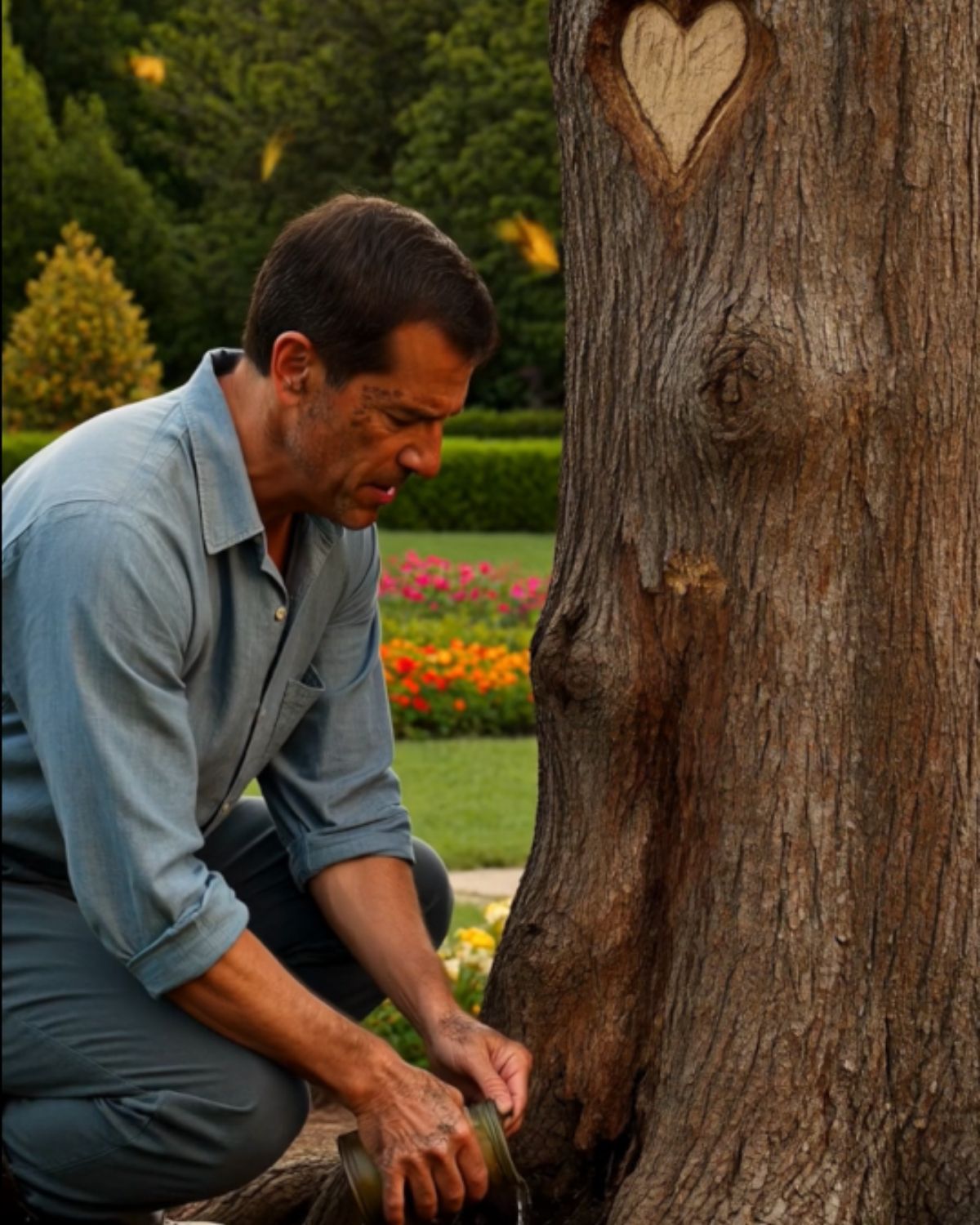
Mateo looked toward a small carved mark on the trunk.
It was almost hidden beneath moss.
Two letters inside a heart.
E and J.
He had noticed them years earlier.
He had never tried to clean or remove them.
Someone had placed them there deliberately.
Someone who believed the tree would remain long enough for the mark to matter.
“I know someone cared about it,” Mateo said.
Richard glanced at the carving.
“People carve initials into trees every day.”
“This garden is private.”
“Not thirty years ago.”
Mateo looked at him.
Richard tapped the clipboard impatiently.
“The removal crew comes Friday.”
“Give me two weeks.”
“No.”
“One week.”
“No.”
“I can stabilize it.”
“And if another branch falls?”
“I will close this section of the garden.”
“You do not have authority to close anything.”
Mateo took a breath.
The other workers remained silent.
Richard stepped closer.
“This conversation is over.”
He handed Mateo a strip of bright orange plastic.
“Tie this around the trunk so the crew knows which tree to remove.”
Mateo looked at the tape.
Then at the tree.
The orange would look like a sentence already passed.
He did not take it.
Richard placed the strip on Mateo’s wheelbarrow.
“Friday morning.”
Then he walked away.
The groundskeepers returned to their work.
The maintenance worker restarted the fountain.
Within seconds, the garden moved again.
But Mateo remained beside the tree.
A single leaf detached from the highest branch and floated down between them.
He caught it before it reached the ground.
The leaf was dry at the edge.
But green at the center.
That afternoon, Mateo skipped his lunch break.
He loosened the compacted soil around the root zone using a narrow hand fork.
Not too deep.
Not enough to damage the fine roots.
He removed decorative stones that had trapped heat around the trunk.
He mixed compost with sand and aged bark.
Then he built a shallow ring around the base so water would move toward the roots instead of running across the lawn.
A banquet supervisor passed by.
“Why are you working on that? I heard they’re cutting it down.”
Mateo did not stop.
“They have not cut it down yet.”
The supervisor shrugged and kept walking.
By three o’clock, Mateo had tied a soft support band around the split trunk.
He used fabric instead of wire so the bark would not be damaged.
He trimmed only the dead wood.
He left every branch that still carried green tissue.
When he finished, the tree still looked old.
Still damaged.
Still out of place beside the polished garden.
But it stood more securely.
The next morning, Mateo arrived before sunrise.
He checked the roots.
Then the branches.
Then the small buds near the eastern side.
There were three.
Tiny.
Closed.
Almost invisible.
He touched one gently.
Life.
For the next four days, he worked around the tree whenever no manager was watching.
He redirected one irrigation line.
Added mulch.
Applied a natural treatment to the fungus near the base.
He placed temporary barriers around the path beneath the weakest branches.
At night, he read articles at the public library about magnolia decline and storm damage.
He copied notes into a small paper notebook because his phone screen was cracked and difficult to use.
His daughter, Sofia, noticed the soil beneath his fingernails when he returned home.
“You stayed late again.”
Mateo placed his lunch container in the sink.
“There is a tree at the hotel.”
“There are hundreds of trees at the hotel.”
“One needs help.”
Sofia looked at him.
She was seventeen and had heard this tone before.
It was the same tone he had used when he found an injured bird behind their apartment building.
The same tone he used when an elderly neighbor’s garden flooded.
“You’re going to get in trouble,” she said.
“Maybe.”
“Will they pay you extra?”
“No.”
“Then why?”
Mateo washed his hands.
“Because something does not become worthless just because saving it is inconvenient.”
Sofia leaned against the counter.
“You’re talking about more than a tree.”
Mateo smiled.
“Most people are.”
Friday arrived beneath a clear blue sky.
At 7:30, a landscaping truck pulled into the service entrance.
Two workers unloaded chainsaws.
Richard entered the garden carrying a printed removal order.
Mateo was already beside the magnolia.
The orange tape remained untouched on the wheelbarrow.
Richard stopped.
“Where is the removal marker?”
“I did not tie it.”
“I can see that.”
Mateo stood.
The support band around the trunk was visible now.
Fresh soil circled the roots.
The dead branches had been removed cleanly.
Richard’s face hardened.
“What have you done?”
“I stabilized it.”
“I told you not to.”
“You told me to cut it down.”
“Yes.”
“I could not.”
Richard looked toward the landscaping crew.
They were waiting near the path.
“Move away from the tree.”
Mateo remained where he was.
“Please examine the buds.”
“I am not interested in buds.”
“The roots are responding.”
“Mateo.”
“Give it one month.”
Richard’s voice became colder.
“You are refusing a direct instruction.”
“I am asking you not to destroy something that can recover.”
Richard stepped close enough that only the nearest employees could hear.
“This is not your garden.”
Mateo looked around.
He knew every plant.
He had planted the white roses beside the ballroom.
He had rebuilt the herb beds after the kitchen renovation.
He had carried buckets through heat waves and covered young trees during frost.
But Richard was right.
The garden did not belong to him.
That did not mean he had no responsibility toward it.
“No,” Mateo said. “But I care for it.”
“That is not the same as making decisions.”
Richard held out his hand.
“Your pruning shears.”
Mateo hesitated.
“Now.”
He unclipped the shears from his belt.
Richard took them.
“Your radio.”
Mateo slowly removed it.
Several staff members had gathered near the glass doors.
A receptionist watched from inside the lobby.
One of the groundskeepers whispered, “He’s firing him.”
Richard held the radio at his side.
“You are suspended pending disciplinary review.”
Mateo’s face changed.
He thought of rent.
Of Sofia’s school fees.
Of the money he sent each month to his mother.
Still, he did not step away from the tree.
Richard pointed toward the service entrance.
“Leave the property.”
Mateo looked at the landscaping crew.
One of the workers started his chainsaw.
The sound tore through the quiet garden.
Mateo flinched.
“Wait.”
Richard turned.
“What now?”
“At least let me show you the carving.”
Richard stared at him.
“What carving?”
Mateo placed one hand near the trunk.
The letters were faint beneath years of weather.
E and J.
Inside a small heart.
“The bark grew around it,” Mateo said. “It is old.”
Richard glanced at the mark.
For one second, uncertainty crossed his face.
Then it disappeared.
“It changes nothing.”
The chainsaw roared again.
At that exact moment, the glass doors behind them opened.
An elderly man stepped into the garden.
He wore a dark coat despite the mild weather and walked with the help of a silver-handled cane.
A younger woman followed carrying a tablet.
The staff near the doors straightened immediately.
It was James Halston.
Owner of the Halston Grand.
He rarely visited the property without notice.
For the past two years, he had left daily operations to the executive team while recovering from heart surgery and the death of his wife.
Most new employees had never met him.
Richard turned.
“Mr. Halston.”
James did not answer.
He was looking at the chainsaw.
Then at Mateo.
Then at the old magnolia.
The color left his face.
The cane stopped against the stone path.
“Turn that off.”
The landscaping worker released the trigger.
Silence rushed back into the garden.
James stared at the tree.
His assistant moved closer.
“Sir, are you all right?”
He did not respond.
He walked forward slowly.
Each step seemed to take more effort than the last.
Richard forced a professional smile.
“We’re removing a diseased tree. It has become a safety and presentation concern.”
James ignored him.
He reached the trunk.
His hand moved toward the carved mark.
The moment his fingers touched the letters, his shoulders dropped.
“My wife planted this tree.”
No one moved.
Mateo looked at him.
James traced the E with his thumb.
“Eleanor and James.”
His voice barely carried.
Richard’s clipboard lowered.
James looked up into the damaged branches.
“This was her last gift to this hotel.”
The assistant covered her mouth.
Several employees exchanged stunned glances.
Richard’s expression changed instantly.
“What do you mean?”
James remained beside the trunk.
“It was planted thirty-two years ago.”
His eyes stayed on the carving.
“Before the west wing. Before the ballroom. Before the hotel had enough money to hire a professional landscaping company.”
He smiled faintly.
“Eleanor chose this magnolia because she said guests should see something alive before they saw anything expensive.”
Mateo looked toward the hotel windows.
James continued.
“She planted it herself.”
His voice tightened.
“I held the shovel wrong. She laughed at me for ten minutes.”
The garden staff stood completely still.
James placed his palm flat against the bark.
“She carved our initials here on our twentieth anniversary.”
Richard swallowed.
“I was not aware of the tree’s history.”
James looked at him for the first time.
“Why would you be?”
There was no anger in the question.
That made it more painful.
James turned back to the tree.
“Eleanor became ill six months later.”
His assistant lowered her eyes.
“She continued visiting this garden even when she could barely walk. She would sit beneath this tree and watch the hotel lights come on.”
Mateo’s face softened.
James looked at the bench near the fountain.
The bench had been replaced years earlier, but he seemed to see another one.
Another morning.
Another life.
“She told me the hotel would become too polished after she was gone.”
A faint smile passed across his face.
“She said I would let people remove everything imperfect.”
Richard looked down.
James touched one of the support bands around the trunk.
“Who did this?”
Mateo answered.
“I did, sir.”
James examined the fabric.
“And the soil?”
“Also me.”
“The pruning?”
“Yes.”
Richard stepped forward.
“Mr. Halston, the tree was scheduled for removal because of structural risk. Mr. Silva acted without authorization.”
James looked at Mateo.
“You are Mr. Silva?”
“Mateo Silva.”
“What is your position?”
“Gardener.”
“How long have you worked here?”
“Eleven years.”
James looked at the roots.
“You believed it could survive?”
Mateo nodded.
“I still do.”
“Why?”
“The inner bark is green. The major roots are firm. New buds formed this week.”
James looked up quickly.
“Buds?”
Mateo pointed toward the eastern branch.
James followed his hand.
Three small buds rested near the end.
James moved closer.
His eyes filled.
“She always waited for those.”
No one spoke.
James touched the nearest bud without pressing it.
“Every spring, she would count them.”
His voice broke.
“She said the first bloom meant the hotel had survived another winter.”
Richard shifted the clipboard beneath his arm.
“The tree may still be unsafe.”
Mateo nodded.
“He is right.”
James looked at him.
“It needs professional inspection. The damaged crown must be reduced carefully. The soil needs treatment for at least one season.”
“You can save it?”
“I cannot promise.”
Mateo looked directly at him.
“But I believe it wants to live.”
James closed his eyes.
For a moment, the owner of the hotel was no longer a powerful businessman.
He was an old man standing beside something his wife had once touched.
When he opened his eyes, he looked toward the chainsaw crew.
“No one cuts this tree.”
Richard spoke carefully.
“Sir, we have already contracted the replacement.”
“Cancel it.”
“There may be a fee.”
“Pay it.”
“Yes, sir.”
James turned to Mateo.
“Were you suspended?”
Mateo glanced at Richard.
“Yes.”
“For refusing to remove the tree?”
“Yes.”
James faced Richard.
“Is that accurate?”
Richard held his posture.
“He disobeyed a direct instruction and altered hotel property without approval.”
James nodded slowly.
“Did you ask why he believed the tree could recover?”
“I considered the visible condition.”
“That was not my question.”
Richard fell silent.
James looked toward the orange tape on the wheelbarrow.
“You judged it dead before learning whether it was alive.”
Richard’s face tightened.
“The decision was based on appearance, risk and the garden plan.”
“And when he disagreed?”
“I enforced procedure.”
James looked back at the buds.
“Procedure nearly destroyed the last living thing Eleanor planted here.”
The words settled over the garden.
Richard’s shoulders dropped slightly.
The certainty left his face.
He finally looked at the tree differently.
Not as a damaged object disrupting the design.
As a piece of someone’s life.
As something that could not be replaced by purchasing a more attractive version.
James turned to Mateo.
“Why did you protect it?”
Mateo answered without hesitation.
“Because it was fighting.”
“You did not know who planted it.”
“No.”
“You did not know its value.”
“I knew it had value.”
James stared at him for a long moment.
Mateo continued.
“The carving told me someone had loved it. The roots told me it was not finished.”
James looked down.
His hand trembled slightly against the cane.
“When my wife became sick, people treated her the same way.”
The garden fell completely silent.
“They stopped speaking to her about next year,” he said. “They spoke around her. They made decisions as though she were already gone.”
Mateo’s eyes remained on him.
James touched the damaged trunk.
“She hated that.”
His voice became quieter.
“She said being weak and being finished were not the same thing.”
Mateo looked at the buds.
“No, sir. They are not.”
James nodded once.
Then he held out his hand.
Mateo looked at it.
His own hand was rough and stained with soil.
He wiped it quickly against his trousers.
James did not wait.
He stepped forward and took it.
“Thank you for saving her memory.”
Mateo’s face tightened.
“I only tried to save the tree.”
James held his hand firmly.
“You saved both.”
Through the hotel windows, guests had begun gathering.
Several employees stood near the doors.
No one applauded.
The moment did not need applause.
Richard remained a few feet away, still holding Mateo’s shears and radio.
He looked at them.
Then at Mateo.
Slowly, he stepped forward.
He returned the tools.
“You were right,” he said.
Mateo clipped the shears back onto his belt.
Richard handed him the radio.
“I should have listened.”
Mateo took it.
Richard’s eyes moved toward James.
Then back to Mateo.
“I saw a dying tree.”
Mateo looked at the green buds.
“You saw the damaged parts.”
Richard lowered his head.
“Yes.”
James turned to his assistant.
“Call an arborist today. The best available.”
She nodded.
“And close this section until the tree is assessed.”
“Yes, sir.”
James looked toward Richard.
“This garden will not be redesigned around photographs.”
Richard remained silent.
“It will be cared for around history.”
“Yes, Mr. Halston.”
James faced Mateo again.
“I want you present during every inspection.”
Mateo looked surprised.
“Sir?”
“You know this tree better than anyone here.”
“I am not certified.”
“You do not need a certificate to explain what you have observed.”
Richard’s face changed again.
The man he had dismissed as only a gardener was now being consulted directly by the owner.
James continued.
“And from now on, no mature tree on this property is removed without a documented health assessment.”
His assistant typed quickly.
“Also,” James said, “create a historical map of the garden. Every original tree, bench and planting.”
Richard nodded.
“We can assign the landscape architect.”
James looked at Mateo.
“Assign him too.”
Mateo glanced behind him as though another person might be standing there.
James almost smiled.
“You preserved the one thing our records failed to protect.”
Within hours, a certified arborist arrived.
She examined the trunk with a resistance drill, tested the soil and inspected the damaged branches from a lift.
The diagnosis was serious but not hopeless.
The magnolia had suffered storm damage, fungal stress and years of compacted soil.
But the trunk remained structurally viable.
The roots were stronger than expected.
The tree could survive.
The dead crown was carefully reduced.
A breathable brace replaced Mateo’s temporary support.
The soil was aerated.
Fungal treatment began immediately.
For weeks, the garden path remained closed.
Guests complained about the barriers.
Wedding photographers asked why an old damaged tree occupied the best location near the fountain.
For once, management did not apologize.
A small sign appeared beside the path.
It read:
This magnolia was planted by Eleanor Halston in 1994, during the early years of the Halston Grand. It is currently undergoing careful restoration. Some things deserve patience.
James visited every Friday morning.
At first, he came with his assistant.
Later, he came alone.
He always stopped beneath the eastern branch.
Mateo would meet him with updates.
Moisture levels.
New growth.
Leaf condition.
Neither man spoke much about Eleanor.
They did not need to.
Her presence lived in the care itself.
One morning, James brought an old photograph.
It showed the garden before the fountain had been installed.
Eleanor stood beside the young magnolia with one boot in the soil and both hands wrapped around a shovel.
James stood behind her, laughing.
The small trunk reached only to her shoulder.
Mateo studied the picture.
“She planted it too close to the path,” he said.
James smiled.
“She refused to move it.”
“She was right.”
“She usually was.”
James handed him the photograph.
“For the garden archive.”
Mateo shook his head.
“This should stay with you.”
“I have another copy.”
Mateo looked more closely.
The carved heart was not yet on the trunk.
Eleanor’s face was bright.
Untroubled.
Alive in a way old photographs sometimes make painfully immediate.
“She looks happy,” Mateo said.
“She was.”
James looked toward the hotel.
“We had almost no money then. Half the rooms needed repair. The kitchen flooded whenever it rained.”
He smiled.
“Those were the best years.”
Mateo handed the photograph back.
James did not take it.
“Keep it near the tree.”
So Mateo placed it inside a weatherproof display beside the restoration sign.
Employees began stopping to look.
Guests did too.
The damaged magnolia became more photographed than the imported flowers intended to replace it.
Not because it was perfect.
Because it had a story.
Three months later, Richard found Mateo near the root zone.
He crouched beside him.
This was new.
Managers usually stood while gardeners knelt.
“What are you checking?” Richard asked.
“New feeder roots.”
“Can you see them?”
Mateo moved a small amount of mulch.
A fine white root crossed the dark soil.
Richard leaned closer.
“That means recovery?”
“It means effort.”
Richard nodded.
For several seconds, they remained there.
Then Richard said, “I owe you more than an apology.”
Mateo looked at him.
“I wanted the garden to look controlled.”
“It is your job.”
“I confused control with care.”
Mateo returned the mulch.
Richard looked toward the tree.
“I nearly removed it because I did not understand it.”
“Most things look simple from far away.”
Richard accepted the answer.
After that, he began asking before deciding.
Not always.
People do not transform in a single afternoon.
But enough.
He consulted older employees before changing long-standing parts of the property.
He requested health assessments before removing trees.
He stopped calling imperfect areas “problems” until someone had explained why they existed.
By early spring, the magnolia had grown leaves across the eastern side.
The western branches remained thin.
The trunk still carried its scars.
No restoration could return it to youth.
But it was alive.
On the morning the first flower opened, Mateo arrived at 5:40.
The garden was blue with early light.
He saw the white petals from across the lawn.
One bloom.
Large and bright against the damaged branches.
He stopped walking.
Then he smiled.
He took a photograph and sent it to James.
James arrived twenty minutes later.
No coat.
No assistant.
He walked faster than Mateo had ever seen him move.
When he reached the tree, he stood beneath the flower and looked up.
His eyes filled immediately.
“She would have counted that as one,” he whispered.
Mateo stood beside him.
“One is enough to begin.”
James nodded.
Hotel staff gathered quietly near the path.
Richard came last.
He removed his phone but did not take a picture.
He simply watched.
James looked at the carved initials.
Then at the flower.
For the first time since Eleanor’s death, the tree had bloomed.
The hotel placed no ribbons around it.
No champagne table.
No public relations banner.
James had refused all of that.
Instead, he invited the garden staff to breakfast beneath the magnolia.
Gardeners.
Groundskeepers.
Maintenance workers.
The people who watered, pruned, repaired and protected things long before guests noticed them.
At the end of the meal, James stood.
He held no prepared speech.
He looked at Mateo.
“This tree is alive because one man saw possibility where the rest of us saw inconvenience.”
Mateo lowered his eyes.
James continued.
“He did not know who planted it. He did not know that it mattered to me.”
He looked across the staff.
“He protected it when there was no reward for doing so.”
Richard stood near the fountain.
His face held no shock now.
Only recognition.
James raised one hand toward the magnolia.
“This hotel has spent years teaching employees to preserve what is expensive.”
His voice softened.
“We must also learn to preserve what is irreplaceable.”
Later that morning, a small plaque was installed near the trunk.
It did not mention the value of the hotel.
It did not mention awards or ownership.
It read:
ELEANOR’S MAGNOLIA
Planted with hope.
Damaged by time.
Saved by care.
Below those words was one final line:
In honor of every person who sees life before others see loss.
Mateo continued working in the garden.
His uniform remained simple.
His boots remained old.
He did not become famous.
But he was promoted to Head of Garden Preservation, a position James created not as a ceremonial reward, but because the hotel had finally understood what Mateo’s work required.
Knowledge.
Patience.
Memory.
Judgment.
And the courage to protect something fragile when everyone with more authority has already decided it is finished.
The magnolia never became perfectly shaped.
One side always grew fuller than the other.
The scar remained visible.
The carved initials stretched wider as the trunk expanded.
Guests sometimes asked why such an uneven tree stood in the center of a luxury garden.
The staff no longer called it damaged.
They told the story.
They pointed toward the white flowers.
They showed visitors the photograph of Eleanor holding the shovel.
And they explained how a gardener risked his job because he believed a living thing deserved one more chance.
Because love does not always survive in grand monuments.
Sometimes it survives in cracked bark, a faded carving and the quiet hands of someone humble enough to notice that it is still alive.