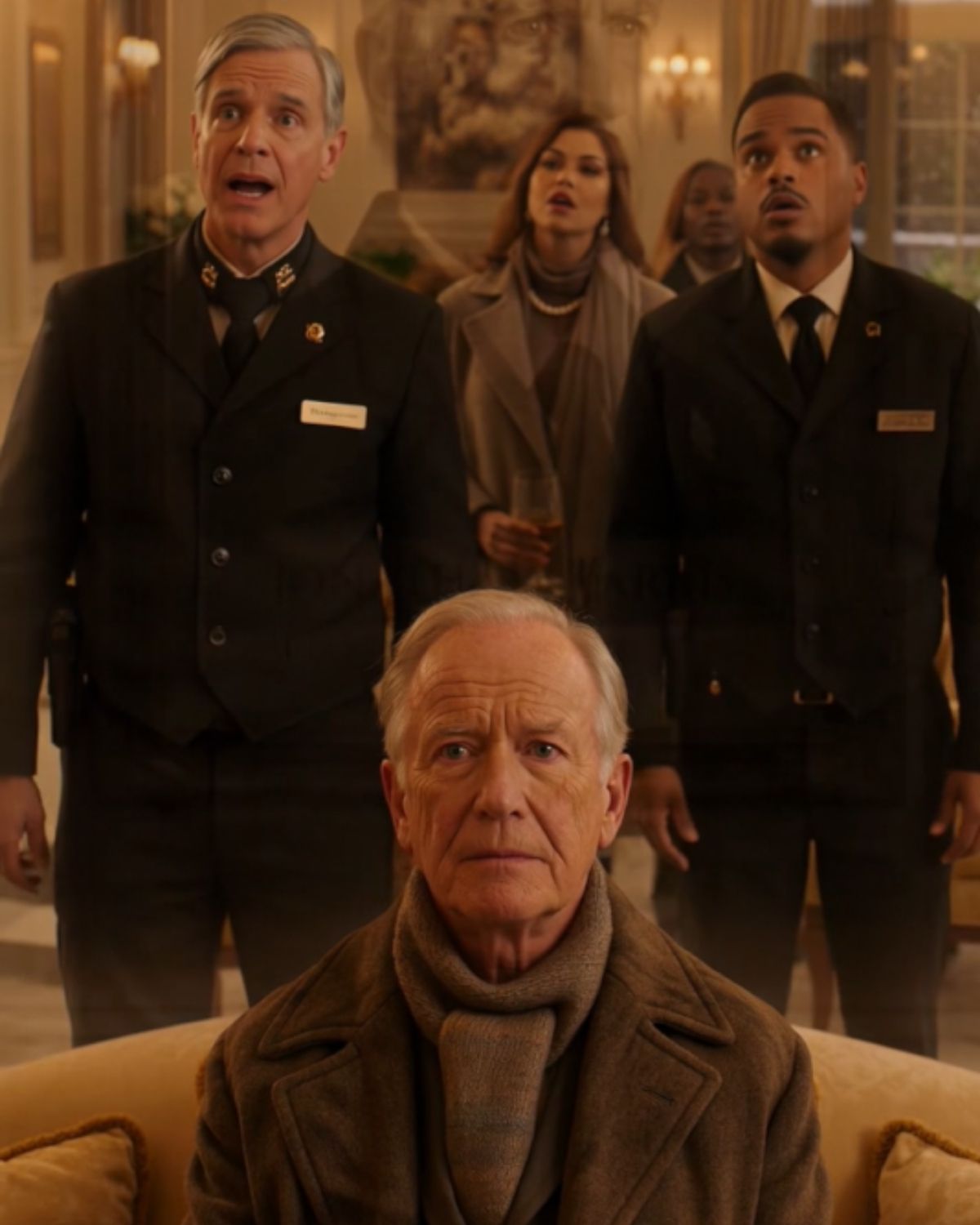
The old man had been sitting beside the fireplace for less than six minutes when the hotel manager decided he did not belong there.
Outside, snow pressed against the tall glass windows of the Waverly Grand.
Inside, the lobby glowed with amber light.
A pianist played softly beneath a crystal chandelier. Wealthy guests rested on velvet sofas with glasses of wine. Bellmen moved through the entrance carrying leather suitcases while the fireplace burned beneath a carved stone mantel.
The old man sat alone at the edge of it all.
His coat was dark brown and worn thin at the elbows.
Snow melted slowly from the shoulders.
His shoes were clean but old, and the wooden cane between his knees carried more scratches than polish.
He held both hands toward the fire.
Not dramatically.
Not desperately.
He simply looked cold.
A woman seated nearby glanced at him, then pulled her handbag closer.
Her husband followed her gaze.
“Is he staying here?” he whispered.
The old man heard him.
He gave no sign.
At the reception desk, Daniel Price, the evening operations manager, had already noticed.
Daniel was thirty-eight, sharply dressed and recently promoted. He took pride in maintaining what he called the atmosphere of the property.
The Waverly Grand was not merely a hotel, he often reminded staff.
It was an experience.
Everything guests saw had to match that experience.
The flowers.
The music.
The uniforms.
The people.
Daniel watched the old man rub his hands near the flames.
Then he looked toward the entrance.
No luggage.
No reservation folder.
No driver.
No expensive coat.
He leaned toward the receptionist.
“Did he check in?”
The receptionist searched the screen.
“I don’t think so.”
“Did anyone see him enter?”
“One of the doormen said he walked in about five minutes ago.”
Daniel’s jaw tightened.
“He’s not a guest. Ask him to leave.”
The receptionist hesitated.
“He’s only sitting by the fire.”
Daniel looked at her.
“That area is for registered guests.”
“There are several empty seats.”
“That is not the point.”
The receptionist glanced toward the old man.
“What should I say?”
Daniel looked toward the security desk.
“I’ll handle it.”
He called over a guard named Marcus.
Marcus followed Daniel’s gaze.
“The man near the fireplace?”
“Yes.”
“What did he do?”
“He entered without checking in.”
Marcus waited.
Daniel lowered his voice.
“Ask him to move along.”
Marcus had worked at the hotel for only four months.
He did not like removing elderly people from warm buildings during winter.
But he also had a probationary review coming soon.
“Understood.”
He crossed the lobby.
The old man was watching the fire.
Up close, Marcus noticed that his coat had been repaired carefully. A different shade of brown thread ran along one sleeve.
Beside his chair sat a small cloth bag.
Not luggage.
More like something used to carry a book or a few personal belongings.
Marcus stopped at a respectful distance.
“Good evening, sir.”
The old man looked up.
His eyes were pale blue and alert.
“Good evening.”
“Are you staying with us tonight?”
“No.”
“Are you meeting someone?”
The old man looked toward the main staircase.
“Not exactly.”
Marcus glanced back at Daniel.
The manager stood near reception, watching.
“I’m afraid the lobby seating is reserved for hotel guests.”
The old man looked around.
Several sofas were empty.
“I see.”
Marcus felt uncomfortable.
“Is there somewhere I can help you get to?”
“No, thank you.”
The old man returned his hands toward the fire.
Marcus remained standing.
“Sir, I’m going to have to ask you to leave.”
The old man looked toward the snow outside.
Wind pushed a sheet of white across the entrance.
“I only need a few minutes to rest.”
His voice was calm.
Not pleading.
That made the request harder to refuse.
Marcus lowered his voice.
“It’s very cold outside.”
“Yes.”
“Is there anyone I can call?”
“No.”
“A shelter?”
The old man smiled faintly.
“I have a home.”
Marcus looked again at the worn coat.
He hated himself for wondering whether that was true.
Behind them, Daniel began walking over.
The old man noticed the manager approaching.
“I won’t cause trouble,” he said.
Marcus nodded.
“I know.”
Daniel arrived.
“Is there a problem?”
Marcus straightened.
“No, sir.”
Daniel looked directly at the old man.
“Good evening. I’m the operations manager.”
The old man studied him.
“You look young for it.”
Daniel was unsure whether this was praise.
“Thank you.”
The old man turned back toward the fire.
Daniel’s expression tightened.
“We have policies regarding non-guests using the lobby.”
The old man nodded.
“Hotels have many policies now.”
Daniel folded his hands.
“May I ask why you came inside?”
“To get warm.”
“There are public facilities several blocks east.”
“I know.”
Daniel’s eyes moved toward the cloth bag.
“What is your name?”
The old man looked at him.
“Why?”
“For our incident record.”
Marcus glanced at Daniel.
The phrase sounded unnecessarily severe.
The old man noticed too.
“Incident?”
“You entered a private property without being a guest.”
The old man slowly leaned back.
“I thought hotels were open to travelers.”
“To paying travelers.”
The words left Daniel before he could soften them.
The receptionist looked down.
A nearby bellman stopped moving.
The old man showed no anger.
Only disappointment.
“That distinction used to matter less.”
Daniel’s voice became firmer.
“Your name, please.”
The old man sighed.
“Arthur Waverly.”
A brass luggage cart stopped suddenly near the elevators.
The employee pushing it froze.
His name was Samuel Ortiz.
He was seventy-one years old and had worked at the hotel for forty-six years.
He had started as a kitchen porter at seventeen.
Then he became a bellman, doorman, concierge and eventually guest relations ambassador.
He had served politicians, actors, athletes and royal families.
He remembered staff members long since retired.
He remembered renovations no current manager had witnessed.
And he remembered the name Arthur Waverly.
Samuel turned slowly.
“What did he say?”
The bellman beside him looked confused.
“Who?”
“The old man.”
Daniel heard him.
“He said his name is Arthur Waverly.”
Samuel released the luggage cart.
It rolled several inches before striking the edge of a rug.
His face lost color.
“That’s impossible.”
Daniel frowned.
“Do you know him?”
Samuel did not answer.
He walked toward the fireplace.
Not quickly.
At his age, he no longer moved quickly.
But every person who knew him saw urgency in his steps.
The old man looked up as Samuel approached.
For several seconds, the two men stared at each other.
Samuel’s mouth opened.
No words came.
The old man smiled.
“You still walk with your left shoulder forward.”
Samuel stopped breathing.
Only one person had ever teased him about that.
A young hotel owner who used to help bellmen carry luggage during busy weekends.
A man who knew every employee’s name.
A man who disappeared from public life nearly thirty years earlier.
Samuel whispered, “Mr. Waverly?”
The old man’s smile deepened.
“Hello, Sammy.”
The lobby changed.
Samuel had not been called Sammy inside the hotel for more than four decades.
His eyes filled immediately.
“No one calls me that anymore.”
“I do.”
Daniel looked between them.
“You know this man?”
Samuel turned toward him.
His expression was unlike anything Daniel had seen before.
Shock.
Joy.
And anger.
“This man?”
Samuel pointed toward the large portrait wall beside the grand staircase.
At the center hung an oil painting of a man in his early forties.
Dark hair.
Straight shoulders.
Blue eyes.
Below the frame, a brass plate read:
ARTHUR JAMES WAVERLY
FOUNDER OF THE WAVERLY GRAND
1972
Guests began turning toward the portrait.
Then toward the elderly man near the fireplace.
The resemblance was unmistakable.
The same eyes.
The same nose.
The same slight tilt of the head.
Samuel’s voice shook.
“You founded this hotel.”
The lobby became silent.
The pianist stopped in the middle of a song.
Daniel’s face went blank.
Marcus stepped back.
The receptionist slowly rose from her chair.
Arthur Waverly remained seated.
He looked toward the portrait.
“That painting always made me look more serious than I was.”
No one laughed.
Samuel moved closer.
“We thought you were dead.”
Arthur nodded.
“I heard that rumor.”
“Where have you been?”
“Living quietly.”
“For twenty-eight years?”
“Mostly.”
Samuel stared at him.
“You never wrote.”
“I wrote several times.”
“To whom?”
“The board.”
Samuel’s expression hardened.
“They told us you wanted no contact.”
Arthur looked toward the reception desk.
“I suspected they might.”
Daniel found his voice.
“Mr. Waverly, I had no idea.”
Arthur looked at him.
“No.”
The answer was quiet.
“You didn’t.”
Daniel’s face flushed.
“I sincerely apologize. Had I known who you were—”
Arthur raised one hand.
“That is exactly the problem.”
The words stopped him.
Arthur looked around the lobby.
Guests sat motionless.
Employees stood near the desks and doorways.
He rested both hands on the handle of his cane.
“You were prepared to welcome me once I became the man in the portrait.”
Daniel swallowed.
Arthur continued.
“But six minutes ago, I was only an old man with a wet coat.”
No one moved.
Marcus looked toward the front doors.
Snow had gathered against the lower glass panels.
Arthur followed his gaze.
“I only asked for a few minutes beside the fire.”
Daniel lowered his eyes.
Samuel sat slowly in the chair across from Arthur.
“You came here to test us?”
Arthur considered the question.
“Not at first.”
“Then why?”
Arthur looked at the fireplace.
“Because I built that.”
Samuel turned.
The stone mantel rose almost three meters high. Carved oak leaves ran along its edges. At the center sat a small brass emblem shaped like a lantern.
Most guests never noticed it.
Samuel did.
“You designed it,” he said.
Arthur nodded.
“My mother hated grand lobbies.”
A faint smile crossed his face.
“She said large rooms made tired people feel even smaller.”
Employees listened.
“When I opened this hotel, she asked me to promise that anyone who entered cold could sit beside a fire without being questioned first.”
Daniel’s face tightened.
Arthur touched the arm of the chair.
“She chose these chairs too. The originals were green. Much less elegant.”
Samuel smiled through tears.
“They were terrible.”
“They were.”
For one brief moment, the tension softened.
Then Arthur looked toward Daniel again.
“But they were always available.”
The manager stood completely still.
A guest near the fireplace slowly moved her handbag back to its original place.
Arthur noticed.
He said nothing.
Samuel leaned closer.
“Why did you disappear?”
Arthur looked toward his younger face on the wall.
“The official story says I retired.”
“That is what we were told.”
“I was forced out.”
The general manager had arrived from the upstairs offices.
Her name was Laura Bennett.
She stopped near the reception desk as Arthur spoke.
Daniel looked toward her for guidance.
She did not move.
Arthur continued.
“The hotel expanded too quickly during the late eighties. I disagreed with the investors. They wanted more rooms, higher rates and fewer staff.”
Samuel nodded slowly.
“I remember the layoffs.”
“I stopped the first round.”
“What happened?”
“They removed me from the board.”
Arthur’s hand tightened around the cane.
“My wife was ill by then. I had spent most of my personal money trying to buy back shares.”
Samuel lowered his eyes.
“We heard she died.”
“Two years later.”
“I’m sorry.”
Arthur nodded.
“After that, I did not have much fight left.”
The lobby remained silent.
He continued.
“I moved north. Bought a small house near the sea. Taught hospitality management at a community college under my middle name.”
Daniel looked surprised.
Arthur almost smiled.
“No one knew who I was. It was peaceful.”
“Why return now?” Laura asked.
Arthur looked toward her.
She approached carefully.
“I am Laura Bennett, general manager.”
“I know.”
Her steps stopped.
“You know me?”
“I read annual reports.”
Laura glanced toward the founder portrait.
“Then why come without contacting us?”
Arthur reached into the cloth bag.
He removed a small envelope.
The hotel logo was printed in the corner.
It was a letter from the Waverly Grand.
“My invitation.”
Laura looked confused.
Arthur handed it to Samuel.
Samuel opened it.
The hotel had invited Arthur to attend the property’s fiftieth anniversary celebration.
It was addressed to:
The Estate of Arthur James Waverly.
The letter requested permission to display personal artifacts belonging to the late founder.
Samuel looked up.
“They think you are dead.”
Arthur nodded.
“The current board never verified it.”
Laura’s face went pale.
Arthur continued.
“I called last week.”
“Who did you speak to?”
“A young man in corporate guest relations.”
“And?”
“He said the anniversary was a private event for investors, executives and invited descendants of the founder.”
A few employees exchanged embarrassed glances.
Samuel folded the letter carefully.
“You told him who you were?”
“I did.”
“What happened?”
“He asked for proof.”
Arthur looked toward the portrait.
“I decided to bring it personally.”
He reached into the cloth bag again.
This time, he removed an old leather folder.
Inside were the original incorporation documents for the Waverly Grand.
The founder’s signature appeared on every page.
There were early architectural drawings.
Photographs of construction workers.
A handwritten list of the hotel’s first twenty-three employees.
Samuel took the list.
His finger moved down the page.
Then stopped.
His own name was there.
Samuel Ortiz — Kitchen Porter — Age 17.
Beside it, Arthur had written:
Fast learner. Wants to work front of house. Give him a chance.
Samuel covered his mouth.
“You kept this?”
“I kept everything.”
Samuel’s tears fell onto the page.
Arthur looked at him.
“You deserved the chance.”
“You gave me my life.”
“No.”
Arthur shook his head.
“I opened one door. You walked through it for forty-six years.”
Daniel stared at the document.
The quiet old man he had tried to remove had not simply founded the hotel.
He had recorded the name and ambition of a teenage kitchen porter decades before anyone else considered him important.
Arthur looked toward Marcus.
“You asked whether there was someone you could call.”
Marcus straightened.
“Yes, sir.”
“That was kind.”
Marcus looked uncomfortable.
“I was still going to remove you.”
“You were following instructions.”
Arthur glanced toward Daniel.
“That does not erase responsibility. But it explains pressure.”
Daniel absorbed the difference.
Arthur did not excuse Marcus.
He also did not use the younger employee to protect the manager who had given the order.
Laura stepped forward.
“Mr. Waverly, I need to apologize on behalf of the hotel.”
Arthur studied her.
“For believing I was dead?”
“For everything that happened tonight.”
“You did not order me out.”
“I created the environment in which the order made sense.”
Daniel looked toward her.
Laura continued.
“Our staff are trained to protect guest spaces. We focus on security, privacy and standards.”
“And hospitality?”
Laura’s voice lowered.
“We assumed those things were hospitality.”
Arthur looked around the lobby.
“Security protects people.”
He gestured toward the furniture.
“Standards protect appearances.”
The distinction settled across the room.
Laura nodded slowly.
“We confused them.”
“Yes.”
Daniel finally stepped closer.
His earlier confidence had disappeared.
“Mr. Waverly, I was wrong.”
Arthur waited.
Daniel looked toward the guests.
The apology would have been easier in private.
But the humiliation had not been private.
“I judged you by your coat,” Daniel said.
Arthur’s expression did not change.
“I assumed you had no right to sit here because you did not look like our guests.”
A man on the nearby sofa lowered his glass.
Daniel continued.
“I asked for your name only after deciding you were a problem.”
Arthur nodded.
“That is accurate.”
Daniel swallowed.
“I am ashamed.”
Arthur looked toward the fire.
“Shame is useful for one evening.”
Daniel waited.
“What matters is what you do the next time an unknown old man walks through those doors.”
The manager’s shoulders lowered.
He looked toward Marcus.
Then toward the receptionist.
Then toward the snow outside.
“I will not ask whether he can pay before asking whether he needs help.”
Arthur met his eyes.
“That would be a beginning.”
Samuel stood.
“We need to announce this.”
Arthur shook his head.
“No.”
Everyone looked at him.
“The anniversary gala begins in two days,” Laura said. “The board must know you are alive.”
“They will.”
“Then why not announce it now?”
Arthur looked toward the guests recording on their phones.
“Because I did not come here to become a spectacle.”
Several phones lowered.
He continued.
“I came to sit beside the fire.”
Samuel looked at him.
“And to see if the place still welcomed people.”
Arthur nodded.
“That too.”
Laura looked toward the founder portrait.
“What did you find?”
Arthur’s eyes moved across the lobby.
He saw the receptionist who had hesitated.
The security guard who had spoken gently despite his orders.
The manager who had valued appearance over humanity.
The guests who had watched.
The employee who remembered.
“I found the building,” he said.
Then he looked at Samuel.
“And one piece of the hotel.”
The words hurt more than criticism.
Laura understood.
A building could remain beautiful after its purpose disappeared.
A company could preserve a founder’s portrait while abandoning the reason he built the place.
Arthur looked toward the brass lantern above the fireplace.
“Do you know what that symbol means?”
Daniel shook his head.
Laura did too.
Samuel answered.
“Shelter.”
Arthur smiled.
“My mother’s idea.”
He pointed toward the emblem.
“She said a hotel should be a lantern in bad weather.”
The snow struck the windows harder.
For a moment, everyone heard it.
Arthur continued.
“Not a fortress.”
Laura closed her eyes briefly.
The phrase exposed the entire evening.
A lantern invited people toward warmth.
A fortress demanded proof before opening its doors.
Arthur stood slowly.
Samuel reached to help him.
Arthur accepted his arm.
His knees were stiff from the cold.
Daniel moved toward the cloth bag.
“May I carry that?”
Arthur looked at him.
Daniel waited.
Not assuming.
Asking.
Arthur handed it over.
“Thank you.”
The small gesture changed Daniel’s face.
Laura approached the fireplace chair.
“Would you remain here tonight?”
Arthur looked surprised.
“As a guest,” she added quickly. “Or simply as someone who needs warmth.”
Arthur smiled faintly.
“Better.”
“We would be honored to prepare a room.”
“I have a room at a modest hotel near the station.”
Laura looked pained.
“We invited the founder’s estate to our anniversary while the founder booked another hotel.”
Arthur nodded.
“The room was affordable.”
Daniel looked toward the floor.
Laura said, “Please stay here.”
Arthur considered it.
“On one condition.”
“Anything.”
“No ceremonial suite.”
Laura waited.
“And no staff lined up to bow when I walk past.”
A few employees smiled nervously.
“I want a normal room.”
“Of course.”
“And Samuel has breakfast with me.”
Samuel laughed through his tears.
“I start at seven.”
“Then breakfast at six thirty.”
Samuel nodded.
“I’ll be there.”
Arthur looked toward the receptionist.
“What is your name?”
“Rachel.”
“Rachel, is the kitchen still serving soup?”
“Yes, Mr. Waverly.”
“What kind?”
“Wild mushroom bisque.”
Arthur frowned.
“Anything simpler?”
She almost smiled.
“Tomato soup.”
“Perfect.”
“Would you like it sent to your room?”
Arthur looked at the fire.
“Here.”
Rachel nodded.
“With bread?”
“Yes.”
She started to turn.
Arthur stopped her.
“And ask the doormen whether anyone outside needs something warm.”
The lobby became quiet again.
Rachel glanced toward Laura.
The general manager nodded.
“Do it.”
Within fifteen minutes, hotel staff carried cups of soup to two delivery drivers waiting beneath the canopy, a taxi driver whose car battery had failed and a woman standing at the bus stop across the street.
No one was asked for a reservation number.
Arthur remained beside the fireplace.
His tomato soup arrived in a white porcelain bowl.
Samuel sat across from him.
For the first time in decades, they spoke about the early hotel.
The first winter.
The leaking roof.
The night every room filled during a railway strike.
The cook who slept in the laundry room because all local shelters were full.
Employees gathered at a respectful distance.
Arthur invited them closer.
He did not tell stories about celebrities or wealthy guests.
He told them about porters.
Cleaners.
Cooks.
Night receptionists.
The people whose names did not appear on the portrait wall.
At one point, Marcus asked, “Did you really let anyone sit in the lobby?”
Arthur shook his head.
“Not anyone.”
The staff waited.
“We removed people who threatened guests. We removed people who were violent or destructive.”
He tore a piece of bread.
“But being poor was never treated as misconduct.”
Marcus nodded.
Daniel stood near the reception desk, listening.
Arthur continued.
“Hospitality without judgment does not mean operating without safety.”
He looked toward Daniel.
“It means judging behavior before appearance.”
Daniel met his eyes.
The lesson was precise.
Not sentimental.
Not impossible.
At 9:40, three board members arrived after Laura contacted them.
They entered through the private executive door.
Arthur saw them.
He did not stand.
The oldest board member, Charles Wren, approached the fireplace with disbelief.
“Arthur?”
Arthur lifted his spoon.
“Charles.”
“We were told—”
“That I was dead?”
Charles looked toward the floor.
“There was confusion.”
“For almost three decades?”
Charles had no answer.
Arthur set down the spoon.
“You received my letters.”
Charles’s expression changed.
Laura looked sharply at him.
“What letters?”
Charles remained silent.
Arthur reached into the leather folder.
He removed copies.
“Requests for financial records. Questions about pension reductions. Concerns about staff cuts.”
Laura took one page.
The letter had been received and stamped by the board office sixteen years earlier.
“You knew he was alive,” she said.
Charles looked around the lobby.
“This is not the appropriate place.”
Arthur looked toward the guests.
“It is the place you nearly removed me from.”
Charles’s face tightened.
Samuel stood beside Arthur.
Employees moved closer.
Not threateningly.
But no longer invisible.
Arthur continued.
“The board preserved my name because it was useful.”
He looked toward the portrait.
“But not my voice.”
Charles spoke quietly.
“The company had changed.”
“Yes.”
“You no longer held shares.”
“I know.”
“Then you had no authority.”
Arthur nodded.
“That is true.”
Charles seemed relieved.
Then Arthur added, “But you continued using my history to market values you no longer practiced.”
The relief disappeared.
Laura looked toward the anniversary banners hanging near the ballroom entrance.
FIFTY YEARS OF WARMTH, SERVICE AND WELCOME.
The words now felt almost cruel.
Arthur looked at Daniel.
“Was the instruction to remove me consistent with current policy?”
Daniel hesitated.
“Yes.”
“Written?”
“Yes.”
Arthur faced the board.
“Then tonight was not one manager’s mistake.”
Charles remained silent.
“It was the result of the culture you approved.”
Arthur did not raise his voice.
He did not need to.
The security cameras had recorded everything.
The employees had witnessed it.
The founder’s own name had turned a routine removal into evidence.
Laura took a breath.
“We will review the policy immediately.”
Arthur looked at her.
“Review is a useful word when leaders are not yet ready to promise change.”
Laura accepted the criticism.
“Then we will change it.”
Charles began to object.
Laura turned toward him.
“He is right.”
The board member stared at her.
She continued.
“We cannot celebrate a founder whose mother wanted strangers warmed beside the fire while instructing staff to remove people who look poor.”
Charles looked toward the guests.
“This could damage the brand.”
Arthur smiled sadly.
“That sentence is why I left.”
The lobby fell silent again.
Charles finally understood.
It appeared in the way his face stiffened.
The way he looked toward the portrait.
The way he stopped trying to control the language of the moment.
For decades, the hotel had treated Arthur Waverly as a dead symbol.
A name beneath a painting.
A safe story.
Now the man himself sat in a worn coat beside the fire, exposing the distance between the symbol and the company.
Arthur turned away from the board.
He looked at Samuel.
“How is the soup?”
Samuel tasted it.
“Too expensive.”
Arthur laughed.
The tension broke.
Even Laura smiled.
Two days later, the fiftieth-anniversary gala began in the ballroom.
Hundreds of guests attended.
Investors expected a polished history presentation followed by champagne.
Instead, the stage remained dark.
Arthur walked out alone.
He wore the same repaired brown coat.
The board had offered him a tailored suit.
He refused.
Behind him, the large screen displayed the security footage from the winter evening.
The old man entering.
The manager watching.
The guard approaching.
The founder sitting beside the fire while people assumed he did not belong.
No audio played.
It did not need to.
Arthur stood beneath the hotel emblem.
“When this building opened fifty years ago,” he began, “we had forty rooms, one unreliable elevator and a fireplace that smoked whenever the wind changed direction.”
The audience laughed softly.
Arthur waited.
“But we had one rule.”
The room quieted.
“No person was judged by their coat before being judged by their conduct.”
Daniel stood near the back with the evening staff.
Arthur continued.
“Two nights ago, I entered the hotel wearing an old coat.”
He looked toward the screen.
“I was asked to leave.”
A murmur moved through the ballroom.
Arthur raised one hand.
“The employee who approached me was not cruel.”
Marcus looked up.
“He was following an instruction.”
Arthur looked toward Daniel.
“The manager who gave that instruction has admitted his mistake publicly.”
Daniel did not hide.
“But a culture cannot blame one person for carrying out the values leadership has rewarded.”
The board members sat completely still.
Arthur looked across the room.
“If you train people to protect luxury from anyone who appears poor, they will do it.”
“If you reward appearance over judgment, they will notice clothes before need.”
“If you display the word welcome while making warmth conditional, eventually someone will expose the contradiction.”
He turned toward the fireplace image on the screen.
“I happened to have my name beneath a portrait.”
His voice softened.
“The next cold person may not.”
The ballroom remained silent.
Arthur announced three changes.
The hotel would remove any policy treating non-guests as automatic security concerns based solely on appearance.
All front-of-house staff would be trained to assess conduct, need and safety before reservation status.
And every Waverly property would maintain a winter hospitality protocol offering temporary warmth, water and assistance to anyone facing dangerous weather.
The board had approved the changes that morning.
Not because Arthur still owned the hotel.
He did not.
They approved them because employees, guests and several journalists had already seen the footage.
The contradiction could no longer be hidden.
But Arthur refused to let the evening become only punishment.
He invited Marcus onto the stage.
The young guard looked terrified.
Arthur shook his hand.
“This man spoke respectfully while carrying out an order he did not like.”
Marcus looked stunned.
Arthur continued.
“That does not make the order right. But integrity often begins when an employee remains human inside a bad system.”
Then he called Daniel forward.
The manager stepped onto the stage beneath hundreds of eyes.
Arthur did not humiliate him.
He asked one question.
“What did you learn?”
Daniel looked toward the screen.
“That I noticed your coat before your condition.”
Arthur waited.
Daniel continued.
“I protected the lobby from a person who had done nothing wrong.”
His voice shook.
“And I became respectful only after learning your name.”
Arthur nodded.
“What will you do differently?”
Daniel looked toward the employees.
“I will never again require someone to prove importance before receiving basic dignity.”
The audience remained silent.
Arthur held out his hand.
Daniel took it.
The image spread across newspapers the next morning.
But the photograph Arthur cared about was taken later.
After the gala.
After the speeches.
After the wealthy guests had left.
It showed Arthur sitting beside the fireplace with Samuel, Marcus, Daniel, Rachel and six night-shift employees.
Paper cups stood on the table.
Someone had brought tomato soup from the kitchen.
No one wore formal clothing.
No one stood according to rank.
Above them, the brass lantern caught the firelight.
Arthur stayed at the Waverly Grand for one week.
Every morning, he sat beside the fireplace.
Some guests recognized him.
Most did not.
He preferred the ones who did not.
A delivery driver once sat beside him while waiting for a signature.
A mother warmed her child’s gloves near the fire after their bus was delayed.
An elderly woman entered during heavy snow and rested for twenty minutes before continuing home.
No employee asked them for a room number.
On Arthur’s final morning, Laura joined him.
“The board wants to offer you an honorary chairmanship.”
“No.”
“They expected that answer.”
“Then why ask?”
“Because boards enjoy formal rejection.”
Arthur smiled.
Laura looked toward the fire.
“What do you want from us?”
Arthur thought for a moment.
“Keep the chairs.”
She looked confused.
“When you renovate,” he explained, “designers will tell you to remove them.”
“The chairs beside the fireplace?”
“Yes.”
“They’ll say the space could generate revenue.”
“They probably will.”
Laura nodded.
“What else?”
“Stop telling employees the founder valued hospitality.”
Arthur looked at her.
“Show them what that requires.”
She accepted the distinction.
Before leaving, Arthur walked to the portrait wall.
Workers had removed the brass plate.
A new one was being installed.
It no longer described him only as founder.
It included the first sentence from his original opening-day speech:
A hotel earns the word “grand” not through marble, chandeliers or price, but through the dignity it gives every person who enters.
Samuel stood beside him.
“Better?”
Arthur read it.
“Too many words.”
Samuel laughed.
“You always used too many words.”
Arthur looked toward his old friend.
“Will you retire?”
“Eventually.”
“When?”
“When you stop disappearing.”
Arthur smiled.
“Fair.”
They walked toward the entrance together.
Snow had stopped.
Morning light filled the street.
Daniel opened the door.
He did not call Arthur “sir.”
He did not deliver a rehearsed farewell.
He simply said, “There will always be a chair by the fire.”
Arthur looked back at the lobby.
At the employees.
At the brass lantern.
At the fireplace his mother had insisted upon half a century earlier.
Then he nodded.
“Make sure it is not reserved for important people.”
Daniel understood.
“It won’t be.”
Arthur stepped outside.
The staff watched him leave.
Not as a forgotten founder returning to claim power.
He claimed nothing.
He left them with something more difficult.
A standard.
Because the true test of hospitality is not how warmly a hotel greets the person whose name hangs on the wall.
It is how warmly it treats the stranger whose name means nothing to anyone in the room.