Inside the Terrifying Nazi Death Factory at Sobibór

The train stopped in a forest so quiet that, for one dangerous moment, the passengers believed they had survived.
There were no factory chimneys towering above the tracks. No sprawling prison blocks. No city nearby.
Only pine trees, wooden fences, a railway platform, and German guards waiting beside signs designed to make the place look temporary.
Some prisoners were told they had arrived at a transit camp.
They would be disinfected, registered, and sent onward to work.
Families climbed down from the freight cars carrying suitcases, blankets, documents, and house keys. Mothers straightened their children’s clothes. Elderly passengers searched the platform for somewhere to sit. Men tried to understand the shouted instructions.
They did not know that Sobibór had not been built to hold them.
It had been built to make them disappear.
Hidden in the forests of German-occupied Poland, Sobibór was one of the Nazi killing centers created as part of Operation Reinhard—the campaign to murder the Jewish population of occupied Poland.
Unlike concentration camps where prisoners were exploited through prolonged forced labor, Sobibór’s central purpose was immediate mass murder.
For most people who stepped off the trains, there would be no barracks assignment.
No prisoner number.
No tomorrow.
The machinery began working the moment the transport arrived.
Guards separated men from women and children. Victims were ordered to surrender valuables and undress, supposedly for bathing and disinfection. Their luggage was collected and sorted. Money, jewelry, clothing, food, documents, and personal objects were removed.
Everything had a designated place.
Everything except the people.
A narrow, fenced passage led from the undressing area toward the gas chambers. Prisoners called it the “tube.”
Branches woven into the fences prevented victims from seeing beyond it. Guards drove people forward with shouting, beatings, and dogs. Confusion was essential. The Nazis understood that panic among hundreds of people could disrupt the process, so deception continued until the final moments.
The victims were told to remember where they had placed their clothing.
They were told they would receive their belongings afterward.
Children sometimes walked beside their mothers.
The elderly were sometimes transported separately under the pretense of receiving medical care.
At the end of the passage stood buildings presented as showers.
They were not showers.
Once the doors were sealed, an engine forced lethal carbon monoxide into the chambers.
Outside, members of the SS watched the time.
Inside, entire families died together.
Their bodies were then removed by Jewish prisoners whom the Nazis had temporarily spared for forced labor. These prisoners had to search mouths for gold teeth, cut women’s hair, clean the chambers, sort belongings, and dispose of the dead.
They lived only because the death factory required workers.
And they understood that the people operating the machinery would eventually be murdered to eliminate witnesses.
That was Sobibór’s most terrifying feature.
It did not rely only on violence.
It relied on organization.
The camp was divided into sections, each designed to isolate one stage of the killing process from another. New arrivals rarely understood what was happening until escape was almost impossible. Victims entering one section could not see the bodies being removed in another.
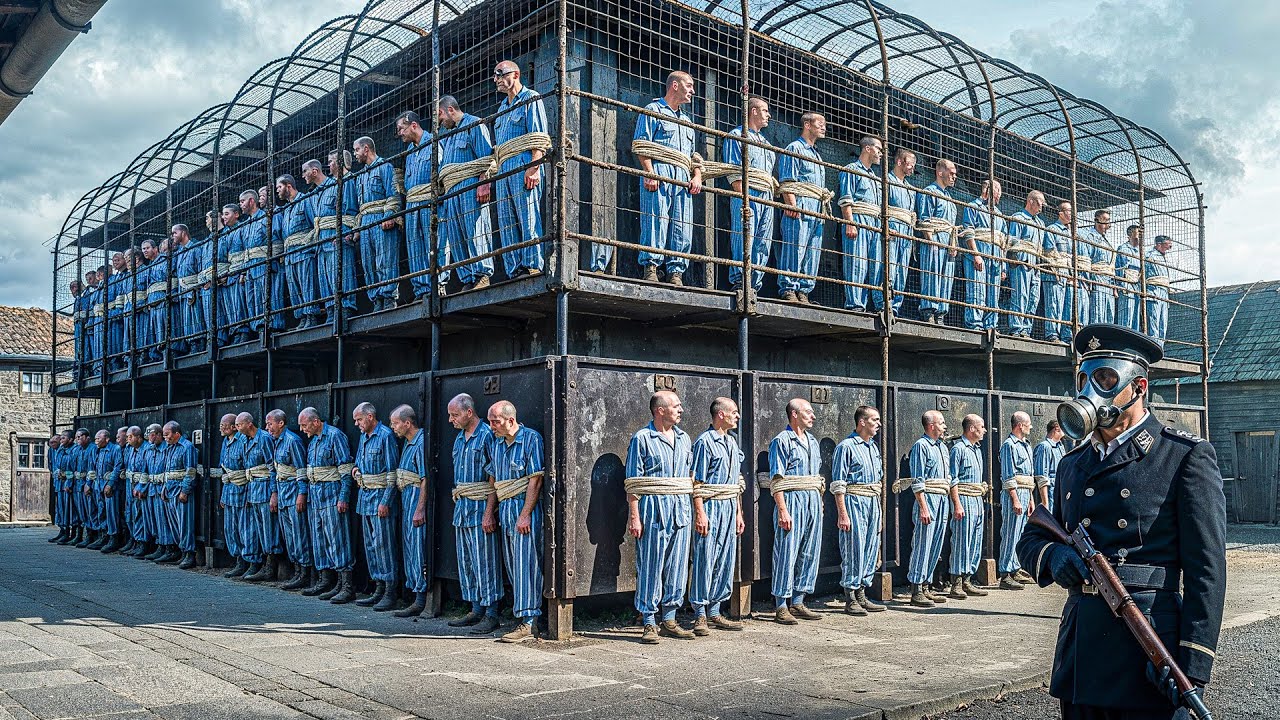
The railway delivered human beings.
The sorting barracks absorbed their possessions.
The gas chambers ended their lives.
The burial pits concealed the evidence.
Behind it all stood clerks, guards, schedules, inventories, orders, and reports.
Mass murder had been turned into a routine.
The guards behaved as if they were managing an industrial facility.
A transport arrived.
The platform was cleared.
The luggage was sorted.
The clothing was processed.
The bodies were removed.
Then the camp prepared for the next train.
But Sobibór contained something its builders had not planned for.
Witnesses who were still alive.
Several hundred Jewish prisoners were kept inside the camp to perform specialized labor. Tailors repaired uniforms. Shoemakers made and fixed boots. Carpenters maintained buildings. Goldsmiths handled stolen valuables. Other prisoners sorted the possessions of murdered families.
Every object carried evidence of a life interrupted.
A child’s shoe.
A wedding photograph.
A prayer book.
A set of apartment keys.
A carefully packed coat for a journey whose true destination had been hidden.
The workers were forbidden to stop. They could not openly mourn. A guard could beat or kill someone for slowing down, speaking at the wrong time, or simply being noticed.
Yet information moved quietly through the camp.
A prisoner assigned to sorting might recognize clothing belonging to someone who had arrived that morning.
Another might find a letter from his own town.
Workers noticed that no passengers ever returned from the supposed showers.
They smelled burning from the areas prisoners were forbidden to approach.
They saw the ashes.
Whatever deception had protected the arriving transports no longer worked on the labor prisoners.
They knew exactly where they were.
And they knew the Nazis would not allow them to leave alive.
Attempts to escape were brutally punished. The camp was surrounded by barbed wire, guard towers, armed patrols, and minefields. Collective punishment meant one person’s escape could lead to the execution of others.
Even reaching the forest did not guarantee survival.
Escapees could be hunted by German forces. They could be betrayed. They could starve or freeze. Local conditions varied, and a Jewish fugitive had no reliable way to know which stranger might offer shelter and which might report him.
The prisoners were trapped between near-certain death inside the camp and enormous danger beyond it.
Still, resistance slowly formed.
One of the central figures was Leon Feldhendler, the former head of the Jewish council in the town of Żółkiewka. He understood the camp and had helped organize an underground network among the prisoners.
But the underground faced a nearly impossible problem.
Individual escapes might save a few people, while leaving hundreds behind to face retaliation.
A mass uprising required military planning.
The prisoners had courage.
What they lacked was an experienced commander.
Then, in September 1943, another transport arrived.
Among the prisoners were Jewish Red Army soldiers captured by the Germans. One of them was Lieutenant Alexander Pechersky, often called Sasha.
The guards saw another prisoner.
The underground saw something else.
A trained soldier.
Pechersky quickly recognized that Sobibór was not an ordinary labor camp. He also understood the limits of an emotional, uncoordinated revolt. The prisoners could not simply rush the fences. Guards in the towers would shoot them down, and the minefields would finish what the bullets did not.
The SS officers had to be neutralized first.
Feldhendler knew the people, routines, and workshops.
Pechersky knew how to organize an attack.
Together, they began developing a plan.
It depended on the Nazis’ own habits.
The SS officers had grown accustomed to absolute control. They entered workshops alone. They ordered prisoners around without imagining that those prisoners might strike back. They coveted expensive clothing, boots, and valuables stolen from murdered victims.
Their arrogance had made them predictable.
The plan was to lure individual officers into workshops under ordinary pretexts.
A new leather coat had arrived.
A pair of boots was ready.
A valuable item needed inspection.
Once an officer entered, prisoners hidden inside would kill him silently. His weapon would be taken. His death would remain undiscovered for as long as possible.
Officer by officer, the camp’s command structure would be removed.
Then, at the normal time for evening roll call, the prisoners would assemble without creating alarm. They would move toward the main gate and escape before the remaining guards understood what had happened.
Everything depended on timing.
One scream could expose the conspiracy.
One officer arriving late could discover a body.
One frightened prisoner could unknowingly betray them.
The uprising was scheduled for October 14, 1943.
That afternoon, Sobibór continued to look like a functioning Nazi camp.
Prisoners carried tools.
Guards walked between buildings.
Workshops remained open.
Orders were shouted.
But beneath the routine, people were waiting for signals that could determine whether hundreds lived or died.
SS deputy commandant Johann Niemann was among the first major targets.
He entered the tailor’s workshop expecting to inspect a leather coat.
The prisoners were ready.
Niemann was killed with an axe.
His uniform, authority, and weapon could no longer protect him.
Elsewhere, other SS men were summoned into workshops and storerooms. They arrived expecting obedience and private access to stolen goods.
Instead, they walked into carefully prepared ambushes.
The reversal was almost unimaginable.
For more than a year, these men had ruled Sobibór through terror. They had watched transports arrive and treated mass murder as employment. Prisoners had been forced to lower their eyes in their presence.
Now the officers were entering rooms from which they would not return.
By late afternoon, eleven members of the camp’s SS staff had been killed, including Niemann.
But the plan began to unravel.
An SS officer who was supposed to be killed failed to arrive at the expected location. A body was discovered earlier than planned. The camp’s routine fractured. Confusion spread among the guards.
Pechersky could no longer wait for the perfectly controlled second phase.
The prisoners gathered near the roll-call area.
Some still did not know the full plan.
Others had understood for days that something was coming.
Pechersky addressed them with urgency. The camp’s officers were dead, he told them. The moment had arrived.
There would be no orderly march through the gate.
There would only be a break for freedom.
Hundreds of prisoners surged forward.
Gunfire erupted from the watchtowers.
People ran toward fences, gates, and gaps in the wire. Some tried to cut their way through. Others climbed over. Guards fired into the crowd as prisoners scattered in different directions.
Beyond the fence lay the minefield.
The Nazis had placed explosives around Sobibór to make escape unthinkable.
Now prisoners ran directly into it.
Explosions tore through the ground.
Some people fell instantly.
Others kept moving.
The minefield became a terrible path to freedom, opened by the bodies of those running first. Behind them came gunfire. Ahead of them stood the forest.
Around 300 prisoners escaped the camp during the revolt, although many were later killed during the manhunt or died before the war ended. Only about 50 of the escapees are believed to have survived the war.
In military terms, the prisoners had not captured the camp.
They had not defeated Nazi Germany.
They had no army waiting in the forest.
Many of them would not live to see liberation.
But what happened next revealed the uprising’s true impact.
The Nazis closed Sobibór.
They dismantled buildings, destroyed evidence, leveled sections of the site, and attempted to erase the camp from the landscape. The ground was altered and disguised so that anyone passing through the forest might see nothing more than an ordinary piece of countryside.
That effort to erase Sobibór was itself an admission.
The prisoners had done more than escape.
They had broken the secrecy on which the killing center depended.
The SS could murder witnesses.
It could burn documents.
It could demolish gas chambers and plant trees.
But it could not force the survivors to forget.
Men and women who reached freedom carried the truth with them. Their testimonies helped reconstruct the camp’s purpose, its organization, its personnel, and the events of October 14.
The people the Nazis had reduced to numbers became witnesses.
The workers forced to handle the evidence became the evidence.
And the camp designed so that no one would leave alive failed in its most important objective.
For decades, Sobibór remained less widely known than Auschwitz. The Nazis had succeeded in destroying much of its physical structure, and relatively few prisoners survived to describe it.
But the forest did not surrender everything.
Archaeological investigations later uncovered objects, building foundations, and traces of the killing center. Personal belongings emerged from the earth—small objects that outlived the people who had carried them.
Each discovery challenged the Nazi attempt to create a crime without witnesses and victims without graves.
Historians estimate that approximately 170,000 or more Jews were murdered at Sobibór, although exact figures remain difficult because records were destroyed. The camp operated from 1942 until the uprising in October 1943.
The scale matters.
But numbers alone cannot explain Sobibór.
A number cannot show a mother being told to tie her shoes together so she could find them after a shower.
A number cannot show a prisoner recognizing his sister’s coat in a sorting barrack.
A number cannot show an SS officer entering a workshop with complete confidence, then noticing—one second too late—that the prisoners were no longer looking at the floor.
That was the moment the system cracked.
Not because the prisoners suddenly became unafraid.
They were terrified.
They knew the fences were guarded. They knew the ground was mined. They knew failure meant death.
They moved anyway.
Sobibór had been constructed around one central Nazi assumption: that people stripped of family, possessions, food, identity, and hope could be controlled until the moment of their murder.
On October 14, 1943, the prisoners proved that assumption wrong.
The uprising did not erase the victims’ suffering. It did not transform tragedy into a simple victory. Most of the people deported to Sobibór had no opportunity to resist because they were killed almost immediately after arrival.
The responsibility remained entirely with the perpetrators who designed, operated, and defended the killing center.
But the revolt changed the final chapter.
Sobibór was supposed to be a place where the Nazis controlled every movement, every object, every breath, and every ending.
Instead, the camp ended with its prisoners running through gunfire, tearing through wire, crossing a minefield, and carrying the truth into the world.
The Nazis destroyed Sobibór because they feared what the survivors represented.
A witness can be hunted.
A building can be demolished.
A forest can be planted over a grave.
But once the truth escapes, even the most carefully engineered machinery of evil can never completely bury it.