The hospital lost power twelve minutes before the helicopter hit the landing pad.
By the time the emergency doors burst open, six Navy SEALs were being wheeled inside, each one bleeding from a different place, each one close enough to death that the trauma monitors seemed almost unnecessary.
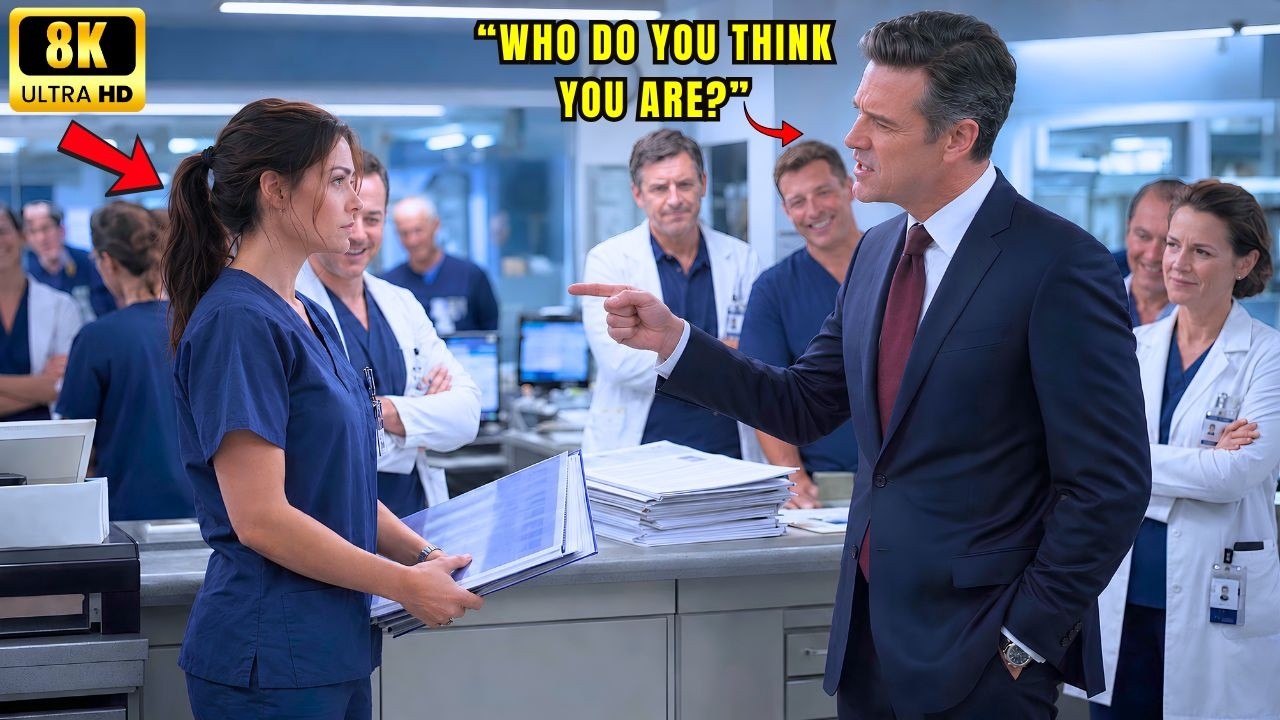
And standing in the middle of the darkened emergency bay was the one person Russell Dayne had spent three years humiliating.
Audrey Lennox.
A night-shift nurse.
At least, that was what everyone believed.
North Haven Naval Medical Center sat two miles inland from Cape Meridian, where winter storms rolled in hard from the Atlantic and salt ate through metal faster than maintenance teams could replace it.
The facility had once been a respected military hospital. Now it was mostly used for routine care, training rotations, and overflow from larger bases.
The walls were old.
The backup systems were older.
The staff had learned to make do.
Audrey had worked nights there for three years.
She always arrived forty minutes early.
She checked crash carts that had already been signed off.
She counted blood units herself.
She tested portable suction devices, opened supply cabinets, and made notes about equipment most people assumed would never be needed.
Her reports were precise.
The blood bank was dangerously low.
The backup generator servicing the old surgical wing had failed two load tests.
The hospital had not completed a realistic mass-casualty drill in twenty-two months.
Each report went to the same man.
Russell Dayne, the facility director.
Each report disappeared.
At first, Dayne ignored her.
Then he began mocking her.
“Another disaster forecast from Nurse Lennox,” he once said during a morning briefing, holding up one of her reports while several physicians looked down at the table.
A few people laughed.
Audrey did not.
Dayne leaned back in his chair.
“Tell me, Nurse, should we prepare for an earthquake next? Perhaps a submarine collision in the parking lot?”
“It would be enough to prepare for the emergencies listed in the facility risk assessment,” Audrey replied.
Her voice was calm.
That irritated him more than anger would have.
“You are not responsible for facility strategy.”
“No, sir.”
“You are not a surgeon.”
“No, sir.”
“You are not in command.”
Audrey held his gaze.
“No, sir.”
After the meeting, Dayne told the chief nursing officer that Audrey had “authority issues.”
She was removed from the safety committee two weeks later.
But she kept writing the reports.
Dr. Colin Barrett was the only person who seemed to notice that Audrey’s calmness was not ordinary.
Colin was a general surgeon in his late thirties, competent, respected, and still young enough to be uncomfortable when administrators entered the room.
During trauma cases, Audrey often prepared instruments before he asked for them.
She noticed subtle changes in blood pressure before monitors alarmed.
She could glance at an injury and say, “The bleeding is deeper than it looks,” or, “He is going to lose the airway,” and she was almost always right.
Once, after a dockworker arrived with a crushed pelvis, Audrey looked at the first portable image for less than three seconds.
“Internal iliac branch,” she said.
Colin stared at her.
“That is a very specific guess.”
“It is not a guess.”
He turned toward her.
“Where did you train?”
Audrey adjusted the IV line.
“Several places.”
“As a nurse?”
She looked at him then.
“Among other things.”
That was all she said.
The storm reached Cape Meridian at 11:18 p.m.
Rain struck the hospital windows sideways.
At 11:31, the lights flickered.
At 11:33, they went out.
Emergency lighting came on in the main corridors, but half the lower wing remained dark.
The backup generator tried to start.
It coughed once.
Then stopped.
Audrey was already moving.
“Portable lights to trauma,” she said. “Check oxygen pressure. Move blood coolers manually. Do not use the elevators.”
A junior nurse blinked at her.
“Who told you to—”
“No one,” Audrey said. “Move.”
The sound came next.
Not thunder.
Rotor blades.
Uneven. Too low. Too close.
The rescue helicopter crossed the roofline at an angle, clipped the edge of a communications mast, and slammed onto the landing platform hard enough to shake ceiling tiles loose.
The aircraft did not explode.
That was the only good news.
The doors opened eight minutes later.
Six men came through.
The first had metal buried in his abdomen and blood pooling beneath him.
The second had severe neck trauma and a rapidly narrowing airway.
The third was gasping with one side of his chest barely moving.
The fourth had a shredded thigh and an arterial bleed that soaked through every dressing placed over it.
The fifth was pale, confused, and showing signs of pressure around the heart.
The sixth was unconscious with a blown pupil and worsening neurological signs.
All six were alive.
Barely.
A corpsman stumbled in behind them.
“We lost altitude during extraction,” he said. “Secondary impact. Possible blast exposure. We need surgery now.”
Colin looked toward the main operating corridor.
The doors were locked by the power failure.
The elevators were dead.
Two surgeons were trapped in another building.
One anesthesiologist was still driving through the storm.
Dayne entered the trauma bay in a raincoat over his shirt and tie.
His eyes moved over the six wounded men.
Then he saw Audrey.
For a moment, something like satisfaction crossed his face.
“Well,” he said, loud enough for everyone to hear. “This is what you have been waiting for, Nurse Lennox.”
No one responded.
Dayne stepped closer.
“All those reports. All those warnings. Here is your opportunity to prove how much you know.”
Audrey was already checking the man with the neck injury.
His oxygen saturation was falling.
“Colin, I need a surgical airway tray.”
Dayne’s voice sharpened.
“You need authorization.”
Audrey did not look at him.
“I need the tray.”
“You will not perform a surgical procedure.”
The patient made a wet choking sound.
Audrey looked up.
“If I wait for authorization, he dies.”
“If you exceed your scope, I will personally see that your nursing license is suspended.”
The trauma bay went silent except for the storm.
Audrey turned to the junior nurse beside her.
“Scalpel. Size ten.”
The nurse hesitated.
Dayne stepped forward.
“Do not hand it to her.”
Colin looked at the patient’s neck.
Then at Audrey.
“Give it to her,” he said.
The nurse placed the scalpel in Audrey’s hand.
Her movements changed.
The hesitation people expected from a nurse facing an unfamiliar procedure never appeared.
She located the anatomy by touch, made a controlled incision, opened the airway, and inserted the tube with the efficiency of someone who had done it under worse conditions than these.
Air moved.
The oxygen level began to climb.
Colin stared at her hands.
Not because they were steady.
Because of the way they were steady.
Audrey pointed to the third patient.
“Absent breath sounds on the left. Distended neck veins. Tension pneumothorax.”
“We do not have imaging,” someone said.
“We do not have time.”
She placed the needle.
There was a sharp release of trapped air.
The man’s chest rose.
His pulse strengthened.
Audrey turned.
“Six stations. One patient per station. Tag priorities by reversible cause, not by appearance. Bring every unit of O-negative blood we have. Open the minor procedure room. Portable lights only. Colin, you take abdominal and thoracic. I will stabilize the rest.”
Dayne laughed once.
“You will do no such thing.”
Audrey faced him.
“Then choose which one dies first.”
He stopped laughing.
No one waited for his answer.
The room began moving around her.
The man with the thigh injury was losing blood faster than they could replace it.
A tourniquet had slowed the bleeding, but his leg was cold and mottled.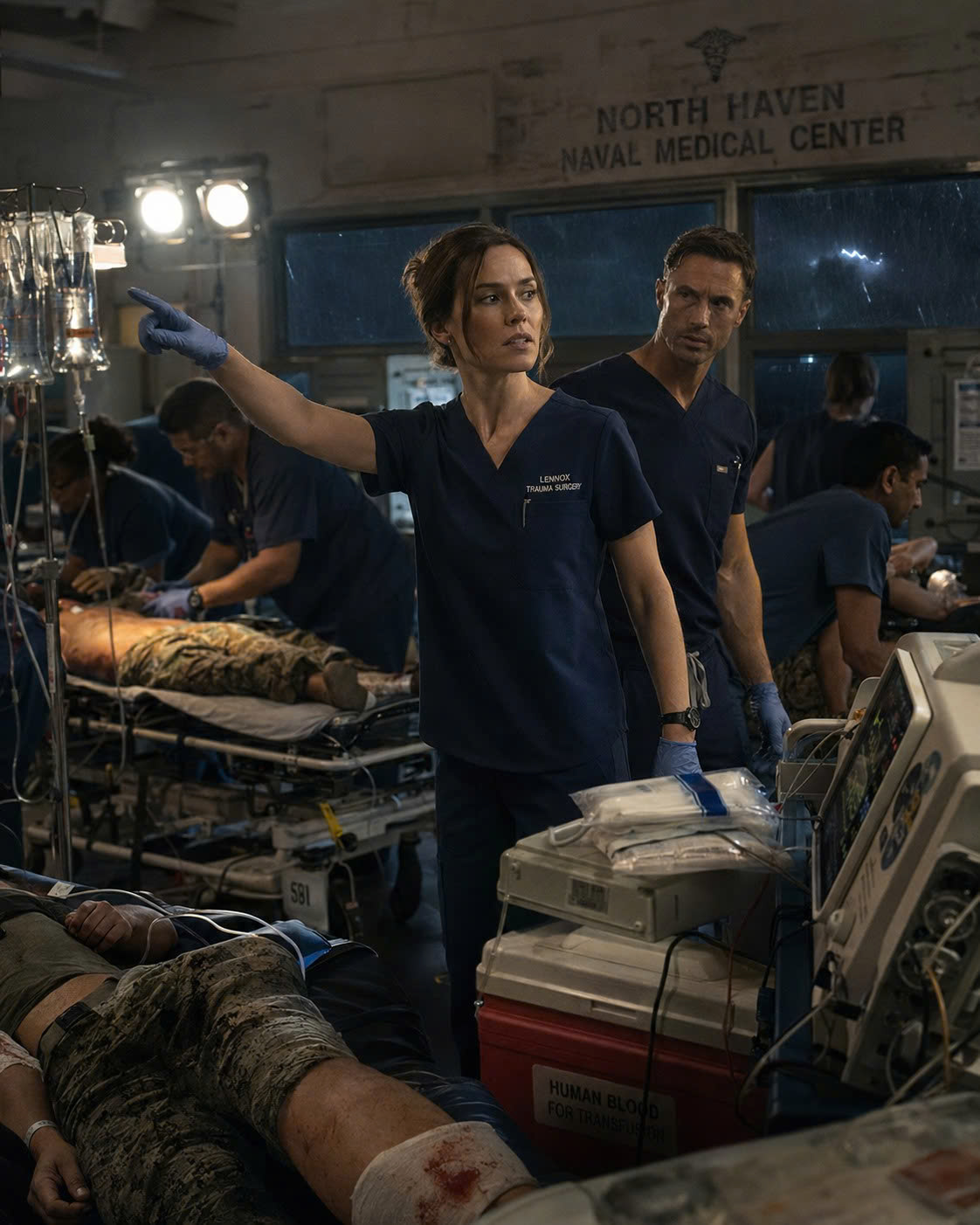
Dayne stood near the foot of the bed.
“He is lowest priority,” he said. “We conserve resources for those with higher survival probability.”
Audrey looked at him.
“He has a survivable injury.”
“He has massive vascular damage.”
“He has a repairable artery.”
“We cannot save everyone.”
“No,” Audrey said. “But we do not turn living men into convenient numbers because the system failed to prepare.”
She exposed the injury and found the torn femoral artery.
Colin glanced over from the next station.
“What are you doing?”
“Temporary shunt.”
He stared at her.
“You can place a vascular shunt?”
Audrey held out her hand.
“Tubing.”
No one questioned her this time.
She inserted the shunt, restored temporary blood flow, and watched color return slowly to the patient’s lower leg.
The fifth man deteriorated next.
His blood pressure dropped.
His heart sounds were faint.
Audrey placed one hand over his chest and studied his face.
“Cardiac tamponade.”
Dayne shook his head.
“You cannot diagnose that without imaging.”
Audrey looked at the monitor.
“I can diagnose it before the monitor becomes a straight line.”
She decompressed the pressure around the heart.
Dark blood returned.
The patient’s pulse improved.
Across the room, Colin had stopped pretending this was merely advanced nursing experience.
“Who are you?” he asked quietly.
Audrey did not answer.
The unconscious patient with the head injury worsened at 12:07 a.m.
One pupil was fixed.
His heart rate slowed.
His blood pressure climbed.
There was no neurosurgeon.
The CT system had restarted twice and failed twice.
Audrey reviewed the signs.
“He is herniating.”
Colin came to her side.
“We cannot confirm the location.”
“Temporal impact. Contralateral weakness before loss of consciousness. Expanding epidural bleed is most likely.”
“You are considering a burr hole.”
“I am not considering it.”
Dayne stepped between them.
“You will not drill into a patient’s skull in my hospital.”
Audrey looked at the unconscious man.
Then at Colin.
“Prepare the hand drill.”
Dayne called security.
No one came.
Half the security team was assisting with the helicopter fire.
The other half had already seen two men return from the edge of death under Audrey’s hands.
The room had chosen its leader.
Audrey made the opening.
The pressure released.
Within minutes, the patient’s pupil began to respond.
That was when the abdominal patient crashed.
His name was Reed Callahan.
Metal fragments had torn through the right upper abdomen. Blood filled the cavity faster than suction could clear it.
Colin opened the abdomen in the minor procedure room under portable lamps.
Audrey stood opposite him.
“Liver injury,” he said.
“Posterior segment.”
“You cannot see that yet.”
“I can feel the tract.”
She packed the liver, controlled the bleeding, and guided Colin through a maneuver he had read about but rarely performed.
The technique was clean.
Efficient.
Designed for survival, not elegance.
Colin looked down at her hands again.
“I know this protocol,” he said.
Audrey’s jaw tightened.
“It is standard damage-control surgery.”
“No,” he said. “This sequence is from the Lennox Field Protocol.”
For the first time that night, Audrey froze.
Only for half a second.
But Reed’s eyes opened.
He was barely conscious.
His face was gray.
He looked at Audrey as though he were seeing someone through smoke.
“Commander?”
The room went still.
Audrey leaned closer.
“Do not talk.”
Reed’s lips moved again.
“Commander Lennox.”
Colin slowly lifted his eyes.
Dayne stood in the doorway.
Reed swallowed.
“You came back.”
Audrey’s expression changed, but her hands did not.
“Stay with me, Reed.”
He gave the faintest smile.
“Kestrel said you were dead.”
The name landed harder than the thunder outside.
Kestrel.
A mission no one in that room recognized.
No one except Audrey.
And Reed.
Colin looked at her.
“You were military.”
Reed’s eyes closed again.
“She was our trauma surgeon,” he whispered. “Navy commander. Special operations medical support.”
Dayne’s face lost color.
Audrey continued packing the wound.
Reed spoke in fragments.
“She wrote the field protocol. Kept eight of us alive in Al-Safir. Operated for nineteen hours during Kestrel.”
Audrey’s voice became firm.
“Stop talking.”
Reed did not seem to hear her.
“Twelve came in.”
His breathing caught.
“She saved eleven.”
The room was silent.
Audrey tied off the bleeding vessel.
Reed opened his eyes one last time.
“She left because of the twelfth.”
Then he lost consciousness.
Dayne recovered first.
Not emotionally.
Strategically.
He stepped into the room and pointed at Audrey.
“This changes nothing.”
Colin turned toward him.
“It changes everything.”
“No. It confirms that she concealed material professional and psychological history from this facility. It confirms she has performed unauthorized procedures.”
“She saved six men.”
“She violated policy.”
“She saved six men because you ignored every warning she submitted.”
Dayne’s voice rose.
“You do not know what was submitted.”
“I saw the generator reports.”
“You saw drafts.”
“I saw signed maintenance warnings.”
Dayne turned toward the room.
“No one discusses this outside official review. Nurse Lennox is suspended effective immediately.”
Audrey looked at Reed’s monitor.
“He is not stable.”
“You are finished here.”
“His chest injury may be more extensive than we thought.”
“You are no longer authorized to touch any patient.”
Two security officers finally arrived.
Dayne ordered them to escort Audrey out.
Neither man moved.
Audrey removed her gloves herself.
She looked at Colin.
“Watch his pressure. If it narrows while his heart rate climbs, check the chest again.”
Colin nodded.
Dayne walked into the corridor and called hospital legal counsel.
Then he called the head of security.
“There are cameras in Trauma Bay One and the minor procedure room,” he said.
“Yes, sir.”
“Secure the recordings.”
“Yes, sir.”
“And delete any footage captured during the power instability. The files may be corrupted.”
The security supervisor hesitated.
“Do you want them preserved for investigation?”
Dayne lowered his voice.
“I want corrupted files removed before they compromise patient privacy.”
By 2:10 a.m., Audrey was sitting alone in an empty staff room.
Her badge had been deactivated.
Her hands were clean, but she could still smell blood on them.
Down the hall, the hospital struggled to stabilize the six men she had kept alive.
Five were improving.
Reed was not.
At 2:23, his blood pressure collapsed.
Colin reopened the abdominal site and found no major recurrent bleeding.
Then Reed’s oxygen level dropped.
His chest tube filled rapidly with blood.
A fragment had migrated near the heart.
The backup lights flickered.
The anesthesiologist had still not arrived.
Colin had been operating for nearly three hours.
His hands were trembling from fatigue.
Dayne stood outside the procedure room with two administrators.
“Continue standard resuscitation,” he said. “Transfer when weather allows.”
“He will not survive the transfer,” Colin replied.
“Then document that the injury was unsurvivable.”
Colin stared at him.
The monitor alarm changed.
Reed’s rhythm became unstable.
A nurse ran to the staff room.
“Audrey.”
She stood immediately.
“Reed is bleeding into his chest.”
Audrey stopped.
For a moment, she was no longer inside North Haven.
She was back in Kestrel.
A desert field hospital.
Sand striking canvas walls.
Twelve wounded men.
Eleven survivors.
And a nineteen-year-old corpsman named Eli Mercer, whose heart had stopped under her hands after she had promised him he would make it home.
She had operated until dawn.
Then she had resigned from surgery.
Not because anyone blamed her.
Because no one did.
That was worse.
She had spent years believing that stepping away from the operating table was an act of humility.
In truth, it had been fear disguised as punishment.
Colin appeared in the doorway.
His gown was soaked through.
“He needs a thoracotomy.”
Audrey said nothing.
“Dayne will report you.”
“I am already suspended.”
“You could lose every license you still hold.”
Audrey looked past him toward the procedure room.
Colin’s voice dropped.
“But if you stay here, Reed dies.”
The words did not persuade her.
They released her.
Audrey walked back into the trauma bay.
Dayne stepped in front of her.
“You are not authorized to enter.”
She kept walking.
He reached for her arm.
The junior nurse moved between them.
Then another nurse did the same.
Then the corpsman from the helicopter.
No one said a word.
They simply formed a line.
Audrey entered the room.
Reed was nearly pulseless.
She opened the chest with Colin assisting.
Blood filled the cavity.
She found the fragment lodged near the pericardium, where every heartbeat widened the injury.
“Suction.”
Colin followed her instructions.
“Retract.”
He did.
“Pressure here. Not there. You will tear it.”
His hand shifted.
The lights dimmed.
Someone held a portable lamp over the wound.
The blood bank called.
Two units remained.
Audrey located the source.
A damaged vessel close to the heart.
Too deep for speed.
Too fragile for force.
Dayne stood outside the glass, speaking into his phone.
“She is a rogue employee performing illegal surgery,” he said. “I want that documented.”
Inside the room, Audrey placed the final suture.
The bleeding slowed.
Then stopped.
Reed’s rhythm remained weak.
“Come on,” Colin whispered.
Audrey kept one hand over the heart.
The monitor showed three uneven beats.
Then five.
Then a narrow but organized rhythm.
A pulse returned.
No one cheered.
They were too exhausted.
But every person in the room looked toward Audrey.
And beyond the glass, Russell Dayne saw them looking.
His face changed.
His mouth remained slightly open.
His phone lowered from his ear.
The certainty he had worn for three years disappeared in a single moment.
He finally understood that the woman he had mocked was not merely more capable than he believed.
She was the reason six men were still alive.
And everyone had seen it.
Rear Admiral Marian Holt arrived at 6:40 that morning.
She entered the hospital in a wet uniform with two investigators and asked one question before Dayne could begin his explanation.
“Where are the generator maintenance records?”
Dayne tried to redirect her toward Audrey’s conduct.
Holt did not move.
“The maintenance records, Mr. Dayne.”
By noon, investigators had found the missing inspection reports.
The generator had failed three previous tests.
Dayne had postponed replacement to protect the facility’s quarterly budget.
The blood reserve had been reduced under his cost-saving plan.
The mass-casualty drills Audrey requested had been marked “completed” on official documents, though no drills had taken place.
The trauma bay video had been deleted.
Dayne believed that had protected him.
It had not.
Each SEAL had worn an integrated tactical recorder.
The helicopter impact damaged several systems, but Reed Callahan’s audio unit continued recording.
It captured Dayne mocking Audrey.
It captured him refusing access to the secondary surgical area.
It captured him threatening her license while patients suffocated and bled.
It captured his order to conserve resources by abandoning the man with the femoral artery injury.
And it captured his attempt to remove Audrey while Reed was still unstable.
The audio was played in the same briefing room where Dayne had once held up Audrey’s safety report and laughed.
This time, no one laughed.
Holt sat at the head of the table.
Audrey sat near the door.
Dayne sat opposite her with legal counsel.
When the recording ended, Holt opened a personnel file.
“Captain Audrey Elise Lennox,” she read.
Dayne looked up.
Holt continued.
“United States Navy Medical Corps. Former commander, Forward Trauma Surgical Unit Seven. Board-certified trauma surgeon. Special operations medical support. Author and principal designer of the Lennox Damage-Control Protocol currently adopted across twelve military medical facilities.”
She turned a page.
“Recipient of the Navy and Marine Corps Medal. Two Bronze Stars. One classified citation attached to Operation Kestrel.”
The staff members in the room looked at Audrey as though they were meeting her for the first time.
Holt closed the file.
“Her surgical privileges were never revoked. They were placed in voluntary inactive status. Under emergency military medical authority, they were legally restorable at the discretion of the senior medical commander.”
Dayne leaned toward his attorney.
Holt looked directly at him.
“I restored them retroactively at 11:33 p.m.”
The exact minute the hospital lost power.
Dayne’s face went still.
He had spent the night calling Audrey unauthorized.
Now the official record showed that she had been the highest-qualified trauma surgeon in the building.
Dayne was removed from his position that afternoon.
The investigation later found falsified drill reports, deferred safety maintenance, improper reduction of blood reserves, retaliation against clinical staff, obstruction of emergency response, and attempted destruction of evidence.
He faced criminal charges under military jurisdiction.
Colin submitted a statement of his own.
He documented everything.
Including the times he had watched Dayne humiliate Audrey and remained silent.
“I thought staying neutral protected my career,” he told investigators. “It only protected the person doing harm.”
Audrey was cleared.
But the hardest conversation came after the hearings ended.
Holt found her alone in the old surgical wing.
“You still believe Kestrel was your failure,” Holt said.
Audrey looked through the dark operating room window.
“Twelve came in.”
“Eleven survived.”
“One did not.”
“You were the only surgeon there.”
“I told him he would live.”
“You told a dying nineteen-year-old what he needed to hear.”
Audrey’s eyes remained on the room.
“I left surgery because I thought I had lost the right to stand at the table.”
Holt waited.
Audrey finally said, “I called it accountability.”
“And what was it?”
Audrey thought of Reed’s heart starting again.
“Fear.”
Three months later, all six SEALs returned to North Haven.
The man with the airway injury could speak again.
The man with the collapsed lung had resumed respiratory training.
The man with the femoral artery injury kept his leg.
The patient with cardiac tamponade had no lasting heart damage.
The man who received the emergency burr hole recovered with only minor weakness.
Reed Callahan walked with a cane.
He was the last to enter the hospital lobby.
The staff gathered quietly as the six men approached Audrey.
She was wearing navy-blue scrubs.
No medals.
No dress uniform.
Reed stopped in front of her.
“We were told there would be a ceremony,” he said.
Audrey glanced at the crowd.
“This looks like one.”
He smiled.
Then his expression became serious.
“We did not survive because of rank.”
He looked toward the administrators standing near the back.
“We did not survive because the system worked.”
The lobby went silent.
“We survived because when everyone with authority stepped backward, one person stepped forward.”
Reed straightened despite the cane.
The six men raised their hands in salute.
For several seconds, Audrey did not move.
Then she returned it.
Not as Nurse Lennox.
Not as the woman Dayne had tried to erase.
As Commander Audrey Lennox.
She later accepted restoration of her surgical title, but she refused to abandon nursing.
Instead, she rebuilt North Haven’s emergency program from the ground up.
Doctors trained beside nurses.
Residents trained beside corpsmen.
Administrators attended the same disaster drills as clinical staff.
Generators were tested under full load.
Blood reserves were protected.
Every person learned the first rule Audrey wrote at the top of the new trauma manual:
In a crisis, responsibility belongs to the person willing and able to act.
People often mistake silence for weakness.
They mistake humility for lack of authority.
And they mistake titles for competence.
But when the lights go out, the alarms fail, and lives depend on the next decision, the truth becomes impossible to hide.
The strongest person in the room is often the one no one bothered to listen to—until everyone else needed saving.