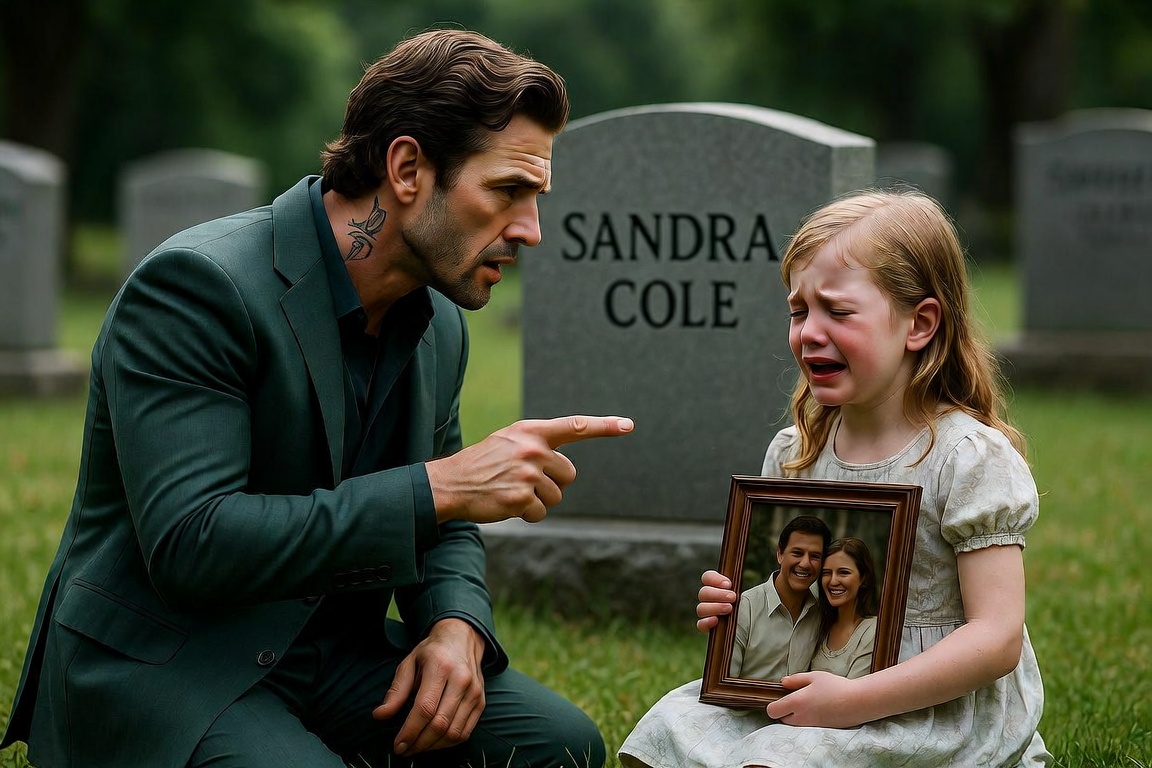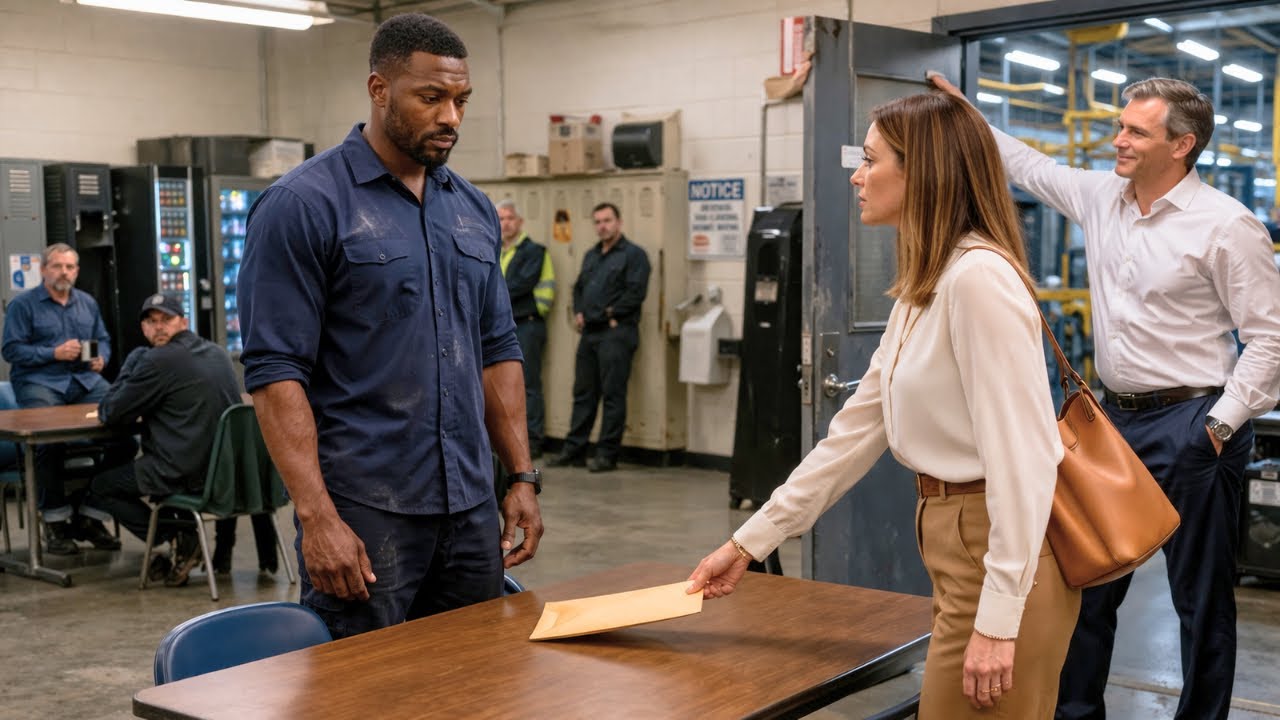
Nate Cole had been awake for sixteen hours when his wife walked into the warehouse break room holding divorce papers.
The fluorescent light above him flickered every few seconds, turning the room pale, then gray, then pale again. A vending machine hummed against the wall. The air smelled like burnt coffee, cardboard dust, and the sweat of men finishing a long shift.
Nate sat alone at a plastic table, still wearing his steel-toed boots and reflective vest. In front of him was the cheapest sandwich the vending machine offered, a compressed triangle of bread, processed turkey, and something pretending to be cheese.
He had worked nine hours on the warehouse floor.
He still had three inventory discrepancy reports to finish before midnight.
Then the door opened.
Tessa walked in wearing new black heels and carrying a cream-colored designer handbag Nate had never seen before.
She looked polished.
Rested.
Almost relieved.
Behind her stood Drew Callahan, Nate’s regional operations director.
Drew was the kind of man who never raised his voice because he didn’t need to. He humiliated people with small smiles, delayed promotions, and sentences like, “Some people are built for leadership, Nate. Others are built to follow instructions.”
For three years, Nate had absorbed those comments without reacting.
Now Drew stood beside Nate’s wife with one hand tucked casually into his coat pocket.
Tessa placed a thick envelope on the table.
“I’m being honest for the first time in a long time,” she said.
Nate looked at the envelope but didn’t touch it.
Tessa sat across from him. Drew remained standing.
“You’re never home,” she continued. “And when you are, you’re exhausted. You work all the time, but somehow we’re still counting every dollar.”
Nate glanced at her handbag.
Then at her shoes.
Then at Drew.
Tessa followed his eyes and tightened her jaw. 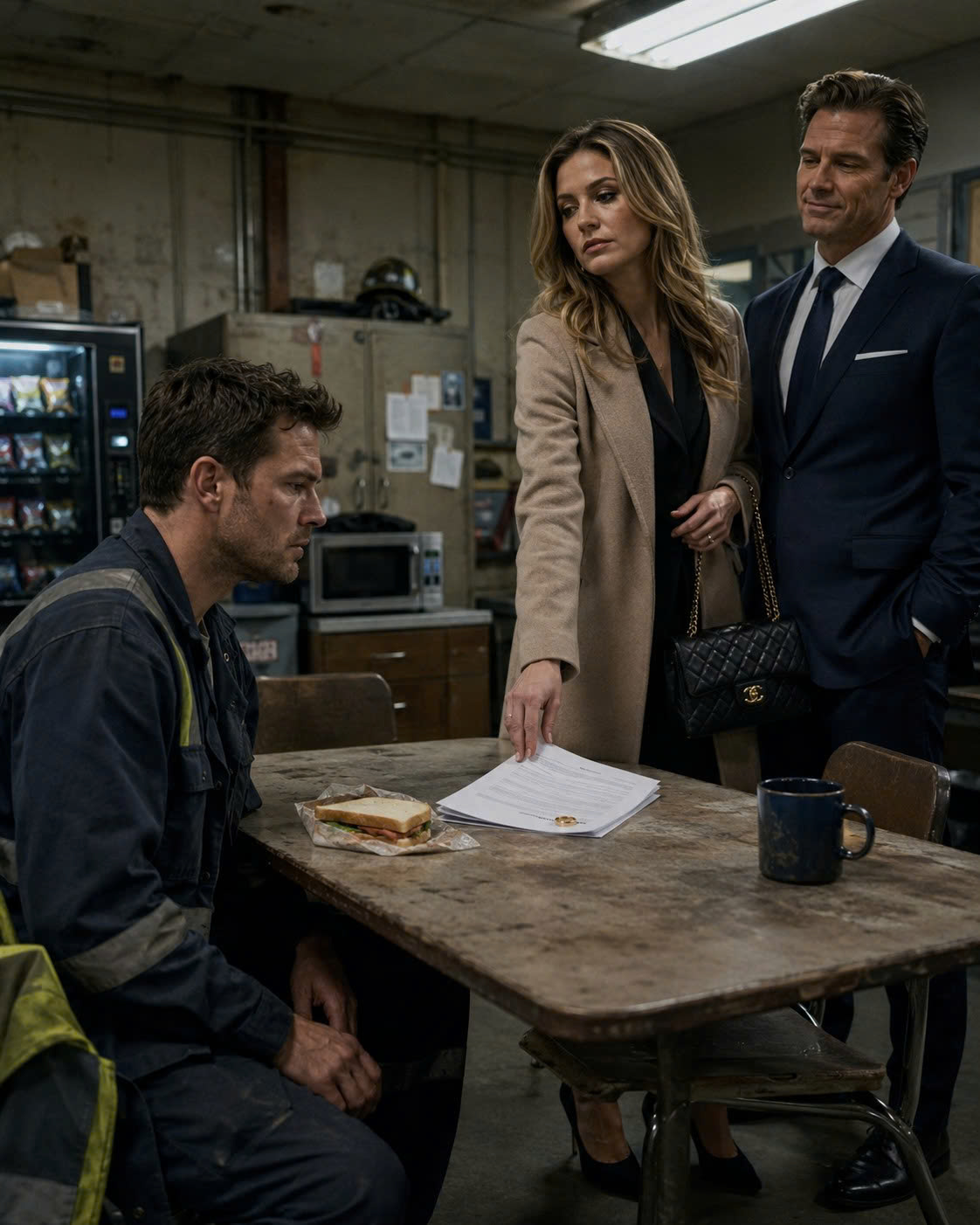
“This isn’t about money.”
Drew looked away.
Nate said nothing.
She pushed the envelope closer.
“I deserve a real life,” she said. “I deserve someone who can actually give me one.”
There it was.
Not an explanation.
A verdict.
Nate thought about the late dinners she had stopped coming home for. The phone she had started turning face down. The sudden gym membership. The coldness in bed. The way she had begun correcting the way he spoke in front of other people.
He had noticed all of it.
He had simply kept believing there was a version of the truth that hurt less.
Tessa slipped off her wedding ring.
For a second, she held it between two fingers.
Then she placed it on the table beside the sandwich, as if returning a key to an apartment she no longer wanted.
The metal made a faint sound against the plastic.
That sound stayed with Nate longer than anything she said.
Drew finally spoke.
“Let’s keep this professional.”
Nate looked up at him.
Professional.
The word hung in the stale air between the burnt coffee and divorce papers.
Drew shifted slightly.
He had expected anger.
Maybe shouting.
Maybe Nate lunging across the table and giving him a reason to call security.
Instead, Nate folded the sandwich wrapper, slid the divorce papers into his work bag, and stood.
Tessa blinked.
“That’s it?”
Nate looked at the ring.
Then at her.
“What else is there?”
Her confidence faltered for less than a second.
Drew stepped closer to her.
Nate walked past both of them and returned to the warehouse floor.
He finished all three discrepancy reports before midnight.
For the next few weeks, his life became colorless.
He woke before sunrise, drove to work, answered emails, signed inventory logs, and came home to an apartment that no longer looked like anyone had lived there.
Half the closet was empty.
Tessa had cleared the bathroom shelves.
Her perfume, makeup, hair products, and expensive skin creams were gone.
All she had left behind was a cheap black hair tie near the sink and an old cracked bottle of lotion she had probably decided was not worth packing.
Nate slept on one side of the bed.
The other side remained smooth.
There were no arguments.
No dramatic phone calls.
No attempts to repair anything.
Just silence.
One Thursday evening, while sorting bills, Nate noticed an envelope buried beneath a medical debt statement and two past-due notices.
It had been sitting there for more than three weeks.
The paper was thick and expensive. His full name was printed across the front.
Nathan James Cole III.
Almost nobody called him Nathan.
Even fewer people knew about the “III.”
He assumed it was another debt collection matter connected to his mother’s final years. She had died after a long illness, leaving behind bills that seemed to reproduce whenever he paid one.
Nate almost threw the envelope away.
Instead, he opened it.
The letter requested his presence at the office of Ashworth, Bell & Pierce regarding the estate of Wallace James Cole.
The name meant almost nothing to him.
Two days later, Nate arrived at a quiet law office downtown wearing the only suit he owned. The sleeves were slightly too short.
A gray-haired attorney named Gerald Ashworth greeted him and led him into a conference room.
Gerald studied him for a moment before speaking.
“Mr. Cole, your great-uncle Wallace passed away six weeks ago.”
Nate searched his memory.
Then he saw a funeral.
His mother’s funeral.
He remembered a tall man standing near the back of the chapel twenty years earlier. The man had shaken Nate’s hand after everyone else left and given him an envelope containing five thousand dollars.
There had been a note inside.
Use it well.
Nate had used the money to cover his mother’s remaining funeral expenses and keep the electricity on.
“I barely knew him,” Nate said.
Gerald nodded.
“He knew more about you than you realized.”
The attorney opened a leather folder.
Wallace Cole had spent forty years building a portfolio of industrial holdings, real estate, transportation companies, and private investments. He had no children. His wife had died years before.
He had watched Nate quietly from a distance.
Not in a sentimental way.
In a deliberate one.
Wallace had reviewed Nate’s employment history, debt records, and financial decisions. He had even known what Nate did with the five thousand dollars.
“He was impressed that you didn’t spend it on yourself,” Gerald said.
Nate leaned back.
“What exactly did he leave me?”
Gerald turned the folder around.
At first, the numbers did not make sense.
Then they did.
The estimated value of the estate was approximately four hundred seventy million dollars.
Nate stared at the page.
He looked at Gerald.
Then back at the page.
“There’s been a mistake.”
“There has not.”
“I work in a warehouse.”
“I’m aware.”
“I have forty-eight dollars in checking.”
“I’m aware of that too.”
Gerald pushed another document toward him.
“The most significant asset is a controlling interest in Meridian Group Holdings.”
Nate recognized the name immediately.
Meridian was the parent company of several logistics and manufacturing businesses.
One of them was Callahan Logistics.
The company where Nate had worked for eleven years.
The company Drew Callahan ran.
Nate sat very still.
Gerald continued speaking about voting rights, trusts, tax structures, board authority, and ownership transition.
But Nate heard only one sentence clearly.
You control the company.
Tessa had left him because she believed he could never become anything more.
Drew had spent years treating him like replaceable labor.
Neither of them knew that Nate now owned the ground beneath their feet.
He did not smile.
He did not call Tessa.
He did not walk into work the next morning and announce anything.
Three years under Drew had taught him something useful.
People reveal the most when they believe the person watching has no power.
For two weeks, Nate continued working as usual.
He completed his shifts.
He corrected shipping errors.
He listened while supervisors complained about overtime costs and broken equipment.
He watched Drew walk through the warehouse without safety glasses, criticizing workers for taking water breaks.
Then Nate submitted his resignation.
No speech.
No confrontation.
He handed the letter to human resources, emptied his locker, and shook hands with the few people who had treated him with dignity.
 Drew called him into his office before he left.
“I figured this was coming,” Drew said, leaning back in his chair. “Not everyone can handle pressure.”
Nate stood near the door.
Drew smiled.
“You’ll probably be happier somewhere with lower expectations.”
Nate looked around the office.
The leather chairs.
The framed leadership awards.
The photograph of Drew shaking hands with a state senator.
“I think you’re right,” Nate said.
Drew mistook the answer for surrender.
Nineteen days after the divorce was finalized, Tessa married him.
The wedding photos appeared online that evening.
There was a rented estate, white roses, gold chairs, and a champagne tower taller than the bride.
Tessa wore a fitted dress and smiled beneath a caption that read:
Sometimes you have to choose the life you deserve.
Nate looked at the photo once.
Then he closed the page and returned to the documents Gerald had spread across the table.
Over the next three months, Nate hired forensic accountants, labor attorneys, compliance investigators, and an outside human resources review team.
He gave them full access to Meridian’s records.
He also gave them one instruction.
“Don’t assume Callahan Logistics is the only problem. Follow everything.”
What they found was worse than expected.
Vendor commissions routed through private accounts.
Inflated invoices.
Transportation contracts awarded to a company owned by Drew’s brother-in-law.
Maintenance funds moved into executive bonus pools.
Safety budgets cut while management compensation increased.
Workplace injuries recorded as “personal medical events.”
Overtime altered.
Harassment complaints settled quietly.
Employees who raised concerns transferred, demoted, or pressured to resign.
One warehouse had requested replacement harnesses after two workers reported damaged safety straps.
The request had been denied.
Eleven days later, Drew approved an increase to his own annual performance bonus.
Nate read that memo three times.
Then he began meeting workers.
Not in corporate offices.
At coffee shops.
In parking lots.
In the back room of a church.
Places where people felt safe enough to speak.
A forklift operator named Luis showed Nate photos of a loading accident management had tried to blame on him.
A former dispatcher named Andrea brought printed emails proving overtime records had been altered.
A supervisor named Kim admitted she had signed a false incident report after being told her health insurance would disappear if she refused.
“I have two children,” she said quietly. “I didn’t know what else to do.”
Nate understood then that this was no longer about Tessa.
It was no longer even about Drew humiliating him.
Hundreds of people had been trained to believe silence was the price of keeping their jobs.
Drew had not merely managed through fear.
He had built a system around it.
Meanwhile, Tessa posted honeymoon photos from the Caribbean.
Blue water.
White linen.
Captions about gratitude, abundance, and finally being aligned with the right future.
She had no idea that federal compliance counsel was reviewing the company’s injury reports.
She had no idea two banks had been asked to preserve transaction records.
She had no idea Nate was preparing to return.
Ninety days after leaving the warehouse through the employee exit, Nate arrived at Meridian Group’s glass headquarters through the main entrance.
Rain struck the pavement in hard silver lines.
He wore a dark suit that fit properly this time.
Three months earlier, he had entered Callahan Logistics through a loading dock in steel-toed boots.
That morning, the receptionist stood as he approached.
“Good morning, Mr. Cole.”
The board meeting had been listed as an ownership transition and strategic review.
Twelve board members attended.
So did senior executives, legal counsel, and assistants.
Drew arrived ten minutes late.
He walked into the room adjusting his cuff links.
Then he saw Nate seated at the head of the table.
Drew stopped.
For the first time since Nate had known him, the man’s face lost its practiced expression.
His eyes moved from Nate to Gerald.
Then to the company attorneys.
Then to the folders placed in front of every board member.
“What is this?” Drew asked.
Nobody answered immediately.
Gerald stood.
“Ladies and gentlemen, following the death of Wallace James Cole, controlling ownership of Meridian Group Holdings has transferred to his sole beneficiary.”
He turned slightly toward Nate.
“Mr. Nathan James Cole III is now the majority voting shareholder and chairman of the board.”
The room went silent.
Drew’s mouth opened, but no words came.
His hand remained frozen near the back of a chair.
Nate watched the recognition move across his face.
First confusion.
Then disbelief.
Then calculation.
And finally fear.
It was not dramatic.
It was smaller than that.
A slight tightening around the eyes.
A loss of color.
A glance toward the door.
The same door he had once expected security to drag Nate through.
Tessa’s new husband sat down slowly.
Nate began the presentation.
Slide by slide, he showed the board bank transfers, vendor records, false invoices, private email chains, altered accident reports, sworn testimony, and internal messages discussing how to make certain employees “voluntarily remove themselves.”
Drew interrupted repeatedly.
“These figures lack context.”
“That vendor relationship was approved.”
“You don’t understand executive-level operations.”
At that, Nate paused.
He clicked to the next slide.
It displayed two documents side by side.
On the left was the denied request for replacement safety harnesses.
On the right was Drew’s approved bonus increase.
The dates were highlighted.
Eleven days apart.
Nate looked directly at him.
“A warehouse team was told the company could not afford equipment that keeps them from falling thirty feet.”
No one moved.
“Eleven days later, you increased your personal bonus by eighty-five thousand dollars.”
Drew’s face hardened.
“That’s an oversimplification.”
“No,” Nate said. “It’s a decision.”
The same word would matter again later.
The board’s outside counsel spoke next.
Several matters had already been referred for civil review. Potential criminal exposure was being assessed. Regulatory agencies would be notified where required.
Drew looked around the table for support.
No one met his eyes.
Nate closed the folder in front of him.
“Your employment is terminated effective immediately.”
Drew stood.
“You can’t do this because of some personal grudge.”
“This is not about my marriage.”
“Of course it is.”
Nate’s voice remained calm.
“This is about fraud, retaliation, concealed injuries, and the misuse of company funds.”
Drew pointed toward him.
“You were a warehouse clerk.”
“I was a warehouse employee,” Nate said. “Which is why I know exactly what your decisions cost people.”
Security entered the room.
Drew looked toward the board again.
Still, no one spoke for him.
As he was escorted out, his shoulder struck the doorframe.
For years, workers had stepped aside when he passed.
That morning, nobody moved.
Tessa called Nate before noon.
Her voice shook with anger.
“What did you do?”
Nate stood beside the conference room window, watching rain move across the city.
“I removed someone who was stealing from the company and endangering employees.”
“You humiliated him.”
“He created the evidence.”
“You could have warned us.”
“Why?”
There was silence.
Then she said, “Because of everything we had.”
Nate looked at his reflection in the glass.
“We didn’t have what I thought we had.”
She began crying, but anger still sat beneath it.
“You planned this.”
“I investigated it.”
“You wanted revenge.”
“I wanted the truth documented.”
She told him Drew’s reputation was destroyed.
Nate replied, “His actions destroyed it.”
Then he ended the call.
The consequences arrived quickly.
Without Drew’s salary, the mortgage on the new house became difficult to carry.
The luxury vehicle disappeared.
The household staff stopped coming.
Business contacts stopped returning calls.
Friends who had celebrated the wedding began canceling dinners.
Civil claims were filed.
Former employees came forward once they knew Drew could no longer retaliate.
Some brought documents.
Others brought names.
A few brought stories they had been too afraid to tell for years.
A month later, Tessa called again.
This time, there was no anger.
Only exhaustion.
She said Drew blamed her for distracting him.
She blamed him for promising a life he could no longer provide.
Their arguments had become constant.
The house was for sale.
Creditors were calling.
“I made a mistake,” she whispered.
Nate sat alone in his apartment.
The bathroom had been remodeled, but he had kept one thing in a drawer without knowing why.
The cheap black hair tie Tessa had left behind.
He turned it once between his fingers.
“No,” he said.
She inhaled sharply.
“It was a mistake.”
“It was a choice.”
Tessa went quiet.
Nate could hear her breathing.
For years, she had believed his silence meant weakness.
Now she understood that silence could also mean a person had stopped needing to explain himself.
“I didn’t know,” she said.
Nate looked at the hair tie.
“That was the point.”
He did not say it cruelly.
He said it plainly.
Tessa had not left because Nate lacked value.
She had left because she had measured value using the wrong things.
Titles.
Cars.
Clothes.
Access.
The appearance of power.
She had chosen Drew when Drew’s position looked permanent and Nate’s exhaustion looked like failure.
She had never asked what kind of man continued working when nobody praised him.
She had never asked why he stayed calm when he was insulted.
She had never understood that character is most visible when a person believes there will be no reward for having it.
Nate ended the call and placed the hair tie in the trash.
Over the following year, Meridian replaced damaged equipment, restored stolen overtime pay, reopened injury claims, and created direct reporting channels outside local management.
Several former workers returned.
Others received settlements and apologies long overdue.
Nate did not place his name on the building.
He did not buy a sports car.
He still visited warehouses without announcing himself.
Sometimes he wore a suit.
Sometimes he wore work boots.
The employees who knew his story watched how he spoke to forklift operators, cleaners, drivers, and receptionists.
He remembered names.
He asked questions.
He waited for honest answers.
Drew spent the next year moving between attorneys, depositions, and court hearings.
Tessa filed for divorce before their first anniversary.
The marriage that had begun with white roses and champagne ended in debt, accusations, and two people arguing over property neither could afford.
Nate heard about it through Gerald.
He felt no satisfaction.
Only distance.
The worst night of his life had happened beneath a flickering light in a warehouse break room, beside a burnt coffee pot and an untouched sandwich.
At the time, he believed he had lost everything.
In truth, he had only lost the people who could see his worth only after they believed it came with money.
And sometimes, the most expensive mistake a person can make is not leaving too soon.
It is realizing too late who they chose to leave behind.