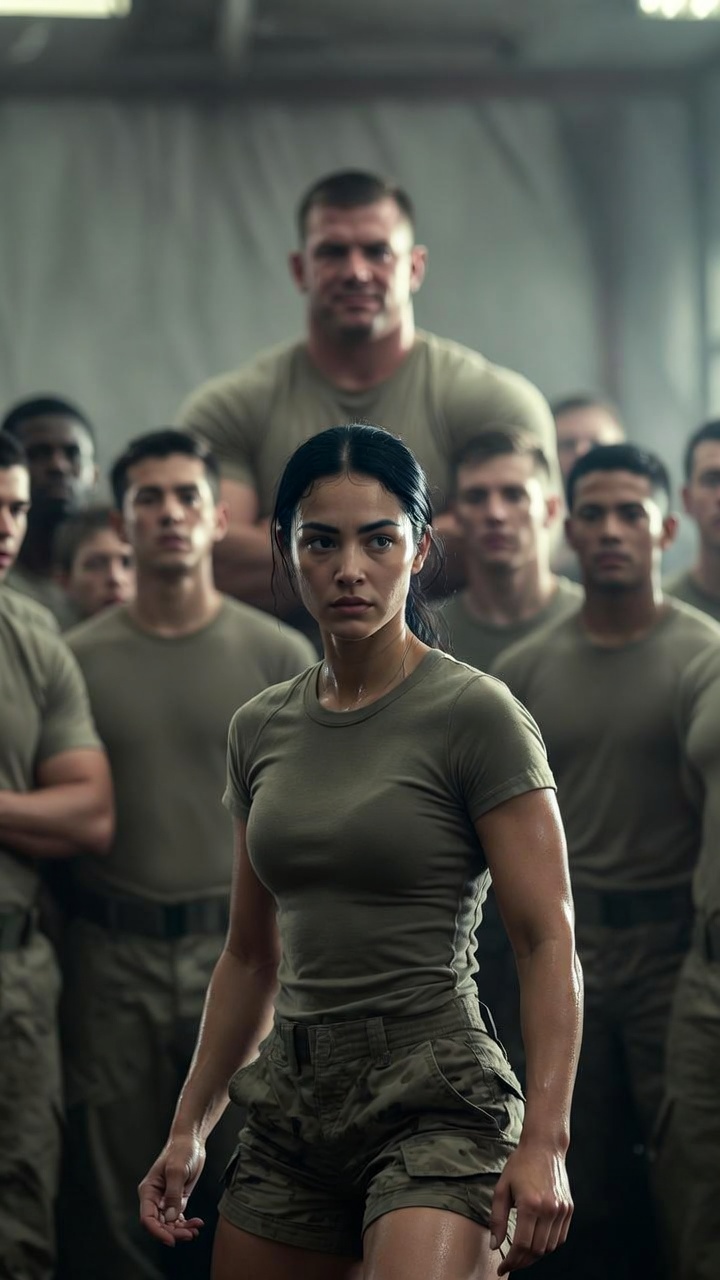
The first laugh came before Captain Leah Cole had even stepped onto the mat.
It was 6:43 on a gray Monday morning at Raven Ridge Joint Combat Training Center, and the close-combat hall already smelled of rubber flooring, old canvas, disinfectant, and sweat.
Nearly forty soldiers stood around the main sparring area.
Some were new arrivals still wearing the stiffness of men and women who had not yet learned which rules could bend.
Others were veterans who had served long enough to believe they could recognize danger the moment it entered a room.
Staff Sergeant Marcus Briggs belonged firmly to the second group.
He stood near the front with his arms folded across his chest, his broad shoulders filling out a faded black training shirt. At six feet three and nearly 230 pounds, he had the kind of build that made people step aside without being asked.
Briggs knew it.
More importantly, he enjoyed knowing that everyone else knew it too.
He had spent eleven years in uniform, survived two overseas deployments, earned several commendations, and built a reputation at Raven Ridge for being one of the hardest men in the training battalion.
He was skilled.
He was experienced.
And over time, those two facts had hardened into a third belief inside him.
He believed he could measure another person’s worth within seconds.
Rank.
Size.
Voice.
Posture.
Confidence.
He treated human beings like equipment laid out for inspection.
Heavy meant strong.
Loud meant fearless.
Young meant inexperienced.
Quiet meant uncertain.
And women, especially smaller women, were usually something to be handled carefully during demonstrations so nobody accused him of embarrassing them.
That was why he laughed when Leah entered.
She walked through the side door carrying a plain canvas bag over one shoulder.
She was not wearing a jacket with a unit patch.
She had no visible ribbons, badges, tabs, or insignia.
Just dark training pants, a fitted gray shirt, and well-used wrestling shoes.
She was five feet seven, perhaps 145 pounds.
Her dark hair was tied back tightly.
There was nothing dramatic about her entrance.
She did not scan the room as if expecting attention.
She did not announce herself.
She walked to an empty bench, placed down her bag, and began wrapping her hands.
Briggs glanced toward Sergeant First Class Nolan Price, one of the senior instructors.
“That the officer they said was joining us?” he asked.
Price looked over his clipboard.
“Captain Cole.”
Briggs raised an eyebrow.
“What does she do?”
Price continued checking names.
“Train.”
A few soldiers nearby smiled.
Briggs looked back toward Leah.
She sat alone, looping white cloth carefully around her knuckles.
“Looks like legal sent us someone for wellness week.”
The soldiers closest to him laughed.
One of them, Private Keller, tried to hide his smile behind his water bottle.
Leah heard them.
Everyone within ten feet heard them.
She did not look up.
Briggs watched for a reaction and seemed disappointed when he got none.
“Maybe intelligence,” he continued. “They’re dangerous with PowerPoint.”
More laughter.
This time Leah tightened the wrap around her wrist, tested her fingers, and stood.
She walked toward the edge of the mat.
No glare.
No comeback.
No visible irritation.
That bothered Briggs more than an argument would have.
People usually reacted to him.
They laughed with him, challenged him, avoided him, or tried to impress him.
Leah did none of those things.
She simply stood beside the other officers as if his voice had been no more important than the ventilation system humming above them.
At 6:50, Price called the group together.
Conversations stopped.
Boots and training shoes scraped across the floor as everyone moved closer.
Price was a compact man in his early forties with a calm voice and a face that rarely revealed whether he was impressed or disappointed.
“Today’s block is close-range control under pressure,” he said. “Not sport fighting. Not boxing for points. Not two people proving who has the bigger ego.”
His eyes passed briefly over Briggs.
Several soldiers glanced in the same direction.
Briggs smiled.
Price continued.
“The objective is control. Position. Timing. Decision-making. You will work at increasing intensity, but you will remain responsible for your partner.”
He paced to the center of the mat.
“Real confrontations are rarely clean. Your opponent may be bigger. Faster. Armed. Injured. Frightened. Angry. You may be tired. You may be outnumbered. Technique matters because strength disappears faster than most people think.”
Briggs whispered to the man beside him.
“Strength disappears if you don’t have any.”
The man coughed to cover another laugh.
Price heard it.
He stopped.
“Staff Sergeant Briggs.”
“Sergeant?”
“You seem ready to contribute.”
“Yes, Sergeant.”
“Good. You can assist with the opening demonstration.”
Briggs unfolded his arms and stepped forward immediately.
This was the moment he enjoyed most.
The room.
The attention.
The opportunity to turn instruction into theater.
Price looked around the group.
“I need a second volunteer.”
Before anyone could move, Briggs pointed toward Leah.
“How about the captain?”
The room shifted.
Not physically at first.
The change was in the faces.
Heads turned.
A few soldiers smiled.
Others looked at Leah with sympathy.
Briggs spread his hands as if he had made a generous offer.
“Good chance to welcome her to Raven Ridge.”
Price looked at Leah.
“You’re not required to volunteer, Captain.”
Leah stepped onto the mat.
“That’s all right.”
Her voice was even.
No challenge.
No hesitation.
Briggs grinned.
“Don’t worry, ma’am. I’ll take it slow.”
Leah adjusted the edge of her right-hand wrap.
“That would probably be best.”
A few people laughed again.
This time, however, they were not certain who the joke belonged to.
Briggs tilted his head.
Leah met his eyes for less than a second, then turned to Price.
“What are the parameters?”
“Controlled contact,” Price said. “Neutralize the threat. Stop when I call it.”
“Understood.”
Briggs rolled his shoulders.
“You done this before?”
Leah checked the distance between them.
“A few times.”
“What kind of training?”
“The useful kind.”
Someone near the back made a quiet sound of surprise.
Briggs’s grin narrowed.
Price stepped between them.
“This is a demonstration, not a competition.”
“Yes, Sergeant,” Briggs said.
Leah nodded.
Price backed away.
Briggs raised his fists.
Leah did not.
At least, not in the way he expected.
Her hands remained loose near chest level, her left foot slightly forward. Her shoulders looked relaxed. Her chin was lowered just enough to protect her throat without restricting her view.
To the soldiers watching, her stance appeared almost casual.
To anyone who understood movement, it was not casual at all.
Her weight was centered.
Her heels were light.
Her elbows guarded the line toward her ribs.
Her body was neither square nor fully bladed.
She was positioned to move in any direction without announcing which one.
Briggs did not notice.
He saw only what he expected to see.
A smaller opponent.
A female officer.
Someone who had probably attended mandatory combatives courses, collected a certificate, and avoided serious contact ever since.
He bounced once on the balls of his feet.
“Ready, Captain?”
Leah looked at him.
“I am.”
Price lifted the whistle.
The room quieted.
For the first time that morning, nobody laughed.
The whistle sounded.
Briggs moved fast.
Faster than most people his size could move.
He closed the distance with a long step and fired a heavy left jab toward Leah’s face.
It was controlled, but only technically.
The punch carried enough force to snap her head back if it landed.
Leah moved two inches.
That was all.
Her head slipped outside the line of the jab.
Briggs followed with a right cross.
She stepped left.
The punch cut through empty air.
He turned and drove forward again, using his shoulders and chest to crowd her toward the edge of the mat.
Leah pivoted.
Briggs passed her.
A few soldiers murmured.
Briggs reset.
“Come on,” he said. “You can hit back.”
Leah’s expression did not change.
“You haven’t given me a reason yet.”
A louder reaction spread through the room.
Briggs glanced at the crowd.
The smile on his face remained, but something underneath it had tightened.
He came forward again.
This time he used a feint.
His left hand twitched.
His right shoulder rotated.
Leah did not react to the hands.
Her eyes remained fixed near the center of his chest.
That was where intention appeared first.
A hand could lie.
Shoulders and hips were less convincing.
Briggs threw a hook.
Leah leaned just beyond its reach.
He followed with a low kick.
She lifted her leg and turned her shin to check it.
The contact made a hard slapping sound.
Briggs stepped back.
Leah placed her foot down exactly where it had been.
No wasted motion.
No anger.
No performance.
Briggs chuckled, though the sound no longer seemed natural.
“She’s quick.”
Price said nothing.
Briggs circled.
Leah turned with him.
“You planning to run all morning?” he asked.
“I haven’t moved more than three feet.”
Several soldiers looked down at the mat.
She was right.
Briggs had crossed almost the entire sparring area.
Leah had remained within a narrow circle near the center.
His breathing had already deepened slightly.
Hers had not.
Briggs came in harder.
A jab.
A cross.
A shoulder bump.
A short hook toward the body.
Leah redirected the jab with her palm, rotated away from the cross, absorbed the shoulder against the frame of her forearm, and stepped outside the hook.
Every movement was small.
She did not collide with his strength.
She let it pass.
Briggs had the uncomfortable sensation of trying to tackle smoke.
“Fight back,” he said.
Leah watched him.
“I am.”
He scoffed.
“No, you’re avoiding.”
“Those aren’t the same thing.”
Briggs lunged.
This time he committed.
His left hand reached to control her shoulder while his right arm moved to wrap around her waist.
It was an aggressive clinch entry designed to force her backward.
For the first time, Leah stepped toward him.
Her left forearm cut across the inside of his reaching arm.
Her right elbow rose sharply through the space between them.
It stopped less than an inch from his jaw.
Before Briggs could process the threat, Leah’s left foot hooked behind his ankle.
Her shoulder touched his chest.
Her hips rotated.
The floor disappeared beneath him.
Briggs hit the mat flat on his back.
The impact echoed through the hall.
For one full second, nobody moved.
Leah stood over him in a balanced stance, one hand controlling his wrist, the other hovering near his throat.
If the movement had continued, she could have struck him before he recovered.
Instead, she released him and stepped back.
Briggs stared at the ceiling.
The room was silent.
Not the respectful silence that followed a good demonstration.
This was the silence of people rearranging what they thought they understood.
Price raised one hand.
“Reset.”
Briggs sat up.
His face had changed.
The confidence was still there, but it now seemed pasted over something wounded.
He got to his feet.
One of the soldiers near the edge whispered, “That was clean.”
Another answered, “He slipped.”
Briggs heard the second comment.
He seized it.
“Mat’s slick.”
Price glanced down.
The mat was dry.
Leah said nothing.
Briggs brushed invisible dust from his shirt.
“You caught me leaning.”
Leah nodded once.
“You were leaning.”
The answer sounded agreeable.
That made it worse.
Briggs walked back to the starting position.
“We going again?”
Price looked at Leah.
She gave a small nod.
“Controlled,” Price reminded them.
Briggs raised his hands.
Leah resumed the same relaxed stance.
The whistle sounded.
Briggs attacked before the note had fully ended.
He fired two fast punches, then drove his knee upward.
Leah turned her hips, caught the line of the knee against her thigh, and framed against his shoulder.
He grabbed for her neck.
She peeled his hand away.
He tried to muscle her backward.
She dropped her weight.
For three seconds, they were chest to chest.
Briggs pushed.
Leah did not.
She shifted one foot, changed the angle of her spine, and suddenly his force had nowhere to go.
He stumbled half a step.
The room reacted.
Briggs shoved away and reset.
“You can stop playing defense.”
Leah’s gaze remained steady.
“You’re mistaking control for passivity.”
“I’m asking you to fight.”
“No. You’re asking me to fight the way you prefer.”
A few heads turned toward Price.
The instructor’s face remained unreadable.
Briggs lowered his hands slightly.
“You think this works outside a classroom?”
Leah’s eyes did not leave him.
“It works especially well outside a classroom.”
Briggs laughed, but nobody joined him.
He stepped close enough that the exchange was no longer for the room.
“You officers love theory.”
Leah answered quietly.
“And some noncommissioned officers love audiences.”
The words landed harder than a strike.
Briggs’s jaw tightened.
Price moved a step closer.
“Keep it professional.”
“Yes, Sergeant,” Leah said.
Briggs rolled his neck.
“Absolutely.”
They reset.
The whistle sounded again.
Briggs abandoned caution.
His first punch came from too far away.
His second carried too much weight.
His third exposed his ribs.
Leah touched the opening with a short palm strike that stopped against his protective vest.
Briggs grunted.
He charged.
Leah moved off-line.
He turned.
She touched his shoulder.
He swung.
She was no longer there.
Each failed attack added another layer to his frustration.
His face reddened.
His breathing became audible.
Sweat appeared along his temples.
Leah looked almost exactly as she had when the round began.
The soldiers watching had stopped seeing a smaller officer surviving against a larger man.
They were now seeing something Briggs could not allow himself to see.
She was setting the pace.
She was choosing the distance.
She was making him move where she wanted.
His strength was real.
His experience was real.
But neither mattered if he could not make contact.
Private Keller, who had laughed first, now leaned forward with both hands on his knees.
Sergeant Kim, a medic standing near the wall, watched Leah’s feet.
Lieutenant Harris looked from Leah to Price, searching the instructor’s face for an explanation.
Price gave none.
Briggs wiped his mouth with the back of his glove.
“You’ve got speed. I’ll give you that.”
Leah waited.
“But speed doesn’t stop power.”
“It does when power misses.”
Briggs stepped in again.
He threw a right hook with everything behind it.
It was the kind of punch that looked impressive even before it landed.
His shoulder rotated.
His hips followed.
His back foot drove into the mat.
For a fraction of a second, his entire body became one heavy weapon moving toward Leah’s head.
She ducked beneath it.
Not backward.
Forward.
She entered the space inside the arc of the punch, where the force had not yet developed.
Her left hand caught his wrist.
Her right forearm rose beneath his elbow.
She turned.
Briggs’s arm straightened across her shoulder.
His momentum continued.
His body moved one direction.
His elbow was forced another.
A sharp pop cracked through the hall.
Briggs shouted.
Leah released him immediately.
He staggered backward, clutching his right arm against his chest.
Price blew the whistle.
“Stop!”
Leah stepped away with both palms open.
“Possible hyperextension,” she said. “Check the elbow.”
Sergeant Kim was already moving.
Briggs pulled away from her.
“I’m fine.”
“Staff Sergeant, let me look.”
“I said I’m fine.”
His face was pale beneath the redness.
He tried to straighten his arm and flinched.
Leah stood several feet away.
“Don’t force it.”
Briggs glared at her.
“You did that on purpose.”
“I released as soon as the joint reached its limit.”
“You cranked it.”
“You continued driving forward.”
Briggs took a step toward her.
Kim caught his uninjured arm.
“Stop moving.”
He shook her off.
Around them, the room had gone completely still.
The demonstration was over.
Everyone understood that.
Everyone except Briggs.
Humiliation had narrowed his vision until he could see only Leah.
Not the instructor.
Not the medic.
Not the soldiers watching.
Not the risk.
Only the person who had made him look smaller than he believed he was.
“You think you’re tough?” he said.
Leah’s expression hardened for the first time.
Not with anger.
With attention.
“Staff Sergeant,” Price warned.
Briggs pointed at Leah with his left hand.
“She wants to embarrass me, she can finish it.”
“I don’t want to embarrass you,” Leah said.
“You already tried.”
“No. You did that yourself.”
A ripple moved through the crowd.
Briggs stepped onto the mat again.
Price placed himself between them.
“That’s enough.”
Briggs’s breathing was heavy.
“She got lucky.”
Price stared at him.
“The session is over.”
Briggs looked past him.
Leah had already turned toward the bench.
That simple act—her willingness to walk away—struck him as the final insult.
He moved around Price.
“Cole!”
Leah turned.
Briggs charged.
There was no whistle.
No reset.
No controlled stance.
He came forward with his injured arm held close and his left shoulder lowered, trying to drive Leah backward with raw force.
Several people shouted at once.
Leah took one step diagonally.
Her left hand guided his shoulder past her.
Her right arm wrapped beneath his uninjured side.
She placed her hip across his path.
Briggs’s feet left the floor.
For an instant, the largest man in the room was horizontal in the air.
Then Leah rotated and completed the throw.
Briggs struck the mat on his back and side.
The sound silenced everyone.
Air exploded from his lungs.
His mouth opened, but no sound came.
Leah followed him down just far enough to control the fall and prevent his head from hitting the floor.
Then she moved away.
Briggs rolled onto one side, gasping.
Leah knelt several feet from him.
“Do not sit up yet.”
He tried.
His body refused.
Kim rushed in and checked his neck and pupils.
Price looked at Leah.
She was breathing slightly faster now.
That was the only sign that the exchange had required effort.
“Captain,” he said carefully, “step off the mat.”
Leah stood and obeyed.
Nobody laughed.
Nobody whispered.
Even the ventilation system seemed loud.
Briggs lay on his side, one arm wrapped around his ribs, the other held protectively against his chest.
His face was no longer angry.
It was shocked.
The expression belonged to a man who had expected the world to confirm him and had instead felt it rotate beneath his feet.
Price turned toward the group.
“Training is suspended.”
No one moved.
“I said training is suspended. Clear the floor.”
The soldiers began stepping back.
Their eyes remained on Leah.
She walked to the bench and began unwrapping her hands.
The motion was slow and ordinary.
That made the room’s reaction even stronger.
Private Keller stared as if she had performed something impossible.
Lieutenant Harris whispered to Sergeant Kim.
“Who is she?”
Kim did not answer.
She was still examining Briggs.
Price crouched beside him.
“You’re going to medical.”
Briggs finally managed a full breath.
“I’m fine.”
“You’re not.”
“I can walk.”
“Then you’ll walk to medical.”
Briggs pushed himself upright with his left arm.
Pain crossed his face.
He looked around.
The crowd had opened a wide circle.
Every person he had wanted to impress had witnessed the same thing.
He had selected Leah because he believed she would be easy to dominate.
He had mocked her before the match.
He had ignored warnings.
He had attacked after the drill ended.
And she had put him down three times without appearing to lose control.
Briggs looked at Leah.
She was folding the wraps into neat loops.
No smile.
No celebration.
No victory pose.
He hated her calm more than he would have hated arrogance.
“What are you?” he asked.
The question came out rough.
Leah looked up.
Briggs struggled to his feet.
Kim kept one hand near his shoulder in case he fell.
“I asked who you are.”
“Captain Leah Cole.”
“I heard your name.”
“Then what are you asking?”
Briggs’s eyes searched her face.
“No regular officer moves like that.”
A few soldiers exchanged glances.
Leah placed the folded wraps inside her bag.
“I never said I was a regular officer.”
The sentence changed the air.
Price straightened.
His attention sharpened.
Briggs gave a bitter laugh.
“So what? Military police? Instructor cadre? Some competition team?”
Leah remained silent.
Briggs took that silence as another challenge.
“Or do you just walk into training halls and hurt people for fun?”
Leah’s gaze shifted toward his injured arm.
“You attacked after the exercise was stopped.”
“You embarrassed me.”
“That is not a tactical emergency.”
Briggs’s face tightened.
“Tell them who you are.”
Leah looked around the room.
Nearly forty people were waiting.
Some were openly curious.
Others appeared uncomfortable, as if they sensed they were about to learn something they should have recognized earlier.
Price glanced down at his clipboard.
For the first time that morning, he seemed uncertain.
“Captain Cole,” he said, “I was told you were attached for advanced evaluation. I wasn’t given details.”
“That was intentional.”
Briggs shook his head.
“Convenient.”
Leah closed her bag.
She stood.
When she spoke, her voice remained measured.
“I’m Captain Leah Cole. I’m currently assigned to Task Group Orion, Special Activities Command.”
No one reacted immediately.
The name took a moment to travel through the room.
Then it landed.
Lieutenant Harris stopped breathing for a second.
Sergeant Kim’s eyes widened.
Private Keller looked toward the soldier beside him, as if waiting for confirmation that he had heard correctly.
Task Group Orion was not a unit people discussed casually.
Officially, its existence occupied a narrow space between classified paperwork and carefully phrased public statements.
Unofficially, every serious soldier had heard stories.
Hostage recovery.
Direct action.
High-risk reconnaissance.
Missions conducted far beyond ordinary support.
Operators selected from experienced personnel who had already excelled elsewhere.
Men and women who trained not to look dangerous, but to remain effective when everything around them collapsed.
The room’s silence deepened.
Briggs stared at Leah.
“No.”
Leah did not respond.
He shook his head again.
“No. Orion doesn’t take—”
He stopped.
The unfinished sentence revealed more than the completed one would have.
Leah watched him.
“Doesn’t take what?”
Briggs looked around.
Nobody helped him.
His mouth tightened.
“You know what I mean.”
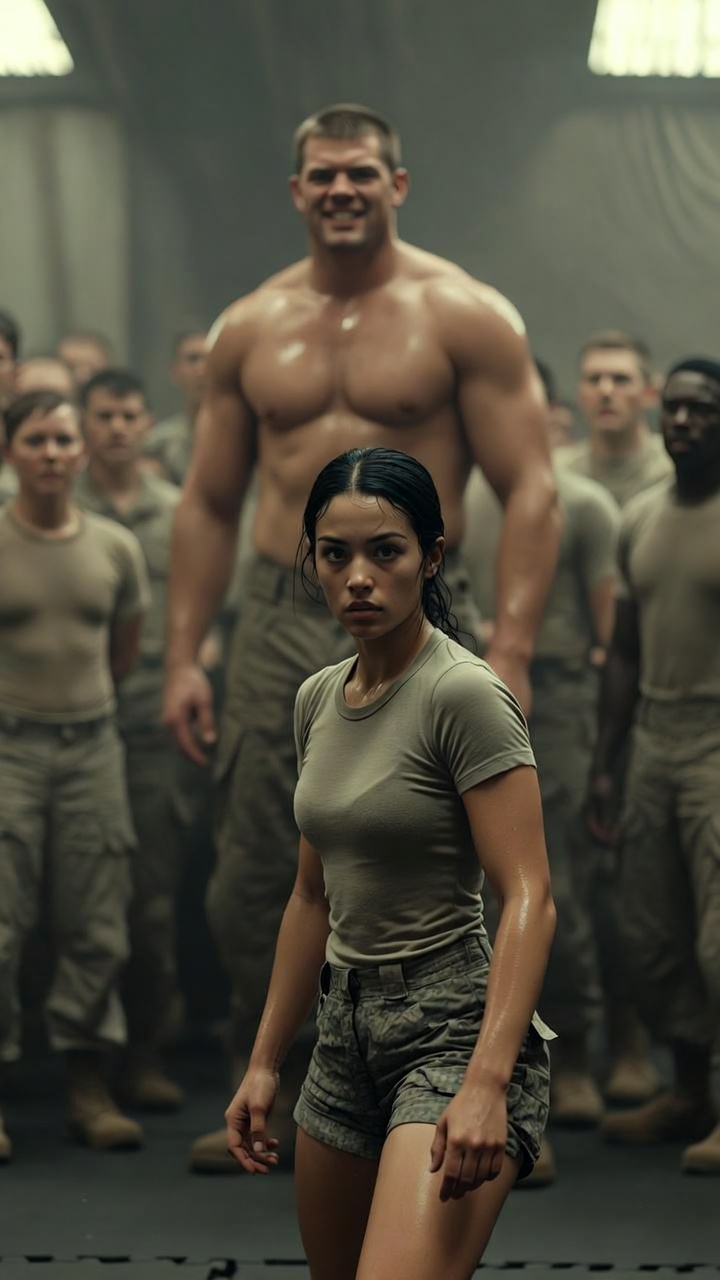
“Yes,” Leah said. “I do.”
Price stepped closer.
“Captain, can you verify that assignment?”
Leah reached into the side pocket of her bag.
She removed a slim identification wallet and handed it to him.
Price opened it.
His eyes moved once across the credentials.
Then again, more slowly.
He closed the wallet and returned it.
“Her assignment is valid.”
A quiet murmur spread through the soldiers.
Briggs looked at Price.
“You knew?”
“No.”
“You just let this happen?”
Price’s voice hardened.
“I told you to stop.”
Briggs looked back at Leah.
The red had drained from his face.
For the first time since she entered the room, he did not see a small officer in plain training clothes.
He saw the details he had dismissed.
The worn shoes.
The economical movement.
The complete absence of nervous energy.
The way she watched the center of his body instead of his hands.
The way she had released his elbow at the precise instant injury became possible.
The way she controlled his head during the throw even after he attacked outside the drill.
Every clue had been present.
He had simply interpreted each one through the filter of what he already believed.
The moment of recognition arrived quietly.
His eyes moved from Leah’s face to her hands.
Then to the mat.
His shoulders lowered.
The anger left his expression, but nothing replaced it except a stunned emptiness.
Around him, the room watched the change.
Briggs had entered the morning believing status was something people displayed.
A voice.
A body.
A reputation.
A crowd’s reaction.
Now he stood in front of a person whose authority had been invisible only because she had not needed it to be seen.
“She should have said something,” he muttered.
Leah tilted her head slightly.
“What should I have said?”
“That you were with Orion.”
“Before the demonstration?”
“Yes.”
“Why?”
Briggs stared at her.
“So I’d know.”
“Know what?”
He looked away.
Leah waited.
The silence forced him to answer.
“Who I was dealing with.”
Leah nodded once.
“And would that have made you respectful?”
Briggs did not speak.
“Would you have listened when I asked about the parameters?”
No answer.
“Would you have controlled your strikes?”
His jaw tightened.
“Would you have stopped when Sergeant Price ended the exercise?”
Briggs looked at the floor.
Leah’s voice remained calm.
“Or would you have simply found a different reason to underestimate me?”
That question held the room.
It was not loud.
It did not need to be.
Briggs’s face changed again.
A muscle near his left eye twitched.
He opened his mouth, but no defense came.
Leah continued.
“I don’t announce my assignment because the moment people hear it, normal training becomes impossible. Some become afraid to engage. Some become eager to prove themselves. Some stop behaving like themselves entirely.”
Her eyes moved briefly across the room.
“This morning, nobody knew. That made it useful.”
Briggs looked up sharply.
“Useful?”
“Yes.”
“You set me up.”
“No. You volunteered.”
“You knew what would happen.”
“I knew what might happen.”
“You let me choose you.”
“You pointed at me in front of the room.”
A few soldiers lowered their eyes.
They remembered the joke about wellness week.
The laughter.
The assumption that Leah needed protection.
Briggs pressed his lips together.
Leah picked up her bag.
“For what it’s worth, your first entry was fast. Your base is strong. Your right hook has power.”
Briggs looked almost offended by the assessment.
“But you announce your attacks,” she continued. “Your shoulders rise before you commit. You watch the target instead of the whole body. And when you become frustrated, you stop making decisions.”
Briggs said nothing.
“That is fixable,” Leah said. “The other problem is harder.”
“What other problem?”
“You decide who deserves your respect before they’ve done anything.”
The words settled over him.
No one moved.
Leah glanced toward Sergeant Kim.
“His elbow needs imaging. The joint shifted past normal range.”
Kim nodded.
“I’ll take him.”
Briggs looked at Leah.
“You hurt me, and now you’re giving medical advice?”
“I’m responsible for what happened while we were training.”
“You think that makes it fine?”
“No.”
The answer surprised him.
Leah stepped closer, stopping outside his reach.
“It makes me responsible for helping prevent further damage. Responsibility is not the same as innocence.”
Briggs stared at her.
She did not look triumphant.
That was the part he could not understand.
If the positions had been reversed, he knew exactly what he would have done.
He would have laughed.
He would have repeated the moment for weeks.
He would have turned the other person’s humiliation into proof of his own importance.
Leah had every reason to do the same.
She did not.
Price pointed toward the exit.
“Medical. Now.”
This time Briggs obeyed.
He walked away with Sergeant Kim beside him.
The soldiers separated to let them pass.
Nobody smiled.
Nobody made a joke.
Briggs kept his eyes forward.
At the doorway, he glanced back once.
Leah was speaking quietly with Price.
She was not watching him leave.
For reasons he could not explain, that hurt more than the fall.
By 9:00 that morning, the story had left the training hall.
By noon, it had crossed Raven Ridge.
By evening, it had become six different stories, each more dramatic than the last.
In one version, Leah had broken Briggs’s arm with a single finger.
In another, she had thrown him across the entire room.
Someone claimed she had served in five countries under seven identities.
Someone else insisted she had been sent to Raven Ridge to investigate the instructors.
None of that was true.
The truth was simpler.
Briggs had selected an opponent based on appearance.
He had ignored skill when it contradicted his assumptions.
He had allowed embarrassment to become anger.
And when ordered to stop, he had attacked again.
Leah had controlled him each time.
That was enough.
The next morning, the dining facility was crowded.
Metal chairs scraped against tile.
Coffee machines hissed.
Soldiers moved through the serving line carrying trays with eggs, oatmeal, toast, and the tired expressions of people who had begun work before sunrise.
At 7:12, Leah walked through the entrance.
The nearest conversations stopped.
The silence traveled outward in a wave.
Forks paused.
Heads turned.
Someone near the coffee station whispered her name.
Leah noticed.
Of course she noticed.
She simply did not react.
She collected a tray, took oatmeal, fruit, two boiled eggs, and black coffee.
The dining staff member behind the counter smiled nervously.
“Good morning, ma’am.”
“Good morning.”
Leah moved toward an empty table.
People watched her cross the room.
Some looked impressed.
Some looked curious.
A few moved their chairs aside even though she had plenty of room.
The behavior irritated her more than Briggs’s jokes had.
Yesterday, they had barely noticed her.
Today, they were creating a corridor.
Her ability had not changed overnight.
Only their knowledge had.
Near the far wall, Briggs sat alone.
His right arm was supported in a black sling.
A compression wrap covered his elbow.
The medical team had diagnosed a severe sprain with partial ligament damage but no fracture.
He would not require surgery.
He would, however, spend several weeks away from full training.
His breakfast remained mostly untouched.
Leah saw him.
He saw her.
For a moment, neither moved.
Then Briggs stood.
The room noticed.
He turned toward Leah, straightened as much as the sling allowed, and raised his left hand in a formal salute.
“Ma’am.”
Leah placed her tray on the nearest table and returned the salute.
“At ease, Staff Sergeant.”
Briggs lowered his hand.
Every nearby conversation had stopped again.
He glanced around.
Leah followed his eyes.
“Do you want an audience?”
His face tightened with embarrassment.
“No, ma’am.”
“Then sit down.”
He sat.
Leah picked up her tray and walked toward the table.
She took the chair across from him.
The room slowly resumed breathing, though few people returned fully to their conversations.
Briggs stared at his coffee.
Leah peeled one of the eggs.
Neither spoke for several seconds.
Finally, Briggs cleared his throat.
“I owe you an apology.”
Leah continued peeling the shell.
“Yes.”
He looked up.
He had expected her to make it easier.
To say it was fine.
To say the moment had passed.
To give him a path away from discomfort.
She did not.
Briggs nodded slowly.
“Yes, ma’am.”
Leah placed the shell on the edge of her tray.
He took a breath.
“I was disrespectful when you entered the training hall. I made assumptions about your ability. I tried to use the demonstration to make myself look good.”
Leah waited.
Briggs glanced at the sling.
“When that didn’t happen, I blamed you.”
Still she waited.
“And after Sergeant Price stopped the drill, I attacked you.”
The words were quieter.
Leah took a sip of coffee.
Briggs looked toward the window.
“That was wrong.”
“Yes.”
“I’m sorry.”
Leah studied him.
The apology appeared sincere.
But sincerity in private was easy.
The real test was whether a person remained honest while people were watching.
Leah looked around the dining facility.
Half the room was pretending not to listen.
“Who are you apologizing to?” she asked.
Briggs frowned.
“You.”
“Then look at me.”
His eyes returned to hers.
“Say it without looking at the crowd.”
He shifted in his chair.
“I’m sorry, Captain Cole.”
Leah held his gaze.
“I accept your apology.”
Relief entered his face.
It lasted less than a second.
“But acceptance does not erase consequences.”
His expression tightened again.
“I know.”
“Do you?”
He looked at the sling.
“I’m off training.”
“That’s an injury. Not a consequence.”
Briggs remained silent.
Leah leaned back slightly.
“You’re an experienced staff sergeant. People watch what you do. When you mocked me, younger soldiers laughed because you gave them permission.”
Private Keller, sitting two tables away, lowered his eyes.
“When you ignored Sergeant Price, you showed them that wounded pride mattered more than discipline.”
Briggs swallowed.
“When you attacked after the whistle, you turned a training failure into a leadership failure.”
The words struck with greater force than anything on the mat.
Briggs’s face reddened.
He glanced again toward the room.
Leah’s voice remained low.
“You wanted people to see you as strong. That desire made you careless.”
Briggs looked down.
“I understand.”
“Tell me what you understand.”
He remained quiet for a long moment.
Then he spoke.
“I treated respect like something people had to earn from me.”
Leah said nothing.
Briggs continued.
“But I expected everyone else to give it to me automatically.”
A nearby table went silent.
He noticed, then forced himself to continue.
“I thought experience meant I couldn’t be wrong about people.”
Leah nodded slightly.
“That’s closer.”
Briggs rubbed his left thumb against the side of his coffee cup.
“I also thought being stronger meant I controlled the situation.”
“You were stronger.”
He looked at her.
She broke the second egg.
“You had more muscle. More mass. Longer reach. None of those facts were imaginary.”
Briggs seemed confused.
“Then why didn’t they matter?”
“They mattered. You simply believed they were the only things that mattered.”
Leah sprinkled pepper over the egg.
“Power becomes predictable when the person using it believes it is enough.”
Briggs sat with that sentence.
Across the dining hall, people had stopped pretending not to listen.
Leah noticed them again.
She raised her voice slightly.
“Everyone heard the story?”
No one answered.
She looked toward Private Keller.
“You heard it?”
He straightened.
“Yes, ma’am.”
“Which version?”
A few nervous smiles appeared.
“The one where you threw Staff Sergeant Briggs.”
“Once?”
Keller hesitated.
“Three times, ma’am.”
Someone coughed.
Leah looked around.
“You saw one training session. Do not turn it into mythology.”
The smiles vanished.
“Staff Sergeant Briggs made serious errors. He is still an experienced soldier. He still has skills worth learning. One bad morning does not erase eleven years of service.”
Briggs looked at her in surprise.
Leah continued.
“But service does not excuse the morning either.”
She turned back to him.
“Both things can be true.”
The room remained quiet.
Briggs’s shoulders shifted.
Some of the stiffness left them.
Leah finished half the egg.
“Your apology matters,” she said. “What you do next matters more.”
He nodded.
“What should I do?”
“That depends.”
“On what?”
“Whether you want to repair your reputation or repair your behavior.”
Briggs blinked.
“Aren’t those the same?”
“No.”
She took another drink of coffee.
“Reputation is what people say when you leave the room. Behavior is what you do when nobody useful is watching.”
Briggs looked around the dining hall.
For perhaps the first time in years, he seemed uncomfortable with attention.
“What would you do?”
Leah considered him.
“I would stop performing.”
The answer was quiet.
Briggs waited.
“I would apologize to Sergeant Price for disobeying a direct instruction. I would speak to the group that witnessed it. I would tell them exactly where I failed.”
Briggs’s jaw tightened.
“In front of everyone?”
“Yes.”
“They already know.”
“They know what happened. They don’t know what you learned.”
He leaned back.
“That sounds like public humiliation.”
Leah’s expression remained neutral.
“Yesterday you wanted a public demonstration.”
His face fell.
She did not soften the point.
“You do not get to seek an audience for your confidence, then demand privacy for your accountability.”
The sentence traveled farther than either of them intended.
Several soldiers looked down at their trays.
Briggs remained still.
The dining hall seemed to wait with him.
After several seconds, he nodded.
“All right.”
“All right what?”
“I’ll address the group.”
“When?”
“This afternoon.”
Leah shook her head.
“This morning.”
His eyebrows rose.
“I have medical.”
“After medical.”
He inhaled slowly.
“Yes, ma’am.”
Leah returned to her breakfast.
The conversation appeared finished.
Briggs stared at her for another moment.
“Can I ask you something?”
“You just did.”
A faint smile appeared at the corner of his mouth.
It vanished quickly.
“Why didn’t you say who you were?”
Leah looked at him.
“I answered that yesterday.”
“I know. But I mean before any of it started. When I made the comments.”
“Would you have believed me?”
Briggs opened his mouth.
Then closed it.
Leah nodded.
“That’s why.”
He looked at the sling.
“I probably would have thought you were trying to impress people.”
“Yes.”
“Or lying.”
“Yes.”
He shook his head.
“I didn’t give you a way to win.”
Leah folded her napkin once.
“People who depend on prejudice rarely do.”
The sentence did not sound angry.
That made it harder to dismiss.
Briggs looked toward Private Keller.
The young soldier immediately looked away.
“I taught them that,” Briggs said.
“You reinforced it.”
“That isn’t better.”
“No.”
He inhaled slowly.
“What if they never respect me again?”
Leah stood and lifted her tray.
“Then spend less time asking for respect and more time becoming respectable.”
She carried the tray toward the return station.
As she crossed the room, soldiers moved aside again.
Leah stopped.
The nearest group froze.
“You don’t need to clear a path.”
“Yes, ma’am,” one of them said.
“Then don’t.”
She walked between the tables like any other officer heading to work.
The corridor disappeared behind her.
At 10:30, Briggs stood in front of the same soldiers who had watched him fall.
His arm remained in the sling.
Price stood near the wall.
Leah was not there.
Briggs had expected her to attend.
Part of him had wanted her there so the apology would be seen by the person who had demanded it.
Another part was relieved she was absent.
The soldiers formed three rows.
Nobody smiled.
Briggs looked at their faces.
Yesterday, he would have known exactly how to command the room.
A joke.
A loud voice.
A challenge.
Today, every familiar tool felt dishonest.
He cleared his throat.
“Yesterday’s demonstration did not go the way I expected.”
A few soldiers shifted.
Briggs almost added a joke.
He stopped himself.
“That sentence is true, but it’s also cowardly.”
Price’s eyes lifted.
Briggs continued.
“I selected Captain Cole because I thought she would be easy to beat.”
The words sounded worse when spoken plainly.
“I judged her by her size, appearance, and the fact that I did not recognize her assignment.”
Private Keller watched him carefully.
“I made disrespectful comments. Some of you laughed.”
Several soldiers looked down.
“That part is on me. I was the senior person in the room behaving that way. I showed you that mocking someone was acceptable if you believed they could not challenge you.”
Briggs paused.
His injured elbow throbbed inside the sling.
He no longer felt entitled to the pain.
“During the exercise, Captain Cole controlled the engagement. Instead of adjusting, I became angry.”
He looked toward Price.
“When Sergeant Price stopped the drill, I disobeyed him.”
Price remained still.
“I attacked Captain Cole after the exercise was over.”
The room had become completely silent.
“That was undisciplined, unprofessional, and dangerous.”
Briggs took a breath.
“I have apologized to Captain Cole. I am apologizing now to Sergeant Price.”
Price gave a small nod.
“And to all of you.”
Briggs looked across the rows.
“Do not learn from the version of me you saw yesterday.”
The sentence caught in his throat for a moment.
“Learn from the mistake.”
He stepped back.
Nobody applauded.
It was not that kind of moment.
Price moved to the front.
“Staff Sergeant Briggs.”
“Yes, Sergeant?”
“You are temporarily removed from combatives instruction pending review.”
Briggs’s jaw tightened.
“Yes, Sergeant.”
“You will assist with equipment, safety logs, and after-action documentation.”
“Yes, Sergeant.”
“You will also complete remedial leadership counseling.”
A few soldiers glanced toward Briggs.
He kept his eyes on Price.
“Yes, Sergeant.”
Price turned to the group.
“This is what accountability looks like. It does not remove consequences. It means you stop running from them.”
Briggs stood beside him, silent.
The old version of himself would have experienced the moment as destruction.
Public correction.
Reduced authority.
A damaged reputation.
Yet something unexpected happened as the group dispersed.
Private Keller approached.
He looked nervous.
“Staff Sergeant?”
“What?”
“I laughed yesterday.”
Briggs waited.
Keller swallowed.
“At the comments about Captain Cole.”
“I know.”
“I’m sorry.”
Briggs studied him.
The easiest response would have been to say it did not matter.
The honest response was different.
“Why did you laugh?”
Keller shifted his weight.
“Because everyone else did.”
“No.”
Briggs’s voice was not loud.
“You laughed because you wanted me to approve of you.”
Keller looked down.
“Yes, Sergeant.”
Briggs glanced toward the empty mat.
“That’s what I taught you to do.”
Keller did not answer.
Briggs continued.
“Next time a senior person gives you permission to act like an idiot, remember that permission does not remove responsibility.”
“Yes, Sergeant.”
“And Keller?”
“Yes?”
“Do not confuse confidence with competence. They sometimes travel together. Sometimes they don’t.”
Keller nodded.
“Yes, Sergeant.”
As he walked away, Price watched Briggs from across the room.
He did not smile.
But he did write something on the clipboard.
That afternoon, Leah returned to the training hall.
She found twelve soldiers practicing defensive movement in pairs.
Most were from a newly assigned support unit.
Among them was Specialist Ava Moreno, a twenty-two-year-old communications technician who had joined the Army after growing up in a small town where almost nobody expected her to leave.
Moreno was quick, intelligent, and terrified of making mistakes in public.
Her partner outweighed her by nearly seventy pounds.
Every time he stepped forward, she retreated in a straight line.
Her shoulders rose.
Her feet crossed.
She looked at his hands instead of his body.
Leah watched for several exchanges.
Then she approached.
“Pause.”
Moreno’s partner stepped back.
Leah looked at Moreno.
“Why are you moving straight backward?”
“To create distance, ma’am.”
“Are you creating it?”
Moreno glanced behind her.
She was less than two feet from the wall.
“No, ma’am.”
“You’re surrendering space.”
Moreno nodded.
Leah stepped beside her.
“When someone larger moves forward, you feel pressure here.”
She touched two fingers lightly against Moreno’s upper chest.
“Your body interprets size as danger before the person has done anything.”
Moreno looked embarrassed.
“I’m trying not to freeze.”
“You aren’t freezing.”
“I keep backing up.”
“That is a decision. Not a useful one, but still a decision.”
A few nearby soldiers smiled.
Leah repositioned Moreno’s feet.
“Do not argue with his weight. Change where it goes.”
She pointed toward the partner.
“Move forward slowly.”
He stepped in.
Leah guided Moreno half a step to the side.
The larger soldier passed her shoulder.
Leah stopped him.
“Again.”
They repeated it.
This time Moreno moved without assistance.
Her partner passed.
Her eyes widened.
Leah nodded.
“Again.”
They repeated the movement five times.
On the sixth, Moreno added a forearm frame and turned naturally toward his exposed side.
Leah stepped back.
“Better.”
Moreno smiled.
“Thank you, ma’am.”
“What changed?”
“I stopped backing up.”
“That is what you did. What changed?”
Moreno thought.
“I stopped assuming he controlled the space.”
Leah nodded.
“Good.”
The soldiers around them listened.
Moreno hesitated.
“Ma’am?”
“Yes?”
“Is it true what happened with Staff Sergeant Briggs?”
The nearby pairs stopped moving.
Leah looked at them.
“It is true that a training session became unsafe.”
Moreno waited.
“And that you threw him?”
“Yes.”
A few soldiers tried not to smile.
Moreno looked toward the floor.
“Everyone says he underestimated you.”
“He did.”
“Does that happen often?”
Leah considered the question.
“Yes.”
Moreno looked up.
“Doesn’t it bother you?”
“Sometimes.”
“What do you do?”
“I collect information.”
Moreno frowned.
Leah pointed toward her partner.
“When he underestimated your ability to move, what happened?”
“I got outside his reach.”
“Exactly.”
Leah folded her arms.
“Being underestimated can be painful. It can also be useful.”
The soldiers leaned closer.
“People reveal themselves when they believe you are not a threat. They become careless. They speak freely. They show you what they depend on.”
Moreno nodded slowly.
“So you use it.”
“I don’t seek it. But I don’t waste it.”
Her partner glanced at Leah.
“How do you not get angry?”
“I get angry.”
The answer surprised them.
Leah continued.
“Discipline is not the absence of emotion. It is deciding that emotion does not get command authority.”
Nobody spoke.
Briggs had entered the hall through the equipment door.
He carried a stack of inventory forms beneath his uninjured arm.
He stopped when he heard Leah’s words.
She had not seen him yet.
Moreno asked another question.
“Did you know you were going to beat him?”
Leah shook her head.
“You never know.”
“But with your training—”
“Training does not create certainty. It reduces preventable mistakes.”
She glanced around the group.
“The moment you believe your title, unit, rank, strength, or experience guarantees the outcome, you have already stopped observing.”
Briggs looked down at the forms.
The sentence could have been directed at him.
It was not.
That made it more powerful.
Leah turned and saw him.
For a second, the hall became quiet.
Briggs lifted the forms slightly.
“Equipment logs, ma’am.”
Leah nodded.
“Staff Sergeant.”
He walked toward the storage cage.
The soldiers watched him.
Briggs felt their eyes.
Yesterday, he would have responded with a joke or an angry look.
Today, he continued walking.
Before he reached the cage, he stopped.
He turned toward Moreno and her partner.
“Specialist.”
Moreno straightened.
“Yes, Sergeant?”
“When you pivot outside, keep your rear hand higher. A larger opponent will often turn with a wide strike.”
Moreno adjusted her guard.
“Like this?”
“Higher.”
She corrected it.
Briggs nodded.
“Better.”
He continued toward the storage cage.
Leah watched him for a moment.
Then she returned to the group.
“Again.”
Training resumed.
Over the next three weeks, Raven Ridge slowly stopped talking about the fight.
This did not happen because people forgot.
It happened because new stories replaced it.
A vehicle inspection failed.
A visiting general arrived.
A storm damaged two training areas.
A platoon broke the base record during a casualty evacuation exercise.
Military life moved forward, as it always did.
But the close-combat hall changed.
The jokes became less personal.
Senior soldiers became more careful about the example they set.
Instructors began pairing participants by training objective rather than appearance.
Price added a discussion on unconscious assumptions to the beginning of every control-under-pressure block.
He did not mention Briggs or Leah.
He did not need to.
Briggs attended physical therapy each morning.
His elbow improved.
The sling came off after ten days.
He returned first to administrative work, then to conditioning, then to limited technical drills.
He did not ask to resume instruction.
He waited.
One Friday afternoon, he found Leah in an empty classroom reviewing an after-action report.
He knocked on the open door.
She looked up.
“Staff Sergeant.”
“Do you have a minute?”
Leah closed the folder.
“Yes.”
Briggs entered.
His right arm was no longer wrapped, though he still moved it cautiously.
He stood in front of the desk.
“I’ve been cleared for controlled training next week.”
“I heard.”
“Sergeant Price says I can return to instruction after evaluation.”
“That seems reasonable.”
Briggs nodded.
He remained standing.
Leah waited.
“There’s something else.”
“What?”
He looked toward the wall.
A training schedule hung beside a map of the base.
“I’ve been thinking about what you said.”
“You’ll need to be more specific.”
“About respect.”
Leah leaned back.
Briggs continued.
“I always thought respect meant people knew what I’d done.”
“Many people think that.”
“I thought my record gave me authority.”
“It gives you credibility.”
“What’s the difference?”
“Credibility helps people believe you. Authority gives you responsibility for what happens when they do.”
Briggs considered that.
“I used both like they were permission.”
“Yes.”
He nodded.
The word no longer seemed to offend him.
“I’ve also been thinking about why I chose you.”
Leah said nothing.
“I told myself it was because you were new.”
“Was it?”
“No.”
He looked at her directly.
“I chose you because I thought beating you would make me look strong without much risk.”
The room remained quiet.
“That is honest,” Leah said.
“It’s ugly.”
“Honesty often is before it becomes useful.”
Briggs exhaled.
“I don’t know when I started becoming that person.”
Leah looked down at the folder.
“People rarely become arrogant in one decision.”
He waited.
“It happens through small rewards. A joke gets a laugh. A threat gets obedience. A reputation removes the need to explain yourself.”
She folded her hands.
“Eventually, the response becomes more important than the reason.”
Briggs nodded slowly.
“That sounds right.”
“Then change the rewards.”
“How?”
“Stop measuring the room by how much attention it gives you.”
He gave a faint, humorless smile.
“That could take a while.”
“Yes.”
Briggs looked at his right elbow.
“Can I ask you something that isn’t about the fight?”
“You can ask.”
“Why are you here?”
“At Raven Ridge?”
“Yes.”
Leah studied him.
“I’m evaluating how conventional units identify and develop personnel for high-pressure assignments.”
Briggs raised his eyebrows.
“So you really were observing us.”
“I was observing the training environment.”
“And me?”
“You made yourself observable.”
He almost smiled.
Almost.
“Are you selecting people?”
“I’m assessing systems.”
“That isn’t a no.”
“It isn’t a yes either.”
Briggs glanced toward the door, then back.
“What do units like yours look for?”
Leah answered without hesitation.
“Judgment.”
“Not physical ability?”
“That can be improved.”
“Experience?”
“Useful, but not enough.”
“Confidence?”
“Necessary in controlled amounts.”
Briggs waited.
Leah continued.
“We look for people who can receive new information without protecting their ego from it.”
The sentence reached him immediately.
He looked away.
Leah did not rescue him from the implication.
“Would I have failed?” he asked.
“Yesterday?”
“Yes.”
“Yes.”
He nodded.
“What about now?”
Leah opened the folder again.
“Ask me after your next difficult day.”
Briggs remained still.
Then he smiled for the first time without performing for anyone.
“Yes, ma’am.”
He turned toward the door.
“Staff Sergeant.”
He looked back.
Leah gestured toward his arm.
“How is the elbow?”
“Still weak.”
“Pain?”
“Only when I rotate fully.”
“Do not rush the recovery.”
“I won’t.”
“You rushed the last engagement.”
He accepted the point.
“Yes, ma’am.”
Two months later, Raven Ridge hosted an inter-unit assessment week.
More than 200 soldiers rotated through medical simulations, navigation exercises, live-fire decision drills, and close-range control scenarios.
Leah served as an evaluator.
She wore the same plain gray shirt.
No visible unit insignia.
No dramatic introduction.
This time, however, Raven Ridge knew who she was.
The danger was different.
Soldiers became stiff when she approached.
Officers overexplained simple decisions.
Instructors attempted to make ordinary sessions look perfect.
Leah disliked it exactly as much as she had predicted.
During the second day, a young lieutenant froze in a decision lane after receiving conflicting information.
A role player shouted about an injured civilian.
A radio operator reported a possible threat.
A team member asked for orders.
The lieutenant stood in the center, trying to calculate the perfect choice.
Leah watched from behind the observation barrier.
Briggs stood beside her.
His elbow had healed enough for normal movement.
He had returned to instruction but was still completing leadership counseling.
The scenario ended badly.
The lieutenant delayed evacuation, failed to secure the room, and allowed confusion to spread through the team.
Afterward, he approached Leah before the formal review.
“Ma’am, I know what I did wrong.”
Leah looked at him.
“What?”
“I hesitated.”
“That is what happened. Why?”
The lieutenant glanced toward Briggs, then back to Leah.
“I didn’t want to make the wrong decision in front of you.”
Leah nodded.
“So you made no decision.”
“Yes, ma’am.”
“Who were you leading?”
“My team.”
“Then why was I the most important person in the room?”
The lieutenant’s face reddened.
Leah pointed toward the team members waiting nearby.
“Your authority belonged to them. You spent it trying to protect your image.”
Briggs heard the words and felt the old discomfort return.
The lieutenant nodded.
“Yes, ma’am.”
Leah looked toward the reset area.
“Run it again.”
The lieutenant blinked.
“We get another attempt?”
“You get another opportunity to make decisions. The result is still recorded.”
He nodded quickly.
“Yes, ma’am.”
As he moved away, Briggs looked at Leah.
“You could have let him fail.”
“He already failed.”
“You know what I mean.”
“Yes.”
Briggs watched the lieutenant reorganize his team.
“Why give him another run?”
“Because punishment and development are different tools.”
Briggs remained quiet.
Leah glanced at him.
“You used to confuse them.”
He did not deny it.
“I thought embarrassment made lessons stick.”
“It makes fear stick.”
“Sometimes fear works.”
“For compliance.”
“Isn’t that enough?”
“Not when the person must think without you.”
The scenario restarted.
This time, the lieutenant made an imperfect but immediate decision.
He secured the room, delegated treatment, clarified the radio report, and moved the casualty.
The outcome was not flawless.
It was effective.
When the lane ended, Leah wrote two lines on her evaluation sheet.
Briggs looked toward her notes.
“What did you write?”
“That he adapted.”
“Good score?”
“Better score.”
Briggs smiled.
“You never answer the easy version of a question.”
“The easy version is usually less useful.”
On the final day of assessment week, heavy rain swept across Raven Ridge.
Outdoor lanes were delayed.
Personnel crowded into covered training areas.
The close-combat hall filled with visiting units.
Near midday, an argument began beside the equipment cage.
A senior instructor from another installation had paired a small female corporal with a much larger male soldier.
The corporal requested clarification about the drill’s contact level.
The instructor laughed.
“Don’t worry. He’ll take care of you.”
Several soldiers smiled.
Briggs heard it from across the hall.
For a second, the scene looked exactly like the morning that had changed him.
The same dismissive tone.
The same public laughter.
The same assumption disguised as reassurance.
Leah stood near the far wall, speaking with Price.
She had not heard.
Briggs walked toward the visiting instructor.
“Sergeant Major.”
The man turned.
“What?”
“The corporal asked about the parameters.”
“I heard her.”
“You didn’t answer.”
The instructor’s face hardened.
“I told her not to worry.”
“That isn’t a parameter.”
The soldiers nearby became silent.
The visiting instructor looked Briggs up and down.
“You running my lane now?”
“No, Sergeant Major.”
“Then stay in yours.”
The old Briggs would have stepped back.
Not because he lacked courage, but because rank had always mattered most when it belonged to someone above him.
The new lesson was harder.
Respect did not require silence.
“Controlled contact or full resistance?” Briggs asked.
The instructor stared.
“Staff Sergeant, walk away.”
Briggs felt every eye on him.
His heart rate increased.
The desire to perform returned.
So did the desire to win.
He recognized both.
He let neither take control.
He spoke more quietly.
“She asked a valid safety question. She deserves a clear answer.”
The corporal stood perfectly still.
The instructor looked around and saw the audience.
His face reddened.
Before he could respond, Price approached.
“What’s the issue?”
Briggs turned toward him.
“Unclear contact standard.”
Price looked at the corporal.
“What were you told?”
She hesitated.
The visiting instructor answered for her.
“I told her the partner would control himself.”
Price looked at him.
“That is not a standard.”
The room remained silent.
The instructor’s jaw tightened.
Price pointed toward the lane card.
“Run controlled contact at fifty percent, then increase only with mutual agreement.”
The corporal nodded.
“Yes, Sergeant.”
Price looked at Briggs.
“Return to your station.”
“Yes, Sergeant.”
Briggs turned away.
As he passed Leah, he realized she had been watching.
She said nothing.
He continued to his station.
Later that afternoon, Leah found him carrying pads toward the storage room.
“You handled that well,” she said.
Briggs stopped.
“I almost didn’t.”
“What changed?”
He thought about the question.
“I remembered how it felt when everyone laughed.”
Leah waited.
“And I remembered that the corporal shouldn’t need a secret assignment before someone answers her question.”
Leah nodded.
“That is the lesson.”
Briggs shifted the pads beneath his arm.
“I wasn’t sure whether I was challenging the sergeant major because he was wrong or because I wanted to prove I’d changed.”
“Which was it?”
“Both.”
“Good.”
He looked surprised.
“Good?”
“Motives are rarely pure. What matters is whether you recognize the dangerous one before it makes the decision.”
Briggs smiled.
“I thought you’d say I failed some character test.”
“There is no final character test.”
Leah opened the storage room door for him.
“There are only repeated decisions.”
He carried the pads inside.
At the end of assessment week, Raven Ridge held a review in the main auditorium.
Leah presented findings to senior leaders.
Her slides were simple.
No dramatic graphics.
No stories about classified missions.
No references to her own record.
She spoke about training design, decision pressure, instructor behavior, and the difference between testing people and humiliating them.
Briggs sat near the back.
On the final slide, Leah displayed one sentence.
PEOPLE REVEAL THEIR TRAINING WHEN THE PLAN FAILS.
She looked across the room.
“Physical skill matters. Technical knowledge matters. Experience matters. But under pressure, people rarely rise to the identity they claim.”
The auditorium was silent.
“They return to the habits they have repeated.”
Her eyes passed over the instructors.
“If your training rewards ego, pressure will reveal ego.”
She looked toward the officers.
“If your organization rewards silence, pressure will reveal hesitation.”
Then toward the junior soldiers.
“If your culture teaches that respect belongs only to the impressive, people will ignore competence until it becomes impossible to deny.”
Briggs lowered his eyes.
Leah continued.
“Do not wait for someone to defeat your assumptions publicly. Correct them while the cost is still private.”
No one moved.
She closed the presentation.
“That concludes the review.”
The room stood.
Applause began near the front, then spread.
Leah did not seem pleased by it.
She simply gathered her notes.
Afterward, soldiers surrounded her with questions.
Some asked about selection.
Some asked about training.
Others wanted photographs, which she declined.
Briggs waited until the room cleared.
He approached with Price.
Price held a folder.
“Captain, your final evaluation packet.”
Leah took it.
“Thank you.”
Price nodded toward Briggs.
“I’ve completed his review.”
Leah looked at him.
Briggs stood with his hands behind his back.
Price continued.
“He is cleared to resume full instructional duties.”
Leah nodded.
“Good.”
“There’s a condition.”
Briggs looked at Price.
The instructor almost smiled.
“He will co-lead the next control-under-pressure block with a junior instructor.”
Briggs frowned.
“Co-lead?”
“You heard me.”
“Who’s the junior instructor?”
Price looked toward the auditorium entrance.
Specialist Ava Moreno stood there holding a training binder.
Briggs stared.
Moreno looked equally surprised.
Price handed Briggs a lesson plan.
“She demonstrated strong technical improvement and submitted the highest-rated peer coaching evaluation in her group.”
Moreno straightened.
Price continued.
“You will provide experience. She will provide the movement module.”
Briggs looked at Leah.
“This your idea?”
“No.”
Price answered.
“It was mine.”
Briggs examined the lesson plan.
The old reaction rose immediately.
A specialist teaching beside him?
In front of a group?
After eleven years of service?
He felt the resistance.
He recognized it.
Then he looked at Moreno.
She was waiting to see which version of him would answer.
Briggs nodded.
“When do we start?”
“Monday,” Price said.
Briggs looked at Moreno.
“Be there at 0600.”
She hesitated.
“The schedule says 0630.”
He almost corrected her.
Then he looked at the paper.
She was right.
“0630,” he said.
“Yes, Sergeant.”
As Moreno walked away, Leah closed the evaluation folder.
Briggs looked at her.
“You enjoyed that.”
“No.”
“You almost smiled.”
“I did not.”
Price looked between them.
“She did.”
Leah walked toward the exit.
Outside, the rain had stopped.
Sunlight broke beneath the clouds, throwing long reflections across the wet pavement.
Raven Ridge glowed in the late afternoon.
Leah crossed the courtyard toward the administrative building.
Soldiers stepped aside as she passed, but no longer in the exaggerated way they had in the dining facility.
Some nodded.
Some greeted her.
A few continued their conversations.
The base had adjusted.
Respect had become quieter.
That pleased her.
Near the training field, Moreno was demonstrating footwork to another young soldier.
Briggs stood several feet away, watching.
He did not interrupt.
When Moreno finished, she looked toward him.
He pointed to her rear foot.
“Shorter step.”
She adjusted it.
“Like this?”
“Exactly.”
No laughter.
No performance.
No need to establish who mattered more.
Leah continued walking.
She had not come to Raven Ridge to become a story.
She had not intended to expose anyone.
She had not entered the training hall seeking a confrontation.
But people often revealed their deepest beliefs in small moments.
A joke before a demonstration.
A decision about who looked dangerous.
A refusal to stop after pride had been wounded.
Briggs’s mistake had not begun when he threw the first punch.
It had begun when Leah walked through the door and he decided, without evidence, who she was.
The fight only made the belief visible.
What happened afterward mattered more.
Briggs could have protected his ego.
He could have blamed the injury, the instructor, the mat, the rules, or Leah’s hidden assignment.
He tried some of those things at first.
Then, slowly and painfully, he chose something harder.
He looked directly at the part of himself that had failed.
That choice did not undo the humiliation.
It did not remove the review from his record.
It did not instantly rebuild trust.
But it gave the failure a purpose beyond punishment.
The following Monday, the close-combat hall filled before sunrise.
Briggs stood near the mat with Moreno.
The soldiers formed a semicircle.
Some had heard the old story.
Some had not.
Price watched from the wall.
Leah stood near the back in plain training clothes.
Briggs began the lesson.
“Today’s block is close-range control under pressure.”
He paused.
Two months earlier, he would have started with a joke.
This time, he looked across the group.
“Your opponent may be larger. Faster. More experienced. Or they may simply look less capable than you expect.”
His eyes passed briefly over Leah.
“Appearance is information. It is not a conclusion.”
The room remained quiet.
Briggs gestured toward Moreno.
“Specialist Moreno will demonstrate movement and angle control.”
A soldier near the front looked surprised.
Briggs noticed.
He recognized the expression.
Once, he would have shared it.
“Pay attention,” he said. “She understands this better than most of you.”
Moreno stepped onto the mat.
Her nervousness was visible.
So was her preparation.
She positioned her feet.
Briggs played the larger attacker.
He moved forward slowly.
Moreno stepped outside, framed against his shoulder, and redirected him.
“Again,” Briggs said.
They repeated the sequence.
Her movement became smoother.
After the fourth repetition, Briggs addressed the group.
“What stopped me?”
A private raised his hand.
“Her strength?”
Briggs shook his head.
“I outweigh her by sixty pounds.”
Another soldier answered.
“Timing.”
“Partly.”
A third said, “Angle.”
Briggs nodded.
“She did not need to overpower me. She needed to make my power irrelevant.”
At the back of the room, Leah folded her arms.
Price glanced toward her.
“You staying for the whole session?” he asked quietly.
“No.”
“Where are you going?”
“Next assignment.”
Price nodded.
“Orion?”
Leah did not answer.
He smiled.
“Of course.”
She picked up her canvas bag.
The same bag she had carried on the first morning.
No insignia.
No dramatic equipment.
Nothing that announced where she had been or what she knew.
Before leaving, she looked toward the mat.
Briggs had paired a large soldier with a smaller woman.
The man glanced at Briggs.
“How hard are we going, Sergeant?”
Briggs answered immediately.
“Controlled contact at fifty percent. Increase only when both partners agree.”
The woman nodded.
“Understood.”
Briggs looked at both of them.
“You are responsible for each other.”
Leah walked toward the door.
Moreno noticed.
“Captain?”
The group turned.
Leah stopped.
Moreno stepped forward.
“Are you leaving?”
“Yes.”
“Will you be back?”
“Possibly.”
Moreno looked disappointed.
Leah adjusted the strap of her bag.
“Keep your rear hand high.”
Moreno smiled.
“Yes, ma’am.”
Briggs approached.
For a moment, the room became still.
He stood in front of Leah.
There was no sling now.
No anger.
No audience he was trying to impress.
He raised his hand in salute.
“Safe travels, Captain.”
Leah returned it.
“Take care of the room, Staff Sergeant.”
“I will.”
She looked at him for a second longer.
“Not just the equipment.”
Briggs understood.
“Yes, ma’am.”
Leah left the hall.
Outside, morning light stretched across Raven Ridge.
Behind her, the whistle sounded.
Training resumed.
Nobody in the room would remember every technique taught that day.
Some would forget the footwork.
Some would forget the exact angle of the frame.
Some would transfer to other bases, leave the service, or become instructors themselves.
But they would remember the morning a decorated staff sergeant chose the quietest person in the room because he believed she was the safest target.
They would remember how quickly confidence collapsed when it was built on assumption.
They would remember that the person with the least to prove often sees the most.
And they would remember that Leah’s greatest demonstration was not the throw, the joint lock, or the revelation of her assignment.
It was the discipline to hold power without needing everyone to see it.
Because real strength does not enter a room demanding recognition.
It watches.
It listens.
It waits.
And when arrogance finally mistakes silence for weakness, real strength does not need to announce itself.
It simply steps aside—and lets arrogance fall under the weight of its own certainty.