The soldiers had been warned about snipers.
They had been warned about mines, ambushes, hidden artillery and German troops pretending to surrender.
No one had warned them about the smell.
On April 4, 1945, men of the United States Army entered Ohrdruf, a forced-labor camp near the German town of Gotha. It was a subcamp of Buchenwald—and the first Nazi concentration camp liberated by American troops.
At first, the place appeared strangely quiet.
There were barracks, fences and guard towers. There were abandoned uniforms and buildings that looked as though their occupants had fled only hours earlier.
Then the soldiers began seeing bodies.
Some lay in open areas. Others had been stacked inside sheds. Many of the prisoners who had remained alive when the SS evacuated the camp had been shot because they were too weak to march.
The American troops had crossed battlefields filled with dead men. They had seen burned tanks, shattered villages and friends killed beside them.
But this was different.
These people had not died fighting.
They had been starved, beaten, worked until their bodies failed—and then discarded.
The soldiers stood in silence because there was nothing in their military training that told them how to respond.
Ohrdruf was not the first Nazi camp reached by Allied forces. Soviet troops had already encountered Majdanek near Lublin, Poland, in July 1944. The Germans, surprised by the speed of the Soviet advance, had tried to destroy evidence before retreating. But they had not erased enough. Gas chambers, crematoria and warehouses of victims’ belongings remained.
Still, many people in the West had struggled to understand reports of systematic mass murder.
They had heard stories.
Now soldiers were walking through the evidence.
And the evidence was looking back at them.
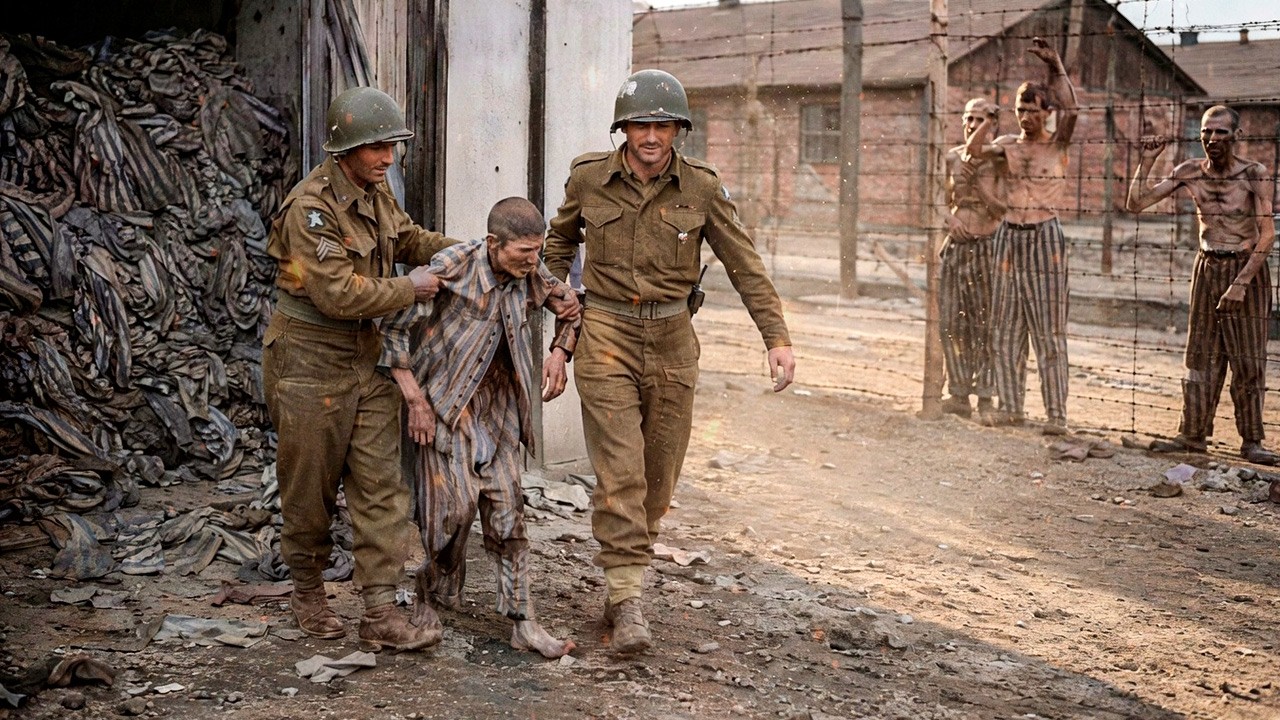
In the barracks, some prisoners were still alive. They were so thin that their uniforms seemed to hang from bones. Their eyes followed the soldiers cautiously.
Liberation did not always look like celebration.
Some prisoners were too weak to stand. Some did not understand that the guards were gone. Others had survived by distrusting every uniform they saw.
The Americans offered food.
That simple act created another danger.
A body that has endured prolonged starvation cannot always handle an ordinary meal. Soldiers who wanted to help sometimes gave survivors rich military rations, only to discover that severely weakened digestive systems could not process them.
Doctors had to intervene. Food had to be introduced carefully. Disease had to be contained. Water systems had to be restored.
The gates were open, but death had not stopped.
A week after Ohrdruf’s liberation, General Dwight D. Eisenhower visited the camp with senior commanders.
He walked past the bodies.
He entered the buildings.
He saw the instruments of forced labor and murder. He listened as survivors and soldiers explained what had happened there.
The people who accompanied him watched the Supreme Allied Commander’s face change.
This was not a man unfamiliar with war. Eisenhower had directed armies across continents. He received casualty reports every day. He knew that victory was being purchased with tens of thousands of lives.
But Ohrdruf forced him to confront something beyond the normal brutality of combat.
It was an organized system designed to erase human beings.
Eisenhower immediately understood that the Nazis’ final defense would not be military.
It would be denial.

One day, people would say the photographs were staged.
They would claim the witnesses had exaggerated.
They would argue that such crimes were too enormous to have happened.
So Eisenhower ordered the camps documented carefully. Photographers and film crews were sent in. Medical officers recorded conditions. Witnesses were interviewed. Local residents, journalists and government representatives were brought to see the evidence for themselves. The goal was to preserve a record that future generations could not easily dismiss.
That decision changed what happened next.
The camps would not simply be opened.
They would become crime scenes.
Across Germany and occupied Europe, other Allied units were making discoveries of their own.
On April 11, American forces reached Buchenwald.
Thousands of prisoners were still alive. Many had survived only because prisoners inside the camp had organized resistance as the SS prepared to evacuate.
Six days after Ohrdruf, another set of gates opened—and another group of soldiers learned that the horror was not isolated.
Then came Bergen-Belsen.
On April 15, 1945, British soldiers from the 63rd Anti-Tank Regiment and the 11th Armoured Division entered the camp in northern Germany.
The Germans had warned them that typhus was spreading inside.
Nothing prepared them for what they found.
Nearly 60,000 prisoners were crowded into the camp. Thousands of bodies lay unburied. The living had little food or clean water. Typhus, dysentery and starvation were killing people every day.
British soldiers drove slowly through the camp, using loudspeakers to announce that they had arrived.
The prisoners heard a voice telling them they were free.
But freedom was difficult to understand when the ground was covered with the dead.
Medical personnel faced an impossible calculation.
Who could still be saved?
Who needed food first?
Who was carrying infectious disease?
How could tens of thousands of people be cleaned, clothed, treated and moved when many could not walk?
British troops and relief workers turned nearby buildings into emergency hospitals. Survivors were washed and deloused. Food distribution was organized. The most critically ill were carried out of contaminated barracks.
Former guards were forced to remove bodies and bury the dead.
For days, trucks moved through the camp.
Cameras recorded the work.
The images were so disturbing that some photographers later said the experience changed them permanently.
And still, people continued to die.
Thousands survived long enough to see liberation but not long enough to recover from what had been done to them.
That is one of the hardest truths about the liberation of the camps:
The arrival of Allied soldiers did not create a clean ending.
It began a desperate race against starvation and disease.
At Dachau, the Americans encountered another scene that would haunt them.
On April 29, 1945, troops approaching the camp found more than 30 railroad cars filled with decomposing bodies. The victims had been transported toward Dachau from other camps during the chaotic final weeks of the war.
Some soldiers turned away.
Others stared without speaking.

The train revealed something they had not yet fully understood.
The killing system was still moving people even as Nazi Germany collapsed.
While German cities burned, while Allied armies closed in and while defeat became unavoidable, prisoners were still being transported, starved and marched to death.
The regime was losing the war.
But it was still trying to finish its victims.
Inside Dachau, prisoners watched the Americans enter.
Some cheered.
Some cried.
Some collapsed.
A few reached through the fences to touch their liberators, as though physical contact were the only proof that the moment was real.
Yet the liberators themselves were changing.
They had entered Germany believing their mission was to defeat an enemy army.
Now they understood that they were also witnesses.
Letters home became different.
Soldiers who had once written about weather, rations and missing their families tried to describe places for which ordinary language seemed inadequate.
Pfc. Harold Porter, an American medic, wrote to his parents after witnessing Dachau. His letter became part of the documentary record preserved by the National Archives.
These accounts carried the same struggle.
How do you explain a human being who weighs less than a child?
How do you explain rooms filled with abandoned shoes, hair and clothing?
How do you explain guards who had gone home each evening after spending the day inside a machinery of suffering?
The soldiers searched for monsters.
Instead, they often found ordinary faces.
That may have been the most frightening discovery of all.
The camp system had not been maintained by a single madman working alone. It required guards, administrators, railway employees, contractors, doctors, informants and officials.
It required people who followed instructions.
People who benefited.
People who remained silent.
And people living nearby who insisted they knew nothing.
In several places, Allied commanders ordered local German civilians to enter the camps.
They were made to walk past the bodies.
They were made to see the barracks.
Some covered their noses. Some began crying. Others stared at the ground.
The soldiers watched them carefully.
This was the moment when denial collided with evidence.
There were no speeches powerful enough to hide what lay in front of them.
No propaganda slogan could explain away the skeletal survivors.

No claim of ignorance could silence the smell.
The balance of power had shifted completely.
The people who had been treated as nameless prisoners now became witnesses.
The men who had worn SS uniforms now stood under guard.
The officers who had once controlled who lived and who died were photographed, questioned and prepared for trial.
At Bergen-Belsen, camp personnel were arrested. The later Belsen Trial presented testimony and images to the world and helped establish foundations for subsequent war-crimes proceedings.
Evidence gathered in the camps also contributed to the larger postwar prosecutions.
Documents were examined.
Command structures were traced.
Survivors testified about selections, beatings, forced labor, starvation and murder.
For many of them, speaking was another form of endurance.
They had survived people who wanted not only to kill them, but to erase the record that they had ever lived.
Now they said their names.
They named the dead.
They identified guards.
They described what had happened behind the fences.
And the world was forced to listen.
But justice, when it came, was incomplete.
Some perpetrators were convicted and executed.
Others received prison sentences.
Many escaped, disappeared or returned to ordinary lives.
Millions of murdered people could not be restored by any courtroom verdict.
Liberation also did not return survivors to the lives they had known.
Many had no homes left.
Their families were gone.
Their communities had been destroyed.
Some returned to towns where former neighbors had taken their property. Others remained in displaced-persons camps because there was nowhere safe to go.
They had been freed from the camp, but they were not yet free from its consequences.
This was the final revelation awaiting the soldiers.
They had believed liberation meant opening the gates.
In reality, opening the gates was only the first act.
The survivors needed medicine, food, documentation, housing and a country willing to receive them.
They needed the world to believe them.
Most of all, they needed time—though many had already been robbed of too much of it.
The Allied soldiers could not undo what they found.
They could not reunite every family or bring the dead back from the pits.
But they could do three things.
They could rescue those still alive.
They could arrest those responsible.
And they could make sure the evidence survived.
That third act may have been the most important plot twist of the liberation.
The Nazis had built camps to make people disappear.
Instead, the camps became evidence that made the crime impossible to bury.
The photographs survived.
The films survived.
The letters survived.
The medical reports, transport lists, military records and survivor testimonies survived.
They remain because people standing at places like Ohrdruf, Buchenwald, Bergen-Belsen and Dachau understood that memory itself had become a battlefield.
The soldiers who entered those gates did not emerge as the same men.
They had expected to find prisoners.
They found witnesses.
They had expected to defeat an army.
They discovered a system.
They had expected victory to feel triumphant.
Instead, it came with the knowledge that they had arrived too late for millions.
That is why the liberation of the camps was not simply the moment the world discovered what the Nazis had done.
It was the moment the world lost the right to say it did not know.
And whenever cruelty depends on silence, remembering the evidence is not merely an act of history—it is the first line of defense against allowing it to happen again.