Chapter One
The Booth No One Wanted
The young lieutenant struck the old man’s table with the flat of his hand hard enough to make the whiskey jump.
Not spill.
Just jump.
A thin amber ring climbed the inside of the glass, hesitated beneath the rim, then slipped back down without losing a drop.
The old man watched it settle.
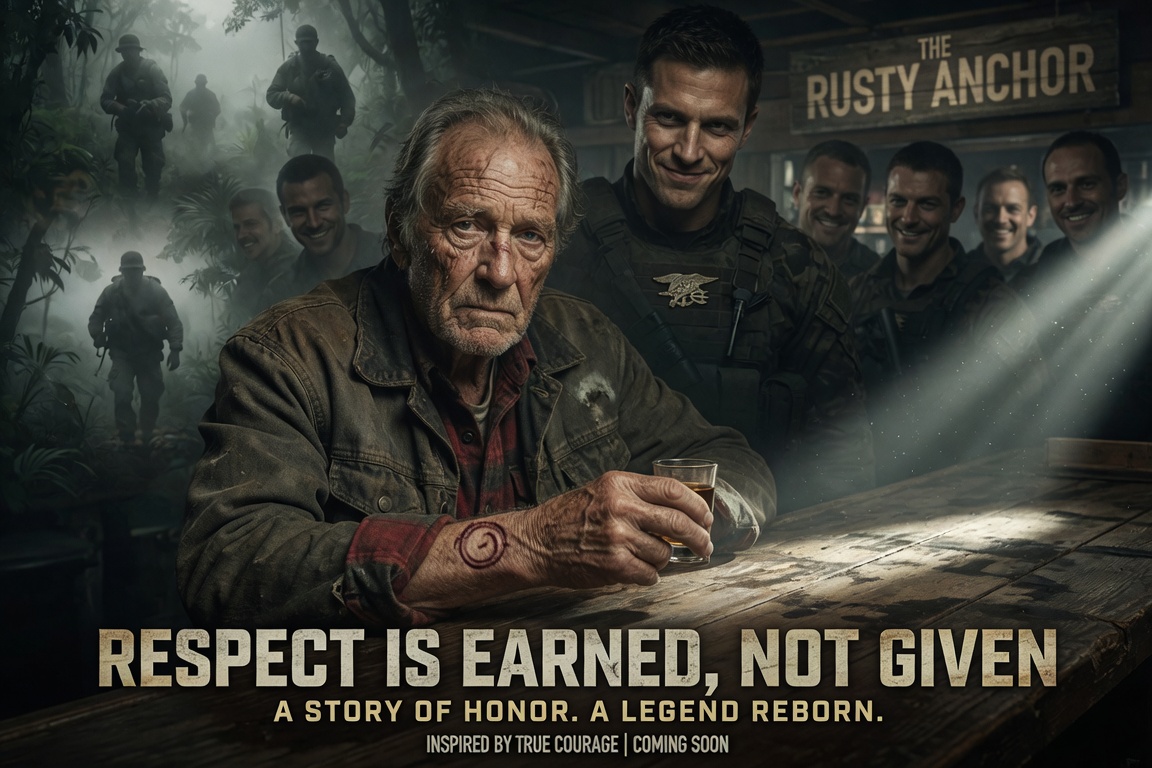
Outside, rain hammered the metal awning above Mercer’s Tavern, turning the parking lot into a black mirror broken by truck tires and neon. The sign over the entrance had lost three letters years ago. From the highway, the place simply advertised:
MER ER’S
COLD BEER
HOT FOOD
Inside, the air smelled of fryer grease, wet denim, old pine, and the salt that blew inland from the Atlantic whenever a storm pressed low over the Carolina coast.
Someone had fed quarters into the jukebox, but the music had stopped between songs.
Thirty-two faces turned toward the booth.
The old man did not look up.
Lieutenant Evan Rourke stood over him in a dark blue T-shirt stretched tight across his shoulders. His hair was still clipped close from the week’s training. His boots were clean despite the rain. A silver trident hung on a chain outside his shirt, where everyone could see it.
Three other Navy SEALs stood behind him, younger enlisted men who had followed their officer into the tavern twenty minutes earlier.
They had arrived laughing.
They were no longer laughing.
Rourke planted both hands on the table.
“You hear me, sir?”
The word sir contained no respect.
The old man sat alone in the corner booth beneath a framed photograph of a fishing boat that had sunk before Rourke was born. He wore a faded canvas jacket, a gray work shirt, and boots so old the leather had molded permanently around his feet.
His left hand rested beside the whiskey.
Two fingers were missing above the first knuckle.
His face was narrow and weather-cut. White hair lay close to his skull. A scar crossed the hollow beneath his right ear and disappeared into his collar.
He might have been seventy.
He might have been older.
“Booth’s taken,” he said.
His voice was quiet, roughened by age and something deeper than age.
Rourke glanced at the empty seat across from him.
“By who?”
The old man lifted his eyes.
The room seemed to shrink.
Not because his stare was threatening. There was no anger in it. No challenge.
Only measurement.
As though Lieutenant Evan Rourke were not a man standing over a table, but distance, wind direction, weight, and consequence.
“By me,” the old man said.
A few patrons looked away.
At the bar, Mercer stopped polishing a glass.
Rourke had been drinking, but not enough to lose control. That was the problem. He was choosing every word.
His team had completed a brutal training cycle that afternoon. They had been underwater, sleep-deprived, cold, and exhausted. Rourke had come to Mercer’s wanting the rear booth, the one beneath the old fishing photograph, because that booth offered a view of both doors.
It was where operators sat.
At least, that was what he had decided.
“You’ve got six empty stools at the bar,” Rourke said. “We’ve got four men.”
“Then you’re fortunate,” the old man replied. “There are exactly six stools.”
A short, involuntary laugh escaped one of the younger SEALs.
Petty Officer First Class Mason Cole covered it with a cough.
Rourke’s head turned.
Cole’s expression closed immediately.
The lieutenant looked back at the old man.
“You know who we are?”
The old man’s gaze dropped briefly to the trident.
“I know what you’re wearing.”
Rourke’s jaw tightened.
Mercer put the glass down.
He was sixty-three, broad through the chest, with forearms tattooed in the faded green ink of another era. He had known Evan Rourke’s father. He had known Evan when the boy was small enough to fall asleep beneath the pool table while adults drank after funerals.
“Evan,” Mercer called. “Leave him be.”
The use of his first name irritated Rourke more than the old man’s refusal.
“I’m handling it.”
“No,” Mercer said. “You’re creating it.”
A few heads turned toward the bartender.
Rourke felt the shift in the room. It was subtle, but he had spent years learning to detect changes in pressure, posture, attention.
Until that moment, he had been a decorated officer celebrating with his men.
Now he was becoming a spectacle.
And Rourke feared humiliation the way some men feared drowning.
He straightened and smiled.
It was the smile he used when anger needed to look like confidence.
“All right,” he said. “Maybe we got off wrong.”
The old man said nothing.
“I’m Lieutenant Evan Rourke.”
Still nothing.
Rourke touched the silver trident.
“Team Eight.”
The old man’s eyes flicked to the insignia again.
Rourke leaned closer.
“And you are?”
The old man lifted his whiskey.
“Drinking.”
Cole looked down at the floor.
The jukebox clicked as though preparing to play another song, then remained silent.
Rourke’s smile thinned.
“Military?”
The old man took a sip.
“Once.”
“What branch?”
No answer.
“What unit?”
The old man placed the glass down gently.
“The kind that didn’t discuss itself in bars.”
The sentence moved through the room like a low electrical current.
At a table near the restrooms, a retired Marine stopped chewing.
A woman in a hospital uniform lowered her phone.
Rourke saw their reactions and misunderstood them.
He believed the old man had performed a trick.
That he had found the right vague words to sound dangerous.
Rourke had met men like that near bases all his adult life. Men who claimed to have done classified work, who could not name their unit, who had lost their records in a fire, whose missions were so secret no government agency would admit they existed.
He had exposed several.
He enjoyed it.
“You know,” Rourke said, “every bar near a military base has one.”
“One what?” the old man asked.
“A ghost.”
The old man’s thumb traced the rim of his glass.
“A man who claims he did things nobody can verify. He never says too much. Just enough to make people wonder.”
The old man looked toward the rain-lashed window.
Rourke continued.
“He sits alone because silence makes him seem interesting. Says his records are sealed. Says his unit never officially existed.”
Mercer came around the end of the bar.
“That’s enough.”
Rourke lifted one finger without looking away from the booth.
“I’m asking a question.”
“No,” Mercer said. “You’re demanding an audience.”
For the first time, something moved behind the old man’s expression.
Not amusement.
Recognition.
He looked at Mercer.
“You still make the chowder too salty?”
Mercer froze.
His face changed so completely that Cole noticed.
The bartender’s shoulders lowered. His eyes glistened for half a second before he looked away.
“Only on Thursdays,” Mercer said.
“It’s Saturday.”
“Then you’re safe.”
A history passed between them without explanation.
Rourke hated histories he did not control.
He dragged the empty chair from the other side of the booth and turned it around. The legs scraped across the wooden floor.
Then he sat backward on it, arms folded across the backrest.
“Let’s keep it simple,” he said. “Did you have a call sign?”
The old man stared at him.
Rourke leaned closer, lowering his voice in mock confidentiality.
“Or did your secret unit skip those?”
Cole shifted his weight.
“Sir,” he said quietly.
Rourke ignored him.
The old man’s missing fingers curled slightly against the table.
The movement was small.
But Mercer saw it.
Mercer’s face lost color.
“Evan,” he said again, more urgently. “Stand up.”
Rourke glanced over his shoulder.
“You protecting him?”
“I’m protecting you.”
A few people inhaled at once.
Rourke’s neck flushed.
From somewhere near the dartboard, a chair creaked.
The lieutenant turned back to the old man.
“What was it?”
The rain intensified, drumming overhead.
The old man lifted the whiskey but did not drink. He held it near his mouth, studying the liquid.
“Call signs aren’t names,” he said.
“What are they?”
“Sometimes jokes. Sometimes warnings.”
Rourke waited.
The old man lowered the glass.
“Sometimes they’re the last word another man hears.”
The lieutenant gave a sharp laugh.
“See? That right there. That’s exactly what I’m talking about.”
The old man’s eyes returned to him.
“You asked.”
“And you didn’t answer.”
“No.”
Rourke placed one boot on the wooden support beneath the booth. The table shifted.
The whiskey trembled again.
This time, one drop crossed the rim and landed beside the old man’s hand.
Every muscle in Mercer’s body went rigid.
The old man studied the drop.
Then he looked at Rourke’s boot.
“Move it.”
Rourke smiled.
There were moments in a man’s life when pride whispered that retreat would cost more than disaster.
Evan Rourke had listened to that whisper since childhood.
He pressed his boot harder against the booth.
“Make me.”
No one moved.
The old man inhaled through his nose.
Slowly.
Quietly.
He closed his eyes for one second.
When he opened them, the age had gone out of his face.
His body was still frail. His white hair was still thin. His hand still bore the damage of decades.
But the man sitting in the booth was no longer old.
He was simply waiting.
Rourke felt it.
The first small crack in his certainty.
He covered it with another grin.
“Come on,” he said. “Give us the legend.”
The old man’s voice fell so low that everyone leaned in without realizing it.
“Reaper.”
The word did not echo.
It did not need to.
At the far end of the room, a beer bottle slipped from someone’s hand and struck the floor.
It did not break.
A retired Marine named Joseph Bell stood abruptly from his table.
The blood drained from his cheeks.
Mercer lowered his head.
Cole looked from one man to the other.
Rourke laughed.
But the sound came out too loud.
“The Reaper?”
No one joined him.
He looked around the tavern.
“What, that’s supposed to scare us?”
Joseph Bell’s chair remained overturned behind him.
He had served twenty-eight years. Two Purple Hearts. One Silver Star. He had spent most of his life refusing to discuss the places he had been sent.
Now his hands were trembling.
He stepped toward the booth.
“Sir,” Bell whispered.
The old man did not look at him.
“Sit down, Joe.”
Bell obeyed immediately.
Rourke saw that.
So did every SEAL behind him.
The lieutenant’s grin faltered.
Then the front door opened.
Wind hurled rain across the floor.
A tall man in a dark uniform entered beneath the flickering red light of Mercer’s sign. Water gleamed on the shoulders of his service coat. Two silver stars shone on each side of his collar.
Rear Admiral Thomas Halden, commander of Naval Special Warfare’s Atlantic operations, stopped inside the doorway.
Behind him stood his aide and two security personnel.
The admiral surveyed the room.
His eyes found Rourke.
Then they moved past him.
To the booth.
The color left Thomas Halden’s face.
He removed his cap.
For several seconds, the highest-ranking officer in the building seemed unable to breathe.
Then he walked forward.
The room parted for him.
Rourke stood quickly, knocking his chair backward.
“Admiral.”
Halden did not acknowledge him.
He stopped three feet from the old man.
His posture straightened.
His heels came together.
And in a tavern that smelled of old beer and rainwater, a two-star admiral raised his hand in a perfect salute.
The old man remained seated.
Halden’s arm trembled.
“Master Chief Vale,” he said, his voice breaking on the name. “I was told you were dead.”
The old man looked up at him.
“So were a lot of people.”
The admiral held the salute.
No one in the bar made a sound.
Then Halden turned his eyes toward Lieutenant Evan Rourke.
And the old man’s spilled drop of whiskey reached the edge of the table.
Chapter Two
The Name in the Black File
Admiral Halden lowered his salute only after the old man nodded.
It was not a full acknowledgment. Barely a dip of the chin.
But it released the admiral’s arm.
Rourke stood beside the overturned chair with one hand still curled around its back. His men remained behind him, motionless.
Rainwater slid from Halden’s coat and gathered in a dark crescent around his shoes.
“Sir,” Rourke began.
The admiral raised one finger.
Rourke stopped.
Halden’s eyes stayed on Silas Vale.
“You vanished in October of 1998.”
Silas lifted his glass.
“I left.”
“You disappeared from Bethesda during recovery.”
“The coffee was bad.”
Halden gave a breath that might have become a laugh in another room.
“You had four surgeries left.”
“I had somewhere to be.”
“You had a collapsed lung, a fractured pelvis, and enough metal in you to confuse airport security for the rest of your life.”
Silas took a sip.
“They removed most of the interesting pieces.”
The admiral stared at him, absorbing the fact of his presence.
Twenty-eight years seemed to move behind Halden’s eyes.
Mercer retrieved a clean glass, poured water, and placed it on the table without asking. His hand brushed Silas’s shoulder for the briefest moment.
Silas did not pull away.
Halden finally looked at the overturned chair.
Then at Rourke.
“What happened?”
Rourke opened his mouth.
Mercer answered first.
“Lieutenant wanted the booth.”
Halden waited.
“That’s all?” he asked.
“No,” Mercer said.
Rourke’s face tightened.
Mercer leaned one hand against the table.
“He decided the man sitting in it needed to prove he’d earned the right to remain.”
Halden’s gaze hardened.
Rourke glanced at his team.
Cole’s eyes remained forward.
Petty Officers Briggs and Alvarez looked at the floor.
The fourth man, Chief Petty Officer Daniel Park, met Rourke’s eyes for one second, then looked toward Silas.
That small act felt like desertion.
“Lieutenant?” Halden said.
Rourke straightened.
“Sir, the situation has been mischaracterized.”
Silas moved his glass slightly to avoid the drop of whiskey creeping across the table.
Halden saw it.
“So characterize it.”
Rourke took a breath.
“My team completed a major training evolution today. We came here for one drink. The rear booth provides visual command of the room, and I asked the gentleman if he would consider relocating.”
Mercer made a sound in his throat.
Rourke continued before the bartender could interrupt.
“The conversation became confrontational.”
“Did he threaten you?”
“No, sir.”
“Did he identify himself falsely?”
“No, sir.”
“Did he interfere with your team?”
“No, sir.”
“Then how did it become confrontational?”
Rourke’s jaw flexed.
Silas watched without expression.
“I may have pressed him for information regarding his service history.”
Halden’s voice became quieter.
“What information?”
“His former unit.”
“And?”
“His call sign.”
Halden closed his eyes.
For a second, the admiral did not look angry.
He looked tired.
“What did he tell you?”
Rourke did not answer.
Joseph Bell spoke from his table.
“He told him.”
Halden turned toward the retired Marine.
Bell nodded once.
The admiral faced Rourke again.
“You asked a man in a public bar to identify a classified operational call sign?”
“Sir, I did not know it was classified.”
“That is why grown men learn not to demand answers to questions whose consequences they do not understand.”
Rourke’s cheeks burned.
The humiliation had become official.
Witnessed by his team, civilians, retirees, and a flag officer.
His father’s voice returned from twenty years earlier.
Never let them see you bend.
Rourke’s father, Captain Patrick Rourke, had been the kind of officer whose uniform looked tailored even at dawn. He believed weakness was contagious. He could turn disappointment into a weapon sharper than anger.
Evan had spent his entire life trying to avoid becoming the object of that disappointment.
He lifted his chin.
“With respect, Admiral, the call sign is a common one. We have Reapers in aviation, reconnaissance, and special operations. I had no basis to recognize it.”
Halden stared at him.
“No,” he said. “You didn’t.”
Something in the answer unsettled Rourke.
The admiral turned back to Silas.
“Does Washington know?”
Silas’s thumb stopped on the glass.
“Know what?”
“That you’re alive.”
“Some of Washington has trouble remembering what day it is.”
“Silas.”
It was the first time Halden used his first name.
The bar grew even quieter.
Silas looked toward the window. Red neon pulsed across his face.
“Three people knew,” he said. “Two are dead.”
Halden’s eyes narrowed.
“And the third?”
Silas turned toward him.
“Was supposed to contact me three nights ago.”
The humor left Halden’s face.
Mercer stepped closer.
“You didn’t tell me that.”
“You worry.”
“You disappear for twenty-eight years and come back talking about my chowder. I’ve earned the right.”
Silas gave him a tired glance.
Rourke saw the exchange, but his mind had fastened onto the admiral’s question.
Does Washington know?
The old man was not merely decorated.
He was hidden.
The realization should have humbled him.
Instead, it frightened him.
Fear in Evan Rourke rarely produced caution. It produced aggression.
“What exactly did he do?” Rourke asked.
The admiral turned slowly.
“That question is not yours to ask.”
“Respectfully, sir, you walked into a civilian establishment and saluted a man declared dead for almost three decades. My team is now standing in the middle of a security incident.”
Chief Park looked at him.
“Lieutenant.”
Rourke raised his voice.
“No. If there is a classified threat, we have a responsibility to establish control.”
Silas’s eyes settled on him again.
Rourke felt the old man’s attention like a cold hand between his shoulder blades.
Halden stepped forward.
“You will not use operational language to disguise wounded pride.”
Rourke’s nostrils flared.
“Sir, that is not what I’m doing.”
“It is exactly what you are doing.”
The admiral’s words cut cleanly through the room.
“You entered this establishment wearing the symbol of an institution built on discipline. You then used that symbol to intimidate a man whose history you did not know. When confronted with your error, you reached for rank, procedure, and security protocol because apology felt more dangerous than escalation.”
Rourke’s fingers tightened.
Halden’s voice dropped.
“That instinct gets people killed.”
Silas looked toward Cole.
The younger SEAL stood with his shoulders squared, but his left knee remained slightly bent. A habit born from an injury he was hiding.
“You tore the meniscus,” Silas said.
Cole blinked.
“Excuse me?”
“Left knee. Maybe six weeks ago.”
Cole glanced down involuntarily.
Rourke looked at him.
“You said it was healed.”
“It is, sir.”
Silas shook his head.
“You’re compensating with the right hip. Another week of fins and you’ll tear something that doesn’t heal clean.”
Cole stared at him.
Silas turned to Alvarez.
“You’re dehydrated.”
Alvarez swallowed.
“To Briggs, your shoulder is unstable. Old dislocation.”
Briggs’s face changed.
Then Silas looked at Chief Park.
“You don’t trust him anymore.”
Park went still.
Rourke’s head snapped toward his chief.
Silas lifted the whiskey.
“And you hate yourself for it.”
No one spoke.
Rourke’s humiliation transformed into rage so quickly he barely felt the change.
He stepped toward the table.
“You don’t know anything about my team.”
Silas remained seated.
“I know your men are injured, exhausted, and afraid to disappoint you.”
“They’re operators.”
“They’re human beings.”
“They volunteered.”
“So did I.”
The words landed harder than a shout.
Rourke leaned over the table.
“You think one salute makes you a legend?”
Silas looked at him for a long moment.
“No.”
“Then what does?”
Silas’s face tightened almost imperceptibly.
“Survivors who wish you hadn’t saved them.”
Admiral Halden’s expression changed.
Mercer turned away.
The answer was not pride.
It was a wound.
Rourke saw it, but he did not understand it.
Before anyone could speak, the lights flickered.
Once.
Twice.
Then Mercer’s Tavern went dark.
The jukebox died. The neon sign vanished. The fans stopped turning overhead.
Only the red emergency light above the rear exit remained, painting the room in a dim crimson wash.
Someone near the bar cursed.
Outside, tires hissed across wet pavement.
Silas stood.
He did it slowly, but every person in the room instinctively moved away.
The old man’s body unfolded to its full height. He was taller than Rourke had realized.
His right hand slipped beneath his canvas jacket.
Admiral Halden’s security detail drew their weapons.
“What is it?” Halden asked.
Silas tilted his head.
Listening.
The rain swallowed most sounds, but beneath it came the low idle of an engine.
Not from the highway.
From the alley behind the tavern.
Silas looked at Mercer.
“Did you lock the kitchen door?”
Mercer’s face tightened.
“I always lock it.”
A metallic click came from the rear corridor.
The sound of a latch being tested.
Silas’s hand emerged from his jacket holding a compact pistol worn smooth at the edges.
Rourke stared.
The old man had been armed the entire time.
Silas glanced toward the admiral.
“Your missing contact,” Halden whispered.
Silas shook his head.
“No.”
Three soft knocks sounded from the kitchen door.
Pause.
Two knocks.
Pause.
Three more.
Silas’s eyes went cold.
Mercer whispered, “You know that signal?”
“Yes.”
“Friendly?”
Silas raised the pistol.
“It used to be.”
Chapter Three
The Man Who Would Not Stay Buried
The emergency light cast long red shadows across the floor.
Silas pointed to the civilians near the front windows.
“Down.”
He did not raise his voice.
They obeyed.
Mercer moved behind the bar and reached beneath the counter. He came up with a twelve-gauge shotgun whose wooden stock had been polished by years of oil and handling.
Rourke stared at him.
“You keep that loaded?”
Mercer chambered a shell.
“I serve sailors.”
Admiral Halden’s security officers took positions near the front entrance. Chief Park guided patrons behind the bar and overturned tables.
Training reclaimed the room.
Fear gave everyone a task.
Everyone except Rourke.
The lieutenant stood near the booth, watching Silas.
The old man’s movements were economical. No wasted motion. No theatrical sweep of the weapon. His shoulders remained low, his breathing even.
He did not look like someone preparing for violence.
He looked like someone returning to a language he had never forgotten.
The knocks came again.
Three.
Two.
Three.
Silas crossed the room, keeping the pistol angled toward the floor. His boots made no sound on the boards.
Rourke moved after him.
Silas stopped without turning.
“Stay.”
“I’m not one of the civilians.”
“No. Civilians usually know when they’re making things worse.”
Rourke’s face hardened.
“This is my operational area.”
Silas looked back.
“This is Mercer’s kitchen.”
The bartender almost smiled.
Rourke moved closer anyway.
Chief Park spoke from behind the bar.
“Lieutenant, let him work.”
The sentence struck harder than Halden’s reprimand.
Rourke looked at his chief.
Park did not look away.
That was new.
Before Rourke could answer, glass shattered in the kitchen.
A woman screamed.
Silas vanished into the corridor.
Not ran.
Vanished.
Rourke followed.
The kitchen was narrow and hot, crowded with steel counters and hanging pans. Rain blew through a broken window above the sink. Shards glittered across the tile.
The rear door remained locked.
Silas crouched beside the sink.
He touched the sill, then held his fingers beneath the dim light from the exit sign.
Blood.
A dark shape moved outside.
Rourke reached for the pistol holstered beneath his shirt.
Silas caught his wrist.
The contact lasted less than a second.
Yet Rourke found his arm twisted downward, elbow locked, balance broken. The old man could have shattered the joint by moving two inches.
Instead, Silas released him.
“Don’t draw unless you know what you’re drawing on.”
Rourke stepped back, stunned.
“You put hands on an officer.”
Silas looked through the broken window.
“I prevented an officer from shooting a frightened man.”
A figure stumbled into view outside.
He wore a black raincoat soaked through, one hand pressed against his abdomen. Blood darkened the fabric.
Silas unlocked the rear door and pulled him inside.
The stranger collapsed across the tile.
He was in his late fifties, with iron-gray hair and a trimmed beard. A small pistol hung loose in his right hand.
Rourke kicked the weapon away.
The wounded man looked up at Silas.
His eyes filled with relief.
“Thought you’d left.”
Silas knelt beside him.
“You’re late.”
“Traffic.”
“You were followed.”
“Occupational hazard.”
Silas opened the man’s coat.
The bullet had entered below the ribs. No exit wound.
Blood pulsed between the wounded man’s fingers.
Admiral Halden entered the kitchen.
He stopped.
“Jonah Pierce.”
The injured man gave a weak smile.
“Admiral.”
Halden’s face hardened.
Jonah Pierce had once served as a senior analyst in Naval Intelligence. Officially, he retired twelve years earlier and spent his time lecturing at private universities.
Unofficially, he had continued doing the kind of work that did not leave retirement papers.
“What happened?” Halden asked.
Pierce looked at Rourke, then at the security officers in the corridor.
“We need less audience.”
Rourke reached for a towel and pressed it against the wound.
Pierce hissed.
“Hold pressure,” Rourke said.
Silas watched the lieutenant’s hands.
They were steady.
Whatever else Evan Rourke lacked, he did not lack competence.
“Ambulance is coming,” Mercer said from the doorway.
“No hospital,” Pierce rasped.
“You’ve been shot,” Rourke said.
Pierce looked at him.
“I noticed.”
Silas pressed two fingers against Pierce’s neck.
“Bullet’s high. Might have clipped the liver.”
Pierce closed his eyes.
“Then we don’t have time.”
“For what?”
Pierce opened his coat farther and removed a waterproof pouch taped beneath his shirt.
He handed it to Silas.
“Project Lantern.”
Halden inhaled sharply.
Rourke noticed.
“What is that?”
Halden ignored him.
Silas did not open the pouch.
“I buried Lantern.”
“No,” Pierce said. “You buried the first version.”
Thunder rolled over the roof.
The rear alley flashed white.
For an instant, a figure stood beyond the broken window.
Silas moved.
His pistol snapped upward.
The figure disappeared.
A suppressed shot punched through the glass and buried itself in a cabinet.
Everyone dropped.
Silas fired once through the window.
A grunt came from outside.
Rourke drew his weapon.
This time Silas did not stop him.
“Two positions,” Silas said. “Shooter near the dumpster. Driver in the vehicle.”
“How do you know there’s a driver?” Rourke asked.
“Engine never stopped.”
Another round struck the metal counter.
Rourke crawled toward the rear door.
Silas caught the back of his shirt.
“What are you doing?”
“Flanking.”
“You’d step directly into his secondary angle.”
“You haven’t seen a second shooter.”
“I’ve lived this long by seeing what other people haven’t.”
Rourke glared at him.
Silas pointed toward a polished steel cabinet.
In its warped reflection, headlights glowed from the alley.
Beside them, a faint shadow shifted near the far wall.
A second man.
Rourke’s anger cooled into concentration.
He nodded once.
Silas looked at Chief Park, who had entered behind the admiral.
“Service hallway to the front?”
“Runs along the east wall.”
“Take two men. Exit front. Circle through the neighboring lot. Do not engage unless they move toward civilians.”
Park glanced at Rourke.
The lieutenant hesitated.
Then said, “Do it.”
Park left with Cole and Alvarez.
Silas looked at Rourke.
“Kill the emergency light.”
“We’ll lose visibility.”
“So will they.”
Rourke shot the red lamp.
Darkness swallowed the kitchen.
Outside, the gunmen paused.
Silas counted under his breath.
“One.”
The engine revved.
“Two.”
A car door opened.
“Three.”
Silas hurled a steel pan through the broken window.
Gunfire followed the sound.
Rourke kicked open the rear door and fired toward the muzzle flashes.
One attacker dropped behind the dumpster.
The second ran for the waiting vehicle.
Chief Park emerged from the neighboring lot and shouted, “Navy! Drop the weapon!”
The man turned.
Alvarez tackled him before he could raise his pistol.
The driver accelerated.
Silas stepped into the alley.
Rain struck his face.
The sedan surged toward him.
Rourke shouted.
Silas fired twice.
The first round broke the windshield.
The second punched through the front tire.
The sedan swerved, slammed into the dumpster, and spun sideways. The driver kicked open the door and stumbled out.
He raised a compact rifle.
Silas’s pistol clicked empty.
Rourke saw it.
He fired.
The driver fell.
Silence returned beneath the rain.
Silas remained in the alley, pistol still raised.
Rourke lowered his weapon slowly.
The old man turned.
For the first time, he looked at Rourke not as an irritation, but as a variable worth recalculating.
“You hesitated,” Silas said.
Rourke stared.
“I took the shot.”
“You hesitated because Park was crossing your background.”
Rourke looked toward his chief.
“That is why I delayed.”
“I know.”
Silas ejected the empty magazine.
“You saw your man before the target.”
Rourke’s breathing slowed.
The statement felt dangerously close to approval.
An ambulance siren approached from the highway.
Inside the kitchen, Pierce coughed.
Silas hurried back.
The wounded analyst’s face had gone gray.
Medics pushed through the tavern with equipment. Pierce grabbed Silas’s sleeve before they could move him.
“Lantern isn’t surveillance,” he whispered.
Silas leaned closer.
“It’s selection.”
“What does it select?”
Pierce’s eyes moved toward Rourke.
“People.”
“For what?”
Pierce tightened his grip.
“To fail.”
The medics lifted him onto a stretcher.
Silas followed.
Pierce pulled him close one final time.
“They used your missions to build it.”
Silas went still.
“Who?”
Pierce’s eyes fluttered.
“The men who learned the wrong lesson from you.”
Then he lost consciousness.
The medics rushed him through the tavern.
Silas stood in the kitchen with the waterproof pouch in his hand.
Rourke looked at it.
“What is Lantern?”
Silas wiped rain from his face.
“An idea I killed thirty years ago.”
Admiral Halden stepped closer.
“You never told me that.”
“You weren’t cleared.”
“I’m a two-star admiral.”
“You weren’t cleared.”
Halden looked toward the wounded attackers outside.
“Apparently someone believes you still are.”
Silas opened the pouch.
Inside lay a black data drive and a folded photograph.
He unfolded the photograph first.
Six men stood beside a transport aircraft in a desert. The image was faded, its corners worn white.
All six wore unmarked uniforms.
Silas was the youngest.
Mercer stood beside him.
So did Joseph Bell.
Three others were unfamiliar to Rourke.
One face had been circled in red.
On the back, someone had written a single sentence:
THE REAPER WAS NEVER THE TARGET.
Silas read it twice.
Then turned the photograph over again.
The circled man was smiling.
A tall, broad-shouldered operator with pale eyes and one hand resting on Silas’s shoulder.
Admiral Halden saw the face.
His expression froze.
“That’s impossible.”
Silas folded the photograph.
Rourke asked, “Who is he?”
Silas’s missing fingers closed around the image.
“My brother.”
Chapter Four
The Brother Who Came Home Wrong
The storm passed before dawn.
By six, clouds hung low and bruised over the ocean. Water streamed through gutters along the naval installation, carrying pine needles, cigarette filters, and gray foam toward the drains.
Silas sat in an interrogation room inside a secure operations building.
No windows.
One table.
Three chairs.
A camera in the ceiling.
He had refused the hospital.
A corpsman had cleaned a shallow cut on his temple from flying glass and checked his blood pressure twice.
The corpsman had looked at the numbers, looked at Silas, and checked the machine.
Across the table, Admiral Halden inserted the black drive into an isolated computer.
Rourke stood near the door.
He had not been invited into the room.
He also had not left.
Silas looked at him.
“You always disobey this quietly?”
Rourke’s eyes remained forward.
“I was ordered to remain available.”
“Available usually means outside.”
Halden did not look up from the computer.
“Let him stay.”
Rourke’s posture shifted slightly.
Silas noticed.
The admiral entered three separate authorization codes. A biometric reader scanned his thumb.
The drive opened.
A single file appeared.
LANTERN ACTIVE PERSONNEL MODEL
ITERATION 11
Halden’s face tightened.
“Iteration eleven?”
Silas leaned closer.
The file contained hundreds of names.
Operators. Pilots. Intelligence officers. Cyber specialists. Logistics personnel. Command staff.
Each name had been assigned a risk score.
Loyalty degradation.
Psychological fracture probability.
Family vulnerability.
Financial pressure.
Susceptibility to coercion.
Likelihood of disobedience.
Rourke moved behind the admiral.
His face lost color.
His own name appeared near the top.
LIEUTENANT EVAN P. ROURKE
COMMAND POTENTIAL: HIGH
MORAL FLEXIBILITY UNDER HUMILIATION: SEVERE
PATERNAL VALIDATION DEPENDENCY: CRITICAL
TEAM LOYALTY INDEX: DECLINING
RECRUITMENT VIABILITY: 87%
Rourke stared at the screen.
The room hummed with ventilation.
“What is this?”
Silas read every line.
No satisfaction appeared on his face.
“Selection.”
“For recruitment?”
“For control.”
Rourke looked at Halden.
“How did they access psychological evaluations?”
“Those records are compartmentalized.”
Silas pointed toward the date beside the profile.
“This was updated yesterday.”
Rourke’s eyes moved down the page.
Training incidents were listed.
Disciplinary notes that had never been formally filed.
The date of his mother’s death.
The time of his last call to his father.
The balance on his private investment account.
A transcript of an argument with Chief Park that had occurred inside a locked planning room.
Rourke stepped back.
“They’re inside the command.”
“They’re inside more than the command,” Halden said.
Silas searched the file.
His own name did not appear.
He typed: MALCOLM VALE.
One result.
STATUS: ARCHITECT
LOCATION: REDACTED
OPERATIONAL AUTHORITY: ABSOLUTE
Silas sat very still.
Halden watched him.
“When did you last see your brother?”
“November 3, 1998.”
“What happened?”
Silas did not answer immediately.
The fluorescent lights flattened every line of his face. Without the tavern’s shadows, he looked older.
More tired.
“My brother was named Malcolm because my mother admired Malcolm X,” he said. “Our father hated the name. Said it invited questions.”
Rourke waited.
Silas looked at the screen.
“We grew up outside Wilmington. Father worked the docks. Drank whatever the week had left in him. Malcolm learned early that strength could stop a beating.”
“He protected you?” Rourke asked.
“He protected everyone.”
Silas’s mouth tightened.
“That was the beginning of the problem.”
Halden folded his arms.
“What problem?”
“He decided pain gave him permission.”
Silas leaned back.
“Malcolm was five years older. Faster, stronger, smarter with people. He could walk into a room and know what everyone wanted before they opened their mouths. In the teams, commanders loved him. Men followed him through doors they wouldn’t approach for anyone else.”
“And you?” Rourke asked.
“I was better at finding the second door.”
A faint smile crossed Halden’s face and disappeared.
Silas continued.
“We were assigned to a compartmented unit in the late eighties. No insignia. No public chain of command. Our work focused on recovering people and material from places where official forces could not exist.”
“Project Lantern?” Halden asked.
“Lantern began as a planning tool. We built behavioral profiles of hostile commanders. Not to kill them. To predict when they would break, run, betray one another, or make irrational decisions.”
Rourke looked at his own profile again.
“Malcolm changed it.”
“He saw another use.”
Silas’s voice hardened.
“He believed the most effective way to defeat an enemy was to understand what shame controlled him. Whose approval he needed. What loss he could not survive. Once you knew that, you didn’t need to threaten the man. You built a situation where he threatened himself.”
Rourke’s jaw tightened.
“Psychological operations.”
“Manipulation without visible pressure.”
Silas looked at him.
“You think you chose that booth last night?”
Rourke’s eyes narrowed.
“Of course I did.”
“Why that booth?”
“It had command of both exits.”
“Did anyone suggest it?”
“No.”
“Did you receive a message before entering the tavern?”
Rourke stopped.
Halden looked at him.
Rourke removed his phone from an evidence pouch. Security had already disabled its network access.
He scrolled through the messages.
At 8:47 p.m., fourteen minutes before entering Mercer’s, an anonymous number had sent him a photograph.
It showed the rear booth.
Beneath it were six words:
REAL OPERATORS NEVER SIT WITH THEIR BACKS EXPOSED.
Rourke stared.
He had seen the message, glanced through the tavern window, noticed Silas in the booth, and felt something hot and irrational rise inside him.
He had assumed it was a joke from one of his men.
“Why didn’t you mention this?” Halden asked.
“I forgot.”
Silas shook his head.
“No. You dismissed it because it agreed with something you already believed.”
Rourke lowered the phone.
The truth of the statement cut through him.
He had not been ordered to confront Silas.
He had been nudged.
His pride had completed the mission.
“Why me?” he asked.
Silas pointed to the score.
“Because you’re talented.”
Rourke almost laughed.
“That’s your answer?”
“You’re decisive. Physically capable. Intelligent under pressure. Your men will follow you farther than they should because you look certain when you’re afraid.”
Rourke’s expression sharpened.
“You don’t know when I’m afraid.”
“I knew before you sat down.”
The old man’s voice carried no insult.
“That makes you useful. But you confuse control with leadership. You believe respect can be extracted. Malcolm looks for people like that.”
Rourke turned away.
His father’s voice returned.
Never let them see you bend.
Silas’s voice followed it.
That instinct gets people killed.
Halden opened another folder.
A map appeared.
Red dots marked military installations across the United States and Europe.
At each location, a service member had recently died, disappeared, assaulted a superior, leaked protected information, or suffered what records described as a psychological collapse.
Rourke recognized one name.
Commander Helen Sykes.
A respected intelligence officer who had driven her vehicle into the Chesapeake three months earlier.
Official finding: suicide.
The file labeled it:
SUCCESSFUL FRACTURE EVENT.
Halden swore under his breath.
Silas searched deeper.
A video loaded.
The image showed Jonah Pierce sitting in a dim room.
He looked exhausted.
He spoke directly into the camera.
“If you are watching this, the live transfer failed.”
Halden turned up the volume.
Pierce continued.
“Lantern’s current version predicts fracture points inside allied command structures. Its operators then create controlled humiliations, family crises, financial pressure, professional isolation, or moral injury. The objective is not simple recruitment. The objective is to place compromised leaders into positions of authority.”
Rourke’s face tightened.
“Why?”
The video answered him.
“Because an officer who believes his own downfall was self-inflicted will obey anyone who offers him restoration.”
Silas closed his eyes.
Pierce held up a photograph.
It was the same image from the tavern.
“Malcolm Vale is alive. He has spent twenty-eight years developing Lantern through private security firms, intelligence subcontractors, political consulting groups, and defense research programs. He does not consider himself a traitor.”
Pierce paused.
“He considers himself a physician treating democracy’s greatest weakness.”
The video glitched.
When it resumed, Pierce’s voice had lowered.
“Silas, he wants you involved. Every path I followed led back to Mercer’s Tavern. Your appearance there was not discovered.”
“It was arranged.”
The screen went black.
Silas remained motionless.
Rourke studied him.
“You knew Mercer would be there.”
“He owns the bar.”
“You knew Bell would be there.”
“No.”
“You went to that booth and waited.”
Silas looked at him.
“For Pierce.”
“But Malcolm knew you would.”
“Yes.”
Halden stood.
“We move you immediately.”
“No.”
“That is not a suggestion.”
Silas’s expression did not change.
“Malcolm built the situation because he wants me moving under pressure. Every security response becomes data.”
“We cannot leave you exposed.”
“I was exposed the moment Pierce was followed.”
Rourke looked at the map.
“What does Malcolm want?”
Silas answered quietly.
“To prove he was right.”
“About what?”
“That every man has a pressure point.”
Silas looked at his brother’s name on the screen.
“And that mine is him.”
A warning flashed across the computer.
UNAUTHORIZED NETWORK ACTIVITY DETECTED.
Halden reached for the keyboard.
The screen went black.
Then a live video feed appeared.
Jonah Pierce lay unconscious in a hospital bed.
A masked figure stood beside him.
The figure held a syringe.
Silas rose so fast the chair struck the wall.
A voice came through the speakers.
Distorted, but calm.
“Hello, brother.”
Silas’s face emptied.
The masked man lowered the syringe toward Pierce’s IV line.
“Come alone,” the voice said. “Or the man who found you dies believing you abandoned him.”
A location appeared.
An abandoned naval radio station thirty miles inland.
A countdown began.
00:59:59.
Rourke stepped beside Silas.
“It’s a trap.”
Silas looked at him.
“Yes.”
“You still plan to go.”
“Yes.”
Rourke holstered his weapon.
“Then you’re not going alone.”
Silas studied him.
“You were specifically told not to.”
“I’ve had a difficult evening with authority.”
For the first time, Silas Vale smiled.
It lasted less than a second.
Then the countdown reached fifty-nine minutes.
Chapter Five
The Shape of a Leader
They traveled in an unmarked utility vehicle.
No convoy.
No helicopter.
No visible security.
Halden protested until Silas asked one question.
“If Malcolm owns our procedures, why would we use them?”
The admiral had no answer.
Chief Park drove.
Rourke sat in the passenger seat.
Silas rode alone in back, assembling equipment from a small canvas bag Mercer had retrieved from beneath the tavern floorboards.
Inside were items that looked older than most of the men in the vehicle.
A fixed-blade knife.
A folding map.
A suppressed pistol.
A photograph of two brothers standing barefoot beside a river.
A small cassette recorder.
Rourke glanced back.
“You kept operational equipment under a bar?”
Silas checked the pistol’s chamber.
“Mercer did.”
“For twenty-eight years?”
“He worries.”
Park watched Silas through the mirror.
“How did he serve with you?”
Silas wrapped black tape around the knife sheath.
“Badly.”
Park almost smiled.
“Mercer said the same about you.”
“He’s becoming sentimental.”
The road narrowed as they moved inland. Wet pine trees pressed close to the shoulders. Mist floated between trunks. The storm had knocked out power across scattered neighborhoods, leaving houses dark except for candles and generators.
Rourke watched the map on his tablet.
“No military communications?”
“Nothing connected,” Silas said.
“We could be walking into a fortified position.”
“We are.”
“We don’t know their numbers.”
“No.”
“We don’t know whether Pierce is physically there.”
“No.”
Rourke turned in his seat.
“You seem comfortable with very little information.”
“I’m comfortable admitting how little we have.”
The answer irritated him.
Park looked over.
“He means you’re making assumptions again.”
“I know what he means.”
“Do you?”
Rourke turned toward the windshield.
The exchange would once have earned Park a private reprimand.
Tonight, Rourke let it pass.
Silas noticed.
“What happened between you two?” he asked.
“Nothing,” Rourke said.
Park kept driving.
Silas waited.
The old man had a way of allowing silence to become heavier than speech.
Park finally answered.
“Training accident six months ago.”
Rourke’s shoulders tightened.
“We lost a man,” Park continued.
Silas looked at Rourke.
“Under your command?”
“Yes.”
“What was his name?”
Rourke’s mouth hardened.
“Petty Officer Second Class Benjamin Harlow.”
“How did he die?”
“Drowning.”
Park’s hands tightened on the steering wheel.
Silas watched both men.
“That’s the report.”
Rourke’s voice sharpened.
“That is what happened.”
“No,” Park said.
The vehicle filled with the hum of tires across wet pavement.
Rourke turned.
Park kept his eyes ahead.
“Harlow blacked out during an underwater problem. Safety divers recovered him late.”
“We followed the evolution plan.”
“You extended the time.”
“He signaled that he was capable.”
“He was trying to prove himself to you.”
“He was an operator. He was responsible for his limits.”
Park hit the steering wheel with the heel of his hand.
“You knew he was hiding a respiratory infection.”
Rourke fell silent.
Silas’s expression remained unreadable.
Park’s voice thickened.
“I told you he was compromised. You said if we pulled him, the whole team would learn that weakness earned relief.”
Rourke looked out the side window.
Pine trees flickered past.
“Harlow begged me not to report it.”
“He was twenty-six.”
“He had completed selection.”
“He had a wife who was seven months pregnant.”
Rourke’s face tightened as though struck.
Park lowered his voice.
“You attended the funeral and told her he died pushing beyond ordinary limits.”
“That was true.”
“No. He died because neither of you knew how to step backward.”
Silas said nothing for several miles.
The absence of judgment was worse than judgment.
Finally, he asked Rourke, “Why did you extend the evolution?”
Rourke stared at the rain sliding across the window.
“My father was observing.”
Park glanced at him.
He had not known.
Rourke’s voice became flat.
“Captain Patrick Rourke. Retired. He was consulting for the training review board. He had spent years telling people I had become soft as an officer. That I cared too much about how the men felt.”
“So you proved him wrong,” Silas said.
Rourke swallowed.
“Harlow died.”
Silas leaned back.
“The dead rarely care which man was right.”
Rourke closed his eyes.
For six months, he had built walls around the incident. Procedure. Volunteer status. Operational necessity. Personal responsibility.
Silas removed them with one sentence.
Park’s voice softened.
“You never told me your father was there.”
“It shouldn’t matter.”
“It mattered to you.”
Rourke looked at him.
“Yes.”
The admission seemed to change the air in the vehicle.
Not forgiveness.
But truth.
Silas placed the suppressed pistol beside him.
“Malcolm will use Harlow.”
Rourke’s expression hardened.
“He already has.”
Silas nodded toward the profile on Rourke’s tablet.
“Not the data. The guilt.”
“What should I do?”
It was the first genuine question Rourke had asked him.
Silas considered it.
“Decide what you owe the dead.”
Rourke waited.
“And?”
“That answer determines what you owe the living.”
They turned onto an abandoned service road.
A rusted gate stood open.
Beyond it, the old naval radio station rose above the trees. Three concrete buildings surrounded a collapsed antenna field. Steel towers leaned against the sky like broken ribs.
The countdown showed thirty-one minutes.
Park killed the headlights.
The vehicle rolled to a stop beneath the trees.
Silas opened his canvas bag.
“No radios,” he said. “No digital optics. Nothing they can spoof or monitor.”
Rourke checked his pistol.
“What’s the plan?”
Silas looked toward the compound.
“We let Malcolm believe he designed one.”
“That’s not a plan.”
“It’s the part of the plan you need.”
Rourke almost objected.
Then stopped.
Silas handed him the cassette recorder.
“Press play if you become separated.”
“What’s on it?”
“My brother.”
Rourke frowned.
“Talking?”
“Lying.”
Park removed a compact shotgun from beneath his coat.
“Entry points?”
Silas unfolded the paper map.
“The station was built in 1964. Main access here. Utility tunnel beneath the western building. Emergency drainage channel along the southern fence.”
Rourke studied it.
“How do you know?”
“I broke into it in 1979.”
Park looked at him.
“Why?”
Silas folded the map.
“I was bored.”
They moved through the trees.
The ground sucked at their boots. Water dripped from the pine needles. Somewhere deeper in the forest, a generator pulsed with a low mechanical rhythm.
Silas led them to the drainage channel.
A steel grate blocked the opening.
It had recently been cut and rewelded.
Silas touched the seam.
“Invitation.”
Rourke looked toward the dark buildings.
“He wants us inside.”
“He wants me inside.”
“Difference?”
Silas drew his knife and worked the weakened grate loose.
“You still think this is about capturing someone.”
“What is it about?”
Silas pulled the grate aside.
“Conversion.”
They crawled through the drainage channel one at a time.
The tunnel smelled of mud, rust, and stagnant water. Rourke moved behind Silas, watching the old man navigate in complete darkness without hesitation.
Halfway through, Silas stopped.
Rourke nearly struck him.
A thin wire stretched across the tunnel.
Silas traced it to a small device mounted in the wall.
Not an explosive.
A camera.
He looked directly into the lens.
“Hello, Malcolm.”
A speaker hidden somewhere ahead crackled.
“Still seeing the second door.”
Silas cut the wire.
Darkness returned.
Rourke felt something cold move through his chest.
The voice was no longer distorted.
It sounded like Silas’s voice with warmth added.
They emerged beneath the western building.
Park climbed first and cleared the room.
Empty.
Dust covered the floor except for a path of recent footprints.
A row of monitors illuminated the far wall.
Each displayed a different live feed.
Mercer’s Tavern.
The hospital.
Admiral Halden’s operations center.
Rourke’s father’s house.
Rourke stopped breathing.
On one screen, Patrick Rourke sat alone in a leather chair, watching television.
Silas studied the image.
“Live?”
Rourke checked the clock on the screen.
“Yes.”
A phone beside Patrick rang.
The retired captain answered.
Rourke watched his father’s expression change.
Then Patrick looked directly toward a hidden camera.
“He knows,” Rourke whispered.
The speakers came alive.
Malcolm’s voice filled the room.
“Evan.”
Rourke turned toward the ceiling.
“Your father has spent his life asking what kind of man you are.”
The screen shifted.
Patrick’s face filled every monitor.
“He agreed to help me find out.”
Rourke’s skin went cold.
“No.”
Patrick spoke through the feed.
“I didn’t know anyone would die.”
The room seemed to tilt.
Rourke stepped toward the monitors.
“What did you do?”
His father looked older than he had that morning.
Smaller.
“I provided evaluations. Training data. Personal observations.”
“You built my profile.”
“I was trying to make you stronger.”
Harlow’s face appeared on a second screen.
A photograph from his service file.
Rourke’s hand began to shake.
Malcolm spoke gently.
“Your father identified Harlow as the ideal pressure test. Talented. Loyal. Eager to impress you. Medically vulnerable.”
Park looked at Rourke.
“No.”
Patrick’s voice broke.
“They told me the exercise would be stopped.”
Rourke’s breath became shallow.
Silas stepped between him and the screens.
“Look at me.”
Rourke stared through him.
“My father killed Harlow.”
“No.”
“He gave them the information.”
“He helped build the situation. You made the choice.”
Rourke flinched.
Silas did not soften the words.
“You extended the evolution.”
Rourke’s eyes filled with rage.
“Why are you defending him?”
“I’m not.”
Silas moved closer.
“I’m refusing to let Malcolm choose where your guilt belongs.”
The screens went dark.
A door opened at the far side of the room.
Jonah Pierce sat bound to a chair beneath a white light.
Behind him stood Malcolm Vale.
He was eighty-one years old.
Tall despite a slight bend in his spine. White hair brushed neatly back. Pale blue eyes clear and alert.
He wore a charcoal suit with no tie.
No mask.
No weapon.
He rested one hand on Pierce’s shoulder.
“Come in,” he said.
Silas raised his pistol.
Malcolm smiled.
“You were always afraid I’d become Father.”
Silas’s finger settled on the trigger.
“You became worse.”
Malcolm looked toward Rourke.
“No. I became honest.”
Chapter Six
The Reaper’s Debt
The room beyond the monitors had once housed radio equipment.
Now it resembled a theater.
Rows of empty metal chairs faced a raised platform. White light poured from industrial lamps overhead. Cables crossed the floor. Cameras watched from the corners.
Jonah Pierce sat at the center of the stage, conscious but pale. A clear IV bag hung beside him.
Malcolm stood behind him.
Six armed men occupied the shadows along the walls.
Silas counted them without moving his eyes.
Rourke counted too.
Park shifted half a step to create distance.
Malcolm noticed.
“Chief Daniel Park,” he said. “Thirty-nine. Divorced. Daughter in Oregon. Three disciplinary notes for challenging command judgment.”
Park’s shotgun remained low.
“People usually buy me dinner before memorizing my failures.”
Malcolm smiled.
“Failure is often the most accurate biography.”
His gaze returned to Silas.
“You look old.”
“You look dead.”
“Disappointed?”
“Undecided.”
Malcolm laughed softly.
The sound changed Silas’s face.
For one instant, the room vanished. The old radio station became a riverbank in summer. Two brothers running barefoot through mud. Malcolm turning back, laughing, one hand extended.
Then Silas’s expression closed again.
“Release Pierce,” he said.
Malcolm looked down at the analyst.
“Jonah has always been dramatic.”
Pierce lifted his head.
“Your brother talks too much.”
Silas almost smiled.
Malcolm patted Pierce’s shoulder.
“He discovered Lantern because I wanted him to.”
Halden’s voice came from a speaker.
“We have tactical teams surrounding the compound.”
Malcolm looked toward a camera.
“No, Admiral. You have tactical teams surrounding three buildings that I no longer need.”
Silas glanced upward.
The generator’s rhythm had changed.
Faster.
“Explosives?” Rourke asked.
Malcolm’s eyes brightened.
“Not exactly.”
Silas understood.
“Data purge.”
“Thermite in the servers. Charges in the underground archive. Enough fire to destroy records and make identification unpleasant.”
“You’ll kill your own men.”
The armed figures along the walls did not react.
Malcolm’s smile faded.
“Every institution demands sacrifice.”
“You’re not an institution.”
“No.”
Malcolm looked around the room.
“I’m a correction.”
Silas stepped forward.
The guards raised their weapons.
Malcolm lifted one hand.
They lowered them.
“You believe democracies fail because leaders are corrupted,” Silas said.
“They fail because weakness is rewarded until crisis exposes it.”
“You manufacture the crisis.”
“I reveal the weakness.”
“You pushed a young operator into a situation where he died.”
“Harlow chose to conceal his illness.”
“Because the culture around him taught him that honesty was cowardice.”
Malcolm’s eyes moved toward Rourke.
“And who created that culture?”
Rourke’s jaw tightened.
Malcolm continued.
“Not me. His lieutenant. His team. His father. Every instructor who praised suffering without judgment. I did not create these flaws, Silas. I illuminate them.”
“With corpses.”
“Medicine can be painful.”
Silas’s gaze turned cold.
“You always liked hurting people more when you could call it necessary.”
Malcolm’s face changed.
The first crack.
“You think you were different?”
Silas said nothing.
Malcolm stepped onto the stage.
“Tell them.”
Silas remained still.
“Tell the lieutenant why survivors wished you had left them.”
Rourke looked toward Silas.
Mercer’s words returned.
I’m protecting you.
Malcolm’s voice filled the chamber.
“Operation Hollow Crown. 1998. A chemical research facility in the Caucasus. Forty-three hostages. Twelve operators. One extraction window.”
Silas’s missing fingers curled.
“The mission was compromised,” Malcolm continued. “Local forces closed the valley. Air support was denied. Command ordered withdrawal.”
Rourke watched Silas.
“You stayed.”
Silas’s face revealed nothing.
Malcolm smiled bitterly.
“He always stayed.”
“What happened?” Park asked.
Malcolm answered.
“Silas found twenty-one hostages in an underground chamber. The remaining twenty-two were being moved toward a second site. He had one choice.”
“There is always more than one choice,” Silas said.
“That is the lie survivors tell themselves.”
Malcolm looked at Rourke.
“My brother sealed the underground chamber to protect the twenty-one people inside. Then he pursued the convoy.”
Silas’s voice turned quiet.
“The chamber had an air supply.”
“For three hours.”
“I planned to return in forty minutes.”
“But you did not.”
The lights hummed overhead.
Silas looked toward Pierce.
“We stopped the convoy.”
Malcolm’s eyes glistened.
“We stopped nothing. We were ambushed. Four operators died. I lost my leg below the knee. Silas was unconscious for two days.”
Rourke looked at Malcolm’s polished shoes.
One concealed a prosthetic.
“What happened to the hostages?” Park asked.
Malcolm’s voice lowered.
“The ventilation system failed.”
Silas closed his eyes.
“Seventeen suffocated.”
The truth entered the room and did not leave.
Rourke felt his judgment shift.
Not disappear.
Shift.
The legendary Reaper had not saved everyone.
He had chosen.
And people had died inside his choice.
Malcolm stepped closer.
“The four survivors told him they heard the others scratching at the door. They begged him to explain why rescue never came.”
Silas opened his eyes.
“I had no explanation.”
“So you disappeared.”
“Yes.”
“You abandoned your name, your rank, your family.”
“Yes.”
“You allowed them to declare you dead because death was easier than living beside the decision.”
“Yes.”
Malcolm’s voice sharpened.
“And still you judge me.”
Silas looked at him.
“Yes.”
Malcolm recoiled as though slapped.
Silas stepped forward.
“I judge you because I know what it means to decide who pays for your certainty.”
His voice remained calm.
“I made one decision in a collapsing operation. I have carried seventeen people every day since.”
He pointed toward the monitors.
“You build rooms like this so you never have to carry anyone.”
Malcolm’s face hardened.
“I carry civilization.”
“No. You carry an argument.”
Silas lowered his pistol slightly.
“You want proof that people break because if everyone breaks, then what happened to you was not your fault.”
Malcolm’s hand tightened on Pierce’s shoulder.
Silas continued.
“You were not born this way. You were hurt. You were ignored. Command erased the operation and called our dead men administrative losses. They left you in a hospital with half a leg and a medal you could not display.”
Malcolm’s jaw trembled.
“You were angry.”
“I was awake.”
“You were afraid your suffering meant nothing.”
“It built Lantern.”
“It built a prison where everyone else has to become as broken as you.”
Malcolm stepped away from Pierce.
Rage moved beneath his controlled expression.
“You think guilt makes you moral?”
“No.”
“Then what does?”
Silas looked toward Rourke.
“What you do after you understand the harm.”
The lieutenant held his gaze.
Something passed between them.
Malcolm saw it.
His expression changed.
“You’ve chosen him?”
Silas frowned.
“I chose nothing.”
“You always needed someone to save.”
Malcolm turned toward Rourke.
“Ask him what happens to the men he saves.”
Silas’s eyes sharpened.
“Evan.”
Too late.
Rourke looked toward a monitor that had flickered to life.
Benjamin Harlow appeared on the screen.
Not a photograph.
Video.
He sat in a locker room, wearing training gear, speaking to someone off camera.
“I can’t breathe right,” Harlow said. “But if I report it, Lieutenant Rourke will pull me.”
A voice asked, “And that would be bad?”
Harlow looked down.
“He already thinks I’m weak.”
Rourke stepped toward the monitor.
“I never said that.”
The video continued.
Harlow rubbed both hands over his face.
“I need to finish. My wife thinks I should stop. My chief thinks I should stop. But Lieutenant Rourke’s father is watching the evolution. If I perform, maybe the lieutenant will finally trust me.”
Rourke’s face crumpled.
Malcolm watched him carefully.
“This is the truth you have avoided.”
Silas moved closer.
“Turn it off.”
“No,” Rourke said.
Harlow looked into the hidden camera.
“If something happens, it’s on me.”
The video ended.
Rourke stood motionless.
Malcolm spoke gently.
“Your father betrayed you. Your chief despises you. Your dead man feared you. The institution will sacrifice your career to protect itself.”
Park stepped forward.
“I do not despise him.”
Malcolm ignored him.
“You have one path left, Lieutenant. Help me complete Lantern. We can identify officers before their weakness kills anyone.”
Rourke’s eyes remained on the dark screen.
“You targeted Harlow.”
“I revealed you.”
“You manipulated my father.”
“He volunteered.”
“You sent the message that led me to the booth.”
“I gave you an opportunity to show restraint.”
Rourke looked at Silas.
“And I failed.”
Silas answered without hesitation.
“Yes.”
Malcolm smiled.
Rourke continued.
“I failed Harlow.”
“Yes.”
“I failed my team.”
“Yes.”
Malcolm’s smile faded.
Silas stood in front of the younger officer.
“But failure is not ownership.”
Rourke’s eyes filled.
“What does that mean?”
“It means he does not get to own you because he found the worst thing you’ve done.”
Malcolm signaled.
The armed men raised their weapons.
“Enough.”
Silas turned.
Malcolm held a small remote.
“Lantern goes live in twelve minutes. Every profile transfers to private command nodes beyond the reach of military oversight.”
Halden’s voice came over the speaker.
“We will stop the transmission.”
“You cannot stop what your own people have authorized.”
Malcolm lifted the remote.
“Silas, join me, and Pierce lives. Refuse, and this building burns.”
Silas looked at Jonah.
Pierce gave a faint shake of his head.
Malcolm smiled.
“You see? Another room. Another sealed door. Another group of lives. Make your choice.”
Silas’s pistol remained low.
Rourke glanced at the cassette recorder clipped to his belt.
Press play if you become separated.
They had not become separated.
But perhaps Silas had never meant physical separation.
Rourke pressed play.
A younger Malcolm Vale’s voice filled the room.
“You keep records on everyone else, but none on yourself.”
The older Malcolm froze.
The cassette continued.
Silas’s younger voice answered.
“Why would I need one?”
“Because you’re afraid someone will learn you enjoy it.”
A long pause.
Then Malcolm laughed on the recording.
“I enjoy winning.”
“No. You enjoy the moment a man realizes you understand him better than he understands himself.”
The present-day Malcolm stared at the recorder.
Silas raised his pistol.
The tape continued.
“You don’t want to protect the country,” young Silas said. “You want a country where no one can surprise you again.”
Malcolm pressed the remote.
Nothing happened.
Rourke held up the battery he had removed while Malcolm watched the screen.
Park fired.
The first guard fell.
Silas shot the second.
Pierce threw himself sideways with the chair as gunfire erupted.
Lights exploded overhead.
Rourke moved toward the stage, firing in controlled pairs.
A bullet struck the metal railing beside his face.
Park crossed behind him and dropped the shooter.
Silas climbed the stage.
Malcolm drew a pistol from beneath his jacket.
The brothers aimed at one another.
For half a second, neither fired.
Malcolm’s eyes filled with something that was not hatred.
“Do it,” he whispered.
Silas’s hand trembled.
Malcolm smiled sadly.
“You came all this way to prove you’re different.”
Silas lowered his weapon.
“No.”
Malcolm’s smile widened.
Then Silas kicked his prosthetic leg sideways.
Malcolm collapsed.
The pistol skidded across the stage.
Silas pinned him to the floor.
“I came to stop becoming you.”
Behind them, an alarm began to scream.
Pierce, still tied to the chair, looked toward a control panel.
“The thermite system.”
Red lights flashed.
Halden’s voice burst through the speakers.
“Evacuate now!”
Smoke poured from vents beneath the stage.
Park cut Pierce free.
Rourke grabbed the analyst beneath one arm.
Silas hauled Malcolm upright.
His brother resisted.
“Leave me.”
Silas dragged him toward the exit.
Malcolm struck him across the face.
“Let me die with it.”
Silas tightened his grip.
“No.”
“You let seventeen people die.”
“I know.”
“You cannot save me.”
Silas looked at him through the smoke.
“I know that too.”
A blast shook the building.
Concrete dust fell from the ceiling.
They moved into the corridor as flames rolled through the radio room.
Rourke supported Pierce. Park covered the rear. Silas half-carried Malcolm, whose prosthetic leg had detached at the knee.
The building groaned around them.
At the drainage tunnel, they found the exit blocked by falling debris.
Rourke looked at Silas.
“Second door?”
Silas pointed upward.
A maintenance shaft.
Park climbed first.
Pierce followed with Rourke beneath him.
Malcolm refused to move.
Silas shoved him toward the ladder.
“Climb.”
“With one leg?”
“You always said pain was educational.”
Malcolm laughed.
Smoke swallowed the sound.
Silas lifted him onto the ladder.
Rourke reached down from above and pulled.
For a moment, Malcolm Vale hung between the two men whose lives he had tried to control.
One old.
One young.
Neither let go.
They emerged outside as fire tore through the roof.
Tactical teams rushed from the tree line.
Silas rolled onto wet grass.
Malcolm lay beside him, coughing.
The eastern wall collapsed inward.
Sparks spiraled into the gray morning sky.
Rourke sat in the mud, staring at his hands.
Park lowered himself beside him.
For several seconds, neither spoke.
Then Rourke said, “You were right about Harlow.”
Park looked toward the burning building.
“I wanted to be wrong.”
“I’ll tell his wife.”
“You should.”
“I’ll tell the review board everything.”
Park nodded.
“They’ll end my career.”
“Maybe.”
Rourke looked at him.
“Will you testify?”
Park met his eyes.
“Yes.”
Rourke swallowed.
“Thank you.”
It was not forgiveness.
But it was the first honest thing they had built together in months.
Across the grass, Malcolm looked at Silas.
“You still think people can change?”
Silas watched medics approach.
“No.”
Malcolm’s lips curled.
Then Silas added, “I think they can choose differently.”
The smile vanished from Malcolm’s face.
For the first time in twenty-eight years, the Reaper’s brother had nothing to say.
Chapter Seven
What Survives the Salute
The investigation lasted nine months.
Lantern had roots in private defense firms, classified research programs, political consultancies, and psychological screening systems across four countries.
Some participants had known the full purpose.
Most had seen only fragments.
A scoring model.
A resilience study.
A leadership prediction system.
A personnel retention project.
Evil had not entered through a single door.
It had been carried in boxes labeled efficiency.
Rear Admiral Halden survived three congressional hearings and one attempt to force his retirement.
Jonah Pierce survived surgery, complained about the food, and returned to intelligence work against every doctor’s recommendation.
Malcolm Vale was placed in federal custody at a secure medical facility.
He gave investigators thousands of names.
Some were guilty.
Some were victims.
Many were both.
Lieutenant Evan Rourke submitted a voluntary statement regarding Benjamin Harlow’s death.
The Navy reopened the case.
Rourke lost command.
His trident was not taken, but for months he could not bear to wear it.
Patrick Rourke admitted providing behavioral assessments to Lantern intermediaries. He insisted he had believed the program existed to strengthen military leadership.
Evan visited him once.
They sat across from each other in the same leather-paneled room where the hidden camera had watched.
Patrick looked thinner.
“I wanted you to be unbreakable,” he said.
Evan stared at the floor.
“You wanted me to be you.”
His father’s mouth tightened.
“I gave you everything I had.”
“That was the problem.”
Patrick flinched.
Evan stood.
For most of his life, he had imagined confronting his father. In every version, he shouted. Accused. Forced the older man to acknowledge the damage.
Now he felt only exhaustion.
“Will you come back?” Patrick asked.
Evan looked at him.
“I don’t know.”
It was the first answer he had ever given his father without trying to sound certain.
He left.
Three weeks later, he drove to Virginia to meet Benjamin Harlow’s widow.
Her name was Rachel.
She opened the door holding a little girl with her father’s eyes.
Rourke had prepared a speech.
He did not use it.
He sat at Rachel’s kitchen table and told her the truth.
Every part.
When he finished, she remained silent for a long time.
The child played with a wooden puzzle on the floor.
Finally, Rachel asked, “Did he suffer?”
Rourke’s throat tightened.
“Yes.”
She closed her eyes.
He wanted to apologize.
The word seemed too small.
He said it anyway.
Rachel looked at him.
“I don’t forgive you.”
“I understand.”
“No, you don’t.”
He lowered his eyes.
“You get to leave here and build a new version of yourself out of honesty. Ben doesn’t get a new version.”
Rourke nodded.
“I know.”
“You keep saying that.”
She stood.
“You don’t know. But maybe one day you’ll understand enough to stop saying you do.”
Rourke rose.
At the door, Rachel called his name.
He turned.
Her face remained hard, but not cruel.
“Make sure the men under you know they can tell the truth before it kills them.”
Rourke nodded.
This time he did not say he understood.
He simply left.
Chief Daniel Park accepted temporary command of the team.
He visited Rourke every Thursday.
Sometimes they spoke about Harlow.
Sometimes they watched baseball.
Sometimes they sat in silence.
Silas Vale returned to Mercer’s Tavern.
The rear booth remained his.
No sign marked it.
No photograph of him appeared on the wall.
Mercer refused to turn the story into a tourist attraction, although strangers arrived asking about the night a two-star admiral saluted an old man.
Mercer told them they had heard nonsense.
When they asked whether Silas Vale had really been called the Reaper, Mercer usually said, “He answers to Silas when he feels social.”
The old fishing photograph still hung above the booth.
The whiskey remained cheap.
One cold evening in November, Rourke entered the tavern alone.
He wore jeans, a brown jacket, and no visible insignia.
Rain tapped softly against the windows.
The jukebox played an old Johnny Cash song at low volume.
Mercer nodded toward the rear.
Silas sat in the booth with two glasses.
Rourke approached.
He stopped three feet away.
“Is the seat taken?”
Silas looked at the empty bench.
“Yes.”
Rourke nodded.
“Understood.”
He turned toward the bar.
“Sit down,” Silas said.
Rourke looked back.
Silas poured whiskey into the second glass.
Rourke slid into the booth.
For a while, neither man spoke.
The tavern was warmer than Rourke remembered.
He noticed the details he had missed the first night. The carved initials beneath the table. The repaired tear in the vinyl seat. The old photograph’s water-damaged corner.
Silas pushed the glass toward him.
Rourke did not drink.
“I met Rachel Harlow.”
Silas waited.
“She hates me.”
“She should.”
Rourke nodded.
“I thought you’d tell me guilt wasn’t useful.”
“Guilt is a compass.”
Silas lifted his drink.
“Shame is a cage.”
“What’s the difference?”
“Guilt says you did something wrong. Shame says you are something wrong.”
Rourke stared at the whiskey.
“And if both feel true?”
“You decide which one helps the next man live.”
Rourke rubbed his palms together.
“The Navy offered me a training position after the review.”
“Will you take it?”
“I don’t know.”
Silas nodded.
Rourke almost smiled.
“You approve of that answer?”
“It’s your most intelligent one.”
The jukebox song ended.
Mercer replaced it with another.
Rourke looked toward the old photograph.
“Who took it?”
“Mercer.”
“Before he joined your unit?”
“After.”
“Why a fishing boat?”
Silas’s face softened.
“It belonged to his father.”
Rourke studied him.
“You came back for Mercer.”
“I came back for chowder.”
“It’s too salty.”
“I know.”
Rourke finally lifted the glass.
He did not drink.
“What happened to your call sign?”
Silas looked at him.
“The real story.”
Rourke waited.
Silas glanced toward the bar.
Mercer was pretending not to listen.
Joseph Bell sat near the dartboard, pretending the same.
Silas traced the scar beneath his ear.
“It wasn’t given because I killed people.”
Rourke remained silent.
“It came from a village in Cambodia. We arrived after a militia attack. Most of the village had been burned. We found a little boy beneath his mother’s body.”
Silas’s voice became distant.
“He thought I was death.”
“Because of what you looked like?”
“Because everyone else who had come wearing a weapon had brought death.”
Rourke lowered the glass.
“What did you do?”
“I carried him twelve miles.”
Silas looked toward the rain.
“When we reached the helicopter, he would not let go. One of the men joked that even death couldn’t take him from me. After that, they called me Reaper.”
Rourke absorbed the story.
“It wasn’t a warning.”
“No.”
“What was it?”
Silas’s missing fingers closed around the glass.
“A reminder.”
“Of what?”
“That the person holding the weapon decides what the name means.”
Rourke looked down at his hands.
For years, he had believed the trident on his chest announced what kind of man he was.
Now he understood that symbols did not carry character into a room.
A man carried character into the symbol.
The front door opened.
Admiral Halden entered wearing civilian clothes.
He saw Silas and stopped.
Silas pointed at him.
“Don’t.”
Halden lowered the hand that had already begun to rise.
Mercer called from the bar.
“We don’t salute indoors.”
Halden removed his coat.
“You made that rule up.”
“I own the building. That’s how rules work.”
The admiral joined them.
The booth was built for four, but three men filled it with histories too large for the space.
Halden placed a folder on the table.
Silas looked at it.
“No.”
“You haven’t opened it.”
“I recognize folders.”
“It’s a presidential citation.”
“No.”
“It will remain classified.”
“Then it can remain unread.”
Halden sighed.
Rourke watched them.
“Why refuse it?”
Silas answered without looking at him.
“Because medals remember the operation. People remember the cost.”
Halden’s expression softened.
“This one remembers the cost.”
Silas pushed the folder back.
“Paper is cheap.”
Mercer arrived with three bowls of chowder.
Steam rose between them.
Silas took one bite and grimaced.
“Too salty.”
Mercer smiled.
“You survived worse.”
The old man looked around the tavern.
At Joseph Bell.
At Admiral Halden.
At Rourke.
At the empty place beside him where his brother might once have sat.
“Yes,” Silas said.
“I did.”
Outside, the rain slowed.
The red neon sign reflected across the road, broken by puddles but still readable if a person stood at the right angle.
Rourke raised his glass.
He hesitated.
Then asked, “What do we drink to?”
Halden looked at Silas.
Silas considered the question.
Not victory.
Not vengeance.
Not legends.
Finally, he lifted his whiskey.
“To the men who tell us when we’re wrong.”
Rourke glanced at Chief Park, who had just entered the tavern.
Park heard the toast.
He walked toward the booth.
Rourke moved aside before being asked.
The chief sat down.
Four men raised their glasses.
No one saluted.
No one needed to.
And for the first time in Evan Rourke’s life, sharing the room did not feel like surrender.
It felt like command.