Chapter One
The Drink That Hit the Floor
The glass left Corporal Tyler Voss’s hand before he realized his fingers had opened.
It struck the concrete floor at McKenna’s Bar, bounced once, and shattered beneath a brass footrail.
The music kept playing for half a second.
Then somebody killed the jukebox.
A wet Friday night pressed against the windows. Rain ran in silver sheets down the glass, smearing the red glow of the neon beer signs across the room. The air smelled of grilled onions, damp leather, spilled lager, and the faint engine oil that clung to Marines even after they changed out of uniform.
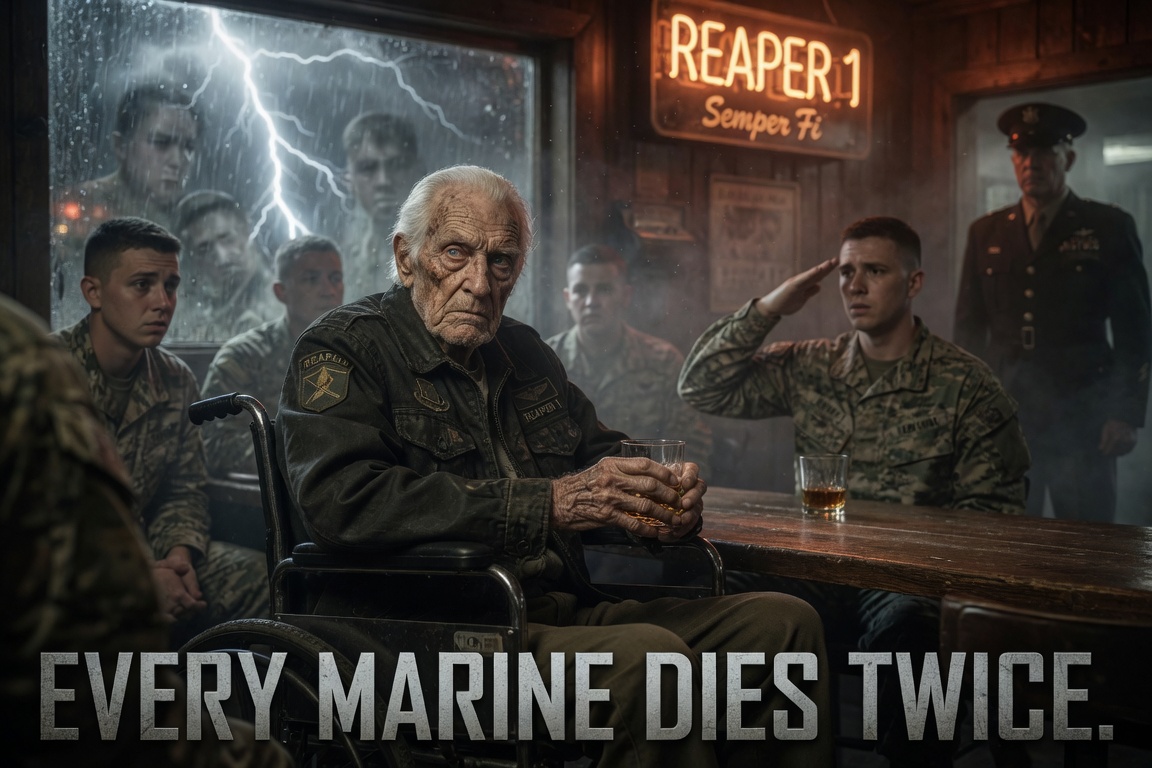
At the center tables, a dozen off-duty servicemen had been celebrating the end of a training rotation at Camp Lejeune. Their laughter had been loud enough to rattle the framed photographs on the walls.
Now no one moved.
The old man in the corner lowered his whiskey.
His wheelchair sat beneath a faded Marine Corps flag near the back exit. One wheel had been patched with black electrical tape. A canvas medical bag hung from the right handle. A dark-green baseball cap rested low over his brow, its front embroidered with a small eagle, globe, and anchor whose threads had almost worn away.
He looked close to seventy.
His shoulders were broad despite the years, but his legs lay thin beneath a wool blanket. A jagged scar crossed his throat and vanished beneath the collar of his flannel shirt. Three fingers on his left hand had been replaced by a polished mechanical prosthesis.
The Marines had barely noticed him when they came in.
They had noticed the wheelchair.
They had noticed the hat.
And Private First Class Logan Pike had decided those things made him harmless.
Pike stood three feet from the old man’s table, one hand still raised from the joke he had been making.
“Say that again,” he whispered.
The old man looked at him.
Pike was twenty-two, square-jawed, red-haired, and drunk enough to mistake an audience for approval. His sleeves had been pushed above his elbows to reveal new muscle and newer tattoos. The black ink on his right forearm showed a skull wearing a campaign cover, though he had never deployed.
Five minutes earlier, he had walked over to the corner because the men at his table were daring one another to ask the old veteran whether the wheelchair was service-related.
Pike had taken it farther.
“Hey, Grandpa,” he had said. “You even serve, or do you just wear that hat for discounts?”
The old man had not reacted.
That had encouraged him.
Pike had tapped the cap with one finger.
“Come on. What was your call sign? Coupon King?”
A few Marines laughed.
Not all of them.
Sergeant Elena Ruiz had lowered her beer.
Staff Sergeant Caleb Dwyer had looked toward the bartender.
Corporal Tyler Voss, who had been drinking beside Pike, had suddenly felt ashamed without yet understanding why.
The old man had lifted his eyes slowly.
His face remained calm.
Then he had said two words.
“Reaper One.”
That was when Tyler dropped his drink.
Now Pike’s grin was gone.
He looked around the room, searching for someone to rescue the joke.
No one did.
Near the pool tables, Gunnery Sergeant Martin Shaw rose from his chair.
Shaw had been in Fallujah.
He was fifty-one now, thick around the waist and silver at the temples. One of his knees no longer bent cleanly. He had been laughing with a former Navy corpsman when the old man gave the call sign.
Now his mouth hung open.
He stepped forward.
“No,” Shaw said.
The old man turned his head.
Shaw’s face hardened with disbelief.
“No,” he repeated. “Reaper One died in 2004.”
The old man looked back at his whiskey.
“People say many things when paperwork becomes easier than truth.”
The silence deepened.
Pike swallowed.
He still did not understand, but he could feel the weight of the room turning against him.
“Reaper One was a story,” he said. “Everybody knows that.”
Shaw moved closer.
“Everybody does not know a damn thing.”
The bartender, Nora McKenna, came around the counter.
She was sixty-four and had run the bar since her husband died. She wore her gray hair braided down her back. A shotgun scar crossed the inside of her right forearm, a souvenir from a hunting accident she never discussed.
“Logan,” she said, “step away from him.”
Pike glanced at his friends.
“He’s messing with us.”
Nora’s eyes sharpened.
“Step away.”
The old man rested his prosthetic fingers around the glass.
Tyler watched the motion.
The mechanical joints moved with faint clicks, delicate and precise.
Pike finally took one step back.
Then pride dragged him forward again.
“Reaper One was Captain Nathan Mercer,” he said. “He died outside Fallujah.”
The old man looked up.
“Major.”
Pike blinked.
“What?”
“He was promoted six weeks before the operation.”
Shaw’s breath caught.
That fact had never appeared in public accounts.
The old man continued.
“His first name wasn’t Nathan.”
The rain hissed against the windows.
“What was it?” Tyler asked.
The old man’s gaze shifted to him.
Tyler immediately regretted speaking.
But the old man answered.
“Jonathan.”
Shaw reached for the chair behind him.
He missed it and had to steady himself on the table.
Nora moved beside him.
“You all right?”
Shaw stared at the old man.
“Who are you?”
The man in the wheelchair took a small sip.
“Elias Kane.”
Shaw’s face went pale.
Tyler saw something pass through the older Marine’s eyes.
Recognition.
And fear.
Shaw stepped closer, slowly now.
“You were attached to Third Battalion.”
Elias did not answer.
“You led the basement extraction on November twelfth.”
Still nothing.
Shaw’s voice dropped.
“You carried six men out after the west stairwell collapsed.”
Elias studied the amber liquid in his glass.
“I carried five.”
Shaw shook his head.
“The reports said six.”
“The reports lied.”
A chair scraped somewhere near the bar.
Tyler looked around.
Every person in the room was listening.
Elias raised the glass toward the light.
“The sixth man walked.”
Shaw’s eyes narrowed.
“No one walked out of that building.”
Elias looked at him.
“One did.”
The front door opened.
Cold rain blew inside.
A Marine major entered with two military police officers behind him. His uniform was soaked at the shoulders. He scanned the room, saw Elias, and stopped.
Major Daniel Harrow was forty-six, clean-shaven, and known across the base for never showing surprise.
He showed it now.
His right hand rose toward his brow.
Elias’s expression changed.
“Don’t.”
Harrow froze halfway through the salute.
The entire bar watched.
Elias’s voice was quiet.
“I left the service before half these boys learned to shave.”
The major lowered his hand.
“Sir, we received a call.”
Nora folded her arms.
“From who?”
Harrow looked at Pike.
“The private called base security.”
Every Marine in the room turned toward him.
Pike’s face reddened.
“I thought he was impersonating a veteran.”
Elias gave no reaction.
Harrow’s eyes moved toward the broken glass, then to the disabled man’s cap.
“Mr. Kane, there are questions regarding your identity.”
Elias looked toward the rain.
“There have always been questions.”
The major stepped closer.
“May we speak privately?”
“No.”
Harrow lowered his voice.
“This concerns Fallujah.”
The mechanical fingers around Elias’s glass stopped moving.
Nora noticed.
So did Shaw.
Elias’s jaw tightened beneath the scar.
“What about it?”
Harrow removed a black envelope from inside his coat.
It was sealed with red evidence tape.
“This was delivered to the base commander forty minutes ago.”
Elias did not reach for it.
“Who sent it?”
“No return address.”
Harrow placed the envelope on the table.
Across the front, someone had written three words in block letters.
REAPER ONE LIVES.
Elias stared at the handwriting.
For the first time that night, the old man looked afraid.
Then the television above the bar turned on by itself.
Static filled the screen.
A grainy image appeared.
A concrete room.
A man tied to a chair.
His face was bloodied, but Tyler recognized him from the framed photographs in the base headquarters.
Colonel Marcus Dane.
The installation’s deputy commander.
A hooded figure stepped into view behind him.
The figure held a knife.
A distorted voice came through the television speakers.
“Elias Kane.”
Everyone in the bar went still.
“You carried the wrong man out of Fallujah.”
The knife touched Colonel Dane’s throat.
“And tonight, you will finally tell them why.”
The screen went black.
Chapter Two
The Name Buried Under Sand
For several seconds, no one breathed.
Then the bar erupted.
Marines reached for phones. Harrow shouted for everyone to stay back. The military police officers moved toward the exits. Nora locked the front door and pulled the blinds.
Elias remained in his wheelchair.
His whiskey sat untouched.
Tyler watched the old man’s chest rise and fall.
Slow.
Controlled.
But not calm.
There was a difference.
“Is that video real?” Shaw asked.
Major Harrow touched the radio at his shoulder.
“We’re verifying.”
“The colonel was scheduled to attend a command dinner tonight,” one of the MPs said. “He never arrived.”
Harrow looked toward Elias.
“When did you last see him?”
“Twenty-two years ago.”
“You knew him?”
Elias’s eyes moved to the dark television.
“He was a lieutenant.”
Shaw stepped forward.
“At Fallujah?”
“Yes.”
The answer moved through the room like a cold draft.
Pike had retreated toward the wall. His swagger had vanished. Without the laughter around him, he looked younger than twenty-two.
Tyler bent and began picking up the larger pieces of his broken glass.
Nora stopped him.
“Leave it.”
He looked up.
“Someone will cut themselves.”
“Then use the broom.”
Tyler nodded.
It was such an ordinary instruction that it broke the panic for half a second.
He found the broom behind the bar.
As he swept, he listened.
Harrow opened the black envelope.
Inside lay a faded photograph and a small brass key.
The picture showed seven Marines standing beside an armored vehicle under a white desert sky.
Their uniforms were gray with dust. Their faces looked hollow from exhaustion.
Elias stood at the center.
He was younger, taller, and uninjured.
Beside him stood a blond officer with sharp features and a confident smile.
Colonel Marcus Dane.
At the end of the line stood another man whose face had been burned away from the photograph with a cigarette.
Harrow turned the image over.
A date had been written on the back.
November 12, 2004.
Beneath it:
ASK REAPER ONE WHO HE LEFT BEHIND.
Elias’s face revealed nothing.
Harrow placed the photograph on the table.
“Who is missing?”
Elias looked at the burned section.
“No one.”
Shaw moved closer.
“Somebody stood there.”
“A shadow.”
“Shadows don’t wear boots.”
Elias’s mechanical hand tightened.
Tyler stopped sweeping.
He had never seen a room full of Marines this quiet.
Major Harrow sat across from Elias.
“Sir, Colonel Dane’s life may depend on this.”
Elias looked at him sharply.
“Do not call me sir.”
Harrow nodded once.
“Mr. Kane. Tell me what happened.”
Elias glanced around the bar.
At the young Marines.
At Shaw.
At Pike, still pressed near the wall.
At Tyler holding a broom beside shattered glass.
“This is not a story for a room like this.”
Nora leaned against the table.
“This room has heard worse.”
“No,” Elias said. “It hasn’t.”
The scar at his throat pulled when he swallowed.
Harrow lowered his voice.
“Then come with us.”
Elias looked down at his wheelchair.
One of the footrests was held together with wire.
The right tire was nearly bald.
Tyler suddenly understood that the old man had not come here expecting anyone to recognize him.
He had come for one drink.
Maybe because it was raining.
Maybe because somewhere in the room lived a memory he could bear only in small doses.
Elias rolled back from the table.
The chair squeaked.
Tyler moved automatically to help.
Elias looked up.
The glance stopped him.
“I can manage.”
Tyler stepped back.
Elias maneuvered around the table and toward the rear door.
Harrow followed.
Shaw caught his arm.
“Wait.”
Elias stopped.
Shaw’s voice trembled.
“My brother was at the industrial complex.”
The old man closed his eyes.
Tyler saw it.
One second.
No more.
“What was his name?” Elias asked.
“Staff Sergeant Owen Shaw.”
Elias turned.
His gaze studied Martin Shaw’s face.
Then something in him softened.
“He wore a silver Saint Christopher medal.”
Shaw’s lips parted.
“Yes.”
“His wife was pregnant.”
“A son.”
Elias nodded.
“He spoke about the boy every night.”
Shaw gripped the back of a chair.
The room blurred behind his eyes.
“Did he die there?”
Elias looked toward the rain-dark windows.
“No.”
Shaw breathed out.
“Then where?”
Elias’s face closed again.
“After.”
The single word crushed the hope from Shaw’s expression.
“What does that mean?”
Elias began rolling toward the exit.
Shaw stepped in front of him.
“What does after mean?”
Nora placed a hand on Shaw’s shoulder.
He shook it off.
“My family was told he died in the collapse.”
Elias stopped.
“Your family was told what command needed them to believe.”
Shaw’s jaw clenched.
“So you knew.”
“Yes.”
“You knew for twenty-two years.”
“Yes.”
Shaw struck the table.
Glasses jumped.
“Then tell me where my brother died.”
Elias looked up at him.
“Not here.”
Shaw’s hands curled.
For one dangerous instant, Tyler thought he might hit the man in the wheelchair.
Elias seemed to think the same.
He did not raise his arms.
He did not retreat.
He simply waited.
Shaw’s fist trembled.
Then opened.
The old man rolled past him.
Major Harrow unlocked the rear door.
Cold air rushed in.
Before Elias crossed the threshold, Pike spoke.
“I’m sorry.”
The words were small.
Elias stopped but did not turn.
Pike swallowed.
“For what I said.”
No one mocked him now.
The old man looked back over his shoulder.
“Are you?”
Pike’s mouth opened.
Elias waited.
The private looked at the floor.
“I don’t know.”
Elias nodded.
“That’s more honest.”
Then he rolled into the rain.
Tyler stared after him.
Harrow and the MPs followed.
Shaw stood near the table with tears bright in his eyes.
Nora picked up Elias’s untouched whiskey.
Beneath the glass sat a folded strip of paper.
She opened it.
The color left her face.
“What?” Tyler asked.
Nora held it toward Major Harrow, who had paused at the door.
The note had been written before the video appeared.
The ink was old, creased from years of folding.
It read:
IF DANE EVER FINDS ME, IT MEANS ROURKE SURVIVED.
Harrow looked toward Elias.
The old man had stopped beneath the awning.
He stared back at the paper.
Then thunder rolled over the parking lot.
And somewhere beyond the rain, a rifle fired.
The rear window exploded.
Harrow threw himself sideways.
Tyler dropped behind the bar.
Marines overturned tables.
Nora hit the floor.
A second round punched through the wall exactly where Elias’s head had been.
But the wheelchair was empty.
For a heartbeat, Tyler could not understand.
Then Elias Kane rose from the mud behind a parked truck.
He had thrown himself out of the chair before the shot.
His thin legs dragged uselessly behind him.
But both hands held a compact pistol.
The disabled veteran aimed toward a dark rooftop across the road.
He fired once.
A shadow fell from the edge.
Everyone stared.
Elias lay in the rain, his broken body pressed against the asphalt, the pistol steady in his prosthetic hand.
Then he looked toward Harrow.
“Now,” he said, “we can speak privately.”
Chapter Three
The Soldier Who Could Not Walk Away
The secure interview room at Camp Lejeune had no windows.
Fluorescent light turned everyone’s skin gray.
Elias sat at one end of a metal table. Someone had replaced his wet clothes with gray hospital scrubs, but he had refused to remove the old Marine cap.
His wheelchair stood beside him.
Major Harrow sat across the table.
Sergeant Elena Ruiz stood near the door. She had volunteered to accompany them after identifying herself as the senior sober Marine at the bar.
Tyler had no official reason to be there.
But when Harrow asked who had seen the shooter fall, Tyler raised his hand.
Now he sat beside Ruiz with his wet jacket folded across his knees.
Pike had been taken back to the barracks.
Shaw had gone home after promising not to contact anyone about his brother until command cleared the investigation.
Nora had stayed at the bar to speak with investigators.
On the table lay the photograph, the brass key, and the old note.
A digital clock on the wall read 1:18 a.m.
Colonel Dane had been missing for nearly four hours.
Elias touched the burned face in the photograph.
“His name was Adrian Rourke.”
Harrow leaned forward.
“Rank?”
“Staff sergeant.”
“Unit?”
“Officially, none.”
Ruiz crossed her arms.
“Unofficially?”
Elias looked at her.
“A joint reconnaissance cell operating under Task Force Monarch.”
Harrow’s expression tightened.
“I have never heard of it.”
“You were not supposed to.”
“What was its mission?”
“To locate foreign fighters moving weapons through civilian neighborhoods. We mapped tunnels, safe houses, and command routes.”
Tyler studied Elias.
The old man spoke without drama.
That made the words feel heavier.
“Reaper was the call sign for the forward observation element,” Elias continued. “One was command. Two handled communications. Three managed overwatch.”
“You were Reaper One,” Tyler said.
“Yes.”
“Rourke?”
“Reaper Two.”
Ruiz looked at the burned photograph.
“Why erase his face?”
“Because someone wanted us to think he was dead.”
Harrow tapped the brass key.
“And this?”
Elias rotated it beneath the light.
A small number had been stamped into the metal.
“Storage locker,” he said.
“Where?”
“Not sure.”
“You wrote the note saying if Dane found you, Rourke survived.”
Elias nodded.
“Why?”
“Because Dane was the only man who knew where I went after the mission.”
Harrow sat back.
“You believe the colonel betrayed you.”
“I believe he betrayed everyone.”
The door opened.
A Navy intelligence officer entered carrying a laptop. Commander Rachel Beck was forty-three, with dark hair pinned at the back of her head and a face that looked carved from sleeplessness.
“We identified the shooter,” she said.
Elias looked up.
“Who?”
“Former Marine Gunnery Sergeant Paul Hines. Discharged in 2011. Worked private security in Jordan, Libya, and Iraq.”
Ruiz frowned.
“Connection to Rourke?”
Beck placed the laptop on the table.
“Hines served under a company called Meridian Strategic Response.”
Elias’s expression hardened.
“Adrian’s company.”
“You knew it?”
“He talked about it before Fallujah. Said modern wars would be run by men who understood that loyalty followed money more reliably than flags.”
Harrow’s mouth tightened.
“That doesn’t sound like a Marine.”
“It sounded like a man who had stopped believing uniforms meant anything.”
Beck opened another file.
“Meridian dissolved in 2015 after allegations involving weapons trafficking and illegal detention sites. No convictions.”
“Because the witnesses disappeared,” Elias said.
Beck looked at him.
“How do you know?”
“I was one.”
The room went silent.
Tyler stared.
“You testified?”
“I tried.”
Elias’s gaze shifted to the wall.
“After I returned home, two investigators visited me at a rehabilitation hospital. I gave them names, dates, coordinates. Three days later, one was killed in a car crash. The other denied ever meeting me.”
Harrow’s fingers tightened around a pen.
“And Colonel Dane?”
“He told me to disappear.”
“Why would he help you?”
“He owed me.”
“For carrying him out?”
Elias looked at him.
“No.”
The answer sat between them.
Commander Beck turned the laptop toward Elias.
“We recovered this from Hines’s phone.”
A photograph filled the screen.
Colonel Dane stood beside a concrete wall, alive but bruised.
Behind him, spray-painted in black, were the words:
THE DEAD DESERVE CORRECTION.
Elias’s face went still.
Ruiz noticed.
“You recognize that phrase.”
“Yes.”
“From where?”
Elias leaned back.
“Rourke used it after missions.”
Tyler frowned.
“What did it mean?”
“He believed history was written by people who arrived after the blood dried.”
Elias’s voice became distant.
“He hated official reports. Said the dead could not correct lies, so the living had a duty to do it for them.”
“That sounds almost honorable,” Ruiz said.
“It was.”
Elias looked at the burned face.
“Once.”
Harrow pointed at the photograph.
“Tell us about November twelfth.”
Elias closed his eyes.
The fluorescent room disappeared behind his expression.
When he spoke, his voice carried dust.
“The city had been burning for five days.”
No one interrupted.
“Our cell received intelligence that a senior insurgent courier was operating from an abandoned municipal building near the industrial district. The structure had a basement network connecting three blocks.”
Elias tapped the photograph.
“Dane was a young lieutenant assigned to provide security. Owen Shaw led the breach team. Adrian and I entered through the east side.”
“What went wrong?” Tyler asked.
Elias opened his eyes.
“The intelligence was designed to bring us there.”
Harrow’s pen stopped.
“An ambush?”
“Worse.”
Elias looked at Beck.
“There were civilians inside. Twenty-three men and boys. Most had been taken from nearby houses.”
Ruiz’s face tightened.
“Human shields.”
“Witnesses.”
“To what?”
“Meridian contractors transporting American weapons to a local militia.”
Harrow stared.
“Meridian did not exist in 2004.”
“Not on paper.”
Elias’s prosthetic fingers clicked against the table.
“Adrian had already begun building it. He believed certain militias could stabilize neighborhoods faster than official forces. He arranged weapons transfers, intelligence trades, safe passage.”
Tyler felt cold.
“Without authorization?”
“Without anyone willing to admit authorization.”
“And the civilians saw it,” Ruiz said.
“Yes.”
Harrow lowered his voice.
“What did Rourke do?”
Elias stared at the burned face.
“He decided witnesses were operational threats.”
The room became very still.
“He wanted to kill them?” Tyler whispered.
“He called it containment.”
Ruiz’s jaw tightened.
“What did you do?”
“I refused.”
Elias’s voice remained flat.
“Adrian drew his weapon. Owen Shaw stepped between us. Dane tried to call command.”
“What happened?”
“A mortar hit the west stairwell.”
The old man’s eyes unfocused.
“The basement collapsed. Smoke filled the corridor. We lost communications.”
He touched the scar at his throat.
“Adrian disappeared in the confusion. I found Dane unconscious beneath concrete. Owen was alive. So were five Marines and eleven civilians.”
Tyler leaned forward.
“You carried them out.”
“I found a maintenance tunnel.”
“The sixth man who walked,” Harrow said. “Owen Shaw.”
Elias nodded.
“He helped me move the wounded.”
“Then why was his family told he died in the collapse?”
Elias looked toward the clock.
“Because after we reached the evacuation point, American helicopters arrived.”
Ruiz waited.
“And?”
“They opened fire.”
Tyler stopped breathing.
Harrow’s face went hard.
“On Marines?”
“On everyone.”
“No.”
“Yes.”
“Why?”
“Someone marked the extraction point as hostile.”
Elias’s jaw tightened.
“Owen dragged two civilians behind a wall. I pulled Dane beneath a vehicle. The others died in seconds.”
“And Owen?” Tyler asked.
“He survived the first burst.”
Elias looked at his mechanical hand.
“I reached him.”
The words became slower.
“He had been hit in the stomach. He gave me the Saint Christopher medal and told me his wife’s name.”
Shaw’s voice echoed in Tyler’s memory.
My brother was there.
“What did he ask you to do?” Ruiz said.
“Tell his son he did not die afraid.”
Elias swallowed.
“I promised.”
“Did you?”
“No.”
The answer struck harder than the story.
Ruiz’s eyes sharpened.
“Why not?”
“Because Dane begged me not to.”
Harrow stared.
Elias continued.
“He said the helicopter strike was a mistake caused by corrupted coordinates. If the truth came out, the militia program would surface. Marines would be prosecuted. Command careers would end. Families of the dead would receive nothing.”
“So you agreed to lie,” Tyler said.
Elias looked at him.
“Yes.”
Tyler flinched under the directness.
“I told myself I was protecting the families. I told myself the truth would only create more pain.”
His mechanical fingers curled.
“But mostly, I was tired.”
The room held the confession.
No defense.
No excuse.
Commander Beck closed the laptop.
“What happened to Rourke?”
“Dane found blood near the tunnel. No body.”
“You believed he died.”
“I wanted to.”
Harrow stood.
“If he survived, why wait twenty-two years?”
Elias looked at the brass key.
“He wasn’t waiting.”
The major stopped.
“He was building.”
Elias pointed toward the key.
“Adrian never attacked directly when leverage could do the work. Colonel Dane is not the target.”
“Then who is?”
Elias looked at Tyler.
“Young Marines.”
Tyler frowned.
“Why?”
“Because Adrian always believed institutions could be defeated by changing what the next generation admired.”
The lights flickered.
Commander Beck reached for the laptop.
Every screen in the room turned red.
A list of names appeared.
Thirty-seven Marines stationed at Camp Lejeune.
Pike’s name was third.
Tyler’s was ninth.
Ruiz stepped toward the monitor.
“What is that?”
Elias looked at the heading.
MERIDIAN CANDIDATE ASSESSMENT.
Beside each name sat a percentage.
PFC LOGAN PIKE — 91%
CPL TYLER VOSS — 78%
SGT ELENA RUIZ — 34%
Harrow reached for the room phone.
It was dead.
A speaker crackled overhead.
Adrian Rourke’s voice filled the room.
“Elias.”
The old man’s face emptied.
“You taught them to worship sacrifice.”
The list began scrolling.
“And I taught them to ask who profits from it.”
A video appeared.
Pike sat alone in his barracks room.
A pistol lay on the desk in front of him.
Tyler rose.
“What is he doing?”
Rourke’s voice continued.
“Private Pike has spent his life believing humiliation is worse than death.”
Pike picked up the weapon.
Ruiz ran for the door.
It would not open.
Elias wheeled toward the control panel.
“Kill the feed.”
Beck struck the emergency release.
Nothing happened.
On-screen, Pike pressed the pistol against his chin.
Tyler shouted his name though the private could not hear him.
Adrian’s voice became almost tender.
“Let us see what your Corps has taught him.”
Chapter Four
The Weight Behind the Trigger
Elias pulled the brass key from the table and jammed it into a narrow maintenance slot beside the door.
It fit.
The lock released.
Ruiz hit the corridor at a sprint.
Tyler followed.
Harrow shouted for Beck to trace the transmission.
They ran through the administration building, boots striking polished floors.
Pike’s barracks were six minutes away by vehicle.
Tyler knew they did not have six minutes.
He grabbed a radio from a startled duty officer.
“Get someone to Pike’s room now!”
Static answered.
The base network had gone silent.
Outside, rain struck the pavement.
Ruiz jumped into a utility vehicle. Tyler climbed beside her. Elias rolled toward the rear bench, but the wheelchair would not fit.
Harrow reached for him.
Elias slapped his hand away.
“Fold the chair.”
They collapsed it and lifted the old man into the back.
His legs hung uselessly.
The humiliation of being carried crossed his face, but only for a moment.
“Drive,” he said.
Ruiz accelerated.
The vehicle fishtailed across the wet lot.
Tyler kept Pike’s image alive on his phone. The broadcast had migrated to public channels. Hundreds of viewers were already watching.
Pike sat motionless with the weapon beneath his chin.
Adrian Rourke appeared behind him.
Not physically.
A second video window opened.
He was an older man now, perhaps sixty-three, with a narrow face and iron-gray hair. A burn scar covered the left side of his neck. His eyes were pale and steady.
“You laughed at a man in a wheelchair,” Adrian said.
Pike’s hand trembled.
“Because I’m an idiot.”
“No. Because the room rewarded you.”
“They stopped laughing.”
“Only after the call sign frightened them.”
Pike’s breathing became ragged.
Adrian leaned toward the camera.
“If Elias had been no one, would your cruelty matter less?”
Tyler felt the question like a blow.
The vehicle jumped a curb.
Ruiz fought the wheel.
Elias watched the screen from the back.
“Logan,” he whispered.
Pike’s finger moved toward the trigger.
Adrian continued.
“You wear a uniform that promises courage, yet you need weaker men beneath you to feel strong.”
Pike’s eyes filled.
“I said I’m sorry.”
“Sorry is what frightened people call regret when consequences arrive.”
Elias reached for Tyler’s phone.
“Can we speak to him?”
“No connection.”
“There is always a connection.”
Elias studied the video.
Behind Pike, a digital alarm clock glowed on the nightstand.
The display flickered every four seconds.
“Signal is routed through the building’s smart grid,” Elias said. “Rourke is using the emergency power network.”
Ruiz glanced back.
“How does that help?”
“Barracks intercom.”
Tyler grabbed the vehicle radio again.
“Duty station, access internal public-address system.”
“No network,” Ruiz said.
“Use analog.”
Elias leaned forward.
“Maintenance frequencies. Channel twelve.”
Tyler switched.
A voice answered.
“Base engineering.”
“This is Corporal Voss. We have a suicidal Marine in Barracks Four. Can you access the analog intercom?”
A pause.
“Who authorized this?”
Elias took the radio.
“Reaper One.”
Silence.
Then the engineer said, “Stand by.”
The vehicle skidded to a stop.
They were still one building away.
On the phone, Pike closed his eyes.
Adrian said, “Pull the trigger.”
The barracks intercom crackled.
Elias grabbed the microphone.
“Logan.”
Pike’s eyes opened.
He looked toward the ceiling.
Elias’s voice entered the room through an old speaker.
“You asked whether I served.”
Pike’s mouth trembled.
“I’m sorry.”
“I am not calling for an apology.”
The old man’s voice stayed level as Ruiz drove across the final lot.
“I am calling because you are about to make the weakest decision of your life and dress it as courage.”
Pike began crying.
Adrian’s expression darkened on-screen.
“Do not listen to him.”
Elias continued.
“You mocked me because you feared being invisible.”
Pike’s hand shook harder.
“You thought laughter meant acceptance. You believed if someone else looked small, you would look larger.”
Pike’s finger loosened slightly.
Elias leaned toward the radio.
“That does not make you evil.”
Adrian’s voice rose.
“It makes him exactly what the institution creates.”
“No,” Elias said. “It makes him unfinished.”
The vehicle stopped outside the barracks.
Ruiz and Tyler ran inside.
Elias shouted after them.
“Do not break the door unless he raises the weapon!”
They reached the second floor.
Marines stood frozen in the hallway, watching the broadcast on their phones.
Tyler pushed through them.
Pike’s door was locked.
Ruiz spoke through it.
“Logan. It’s Ruiz.”
No answer.
Inside, Elias’s voice continued through the speaker.
“You can put the gun down without earning forgiveness.”
Pike whispered, “Then what do I earn?”
“Tomorrow.”
Tyler pressed his ear to the door.
A metallic sound came from inside.
The pistol striking the desk.
Ruiz unlocked the door with a master key.
Pike sat on the floor.
His hands were empty.
Tyler crossed the room and kicked the pistol away.
Pike collapsed against him.
For a moment, Tyler did not know what to do.
Then he wrapped both arms around the private.
Pike sobbed into his shoulder.
The video feed cut to Adrian Rourke.
His expression remained calm.
“Interesting,” he said.
Then he looked directly into the camera.
“Elias, you saved one.”
A timer appeared beneath his face.
03:00:00.
“Now choose between thirty-six.”
Coordinates flashed on-screen.
A warehouse district outside Jacksonville.
Then another image appeared.
Colonel Dane lay chained inside a metal cage.
Around him stood rows of crates marked as medical supplies.
One crate had been opened.
Inside were military rifles.
Adrian smiled faintly.
“At sunrise, the world learns who armed Fallujah.”
The broadcast ended.
Ruiz looked at the coordinates.
“It’s a trap.”
Tyler kept one hand on Pike’s shoulder.
Elias’s voice came over the radio.
“Yes.”
“What do we do?”
A pause.
Then the old man answered.
“We stop pretending traps remove our choices.”
Chapter Five
The Men Who Believed They Were Saving the Corps
The warehouse stood near the river, hidden behind rusted shipping containers and abandoned seafood-processing plants.
Fog rolled in from the water before dawn.
Elias sat in the rear of an armored van while Commander Beck reviewed satellite images. Major Harrow had assembled a small response team outside normal command channels.
They did not know who could be trusted.
Ruiz checked her rifle.
Tyler sat opposite her, still wearing damp civilian clothes beneath borrowed body armor.
He had no place on the operation.
Elias had told him so.
Tyler had answered, “My name is on Rourke’s list.”
The old man studied him.
“That is not a qualification.”
“No.”
“Why are you here?”
Tyler thought about Pike on the floor.
“Because I laughed.”
Elias’s expression did not change.
But he stopped arguing.
Now the van moved through the fog.
Pike remained under medical supervision on base. Before they left, he had asked Tyler one question.
“Do you think he was right about me?”
Tyler had looked at the young private for a long time.
Then answered, “About some things.”
Pike had nodded.
It hurt him.
But it did not destroy him.
Elias examined the brass key.
Commander Beck pointed at the satellite image.
“The coordinates lead to Warehouse Seventeen. Owned by a shell corporation connected to Meridian.”
“Entrances?” Harrow asked.
“Three visible. Possibly river access.”
Elias tapped the image.
“Adrian will want us to enter from the south.”
Ruiz looked at him.
“How do you know?”
“The southern approach offers the cleanest line of sight. He knows trained teams prefer control.”
Harrow leaned forward.
“So we enter north.”
“No.”
Elias pointed to an old drainage canal beneath the property.
“We enter below.”
Tyler looked at the narrow tunnel.
“Can your chair fit?”
“No.”
The old man said it without emotion.
Ruiz frowned.
“You cannot crawl that distance.”
Elias looked at his legs.
“Not elegantly.”
Harrow shook his head.
“You remain in command outside.”
Elias turned toward him.
“You still think this operation has a command.”
The major held his gaze.
“You are not going into a tunnel without functioning legs.”
“No.”
Elias clipped a harness around his waist.
“I’m going with functioning arms.”
The team entered the canal at 4:40 a.m.
Cold water reached Tyler’s knees.
The concrete tunnel narrowed until they had to move single file. Harrow and Ruiz carried Elias on a drag sling between them. His useless legs struck the walls when they turned.
Each impact tightened his mouth.
He made no sound.
Tyler followed behind.
The old man’s pride was not the loud kind Pike had displayed at the bar.
It was quieter.
More dangerous.
He hated being carried.
Yet he allowed it because the mission required it.
Tyler understood then that humility was not the absence of pride.
It was the ability to place purpose above it.
They reached a rusted maintenance hatch beneath the warehouse floor.
Elias raised one hand.
Everyone stopped.
Voices traveled through the metal.
Colonel Dane.
“You should have killed me in Fallujah.”
Adrian answered.
“You misunderstand. I needed you alive.”
“For what?”
“To prove institutions never punish the useful.”
Elias’s eyes hardened.
Dane continued.
“I covered for you.”
“You covered for yourself.”
“You were moving weapons.”
“I was building stability.”
“You murdered witnesses.”
“I prevented a district from collapsing into chaos.”
Silence followed.
Then Dane said, “You marked the extraction point.”
Tyler felt Ruiz stiffen.
Adrian did not deny it.
“The civilians would have exposed the network.”
“You killed Marines.”
“I accepted losses.”
“You killed Owen Shaw.”
“He chose Elias.”
The words struck the tunnel.
Elias closed his eyes.
For twenty-two years, uncertainty had lived inside him.
Now it had a voice.
Adrian continued.
“Owen could have joined me. Instead, he helped Elias move witnesses toward extraction.”
Dane’s chains rattled.
“And Elias?”
“I could not kill him.”
“Why?”
A pause.
“Because he was my brother.”
Tyler looked at the old man.
Elias opened his eyes.
No one moved.
Harrow whispered, “Brother?”
Elias touched two fingers to his lips.
Above them, Dane laughed bitterly.
“You hated him.”
“I loved him.”
Adrian’s voice became colder.
“That was the problem.”
The team stared at Elias.
He had called Rourke a colleague.
A partner.
Never a brother.
Ruiz’s expression sharpened with betrayal.
Elias looked away.
Adrian continued.
“Our mother married Elias’s father when I was nine. He was six. We learned war in the same house before either of us wore a uniform.”
Dane said, “He thought you were dead.”
“He needed to.”
“Why?”
“Because hope made him disobedient.”
Elias’s mechanical hand tightened around his pistol.
Tyler understood the old man’s silence now.
Rourke was not merely a ghost from a mission.
He was family.
A wound beneath every other wound.
Adrian spoke again.
“Bring him in.”
Footsteps moved above the hatch.
Elias pointed to positions.
Ruiz shifted left.
Harrow raised his rifle.
Tyler moved right.
The hatch opened.
A guard looked down.
Elias fired once.
The suppressed round struck the man’s shoulder, spinning him away without killing him.
Ruiz climbed through.
Gunfire erupted.
Tyler followed into a cavernous warehouse lit by hanging lamps. Crates formed narrow corridors. Fog entered through broken windows near the roof.
Colonel Dane sat inside a cage at the center.
Adrian stood on a metal platform above him.
He wore a dark coat over body armor.
White hair framed his scarred face.
His eyes found Elias immediately.
The old man was being lifted through the hatch by Harrow and Tyler.
Adrian’s expression changed.
Not surprise.
Grief.
“You still wear the hat,” he said.
Elias settled against a crate.
“You still hide above other men.”
Adrian smiled.
“I missed you.”
“You shot at me.”
“I missed you badly.”
Gunmen emerged from behind the crates.
Ruiz’s team took cover.
Adrian raised one hand.
No one fired.
Elias looked toward the cage.
“Release Dane.”
“He confessed.”
“He spoke.”
“To you, those are different.”
“To anyone honest.”
Adrian descended the stairs.
He moved with a limp.
Tyler noticed the left leg was braced beneath his trousers.
Elias noticed too.
“What happened?”
Adrian stopped.
“The helicopter.”
Elias’s face tightened.
“You were at the extraction point.”
“I marked it.”
“You were there.”
“I wanted to stop the strike after Owen chose you.”
Adrian’s mouth twisted.
“I changed my mind too late.”
Elias looked at his brother’s leg.
“You deserved worse.”
“Yes.”
The answer stole the force from the accusation.
Adrian moved closer.
“I spent three years recovering in a private clinic. Dane told command I was dead. Meridian’s sponsors helped me disappear.”
“You built an army.”
“I built evidence.”
Adrian gestured toward the crates.
“Every weapon here carries a serial number tied to programs that officially never existed. Every document proves our government armed men who later killed Marines.”
Harrow called from behind cover.
“Then release the evidence.”
Adrian looked toward him.
“And watch it vanish inside classified hearings?”
His eyes returned to Elias.
“No. At sunrise, the files go public.”
“Along with the names of Marines you manipulated,” Elias said.
“I selected men already abandoned by the system.”
“You pushed Pike toward suicide.”
“I showed him what humiliation did to him.”
“You nearly killed him.”
“I gave him a choice.”
Elias’s expression hardened.
“No. You narrowed the room until death looked like the only door.”
Adrian stepped closer.
“And you opened another. Good.”
He smiled faintly.
“That was always your gift.”
Tyler looked between them.
The brothers were opposites only from a distance.
Up close, they shared the same stillness.
The same habit of studying a room before speaking.
The same conviction that action mattered more than explanation.
Adrian stopped ten feet from Elias.
“You think I am the enemy because I refused to let the dead disappear.”
“You use the dead to control the living.”
“And you used silence to protect the institution.”
Elias flinched.
The words landed.
Adrian saw it.
“I told Owen the truth would die unless someone carried it.”
Elias’s voice dropped.
“You killed him.”
“Yes.”
The warehouse went still.
Adrian’s face tightened.
“He raised his rifle.”
“He was protecting civilians.”
“He was protecting you.”
“That is why you killed him?”
Adrian looked away.
For the first time, his certainty fractured.
“I fired before I understood.”
Elias stared at him.
A lifetime moved across his face.
Anger.
Disbelief.
Sorrow so old it had become structural.
“You told yourself it was necessary.”
“Yes.”
“You have spent twenty-two years building an argument large enough to hide one bullet.”
Adrian’s jaw clenched.
“You are simplifying.”
“No.”
Elias pulled Owen Shaw’s Saint Christopher medal from beneath his shirt.
The chain had darkened with age.
He held it up.
“This is simple.”
Adrian stared at the medal.
His face changed.
Elias continued.
“A man trusted us. You killed him. I lied about it.”
His voice shook now.
“We both betrayed him.”
Adrian’s eyes filled.
Then a gunshot cracked from the far catwalk.
Major Harrow fell.
Chaos exploded.
Ruiz fired toward the shooter.
Adrian spun around.
“I gave no order!”
A second gunman opened fire on both groups.
Crates splintered.
Tyler dragged Elias behind cover.
Colonel Dane shouted from the cage.
“They’re not yours!”
Adrian looked toward the catwalk.
His own men were shooting at him.
Commander Beck’s voice came through Harrow’s radio.
“Meridian transfer team approaching. They intend to erase the site.”
Adrian’s face went pale.
His organization had turned against him.
Elias looked at him.
“You taught them loyalty followed money.”
Adrian drew his pistol.
“And now we see the tuition.”
Chapter Six
The Last Extraction
The first explosion tore open the warehouse’s eastern wall.
Fog and fire rolled together.
Automatic gunfire echoed between the crates.
Tyler crawled toward Major Harrow. The round had entered below the collarbone. Blood spread beneath his vest.
Ruiz pressed gauze into the wound.
“Stay with me.”
Harrow gripped her wrist.
“Get Dane.”
Adrian fired from behind a forklift, dropping one of the attacking contractors.
Elias lay behind a crate, unable to move without help.
His wheelchair remained outside the drainage tunnel.
Tyler looked at him.
The old man was trapped in the middle of a firefight.
Yet his eyes moved calmly across the room.
Counting.
Calculating.
“Two shooters on the west catwalk,” Elias said. “One near the loading door. Another behind the blue container.”
Ruiz fired twice.
A body fell from the catwalk.
Adrian moved toward Elias.
Tyler raised his rifle.
Elias pushed the barrel down.
“He is not the immediate threat.”
Adrian reached them.
“They are initiating the burn protocol.”
“What does that mean?” Tyler asked.
“Thermite charges in the evidence crates.”
Elias looked toward the cage.
“And Dane?”
“The cage is wired.”
Colonel Dane gripped the bars.
“Do not come near me!”
A red light blinked beneath the cage floor.
Adrian’s face hardened.
“They changed the design.”
“You built it,” Elias said.
“I built a remote release.”
“Then use it.”
“The signal is blocked.”
Another explosion shook the roof.
Steel groaned overhead.
Ruiz pointed toward a control booth near the north wall.
“Manual system?”
Adrian nodded.
“Two switches must be turned simultaneously. One at the booth. One beneath the cage.”
Tyler looked at the gunfire crossing the open floor.
“Who goes where?”
Elias answered.
“Adrian takes the booth.”
His brother looked at him.
“You trust me?”
“No.”
Elias pulled himself upright using the crate.
“But you want Dane alive more than they do.”
Adrian nodded.
“I’ll reach the cage,” Elias said.
Tyler stared.
“You cannot cross that floor.”
“I can crawl.”
“It is forty yards.”
“I have crossed farther.”
“Not through gunfire.”
Elias looked at him.
“You think the chair made danger new?”
Tyler grabbed his shoulder.
“No.”
The old man’s eyes sharpened.
Tyler continued.
“You said Pike was unfinished. So am I. Let me make one useful decision.”
Elias studied him.
The roof shook again.
Tyler lowered himself.
“Get on my back.”
For one second, Elias’s pride resisted.
Then he nodded.
Tyler lifted him.
The old man was lighter than expected.
Too light.
His arms locked around Tyler’s shoulders. His useless legs hung against Tyler’s sides.
Ruiz provided cover.
Adrian ran toward the control booth.
Tyler sprinted between the crates.
Bullets struck wood and steel around him.
Elias fired one-handed over Tyler’s shoulder.
Each shot was measured.
A contractor stepped from behind a container.
Elias hit him in the thigh.
Tyler kept moving.
“Why not kill him?” Tyler shouted.
“Because he may know who paid him.”
Even now, the old man was thinking beyond the moment.
They reached the cage.
Colonel Dane stared through the bars.
“Elias.”
The old man slid from Tyler’s back.
He landed hard and dragged himself beneath the cage platform.
Wires ran into a metal housing.
The red light blinked faster.
“Two minutes,” Adrian called from the booth.
Tyler crouched beside Elias.
“What do you need?”
“Cover.”
A contractor appeared above the cage.
Tyler fired.
The man fell backward.
Elias opened the housing with his mechanical fingers.
Inside were three switches.
He looked toward Adrian.
“Which one?”
“Black.”
“All three are black.”
Adrian swore.
The control booth windows shattered under gunfire.
He returned fire.
“They changed it!”
Colonel Dane gripped the bars.
“Leave me.”
Elias ignored him.
“Adrian, wire colors.”
“Red feeds the charge. Blue feeds the locking bolts.”
“There is no blue.”
“Then they inverted the circuit.”
Tyler looked toward the blinking light.
“Can we cut everything?”
Elias shook his head.
“Failsafe detonates.”
Dane lowered his voice.
“You lied for me.”
Elias kept working.
“I lied for myself.”
“You saved me.”
“I saved the wrong man.”
Dane closed his eyes.
“Yes.”
The admission stopped Elias’s hands.
Dane looked through the bars.
“I knew Adrian marked the extraction coordinates.”
Tyler stared.
“You knew?”
“I discovered it after the strike.”
“And you covered it up,” Elias said.
Dane’s face tightened.
“I believed exposing the program would collapse operations across the region.”
“You protected careers.”
“I protected missions.”
“You protected yourself.”
“Yes.”
The colonel’s voice broke.
“Yes.”
Elias looked at him.
No excuses remained.
Dane continued.
“I spent twenty-two years convincing myself the lie preserved something valuable.”
The red light accelerated.
“Maybe all it preserved was me.”
Elias returned to the wires.
“Confess later.”
A burst of gunfire struck the cage.
Tyler pulled Elias behind a support beam.
Ruiz shouted from across the warehouse.
“Thirty seconds!”
Adrian emerged from the control booth.
Blood ran from his shoulder.
“The switch is jammed!”
Elias looked toward him.
“Break it.”
“It will trigger the transfer.”
“Break it!”
Adrian struck the control lever with the butt of his pistol.
Sparks erupted.
Beneath the cage, one wire changed color as current shifted.
Elias saw it.
“White wire!”
Tyler fired toward another attacker.
Elias reached with his mechanical hand.
The prosthetic fingers slipped.
He tried again.
The old joints clicked.
Ten seconds.
The wire sat half an inch beyond his reach.
Tyler saw it.
He dropped his rifle and thrust his arm beneath the housing.
“Which one?”
“Far left!”
Tyler grabbed it.
“Pull?”
“On three.”
The timer flashed five.
Elias looked toward Adrian.
His brother held the broken lever in place with both hands.
“One.”
The roof began to collapse.
“Two.”
Adrian smiled through the smoke.
For one instant, the old burn scar disappeared beneath the face of the young man from the photograph.
“Three.”
Tyler ripped the wire free.
The cage locks released.
The red light went dark.
Then the thermite charges ignited.
White fire erupted across the warehouse.
Ruiz reached Harrow.
Tyler pulled Dane from the cage.
Elias lay beneath the platform.
Adrian ran toward them.
A steel beam crashed between the brothers.
Flames rose.
“Elias!” Adrian shouted.
The old man dragged himself forward.
Tyler lifted him again.
Dane supported Harrow.
Ruiz pointed toward the drainage hatch.
“Move!”
They ran.
Adrian remained on the other side of the burning beam.
Elias looked back from Tyler’s shoulder.
“Come around!”
“There is no time.”
“Adrian!”
His brother stepped closer to the flames.
The roof groaned above him.
For twenty-two years, Elias had imagined killing this man.
Now terror opened inside him at the thought of losing him again.
Adrian saw it.
His expression softened.
“You always carried the wrong man.”
Elias struggled against Tyler.
“Put me down!”
Tyler held tighter.
Adrian lifted one hand.
Not a salute.
A farewell.
Then he turned toward the control system.
“What are you doing?” Elias shouted.
“Opening the river gate.”
A warning siren began.
Water-control doors at the back of the warehouse lifted.
Black river water rushed inside, flooding the floor and suppressing part of the thermite fire.
It also cut Adrian off completely.
“Go!” he shouted.
Tyler reached the hatch.
Ruiz descended first.
Dane lowered Harrow.
Elias fought to turn.
“Adrian!”
Through smoke and water, his brother looked back.
“I was wrong about Owen.”
Elias froze.
Adrian’s voice carried across the warehouse.
“He did not choose you over me.”
A beam collapsed behind him.
“He chose what was right.”
Then the roof came down.
Tyler carried Elias into the tunnel as fire and river water collided above them.
The old man did not speak during the escape.
He did not struggle.
He held Owen Shaw’s medal so tightly the chain cut into his palm.
Chapter Seven
The Truth the Dead Could Not Correct
Adrian Rourke’s body was never recovered.
Neither were most of the Meridian records.
But enough survived.
Commander Beck secured three data drives from the control booth before the warehouse collapsed. The files documented weapons transfers, false targeting reports, covert detention sites, and private recruitment programs spanning two decades.
Colonel Marcus Dane confessed.
Not privately.
Not behind a closed hearing.
He recorded a public statement from his hospital bed.
He named officers, contractors, companies, and political officials.
Then he described the helicopter strike outside Fallujah.
He spoke the names of the dead.
Including Staff Sergeant Owen Shaw.
The Department of Defense attempted to delay release of the statement.
Commander Beck leaked it.
Major Harrow pretended not to know how.
The investigation spread across agencies and countries. Careers ended. Contracts vanished. Families received new casualty reports that contradicted the stories they had lived with for twenty-two years.
Some thanked Elias.
Others hated him.
He accepted both.
Martin Shaw visited him six weeks after the warehouse fire.
They met at McKenna’s Bar before opening.
Morning sunlight entered through the blinds, revealing dust floating above empty tables.
Elias sat in his usual corner.
His repaired wheelchair had new tires but the same electrical tape around one handle.
Nora placed two coffees on the table.
Shaw sat across from him.
For a while, neither man spoke.
Then Elias removed the Saint Christopher medal.
He placed it between them.
Shaw stared at it.
His fingers trembled when he reached forward.
“My mother gave him this.”
Elias nodded.
“She told him it would bring him home.”
Shaw closed his hand around the medal.
“It did.”
Elias looked away.
“No.”
“Yes.”
Shaw’s eyes filled.
“Not the way she wanted. But it did.”
Elias’s jaw tightened.
“I should have come to your family.”
“You should have.”
“I was afraid.”
Shaw looked at him.
“Of prison?”
“No.”
“Then what?”
Elias stared at his coffee.
“That your mother would forgive me.”
Shaw sat back.
The answer surprised him.
Elias continued.
“I could survive hatred. Forgiveness would have required me to live differently.”
Nora stopped polishing a glass behind the bar.
Shaw lowered his eyes.
“My brother trusted you.”
“Yes.”
“And you failed him.”
“Yes.”
Shaw rubbed the medal with his thumb.
“But you tried to carry him.”
Elias said nothing.
Shaw stood.
He placed the medal back on the table.
Elias frowned.
“It belongs to your family.”
“It belongs to the man he gave it to.”
“I do not deserve it.”
Shaw looked down at him.
“Maybe not.”
He pushed the medal closer.
“Carry it anyway.”
Then he left.
Elias sat alone for a long time.
Nora eventually brought him whiskey.
“It’s nine in the morning,” he said.
“You look like you need to stop knowing what time it is.”
He took the glass.
She leaned against the booth.
“Did you love him?”
Elias knew who she meant.
“Adrian?”
Nora nodded.
“Yes.”
“Even after?”
“Yes.”
“That seems inconvenient.”
“It was.”
She looked toward the old Marine flag.
“You think he died?”
Elias turned the whiskey beneath the light.
“I saw the roof fall.”
“That is not an answer.”
“No.”
Nora smiled faintly.
“You always were difficult.”
Across town, Tyler Voss sat inside a military hearing room.
He had been called to testify about the bar, Pike, and the warehouse.
His hands were cold.
Sergeant Ruiz sat behind him.
Pike sat farther back wearing service uniform. He looked thinner, but his eyes were clear.
When Tyler’s name was called, he walked to the witness table.
A panel officer asked whether Elias Kane had exercised unauthorized operational command.
Tyler thought about the old man beneath the cage.
He thought about being told not to help with the wheelchair.
He thought about carrying Elias across gunfire.
“Yes,” Tyler said.
The officer leaned forward.
“You admit he issued orders?”
“Yes.”
“Did you follow them?”
“Yes.”
“Why?”
Tyler looked toward Ruiz.
Then Pike.
“Because he was usually right.”
A few people shifted.
The officer frowned.
“That is not a legal standard.”
“No, sir.”
“What is?”
Tyler swallowed.
“Responsibility.”
The panel waited.
Tyler continued.
“He never asked us to do what he was unwilling to suffer himself. He told the truth even when it made him look worse. And when Pike was in danger, he did not ask whether Pike deserved saving.”
Pike lowered his head.
Tyler looked back at the panel.
“He just saved him.”
The testimony ended.
Outside the room, Pike waited.
Tyler approached.
Pike’s hands remained behind his back.
“I heard what you said.”
Tyler nodded.
“I am being reassigned.”
“That may be good.”
Pike almost smiled.
“I volunteered for counseling.”
“That is definitely good.”
Pike looked toward the hallway.
“Do you think I should stay in the Marines?”
Tyler considered the question.
“I think you should stop asking whether leaving makes you weak.”
Pike looked at him.
“And ask what?”
“What kind of man you become if you stay.”
Pike nodded slowly.
Tyler saw the difference between shame and guilt now.
Shame wanted a verdict.
Guilt demanded work.
Sergeant Ruiz stepped into the hallway.
“Voss.”
“Yes, Sergeant?”
“You dropped a drink.”
Tyler blinked.
“What?”
“At the bar. You never paid Nora for the glass.”
Pike laughed.
Tyler stared at Ruiz.
She almost smiled.
“Handle your debts, Corporal.”
“Yes, Sergeant.”
That evening, Tyler returned to McKenna’s.
The bar was quieter than the night everything began.
No celebration.
No loud dares.
Rain tapped lightly against the windows.
Elias sat in the corner with his whiskey.
Tyler approached.
“Is the seat taken?”
Elias looked at the empty chair.
“Yes.”
Tyler nodded.
“I’ll sit at the bar.”
He turned.
“Voss.”
Tyler looked back.
Elias moved the chair with one mechanical hand.
“Sit.”
Tyler joined him.
Nora brought a beer and placed a bill beside it.
It included the cost of the broken glass.
Tyler paid without complaint.
For a while, he and Elias listened to the rain.
Then Tyler asked, “Why did the call sign make everyone afraid?”
Elias looked at him.
“You were there.”
“I know what happened. I don’t know what it meant before.”
The old man traced the rim of his glass.
“Reaper One was not supposed to be a legend.”
“What was it supposed to be?”
“A radio identifier.”
“That is all?”
“That should have been all.”
Tyler waited.
Elias looked toward the faded flag.
“During the first months overseas, our team was sent after men who planted bombs along civilian roads. We found one location after another empty. Adrian began leaving cards behind.”
“What kind of cards?”
Elias reached into his pocket.
He placed a black playing card on the table.
The ace of spades.
“He thought fear would make the bomb makers careless.”
“Did it?”
“Yes.”
Tyler touched the card.
“So the Reaper name came from that?”
“Partly.”
“What was the other part?”
Elias looked down at his legs.
“After one operation, our vehicle was hit. I lost both legs below the knee, three fingers, and enough blood to kill me twice.”
Tyler frowned.
“That was before Fallujah?”
“Six months before.”
“But you were walking in the photograph.”
“Prosthetics.”
Tyler stared.
Elias had returned to combat after losing his legs.
The old man saw his expression.
“Do not admire it too quickly.”
Tyler remained silent.
“I went back because I believed the team could not function without me. I called it duty.”
Elias took a sip.
“It was arrogance.”
“You saved people.”
“I also taught young Marines that destroying themselves was evidence of loyalty.”
The words echoed Pike’s crisis.
Elias continued.
“Men began using the call sign as proof that pain could be ignored. Reaper One does not quit. Reaper One does not break. Reaper One does not need help.”
His mechanical fingers clicked against the glass.
“Adrian believed it. Owen believed it. I believed it longest.”
Tyler looked toward the wheelchair.
“So the legend was wrong.”
“All legends are wrong.”
“Why?”
“They remove the cost.”
The front door opened.
Pike entered.
He wore civilian clothes.
He saw Elias and stopped.
The old man gestured toward the table.
Pike approached slowly.
Tyler stood.
“I can move.”
Elias shook his head.
“There are three chairs.”
Pike sat.
His eyes moved to Elias’s whiskey.
“I wanted to say something.”
Elias waited.
Pike breathed in.
“I mocked you because I thought the wheelchair made you less than me.”
“Yes.”
“I was wrong.”
“Yes.”
Pike’s face tightened.
Elias did not rescue him from the discomfort.
Pike continued.
“But I also think everyone treating you like a legend is dangerous.”
Tyler looked at him.
Elias remained still.
Pike swallowed.
“You saved me. But you also lied to a family for twenty-two years. You went back to combat when you were injured and taught other men to hide pain. And you kept your brother secret until people got hurt.”
The room seemed to quiet around them.
Tyler expected anger.
Instead, Elias nodded.
“Good.”
Pike blinked.
“Good?”
“You finally asked whether the story deserves respect instead of whether the man does.”
Pike looked confused.
Elias lifted his glass.
“Respect is not obedience.”
Nora placed a soda in front of Pike.
“On the house.”
Pike looked toward her.
“Why?”
“You are young and currently useful as furniture.”
He almost laughed.
The three men sat beneath the old flag.
One had carried lies for decades.
One had dropped a drink when a legend entered the room.
One had nearly died because humiliation felt permanent.
None of them were heroes.
None of them were finished.
Outside, headlights moved slowly across the wet parking lot.
A black sedan stopped beyond the neon sign.
No one inside the bar noticed.
A man stepped out.
He wore a long coat and walked with a limp.
The rain hid his face.
He stood across the road, looking through the window at Elias.
For several seconds, he did not move.
Then he removed something from his pocket.
A Saint Christopher medal.
Not Owen Shaw’s.
Another one.
He closed his hand around it.
Inside the bar, Elias suddenly looked toward the window.
Tyler followed his gaze.
The road was empty.
Only rain and red neon remained.
“You all right?” Tyler asked.
Elias stared into the darkness.
His mechanical fingers tightened around the whiskey.
“Yes.”
But he did not sound certain.
Chapter Eight
Reaper One
Three months later, Camp Lejeune held a memorial service for the Marines killed near Fallujah on November 12, 2004.
For the first time, the official record named the helicopter strike.
For the first time, Owen Shaw’s family heard the truth in public.
The ceremony took place beneath a white sky.
Wind moved across the rows of uniforms. Flags snapped sharply above the field. Families sat in folding chairs arranged before a granite wall bearing newly corrected names.
Elias waited at the edge of the crowd.
He wore a dark suit that hung loosely from his shoulders. His Marine cap rested on his lap.
He had refused a place on the stage.
Major Harrow, his arm still in a sling, found him near the back.
“You should be up there.”
“No.”
“You were part of the team.”
“So were men who did not survive to refuse ceremonies.”
Harrow stood beside him.
“You make gratitude difficult.”
“That protects it from becoming lazy.”
The major smiled faintly.
Tyler stood with Ruiz and Pike near the formation.
Pike had chosen to remain in service. His counseling continued. His reassignment placed him under a staff sergeant who valued questions more than appearances.
He still carried shame.
But he no longer treated it as an order.
Martin Shaw approached the podium.
He held his brother’s Saint Christopher medal.
His voice shook at first.
Then steadied.
“My brother did not die in a building collapse.”
Families watched.
“He died protecting civilians and fellow Marines after an American aircraft was given false coordinates.”
The wind strengthened.
“He was betrayed by men who believed the mission mattered more than the truth.”
Elias lowered his eyes.
Shaw continued.
“He was also betrayed by silence.”
The words reached the back row.
Elias accepted them.
“My family spent twenty-two years mourning the wrong death.”
Shaw looked toward him.
“But today is not about punishing one old man for surviving with fear.”
Elias looked up.
“It is about ensuring no uniform becomes more important than the people inside it.”
Tyler watched Elias.
The old man’s eyes shone.
Shaw left the podium.
A chaplain read the names of the dead.
After each name, a bell rang once.
Owen Shaw.
Bell.
Christopher Hale.
Bell.
David Morales.
Bell.
The sound traveled across the field.
When the final name was read, Colonel Dane’s recorded confession played.
His voice described the false strike.
The covert weapons network.
The cover-up.
No excuses were included.
At the end, he said one sentence.
“Duty without truth becomes permission.”
The recording ended.
Silence followed.
Then the base commander approached the podium.
He looked toward Elias.
“Mr. Kane, would you join us?”
Elias did not move.
Harrow leaned down.
“They are asking.”
“I heard.”
“You cannot hide forever.”
“I have been highly visible lately.”
Tyler left formation and walked toward him.
Officers noticed.
Some frowned.
Tyler stopped beside the wheelchair.
“I can push you.”
Elias looked at him.
“I can move.”
“I know.”
Tyler waited.
The old man’s expression softened.
“Walk beside me.”
They crossed the field together.
Elias rolled his own chair.
Tyler matched his pace.
No one applauded.
The moment did not need applause.
At the front, the commander held a folded flag.
“This flag was originally presented to the family of a man believed dead in 2004.”
Elias’s jaw tightened.
“Your name was removed from active records. Your actions were classified. Your survival was treated as an administrative problem.”
The commander stepped down from the stage.
“Today, we cannot correct everything.”
He placed the flag on Elias’s lap.
“But we can correct this.”
Elias looked at the folded cloth.
For years, he had believed recognition would feel like absolution.
It did not.
The flag was heavy.
Not with honor.
With names.
Owen.
Adrian.
The civilians in the basement.
The Marines at the extraction point.
Pike in the locked room.
Every man who had confused endurance with worth.
Elias looked toward the formation.
Young faces.
Older ones.
Some proud.
Some uncertain.
He understood then why legends were dangerous.
People listened for strength and missed the warning hidden inside it.
The commander stepped back.
Every Marine on the field raised a salute.
Hundreds of hands moved at once.
Elias stared at them.
Then shook his head.
“Lower them.”
The commander hesitated.
Elias’s voice carried across the field.
“Please.”
One by one, the salutes lowered.
Tyler watched the confusion move through the crowd.
Elias placed both hands on the wheels of his chair.
“You know my call sign,” he said.
The wind carried his words.
“Some of you heard stories about what it meant.”
He looked across the rows.
“You were told Reaper One never quit.”
A few faces tightened.
“That was a lie.”
The field remained silent.
“I quit telling the truth.”
His mechanical hand clicked against the wheel.
“I quit facing a dead man’s family.”
He looked toward Martin Shaw.
“I quit asking whether obedience was still honorable after the order became wrong.”
No one moved.
“Pain did not make me brave. Survival did not make me wise. A classified file did not make me better than the young Marine who mocked me in a bar.”
Pike lowered his eyes.
Elias looked at him.
“That young man made a cruel choice.”
Pike swallowed.
“Then he made another choice.”
Elias turned back to the formation.
“That is what character is. Not the worst thing you have done. Not the best story told about you. Character is the next decision after the truth arrives.”
The wind moved the flag on his lap.
“Do not admire men because they are silent.”
His voice roughened.
“Sometimes silence is discipline.”
He looked toward Shaw.
“Sometimes it is cowardice.”
A long breath passed through him.
“And do not confuse a call sign with a soul.”
No one applauded when he finished.
The silence was deeper than applause.
It contained thought.
That was enough.
After the ceremony, families gathered near the memorial wall.
Elias remained alone for several minutes.
Then Pike approached.
“Mr. Kane.”
Elias looked up.
Pike held two drinks.
One whiskey.
One soda.
“I remembered yours.”
Elias accepted the whiskey.
“You are not supposed to drink in uniform.”
“The soda is mine.”
“Good.”
Pike shifted his weight.
“Why did you tell me tomorrow was enough?”
Elias looked toward the names on the wall.
“Because sometimes tomorrow is the only honest promise.”
Pike nodded.
Tyler joined them.
Ruiz followed.
Harrow stood a few feet away, pretending not to listen.
The group looked less like a unit than a collection of people who had survived different versions of themselves.
Elias raised the whiskey.
“To Owen Shaw.”
They lifted their drinks.
“To Owen.”
A bell rang somewhere near the chapel.
One clear note.
At the edge of the field, beyond the families and flags, a man in a long coat stood beneath an oak tree.
He walked with a limp.
Elias saw him.
This time, he was certain.
The glass stopped halfway to his mouth.
Tyler followed his gaze.
“Who is that?”
The man beneath the tree lifted one hand.
Between his fingers hung a Saint Christopher medal.
Then he turned and disappeared behind the memorial building.
Elias placed the whiskey on his lap.
His pulse hammered beneath the scar at his throat.
Adrian had survived.
Again.
Harrow saw Elias’s face.
“What is it?”
The old man stared toward the empty tree.
For twenty-two years, Elias had believed the worst thing his brother could do was return.
Now he understood something more frightening.
Adrian had witnessed the confession.
The memorial.
The truth spoken without his control.
He had not come to attack.
He had come to listen.
Elias closed his mechanical hand around the wheels.
“Nothing,” he said.
Tyler studied him.
It was the same word men used when the truth frightened them.
Elias recognized it.
He looked toward the path where his brother had vanished.
Then he corrected himself.
“My brother is alive.”
Harrow’s face changed.
Ruiz turned toward the building.
Tyler reached instinctively for his radio.
Elias raised one hand.
“No.”
“You want to let him escape?” Harrow asked.
Elias looked at the names carved into granite.
“No.”
He placed Owen’s medal beneath his shirt.
“I want to find him without becoming him.”
The wind moved across the memorial field.
Far beyond the base, thunder rolled over the Carolina coast.
Elias Kane turned his wheelchair toward the path.
Tyler walked beside him.
Ruiz followed.
Pike hesitated, then joined them.
No one asked who was in command.
For once, the answer did not matter.
At the entrance to the memorial building, Elias stopped.
A black playing card lay on the ground.
The ace of spades.
On the back, Adrian had written a message.
THE DEAD HAVE BEEN CORRECTED.
BENEATH IT:
NOW LET US SEE WHAT THE LIVING DO.
Elias read the words twice.
Then he folded the card and placed it in his pocket.
Behind him, the bell rang again.
Ahead, the hallway stood open.
Dark.
Silent.
Waiting.
Elias pushed forward.
Not because Reaper One never quit.
Not because legends demanded an ending.
But because the truth had finally arrived.
And this time, he refused to leave it behind.