On September 1, 1967, Ilse Koch was found dead inside a women’s prison in Aichach, West Germany.

She was 60 years old.
There were no servants outside her door. No frightened prisoners lowering their eyes as she approached. No husband in an SS uniform to transform her complaints into beatings, punishment, or death.
There was only a locked cell.
For years, Koch had insisted that she was innocent. She portrayed herself as an ordinary wife and mother who had somehow been caught in the machinery of history.
But the walls around her told a different story.
She had spent nearly two decades imprisoned under a life sentence. Her appeals had failed. Her petitions for mercy had been rejected. The woman who had once lived comfortably beside one of Nazi Germany’s largest concentration camps had finally reached a place where her name inspired no obedience.
Her death came by suicide, not execution.

And that distinction matters.
Because the real justice in Ilse Koch’s story was not the manner in which she died. It was the long, humiliating destruction of the power she had once treated as permanent.
To understand that fall, you have to return to a wooded hill outside Weimar, where a respectable-looking family home stood within sight of a place built for suffering.
Buchenwald concentration camp opened in 1937. Behind its electrified fences, the SS imprisoned Jews, political opponents, Roma, prisoners of war, Jehovah’s Witnesses, resistance fighters, and thousands of others the Nazi state considered disposable.
Over the camp’s existence, approximately 250,000 people passed through the Buchenwald system. At least 56,000 male prisoners were murdered or died because of the conditions imposed on them.
The camp contained barracks, punishment cells, forced-labor facilities, watchtowers, a crematorium, and a notorious detention block where prisoners were tortured.
But nearby, life looked very different.
SS officers and their families lived in comfortable homes in a special settlement. The commandant occupied the largest residence, known as “Haus Buchenwald.” Prisoners were assigned to work inside these homes as domestic servants while other inmates starved only a short distance away.
That was the world Ilse Koch entered.
Born Margarete Ilse Köhler in Dresden in 1906, she trained for office work and spent part of her early adulthood as a secretary. In 1932, as Germany’s democracy was collapsing, she joined the Nazi Party.
Through Nazi and SS social circles, she met Karl-Otto Koch.
He was ambitious, ruthless, and already building a career inside the concentration-camp system. They married, and when Karl became Buchenwald’s first commandant, Ilse became the most powerful woman in the camp’s residential community.
She was not officially a concentration-camp guard.
She did not need to be.
Her authority came from proximity to the commandant. A gesture, a complaint, or an accusation from her could place a defenseless prisoner before SS men trained to punish without mercy.
Inside the Koch residence, prisoners cooked, cleaned, repaired, carried, and served. The family lived with comforts created by people who had been stripped of their names and reduced to numbers.
Ilse could leave the house, cross the grounds, ride horses, entertain guests, and return to a warm home.
The prisoners could not leave at all.
Survivors later described a woman who used her position not merely with indifference, but with aggression. Witnesses accused her of striking prisoners and reporting men to SS guards, knowing what could follow.
The historical record cannot prove exactly what she felt when another person suffered.
It does not need to.
Cruelty is visible in choices.
She knew where she lived. She knew who served her. She knew what happened behind the fences. Yet she continued to use the camp’s prisoners as tools for her comfort and targets for her anger.
One of the most infamous symbols of the Koch household was an enormous indoor riding arena.
It was built at great expense while prisoners labored under brutal conditions. For Ilse, horses represented leisure and status. For the prisoners forced to construct and maintain the facilities surrounding the commandant’s life, every demand carried the threat of exhaustion, injury, or punishment.
The contrast was almost impossible to comprehend.
Men weakened by hunger were expected to create luxury for those overseeing their imprisonment.
The Koch family did not simply live beside Buchenwald.
They benefited from it.
Karl-Otto Koch became notorious even within the corrupt world of the SS. He stole property from prisoners, enriched himself, falsified records, and treated the camp as a personal source of wealth.
The couple’s confidence grew with every year they remained protected.
They had seen what happened to people without power. They had watched guards beat men for minor mistakes. They had lived among uniforms, weapons, threats, and silence.
Everything around them suggested the same lesson:
They could do what they wanted.
Then the Nazi system turned on its own commandant.
Karl-Otto Koch’s corruption became too extensive to ignore. SS investigators examined his theft, fraud, and involvement in the killing of prisoners who might have exposed him.
The regime that had allowed him to terrorize thousands suddenly treated him as a liability.
He was arrested, tried by an SS court, and sentenced to death.
In April 1945, only days before American troops liberated Buchenwald, Karl-Otto Koch was executed by the organization he had served.
Ilse had already been detained during the investigation but was ultimately acquitted by the SS court of the charges brought against her. She left with her children and attempted to disappear into the ruins of Germany.
For a brief period, she may have believed the worst had passed.
Her husband was dead. The Nazi state was collapsing. Millions of people were displaced, cities were destroyed, and former officials were removing uniforms and inventing new biographies.
Ilse Koch could present herself as a widow.
Perhaps, she thought, no one would look closely enough to see what stood behind that word.
But survivors remembered her face.
In June 1945, she was recognized on a street by a former Buchenwald prisoner.
The power balance changed in a single encounter.
Years earlier, a prisoner seeing Ilse Koch would have been expected to step aside.
Now she was the one who could not walk away.
American occupation authorities arrested her and eventually placed her on trial with other members of the Buchenwald camp administration.
The proceedings began at Dachau in 1947.
Survivors entered the courtroom carrying memories that Koch had spent years assuming would never matter. They described the camp, the beatings, the fear, and the authority she had exercised through her position as the commandant’s wife.
The world’s attention focused on the most horrifying allegation attached to her name.
Witnesses claimed Koch had selected tattooed prisoners and that objects—including lampshades, book coverings, and other items—had been produced from human skin.
The accusations turned her into an international symbol of Nazi depravity.
Newspapers gave her names designed to capture public disgust: the “Witch of Buchenwald,” the “Beast of Buchenwald,” and far cruder titles.
But this is where historical truth becomes more complicated than legend.
Objects made from human remains were associated with Buchenwald’s pathology facilities, and testimony concerning tattooed skin appeared in postwar proceedings. However, the courts did not establish solid legal proof that Ilse Koch personally ordered prisoners killed for their tattoos or commissioned the famous lampshade attributed to her.
Later historical scholarship has emphasized the absence of conclusive evidence tying her to those specific objects.
That does not make her innocent.
It reveals something more important.
Ilse Koch did not need the most sensational accusation to be guilty.
The documented case against her involved her participation in Buchenwald’s system of abuse, her use of prisoner labor, physical assaults, and accusations that exposed inmates to violent punishment.
When history turns criminals into monsters, people sometimes imagine that disproving one monstrous story erases everything else.
It does not.
A myth can be false while the underlying cruelty remains real.
In August 1947, the American military court convicted Koch of participating in the common criminal system through which Buchenwald prisoners were abused. She received a life sentence.
For the first time, the woman who had lived above the camp’s prisoners heard a court place her beneath the authority of law.
Yet the story was not over.
American military lawyers reviewed the case and found the evidence insufficient for some of the most widely publicized claims. General Lucius Clay, military governor of the American occupation zone, reduced Koch’s life sentence to four years.
The decision caused outrage.
To survivors, it looked like the familiar machinery of protection beginning again. They had watched powerful people escape responsibility before. Now one of Buchenwald’s most recognizable figures appeared to be moving toward freedom.
By October 1949, with time served taken into account, Koch was scheduled for release.
A prison door opened.
For a moment, the system that had convicted her seemed ready to let her return to ordinary life.
Then came the turn she had not expected.
West German authorities were waiting.
The American tribunal had operated under limits concerning which victims and offenses it could prosecute. German prosecutors built a separate case involving crimes committed against German nationals.
Ilse Koch was rearrested the same day she was released.
There would be no triumphant walk into freedom.
One prison door had opened only so another could close behind her.
That was the moment her old world truly disappeared.
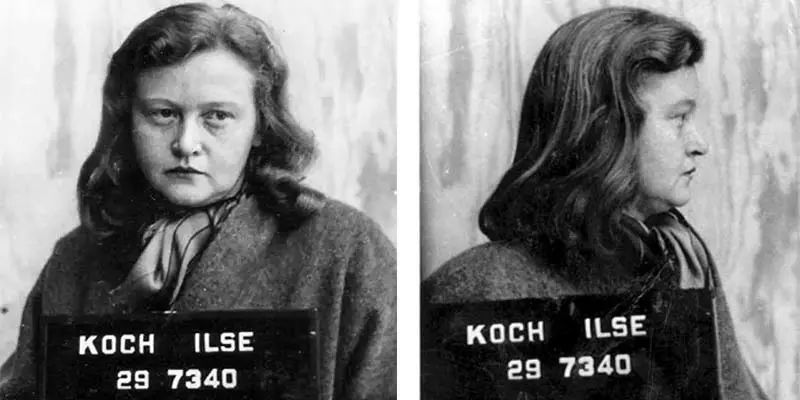
In photographs from the later proceedings, the transformation is visible. The commandant’s wife who had once moved through Buchenwald surrounded by servants and SS protection now sat at a courtroom table under guard.
Her shoulders were held rigid. Her mouth appeared tight. She turned toward judges, lawyers, and witnesses who no longer had to lower their voices in her presence.
The room belonged to the law.
Not to her.
The Augsburg trial opened in November 1950 and continued for weeks. Hundreds of witnesses were heard. Survivors once treated as disposable stood in a German courtroom and placed their memories into the official record.
Koch continued denying responsibility.
She claimed she had been occupied with raising her children and had not witnessed the crimes occurring around her.
But Buchenwald had not been a distant city she had visited once.
It had been her home.
Prisoners had worked in her household. The commandant had been her husband. The camp’s system had financed and supported the family’s privileged life.
Her defense required the court to believe that she had lived at the center of terror while somehow seeing nothing.
The judges did not believe her.
In January 1951, the Augsburg court convicted Koch on charges that included incitement to serious bodily harm, attempted murder, and murder. She was sentenced to life imprisonment and permanently deprived of her civil rights. Her later appeal failed, and repeated requests for clemency were rejected.
The famous human-skin accusations still dominated public memory, but the German court’s judgment did not depend on proving every gruesome story told about her.
That was the final reversal.
For years, Koch’s name had been surrounded by a horror so extreme that it almost became a shield. If one accusation could be challenged, she could pretend the entire case was a fabrication.
The court removed that shield.
It judged her on conduct that could be established.
Behind the sensational headlines stood something colder and more ordinary: a person who had been given access to unchecked power and repeatedly chose to use it against people who could not defend themselves.
Koch was transferred to Aichach women’s prison.
The years passed slowly.
The Nazi uniforms disappeared from German streets. Buchenwald became a memorial. Survivors built families, gave testimony, wrote accounts, and returned to the places where the regime had attempted to erase them.
Koch remained behind bars.
The woman who had once occupied the largest house in the SS settlement lived in a cell measured in steps.
The woman who had commanded prisoner servants had to follow prison schedules.
The woman whose displeasure could once bring punishment now submitted petitions that officials could reject with a signature.
Her authority had not merely been taken away.
It had been reversed.
In 1967, after years of imprisonment and failed appeals, Ilse Koch died by suicide in her cell.
Some will call that a deserved death.
But death itself was not the most meaningful punishment.
Death ended her awareness of the cell.
Justice was waking up inside it year after year, knowing that the people she once considered powerless had survived long enough to testify.
Justice was the survivor who recognized her on the street.
Justice was the witness who entered a courtroom without lowering his eyes.
Justice was the failed release, the waiting arrest warrant, the second trial, the life sentence, and every rejected appeal.
Ilse Koch once lived in a world where a uniform, a marriage, and a powerful surname allowed her to treat human beings as objects.
She died in a world where that surname had become evidence against her.
That is the warning her story leaves behind.
The most dangerous people are not always those who create an evil system. Sometimes they are the people who discover that the system rewards cruelty—and decide to enjoy every privilege it gives them.
Power allowed Ilse Koch to believe that the suffering beneath her window would remain silent forever.
She was wrong.
The victims found their voices, the witnesses remembered her face, and history made certain that the woman who once treated other people as prisoners spent the rest of her own life as one.