Then I Took the Microphone and Ended More Than a Wedding
Chapter One
Table Twenty-Seven
My father’s chair disappeared during the first dance.
One moment it stood beside my mother’s place card at Table Twenty-Seven, its burgundy cushion tucked neatly beneath the linen. The next, a banquet captain wheeled it across the ballroom and positioned it at the head table for a late-arriving investor.
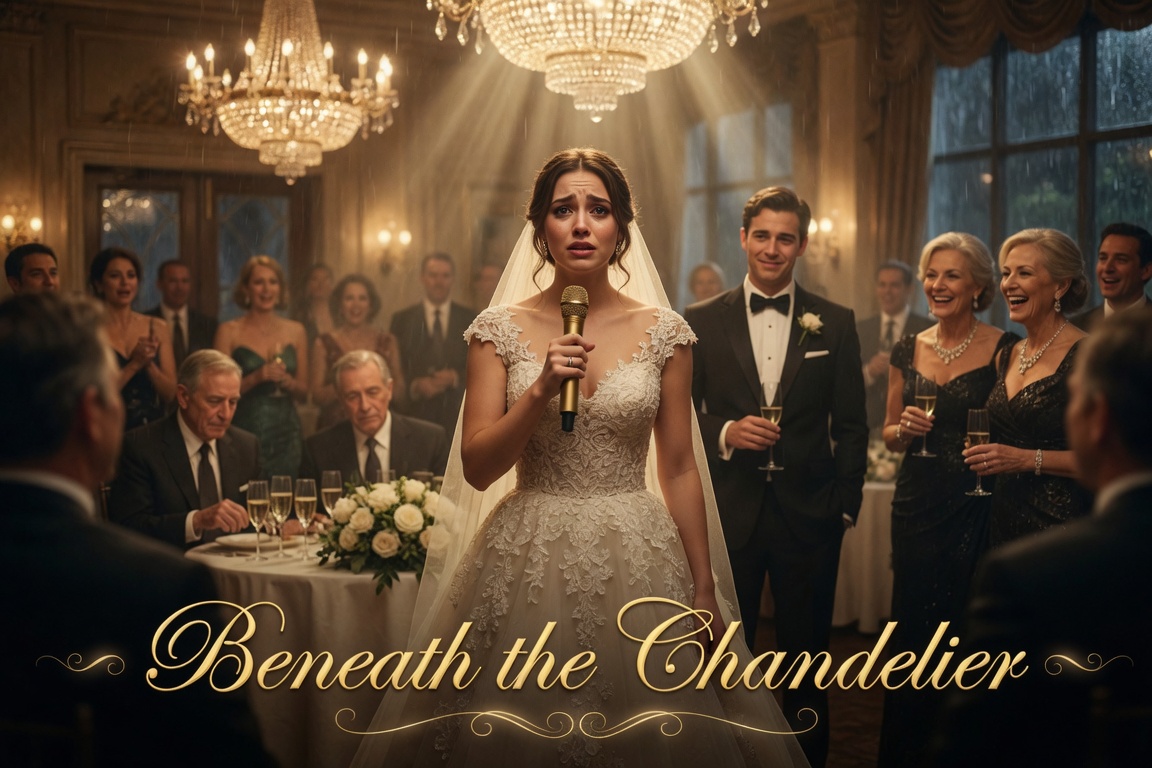
Dad watched the chair go.
He did not complain.
He simply lifted his water glass, moved two inches to the left, and continued standing beside my mother as if that had been the plan all along.
That was the first moment I understood my wedding was not a celebration.
It was an audition.
And my family had already failed.
The Whitmore Hotel ballroom glittered beneath three tiers of crystal chandeliers. Beyond the arched windows, January snow covered the rooftops of Philadelphia in soft white layers, muting the city’s usual roar. Inside, waiters moved between tables carrying silver trays of champagne. A twelve-piece band played beneath a wall of winter roses imported from Ecuador.
Every surface reflected money.
Polished marble.
Gold-rimmed plates.
Handwritten menus on thick cotton paper.
Even the ice cubes in the whiskey glasses had been stamped with the Whitmore family crest.
My new husband stood in the center of the dance floor, one hand resting at my waist.
Graham Whitmore smiled for the photographer.
“Look at me,” he murmured.
I was looking past him.
At my father.
Thomas Ellis was sixty-eight years old, five feet ten when his back did not ache, and still broad through the shoulders from forty-two years of ironwork. His hands looked out of place in that ballroom. The nails were ridged, the knuckles swollen, and a white scar crossed his right palm where a steel cable had snapped in 1998.
He wore a dark brown suit that had belonged to another decade.
The lapels were narrow. The sleeves had been altered twice. A careful patch beneath the left pocket was almost invisible unless the light struck it from the side.
My mother had sewn that patch eleven years earlier, before cancer took her ability to hold a needle.
Dad had refused to replace the suit.
“It still knows the shape of your mother’s hands,” he told me when I suggested renting a tuxedo.
Now he stood beside Table Twenty-Seven while strangers drank champagne in chairs meant for my parents.
My mother was not actually there.
Her framed photograph occupied the place setting beside him, surrounded by small white carnations.
The Whitmores had insisted the photograph remain at the rear of the ballroom.
“Memorial elements can darken the visual tone,” my mother-in-law had explained.
I had allowed it.
That truth would hurt later.
At the time, I had called it compromise.
Graham turned me gently toward the camera.
“Mara.”
“What?”
“You’re not here.”
“I’m watching my father stand.”
His smile remained fixed.
“It’s a chair.”
“It was his chair.”
“Mr. Caldwell arrived unexpectedly. My mother had to put him somewhere.”
“Then she could have put him at your table.”
“Our table is full.”
I looked toward the twenty-foot head table.
Graham’s mother sat between two senators. His sister occupied the seat beside mine, though she had spent most of dinner speaking to people at another table. Three empty chairs remained near the far end beneath floral arrangements so large no one could see across them.
“Graham.”
The photographer lowered his camera.
My husband’s fingers tightened slightly at my waist.
“Not now.”
Two words.
Quiet.
Reasonable.
Almost tender.
That was how Graham handled danger. He reduced it until objecting made me appear irrational.
The band finished the song.
Guests applauded.
He kissed my forehead, then moved toward a group of executives waiting near the bar.
I stood alone on the dance floor in a wedding dress that had cost more than my parents paid for their first house.
The photographer raised his camera again.
I walked away before he could capture my face.
Dad saw me approaching and smiled.
“There’s my girl.”
“Where’s your chair?”
He glanced toward the head table.
“Promoted.”
“Dad.”
“My knees could use the exercise.”
A waiter hurried over with a folding chair from the service corridor.
Dad thanked him as if he had been offered a throne.
The chair was metal, painted black, with rubber feet and no cushion. When he sat, it placed him six inches lower than everyone else.
His chin barely cleared the floral centerpiece.
My father laughed.
Actually laughed.
“Now I know how your Aunt Linda feels at Thanksgiving.”
The guests seated nearby smiled uncertainly.
My cousin Rachel looked ready to cry.
I crouched beside him.
“We can move tables.”
“And disrupt this military campaign your mother-in-law calls dinner?”
“I don’t care.”
“Yes, you do.”
He straightened my veil.
His fingertips were careful around the crystal pins.
“You spent eighteen months building this day.”
“Celia built this day.”
“You agreed to it.”
The words were not cruel.
That was why they landed.
I had agreed to everything.
The hotel.
The guest list.
The removal of my mother’s favorite yellow roses because Celia called them common.
The orchestra during cocktails.
The seating chart that placed construction workers, teachers, nurses, and my childhood neighbors at the back while people Graham barely knew sat near the dance floor.
Each concession had arrived alone.
Each seemed too small to end a relationship over.
Together, they had built a room where my father did not belong.
A spoon tapped against a champagne glass.
The band stopped.
Graham’s younger brother, Spencer, climbed onto the stage.
At thirty-six, Spencer Whitmore had never held a position he had not inherited or left a restaurant without someone else paying the bill. He was handsome in the smooth, unfinished way of men who mistake attention for affection.
He adjusted the microphone.
“I’ve been told I have four minutes,” he said. “Which is more time than Mara gave Graham before reorganizing his entire life.”
Laughter moved through the ballroom.
I smiled because three hundred people expected me to.
Spencer told a story about Graham’s childhood.
Then another about their father.
The jokes were warm, practiced, and built around the assumption that everyone in the room had known the Whitmores forever.
Finally, he turned toward me.
“And now Graham has married Mara Ellis, who brings something our family desperately needs.”
He paused.
“A conscience.”
The room laughed again.
I did not.
Spencer raised his glass.
“Mara grew up in South Philadelphia, the daughter of a public school secretary and an ironworker. She has spent her career telling rich people what they’re doing wrong with their buildings.”
That was one description of my work.
I was an architect specializing in the restoration of public housing, libraries, and abandoned industrial properties. I preserved structures other developers wanted demolished.
The Whitmores found this charming when it appeared in magazine profiles.
Less charming when I questioned their projects.
Spencer continued.
“We welcome Tom Ellis tonight, who apparently wore the same suit to Mara’s baptism, high school graduation, and now her wedding.”
Several heads turned toward my father.
Dad looked down at his jacket.
The laughter began cautiously.
Spencer waited.
It grew.
Someone near the bar called, “That’s value engineering.”
More laughter.
Graham stood beside the stage.
He was smiling.
Not broadly.
Not maliciously.
The small, helpless smile of a man who wanted everyone to know he understood the joke.
My father raised his water glass toward Spencer.
If anyone had been watching closely, they might have seen his thumb tremble against the rim.
I saw it.
Spencer lifted a garment bag from behind the podium.
“But don’t worry, Tom. The Whitmores take care of family.”
An assistant unzipped the bag.
Inside hung a black designer tuxedo.
Applause broke out.
My father’s smile disappeared.
Spencer carried the tuxedo down from the stage and held it against Dad’s shoulders.
“Try it on.”
“No, thank you,” Dad said.
“It’s your size.”
“I have a suit.”
“Yes,” Spencer said. “We all noticed.”
The laughter was louder this time.
My father stood.
The metal chair scraped across the floor.
“I said no, son.”
The word son should have softened the moment.
Instead, Spencer’s face tightened.
He was unused to refusal from people he considered grateful.
Celia Whitmore appeared beside him.
My mother-in-law wore silver silk and an emerald necklace that had once belonged to a European duchess. Her white-blond hair remained perfectly arranged despite six hours of photographs.
She placed one hand on Dad’s arm.
“Thomas, it’s a gift.”
“My wife repaired this suit.”
Celia glanced at the patched pocket.
“Yes. We heard.”
“My wife is dead.”
The ballroom changed.
Only slightly.
A few guests lowered their glasses.
Spencer looked toward Graham.
Graham looked toward me.
Celia withdrew her hand.
“No one meant disrespect.”
Dad nodded.
“Then no one needs to insist.”
He sat again in the folding chair.
Celia’s smile returned, thinner than before.
“Of course.”
She handed the garment bag to a waiter as though disposing of something unpleasant.
Spencer returned to the stage.
The toast continued.
But the room no longer laughed as easily.
I found Graham near the head table.
“Why didn’t you stop him?”
“He was joking.”
“My father asked him twice.”
“Mara, Spencer misjudged the room.”
“No. He judged it correctly. Most of them laughed.”
“What do you want me to do now?”
The question stunned me.
Not What should I have done?
What do you want me to do now?
As if dignity were a spilled drink requiring staff.
“I wanted you to walk onto the stage.”
“And make a public scene at our wedding?”
“It became a public scene when your brother used a microphone.”
Graham glanced around.
“Lower your voice.”
“I am speaking normally.”
“You have that expression.”
“What expression?”
“The one where you’ve already decided everyone is guilty.”
My stomach tightened.
Graham touched my wrist.
“Let tonight survive.”
I stared at him.
Behind his shoulder, Celia watched us.
Her eyes moved from my face to her son’s hand around my wrist.
She knew he was asking me to remain silent.
She also knew I probably would.
That had been my role throughout the engagement.
The practical one.
The reasonable one.
The woman who understood the pressures of marrying into a public family.
Celia approached carrying a cream envelope.
She offered it to my father.
“This should cover the inconvenience.”
Dad did not take it.
“What inconvenience?”
“The seating confusion. And the misunderstanding over the suit.”
My father looked at the envelope.
Then at her.
“Is that money?”
“A gesture.”
“How much dignity does it buy?”
Celia’s jaw tightened.
Several phones appeared above the tables.
Graham stepped between them.
“Tom, please.”
Dad looked at him.
Something in my father’s face went quiet.
Not anger.
Recognition.
He had finally understood the man I had married.
“I think I need some air,” he said.
He lifted my mother’s photograph from the table.
“Dad, wait.”
“I’ll be right outside.”
He kissed my cheek.
His beard brushed my skin.
Then he walked toward the ballroom doors carrying the framed photograph beneath one arm.
Spencer leaned toward a cousin and whispered loudly enough for nearby tables to hear.
“At least he took his date.”
A burst of laughter escaped from the Whitmore table.
Graham’s mouth twitched.
He tried to stop it.
He failed.
I saw the smile.
Everything inside me became still.
Across the ballroom, the clock above the doors showed 9:17 p.m.
At 9:30, my father was scheduled to sign the document that would save the Whitmore family’s largest project.
No one in the room knew that.
No one except me.
And suddenly, I knew he would never sign it.
Chapter Two
The Last Trustee
I found Dad on the hotel’s loading dock.
Snow drifted beneath the security lights, melting against the warm concrete. Delivery trucks idled near the alley. Somewhere inside the building, the band had started another song. The bass traveled through the brick walls as a dull, distant pulse.
Dad sat on an overturned milk crate with my mother’s photograph resting on his knees.
His old suit looked almost black beneath the fluorescent lights.
I wrapped my arms around myself.
The temperature had dropped below freezing, and I had left my coat upstairs.
“You’ll catch pneumonia,” he said.
“You sound like Mom.”
“Your mother would have brought a coat.”
“She also would have overturned three tables.”
He smiled.
“That too.”
I sat beside him despite the cold concrete.
For a while, we watched snow collect on the dumpsters.
Dad traced one thumb across the frame around my mother’s photograph.
It had been taken at my college graduation. She wore a yellow dress, held her chin too high, and looked as though she had personally invented architecture.
“I’m sorry,” I said.
“For what?”
“All of it.”
“You did not make that boy give a speech.”
“I married into the family that applauded.”
Dad looked at me.
The loading dock light exposed every line in his face.
“You married Graham, not his family.”
“I’m not sure Graham knows the difference.”
He said nothing.
That silence frightened me.
My father had defended Graham for three years. When I complained that Graham avoided arguments with Celia, Dad called it patience. When Graham missed my birthday dinner because a board meeting ran late, Dad said responsibility was not a character flaw.
He wanted the marriage to work.
Perhaps because he saw how badly I wanted it.
Perhaps because he feared I had inherited my mother’s talent for leaving before anyone could leave me.
“Did you bring the papers?” I asked.
Dad tapped the inside pocket of his jacket.
A folded document rested there.
The Foundry Parcel transfer agreement.
The Whitmore family’s Harbor Crown development was supposed to transform thirty-one acres of abandoned riverfront into offices, apartments, shops, and a private marina.
The project had appeared in newspapers for four years.
What those newspapers rarely mentioned was the seven-acre strip cutting through its center.
The strip had once contained the union hall, training yard, and memorial garden of Keystone Steelworkers Local 418. When the foundry closed in 1989, the land entered a protective trust created for former workers and their families.
No development could occur without the unanimous consent of the surviving trustees.
There had been five.
Four were dead.
My father was the last.
The Whitmores knew the final trustee as Thomas J. Ellis.
Their attorneys had exchanged letters with him for months.
But no one had connected Thomas J. Ellis, retired ironworker and union steward, with Tom Ellis, the bride’s father.
Graham knew Dad had worked at the old foundry.
He did not know about the trust.
I had discovered the connection five weeks before the wedding, when Dad handed me the proposed agreement and asked me to review the preservation clauses.
The Whitmores offered twelve million dollars for land worth nearly forty.
Dad did not care about the amount.
He wanted eighty affordable apartments included in the project.
A permanent memorial to the eleven workers killed at Keystone Foundry.
A job-training program for neighborhood residents.
Pension support for workers whose benefits vanished when the mill closed.
The Whitmores agreed to discuss the conditions.
Then, three days before the wedding, Celia’s attorneys sent a revised agreement.
The affordable apartments had become “workforce housing subject to market feasibility.”
The memorial had been reduced to a plaque.
The training fund could be canceled after five years.
Dad refused to sign.
That morning, another version arrived.
Most protections had been restored.
Dad believed the changes represented good faith.
I was less certain.
“Were you still going to sign tonight?” I asked.
He looked toward the snow.
“I had not decided.”
“Why bring it?”
“Because if I signed after the reception, they couldn’t claim I used the wedding to pressure them.”
“They used the wedding to pressure you.”
“Yes.”
“You knew they might.”
“I knew Celia wanted that parcel.”
“She wanted you emotionally cornered.”
“She was not the only one.”
I looked at him.
Dad folded his hands over the photograph.
“You wanted me to sign.”
“For the protections.”
“For Graham.”
I opened my mouth.
Then closed it.
The truth entered without permission.
Part of me had wanted the agreement completed because it would bind our families together in a way love had failed to do.
Dad’s signature would make me useful to the Whitmores.
Not merely Graham’s socially inconvenient wife.
Not the architect who criticized their luxury developments.
I would become the bridge to Harbor Crown.
The thought sickened me.
“I didn’t know I was doing that.”
“That is how pressure works best.”
“Why didn’t you tell me?”
“Because you were getting married.”
“So?”
“So a father should not ask his daughter to choose between him and the man she loves.”
“They forced the choice.”
“No.”
Dad turned toward me.
“They revealed it.”
The loading dock door opened.
Graham stepped outside without a coat.
He stopped when he saw us.
“Mara, everyone’s waiting.”
“For what?”
“The cake. Photographs. Your first speech.”
“Our first dance already happened.”
“You walked out.”
“My father was humiliated.”
Graham exhaled.
“I apologized to him.”
Dad looked up.
“When?”
“Inside.”
“You apologized to the room after I left?”
“I told Spencer he crossed a line.”
“That is not an apology to me.”
Graham rubbed his hands against the cold.
“You’re right.”
Dad waited.
Graham looked at him.
“I’m sorry, Tom.”
“For which part?”
“For Spencer’s joke.”
“And the chair?”
“That was my mother.”
“The envelope?”
“My mother again.”
“The smile?”
Graham’s face changed.
He glanced at me.
I said nothing.
Dad rose from the milk crate.
At sixty-eight, with his patched suit and stiff knees, he still seemed larger than Graham beneath the loading lights.
“You looked at my daughter before you smiled,” Dad said. “You knew it hurt her. Then you smiled anyway because disappointing your brother frightened you more than humiliating us.”
“That isn’t fair.”
“No,” Dad said. “It isn’t.”
Graham’s jaw tightened.
“Can Mara and I speak alone?”
“No,” I said.
His eyes moved to me.
“What?”
“We have spent three years speaking alone. You agree with me in private and surrender me in public.”
“That is not what happened.”
“It happened twelve minutes ago.”
“Mara, my family is under pressure.”
“So is everyone. Pressure doesn’t invent character. It reveals what character costs.”
Graham stared at me.
“You’ve been waiting to say that.”
“No. I’ve been avoiding saying it.”
The hotel door opened again.
Celia stepped onto the loading dock wearing a white fur wrap.
Two attorneys followed her.
She took in the scene.
My wedding dress.
My father’s photograph.
Graham without a coat.
Then her gaze settled on Dad’s inside pocket.
“Mr. Ellis,” she said. “I believe we have an appointment.”
Graham looked between them.
“What appointment?”
Celia did not answer.
Dad removed the folded agreement from his jacket.
Graham recognized the Whitmore Urban letterhead.
His face drained.
“What is that?”
“The Foundry Parcel transfer,” Dad said.
Graham turned toward his mother.
“You found the final trustee?”
“Yes.”
“Tom is the trustee?”
Celia’s silence answered.
“You knew?”
“I learned yesterday.”
My father looked at her.
“You knew before the reception.”
Celia adjusted the edge of her fur wrap.
“Our legal team confirmed your identity this morning.”
“And you still let Spencer mock him,” I said.
“I cannot control Spencer’s sense of humor.”
“You control where everyone sits, which flowers they see, and how long the waiters hold the doors. You could have controlled a microphone.”
Her eyes sharpened.
“I did not believe Mr. Ellis would allow a family misunderstanding to jeopardize a four-hundred-million-dollar development.”
Dad unfolded the agreement.
“You were counting on my daughter.”
“I was counting on professionalism.”
“You gave me cash in an envelope.”
“A gesture of apology.”
“You tried to purchase the right not to apologize.”
One attorney stepped forward.
“Mr. Ellis, perhaps we should move inside. The financing deadline is ten o’clock.”
Graham looked at his mother.
“What financing deadline?”
Celia’s expression tightened.
The attorney stopped speaking.
Graham turned toward him.
“What happens at ten?”
No one answered.
Snow landed in Graham’s dark hair.
He looked suddenly younger.
Like the boy Celia had raised to inherit a building without ever showing him the cracks in its foundation.
I knew then that the Foundry Parcel was not the only secret.
And whatever Celia had hidden was due in thirty-five minutes.
Chapter Three
The Debt Beneath the Ballroom
We returned through the service corridor.
Kitchen staff pressed themselves against stainless-steel counters as our strange procession passed: the bride, the groom, the groom’s mother, two attorneys, and an ironworker carrying a dead woman’s photograph.
The ballroom doors remained closed.
Beyond them, the band played “Moon River.”
Celia led us into the hotel library.
The room smelled of leather, smoke from the fireplace, and old money protected from sunlight. Portraits of Whitmore men lined the walls. Each wore the same expression of inherited certainty.
Graham locked the door.
“What happens at ten?”
Celia removed her fur wrap and laid it across a chair.
“Harbor Crown’s bridge facility expires.”
“How much?”
“We are refinancing.”
“How much?”
One attorney opened his folder.
Celia shot him a look.
Graham saw it.
His hands curled at his sides.
“How much, Mother?”
“One hundred and twenty-eight million dollars.”
The fire snapped behind me.
Graham laughed once.
There was no humor in it.
“You told the board it was forty-six.”
“It was.”
“When?”
“Eighteen months ago.”
“What did you use as security?”
“Various assets.”
“The hotel?”
Celia looked toward the portraits.
Graham’s face went still.
“You mortgaged this hotel.”
“We leveraged it.”
“For Harbor Crown.”
“For the future of Whitmore Urban.”
“What else?”
“Graham,” she said softly.
“What else?”
The attorney answered.
“The Boston property. Two parking subsidiaries. A portion of the family trust’s marketable assets.”
Graham gripped the back of a chair.
“And if Dad doesn’t sign the parcel agreement?”
“The senior lender will not fund.”
“What happens to the bridge loan?”
“It enters default.”
“And this hotel?”
The attorney closed his folder.
“The lender may begin enforcement.”
My wedding reception continued one wall away.
Three hundred guests drank champagne in a ballroom that might belong to a bank by morning.
Graham turned toward his mother.
“You used my wedding to get the signature.”
“I scheduled the closing to coincide with a family gathering.”
“You told me the attorneys were here for the prenup.”
“They were handling several matters.”
“You knew Tom was the trustee, and you seated him beside the kitchen.”
“That was an error.”
“You gave away his chair.”
“Caldwell’s fund controls two of our credit extensions.”
“So my father-in-law had to stand.”
Celia’s composure cracked.
“What did you expect me to do? Place a retired ironworker above a man holding eighty million dollars of our debt?”
The words hung in the library.
Dad looked at her.
No anger entered his face.
Only a kind of tired clarity.
“That,” he said, “is why you will never understand the land.”
Celia stared at him.
“My father melted steel at Keystone Foundry,” Dad continued. “My brother lost two fingers there. Eleven men died in that mill because owners placed deadlines above bodies. The union protected the parcel so no one could use their graves to build another monument to people who think money determines which chair a man deserves.”
“This project creates six thousand jobs.”
“And removes three hundred families.”
“It redevelops blight.”
“It relocates poverty beyond your windows.”
Celia folded her arms.
“You are allowing personal offense to interfere with public benefit.”
Dad held up the agreement.
“Your affordable housing commitment can be canceled by your board.”
“It is subject to financial conditions.”
“Your training program ends after five years.”
“It can be renewed.”
“The memorial becomes a brass strip beside a parking garage.”
“It is land, Mr. Ellis. Not scripture.”
My father’s fingers tightened around the paper.
Graham looked at him.
“What did she promise you?”
“I asked for housing, jobs, and a memorial.”
“You didn’t ask for money?”
“The trust receives compensation. I don’t.”
Celia stepped closer.
“He did not tell you because he wanted control.”
Dad’s eyebrows lifted.
“Control of what?”
“Our project.”
“I wanted eighty apartments ordinary people could afford.”
“You demanded them.”
“I required them.”
Celia turned to me.
“And you helped him.”
“Yes.”
“You reviewed confidential drafts while planning to marry my son.”
“I reviewed a public trust agreement for my father.”
“You concealed a material conflict.”
“So did you.”
Her eyes hardened.
“You entered this family under false pretenses.”
“What pretenses?”
“You allowed Graham to believe your father was irrelevant to our business.”
Graham flinched.
Dad looked at him.
“Did you think I was irrelevant?”
“No.”
The answer came too quickly.
Celia continued.
“Mara has opposed Harbor Crown since its earliest design phase.”
“I opposed demolishing the Franklin Row houses.”
“You embarrassed Whitmore Urban at the planning commission.”
“I testified that your relocation study was incomplete.”
“You called our project predatory.”
“I called one financing mechanism predatory.”
“You wanted access to Graham.”
I stared at her.
“What?”
“You met him at a zoning hearing. You dated him while filing objections against our company. Now your father controls the only parcel standing between us and financial ruin.”
Graham stepped forward.
“Stop.”
But Celia had found a version of events that protected her.
She believed it because she needed to.
“You think this is coincidence?” she asked him. “She positioned herself inside this family.”
My father crossed the room before I could answer.
He placed my mother’s photograph on the desk.
Then he laid the transfer agreement beside it.
“My daughter met your son because your architects ignored an accessible entrance at a public library.”
Celia opened her mouth.
Dad raised one hand.
“You will listen now.”
The authority in his voice silenced even the fire.
“Mara argued with him for forty minutes. She came home that night furious because Graham listened, apologized, and changed the plans. She liked him because he did what your family rarely does. He heard the word no without treating it as an attack.”
Graham lowered his eyes.
Dad looked at him.
“I don’t know when that changed.”
Neither did I.
Perhaps Graham had not changed.
Perhaps listening had always been easy when the cost was a ramp.
Harder when the cost was his mother’s approval.
Celia checked the clock.
9:37.
“Mr. Ellis, the lender requires confirmation by ten. If the project defaults, hundreds of hotel employees and thousands of contractors will suffer.”
Dad looked toward the ballroom wall.
“You knew the risk when you borrowed the money.”
“I knew the parcel would be approved.”
“No. You believed my love for my daughter could be converted into leverage.”
“I believed you were reasonable.”
“Reasonable men can still say no.”
Her face whitened.
Graham stepped toward Dad.
“Please.”
I felt the word strike him.
Not because Graham had apologized.
Because he had not.
Not for the chair.
Not for the toast.
Not for the envelope.
He had apologized only after learning what my father controlled.
Dad heard it too.
“Would you be asking this way if I had signed before dinner?” he asked.
Graham said nothing.
Dad picked up the agreement.
He tore it once.
The sound was small.
Celia lunged forward.
“No.”
He tore it again.
Then again.
White pieces fell across the desk.
The attorney rushed to gather them.
“It was an original counterpart.”
“It was unsigned,” Dad said.
“We can print another,” Celia snapped.
“Yes.”
He looked at her.
“You can.”
At 9:41, Celia still believed the problem was paper.
Then the library door opened.
A young attorney I did not recognize entered, breathless.
He looked at Celia.
“The lender has frozen the facility.”
She stopped moving.
“The deadline is ten.”
“They received a dispute notice.”
“What dispute?”
The attorney looked at my father.
“The trustee’s signature submitted last week has been challenged as unauthorized.”
Every eye turned toward Dad.
He did not look surprised.
I did.
“What signature?” I asked.
Dad reached into his pocket and removed his phone.
“This one.”
On the screen was a scanned document bearing his name.
Thomas J. Ellis.
The signature looked almost correct.
Almost.
But my father had stopped using the middle initial after my brother died. No legitimate document in fifteen years carried the J.
Celia’s face changed.
Not shock.
Recognition.
“You knew,” I said.
She turned toward the attorney.
“Who filed the dispute?”
Dad answered.
“I did.”
“When?”
“While I was outside.”
Graham stared at his mother.
“Did we submit a forged signature?”
Celia said nothing.
The ballroom clock began chiming the quarter hour.
Nine forty-five.
Fifteen minutes before the loan expired, the Whitmore family no longer needed my father to save their project.
They needed him not to send them to prison.
Chapter Four
The Microphone
Celia ordered the attorneys to remain in the library.
I walked out.
Graham followed me into the corridor.
“Mara.”
I kept moving.
“What are you doing?”
“Finishing the reception.”
“You can’t go in there.”
“It’s my wedding.”
He caught my hand.
I stopped.
His grip loosened immediately.
“I didn’t know about the signature.”
“I believe you.”
Relief crossed his face.
It disappeared when I continued.
“You knew about the jokes.”
“Mara.”
“You knew my father was standing. You knew Spencer was humiliating him. You knew your mother offered him money. You knew I was asking you to intervene.”
“I froze.”
“You smiled.”
“I was uncomfortable.”
“So was my father.”
“I made a mistake.”
“No. A mistake is calling someone by the wrong name. You made a choice because silence protected your place in the room.”
He looked toward the closed ballroom doors.
“What do you expect me to do now?”
There it was again.
The same question.
As if I were responsible for designing his courage.
“I expected you to be my husband.”
“I am.”
“No.”
I removed my wedding ring.
The diamond caught the corridor light.
For years, the Whitmore family had used the stone in advertisements for their jewelry subsidiary. Celia called it a family heirloom.
Graham had called it a promise.
Now it felt like a small transparent window into a structure with no door.
I placed it in his palm.
“We signed the license,” he whispered.
“We haven’t filed it.”
His fingers closed around the ring.
“Mara, don’t decide this in anger.”
“I decided it while watching you smile.”
The ballroom doors opened.
Spencer appeared.
His face was flushed from alcohol.
“There you are. The band’s been stalling for twenty minutes.”
He noticed the ring in Graham’s hand.
“What happened?”
I walked past him.
The ballroom had become louder in our absence.
Guests were drinking faster. Rumors traveled from table to table. Some believed my father had been removed. Others believed the Whitmore deal had closed and private celebrations were occurring.
The bandleader saw me and lifted his baton.
I raised one hand.
The music stopped.
Three hundred faces turned.
My wedding dress caught the chandelier light as I crossed the dance floor.
A champagne stain darkened the hem where someone had stepped on it. One sleeve had begun to separate at the seam. My veil hung crooked because my father had been interrupted while straightening it.
I climbed the stage.
Spencer followed.
“What are you doing?”
I removed the microphone from its stand.
He reached for it.
I looked at him.
Something in my face made him stop.
The room settled.
I could hear silverware touching plates.
The heating system humming through old vents.
Snow brushing the tall windows.
My father appeared at the ballroom entrance carrying my mother’s photograph.
Behind him stood Celia and the attorneys.
I looked at the guests.
“Thank you for coming.”
My voice sounded different through the speakers.
Stronger, perhaps, because I could no longer pretend it belonged only to me.
“I had prepared a speech about love.”
A few guests smiled uncertainly.
“I was going to tell you that Graham and I met during a fight over a library entrance. That he listened when everyone else wanted me to stop talking. I thought that was the beginning of our marriage.”
Graham stood beneath the stage.
His hand remained closed around my ring.
“I was wrong.”
The room became still.
Celia moved toward the sound booth.
Dad stepped into her path.
I continued.
“Tonight, my father’s chair was given to a wealthy investor. His suit was mocked in a public toast. He was offered money after refusing to participate in the joke. My husband watched.”
Whispers moved through the ballroom.
Spencer climbed one step toward the stage.
“It was a joke, Mara.”
I looked at him.
“No. It was a measurement.”
He frowned.
“You wanted to know how much disrespect my father would accept for the privilege of standing near your family.”
Several guests lowered their phones.
Others raised them higher.
I looked toward Dad.
He stood at the rear of the ballroom in his old brown suit, one hand resting on the frame containing my mother’s face.
“That suit belonged to my father before I was born,” I said. “My mother repaired it after he tore the pocket carrying groceries home during a snowstorm. He wore it to my brother’s funeral. He wore it beside my mother during chemotherapy. He wore it tonight because it is the last formal thing he owns that still carries evidence of her hands.”
No one laughed.
Spencer stepped backward.
I turned toward the head table.
“The Whitmore family believed my father was poor.”
Celia spoke from the aisle.
“This is not appropriate.”
“No,” I said. “What happened tonight was not appropriate. This is simply public.”
Her face hardened.
I continued.
“My father is not secretly wealthy. He does not own a corporation. He has no private plane, investment fund, or mansion.”
Confusion crossed several faces.
They had expected the familiar reveal.
The janitor who owned the building.
The farmer who controlled a fortune.
The poor father who was never truly poor.
I would not give them that comfort.
“My father spent forty-two years building structures other people put their names on. He raised two children on union wages. He cared for my mother until she died. He lives in the same row house he purchased in 1981.”
Dad’s eyes shone.
“He is exactly the man you thought he was.”
The sentence traveled across the room.
“And you decided that made him safe to humiliate.”
A woman near the front covered her mouth.
One of the hotel servers stopped beside the wall, a tray balanced against his palm.
I lifted the torn pieces of the Foundry Parcel agreement.
“What the Whitmores did not know until yesterday is that my father is the surviving trustee of land their four-hundred-million-dollar Harbor Crown development cannot proceed without.”
A wave of voices rose.
Celia moved forward.
“Turn off the microphone.”
The bandleader looked at her.
Then at me.
He did nothing.
I held up the pieces.
“My father intended to approve the transfer if the project protected affordable housing, worker training, and the memorial of eleven men killed at the Keystone Foundry.”
Spencer stared at Graham.
Graham did not look at him.
“The Whitmores borrowed more than one hundred million dollars expecting the land would become theirs. Tonight, their financing expires.”
Celia’s voice cut through the room.
“You are discussing confidential business.”
“I am discussing why my father’s chair was worth less than an investor’s.”
A few guests began leaving their tables.
Board members gathered near the back.
Phones lit up as messages arrived.
I looked toward the employees lining the walls.
“I also learned tonight that someone submitted an unauthorized signature in my father’s name.”
The ballroom erupted.
Celia climbed the stage steps.
Dad caught her arm before she reached me.
He did not squeeze.
He only stopped her.
“Let her speak,” he said.
She looked at his hand.
Then at his face.
“You are destroying nine hundred jobs.”
Dad released her.
“No. I am refusing to hide what you risked.”
I faced the room again.
“The lender has frozen the project facility. The transaction will not close tonight.”
Executives began dialing phones.
One of the senators left through the side entrance.
Mr. Caldwell, the investor who had taken my father’s chair, stood so quickly his glass overturned.
Champagne spread across the table.
Celia watched it drip onto the carpet.
Something inside her finally cracked.
“You ungrateful girl.”
The words carried through my microphone.
Everyone heard.
I looked at her.
“For what should I be grateful?”
“We welcomed you.”
“You redesigned me.”
“We gave you access to rooms your family could never enter.”
“My father built rooms like this.”
“You used my son.”
Graham flinched.
I removed the microphone from my mouth.
For one second, I saw Celia not as a matriarch but as a frightened woman standing before the collapse of everything she had protected.
Her cruelty had logic.
That did not make it less cruel.
It made it more dangerous.
“You taught Graham that love means never embarrassing the family,” I said. “Even when the family deserves to be embarrassed.”
Celia’s mouth trembled.
She turned toward her son.
“Tell her.”
Graham looked at me.
Then at his mother.
For most of his life, he had survived by choosing the silence that delayed pain.
Now every possible silence had become a choice.
He climbed the stage.
Celia exhaled with relief.
Graham took the second microphone.
“I knew the project was overleveraged,” he said.
Her face changed.
“I did not know the full amount. I did not know about the signature.”
“Graham,” she warned.
“But I knew my mother wanted Tom’s cooperation. I knew she expected the wedding to make refusal harder.”
He looked at Dad.
“And I said nothing.”
The room remained silent.
Graham turned toward me.
“I let you carry every conflict because I was afraid that choosing you publicly meant losing my family privately.”
He opened his hand.
My ring lay in his palm.
“I am sorry.”
My chest tightened.
It was the apology I had needed twenty minutes earlier.
Perhaps three years earlier.
Now it could not return us to the beginning.
“I believe you,” I said.
Hope appeared in his face.
Then I added, “But I cannot remain married to the person you may become after tonight. I would spend the rest of my life waiting for the man who stood silent before it.”
His fingers closed around the ring.
Behind us, phones rang throughout the ballroom.
Board members hurried toward Celia.
One whispered into her ear.
The color left her face.
“What happened?” Spencer demanded.
The board member looked at Graham.
“North Meridian has called the bridge loan.”
Another man approached.
“The city pension authority has suspended participation in Harbor Crown.”
A third voice came from the aisle.
“The press has the forged-signature allegation.”
Everything did not collapse at once.
It collapsed in precise layers.
Financing.
Political support.
Investor confidence.
Board loyalty.
The wedding.
The illusion that the Whitmores could control which truth entered the room.
Celia stood beneath the chandeliers as people moved away from her.
For the first time that night, she had no seat.
Chapter Five
What Survived the Night
The ballroom emptied before the cake was cut.
Reporters gathered outside the hotel by midnight. Camera lights flashed against the snow. Guests escaped through kitchens, freight elevators, and underground parking ramps.
Celia locked herself in the library with attorneys.
Spencer disappeared.
Graham remained on the stage long after everyone stopped looking at him.
My father found me in the bridal suite.
I had changed into gray sweatpants and one of Graham’s white shirts. The sleeves hung past my hands.
My wedding dress lay across the bed.
From a distance, it still looked perfect.
Up close, the hem was blackened, one sleeve torn, and a wine stain marked the waist where a guest brushed past me during the panic.
Dad stood in the doorway.
“You all right?”
“No.”
“Good.”
I looked at him.
He entered.
“People who say they’re all right on nights like this usually make expensive decisions.”
Despite everything, I laughed.
The sound broke apart halfway out.
Dad sat beside me.
I leaned against his shoulder.
His old suit smelled of cold air, coffee, and the faint cedar blocks he kept in his closet.
“I should have stopped the toast sooner.”
“Yes.”
“I should have left when they moved your chair.”
“Probably.”
“I should have seen Graham clearly.”
Dad looked at the wedding dress.
“You saw the parts he showed you.”
“I ignored the rest.”
“You loved him.”
“That isn’t an excuse.”
“No. But it is an explanation.”
Outside, a helicopter passed above the hotel.
Its searchlight swept across the bedroom ceiling.
I closed my eyes.
“What happens to Harbor Crown?”
“The forged signature will trigger an investigation.”
“Did Celia know?”
“I don’t know.”
“Do you think she did?”
Dad took his time.
“I think she knew enough not to ask.”
That answer felt more believable than innocence or conspiracy.
Celia did not need to order the forgery.
She only needed to create a company where failure was unforgivable and consent was treated as delay.
Someone beneath her had solved the problem.
Exactly as she had trained them to.
“Will the hotel close?” I asked.
“Maybe.”
“Employees could lose everything.”
“Yes.”
“Then I did what she accused me of.”
“No.”
“I made it public.”
“She made it true.”
I stood and walked toward the window.
Below, reporters crowded behind police barriers.
“It doesn’t matter who made it true if housekeepers lose their jobs.”
Dad joined me.
Snow fell through the lights like ash.
“What do you want to do?”
“Save the employees.”
“That sounds like your mother.”
“She would have been downstairs organizing food before the speeches ended.”
“She also would have stolen the silverware.”
“She hated waste.”
Dad smiled.
Then his expression sobered.
“The land trust can still negotiate.”
“With whom?”
“Not the Whitmore family alone.”
I turned.
He continued.
“The lender owns most of the risk now. The city wants the project. The unions want jobs. Neighborhood groups want housing. Harbor Crown does not have to disappear.”
“You would still transfer the parcel?”
“If the agreement changes.”
“After what happened?”
“The land was not protected to punish rich people. It was protected to serve workers.”
I looked at him.
The power he held had never interested him as revenge.
That was why he deserved it.
“We could require independent oversight,” I said. “A community land board. Permanent affordability instead of time-limited units.”
“More than eighty apartments.”
“One hundred and twenty.”
“A training center.”
“Run by the building trades, not Whitmore Urban.”
“The memorial garden stays.”
“And the pension fund gets first claim on development proceeds.”
Dad nodded slowly.
“What about the hotel employees?”
“A stabilization trust funded through the sale of nonessential Whitmore assets.”
“You think the lenders will agree?”
“They’ll agree if their alternative is litigation and an empty parcel.”
My mind had begun building.
Not a revenge plan.
A structure.
That was what I knew how to do.
Dad watched me.
“There’s my girl.”
A knock sounded.
Graham stood outside.
Dad looked at me.
“Do you want me to stay?”
“Yes.”
Graham heard.
Pain crossed his face, but he entered.
He had removed his tuxedo jacket and tie. His shirt was open at the collar. He looked as though the night had aged him ten years.
“My mother has been removed as chief executive,” he said.
I said nothing.
“The board appointed an emergency committee.”
“Are you on it?”
“No.”
The answer surprised me.
“I resigned.”
Dad folded his arms.
“Before or after the board asked?”
“Before.”
Graham looked at me.
“I gave them the emails.”
“What emails?”
“Correspondence between my mother, the project attorney, and the financing team.”
“About the signature?”
“I don’t know. I haven’t read everything.”
“You handed over your own company records without reading them?”
“I knew if I read them first, I might find a reason not to.”
For the first time that night, he had chosen action before comfort.
It did not repair us.
But it mattered.
“My mother says the forged signature came from an outside closing firm,” he continued. “She says she believed it was legitimate.”
“Do you believe her?” Dad asked.
Graham looked toward the floor.
“I believe she stopped distinguishing between what she ordered and what people did because they feared disappointing her.”
Dad nodded.
“She taught you the same thing.”
“Yes.”
Graham reached into his pocket.
He placed the wedding ring on the dresser.
“I won’t contest an annulment.”
My throat tightened.
“Thank you.”
“I’m going to cooperate with investigators.”
“That may destroy your family.”
He looked at me.
“They were willing to let silence destroy yours.”
No one spoke.
The man before me was closer to the Graham I had loved than the groom who smiled during Spencer’s toast.
That was the tragedy.
Some people become brave only after cowardice has taken everything courage might have saved.
Graham moved toward the door.
“Mara.”
“Yes?”
“If I had walked onto the stage when Spencer started—”
“Don’t.”
“I need to know.”
“No, you don’t.”
He waited.
I looked at him.
“You need to become the man who crosses the room without knowing whether someone will reward him.”
His eyes filled.
Then he left.
Dad and I remained beside the ruined dress.
At 2:14 in the morning, I received a message from an unknown number.
It contained a photograph of an email.
The sender was Celia.
The message had been written six weeks earlier.
If Ellis refuses, use the authorization from his previous trust filing. We cannot permit one sentimental old man to obstruct the future.
My father read it over my shoulder.
For the first time that night, his face showed anger.
Not wounded pride.
Not embarrassment.
Fury.
Celia had known.
And the collapse of her company was no longer the greatest danger she faced.
Chapter Six
The Price of a Name
Federal investigators arrived before sunrise.
Celia was charged seven months later with conspiracy to commit bank fraud and making false statements to lenders.
She insisted she had authorized the use of an existing signature only as a temporary indication of consent. Her attorneys argued that she believed Dad would eventually approve the agreement.
The jury did not find the distinction persuasive.
She served eleven months in a federal detention center and spent another year under home confinement.
Spencer was never charged.
His punishment was less official.
The video of his toast followed him into every meeting, restaurant, and charity event. Whitmore relatives who laughed beside him later claimed they had been uncomfortable. Friends disappeared. Invitations stopped.
He issued three apologies.
The first blamed alcohol.
The second blamed family pressure.
The third, written nearly a year later, contained no excuse.
My father accepted it.
He did not forgive Spencer.
Those were different acts.
The Whitmore Hotel entered receivership but did not close.
Graham sold his apartment, surrendered his trust distributions, and contributed the proceeds to an employee stabilization fund. Several relatives did the same after discovering public disgrace was more expensive than restitution.
Harbor Crown survived.
Not in its original form.
The glass towers became mixed-income apartment buildings.
The private marina became a public riverwalk.
One hundred and thirty-two permanently affordable homes were included.
The Keystone training center opened in the restored union hall.
Eleven steel columns stood in the memorial garden, one for every worker who died at the foundry.
My father refused to place his name anywhere.
“Names are how people start thinking land belongs to them,” he said.
The project took four years.
I served as lead preservation architect.
Dad attended every community meeting in the same brown suit.
After the third meeting, I bought him a new one.
He thanked me, placed it in his closet, and continued wearing the old one.
“The new one is for emergencies,” he explained.
“You testified before a federal grand jury in the old suit.”
“That was official business.”
“What qualifies as an emergency?”
He considered.
“Your next wedding.”
“There will not be one.”
“There might.”
“No.”
“Then I’ll be buried in an untouched suit. Very wasteful.”
He smiled when he said it.
But for a long time, I believed him.
I dated no one for two years.
I worked.
I restored libraries, row houses, and the Keystone union hall.
I learned that heartbreak did not vanish when given meaningful labor. It simply became less efficient at consuming the entire day.
Graham and I spoke occasionally through project meetings.
He no longer worked for Whitmore Urban.
After cooperating with investigators, he accepted a position at a nonprofit that rehabilitated hotels into transitional housing.
The salary was less than his former travel budget.
He seemed relieved.
We never tried again.
Love had not disappeared.
It had changed into something that could exist only at a distance.
One autumn afternoon, four years after the wedding, I stood with Dad inside the completed Keystone memorial garden.
Rain had darkened the steel columns.
Children ran between them while their parents read the names engraved at eye level.
A wedding party posed near the riverwalk.
The bride’s father wore a rented tuxedo two sizes too large.
Dad watched him adjust the sleeves.
“You should tell him,” he said.
“Tell him what?”
“To keep it. His daughter may need him to wear it again.”
I looked at Dad’s patched pocket.
“Do you regret not signing that night?”
“No.”
“Even after everything?”
“Especially after everything.”
He walked toward one of the columns.
My brother’s name did not appear there. Daniel died years later in a car accident, but he had spent three summers working at the foundry beside Dad.
Dad touched the steel as if greeting someone.
“Your mother worried you would become ashamed of us,” he said.
I stared at him.
“She never said that to me.”
“She said it to me.”
“Why would she think that?”
“Because you entered rooms we had never seen. College. Architecture firms. Magazine interviews. People who knew which fork to use without watching anyone else.”
“Mom taught me the forks.”
“She learned from television.”
I laughed.
Dad turned.
“Were you ashamed of me that night?”
The question stunned me.
“No.”
“Not even for a second?”
“Dad.”
“I’m not asking to hurt you.”
Snow had not yet arrived that year, but cold moved across the river.
I looked at the old suit.
At the patch.
At the shiny elbows and narrowed lapels.
“I was afraid they would judge you.”
“That isn’t the same.”
“It became the same when I asked you to accept it.”
Dad nodded.
I swallowed.
“I was ashamed that their judgment mattered to me.”
“That,” he said, “is different.”
“Is it better?”
“It is honest.”
We sat on a bench facing the water.
For years, I had told the story as the night I defended my father.
The version people shared online was simpler.
A wealthy family humiliated a working-class man.
His daughter exposed their fraud.
Their empire collapsed.
But the truth was less flattering.
I had watched smaller humiliations throughout the engagement.
The way Celia corrected Dad’s pronunciation of wine labels.
The way Spencer asked whether construction workers truly understood architectural drawings.
The way Graham suggested my parents enter through the hotel’s side door to avoid press photographs.
I had objected privately.
Then attended dinner.
I had protected the relationship by allowing disrespect to arrive in pieces too small to justify leaving.
The microphone had not made me brave.
It made my previous silence impossible to ignore.
“I’m sorry,” I said.
Dad placed one hand over mine.
“You stood up.”
“Late.”
“Most people do.”
“Mom wouldn’t have.”
“Your mother once spent eight years letting her sister borrow money without repaying it.”
“That’s different.”
“It always is when we love the coward.”
I looked at him.
He smiled faintly.
“Bravery is rarely recognizing the villain, Mara. It is recognizing the part of the villain that sounds like someone we love.”
The wedding photographer sent my photographs six months after the annulment.
For years, I left the folder unopened.
That evening, I found it in a drawer.
Most images were exactly what Celia wanted.
Crystal chandeliers.
Perfect flowers.
Politicians smiling beneath candlelight.
Graham and me dancing beneath the Whitmore crest.
Near the end was a photograph I had never seen.
My father stood beside the service corridor holding my mother’s picture.
His chair was already gone.
Spencer had not yet begun the toast.
Dad was looking toward me on the dance floor.
His expression contained pride, worry, and something close to farewell.
He had known before I did that the marriage would ask me to choose.
Beneath the photograph, the file number showed the time.
8:53 p.m.
Twenty-four minutes before Spencer’s speech.
Thirty-seven minutes before Dad’s signature was due.
I printed the image and placed it in the Keystone training center.
Not in the memorial garden.
Not beneath my father’s name.
It hung beside the main entrance, where apprentices arrived each morning wearing work boots and carrying metal lunch boxes.
Below it, I added one sentence.
A person’s dignity is not proven by the power hidden behind them. It is revealed by how we treat them when we believe they have none.
Dad complained that the photograph made his ears look large.
Then he stood beside it for twenty minutes, pretending to read the construction schedule while visitors stopped to look.
The Whitmore name still existed.
So did mine.
Neither controlled the land.
Neither controlled the story.
On my wedding night, I believed everything collapsed when I took the microphone.
I was wrong.
The debt had already been there.
The forged signature had already been submitted.
The marriage had already been hollowed by silence.
Nothing honest collapsed that night.
The microphone only made the hidden structure visible.
And once I saw what had been holding it up, I finally stopped standing beneath it.