Chapter One
The Pearl Necklace
My son told me to go home while my granddaughter was standing twenty feet away in her wedding dress.
He did not shout.
Daniel had inherited his mother’s talent for making cruelty sound reasonable.
He placed one hand on my shoulder, turned his body so the photographers could not see his face, and leaned close enough for me to smell the peppermint he chewed when he was afraid.
“Go home, Dad.”
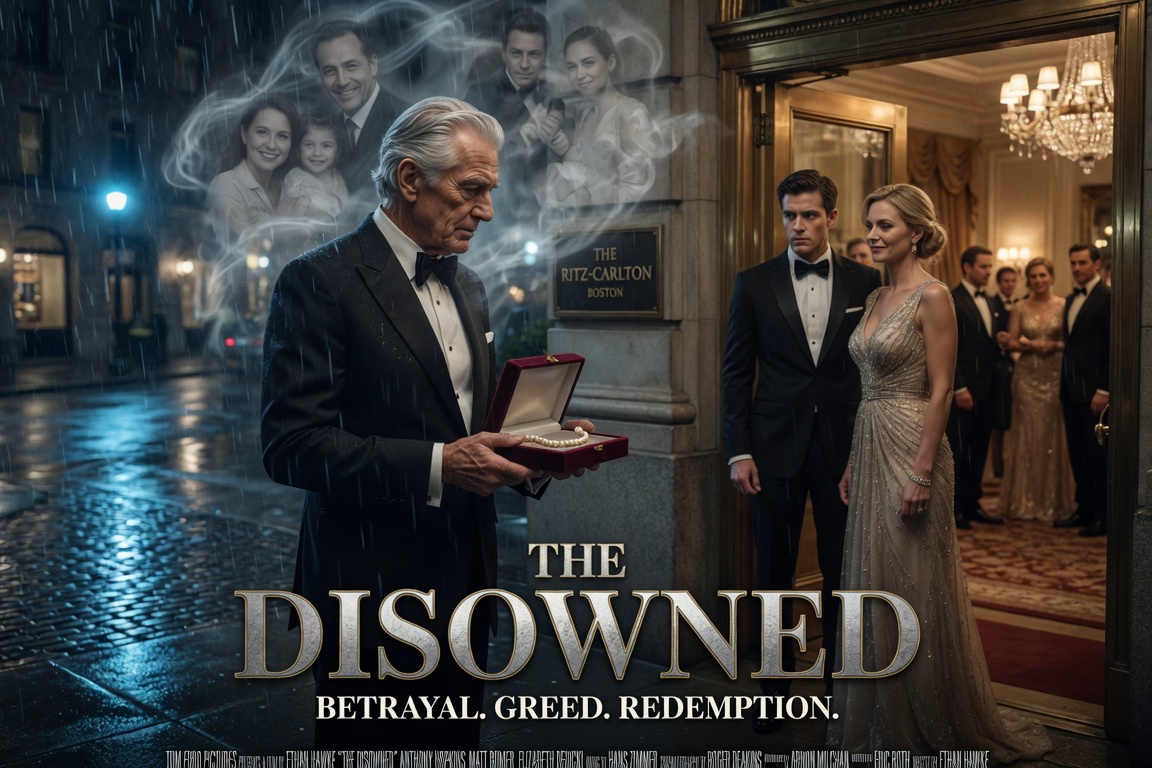
Behind him, the Ritz-Carlton ballroom glittered with two thousand candles.
A string quartet played near the marble staircase. White roses spilled from silver urns. Snow pressed softly against the tall windows, turning Boston Common into a blurred sheet of white beyond the glass.
Harper stood beneath the chandelier while a makeup artist adjusted her veil.
My granddaughter’s eyes were fixed on me.
She had heard him.
Everyone nearby had.
Daniel’s wife, Elise, stared at the floor. Two bridesmaids stopped pretending to arrange flowers. A waiter held a tray of champagne perfectly still beside the wall.
In my left hand, I carried a small blue velvet box.
Inside was Sarah’s necklace.
Fifty-three graduated pearls, each slightly different in shape, held together by a tarnished platinum clasp. My wife had worn it on our wedding day in 1973. She wore it again when Daniel graduated from college, when our company opened its first overseas terminal, and on the last anniversary we spent together before cancer reduced our life to hospital corridors and whispered decisions.
The necklace was the final thing she had asked me to give away.
“Harper should have it on her wedding day,” Sarah told me.
Her voice had been almost gone by then.
“She remembers people better than the rest of us.”
I had kept that promise for eight years.
Now Daniel looked at the velvet box as though I had brought a weapon.
“You weren’t supposed to come through the main entrance,” he said.
“I was invited through the main entrance.”
“You were asked to use the private family elevator.”
“No one asked me.”
“Elise’s assistant emailed you.”
“I don’t take instructions from assistants about how to enter my granddaughter’s wedding.”
His fingers tightened on my shoulder.
“Keep your voice down.”
“I’m speaking normally.”
“You are already making this difficult.”
The old anger stirred inside me.
For forty years, anger had been an engine. It got trucks through blizzards, forced banks to return calls, made port officials move cargo when everyone else said nothing could be done.
It also made my children measure the distance to the nearest door.
I looked at Daniel’s hand.
He removed it.
“What exactly am I making difficult?”
His eyes moved toward the ballroom.
Near the bar stood Charles Remington, chairman of North Atlantic Freight. Beside him were two investment bankers, a state senator, and three members of the Mitchell Global Supply board.
This was not simply Harper’s wedding.
It was a room full of people Daniel needed.
“Tonight matters,” he said.
“It matters to me too.”
“Then don’t turn it into a confrontation.”
“I came to give Harper her grandmother’s necklace.”
Daniel glanced toward the box.
“She isn’t wearing it.”
“I haven’t asked her.”
“She already has jewelry.”
Through the open ballroom doors, I could see a diamond necklace resting against Harper’s collarbones. It was cold, sharp, and enormous enough to require its own security detail.
“That belongs to Remington Jewelers,” Daniel said. “They loaned it for the photographs.”
“She’s wearing an advertisement?”
“It’s insured for four million dollars.”
“Sarah’s necklace is worth more.”
Daniel gave me a tired look.
“Dad.”
I was not talking about money.
That was the trouble with men who spent their lives studying balance sheets. Eventually, every use of the word worth sounded financial.
I tried to step around him.
He blocked me.
Harper saw.
She lifted one hand toward the makeup artist, then began walking across the ballroom.
Daniel turned before she reached us.
“Go back,” he told her.
Harper stopped.
She was twenty-seven, tall like her mother, with dark brown eyes and a small scar above her eyebrow from falling off my old dock when she was nine. Her dress was simple compared with the room around her. Long sleeves. Clean lines. No glitter.
The diamond necklace looked wrong on her.
“Grandpa,” she said.
Her voice carried through the marble foyer.
I smiled.
“There’s my girl.”
She moved toward me again.
Daniel stepped between us.
“Your photographs start in three minutes.”
“I can take photographs in three minutes.”
“Harper.”
She looked at him.
Something passed between father and daughter. Something old.
Obedience disguised as timing.
“I brought you something,” I said.
I raised the box.
Her expression softened before she even saw what was inside.
“Is that—”
“Yes.”
Daniel exhaled.
“Dad, this is not the moment.”
“It is exactly the moment.”
“The styling team has planned every detail.”
“Sarah planned this before any of them knew Harper’s name.”
A few guests had begun watching openly.
Daniel noticed.
His face changed.
Not anger.
Fear.
For the past eighteen months, he had served as chief executive of Mitchell Global Supply, the company I built from one rusted delivery truck into a logistics network spanning fourteen countries.
Every newspaper profile described the transition as smooth.
It was not.
I had stepped down after Sarah died because grief had hollowed out my judgment. Daniel took over operations, stabilized our debt, modernized our systems, and replaced half the executives I had protected out of loyalty.
Some of those decisions saved the company.
Some erased the people who built it.
We disagreed.
Then we fought.
Then Daniel stopped calling disagreements by their names.
He called them episodes.
He told the board I was becoming unpredictable.
He persuaded me to take a leave from the chairman’s office.
Six months later, my access card stopped working.
Now he looked at the guests surrounding us and saw not his father, but another episode beginning.
“Please,” he said. “For Harper.”
People often use the name of the person they are hurting when they want obedience to sound like sacrifice.
I looked at my granddaughter.
“What do you want?”
Daniel answered for her.
“She wants tonight to be peaceful.”
I kept my eyes on Harper.
She looked at the velvet box.
Then at the board members.
Then at her father.
Her throat moved.
“I want the necklace,” she whispered.
Daniel’s jaw tightened.
“After the ceremony.”
Harper did not move.
Neither did I.
The string quartet stopped.
A wedding coordinator approached holding a headset.
“Mr. Mitchell, we need the bride for photographs.”
Daniel gestured toward the ballroom.
Harper remained where she was.
“Grandpa,” she said, “can I see it?”
I opened the box.
Sarah’s pearls caught the chandelier light.
They did not blaze like diamonds.
They glowed.
Harper covered her mouth.
For a moment, the ballroom, the investors, the flowers, and every expensive arrangement disappeared. I saw the child who used to sit at Sarah’s dressing table and count those pearls with one finger.
“Fifty-three,” she would announce.
“Fifty-four,” Sarah would say.
Harper always forgot the tiny pearl hidden beside the clasp.
She reached for the necklace.
Daniel caught her wrist.
Not violently.
But visibly.
Harper stared at his hand.
So did I.
He released her.
“Enough,” he said.
His voice remained low, but the word struck the marble walls.
“You’ve ignored every request we made. You arrived through the front entrance. You refused security. You interrupted the photographs. Now you are trying to change Harper’s jewelry in front of our guests.”
“Our guests?” I asked.
Daniel’s nostrils flared.
“Do not do this.”
“What exactly am I doing?”
“Making everything about you.”
The accusation found its mark because part of it was true.
I had spent years entering rooms as though my presence should rearrange them.
My company.
My family.
My rules.
After Sarah died, I mistook being needed for being loved. When my children tried to continue without my permission, I treated independence like betrayal.
Daniel knew that wound.
He pressed it deliberately.
“You could not let one day belong to someone else,” he said.
Harper’s eyes filled.
“Dad, stop.”
“No. He needs to hear it.”
The board members were watching now.
So were the hotel staff.
Daniel looked at me with the expression of a man finally doing what he had rehearsed privately for months.
“You are not chairman tonight. You are not the founder. You are not the most important person in the room.”
“I know.”
“Do you?”
His voice cracked.
“You come and go when you choose. You demand meetings. You call employees directly. You undermine decisions, then act wounded when people set boundaries.”
The words were not entirely false.
That made them harder to resist.
“But this?” I lifted the necklace. “This is not the company.”
“No. This is Harper’s wedding, and you are turning it into another test of loyalty.”
Harper stepped toward us.
“It isn’t a test.”
Daniel ignored her.
“Go home, Dad.”
Silence spread outward.
He continued before courage could leave him.
“Please leave before security has to escort you.”
Elise closed her eyes.
Harper looked as though he had struck her.
I felt the old engine inside me roar awake.
I could have told the room who still controlled the Founders’ Stewardship Trust.
I could have reminded Daniel that no sale, merger, or executive succession became permanent without my signature.
I could have taken out my phone and ended the agreement he had spent a year arranging with North Atlantic Freight.
The words lined up inside my mouth.
Then I heard Sarah.
Not literally.
Memory does not need sound to command us.
Do not give anger the dignity of calling itself love.
I closed the velvet box.
“All right,” I said.
Daniel blinked.
He had prepared for resistance.
Silence frightened him more.
I looked at Harper.
“I’m sorry.”
“For what?” she whispered.
“For leaving you alone in this room.”
I turned and walked toward the revolving doors.
No one stopped me.
Not my son.
Not his wife.
Not the board members who had shaken my hand for thirty years.
Snow struck my face outside.
The valet ran after me carrying my coat.
As I slid one arm into the sleeve, my phone vibrated.
A message from my attorney appeared.
The merger documents were filed forty minutes ago. Daniel certified that the Stewardship Trust had approved them.
A second message followed.
Richard, you never approved anything.
I looked back through the hotel windows.
My son stood beneath the chandelier, telling everyone I no longer belonged.
He had made one mistake.
He believed humiliating me would make me surrender quietly.
He did not understand that humiliation had just given me a reason to examine what he was so desperate to protect.
Chapter Two
The Empty Chair
I did not go home.
I walked three blocks through the snow to a coffee shop across from the Public Garden.
My tuxedo shoes filled with slush. By the time I reached the door, my toes were numb, and my coat collar had collected a thin line of ice.
The shop was nearly empty.
A college student worked behind the counter. She did not recognize me, which felt like a gift.
I ordered black coffee and sat beside the window with Sarah’s necklace in my pocket.
My attorney, Miriam Cole, arrived twenty minutes later.
Miriam was seventy-two, five feet tall, and had represented Mitchell Global Supply since the company owned more lawsuits than trucks.
She removed her hat, shook snow from the brim, and placed a thick folder on the table.
“You look terrible,” she said.
“My son threw me out of a wedding.”
“Then you look appropriately terrible.”
She ordered tea, rejected the first cup because the water was not hot enough, then opened the folder.
The proposed merger with North Atlantic Freight had been announced as a strategic partnership. Daniel said it would combine our warehouse network with North Atlantic’s ports and rail access.
The public materials promised expansion.
The private agreement told another story.
North Atlantic would gain fifty-two percent voting control.
Daniel would remain chief executive for three years.
Several Mitchell family trusts would receive cash payouts.
Older distribution centers would be sold.
Two thousand employees would face “operational consolidation.”
I read the phrase twice.
“How many jobs?”
Miriam adjusted her glasses.
“Between eighteen hundred and twenty-four hundred.”
“Daniel told the board no mass layoffs.”
“The public board.”
“There is only one board.”
“Not anymore.”
She slid forward another document.
Daniel and three directors had created a transaction committee.
The committee excluded employee representatives, two independent directors, and me.
It also certified that the Founders’ Stewardship Trust had consented.
The signature on the certification was not mine.
It belonged to David Lang, the corporate secretary.
“David cannot approve trust matters,” I said.
“He claims you delegated authority.”
“I did not.”
“There is a memorandum.”
Miriam handed me a photocopy.
The document was dated eight months earlier, during the week I entered a private treatment center for depression.
I remembered almost nothing from those days except closed curtains, paper slippers, and the shame of hearing my own name called before group therapy.
The memorandum gave Daniel temporary authority to act for the Stewardship Trust if I became medically unavailable.
My signature appeared at the bottom.
It looked real.
Perhaps it was.
“I signed documents before treatment,” I said.
“Did you read them?”
“I don’t know.”
Miriam waited.
The honest answer tasted bitter.
“No.”
“Daniel may have legal authority.”
“Temporary authority.”
“The memorandum contains no expiration date.”
I stared at the page.
“Who drafted it?”
“Daniel’s private counsel.”
“Not you?”
“No.”
Outside, snow gathered along the window ledge.
People passed carrying shopping bags and umbrellas. Somewhere across the park, my granddaughter was preparing to walk down an aisle without her grandmother’s pearls.
“Did Harper know about the merger?” I asked.
“I don’t know.”
“Did Elise?”
“I don’t know.”
“What do you know?”
Miriam’s expression hardened.
“I know your son has spent fourteen months trying to remove uncertainty from the company.”
“I am the uncertainty.”
“Often.”
I looked at her.
She did not apologize.
“You call regional managers at midnight,” she continued. “You reverse procurement decisions through personal relationships. You promised a union leader a contract Daniel had already canceled. You accused him of betraying your legacy during a shareholder meeting.”
“He was betraying it.”
“That does not mean you were stable.”
The coffee had gone cold.
I wrapped both hands around the cup.
“I was sick.”
“Yes.”
“He used it.”
“Possibly.”
“Do not say possibly.”
Miriam leaned forward.
“Richard, if you want me to tell you that your son is a monster and you are the wounded king returning for justice, hire a worse attorney.”
I looked toward the park.
She continued.
“Daniel grew up watching you use work to control every room in the family. After Michael’s accident, you fired a driver at Thanksgiving dinner. When Sarah asked you to retire, you stopped speaking to her for three days.”
My throat tightened.
“That was thirty years ago.”
“Daniel was sixteen.”
“He remembers?”
“Children remember the weather inside their homes.”
The phrase stayed between us.
I had built my life around providing shelter.
I had not asked whether the shelter felt safe.
Miriam tapped the merger agreement.
“Your son may believe this deal protects Mitchell Global from you.”
“By selling control?”
“By attaching the company to something larger than one man’s grief.”
I looked at the forged or forgotten memorandum.
“Does motive make fraud legal?”
“No.”
“Then what do we do?”
“We determine whether the trust delegation is valid.”
“And if it is?”
“You decide whether to challenge the merger through the trust’s conduct clause.”
The Founders’ Stewardship Trust was Sarah’s idea.
After our first overseas expansion, she worried that the company would become a family treasure chest instead of a living institution. We placed twenty-six percent of Mitchell Global’s voting shares into an irrevocable trust.
Its purpose was not to preserve our wealth.
It was to protect employees, maintain essential supply routes during crises, and prevent any sale that treated the company solely as an extractable asset.
Three trustees had once governed it.
Sarah.
Me.
And our oldest driver, Henry Brooks.
Sarah died.
Henry died two years later.
The documents required replacements, but grief made every future decision feel disloyal.
I became the sole acting trustee.
One old man holding too much power because he could not accept that others were gone.
“The conduct clause allows intervention if a transaction involves fraud, coercion, or material harm to the workforce,” Miriam said.
“Two thousand jobs qualify.”
“Only if the merger documents were concealed from required review.”
“They were.”
“We need evidence.”
“My son threw me out of a wedding.”
“That is cruelty, not evidence.”
Her phone rang.
She looked at the screen.
“Harper.”
I stood so quickly my chair struck the wall.
“Answer.”
Miriam did.
She listened without speaking.
Then she handed me the phone.
Harper’s breathing came fast through the line.
“Grandpa?”
“I’m here.”
“Where are you?”
“Across the park.”
“Please don’t leave.”
The ceremony music had begun behind her.
I could hear doors opening.
“Harper, you’re supposed to be walking down the aisle.”
“I know.”
“Then why are you calling me?”
“Because Dad said you left.”
“He asked me to.”
“He said you caused a scene.”
“I opened a box.”
Her breath caught between a laugh and a sob.
“I don’t want to get married without the necklace.”
I closed my eyes.
“Then don’t.”
Silence.
Miriam looked at me sharply.
I continued.
“Do not walk into any marriage because a room is waiting.”
“It isn’t Owen.”
Owen Grant, Harper’s fiancé, worked as an emergency physician. Quiet, observant, and stubborn enough to correct me in my own house.
I liked him.
That made me suspicious at first.
“What is it?” I asked.
“Dad made me sign something this morning.”
My hand tightened around the phone.
“What?”
“He said it was a wedding trust acknowledgment. He said it protected the family shares if Owen and I divorced.”
“Did you read it?”
“No.”
The same answer I had given Miriam.
The same family weakness.
We signed when love asked us to hurry.
“What did it look like?”
“Blue cover. Mitchell Global logo.”
Miriam began searching the folder.
“Harper, listen carefully. Do you have a copy?”
“It’s in the bridal suite.”
“Get it.”
“The ceremony—”
“Can wait.”
“Dad will—”
I lowered my voice.
“You are twenty-seven years old. Your father may be disappointed. The building will remain standing.”
She became quiet.
Then I heard movement.
A door closed.
“I’m going upstairs.”
“Call when you have it.”
The line ended.
Miriam pulled a document from the back of the folder.
Her face changed.
“What?”
She turned it toward me.
Under the merger agreement, every adult Mitchell beneficiary had to acknowledge the conversion of family voting shares into cash and restricted stock.
Harper’s signature was required.
“What did Daniel tell her?” I asked.
“A lie.”
I looked through the coffee shop window toward the Ritz-Carlton.
The building glowed against the snow.
Inside, hundreds of people waited for my granddaughter to continue a ceremony while her father converted her inheritance into approval for a merger she knew nothing about.
Daniel had not sent me home merely because I embarrassed him.
He needed me outside the building before Harper discovered what she had signed.
My phone rang again.
Harper’s name lit the screen.
I answered.
Her voice was barely audible.
“Grandpa, there’s another page.”
“What page?”
“It transfers Grandma’s trust shares to Dad.”
Miriam went still.
Harper continued.
“And the signature at the bottom isn’t mine.”
Chapter Three
The Bride Who Stopped the Music
The hotel security director tried to prevent me from reentering.
He stood beneath the revolving doors with two guards and an expression trained to look apologetic without becoming disobedient.
“I was instructed that you had left the event.”
“I changed my mind.”
“Mr. Daniel Mitchell requested—”
“My granddaughter requested me.”
He touched his earpiece.
I could feel the old anger looking for a handle.
The temptation to raise my voice was almost physical.
Instead, I took out my phone and called Harper.
She answered immediately.
“Tell security.”
I handed him the phone.
Harper’s voice carried through the speaker.
“Let my grandfather in. He is my guest.”
The director hesitated.
“Ms. Mitchell, your father—”
“This is my wedding.”
The words were quiet.
The director stepped aside.
Miriam and I entered.
The ceremony music had stopped.
Guests remained seated in the ballroom, whispering beneath the chandeliers. Owen stood at the altar with his parents. His tuxedo jacket was unbuttoned, and his hands rested loosely at his sides.
No panic.
Only patience.
That told me something about the man Harper had chosen.
Daniel waited near the staircase.
When he saw me, color rose beneath his collar.
“I told you to leave.”
“And Harper told me to return.”
“You have no right to interrupt the ceremony.”
“The bride interrupted it.”
“She is emotional because you involved her in business.”
“I asked her what she signed.”
Daniel looked at Miriam.
“You brought an attorney to my daughter’s wedding?”
“She buys her own coffee.”
Miriam walked past him.
Daniel caught my arm.
The gesture was discreet.
His fingers were not.
“You are proving everything I told the board.”
I looked down at his hand.
He released me.
“What did you tell them?”
“That you cannot separate family from control.”
“Can you?”
His jaw tightened.
“You think this merger is theft because it changes what you built.”
“I think it may be fraud because signatures were misrepresented.”
His eyes shifted.
There it was.
Not guilt.
Calculation.
“You have no idea what you’re talking about.”
“Then show me Harper’s documents.”
“This is neither the time nor place.”
“You made it the place when you put them in her bridal suite.”
Daniel looked toward the guests.
He could hear the whispers growing.
Public image had always been his weakest joint.
I had taught him that.
For years, I praised him when he appeared composed and punished him when he exposed family problems outside the house.
Now he believed controlling the room was leadership.
“Come upstairs,” he said.
“No.”
“Dad.”
“We speak where Harper chooses.”
The elevator doors opened.
Harper stepped out wearing Sarah’s necklace.
The diamonds were gone.
The pearls rested against her throat as though they had been waiting eight years to return.
My chest tightened.
She carried a blue folder.
Owen followed her.
Behind them came Elise and two bridesmaids.
Daniel stared at the pearls.
“You changed the jewelry.”
Harper looked at him.
“That is what you see?”
His mouth closed.
She walked into the ballroom.
Every guest stood.
Harper did not continue toward the altar.
She climbed onto the small stage where the band had performed and took the microphone.
The wedding coordinator rushed forward.
Owen stopped her with one hand.
“Let her.”
Harper looked across the room.
Her fingers shook around the microphone, but her voice did not.
“I’m sorry for the delay.”
The guests quieted.
“This morning, my father gave me documents and told me they protected my inheritance after marriage.”
Daniel moved toward the stage.
Elise caught his sleeve.
Harper continued.
“I signed because I trusted him.”
Every word cost her something.
“That document was not a marriage agreement. It approved the conversion of my Mitchell Global voting rights in a merger I had never seen.”
A ripple moved through the board members.
Charles Remington whispered to one of the bankers.
Daniel climbed the first step.
“Harper, stop.”
She looked down at him.
“Did you sign my name on the trust-transfer page?”
“No.”
“Did you know it was there?”
“Come down.”
“That isn’t an answer.”
He glanced toward the guests.
“Not here.”
She lifted the folder.
“You chose here.”
The sentence cut cleanly.
I had told her the same truth about pressure.
Now she used it without rage.
Miriam stepped onto the stage.
“I have reviewed the documents,” she said. “The acknowledgment signed by Ms. Mitchell was materially misrepresented. A separate signature attributed to her appears on the beneficiary-transfer schedule.”
Daniel looked at me.
“You planned this.”
“No.”
“You came to sabotage the merger.”
“I came with pearls.”
The simplicity of the answer seemed to enrage him.
Years of conflict had trained Daniel to see strategy behind every action I took.
He could not imagine I had arrived simply as a grandfather.
Perhaps because I had rarely allowed myself to be only one thing.
Charles Remington stood.
“This is a private family dispute.”
I looked at him.
“How many distribution centers close under your consolidation plan?”
He remained still.
Daniel turned toward me.
“You had no right to read confidential terms.”
“I had a duty to review them as trustee.”
“You delegated your authority.”
“Under circumstances I do not fully remember.”
“You signed the memorandum.”
“Then we will examine whether it authorized concealment and forged beneficiary consent.”
Board members began speaking over one another.
Phones appeared.
Guests turned in their seats.
The wedding had become a shareholder crisis.
Harper lowered the microphone.
Owen stepped onto the stage and stood beside her.
He did not take it from her.
He did not speak for her.
He simply stood there.
I saw Daniel notice.
His daughter had chosen a man who could remain present without taking control.
The contrast reached him.
For a moment, his face looked almost young.
Then Charles Remington approached.
“Daniel, we need to contain this.”
Contain.
The word changed Daniel’s posture.
He straightened.
The frightened son disappeared.
The chief executive returned.
He took the second microphone.
“My father has a documented history of emotional instability since my mother’s death.”
A few guests shifted uncomfortably.
Daniel continued.
“He has repeatedly interfered with company operations, threatened executives, and attempted to reverse lawful board decisions based on personal loyalty.”
Everything he said contained truth.
That was why the lie beneath it was so effective.
“He signed a delegation authorizing me to act for the trust during periods of incapacity,” Daniel said. “The merger was approved under that authority.”
Miriam raised her hand.
“Approval is not permission to falsify another beneficiary’s signature.”
Daniel’s eyes remained on me.
“No one falsified anything.”
Harper lifted the page.
“This is not my signature.”
“You may not remember signing it.”
The room changed.
Harper’s face went still.
The same tactic.
If someone challenged the version that benefited him, question their memory.
I understood then that Daniel had learned more from me than I wanted to admit.
After Sarah died, whenever my children confronted me about promises I had forgotten, I called them mistaken.
When managers showed me instructions I regretted giving, I said they misunderstood.
Power allowed memory to become negotiable.
“Do not do that to her,” I said.
Daniel looked at me.
“Do what?”
“Make her doubt what she knows because the truth is inconvenient.”
His lips parted.
For one second, he heard me.
Then Charles Remington whispered something in his ear.
Daniel’s expression closed.
“We will have this document examined privately,” he said. “For now, the wedding will continue.”
He turned toward the musicians.
No one moved.
The conductor looked at Harper.
Harper looked at Owen.
Owen spoke quietly.
“We don’t have to do this today.”
Tears entered her eyes.
“You flew your grandmother from Oregon.”
“She likes hotels.”
A soft laugh moved through the front rows.
Owen took both Harper’s hands.
“I want to marry you. I do not need to marry you while your family is bleeding onto the floor.”
Harper’s shoulders shook.
Daniel looked at them.
“You cannot cancel.”
She turned toward him.
“I’m postponing.”
“Harper.”
“I am not signing anything else today.”
The finality in her voice struck harder than anger.
Guests began standing.
Some left.
Some remained frozen in place, uncertain whether etiquette required sympathy or distance.
The board members gathered near Charles Remington.
Daniel stepped off the stage and came toward me.
“You did this.”
“No.”
“You entered this room with an attorney and destroyed her wedding.”
“I left when you asked.”
“You came back.”
“She called.”
His hands clenched.
“You always have an explanation.”
“So do you.”
For a second, I thought he might strike me.
Instead, his face collapsed.
Not completely.
Only enough for me to see the fear beneath the anger.
“You have no idea what happens if the merger fails.”
“What happens?”
“The company runs out of credit in eleven weeks.”
The ballroom noise seemed to recede.
“What?”
Daniel looked away.
“Fuel costs. Port delays. The cyberattack last spring. We lost more than the board knows.”
“How much?”
“Four hundred and twelve million.”
My mouth went dry.
Mitchell Global had reported a profitable quarter.
“You falsified earnings?”
“No. We delayed impairment recognition and borrowed against receivables.”
“Why didn’t you tell me?”
He laughed bitterly.
“You were grieving in Maine, calling branch managers to ask why the old logo had been removed from trucks.”
“You could have told the trust.”
“You are the trust.”
The words stopped me.
That was the structure Sarah had warned against.
I had preserved control in the name of responsibility, then become too wounded to exercise it responsibly.
Daniel saw no institution.
He saw his father.
A father he feared, resented, and still needed.
“The merger saves the company,” he said.
“And cuts two thousand jobs.”
“It saves six thousand.”
“By lying?”
“By moving before panic destroys all of them.”
I looked toward Harper.
She stood beside Owen beneath the chandeliers, Sarah’s pearls against her skin, watching us.
Daniel followed my gaze.
“I needed the signatures before the board meeting Monday,” he whispered.
“So you hid them inside wedding paperwork.”
“I needed one day when everyone would cooperate.”
There it was.
Not greed.
Desperation transformed into entitlement.
He believed the company’s survival made consent optional.
The same logic I had used for decades.
I felt no victory.
Only recognition.
“You made one mistake,” I said.
Daniel’s eyes hardened.
“What?”
“You believed the trust existed to protect the company from failure.”
“It does.”
“No. It exists to protect people from what frightened leaders do when failure becomes possible.”
Chapter Four
Sarah’s Rule
We moved to a private dining room after the guests left.
The wedding flowers remained in the ballroom.
The cake remained uncut.
Harper changed into a gray sweater but kept Sarah’s pearls around her neck.
At the long table sat Daniel, Elise, Harper, Owen, Miriam, three independent directors, Charles Remington, and me.
No photographers.
No champagne.
No speeches.
Snow darkened the windows.
Daniel opened the financial records.
The company was not eleven weeks from total collapse.
It was eleven weeks from violating lending covenants that could trigger a chain of defaults.
The distinction mattered legally.
It did not matter to the payroll clerk wondering whether her check would clear.
Mitchell Global had expanded too quickly in Southeast Asia. A cyberattack shut down routing systems for nine days. Two warehouses lost insurance coverage after fire-safety violations. Daniel borrowed heavily to conceal weakness until the North Atlantic merger could close.
Charles Remington promised credit, port access, and stability.
In return, North Atlantic would control the board.
The Mitchell name would remain on the trucks.
Everything else could change.
“You called it a partnership,” I said.
Charles folded his hands.
“Public markets respond poorly to distress.”
“So do employees.”
“The alternative is insolvency.”
Miriam slid the workforce analysis toward me.
Twenty-one hundred positions would be eliminated.
Four pension plans would be frozen.
Three smaller cities would lose their primary distribution hubs.
“Those facilities are inefficient,” Charles said.
“They are entire towns.”
“They are cost centers.”
I looked at Daniel.
“Did you agree with him?”
My son rubbed one hand across his face.
“I agreed that survival required sacrifice.”
“Whose?”
He did not answer.
Harper sat at the far end of the table, turning the hidden pearl beside Sarah’s clasp between two fingers.
“Grandma wrote something about this,” she said.
Everyone looked at her.
“What?” Daniel asked.
Harper removed the necklace.
She pressed the clasp, but it did not open.
Instead, a small panel shifted along the side.
I stared.
Sarah had never shown me.
Inside the clasp was a folded strip of paper sealed beneath thin plastic.
Harper eased it out.
The paper was yellowed and covered in Sarah’s handwriting.
My chest tightened at the sight.
Harper unfolded it carefully.
At the top were four words.
For the next trustee.
No one spoke.
She read aloud.
“Mitchell Global began because Richard believed no town should go hungry because a truck failed to arrive. It survived because thousands of people carried that belief when he could not carry it alone.”
My vision blurred.
Harper continued.
“If this necklace reaches you, I am gone, and Richard may be tempted to treat grief as ownership.”
A faint sound escaped me.
Half laugh.
Half wound.
Daniel stared at the table.
“Do not preserve the company merely because it bears our name,” Harper read. “Preserve its purpose. If saving the business requires destroying the people whose labor gave it value, then you are not saving it. You are saving the sign on the building.”
Silence filled the room.
Sarah had written the trust’s moral logic before the final documents were signed.
She had hidden it in the one object she knew would eventually reach the next generation.
Not me.
Harper.
At the bottom was another line.
No Mitchell should ever serve as sole trustee after Richard. Family love is too easily confused with permission.
Miriam closed her eyes.
“She told me to amend the succession clause,” she said.
“You didn’t?” I asked.
“You refused to appoint additional trustees after Henry died.”
I remembered the argument.
Miriam brought names.
I rejected all of them.
Too corporate.
Too cautious.
Too unfamiliar.
In truth, every replacement felt like admitting Sarah and Henry would not return.
I had trapped the trust in grief.
Daniel looked at me.
“You were warned.”
“Yes.”
“And you ignored her.”
“Yes.”
The admission surprised him.
I continued.
“Just as you ignored Harper.”
His expression closed again.
“Do not compare them.”
“Why? We both believed love gave us authority to decide what others could bear.”
Elise spoke for the first time.
“Daniel was trying to protect the family.”
Her voice trembled.
She had spent the evening watching her husband become someone publicly indefensible.
Daniel looked at her with gratitude.
I did not dismiss her.
“What did he tell you?” I asked.
“That North Atlantic would preserve jobs.”
“How many?”
She looked toward him.
“He did not give me a number.”
“He told you the merger was necessary.”
“Yes.”
“Did he tell you Harper’s signature was required?”
“No.”
Daniel’s face tightened.
Elise turned toward him.
“You told me the blue folder was a prenuptial trust package.”
“It contained marital provisions.”
“It contained a transfer.”
“I was going to explain after the wedding.”
“When she could no longer refuse without embarrassing you publicly?”
He looked away.
Elise took off her wedding ring.
Not completely.
She turned it once around her finger and left it there.
The gesture was not departure.
It was warning.
Miriam drew the trust agreement toward her.
“Sarah’s note does not change the current legal structure. Richard remains acting trustee unless the delegation is valid.”
Daniel leaned forward.
“It is valid.”
“Perhaps,” Miriam said. “But the merger approval may still violate the conduct clause because of concealed workforce impact and misrepresented beneficiary consent.”
Charles Remington pushed back his chair.
“This meeting is becoming sentimental.”
Harper looked at him.
“My grandmother’s words established the purpose of the trust your merger requires.”
“A handwritten note hidden in jewelry is not governance.”
“No,” Miriam said. “But fraudulent consent is.”
Charles stood.
“North Atlantic will withdraw if the transaction is delayed.”
Daniel’s face whitened.
“How long?”
“Until Monday morning.”
“It is Saturday night.”
“Yes.”
“You knew about the wedding.”
“That is why your schedule appeared achievable.”
Daniel stared at him.
I recognized the look.
He was discovering that Charles had viewed his desperation not as a partnership, but as a discount.
“If we do not approve by Monday?” I asked.
“The bridge facility expires. Our offer changes.”
“Changes how?”
“Lower valuation. Greater control.”
Daniel’s hand tightened around a pen.
“You said the terms were final.”
Charles buttoned his jacket.
“Circumstances change.”
He walked toward the door.
Owen spoke.
“Mr. Remington.”
Charles stopped.
Owen had remained silent through most of the meeting.
He looked at Daniel.
Then at the financial pages.
“How many hospitals rely on Mitchell Global for emergency medical shipments?”
Daniel blinked.
“Three hundred and twelve.”
“Can North Atlantic replace those routes immediately?”
“No.”
Charles turned back.
Owen continued.
“Then you are threatening to destabilize a critical supply network because a wedding exposed defects in your transaction.”
Charles’s face hardened.
“You are a doctor. Do not pretend to understand logistics.”
“I understand when someone believes urgency removes everyone else’s right to consent.”
The room quieted.
Charles left.
At the table, Daniel placed his face in both hands.
For the first time in my life, I saw my son with no strategy left.
Not the angry teenager who crashed my truck.
Not the executive arguing before the board.
A frightened man who had spent eighteen months holding a failing company above his head because he believed dropping it would prove he had never deserved to inherit it.
I moved toward him.
He looked up.
“Don’t,” he said.
I stopped.
Even comfort required consent.
“What do you need?” I asked.
He laughed bitterly.
“Four hundred million dollars.”
“I don’t have it.”
“You’re Richard Mitchell.”
“I have assets. Not a miracle.”
Harper placed Sarah’s note on the table.
“We don’t need to save everything by Monday.”
Daniel stared at her.
“Yes, we do.”
“No. We need to protect the routes that cannot fail. Payroll. Medical shipments. Food contracts.”
“That is the company.”
“Then separate it from the parts that are dragging it under.”
He looked at her as though she had suggested removing an organ.
Miriam began turning pages.
“An emergency restructuring could place essential operations under the Stewardship Trust.”
Daniel shook his head.
“Lenders will never agree.”
“They may if the alternative is uncontrolled default.”
“We would lose overseas assets.”
“Yes.”
“The new terminals.”
“Probably.”
“Half the board.”
“Hopefully,” I said.
No one smiled.
Miriam continued.
“The trust can authorize the sale of nonessential real estate, suspend dividends, and seek debtor-in-possession financing without approving the merger.”
Daniel looked at me.
“You would dismantle the global network.”
“I would stop pretending size is survival.”
His face twisted.
“You built it.”
“Yes.”
That was the answer he had not expected.
I had spent years defending every warehouse, route, truck, and foreign office as though shrinking meant failure.
But companies, like families, could become so devoted to preserving their shape that they destroyed their function.
“I built too much,” I said. “You hid too much. Both can be true.”
Harper reached across the table and placed her hand over her father’s.
He did not pull away.
“What happens to me?” he asked.
The question held the voice of a child.
Miriam answered first.
“You step aside during independent review.”
Daniel looked at me.
I said nothing.
He searched my face for triumph.
There was none.
Only grief.
“Will you become CEO again?” he asked.
“No.”
“Chairman?”
“No.”
“Then who?”
“We find someone who does not need the company to prove he is loved.”
Daniel looked down.
The sentence hurt him.
It also hurt me.
Because I had described both of us.
Chapter Five
The Company Without a King
The wedding became a national story before sunrise.
Not because Harper postponed the ceremony.
Because one of the guests uploaded a video of Daniel telling me to go home.
The clip ended before the business dispute began.
That allowed millions of strangers to create a cleaner story.
A cruel CEO humiliates his elderly billionaire father.
A hidden inheritance.
A family empire about to collapse.
People praised me before knowing what I had done wrong.
They condemned Daniel before knowing what frightened him.
Public sympathy is often another form of laziness.
It chooses one face for innocence and another for blame.
Mitchell Global announced the restructuring Monday morning.
Daniel took temporary leave.
The board appointed an independent crisis committee with employee, lender, customer, and trust representation.
I surrendered my sole trustee authority.
Three new trustees were appointed.
Harper became one.
A union representative named Linda Chen became another.
The third was a retired supply-chain regulator who disliked every Mitchell equally.
The trust suspended the North Atlantic merger.
Charles Remington sued.
He lost the first injunction.
Then withdrew his financing offer.
For six weeks, Mitchell Global existed one payroll away from collapse.
We sold the private aviation division.
Closed two European offices.
Abandoned the luxury logistics subsidiary Daniel had launched to serve yachts and private art collections.
I sold the Boston house Sarah and I bought after the company’s first successful year.
Daniel objected.
“That house is yours.”
“It is an asset.”
“It is our family home.”
“You have not visited in four years.”
“That does not mean sell it.”
I looked at him across Miriam’s conference table.
“Now you understand why employees fight for buildings you call inefficient.”
He lowered his eyes.
The sale funded three payroll cycles.
Employees accepted reduced hours instead of layoffs at five facilities.
Executives took compensation cuts.
Several left.
The company survived the winter.
Not intact.
Alive.
Daniel cooperated with the independent investigation.
The signature on Harper’s transfer page had been copied by a junior attorney working under impossible deadlines. The attorney claimed he believed Harper had signed a digital version.
Emails showed Daniel had seen the unsigned page and told counsel:
Complete the package. I cannot reopen family negotiations this weekend.
He had not ordered a forgery.
He had made it clear that failure was unacceptable.
Someone beneath him converted pressure into misconduct.
That had been my leadership style for decades.
Never instruct anyone to break the rule.
Simply make obedience impossible without breaking it.
The board removed Daniel as chief executive.
He was not charged criminally.
He surrendered his transaction bonus, repaid legal costs, and remained with the company as an unpaid adviser during restructuring.
Commentators called it humiliation.
Daniel called it Monday.
Elise moved into an apartment near her sister.
She did not file for divorce.
She told Daniel she wanted to discover who he was without a title before deciding whether she could remain married to him.
He hated the uncertainty.
That was probably why he needed it.
Harper and Owen married four months later at the old Mitchell distribution terminal in Worcester.
They invited eighty people.
Employees strung lights between loading beams.
The food came from a neighborhood restaurant.
Snowmelt dripped through one section of the roof, so we placed a bucket beneath it and called it decoration.
Harper wore Sarah’s pearls.
I walked her halfway down the aisle.
Daniel waited in the middle.
When we reached him, I stopped.
For several seconds, father and son stood on opposite sides of the bride.
Daniel looked at me.
“May I?” he asked.
The question was simple.
It contained months of work.
I placed Harper’s hand in his.
Together, we walked her the remaining distance to Owen.
No one gave her away.
She arrived with both of us and chose where to stand.
After the ceremony, Daniel found me near the loading dock.
I was eating cake from a paper plate.
He carried two cups of coffee.
“Black,” he said, handing me one.
“Trying to bribe a trustee?”
“You’re not a trustee anymore.”
“Then it’s a very poor investment.”
He leaned against the concrete wall.
Outside, trucks moved along the interstate beneath a pale spring sky.
For a while, we watched them.
“I hated you that night,” he said.
“I know.”
“I wanted security to remove you.”
“I know.”
“When you left without fighting, I thought you were planning something worse.”
“I was mostly cold.”
He almost smiled.
Then his expression sobered.
“You think I used your illness.”
“Yes.”
“I thought I was protecting the company.”
“I believe you.”
“Does that make it better?”
“No.”
He nodded.
“You think I’m like you.”
“Yes.”
“That used to be a compliment.”
“It was often a warning.”
He looked down at his coffee.
“I remember the Thanksgiving driver.”
The same memory Miriam had raised.
“I fired him because he damaged a truck,” I said.
“You fired him because he disagreed with you in front of Mom.”
I opened my mouth.
The defense arrived automatically.
Then I let it die.
“You may be right.”
“I was sixteen. I watched him carry his coat out while we ate pie.”
“I’m sorry.”
Daniel looked at me.
“For firing him?”
“For teaching you that authority means never allowing someone to embarrass you publicly.”
The loading dock grew quiet.
He rubbed one thumb along the coffee lid.
“That’s why I sent you home.”
“I know.”
“You embarrassed me.”
“Yes.”
“I was afraid everyone would see I couldn’t control you.”
“Yes.”
He laughed softly.
“You’re enjoying this.”
“A little.”
The honesty surprised him.
I continued.
“I wanted to destroy the merger partly because it was harmful. I also wanted to punish you.”
“What stopped you?”
“Your mother.”
He looked toward Harper, who was laughing beside the temporary dance floor.
“Mom’s note?”
“Her rule.”
“What rule?”
“Never let anger borrow the language of love.”
Daniel became still.
“She said that to me once.”
“When?”
“After Michael crashed your truck.”
I remembered.
Michael was seventeen and drunk. He drove through our garage door. I refused to speak to him for two weeks.
Sarah sat between us at dinner each night and filled the silence until her voice disappeared.
Daniel had watched that too.
Children remember the weather.
“Did you forgive me?” I asked.
Daniel looked toward the trucks.
“I’m trying to understand you first.”
“That sounds expensive.”
“Therapy is.”
We drank our coffee.
Not reconciled.
Not estranged.
Two men standing inside the ruins of the kingdom they had each mistaken for a family.
Chapter Six
Fifty-Four Pearls
Mitchell Global returned to profit eighteen months later.
It was smaller.
Seven countries instead of fourteen.
No private aviation division.
No luxury art logistics.
No corporate jet.
The old red-and-white logo returned to several trucks after employees voted for it.
Not because the past was better.
Because they wanted proof that history could be remembered without controlling the future.
Linda Chen became board chair.
She had driven overnight routes for sixteen years before moving into labor relations.
The first time she chaired a meeting, I arrived nine minutes late.
She locked the door.
I waited outside.
When she let me in during the break, I asked whether she enjoyed it.
“Deeply,” she said.
Harper served one term as a trust representative, then stepped down to work with a nonprofit that converted abandoned warehouses into community health centers.
Owen continued practicing emergency medicine.
They had a daughter.
Sarah Rose Grant.
The child inherited my eyebrows, Harper’s stubbornness, and no respect for adult schedules.
Daniel did not return as CEO.
After the investigation ended, he accepted a position overseeing disaster-response logistics.
No corner office.
No private elevator.
When hurricanes or wildfires disrupted supply routes, he coordinated food, generators, and medical shipments.
He was good at it.
The work gave him no time to manage appearances.
Elise returned after fourteen months.
They rented an apartment rather than moving back into their old house.
Sometimes families require smaller rooms before they can stop performing for one another.
I moved into a modest place near the harbor.
The windows rattled in winter.
Sarah would have hated the kitchen.
She would have loved the view.
On the third anniversary of Harper’s wedding, she visited carrying the blue velvet box.
The necklace lay inside.
“You should keep it,” I said.
“I have.”
“Then why bring it?”
She placed the box on my table.
“The clasp is loose.”
I took out my magnifying glass.
My hands were not as steady as they had been.
Age makes every act of care more visible.
I examined the hidden compartment.
The paper containing Sarah’s note had been moved to the trust archive. Inside the clasp remained only the smallest pearl.
The one Harper always forgot.
“Fifty-four,” I said.
She smiled.
“You remembered.”
“Your grandmother never let me forget.”
I tightened the hinge.
Harper watched me.
“Dad wants to come to dinner Sunday.”
“He does?”
“He asked me to ask you.”
“Why didn’t he call?”
“He said you might say no.”
“I might.”
“Will you?”
I looked toward the harbor.
A cargo ship moved slowly beyond the glass, stacked with containers bearing names of companies that might not exist in ten years.
Empires often look permanent from shore.
They are mostly objects in transit.
“No,” I said. “Tell him seven.”
Harper closed the box.
Before leaving, she stopped beside the door.
“Do you regret going to the wedding?”
The question surprised me.
“No.”
“Even after what happened?”
“Especially after.”
She waited.
I looked at Sarah’s photograph on the shelf.
“I spent most of my life believing family was the greatest legacy a person could leave.”
“You don’t believe that anymore?”
“Not exactly.”
“What changed?”
“Family is not the legacy.”
Harper frowned.
“What is?”
“The way people learn to use power after living with you.”
She looked down at the velvet box.
Her father had used power to force consent.
I had used it to preserve dependence.
Sarah had used what little time remained to place limits around both of us.
That was her legacy.
Not the pearls.
Not the company.
The rule.
Harper opened the door.
“Seven on Sunday.”
“Tell your father I’m making pot roast.”
“He hates your pot roast.”
“He will arrive hungry.”
After she left, I stood beside the window.
Years earlier, Daniel had told me to go home because he believed I was endangering everything he needed to protect.
He was not entirely wrong.
I had arrived carrying love, grief, authority, and expectation inside the same small box.
He responded with fear and humiliation.
Then he made the mistake that changed us all.
He assumed silence meant surrender.
It did not.
But neither did it become revenge.
Silence gave me time to see that the company was not the only thing on the edge of collapse.
We were.
The merger failed.
The old empire shrank.
My son lost his title.
I lost control.
Harper lost the wedding she had planned.
Yet what remained was worth more than the world thought we had lost.
A company no longer ruled by one frightened family.
A granddaughter who learned to stop a ceremony rather than surrender her consent.
A son who finally discovered that leadership begins where control ends.
And an old man who learned, far later than he should have, that leaving a legacy does not mean placing your name on everything that survives you.
Sometimes it means removing your hand.
Sunday evening, Daniel arrived at 6:52.
He stood outside my door holding a bottle of wine and wearing no tie.
For a second, neither of us spoke.
Then he looked past me toward the table.
“Is that pot roast?”
“Yes.”
“You know I hate your pot roast.”
“So I’ve been told.”
He smiled.
Not the careful executive smile.
My son’s smile.
I stepped aside.
“Come home,” I said.
This time, neither of us heard it as an order.