Chapter One
The Medals He Could Not Forgive
My father waited until the church doors opened before telling me to take off my medals.
The organ had already begun.
Two hundred guests stood beneath white flowers and candlelight, turning toward the entrance to see my younger sister walk down the aisle. Rain tapped softly against the stained-glass windows. Somewhere behind the altar, a child whispered too loudly and was immediately silenced.
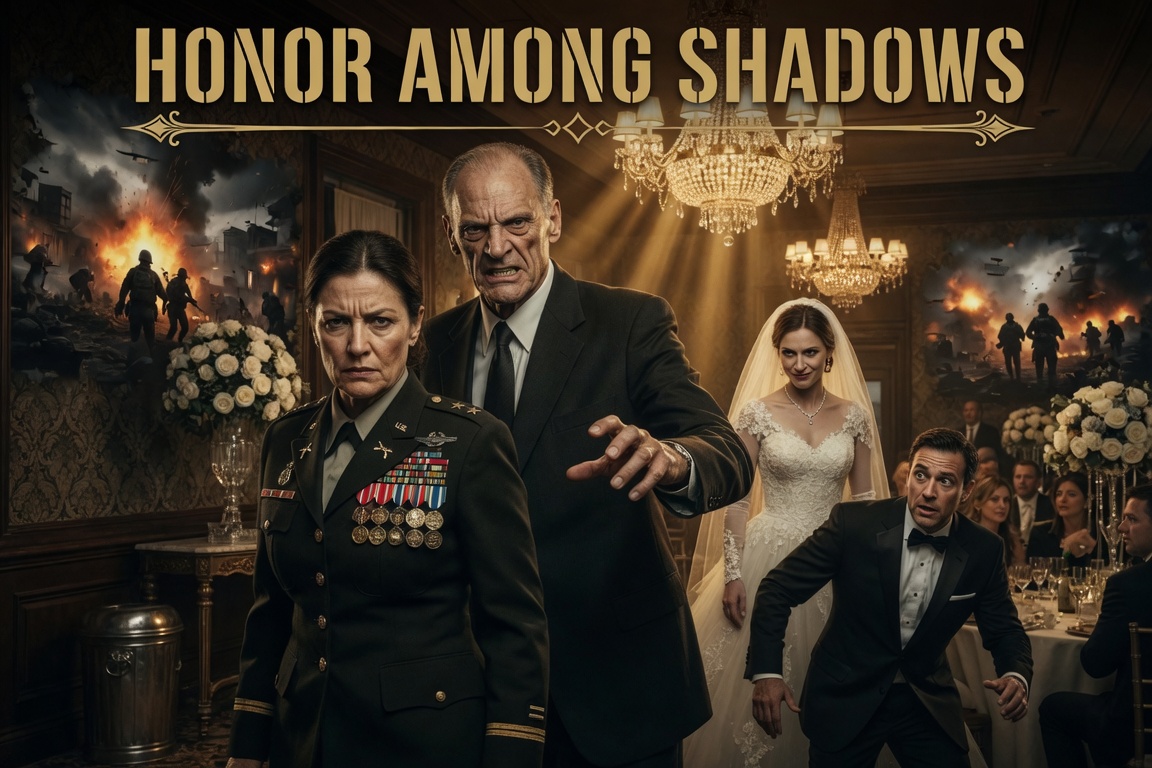
Then Frank Ellison caught my sleeve.
“Not in here.”
His fingers closed around the dark-blue fabric of my Army dress uniform.
I looked down at his hand.
Seventy-three years had thickened the knuckles and bent the index finger he broke repairing a combine when I was twelve. He still smelled faintly of machine oil, despite the charcoal suit Sophie had bought him.
“What are you doing?” I whispered.
His gaze dropped to my chest.
The Distinguished Service Cross rested above a Silver Star, a Bronze Star with valor device, two Purple Hearts, and ribbons from wars my family knew only as missed holidays.
Dad’s mouth twisted.
“Take that scrap metal off.”
The words carried farther than he intended.
The woman in the pew nearest us turned.
So did one of the ushers.
I heard my aunt inhale behind a white lace handkerchief.
At the front of the church, my sister Sophie had just entered on the arm of our cousin. Her smile faltered when she saw us beside the doors.
“Dad,” I said quietly, “this is not the place.”
“That’s exactly what I’m saying.”
His thumb struck the edge of my Silver Star.
Metal clicked against metal.
“Not today. Not while we’re supposed to remember your brother.”
Fifteen years had passed since Owen came home beneath a flag.
Dad could still make the name feel like an open door in winter.
“I’m wearing them because Sophie asked me to.”
“She doesn’t understand what they cost.”
“She understands more than you think.”
He gave a small, bitter laugh.
“You always say that when you’ve decided not to explain something.”
The organ continued.
The guests remained standing, though half the room had stopped watching the bride.
Sophie’s white dress moved slowly between the pews. She was thirty-nine, luminous beneath the candlelight, her dark hair pinned with our mother’s pearl comb. She had spent three years planning this day and fifteen years trying to keep our family in the same room.
I would not let my father ruin it.
I gently removed his hand from my sleeve.
“We’ll talk after the ceremony.”
“No.”
His jaw tightened.
“You don’t get to stand beside Owen’s photograph wearing the rewards you collected after leaving him behind.”
The sentence entered the church like a shot.
Sophie stopped walking.
At the altar, her groom turned toward us.
Caleb Mercer wore a black tuxedo, not a uniform. Most of the guests knew him as a trauma surgeon from Baltimore, a quiet man with a slight limp and the kind of patience that made frightened children stop crying before he touched them.
They did not know he had once served in Army Special Forces.
I did.
His name had been on the wedding invitation for six months.
I had recognized it immediately.
Captain Caleb Mercer.
Third Special Forces Group.
Sole surviving officer of Ashfall Team Seven.
The man my brother died carrying out of a burning valley.
Caleb had never met me face-to-face.
Not officially.
During Operation Ashfall, my helmet had covered most of my features, and smoke had turned every survivor into a shadow. He knew only my call sign, my voice over the radio, and the fact that a woman had returned after command ordered everyone to withdraw.
I had intended to tell him after the wedding.
I had intended to tell Sophie too.
My family had lived too long inside secrets announced by funerals.
Caleb left the altar.
He walked down the aisle while guests shifted uncertainly around him.
Sophie watched, one hand gripping her bouquet.
Dad did not release my sleeve.
Caleb stopped a few feet away.
His eyes traveled over my uniform.
The medals.
The two stars on my shoulders.
Then the pale scar disappearing beneath the left side of my collar.
Something changed in his face.
Not recognition yet.
A disturbance beneath memory.
“Sir,” he said to Dad, “what did you mean when you said she left Owen behind?”
Dad looked at him.
“You don’t need this today.”
“I need an answer.”
I stepped between them.
“Caleb, return to the altar.”
His gaze fixed on me.
The church seemed to recede around us.
“Say that again.”
“What?”
“My name.”
I had spoken it the way I did fifteen years earlier, through static and fire, while ordering him not to close his eyes.
His lower lip parted.
“Where were you in October 2009?”
Nobody moved.
I could have lied.
I had spent half my career learning how to offer incomplete truth with an honest face.
Instead, I said, “Kandar Province.”
Color left him.
“Which unit?”
“Joint Recovery Detachment.”
His eyes dropped to the small compass insignia above my right pocket. The emblem did not appear on public unit lists.
“Call sign?” he whispered.
Dad’s fingers loosened from my sleeve.
I looked at the man my brother had saved and answered with the name buried inside fifteen years of classified files.
“Northstar Six.”
Caleb stumbled backward.
The best man caught his arm.
“No.”
He stared at me as if I had stepped out of a grave.
“Northstar Six was a lieutenant colonel.”
“She was.”
“He came back for us when everyone else pulled out.”
“She did.”
His eyes widened.
Caleb looked at the two stars on my shoulders.
Then he came to attention so quickly his injured leg nearly failed.
His right hand rose.
“Major General Ellison.”
The words broke on the final syllable.
Every veteran in the church turned.
Three of Caleb’s groomsmen came to their feet with instinctive precision. One was missing two fingers. Another carried a burn scar across his neck.
Caleb saluted.
I returned it.
Behind him, Sophie’s bouquet trembled in her hands.
Dad stared at me.
The medals he had called scrap metal gleamed beneath the candles.
But he did not look ashamed.
He looked betrayed.
“You knew who Caleb was,” he said.
I lowered my hand.
“Yes.”
“And you came here without telling us.”
“Yes.”
Sophie’s voice reached us from the aisle.
“Mara.”
I turned toward my sister.
She was no longer smiling.
“What else did you bring to my wedding?”
Before I could answer, the church lights went out.
The organ died mid-note.
Emergency lamps glowed red along the walls.
Then the exterior doors locked with a heavy mechanical sound.
A man shouted near the entrance.
Someone else screamed.
Through the darkness, I saw Adrian Vale rise from the front pew.
He was Sophie’s employer, the founder of Vale Response Technologies, and the wealthy donor who had paid for half the wedding.
Fifteen years earlier, he had also been the civilian strategist who ordered me to abandon Ashfall Team Seven.
Vale looked directly at me.
His hand disappeared inside his jacket.
And I knew the blackout was not an accident.
Chapter Two
The Man My Brother Saved
“Everyone stay where you are.”
My voice cut through the church before panic could choose its own leader.
The military tone returned too easily.
That frightened me more than the darkness.
A woman began crying near the rear pews. Someone tried the locked side door. Men rose, blocking aisles as they searched for spouses and children.
“Sit down,” I ordered. “Keep the center aisle clear.”
People obeyed before understanding why.
Caleb moved beside Sophie.
His arm went around her waist, but his eyes remained on the exits.
The groom had disappeared.
The former team leader stood in his place.
“Power failure?” he asked.
“No.”
“How many?”
“I saw two unfamiliar men near the rear doors before the lights cut.”
Vale remained near the front pew.
His hand emerged from his coat holding a phone, not a weapon.
“Please remain calm,” he announced. “The estate’s security system triggered an automatic lockdown.”
The church stood on the grounds of Bellweather House, a restored Virginia estate surrounded by vineyards and winter forest. Vale Response Technologies owned the security contract.
Vale had recommended the venue.
I had not known that until two days earlier.
“What triggered it?” Caleb asked.
“A fire alarm in the reception hall.”
“There’s no alarm sounding,” I said.
Vale’s gaze touched mine.
Only briefly.
“The system may be malfunctioning.”
“You designed it.”
His expression remained mild.
“My company did.”
Rain strengthened against the windows.
Emergency light caught the silver at Vale’s temples and the expensive restraint of his navy suit. At sixty-one, he looked less like the man from Ashfall than I expected. Time had softened his face without reaching his eyes.
He approached us.
Sophie stepped between him and me.
“Adrian, open the doors.”
“I have technicians working on it.”
“You have a remote override.”
“Not during a fire event.”
“That is not true,” I said.
Vale glanced toward my uniform.
“You’ve been studying the venue.”
“I study every place where my family gathers.”
Dad gave a hard laugh.
“Except home.”
The words landed, but I kept my attention on Vale.
“Where is your security chief?”
“Handling the alarm.”
“Name?”
“Gavin Holt.”
I knew the name.
Former military intelligence. Discharged after an investigation into unauthorized surveillance. He had spent nine years working for Vale.
I looked toward the dark choir balcony.
A shape moved behind the railing.
“Caleb,” I said.
“I see him.”
The man above us carried no visible firearm, but one hand remained pressed to his ear.
Communications.
Watching us.
Not the guests.
Me.
Vale lowered his voice.
“This is a wedding, Mara.”
“You used my first name.”
“We have met.”
“Never publicly.”
His jaw tightened slightly.
Sophie looked between us.
“Somebody explain.”
Caleb answered.
“He was at Ashfall.”
She turned toward Vale.
Her employer.
The man who had promoted her foundation work, paid for her graduate degree, and sat beside Dad at Owen’s memorial every October.
“You knew my brother?”
Vale looked almost pained.
“I knew the operation.”
Dad stepped closer.
“You told me Mara ordered the withdrawal.”
Silence formed around us.
I looked at him.
“What?”
“After Owen died.”
Dad’s voice had gone rough.
“You came to the house once, Adrian. You brought the report.”
Vale did not move.
“You showed me her signature.”
I felt something inside me become very still.
The official withdrawal authorization carried my authentication because command routed it through my station. I had signed receipt.
Not agreement.
Vale had shown Dad only the final page.
“Frank,” Vale said, “this is not the time.”
“No,” Dad replied. “It never is with this family.”
Caleb’s hand closed slowly.
“You gave him an edited report?”
Vale looked toward him.
“I gave a grieving father the information cleared for release.”
“You made her look responsible.”
“She commanded the recovery unit.”
“She came back.”
Dad turned on Caleb.
“You do not know what she did.”
“I was there.”
The church seemed to tilt.
Dad’s face emptied.
Caleb stepped away from Sophie and unbuttoned his tuxedo jacket.
He lifted his shirt enough to reveal a wide scar running beneath his ribs.
“Your son pulled me across eighty yards of open ground with shrapnel in his lungs.”
Dad stared.
“Northstar Six reached us after command had written off the valley. Her helicopter took two rounds before landing.”
He pointed toward me.
“She carried me into that aircraft herself.”
My father’s mouth opened.
No sound emerged.
Caleb continued.
“Owen stayed at the bridge because the last helicopter could not lift with everyone aboard.”
“No,” Dad whispered.
“He chose to hold the crossing.”
“No.”
“I heard him order her to leave.”
Dad looked at me.
His eyes were no longer angry.
They were pleading.
“Did he?”
I could have answered.
Instead, I noticed the church’s north door open half an inch.
A man in a dark suit slipped through.
He carried my black field case.
The one I had locked inside my car.
It contained Owen’s recovered recorder and the newly declassified Ashfall files.
“There,” I said.
The man ran.
I moved before anyone else understood.
Caleb followed.
We crossed the side aisle as the thief reached the service corridor. He shoved a catering worker aside and slammed through a narrow door leading toward the reception hall.
My dress shoes struck polished stone.
The uniform was not designed for pursuit.
Neither was I anymore.
A nerve injury beneath my right hip sent pain up my spine with each step. I ignored it until the thief threw a metal serving cart behind him.
Caleb pushed me aside.
The cart struck his injured leg.
He fell against the wall.
I cleared it and continued.
The reception hall opened before me, lit only by lightning through tall glass doors. White tablecloths moved in the draft. Hundreds of candles waited unlit beneath arrangements of winter roses.
The thief disappeared through the kitchen.
I reached the rear entrance three seconds later.
Locked.
On the other side of the glass, a black SUV accelerated down the estate road.
The field case lay open near the threshold.
Empty.
Caleb limped into the room.
“What was inside?”
“The truth.”
His face tightened.
“About Owen?”
“Yes.”
“Why bring it here?”
“Because tonight was the first time Vale, you, my father, and I would be in the same place.”
Caleb stared.
“You used Sophie’s wedding.”
“I planned to wait until after the reception.”
“That distinction will comfort her.”
“I had federal agents outside the property.”
“Where are they?”
I looked through the glass.
The security lights along the estate road were dark.
“No longer outside.”
The reception doors opened behind us.
Sophie stood there in her wedding dress.
Dad beside her.
Vale behind both.
My sister looked at the empty field case.
“You did bring an operation to my wedding.”
“Yes.”
Her face hardened.
“You always said secrecy protected us.”
“I was wrong.”
“Wonderful timing.”
A distant gunshot sounded beyond the vineyards.
The room froze.
Then Vale’s phone rang.
He looked at the screen.
For the first time that evening, his control broke.
“That wasn’t my team,” he said.
I faced him.
“How many teams are there?”
Before he answered, every emergency light in the estate turned red.
A recorded voice filled the building:
“Security breach. All exterior exits sealed.”
Caleb looked toward the dark windows.
“Somebody else wants the Ashfall files.”
Vale’s jaw tightened.
“No.”
He looked at the empty field case.
“Someone wants what was hidden inside them.”
Chapter Three
The Wedding Becomes a Siege
The first federal agent reached us through the wine cellar.
Special Agent Dana Reyes emerged from behind a rack of Bordeaux with blood on one sleeve and mud across her face. She had entered through a drainage culvert after Vale’s security system sealed the main road.
“One agent wounded,” she said. “Three unidentified men took the outer security post.”
Vale stared.
“My people?”
“Two missing. One unconscious.”
Reyes looked at the guests sheltering in the reception hall.
“Who knew the evidence transfer was tonight?”
“Five people,” I said.
“Now?”
“Approximately two hundred.”
Sophie stood near the fireplace with her veil removed. Nina, her maid of honor, had transformed strips of table linen into pressure bandages. Caleb’s groomsmen guarded the interior doors with serving trays, fire extinguishers, and the grim creativity of veterans trapped in formal clothes.
Dad sat alone beneath a portrait of Bellweather House’s original owner.
His hands rested on his knees.
He had not spoken since Caleb told him how Owen died.
Vale paced beside the windows.
“Gavin Holt must have sold the operation.”
“Sold it to whom?” Reyes asked.
Vale did not answer.
She stepped closer.
“Mr. Vale, the blackout began through your company’s system. Your chief removed classified evidence from a general officer’s vehicle. Armed men then attacked federal agents. Silence is losing usefulness.”
His mouth tightened.
“The Ashfall archive includes prototype designs for the Aegis evacuation network.”
I knew the name.
After Ashfall, Vale Response Technologies developed autonomous rescue platforms now used by hospitals, fire departments, and military units worldwide.
The company had built a humanitarian empire from technology tested during the operation that killed my brother.
“The prototype caused the navigation failure,” I said.
“It contributed.”
“It redirected our extraction aircraft six miles south.”
“The system received falsified terrain data.”
“Your test bypassed verification.”
Vale’s voice sharpened.
“Because command wanted a field demonstration before Congress canceled the program.”
Caleb stared at him.
“You tested unapproved guidance software during a live operation?”
“The software was intended to shorten casualty evacuation time.”
“It trapped us.”
“It saved lives afterward.”
There it was.
Vale’s refuge.
The future value of the system used as shelter from the first bodies beneath it.
Reyes folded her arms.
“Who is buying the original design?”
“Foreign defense contractors. Private intelligence groups. Anyone who wants to compromise modern evacuation networks.”
“And Holt?”
Vale looked toward the locked service doors.
“He believes the archive contains an override key.”
“Does it?”
“Yes.”
Every face turned toward me.
I nodded.
“The final recorder includes the original authentication sequence.”
Sophie stared.
“You brought a key capable of disrupting rescue systems to my wedding?”
“It was stored offline.”
“In your car.”
“Inside a protected case.”
“The empty protected case behind you?”
I accepted the blow.
“Yes.”
She turned away.
The hem of her dress dragged through spilled wine.
Caleb followed, but she lifted one hand.
“Not yet.”
He stopped.
Dad finally spoke.
“Did Adrian know the key was coming?”
I looked at Vale.
“Yes.”
“I informed him three days ago,” I said.
Vale’s head snapped toward me.
“You what?”
“I told you the archive would be released after tonight.”
“You never said it would be here.”
“No. I wanted to see whether your network reacted.”
Sophie laughed once.
It sounded close to breaking.
“You baited him.”
“I gave Vale the opportunity to cooperate.”
“At my wedding.”
“Yes.”
My sister turned.
For years, she had been the gentle one. The bridge. The person who called everyone on birthdays and translated Dad’s anger into language I could survive.
Now there was nothing gentle in her face.
“You missed Mom’s last Christmas because a briefing ran late.”
“It was not a briefing.”
“You left my college graduation during dinner.”
“There was an embassy attack.”
“You sent flowers to Owen’s funeral because you were still deployed.”
“I was tracking the men responsible.”
“And today you came wearing two stars and turned my vows into another place where everyone has to wait for your truth.”
The guests pretended not to listen.
Families always believe privacy survives lowered voices.
“I’m sorry,” I said.
“No.”
Her eyes shone.
“You’re sorry the plan failed. That is different.”
She walked toward the kitchen.
Caleb looked at me.
“Is she right?”
“Yes.”
The answer surprised him.
It surprised Dad too.
My weakness had never been dishonesty.
It was believing accurate information excused decisions made alone.
A radio crackled from Reyes’s belt.
The injured agent outside whispered through static.
“Vehicle moving toward helipad. Four armed. One prisoner.”
“Description?”
“Male. Gray hair. Limp.”
Vale closed his eyes.
“Gavin.”
The radio continued.
“Prisoner appears military. Female.”
Reyes looked at me.
“Your second agent?”
“No.”
A photograph arrived on her device.
The prisoner wore a winter coat over an Army uniform. Silver hair, dark skin, four stars.
General Miriam Carter, Chair of the Joint Recovery Oversight Board.
My commanding officer.
The official who had authorized the Ashfall declassification.
Holt had taken her from the federal convoy.
He now possessed the archive and the one person whose biometric approval could activate the override key.
“Helipad is seven minutes east,” Caleb said.
Vale looked toward the estate doors.
“Security shutters will not release without Gavin’s code.”
Dad stood.
“I know another way.”
We turned.
He pointed toward the stone floor.
“This place was a winery before it became a wedding venue. Old delivery tunnels run beneath the east vineyard.”
Vale frowned.
“They were sealed.”
Dad gave him a hard look.
“You pay people to read blueprints. I spent forty years repairing buildings after men like you said they were sealed.”
He walked toward the cellar stairs.
I followed.
Sophie appeared near the kitchen doorway.
Her eyes moved from Dad to me.
“You’re leaving.”
“I have to stop Holt.”
“Of course you do.”
“Sophie.”
She looked toward the church where her unfinished ceremony waited beneath emergency lights.
Then she removed her pearl earrings and placed them in Nina’s palm.
“Caleb.”
He approached.
She handed him the train of her wedding dress.
“Hold this.”
He stared.
“What are you doing?”
“Coming with you.”
“No,” I said.
She faced me.
“You do not get to decide which family member stays behind this time.”
Dad nodded once.
Caleb gathered the white fabric over his arm.
Sophie looked at Vale.
“You too.”
His eyebrows rose.
“Holt was your man. You’re going to help us stop him.”
For the first time that evening, my younger sister took command.
Nobody argued.
Chapter Four
The Last Recording of Owen Ellison
The delivery tunnel smelled of wet limestone and old grapes.
Dad led with a flashlight taken from the kitchen. The beam shook slightly in his hand but never lost the path.
Caleb followed with Sophie, carrying the train of her dress above the mud. Agent Reyes moved behind them with her weapon raised. Vale walked between Reyes and me.
Rainwater dripped through cracks overhead.
The gunfire outside had stopped.
That did not comfort anyone.
“Holt served under you?” Caleb asked Vale.
“Military intelligence. He lost his clearance after an interrogation complaint.”
“And you hired him.”
“He was never charged.”
“Neither was I,” Caleb said. “That does not make every decision I made clean.”
Vale glanced at him.
The remark found its mark.
Dad stopped near a rusted iron gate.
The lock had fused years earlier. He examined the hinges.
“Give me your sidearm.”
Reyes stared.
“No.”
“Then enjoy the gate.”
She handed him a compact pry tool instead.
Dad worked it beneath the lower hinge.
His hands became steadier around metal. Machines had always received the patient version of him his children rarely saw.
Sophie held the flashlight.
“Why did Owen stay?” Dad asked without looking up.
Caleb stood behind him.
“To keep the bridge open.”
“Why him?”
“He was least wounded.”
Dad’s shoulders tightened.
“That sounds like him.”
The hinge cracked.
Nobody moved forward.
Dad remained crouched.
“Did he ask for Mara?”
Caleb looked toward me.
“Yes.”
My throat tightened.
“What did he say?” Dad asked.
I answered.
“He told me to leave.”
“I want his words.”
“They were classified.”
Dad stood slowly.
“You do not work for the classification anymore.”
The sentence cut deeper than shouting would have.
“No,” I said. “I don’t.”
I removed a slim black device from inside my uniform.
Vale’s head snapped toward it.
“The archive was stolen.”
“The copies were.”
“You kept the recorder?”
“I kept Owen’s final audio separate.”
Sophie stared at me.
“You had it all these years?”
“Yes.”
“Did Mom ever hear it?”
“No.”
Dad’s face changed.
I activated the device.
Static filled the stone tunnel.
Then Owen’s voice returned.
Fifteen years younger.
Breathless.
Alive.
“Northstar, bridge is going.”
My recorded voice answered through gunfire.
“Fall back. Now.”
“Negative.”
“That is an order.”
“You’re out of aircraft.”
“I’m coming to you.”
“No, you’re not.”
His laugh broke beneath coughing.
“I’ve spent thirty-two years watching you turn bad ideas into transportation.”
Dad’s head lowered.
Sophie pressed one hand to her mouth.
The recording continued.
“Mercer’s on the bird?”
“Yes.”
“Then lift.”
“Owen.”
“Mara, listen. Vale’s prototype marked the north route hostile. Somebody knew that would happen.”
Vale’s face tightened in the tunnel.
My younger voice said, “I have the logs.”
“Keep them.”
A blast swallowed several seconds.
Then Owen returned, weaker.
“Tell Dad I chose the bridge.”
Dad closed his eyes.
“Tell him?”
The words came through static.
“Tell him the machine didn’t choose. Command didn’t choose. You didn’t choose. I did.”
My breathing sounded over the recorder.
“I’m not leaving you.”
“Yes, you are.”
“Owen.”
“That family habit where nobody listens is suddenly inconvenient.”
Sophie began crying silently.
Owen continued.
“Get them home, Northstar.”
The bridge collapsed.
The recording ended.
For several seconds, the tunnel contained only dripping water.
Dad leaned one shoulder against the wall.
His face had gone gray.
“He knew,” he whispered.
“He knew he would not make it,” I said.
“And you kept this from us.”
“Yes.”
“Why?”
“The recording identified Vale’s prototype, active routes, and surviving operators. Releasing it could have exposed Caleb and eleven others.”
“After they were safe?”
“The program remained classified.”
“After you became a general?”
“I petitioned twice.”
“After Mom was dying?”
I could not answer quickly enough.
Dad looked at me.
There was no rage left.
That was worse.
“You let her believe Owen called for you and you did not come.”
“I told her he chose to stay.”
“You told us the approved sentence.”
“Yes.”
His eyes filled.
“Your mother kept the porch light on for you every Christmas.”
The tunnel blurred.
I blinked until it became stone again.
“I know.”
“No. You saw a light. She lived what it meant.”
He turned away.
Vale spoke quietly.
“The recording could have collapsed the Aegis program.”
Dad looked at him.
“You say that as though the machine was a child.”
“It became the foundation of modern rescue networks. Thousands are alive because we corrected the failure.”
“And Owen?”
Vale’s mouth tightened.
“His death helped identify it.”
Caleb moved before I could stop him.
He drove Vale against the wall.
Reyes raised her weapon.
“Stand down.”
Caleb’s forearm pressed across Vale’s throat.
“You turned him into a data point.”
Vale did not struggle.
“I spent fifteen years making sure the failure did not happen again.”
“Did you spend one day telling his father the truth?”
“I told him what I was authorized to tell.”
“No,” Dad said.
He stepped closer.
“You told me the version that kept me donating to your foundation.”
Vale’s face changed.
Dad continued.
“You sat at my table every October. You helped build Owen’s memorial scholarship. You let me blame my daughter because that kept me from looking at you.”
“I funded seventy-three military families through that scholarship.”
“With what?”
Vale’s eyes hardened.
“Results matter.”
Dad shook his head.
“Not when the result needs the dead to remain misunderstood.”
Caleb released him.
Vale coughed once.
Sophie looked at me.
“Is that why you wore the medals today?”
“No.”
“Then why?”
I touched the Distinguished Service Cross.
“These were awarded after Ashfall. Dad believed they were payment for Owen.”
“They weren’t?”
“Some were.”
The truth startled everyone.
“My citation said I led a recovery under overwhelming fire. It did not mention that I ignored withdrawal orders, that Owen held the bridge, or that Caleb’s team carried civilians command had not approved for extraction.”
“You accepted,” Sophie said.
“Yes.”
“Why?”
“Because command offered benefits to Owen’s team and protection for the survivors if I stopped contesting the report.”
Dad looked toward the medals.
“Scrap metal.”
His voice was softer now.
Not mockery.
Grief.
“In part,” I said.
The gate opened behind us with a long groan.
Cold night air entered the tunnel.
Beyond it, the vineyard rose toward the helipad.
A helicopter waited above the slope with rotors beginning to turn.
Holt stood beside it, holding General Carter at gunpoint.
He had the stolen drive connected to a portable terminal.
A countdown glowed across the screen.
Vale saw it.
“He’s activating the master override.”
“How long?” Reyes asked.
“Four minutes.”
“What happens?”
Vale looked toward the distant lights of the county hospital.
“Every Aegis-linked rescue aircraft within two hundred miles receives Holt’s command.”
Sophie stared.
“How many?”
“Thirty-one.”
Caleb looked at me.
“If he redirects them?”
Vale’s voice became quiet.
“People waiting for rescue will watch their aircraft fly somewhere else.”
Chapter Five
The Man Who Believed the Future Excused Him
We emerged beneath the vineyard wall.
The helipad lay forty yards above us, exposed to rain and rotor wash. A black helicopter waited with its cabin door open.
Holt stood behind General Carter.
He had removed his suit jacket, revealing body armor and a shoulder holster. Rain flattened his dark hair against his forehead. The stolen drive fed into a terminal mounted on the helicopter’s landing skid.
Three security contractors guarded the slope.
They had worked for Vale.
Now they watched him with weapons raised.
“Holt,” Vale shouted.
The security chief turned.
“You should have stayed in the church.”
“You are using my network.”
“I built half of it while you gave speeches.”
Vale’s face tightened.
Holt continued.
“You promised the Ashfall archive would remain sealed.”
“I believed it would.”
“Then the general brought it to a wedding.”
His gaze moved toward me.
“Sentiment makes intelligent people careless.”
General Carter’s hands were bound, but her posture remained straight.
At sixty-four, she carried four stars without needing them visible. Blood ran from a cut near her eyebrow.
“Mara,” she called, “do not provide authentication.”
Holt pressed the pistol against her neck.
“She is required for one part. You’re required for the other.”
The terminal showed two empty boxes.
OVERSIGHT AUTHORIZATION
FIELD COMMAND AUTHORIZATION
Holt needed Carter and me.
“Why?” I asked.
“To demonstrate control.”
“To whom?”
“A buyer offshore.”
Vale stepped forward.
“You told me the stolen modules were being tested for private rescue contracts.”
“They are.”
Holt smiled.
“Private governments. Private armies. Private wars. The market is broader than your conscience allowed.”
Vale flinched.
“You used my rehabilitation division to recruit men.”
“You used wounded men to create a loyal workforce. I simply gave loyalty a more profitable direction.”
One contractor shifted.
Holt noticed.
“Eyes forward.”
The man complied.
Vale looked at the terminal.
“If you activate the override, civilian helicopters will leave current missions.”
“For ninety seconds.”
“Some patients do not possess ninety seconds.”
Holt’s mouth tightened.
“There are always immediate costs.”
The phrase belonged to Vale.
He heard it.
So did I.
For years, Vale had defended Ashfall by saying the rescue network eventually saved more lives than Owen’s operation lost.
Now Holt used the same arithmetic to justify sacrificing strangers for a demonstration.
Vale looked older beneath the rain.
“I taught you that.”
“You paid me to understand it.”
Holt raised the weapon toward Carter.
“General Ellison, come forward.”
Caleb’s hand caught my arm.
“No.”
“He will shoot her.”
“He may shoot her after authentication.”
“Yes.”
Sophie stood behind us, wedding dress stained brown along the hem.
“What does the system need from you?”
“Voice and blood pulse.”
“Can it be faked?”
“Not easily.”
“That was not my question.”
I looked at her.
The younger sister I had spent years protecting through silence had become the only person asking the useful question.
“Vale?” she said.
He studied the terminal.
“The field code is dynamic. It compares pulse rhythm to the stored service profile.”
Sophie looked toward my right hand.
The one that began trembling when adrenaline rose.
“Your pulse is different now.”
“Not enough.”
“What if you’re injured?”
Caleb understood.
“No.”
Sophie turned.
“You already told me I cannot choose what I survive.”
“That does not mean you cut your sister.”
“I wasn’t asking.”
She looked at me.
“Can pain disrupt the profile?”
“Yes.”
Holt shouted from the helipad.
“Thirty seconds before the current authorization window closes.”
Reyes whispered, “Federal tactical team is eight minutes out.”
Too late.
The helicopter rotors accelerated.
I removed the ceremonial saber from my belt.
Caleb’s eyes widened.
“Mara.”
I drew the blade across my left palm.
Pain flashed hot and immediate.
Blood darkened the white glove.
Sophie did not look away.
“Now what?” she asked.
“We give him what he thinks he wants.”
I climbed the slope.
Rain struck my face.
Holt kept his weapon on Carter.
“Stop there.”
I did.
“Enter your code.”
“Release her first.”
“No.”
“Then the answer is no.”
His jaw tightened.
“You sacrificed your brother to preserve a mission.”
The words came from the edited report.
From Vale.
From my father’s grief.
From every room where silence had spoken for me.
“No,” I said. “My brother chose.”
“Convenient.”
“He also left evidence.”
Holt glanced toward the terminal.
“What evidence?”
Caleb stepped into the open below us.
“Owen gave me a memory wafer before the helicopter lifted.”
Holt’s attention shifted.
That was all Reyes needed.
She fired once.
The bullet struck the terminal, not Holt.
Sparks erupted.
The override screen froze.
General Carter drove her heel into Holt’s knee. He fired into the air as she dropped.
I crossed the distance.
My bleeding hand caught his wrist. My other struck his throat. He twisted, stronger than his age suggested, and drove me against the helicopter skid.
Pain exploded beneath my shoulder.
The pistol slid across wet concrete.
One contractor aimed toward us.
Vale stepped between the weapon and me.
“Stand down.”
The contractor hesitated.
Holt shouted, “She will destroy everything we built.”
Vale faced his own men.
“No.”
His voice cracked beneath the rotors.
“We destroyed it when we decided the people saved owed us silence about the people sacrificed.”
The first contractor lowered his rifle.
Then the second.
The third looked toward Holt.
Caleb climbed the slope and tackled him before he chose.
Holt reached for the terminal.
Sophie appeared beside it.
She lifted the ruined machine with both hands and threw it beneath the helicopter’s landing skid.
The pilot shut down the engines.
Rotor speed began to fall.
Holt stared at Vale.
“You chose them.”
Vale looked toward General Carter, Caleb, Sophie, Dad, and me.
“No.”
He removed his Vale Response identification badge.
“I stopped choosing for everyone.”
Federal vehicles appeared along the vineyard road.
Blue lights moved through the rain.
Holt looked around.
The future he believed justified him had become a wet hill, a broken terminal, and men lowering weapons one by one.
He surrendered.
General Carter rose.
Her gaze moved toward my bleeding hand.
“Your authentication?”
“Corrupted.”
“You damaged yourself deliberately.”
“Yes, ma’am.”
She glanced toward Sophie.
“Your idea?”
Sophie nodded.
Carter looked almost amused.
“General Ellison, your family demonstrates operational impatience.”
Dad came up the hill last.
He stopped beside the ruined terminal.
Then he looked at my medals.
One had torn loose during the struggle.
The Silver Star hung sideways from a single pin.
He reached toward it.
I stiffened.
His hand stopped.
“May I?”
The question hurt more than the insult.
I nodded.
Dad straightened the medal carefully.
His fingers trembled against the metal.
“I called these scrap.”
“Yes.”
“I thought they meant you chose your career over Owen.”
“I let you think that.”
“You were ordered.”
“I still let you.”
His eyes filled.
“I don’t know what to do with both truths.”
“You don’t have to decide tonight.”
Behind us, the church bell rang once.
The power had returned.
Sophie looked toward the estate.
Her wedding guests waited beneath emergency lights, probably wondering whether the marriage had been canceled or merely militarized.
She took Caleb’s hand.
“Are you still planning to marry me?”
He looked at her mud-streaked dress.
“I have already followed you through a tunnel during an armed takeover.”
“That was not the question.”
“Yes.”
She turned toward us.
“Good. We have forty minutes before the caterer charges overtime.”
For the first time that night, Dad laughed.
It broke in the middle.
But it was laughter.
Chapter Six
The Wedding After Midnight
We returned to the church at 12:43 in the morning.
The flowers had begun to wilt.
The candles burned lower.
Several guests had left after giving statements to federal agents, but most remained. Some sat wrapped in tablecloths because the heat had failed during the lockdown. The children slept across pews in formal clothes.
No one complained.
They had watched a wedding become an evacuation, a family argument become a national-security incident, and a bride walk into the rain in white satin and return with mud to her knees.
They wanted the ending.
Sophie stood in the vestibule while Nina repaired her dress with safety pins and a strip of lace cut from a table runner.
Caleb waited beside the altar.
He had changed nothing. His tuxedo remained torn near the knee, and a bruise was forming along his jaw.
Dad found me near the rear pew.
My left palm had been bandaged. The Silver Star remained crooked despite his attempt to fix it.
“You can take the uniform off,” he said.
I looked at him.
He swallowed.
“That came out wrong.”
“Historically consistent.”
A faint smile moved across his face.
Then he became serious.
“I meant you don’t have to wear it for us.”
“Sophie asked.”
“I know.”
He looked toward Owen’s photograph near the memorial candle.
My brother wore his service uniform and the grin he used whenever rules had failed to entertain him.
“Caleb said Owen saved him.”
“Yes.”
“And you saved Caleb.”
“I extracted the team.”
“Do not hide inside verbs.”
The sentence belonged to me.
Dad had learned it quickly.
“You came back for them,” he said.
“Yes.”
“Against orders.”
“Yes.”
“And Owen stayed by choice.”
“Yes.”
He touched the edge of the pew.
“For fifteen years, I needed one person to blame.”
“I know.”
“Vale gave me the report. You gave me silence. I chose you.”
His voice weakened.
“Because hating the living was easier than admitting my son chose a place I could not reach.”
I looked toward Owen’s photograph.
“I blamed command. Vale. The classification. Sometimes Owen.”
Dad turned.
“You blamed him?”
“For making me leave.”
The admission came out smaller than I expected.
“I heard his voice every time somebody called Ashfall heroic. I wanted to drag him back and ask why he made me carry the part that survived.”
Dad’s eyes filled.
“No one tells families that heroes can make you angry.”
“No.”
“They only give you folded flags and expect grief to stand at attention.”
We remained beside the pew while the organist tested the first notes again.
Dad looked at the medals.
“Which one was Ashfall?”
I touched the Distinguished Service Cross.
“This.”
He studied it.
“They should have put Owen’s name on it.”
“Yes.”
“And Caleb’s team.”
“Yes.”
“And the civilians.”
“Yes.”
He nodded slowly.
“Then maybe the metal wasn’t the lie.”
“What was?”
“The idea that one person could wear the whole story.”
The church doors opened.
Sophie appeared.
Everyone rose.
This time, Dad offered me his arm.
I stared.
“You’re walking her,” I said.
“She asked both of us.”
Sophie stood beneath the doors, one arm extended toward him and the other toward me.
Her repaired dress caught the candlelight. Mud stained the hem. Our mother’s pearl comb remained in place.
“She is determined,” Dad said.
“It runs in the family.”
He looked at me.
“I know.”
We approached her together.
Sophie’s eyes moved to my bandaged hand.
“Does it hurt?”
“Yes.”
“Good.”
Dad frowned.
She smiled.
“I am still angry.”
“That is fair,” I said.
“At both of you.”
“Also fair.”
She took our arms.
The organ began.
We walked down the aisle as a family that had not repaired itself and had finally stopped pretending repair required perfection first.
At the altar, Caleb held out his hand.
Sophie took it.
The minister looked over the congregation.
“I had prepared remarks about patience, trust, and the sacred courage of commitment.”
He glanced at the broken door latch.
“It appears the couple has completed the practical examination.”
Laughter moved through the church.
Even General Carter smiled from the second row, a bandage above one eyebrow.
The vows were simple.
Caleb promised not to confuse protection with exclusion.
Sophie promised to ask questions even when she feared the answers.
Neither line had appeared in the rehearsal.
When the minister pronounced them married, the applause carried relief more than celebration.
Caleb kissed my sister.
Dad wiped his eyes without pretending rain had entered the church.
At the reception, the tables were cold and the champagne warm. Nobody cared.
Vale sat under federal supervision at the edge of the hall. He had not been arrested yet, though his cooperation would not erase the investigation waiting for him.
Before agents took him away, he approached Dad.
“I am sorry.”
Dad looked at him.
“For Owen?”
“For the report.”
“That is not the same thing.”
“No.”
“For using his scholarship to keep me grateful?”
Vale’s face tightened.
“Yes.”
“For building something helpful from something criminal and deciding the help made the crime belong to you?”
Vale lowered his gaze.
“Yes.”
Dad nodded.
“I believe your apology.”
Vale looked up.
“I did not say I forgive you.”
The agents led him away.
Dad watched until the doors closed.
Then he found a champagne glass and approached the microphone.
Sophie tensed.
“Should we stop him?” Caleb whispered.
“No,” I said.
“If it goes badly?”
“Then it will be historically accurate.”
Dad tapped the glass.
The room quieted.
“I had a speech.”
He unfolded a page.
Then tore it in half.
“My son Owen died fifteen years ago. My daughter Mara came home with medals. I decided the two facts explained each other.”
He looked toward me.
“They did not.”
No one moved.
“I called those medals scrap metal tonight.”
His voice caught.
“They are real. Her service is real. So is the silence that hurt our family. So is the brother whose name was missing from the citation.”
He raised his glass toward Caleb.
“And the man he saved.”
Caleb lowered his head.
Dad looked toward Sophie.
“My youngest daughter wanted one day without war, secrets, or funerals.”
A faint smile crossed his face.
“We performed poorly.”
The guests laughed softly.
“But she also reminded us that family is not the place where nobody hurts you. It is the place where people must eventually stop hiding who did.”
His glass trembled.
“To Sophie and Caleb. May you tell the truth before it becomes evidence.”
The room raised its glasses.
Dad stepped away from the microphone.
I followed him outside.
Chapter Seven
What the Medals Could Not Say
Dawn had begun beyond the vineyards.
Rainwater silvered the stone terrace. The storm moved east, leaving broken clouds above the trees. Somewhere near the helipad, federal investigators photographed tire tracks and pieces of Holt’s terminal.
Dad stood beneath the bare branches of an oak.
His tie hung loose.
I joined him.
For a while, neither of us spoke.
Then he said, “Your mother would have hated the mud on that dress.”
“She would have blamed the venue.”
“She never trusted houses with names.”
“That was wise.”
He looked toward me.
“When did you become a general?”
“Four years ago.”
“I saw it in the newspaper.”
“You never called.”
“No.”
The honesty had become easier. Not painless.
“I thought promotion proved you had made peace with what happened.”
“I had not.”
“I thought you forgot Owen.”
“I used his name as a password for fifteen years.”
Dad’s face tightened.
“What?”
“Every secure archive I kept personally used a variation of his birthday.”
“That sounds unsafe.”
“It was never discovered.”
“You inherited my humility.”
I smiled.
The expression felt unfamiliar between us.
He looked at the sky.
“Why did you really come tonight?”
“To protect Sophie.”
“No.”
He had learned my evasions too.
I took time.
“I wanted you to see the recording.”
“Why now?”
“General Carter finally approved the release.”
“That is the official answer.”
“Yes.”
“And the real one?”
I watched light reach the church windows.
“I was afraid you would die still believing I traded him for rank.”
Dad’s jaw trembled.
“I’m not dying.”
“You are seventy-three, live alone, and consider canned chili a vegetable.”
“Medical speculation.”
“I command military medicine.”
“You commanded rescue people.”
“Among other things.”
He turned toward me.
“You could have come home without the file.”
“I did not know how.”
The sentence seemed to surprise him.
I had entered combat zones with failing communications. Negotiated with armed commanders. Directed evacuations beneath missile fire.
My father’s kitchen remained the place I did not know how to enter.
“I thought I needed proof before asking you to love me again,” I said.
Dad closed his eyes.
When he opened them, they were wet.
“I never stopped.”
“You made a convincing effort.”
“I stopped liking you for a while.”
“That is different.”
“Yes.”
He touched the bandage around my hand.
“When you were six, you climbed the grain silo because Owen said there was a nest at the top.”
“There was.”
“There was also a ladder missing four rungs.”
“I noticed.”
“After climbing.”
“Yes.”
He shook his head.
“You always believed fear was something to solve after moving.”
“That approach became professionally useful.”
“And personally disastrous.”
“Yes.”
We stood close enough for an embrace.
Neither of us moved.
Some distances become habits long after anyone remembers who first stepped away.
Dad looked at the Distinguished Service Cross.
“Will you keep wearing them?”
“When required.”
“Do they feel different now?”
I considered the metal against my chest.
For years, the medals had felt like sealed doors. Each represented courage described without the people whose choices made mine possible.
“They feel heavier,” I said.
“Then take them off.”
I looked at him.
He lifted both hands.
“Not because they’re scrap.”
His voice softened.
“Because the wedding is over, and you don’t have to prove anything on this terrace.”
I removed my uniform jacket.
Dad took it carefully.
For a moment, he held two stars, the ribbons, the medals, and every story he had misunderstood.
Then he draped it over the back of a stone bench.
Without the jacket, I wore a plain white shirt stained faintly with rain and blood.
Dad looked at my shoulders.
“You’re smaller than I remember.”
“I was twelve the last time you saw me without a title.”
“That’s not true.”
“It feels true.”
He nodded.
“Then we’ll need practice.”
The church door opened.
Sophie stepped onto the terrace wearing Caleb’s tuxedo jacket over her wedding dress.
“You two disappeared.”
Dad and I answered together.
“We were talking.”
She stopped.
“Well, that is unsettling.”
Caleb appeared behind her.
He had removed his tie and carried four cups of coffee.
He handed one to me.
“General.”
I raised an eyebrow.
He corrected himself.
“Mara.”
“Better.”
He looked toward my uniform jacket on the bench.
Then at the scar along my collar.
“I spent years trying to identify Northstar Six.”
“Why?”
“To say thank you.”
“Owen is the one you should thank.”
“I have. Every October.”
Dad looked at him.
“You visit his grave?”
“Yes, sir.”
“Why didn’t you tell us?”
“I believed you knew who I was.”
Sophie looked at all three of us.
“Apparently this family should begin using full names and background checks.”
Caleb smiled.
Then his expression became serious.
“Owen gave me something before the helicopter lifted.”
He reached beneath his shirt and removed a thin chain.
A damaged dog tag hung from it.
Not Caleb’s.
Owen’s.
Dad stopped breathing.
“He told me to give it to Mara when she came home,” Caleb said. “I never knew who she was.”
He offered it to me.
I did not take it immediately.
The metal had been scorched nearly black. One edge was bent. Owen’s name remained visible beneath the damage.
Dad touched it first.
Then Sophie.
Finally, I closed my fingers around it.
This piece of metal carried no citation.
No rank.
No polished version of courage.
Only my brother’s name.
Dad looked at the medals across the bench, then at the tag inside my hand.
“Which matters more?”
“The person.”
Sophie leaned against Caleb.
“Can we go eat cake now?”
“At six in the morning?” Dad asked.
“It cost nine hundred dollars.”
He started toward the church.
“Then nobody leaves until it’s gone.”
Sophie followed, laughing.
Caleb paused beside me.
“Are you coming?”
The old instinct rose.
General Carter would need a briefing. Federal agents would need statements. Vale’s company required immediate containment. Holt’s buyer remained unidentified.
There would always be another room where urgency made absence look honorable.
I looked toward my sister.
She stood in the church doorway, waiting.
“Yes,” I said.
Caleb entered ahead of me.
I picked up my uniform jacket.
For one second, the medals caught the first sunlight.
They were not scrap.
They were not the whole truth either.
I folded the jacket over my arm and walked inside carrying Owen’s tag in my unbandaged hand.
My father held the door.
He did not salute.
He did something harder.
He waited until I crossed the threshold with him.


