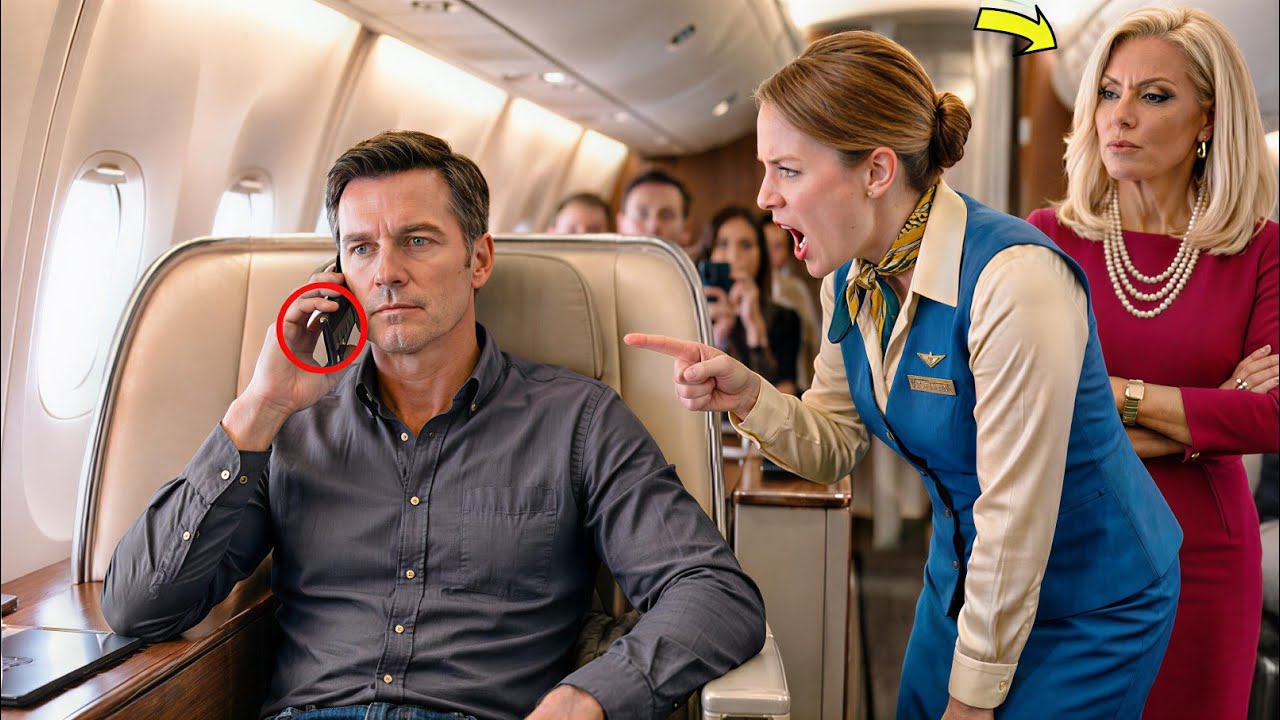
The cabin manager leaned toward the exhausted father and lowered his voice.
“Sir, I need you and your daughter to leave these seats. An important passenger requires them.”
Daniel Harper stared at him, certain he had misunderstood.
Beside him, eight-year-old Lily had both hands pressed against the airplane window, searching the horizon for the first glimpse of the ocean she had dreamed about for months.
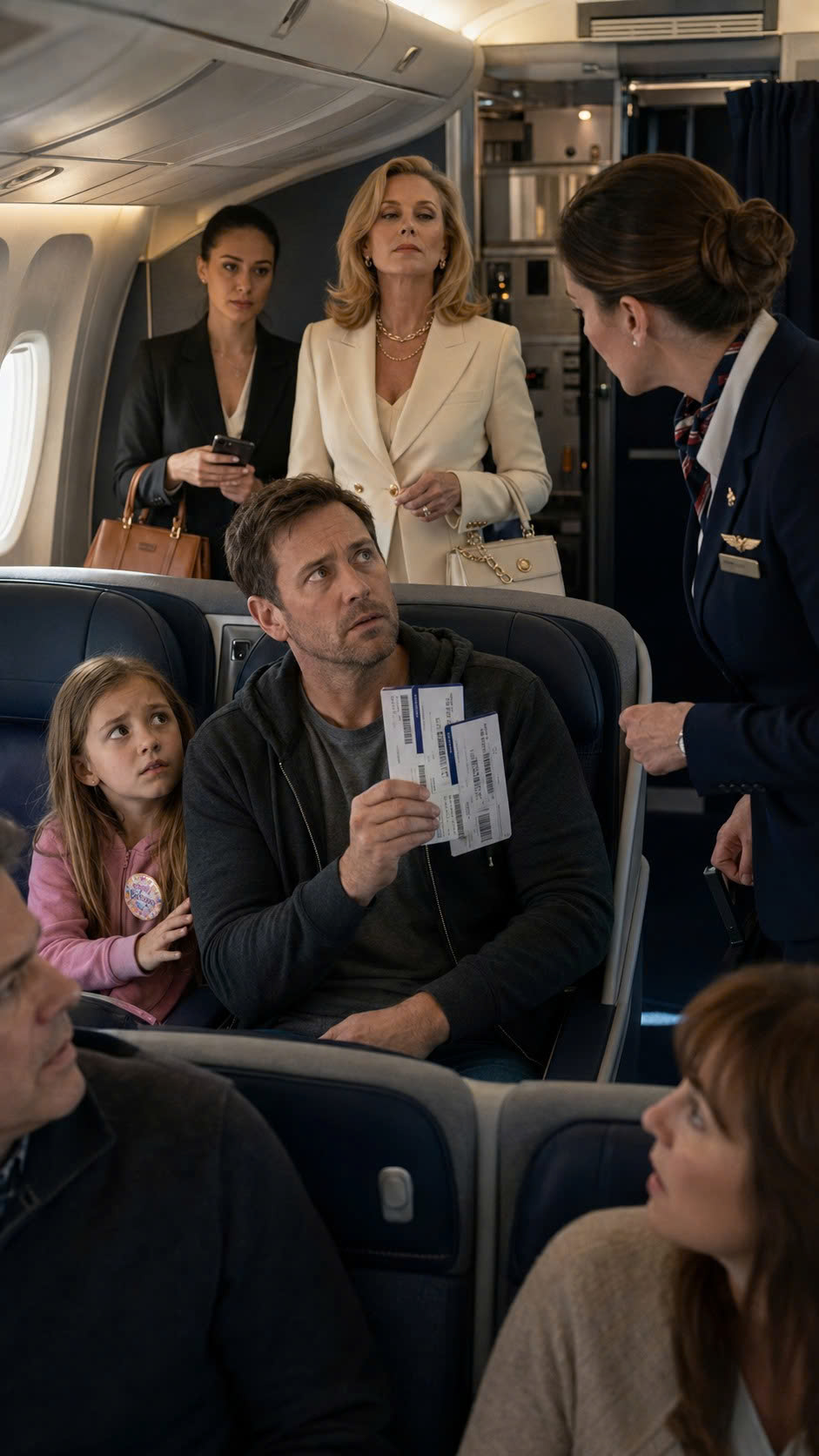
Daniel slowly held up their boarding passes.
“These are our seats,” he said. “I paid for them.”
The manager barely glanced at the tickets.
“I understand, sir. But the decision has already been made.”
Three years earlier, Daniel had sat beside his wife, Claire, in a hospital room that smelled of antiseptic and fading flowers.
Cancer had taken her strength first, then her voice, then nearly everything else. In her final hours, she held Daniel’s hand and looked toward Lily, who was asleep in a chair with her head resting against a stuffed rabbit.
“Promise me she won’t feel alone,” Claire whispered.
Daniel promised.
He had spent every day since then trying to keep that promise.
Most mornings began at 4:45.
Daniel would wake before the alarm, quietly fold the blanket on the sofa where he had fallen asleep the night before, and prepare Lily’s breakfast. He packed her lunch, checked her homework, braided her hair badly enough that she often redid it herself, and walked her to the neighbor’s apartment before catching the first bus to work.
He worked as a shift coordinator at a medical supply warehouse outside Baltimore. The job was physically demanding, the hours were long, and the pay disappeared almost as soon as it arrived.
Rent.
Electricity.
Groceries.
Claire’s remaining medical bills.
By the end of most months, Daniel had just enough left to buy Lily a small ice cream on Friday evening.
He never complained in front of her.
When Lily asked why he wore the same two work shirts every week, he told her they were his lucky shirts. When she noticed him walking instead of taking the bus, he said the exercise kept him young.
She believed him because children often believe the lies their parents tell out of love.
One evening, several months before her ninth birthday, Lily was watching a documentary about airplanes.
The screen showed a jet rising above a coastline. Far below, the ocean looked like a sheet of blue glass.
Lily leaned forward.
“Dad, do you think the sea looks different from the clouds?”
Daniel looked up from the stack of overdue notices on the kitchen table.
“I’m sure it does.”
“I want to see it someday.”
She did not ask for a trip. She did not ask for an airplane ticket.
She simply said it the way children speak about impossible things—without expecting anyone to make them real.
That night, Daniel opened an empty coffee tin and placed seven dollars inside.
For the next eight months, he saved everything he could.
He stopped buying lunch at work and carried peanut butter sandwiches instead. He walked nearly four miles each way whenever the weather allowed. He accepted weekend shifts, holiday shifts, and overnight inventory assignments no one else wanted.
When the sole of his left shoe split, he repaired it with industrial glue from the warehouse.
When his supervisor suggested he replace his winter coat, Daniel laughed and said it still had another year in it.
Every sacrifice went into the coffee tin, then into a savings account Lily knew nothing about.
Two weeks before her birthday, Daniel found a discounted package for a short coastal flight and one night at a modest hotel. The plane had a small premium cabin near the front, with wider seats and large windows.
The tickets cost far more than he had planned.
He stared at the payment screen for nearly twenty minutes.
It was almost everything he had saved.
Then he remembered Lily’s face in front of the television.
He clicked “Confirm.”
On the morning of the trip, Lily woke to find a small envelope beside her cereal bowl.
Inside were two printed boarding passes and a note written in Daniel’s uneven handwriting.
For your birthday, we’re going to see the ocean from the clouds.
Lily read it twice.
Then she screamed so loudly that their downstairs neighbor knocked on the ceiling with a broom.
At the airport, everything felt magical to her.
The moving walkways.
The departure screens.
The giant windows overlooking the runway.
She asked Daniel at least fifteen questions before they reached security and another twenty before they found the gate.
Their check-in went smoothly. Their boarding passes were scanned without issue. A gate agent smiled at Lily’s birthday badge and wished her a wonderful flight.
When they entered the plane, Lily gasped.
Their seats were in the second row.
She slid into the window seat and immediately opened the shade. Daniel placed their small backpack in the overhead compartment and sat beside her.
For the first time in months, he felt the tightness in his chest loosen.
Claire should have been there.
That thought always came during happy moments.
But when Lily slipped her hand into his and whispered, “This is the best birthday ever,” Daniel allowed himself to feel grateful.
Then a woman in a cream-colored designer suit stepped onto the plane.
She was followed by a young assistant carrying two phones, a leather laptop bag, and a garment case.
The woman did not look at the passengers. She looked at the cabin as if she were inspecting a room someone else had failed to prepare properly.
A flight attendant hurried toward her.
“Ms. Whitmore, welcome aboard.”
The woman gave a brief nod.
Her name was Evelyn Whitmore, chief executive of a national luxury property group. Her face appeared regularly in business magazines, usually beside headlines about record growth, exclusive resorts, and multimillion-dollar acquisitions.
Her assistant spoke quietly to the flight attendant.
“There seems to be a mistake. Ms. Whitmore was promised a seat in the forward cabin.”
The attendant checked a tablet.
A second attendant joined her. Then the cabin manager.
They whispered near the galley, glancing repeatedly toward Daniel and Lily.
Daniel noticed, but he said nothing.
A minute later, the cabin manager approached.
His name badge read RICHARD COLE.
“Mr. Harper?”
“Yes?”
“We have a seating issue that needs to be resolved before departure.”
Daniel waited.
Cole gestured toward the back of the plane.
“We need to relocate you and your daughter to the main cabin.”
Lily turned from the window.
Daniel took out the boarding passes.
“I booked these seats months ago.”
“Yes, sir, but we have an operational requirement.”
“What requirement?”
Cole’s expression hardened slightly.
“A priority passenger needs to be accommodated.”
Daniel looked past him.
Evelyn Whitmore stood near the galley, waiting.
She did not appear embarrassed.
She did not ask what was happening.
She simply watched as though the outcome had already been decided.
Daniel looked back at Cole.
“Are our tickets invalid?”
“No.”
“Did we miss a payment?”
“No, sir.”
“Did we do something wrong?”
A few passengers nearby began listening.
Cole lowered his voice.
“This does not need to become difficult.”
“I’m not trying to make it difficult,” Daniel said. “I’m asking why my daughter is losing a birthday gift I paid for.”
Lily’s smile disappeared.
Cole glanced around the cabin, aware that people were watching.
“If you refuse to cooperate, I will have to involve airport security. That could delay the flight for everyone.”
The threat changed the atmosphere immediately.
Passengers looked at one another.
A man across the aisle raised his phone slightly. A woman in the row behind Daniel began recording from her lap.
No one spoke.
Lily pulled gently at her father’s sleeve.
“Dad, did we break a rule?”
Daniel turned toward her.
Her eyes were wide, not with anger but with fear.
That was the moment he understood what Cole was doing.
The manager was not merely taking two seats.
He was forcing Daniel to choose between defending himself and frightening his daughter with a public confrontation.
Daniel could have raised his voice.
He could have refused to move.
He could have demanded that security be called and forced the airline to explain its decision in front of everyone.
But Lily was watching.
And Daniel had spent three years teaching her that dignity was not something another person could take unless you handed it over.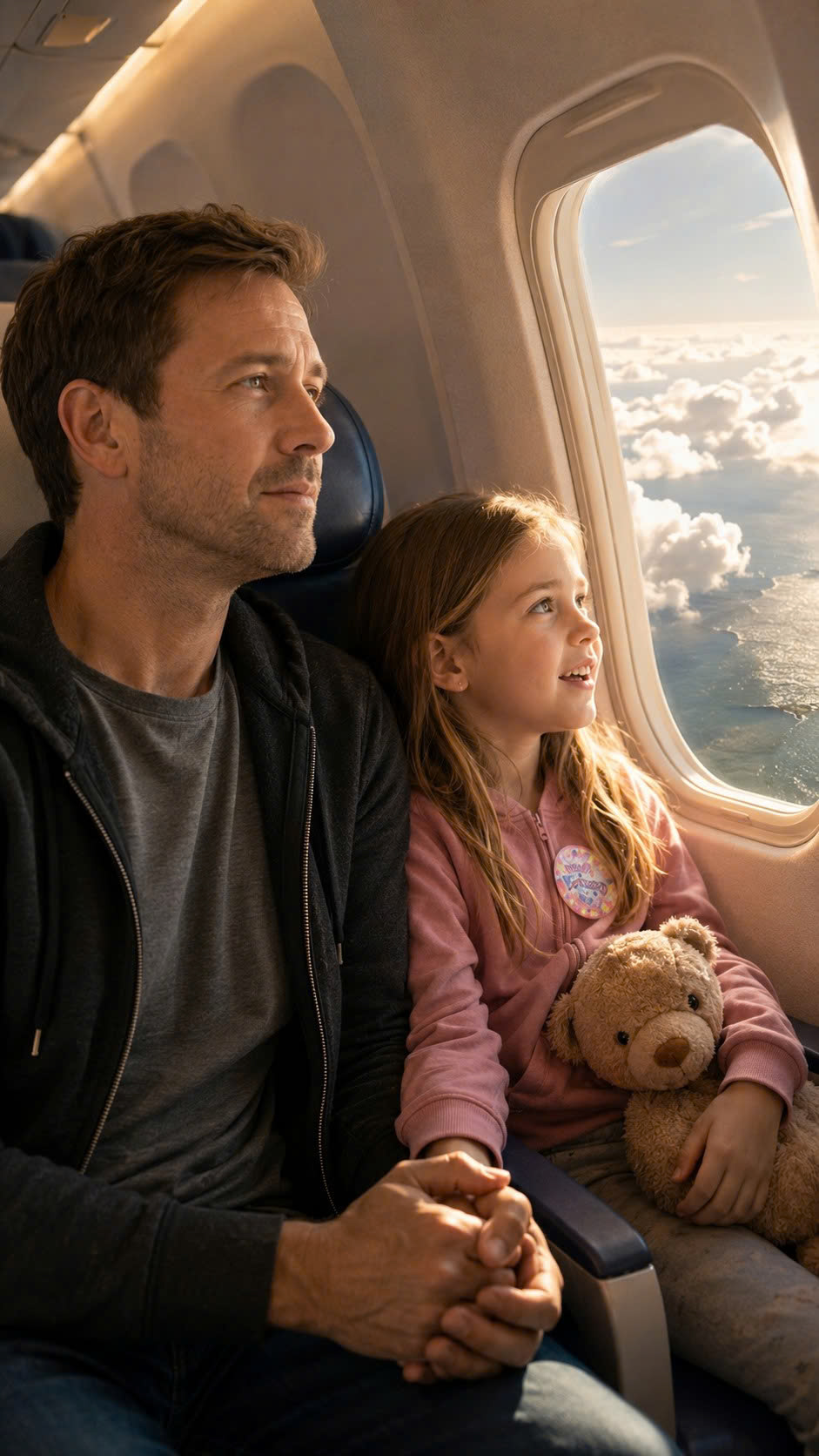
He forced a small smile.
“No, sweetheart. We didn’t break any rules.”
He stood and opened the overhead compartment.
The cabin was silent as he removed their backpack.
Cole stepped aside.
Evelyn Whitmore moved closer to the seat before Daniel and Lily had fully left the row.
Lily held her father’s hand as they walked toward the back of the plane. Her birthday badge was still pinned to her sweater, but she kept her head down.
Halfway down the aisle, she looked back at the window seat.
“That was my birthday present,” she whispered.
Daniel squeezed her hand.
“The seat wasn’t the present.”
She looked up at him.
“What was?”
“Being together,” he said. “That part no one can take.”
A woman near the aisle covered her mouth.
The man recording lowered his phone and looked away for a moment.
Daniel and Lily were placed in the final row, beside the lavatory, where the seats did not recline. There was no clear window beside Lily—only a narrow panel partly blocked by the wall.
She sat quietly.
Daniel buckled her seat belt and tried to make a joke about being close to the snacks.
She did not laugh.
At the front of the plane, Evelyn Whitmore settled into Lily’s seat and handed her coat to an attendant.
Then another passenger boarded.
He wore dark trousers, an open-collared shirt, and a navy jacket that looked several years old. He carried his own canvas bag and paused to let an elderly passenger pass before approaching the front galley.
No one recognized him.
He handed a document to the lead flight attendant.
She looked at it.
Then looked at him.
The color drained from her face.
“Mr. Lawson?”
The captain emerged from the cockpit seconds later.
“Michael,” he said, clearly startled. “We weren’t told you would be joining us.”
“That was intentional,” the man replied.
Michael Lawson had founded the airline twenty-two years earlier with three leased aircraft and a belief that ordinary travelers deserved to be treated with the same respect as wealthy ones.
He still owned the majority of the company.
Although his photograph appeared in annual reports, few frontline employees recognized him in person. He preferred it that way. Several times a year, he booked flights under abbreviated names and traveled without an entourage to see how the airline operated when staff believed no executive was watching.
That morning, while waiting near the gate, Michael had received a message through the airline’s internal customer escalation address.
A passenger had attached a photograph of Daniel’s boarding pass and written:
A father and his little girl were removed from paid premium seats for someone your staff decided was more important. I thought you should know what your company looks like today.
Michael had checked the booking record before stepping onto the plane.
Daniel’s tickets were valid.
There had been no upgrade error.
No safety issue.
No operational requirement.
The seats had been taken because Evelyn Whitmore’s assistant had pressured the crew, and the crew had decided that a famous executive mattered more than a tired father in an old jacket.
Michael looked at Cabin Manager Richard Cole.
“Why were passengers in seats 2A and 2B moved to the last row?”
Cole opened his mouth.
Nothing came out.
One of the attendants stared at the floor.
Michael waited.
The silence spread through the cabin.
It was not the silence of confusion.
It was the silence of people who knew the truth and were hoping someone else would speak first.
Finally, a passenger in row three stood.
“I saw the whole thing,” she said. “The father showed his tickets. Your manager threatened to call security if he didn’t move.”
Another passenger held up his phone.
“I recorded it.”
“So did I,” someone else said.
Within seconds, three videos were being passed forward.
Michael watched the first one without expression.
He saw Cole dismiss the boarding passes.
He heard Lily ask whether she and her father had broken a rule.
He watched Daniel swallow his anger, gather their belongings, and lead his daughter down the aisle while Evelyn Whitmore waited for the seat.
When the video ended, Michael handed the phone back.
“Thank you for telling the truth.”
Then he walked to the last row.
Daniel began to stand, but Michael raised a hand.
“Please. Stay seated.”
He crouched in the aisle so he was at Lily’s eye level.
“I’m Michael,” he said. “I work for the airline.”
Lily nodded.
“I heard this trip was for your birthday.”
Another nod.
“Were you excited?”
She glanced at Daniel before answering.
“My dad worked extra shifts for it.”
Michael looked toward Daniel, then back to Lily.
“What happened wasn’t fair.”
Lily twisted the edge of her birthday badge between her fingers.
“My dad said the seat wasn’t the present.”
“He sounds like a wise man.”
“He says things like that when something hurts him.”
Daniel looked down.
The sentence struck the cabin harder than any accusation could have.
Lily continued quietly.
“He saved for a long time. Then somebody took it away in a few minutes.”
Michael stood.
At the front, Richard Cole was watching him.
So was Evelyn Whitmore.
For the first time since boarding, the confidence had left her face.
Michael walked slowly up the aisle.
“Captain, delay departure.”
Cole stepped forward.
“Mr. Lawson, perhaps we can discuss this privately—”
“No,” Michael said. “This happened publicly.”
He turned toward the passengers.
“My name is Michael Lawson. I am the founder and majority owner of this airline.”
A murmur moved through the cabin.
Evelyn Whitmore’s assistant froze with both phones in her hands.
Michael continued.
“Every employee here is entrusted with representing three basic values: fairness, honesty, and respect. Those values do not change depending on a passenger’s clothing, job title, income, or public profile.”
He looked directly at Cole.
“No passenger will lose a seat they lawfully purchased because someone else appears more important.”
Cole’s face tightened.
A thin line of perspiration appeared near his temple.
Michael then looked toward Evelyn.
“Ms. Whitmore, you will occupy the seat assigned on your ticket.”
For several seconds, she remained motionless.
The entire cabin watched her.
Her eyes moved toward Lily’s empty window seat, then toward the passengers holding phones, then finally toward Michael Lawson.
The recognition arrived slowly.
Her shoulders lowered.
Her lips parted, but no words came.
She understood that the people she had considered invisible now held the evidence, the audience, and the power.
Without protest, she stood and collected her coat.
Michael turned to Daniel.
“Mr. Harper, you and your daughter will be returned to seats 2A and 2B.”
Applause began near the middle of the plane.
Then it spread.
Several passengers stood.
Daniel’s face reddened as he carried the backpack forward. Lily walked beside him, still uncertain, until she saw the window again.
Then she smiled.
It was not a dramatic smile.
It was small, cautious, and real.
Michael waited until they were seated before addressing the crew.
“Mr. Cole, you and the two employees involved are suspended from duty effective immediately, pending termination review. A replacement crew is being brought aboard.”
Cole stared at him.
“Sir, I have worked here for eleven years.”
“And in less than eleven minutes,” Michael replied, “you showed a child that our policies could be sold to the person with the most influence.”
Cole looked around as though searching for support.
He found none.
The passengers had stopped applauding.
Now they simply watched.
That was worse.
Thirty minutes later, a replacement crew boarded, and the plane finally pushed back from the gate.
As the aircraft climbed, Lily pressed her forehead against the window.
The city became a pattern of roads and rooftops. Then the clouds opened beneath them.
Far in the distance, the ocean appeared.
Blue.
Endless.
Bright beneath the morning sun.
Lily reached for Daniel’s hand.
“Mom would have liked this,” she said.
Daniel blinked quickly.
“Yes,” he whispered. “She would have.”
Michael did not return to a private seat.
During the flight, he sat across the aisle from Daniel and listened.
He learned about Claire.
He learned about the promise Daniel had made beside her hospital bed.
He learned about the medical bills, the overnight shifts, the repaired shoes, and the coffee tin that had held the beginning of Lily’s birthday trip.
But Michael also learned something Daniel rarely mentioned.
At the warehouse, Daniel had earned a reputation for solving problems without humiliating people. When employees made mistakes, he corrected the process before blaming the person. When exhausted workers argued, he listened until the real problem surfaced.
He had no degree in aviation.
But he understood people.
When the plane landed, Michael handed Daniel a business card.
“Come to our headquarters next Thursday.”
Daniel looked at the card.
“For what?”
“A conversation.”
Daniel assumed the airline wanted him to participate in an investigation or accept a formal apology.
Instead, the following week, Michael offered him a position in the company’s customer experience division.
Not a ceremonial role.
Not a publicity arrangement.
A real executive position, supported by a six-month training program and a team of experienced operations leaders.
Daniel stared at the offer letter.
“You want me to be Director of Customer Experience?”
“I want someone in that role who knows what passengers remember,” Michael said.
“I’ve never worked for an airline.”
“That can be taught.”
Michael leaned forward.
“Compassion cannot.”
Daniel did not accept immediately.
He spent several weeks asking questions, studying the responsibilities, and worrying that he was unqualified.
Then Lily reminded him of something he had told her many times.
“You say being scared doesn’t mean we shouldn’t try.”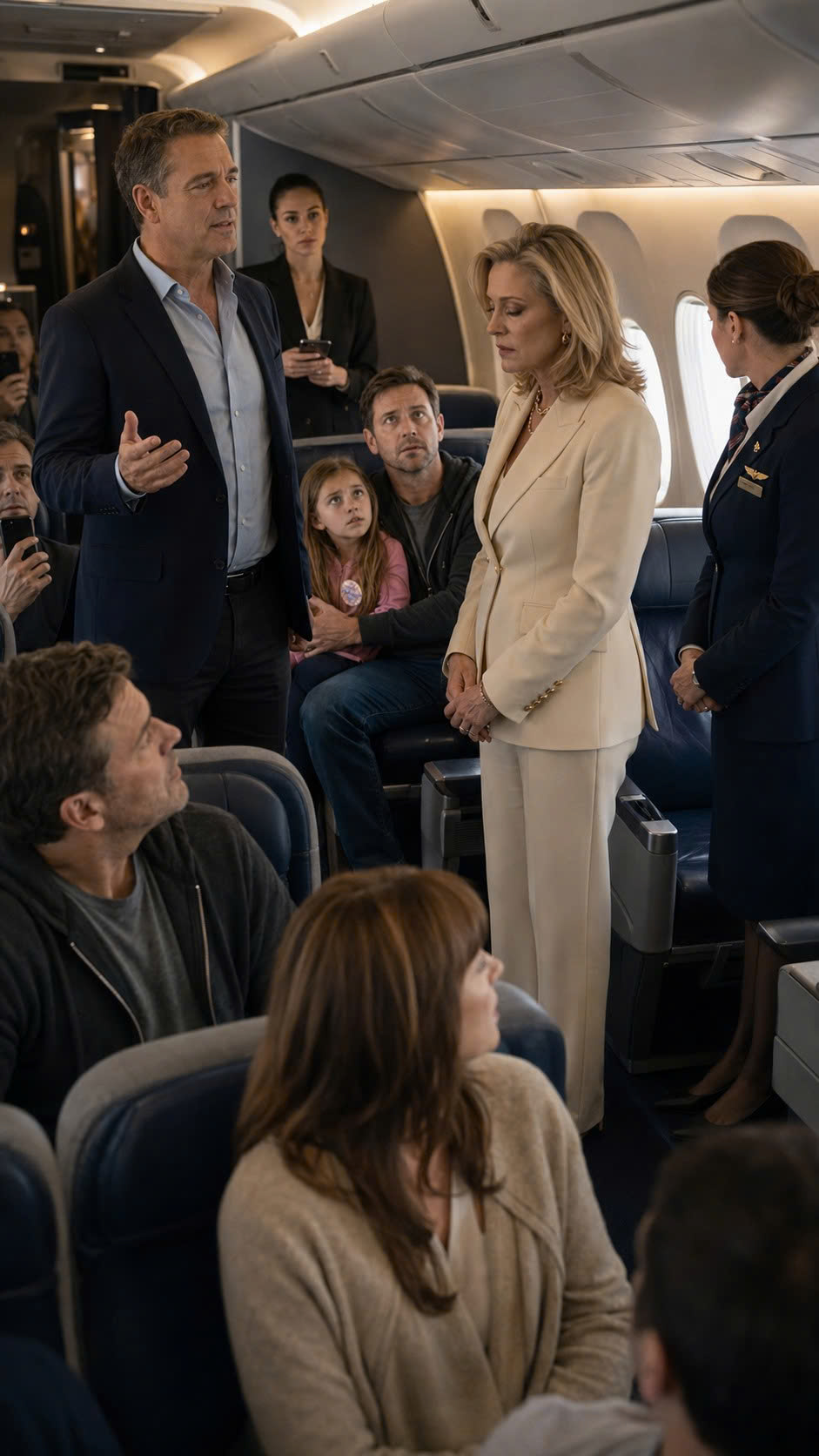
Daniel accepted the job.
His first major policy was simple: no employee could reassign a paid seat for status-based preference without documented operational or safety grounds. Any exception required written authorization and automatic review.
His second initiative redesigned staff training around real passenger situations rather than scripted service language.
Employees were rewarded for fair problem-solving, not for flattering wealthy travelers.
Complaints were reviewed for patterns of bias.
Families traveling for medical reasons, bereavement, military deployment, or once-in-a-lifetime events were given clearer support channels.
Within a year, customer satisfaction reached the highest level in the airline’s history.
But the numbers were not what Daniel valued most.
He valued the emails from parents who said an employee had treated their frightened child with patience.
He valued the message from an elderly passenger who had been escorted through a confusing terminal instead of being dismissed.
He valued the handwritten note from a baggage agent who said, “For the first time, we are being trained to see the person before the ticket.”
The video from the original flight spread across social media.
Millions watched Daniel give up the seats he had worked months to afford.
They watched Lily ask whether she had done something wrong.
They watched a powerful executive move silently from a seat that never belonged to her.
But the moment people shared most was not Michael Lawson’s announcement.
It was Daniel telling his daughter that the seat was never the real gift.
Years later, Lily would barely remember the hotel, the airport snacks, or the color of the airplane seats.
She remembered looking down at the ocean through a window her father had fought for without shouting.
She remembered that he had been humiliated without becoming cruel.
She remembered that when power tried to make him feel small, he refused to teach her hatred.
And she learned that real strength does not come from an expensive seat, a famous name, or a title printed on a business card.
It comes from the choices people make when they have every reason to become bitter—and choose dignity instead.
Never judge a person by the seat they occupy, because the quietest person in the cabin may be the one capable of changing the entire company.