
Forty-three assistants had walked into Vivienne Cross’s office.
None had lasted longer than six weeks.
Some resigned quietly. Some left in tears. One reportedly abandoned her company laptop in the lobby and told security she would rather repay its full value than go back upstairs to return it in person.
By the time Rowan Hale applied for the position, the role had become a warning whispered through the halls of CrossDyne Technologies.
“Don’t take it.”
“She’ll destroy you.”
“The money isn’t worth it.”
Rowan took it anyway.
He was thirty-seven, raising an eight-year-old son alone, and three months behind on nearly everything that mattered.
The red notices were stacked beneath a refrigerator magnet shaped like a dinosaur. His savings account had fallen below four hundred dollars. The landlord had stopped saying, “Whenever you can,” and started including dates in bold letters.
Rowan wasn’t chasing status.
He was trying to keep the lights on.
The salary for Vivienne Cross’s personal assistant was nearly double what he had earned at his previous job. On paper, the duties sounded manageable: coordinate meetings, organize travel, manage communications, prepare documents and anticipate the CEO’s needs.
The job description did not mention surviving her.
Vivienne was the founder and chief executive of CrossDyne, a technology company valued at more than two billion dollars. She had built it from a rented apartment twenty years earlier, coding at night and pitching investors during the day.
Then, three years before Rowan arrived, a delivery truck ran a red light and struck her car.
The accident left her paralyzed from the neck down.
Her mind remained as sharp as ever. Her voice still commanded boardrooms. Her decisions could move millions of dollars before lunch.
But the loss of control over her own body changed something in her.
Employees described her as cold, exacting and impossible to please. She noticed every delayed email, every missing attachment, every hesitation before an answer.
She could reduce a senior executive to silence with a single question.
And personal assistants received the worst of it.
On Rowan’s first morning, he entered her office at 7:42.
The room occupied the top corner of CrossDyne’s headquarters, with floor-to-ceiling windows overlooking the city. Everything was polished, expensive and perfectly aligned.
Nothing felt warm.
Vivienne sat in a custom motorized wheelchair near the windows. Her dark suit was immaculate. Her hair was pinned neatly behind her head. Only the faint shadows beneath her eyes suggested she had not slept.
She looked at the clock on the wall.
“You were told to arrive at 7:45.”
“Yes.”
“It is 7:42.”
“I thought arriving early would be helpful.”
“You thought incorrectly. My morning care routine ends at 7:44. You have been standing outside the office for six minutes, which distracted two members of my medical team.”
Rowan paused.
“I’m sorry.”
“I don’t need an apology. I need you not to repeat it.”
That was the first correction.
By noon, there had been twenty-seven more.
He formatted a briefing document with the wrong line spacing. He transferred a call three seconds too slowly. He scheduled a meeting in Conference Room B without checking whether the afternoon sunlight would create glare on Vivienne’s communication screen.
When he brought her coffee, she stared at the cup.
“I don’t drink coffee after eleven.”
“It’s 10:55.”
“The meeting begins at eleven. By the time I could drink it, it would be after eleven.”
Rowan quietly removed it.
The executive team watched him the way people watch a glass balancing near the edge of a table.
At 6:30 that evening, Vivienne added three meetings to the following morning, dictated twelve emails and asked Rowan to locate a contract amendment from seven years earlier.
When he finally reached home, it was almost nine.
His son, Milo, was asleep on the sofa with a math workbook open on his chest. A bowl of untouched cereal sat on the coffee table.
Rowan stood in the doorway for a long moment.
Milo had tried to wait for him.
Rowan carried him to bed, pulled the blanket over his shoulders and noticed a note written in crooked pencil beside the unfinished homework.
“Dad, I saved you the blue cereal pieces because they’re your favorite.”
Rowan sat on the edge of the bed and covered his face with both hands.
The next morning, he returned to CrossDyne at exactly 7:45.
Vivienne looked at the clock.
“Cutting it close.”
“I’ll try to survive the risk.”
Her eyes shifted toward him.
For half a second, he thought he saw the beginning of a smile.
Then it disappeared.
The days became weeks.
Rowan learned that Vivienne hated vague answers but respected honest ones. She preferred bad news delivered immediately and good news supported by evidence. She remembered every promise anyone made and every excuse they offered when they failed to keep it.
She was harsh.
But she was rarely wrong.
Instead of defending himself when corrected, Rowan wrote things down. He created a system for her meetings, another for medical appointments and a third for the countless details other people considered too small to matter.
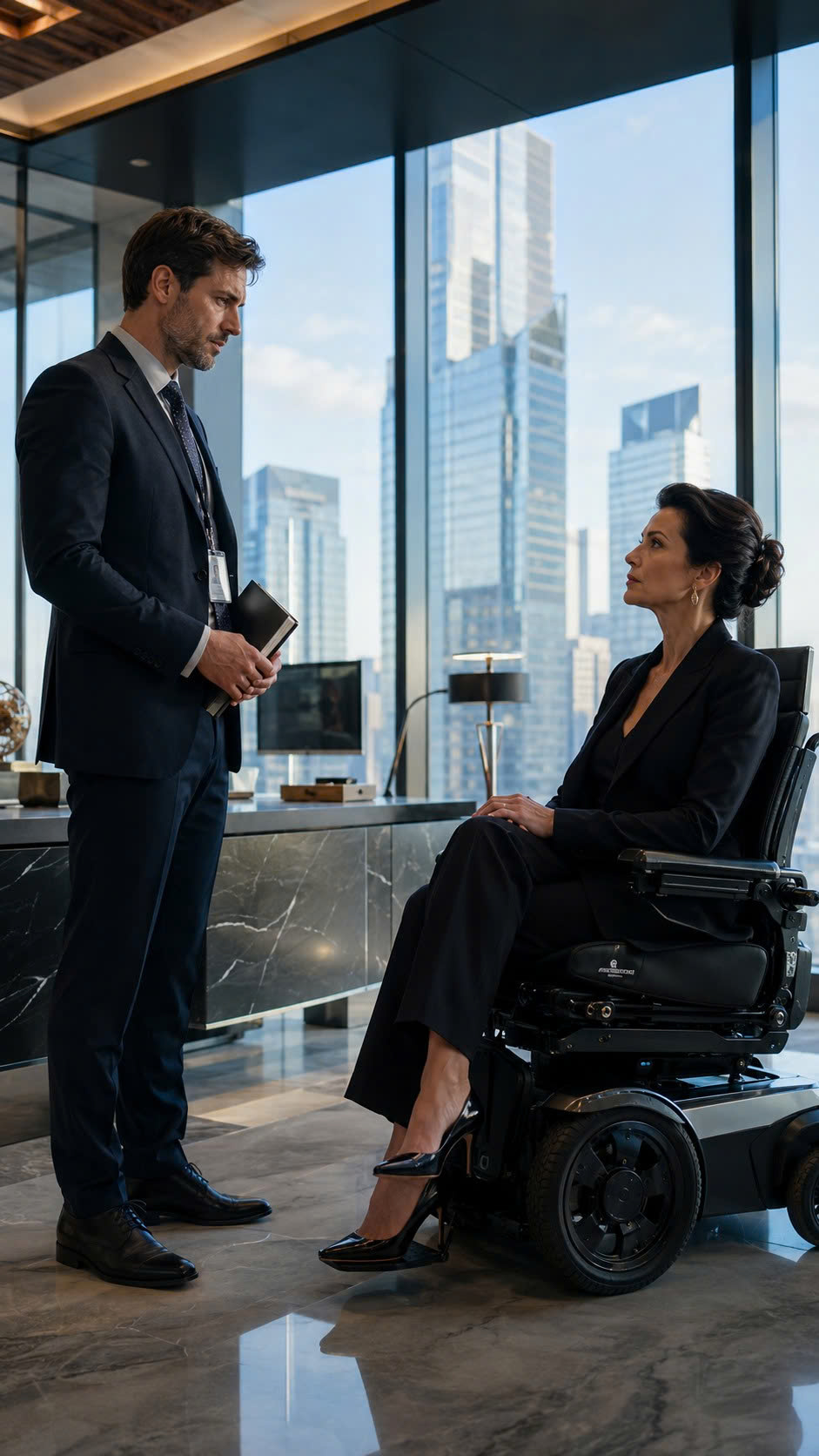
He learned how much time she needed between long presentations. He recognized when the muscles in her face tightened from pain. He began leaving two minutes of silence after difficult calls because she hated being asked whether she was all right.
Most importantly, he kept coming back.
People started placing quiet bets on how long he would last.
Two weeks.
Then four.
Then six.
On the morning he passed the previous record, someone left a cupcake on his desk with the words “Still Alive” written in icing.
Vivienne saw it.
“Celebrating mediocrity?”
“Apparently survival is now a corporate milestone.”
“It is when standards are this low.”
But she allowed him to keep the cupcake.
As Rowan became less afraid of her, he began noticing things other employees overlooked.
There was a framed photograph on the shelf behind her desk. In it, a younger Vivienne stood between her parents at CrossDyne’s first office, a cramped room above a laundromat.
Whenever a difficult board meeting ended, her eyes drifted toward that photograph.
She never asked anyone to move it closer.
She also remained in the office long after most employees had gone home.
Not because there was always more work.
Sometimes Rowan would return for a forgotten folder and find her facing the dark windows, the city reflected around her.
No calls. No meetings. No sharp instructions.
Just silence.
People called Vivienne controlling.
Rowan began to wonder how much of that control had been built from fear.
The first real change between them happened during CrossDyne’s annual investor showcase.
More than three hundred employees, clients and investors had gathered in the company’s presentation center. The engineering team was preparing a live demonstration of a new artificial intelligence platform when the building lost power.
The lights vanished.
The screens went black.
The elevators stopped between floors.
Emergency alarms sounded as backup systems struggled to activate.
Within seconds, the building filled with shouting and hurried footsteps. Executives rushed to save presentations. Engineers worried about servers. Event staff tried to move guests toward emergency exits.
Rowan was in the main hall when he realized Vivienne was missing.
He found her alone inside a smaller conference room.
Her wheelchair had entered power-protection mode and stopped responding. The automated door had partially closed, trapping her inside. Her medical aide had gone downstairs minutes earlier to retrieve medication.
Vivienne’s face was calm.
Too calm.
“Facilities has been notified,” she said.
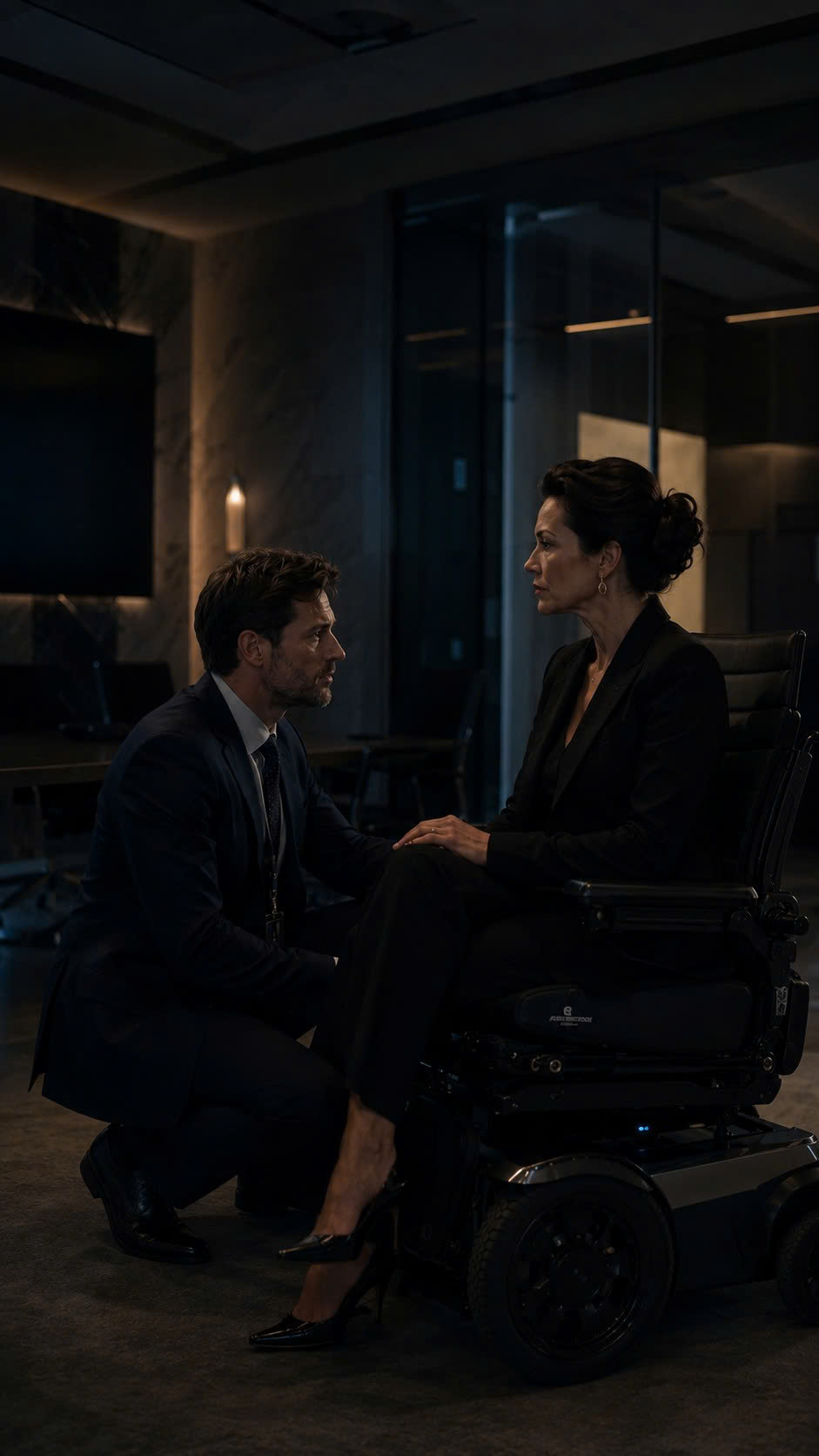
Rowan crouched beside her.
“I’m staying.”
“That is unnecessary. The investor files need to be secured.”
“There are forty people securing the files.”
“The product demonstration—”
“Can be rescheduled.”
She looked at him sharply.
“This company cannot afford to appear unprepared.”
“And I’m not leaving you alone in a locked room.”
The words landed harder than he expected.
Vivienne looked away.
For nearly two hours, Rowan remained beside her in the dim emergency lighting. He updated her every few minutes, contacted her medical team and kept the room from filling with panicked employees who had suddenly remembered the CEO existed.
When her breathing became shallow, he did not ask whether she was frightened.
He simply spoke.
He told her about Milo’s failed attempt to build a volcano for school. He described how baking soda had exploded across the kitchen ceiling and how Milo had insisted the experiment was successful because “something definitely erupted.”
Vivienne listened without interrupting.
Eventually, her breathing slowed.
When the power returned, her wheelchair rebooted and the doors reopened.
Employees crowded into the room, offering explanations and apologies.
Vivienne ignored them.
She looked at Rowan.
“Thank you.”
It was the first time she had said those words to him.
After that night, the walls between them did not disappear.
But they began to crack.
Vivienne told him small pieces of her past, never in one conversation and never with unnecessary emotion.
She had built CrossDyne with five employees and one unreliable server. She had slept beneath her desk before important product launches. She had negotiated the company’s first major contract while hiding the fact that the electricity in her apartment had been disconnected.
She had once trusted people easily.
After the accident, those people began disappearing.
Friends who had promised to visit became uncomfortable with the medical equipment. A man she had planned to marry ended their relationship six months into her recovery. Board members who once praised her instincts began asking whether she was physically capable of leading.
Every assistant who left seemed to confirm what she had already begun to believe.
Everyone stayed while she was useful.
Everyone left when being near her became difficult.
Rowan did not try to convince her otherwise.
He simply continued showing up.
He answered calls from the office while preparing Milo’s breakfast. He reviewed contracts from the hospital parking lot during routine pediatric appointments. He learned to sleep in fragments and hide exhaustion behind clean shirts.
Vivienne noticed.
She never mentioned the dark circles beneath his eyes, but meetings after 5:30 began disappearing from his calendar.
Then, one Tuesday morning, Rowan called her from an emergency room.
Milo had developed a high fever during the night. By sunrise, he was struggling to breathe.
Doctors suspected a severe infection and wanted to admit him immediately.
Rowan stood in a hospital corridor with one hand pressed against the wall.
“I won’t be able to come in,” he said. “I’ve already sent today’s briefing notes to your tablet. Elena can handle the investor call, and the revised acquisition documents are—”
“Rowan.”
He stopped.
There was a long silence.
His stomach tightened.
He thought about the rent. The hospital bills. The forty-three assistants who had come before him.
“I understand if this creates a problem,” he said.
Vivienne’s voice softened.
“Which hospital?”
Two hours later, she arrived.
Not an assistant carrying flowers on her behalf.
Vivienne herself.
She entered Milo’s room in her wheelchair, followed by her medical aide and CrossDyne’s director of employee services. Within an hour, the hospital’s pediatric infectious disease specialist had reviewed Milo’s case.
Vivienne arranged the paperwork, contacted the insurance provider and moved every meeting off Rowan’s calendar for the next five days.
“You don’t have to do this,” Rowan told her.
She looked through the glass toward Milo’s bed.
“You stayed when the lights went out.”
“That was different.”
“No,” she said. “It wasn’t.”
Milo recovered slowly.
During one visit, he woke to find Vivienne beside his bed.
“You’re Dad’s scary boss,” he whispered.
Rowan nearly dropped his cup of water.
Vivienne raised an eyebrow.
“Is that how he describes me?”
“No. He says you’re complicated.”
For the first time since Rowan had met her, Vivienne laughed without stopping herself.
It was quiet and brief, but everyone in the room heard it.
By the time Rowan returned to work, their relationship had changed. Employees saw it in the way Vivienne waited for his opinion during meetings and in the way Rowan no longer flinched when she challenged him.
But something else had changed too.
While Rowan had been at the hospital, a confidential file had been delivered to his inbox by mistake.
It contained performance reports on all forty-three assistants who had held his position.
The reports were signed by Adrian Mercer, CrossDyne’s chief operating officer and the board member most likely to replace Vivienne if she were declared unable to continue as CEO.
Rowan expected to find records of mistakes, complaints and resignations.
Instead, he found a pattern.
Many of the assistants had received strong reviews during their first weeks. Then Adrian’s office began contacting them privately.
Some were offered transfers with better titles. Some were warned that remaining close to Vivienne could damage their careers. Others were instructed to document her “emotional instability” and report any moment in which her disability affected company operations.
During the power outage, Adrian had personally ordered the emergency team to prioritize the investor demonstration and server rooms before reaching Vivienne.
Her isolation had not been accidental.
Neither had the constant turnover.
For three years, Adrian had been building a case that Vivienne was impossible to work with, incapable of maintaining staff and too dependent to lead the company.
Her cruelty had driven some people away.
But someone had been quietly pushing the others.
Rowan checked dates, emails and transfer records. He spoke with two former assistants who agreed to provide statements. One admitted Adrian had promised her a management position if she submitted a report questioning Vivienne’s judgment.
The truth changed everything.
Vivienne had spent years believing people abandoned her because she was broken.
In reality, a man she trusted had been turning her fear into evidence against her.
Rowan brought the file to her office.
Vivienne read every page in silence.
Her expression did not change until she reached the emergency response order from the night of the blackout.
Then her eyes stopped moving.
For several seconds, the only sound in the room was the quiet motor of her wheelchair.
“He knew I was trapped,” she said.
“Yes.”
“And he told them to protect the demonstration.”
“Yes.”
Vivienne looked toward the photograph of her parents.
When she spoke again, her voice was steady.
“Schedule an emergency board meeting.”
Adrian entered the meeting the following morning with the relaxed confidence of a man who believed the outcome had already been arranged.
He placed a leather folder on the table and began discussing “leadership continuity.”
Then Rowan connected the conference screen.
One by one, the emails appeared.
The transfer offers.
The private instructions.
The reports written before assistants had even completed their probation periods.
Finally, Rowan displayed Adrian’s order from the blackout.
PRIORITIZE INVESTOR ASSETS. CEO EXTRACTION CAN WAIT FOR FACILITIES.
The room became completely still.
Adrian stared at the screen.
His mouth opened, but no words came.
Vivienne watched him carefully.
For years, employees had described the expression people wore when she dismantled their arguments in public.
Now they saw that expression on Adrian’s face.
His confidence drained first. Then the color left his cheeks. His hand tightened around the edge of the table as he realized no explanation could make the sentence on the screen disappear.
A board member closed her folder.
Another removed his glasses.
No one looked at Adrian.
Vivienne did not raise her voice.
“You spent three years trying to prove I could not lead because I needed help,” she said. “All you proved is that you were willing to endanger another human being to gain her chair.”
Adrian was removed from the building that afternoon.
The board terminated him following an independent investigation. Two executives who had assisted him resigned. Several former assistants received formal apologies, and CrossDyne rewrote its emergency procedures and disability accommodation policies.
Vivienne also did something no one expected.
She apologized.
Not for her standards.
\
Not for demanding excellence.
She apologized for using cruelty as armor and calling it strength.
Months later, CrossDyne celebrated its twentieth anniversary in a ballroom filled with employees, investors and former staff members.
Vivienne’s speech began with the company’s familiar history: the apartment, the first product, the contracts that nearly failed and the risks that had built a billion-dollar business.
Then she stopped reading from the teleprompter.
“Three years ago,” she said, “I lost control of my body. Not my mind. Not my ability. But I became so afraid of being considered weak that I punished everyone who came close enough to see that I was hurting.”
The ballroom was silent.
“I believed forty-three people had left because no one could tolerate what I had become. The truth was more complicated. Some were manipulated. Some were frightened. And some left because I gave them every reason to.”
Her eyes moved toward Rowan.
“One person stayed.”
Rowan stood near the back of the room beside Milo.
“He did not stay because I was kind,” Vivienne continued. “I wasn’t. He did not stay because the work was easy. It wasn’t. He stayed because he understood that a person can behave badly and still be in pain. He offered patience without surrendering his dignity, and loyalty without ignoring the truth.”
She paused.
“When the building went dark, hundreds of people protected our technology. Rowan protected me.”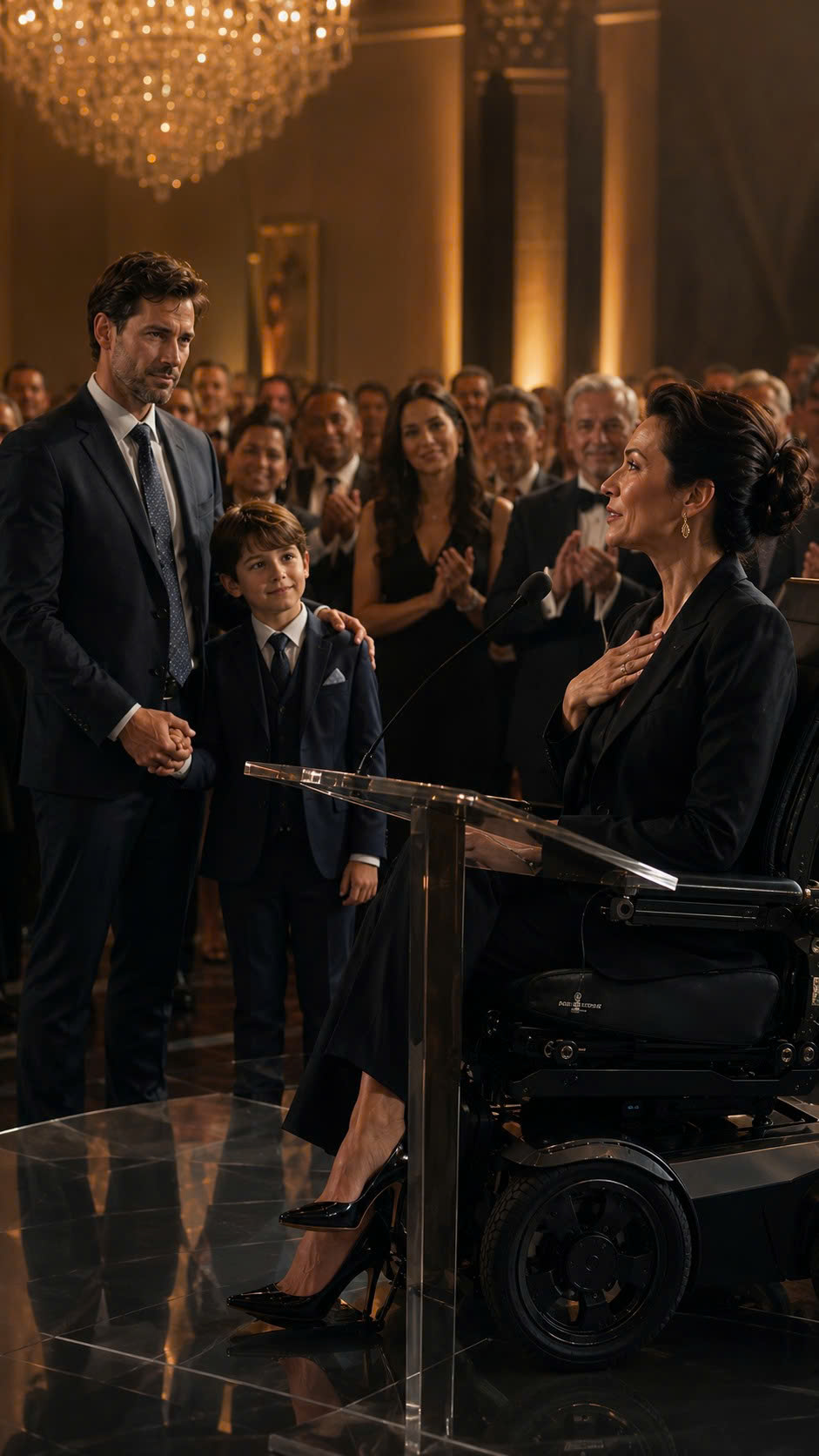
Milo reached for his father’s hand.
“And when his own world was falling apart,” Vivienne said, “he gave me the opportunity to become someone worth trusting again.”
The applause began in one corner of the room.
Then everyone stood.
Rowan lowered his head, overwhelmed. Milo looked up at him with a grin so wide it seemed to brighten his entire face.
Across the ballroom, tears moved down Vivienne’s cheeks.
She did not ask anyone to wipe them away immediately.
She let people see.
Rowan had accepted the job because he needed a paycheck.
He kept it because he saw what fear had hidden.
And Vivienne, the CEO everyone believed was incapable of trusting another person, finally understood that needing someone was not the same as being weak.
Sometimes the person everyone calls “difficult” is carrying a wound no one stayed long enough to understand.
And sometimes justice begins with one ordinary person deciding not to walk away when kindness becomes inconvenient.