Rear Admiral Marcus Webb had removed men from classified facilities for less.
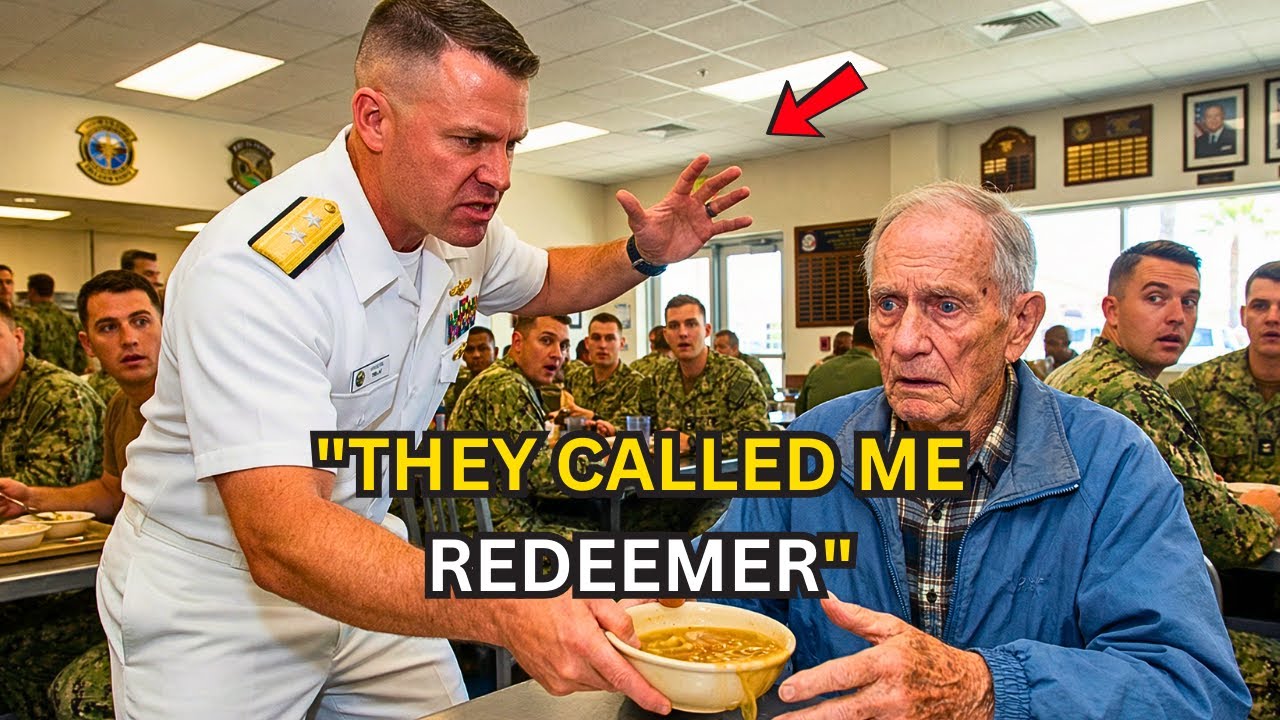
So when he saw an unfamiliar old man sitting alone inside the Naval Special Warfare dining facility, calmly eating soup as if he belonged there, Webb did not hesitate.
“Sir,” the admiral said, stopping beside the table. “I need to see your identification.”
The old man did not look up.
He lifted another spoonful, blew gently across the surface, and said, “I’m eating my soup.”
At first, several operators nearby tried not to stare.
Ten minutes later, every person in the room would be watching.
And Webb would be standing frozen beside a living piece of history, holding the bowl he had just ripped from the man’s hands.
The dining facility sat inside a secured compound on the West Coast, behind guarded gates, coded doors, cameras, and layers of authorization that had only grown stricter after September 11.
It was called a dining facility, but everyone who entered knew it was more than that.
The walls carried the memory of the command.
Framed insignia from units that officially existed and patches from missions that officially did not. Photographs of young men smiling before deployments from which some never returned. Plaques engraved with names spoken carefully and never casually.
Operators ate there.
So did trusted support staff, senior commanders, and occasionally family members escorted for specific ceremonies.
Nobody simply wandered in.
That was why the old man caught Webb’s attention immediately.
He appeared to be in his early eighties. His jacket was faded at the shoulders. His shoes were clean but worn almost smooth at the heels. One hand trembled slightly as he steadied the white ceramic bowl in front of him.
He was not wearing a uniform.
There were no medals on his chest, no unit cap on his head, no expensive watch, no visible sign that he had ever been anyone important.
But there was something unusual about his eyes.
They were old, certainly, but not uncertain.
They moved through the room without nervousness. They noticed doors, corners, reflective surfaces and people approaching from behind. He seemed less like a confused visitor and more like someone who had spent a lifetime knowing exactly where he was.
Rear Admiral Marcus Webb noticed those things too.
At forty-one, Webb was one of the youngest flag officers in the community. His record was polished enough to make even experienced commanders pay attention: combat deployments, joint task force leadership, intelligence assignments, Pentagon evaluations full of words such as exceptional and decisive.
He demanded discipline because he believed discipline kept people alive.
That morning, however, Webb was carrying more than discipline into the room.
He had spent three hours in meetings over budget cuts, readiness figures and personnel shortages. A congressional staff briefing had gone badly. Two unit commanders were arguing over resources, and an urgent security review had identified procedural failures inside the compound.
By lunchtime, Webb’s patience had narrowed to a thin, dangerous line.
Then he saw Thomas Garrett eating soup in a restricted facility.
Webb waited for the man to produce identification.
Garrett took another spoonful.
“Sir,” Webb repeated, “this is a controlled area. I need you to show me your credentials.”
The old man finally raised his eyes.
“I heard you.”
“Then you understand what I’m asking.”
“I understand the words.”
A lieutenant commander seated nearby stopped chewing.
Webb kept his voice professional.
“Are you here with someone?”
“No.”
“Were you escorted into the facility?”
“No.”
“Then how did you get inside?”
Garrett glanced toward the security door.
“I opened it.”
A few people looked down at their trays.
Webb did not find the answer amusing.
“You cannot enter this building without authorization.”
“Apparently, I can.”
The tremor remained in Garrett’s hand, but his voice was steady.
Webb drew a slow breath.
“Identification. Now.”
Garrett set down his spoon, reached inside his jacket and removed a DoD identification card. He slid it across the table with two fingers.
Webb picked it up.
The photograph was old but recognizable. The name read Thomas Elias Garrett. The card classified him as a military dependent under a category Webb did not immediately recognize.
Beneath the standard information was an access notation containing a sequence rarely used in ordinary base credentials.
Webb saw it.
He simply did not understand what it meant.
To him, Garrett remained an elderly dependent sitting alone in an operational facility where he should not have been.
“This card doesn’t explain why you’re here,” Webb said.
“It opened the door.”
“That is not an explanation.”
“It’s the only one you asked for.”
Webb placed the card on the table.
“You’re going to come with me while security verifies your access.”
Garrett picked up his spoon again.
“After I finish.”
Webb stared at him.
“That was not a request.”
Garrett tasted the soup and frowned faintly, as though considering whether it needed salt.
Around them, conversations began to fade.
Most people in the room knew Webb. They knew how quickly he could turn a mistake into a lesson delivered in front of everyone. They also knew that ignoring a direct order from a rear admiral was not something rational people did.
Garrett seemed completely unmoved.
“Sir,” Webb said, louder now, “stand up.”
“No.”
The word was not defiant.
It was almost gentle.
That made it worse.
Webb became aware of the eyes on him. Young SEALs at one table. Senior enlisted leaders near the far wall. Intelligence staff, planners and support personnel pretending not to listen.
An admiral could correct a misunderstanding quietly.
An admiral could not allow himself to be publicly dismissed.
Webb stepped closer.
“You are inside a restricted Naval Special Warfare facility. Your authorization is unclear, your presence is unexplained, and you are refusing a direct order from the commanding officer responsible for this compound.”
Garrett looked past him toward one of the photographs on the wall.
It showed six men standing beside a helicopter in Southeast Asia. The image was grainy. Two faces had been marked with small black ribbons.
Webb followed his gaze.
“Do you understand me?”
“Yes,” Garrett said.
“Then stand up and come with me.”
“I’ll leave when I’ve finished eating.”
The room had become completely quiet.
Webb’s face tightened.
He reached forward, took the bowl from Garrett’s hands and lifted it from the table.
Soup spilled over the rim, splashing across the tray and onto the old man’s sleeve.
Someone near the kitchen whispered, “Jesus.”
Garrett looked down at the stain.
For the first time, his expression changed.
Not into fear.
Not into anger.
Something colder appeared in his eyes, something that made the operators watching instinctively straighten.
Garrett slowly raised his head.
“You should put that down,” he said.
Webb carried the bowl to the next table and set it down hard enough to make the spoon jump.
“You are now interfering with a security investigation. If you refuse another order, you may be detained and charged with unlawful entry.”
Garrett studied him for several seconds.
Then the old man placed both palms on the table and pushed himself upright.
The movement was slow.
His left knee barely bent. One shoulder sat lower than the other. Beneath the cuff of his jacket, pale scar tissue crossed his wrist and disappeared up his arm.
Standing, he looked smaller than Webb had expected.
Frail, almost.
Yet nobody in the room felt that the admiral had gained control.
Webb pointed toward the exit.
“Now tell me who you are.”
Garrett picked up his identification card.
“My name is on the card.”
“I asked who you are.”
The old man’s gaze moved across the room, pausing briefly on the photographs, the plaques and the men watching him.
Then he said quietly, “They used to call me Redeemer.”
The silence that followed was different from the silence before it.
The earlier silence had been curiosity.
This was recognition.
At the far side of the room, Master Chief Daniel Rourke went pale.
Rourke had served more than thirty years. His beard was gray at the edges, and half the operators in the building had been trained, corrected or terrified by him at some point in their careers.
His chair scraped violently against the floor as he stood.
“What did you say?” Rourke asked.
Garrett looked at him.
“Redeemer.”
The Master Chief’s mouth opened, but no words came.
Webb glanced between them.
“You know this man?”
Rourke did not answer immediately.
His eyes were fixed on Garrett’s face, searching through age for the features of someone he had only seen in old photographs stored in secure archives.
Finally, he spoke.
“Sir, I know the name.”
“What name?”
Rourke swallowed.
“Redeemer was a call sign from Vietnam. Early SEAL operations. Cross-border work. MACV-SOG coordination. Most of the records are still heavily classified.”
Webb looked at Garrett again.
The faded jacket.
The trembling fingers.
The spilled soup drying on his sleeve.
“That was more than fifty years ago.”
“Yes, sir.”
“And you’re telling me this is the same man?”
Rourke’s voice dropped.
“I’m telling you there are people in this building alive because of procedures that man helped create.”
A murmur moved through the room.
Webb felt the first crack in his certainty.
He reached for Garrett’s identification card and examined it again. The unusual access notation suddenly seemed less like an administrative error and more like a language he should have understood.
Before Webb could speak, the secure doors opened.
Two senior aides entered first.
Behind them walked Admiral William Carson, Chief of Naval Operations.
Every uniformed person in the facility stood.
Webb turned sharply.
He had not been told the CNO would arrive until later that afternoon, and certainly not in the dining facility.
Carson acknowledged the room with a brief nod.
Then he saw Garrett.
He walked past Webb without slowing.
Past the officers.
Past the Master Chief.
Straight to the old man with soup on his sleeve.
Admiral Carson stopped in front of him and extended his hand.
“Mr. Garrett,” he said, “I was beginning to think you’d leave before we found you.”
Garrett looked at the hand, then shook it.
“I considered it.”
Carson smiled.
“I’m grateful you didn’t.”
Webb stood beside them, his posture rigid.
“Admiral, there appears to have been a misunderstanding regarding this gentleman’s access.”
Carson turned and noticed the overturned tray, the spilled soup and the untouched bowl sitting on another table.
His smile disappeared.
“What misunderstanding?”
Webb started to answer.
Garrett spoke first.
“The young admiral wanted to make sure I belonged here.”
Carson looked at Webb.
“And did you?”
“I attempted to verify his authorization, sir.”
“By taking his lunch?”
Nobody moved.
Webb’s face began to redden.
“He refused to comply with a direct order.”
Carson held out his hand.
“His card.”
Webb gave it to him.
Carson looked at the access code for less than a second.
Then he looked back at Webb.
“Do you know what this designation means?”
“No, sir.”
“Did you ask?”
Webb said nothing.
Carson’s voice remained controlled, which made every word land harder.
“This designation is reserved for a small number of individuals whose historical assignments, identities or service records remain connected to classified programs. It grants escorted or unescorted access to designated facilities when approved by the office of the Chief of Naval Operations.”
He handed the card to Garrett.
“He did not bypass your security. Your security admitted him exactly as instructed.”
Webb’s jaw tightened.
“Sir, I was not informed—”
“No,” Carson interrupted. “You were not informed. That is not the same as being entitled to assume.”
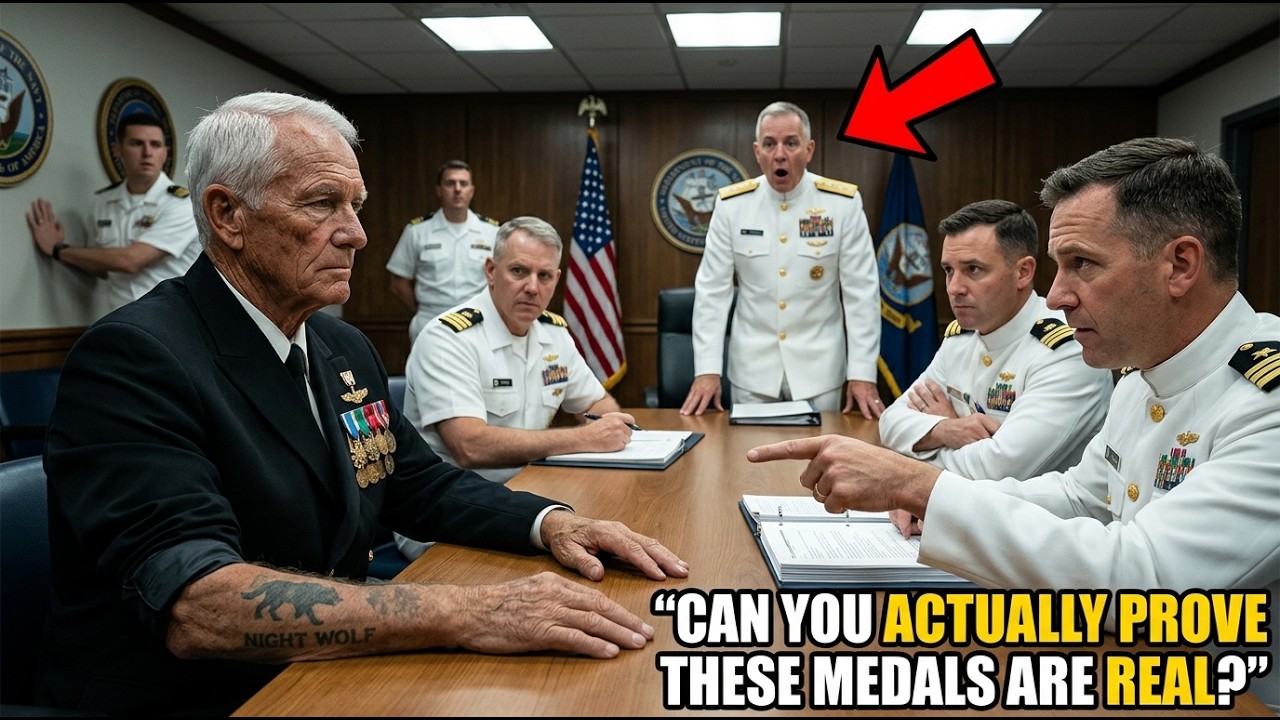
An aide entered carrying a dark blue presentation folder.
Carson accepted it and turned toward the room.
“Most of you were scheduled to attend a ceremony this afternoon. Mr. Garrett has spent the last forty-seven years refusing ceremonies, so we arranged something small enough that he might not escape.”
A few restrained smiles appeared.
Garrett did not smile.
Carson opened the folder.
“Thomas Elias Garrett enlisted in the United States Navy at seventeen. He served with underwater demolition personnel before selection into the early SEAL community. He later operated with SEAL Team One and alongside Military Assistance Command, Vietnam—Studies and Observations Group.”
The room seemed to draw inward around the words.
“Between 1967 and 1971, Petty Officer Garrett participated in twenty-nine confirmed deep reconnaissance and personnel-recovery missions. Several crossed borders the United States did not publicly acknowledge crossing.”
Carson turned a page.
“His file credits him with the recovery of fourteen American aviators and at least thirty-one allied personnel. The actual number may be higher.”
Webb’s eyes shifted toward Garrett.
The old man was not looking at Carson.
He was looking at the photograph on the wall.
The six men beside the helicopter.
“Garrett received the Navy Cross, two Silver Stars, four Bronze Stars with Valor and three Purple Hearts,” Carson continued. “One recommendation was elevated beyond the Department of the Navy but sealed because the supporting mission could not be disclosed without compromising active operations and foreign agreements.”
Nobody needed Carson to say the words.
Everyone understood what award existed above the Navy Cross.
Webb’s breathing became shallow.
The presentation folder contained citations, operational summaries and photographs, many with entire paragraphs blacked out.
Carson lifted one page.
“This report describes the mission that produced his call sign.”
Garrett finally looked away from the wall.
“You don’t need to read that.”
“Yes,” Carson said quietly. “I do.”
The old man’s face tightened.
Carson faced the room.
“In November 1969, Garrett’s reconnaissance element was compromised near a river valley used as a major supply corridor. Their point man was killed. Two others were critically wounded. The team called for extraction, but enemy fire forced the first helicopter away.”
No one in the room made a sound.
“The surviving men moved toward a secondary landing zone. During that movement, Garrett discovered that one allied scout was missing. His team leader told him the man was almost certainly dead.”
Carson paused.
“Garrett went back alone.”
The operators listening understood what those four words meant.
Not bravery in the abstract.
Not a clean action scene from a movie.
They meant moving against the flow of survival. Returning through enemy fire to a position already overrun. Choosing a man who might be dead over the possibility of reaching home alive.
“He found the scout unconscious and carried him nearly a kilometer,” Carson said. “When pursuit closed in, Garrett concealed the wounded man, drew the enemy away and returned again after dark.”
Master Chief Rourke lowered his eyes.
“The opposition began referring to an American who repeatedly returned for men they believed had been lost. Intercepts translated the description in several ways. The name entered our records as Redeemer.”
Carson looked at Garrett.
“He did not receive the call sign because he believed he could save everyone.”
Garrett’s eyes remained on the photograph.
“He received it because he refused to let the abandoned believe nobody was coming.”
Webb looked down at the soup stains on Garrett’s sleeve.
Only then did the full weight of what he had done become visible on his face.
His shoulders, so rigid minutes earlier, seemed to lose their structure. His lips parted, but no words emerged. Around him stood men whose respect he had commanded through rank, record and authority.
Now they were watching him understand that he had humiliated someone who had helped create the standard by which all of them measured courage.
Carson closed the folder.
“Rear Admiral Webb.”
“Sir.”
“You saw an old man in worn shoes and decided that confusion was more likely than significance.”
Webb stared straight ahead.
“Yes, sir.”
“You saw an access code you did not recognize and chose force before knowledge.”
“Yes, sir.”
“You converted a security question into a contest of authority because he did not respond with the fear you expected.”
The muscles in Webb’s jaw moved.
“Yes, sir.”
Carson stepped closer.
“In this profession, an untested assumption does not merely embarrass people. It kills them.”
Webb’s face had gone gray.
“I understand.”
“No,” Carson said. “You are beginning to.”
The rebuke settled over the room.
Webb turned toward Garrett.
For several seconds, he seemed unable to speak. This was a man accustomed to briefing cabinet officials, commanding task groups and making decisions while other people waited for certainty.
Now certainty had deserted him.
“Mr. Garrett,” he finally said, “I was wrong.”
Garrett said nothing.
Webb continued.
“I failed to verify the information in front of me. I allowed frustration and pride to affect my judgment. And I treated you without the respect owed to any person, regardless of your record.”
His eyes moved toward the soup bowl.
“What I did was inexcusable. I am sorry.”
Carson watched Garrett carefully.
The old veteran lowered himself back into his chair.
“You thought I was nobody,” he said.
Webb did not try to defend himself.
“Yes.”
Garrett nodded slowly.
“That’s the part you need to remember.”
Webb’s eyes lifted.
Garrett rubbed the scar along his wrist.
“You’re apologizing because you found out I have medals. Because an admiral walked in. Because the Master Chief knew my name.”
He pointed toward the kitchen, where a young civilian employee stood watching.
“Would you apologize the same way if I had spent forty years washing dishes?”
Webb looked toward the employee.
No answer came.
Garrett leaned back.
“I’ve known brave men whose names never appeared in a citation. I’ve known cooks who stayed at their stations during attacks, corpsmen who worked until their hands stopped closing, mechanics who kept aircraft flying with tools older than the pilots.”
His voice was quiet, but the entire facility heard it.
“Rank tells you what responsibility a person holds. It does not tell you how much wisdom they carry.”
He glanced at his trembling hand.
“And age tells you how long someone has survived. It does not tell you whether they have become useless.”
Carson turned to Webb.
“The Secretary has been briefed. Depending on my recommendation, this incident could result in formal censure, removal from command or reassignment pending retirement.”
The words struck the room like a dropped weight.
Webb did not protest.
“I understand, sir.”
Garrett looked at Carson.
“That won’t fix it.”
Carson raised an eyebrow.
“What would?”
“Make him stay.”
Webb looked confused.
Garrett nodded toward the rows of tables.
“Make him stay for the ceremony. Make him hear the names of the men who didn’t come home. Make him sit with the youngest people in this building and explain what happened here without hiding behind an aide or a statement.”
Carson considered him.
“And after that?”
“Put him in charge of reviewing how this command teaches authority.”
Webb blinked.
Garrett continued.
“He knows how to give orders. Make him prove he knows when not to.”
Carson’s expression softened.
“You’re asking me not to end his career.”
“I’m asking you not to waste the lesson.”
The room remained silent.
Garrett reached for the bowl Webb had moved, but the soup had gone cold.
Before he could touch it, Webb stepped forward.
He picked up the bowl.
For one brief moment, several operators tensed, remembering how he had taken it the first time.
But Webb carried it to the serving counter.
He asked for fresh soup.
Then he returned, set the bowl carefully in front of Garrett and placed the spoon beside it.
No speech.
No dramatic salute.
Just a rear admiral serving lunch to the man he had mistaken for an intruder.
Garrett examined the bowl.
“This one looks hotter.”
“Yes, sir,” Webb said.
Garrett raised an eyebrow.
“I’m not a sir.”
Webb looked at him.
“I know.”
For the first time, Garrett smiled.
That afternoon, Thomas Garrett stood beneath the photographs of men he had once carried, covered and refused to leave behind.
The ceremony was brief, just as he demanded.
Some details of his service remained classified. Some names were spoken only once. There was no press, no television crew and no public announcement.
Rear Admiral Marcus Webb sat in the first row.
He did not check his phone.
He did not speak.
He listened.
In the months that followed, Webb remained in command, but not unchanged. He required senior officers to complete access and classification refresher training alongside junior personnel. He prohibited public humiliation as a leadership tool. Every command review began with one question:
“What are we assuming that we have not verified?”
The story of the soup bowl spread through the compound, though nobody told it as a joke.
Years later, operators still remembered the moment the balance of power changed inside that dining facility.
It was not when the Chief of Naval Operations entered.
It was not when the medals were listed.
It was when an old man with shaking hands looked at a powerful admiral and reminded him that dignity should never depend on discovering someone’s résumé.
Because the quietest person in the room may be carrying a history you are not important enough to recognize—until the moment your character is tested in front of them.