The receptionist looked at the man’s worn leather briefcase, then at his old jacket.
“You can’t wait in here,” she said, without asking his name. “Please go outside.”
The man nodded, quietly stepped back through the glass doors, and sat on a wooden bench in the cold.
Forty minutes later, the company’s entire executive team came running downstairs.
Because the man they had just thrown out was the founder of the company.
His name was Daniel Brooks.
But that morning, before anyone dismissed him as unimportant, he had been standing in a small kitchen at 5:42 a.m., trying to make two braids look the same.
“Daddy, that one is crooked,” his eight-year-old daughter said, pointing at the left side of her head.
Daniel studied his work with the seriousness of an engineer reviewing a bridge.
“They’re not crooked,” he said. “They’re creatively independent.”
Lily stared at him through the mirror.
“That means crooked.”
Daniel laughed, untied the braid, and started again.
He had been raising Lily alone since his wife, Rachel, died several years earlier. There were still mornings when he reached for a second coffee mug before remembering there was no one to hand it to.
But grief had taught him how to move gently through ordinary moments.
He woke before sunrise every day. He made Lily breakfast, checked her homework, packed her lunch, and slipped a handwritten note beside her sandwich.
Sometimes the notes were simple.
“You are braver than you think.”
Other days, they were ridiculous.
“Warning: This apple may contain superhero powers.”
Lily saved every one of them in a shoebox under her bed.
That morning, Daniel placed the lunchbox in her backpack, helped her into her coat, and drove her to school.
Before getting out of the car, Lily turned to him.
“Are you going to your office today?”
Daniel nodded.
“Will people know who you are?”
He smiled.
“Probably not.”
Lily frowned as if this made no sense.
Daniel Brooks was not simply an employee returning from leave.
He was the founder of Brooks Technology Group, one of the fastest-growing technology companies in the country.
Fifteen years earlier, he had started the company from a rented room above a closed-down bakery. He had slept beneath his desk, repaired old computers for extra cash, and convinced his first three employees to work for salaries he could barely afford.
The company had since grown into a national organization with thousands of employees, major corporate clients, and a glass headquarters that carried his last name in silver letters above the entrance.
But during the previous year, Daniel had stepped away from daily operations.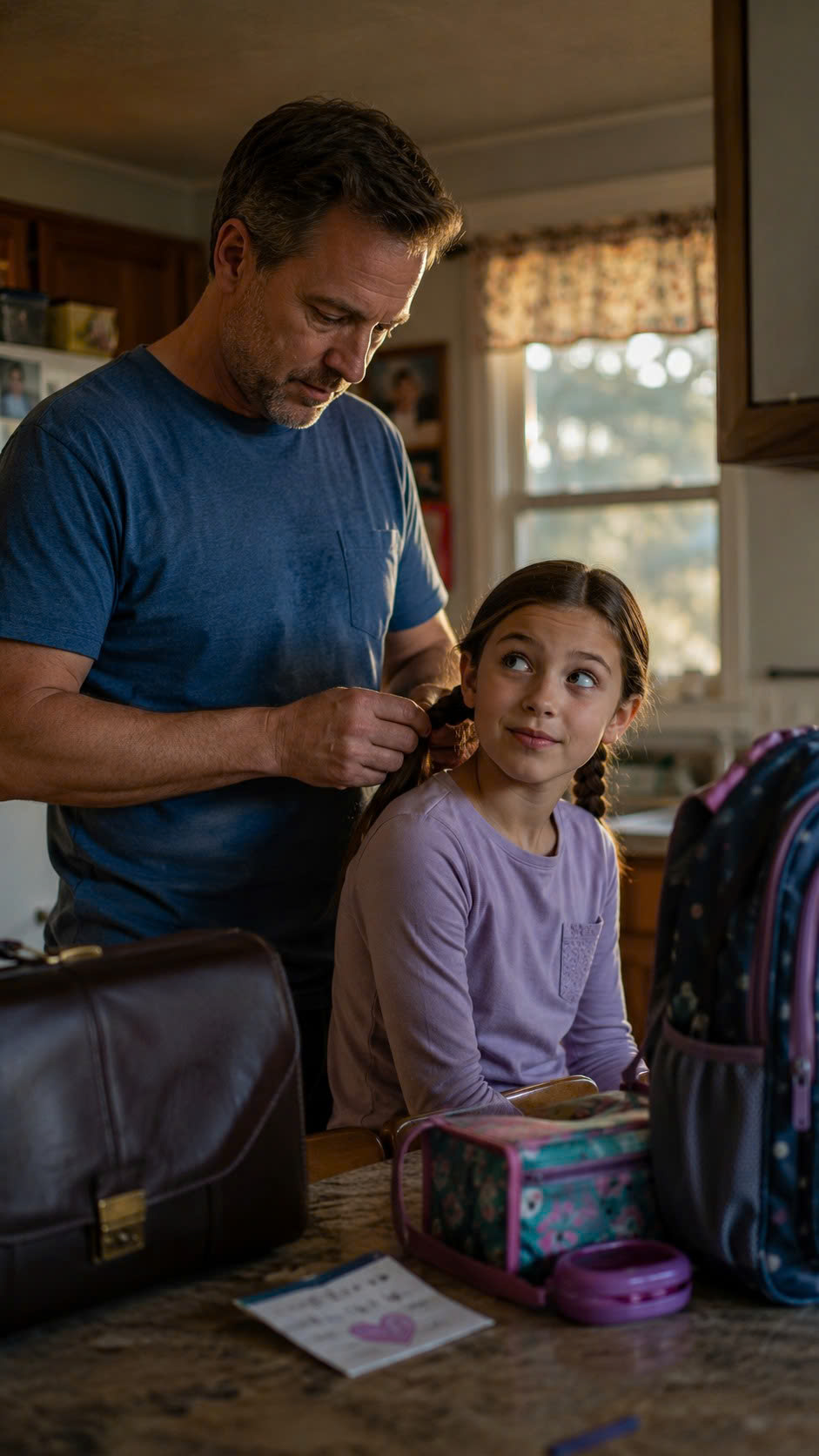
Lily had become seriously ill, and he had made the decision without hesitation. He handed control to the executive team, canceled public appearances, and spent months moving between hospital rooms, specialist appointments, and long nights beside his daughter’s bed.
The company continued growing in his absence.
Hundreds of new employees were hired.
Most had never met him.
Some had seen his name in old company newsletters. A few had passed a framed photograph of him in a conference hall without looking closely.
To them, Daniel Brooks was not a person.
He was a name printed beneath the company logo.
After Lily recovered, Daniel prepared to return.
But he did not want a ceremony. He did not want banners, rehearsed speeches, or executives waiting in the lobby with perfect smiles.
He wanted to see the company when no one knew they were being watched.
He had spent years listening to presentations about values, inclusion, service, and respect. Every quarterly report claimed the culture was strong.
But Daniel knew culture was not what people said during leadership meetings.
Culture was how someone behaved when they believed the person in front of them had no influence.
So he told no one he was coming.
He wore a plain blue shirt, an old jacket, and the same worn leather briefcase he had carried when the company was still operating above the bakery.
At 8:10 a.m., he parked two blocks away and walked toward the building.
Employees hurried past him carrying expensive coffee and polished laptop bags. The revolving doors opened into a marble lobby filled with soft lighting, tall plants, and a wide reception desk.
Daniel approached with a smile.
“Good morning.”
The receptionist continued typing.
“Do you have an appointment?”
“I was hoping to take a look around and see how things are going.”
That made her look up.
Her eyes moved from his jacket to his briefcase.
“This is a private office building.”
“I understand.”
“Then you understand that you can’t just walk in.”
Daniel kept his voice calm.
“I believe someone upstairs may be expecting me.”
“What’s the name?”
Before he could answer, another receptionist leaned over.
“If he were expected, he’d be on the visitor list.”
Daniel looked toward the elevators. Several employees were scanning their badges and walking through.
“I can explain,” he said.
The first receptionist sighed.
“Sir, people come in here all the time thinking they can speak to an executive without an appointment. That’s not how this works.”
“I’m not asking to interrupt anyone.”
“Then what exactly are you asking?”
Daniel paused.
He had imagined the possibility of being questioned.
He had not expected to be judged before giving his name.
“I’d simply like to wait inside.”
A security guard approached.
“Is there a problem?”
The receptionist gestured toward Daniel as though he were an abandoned package.
“He doesn’t have an appointment and won’t leave.”
Daniel turned to the guard.
“I haven’t refused to leave.”
“Then let’s not make this difficult,” the guard said.
There were people watching now.
A manager near the elevators glanced at Daniel, then leaned toward a colleague and whispered something. Both of them smiled.
Daniel could have ended the situation with one sentence.
He could have said his full name.
He could have called the chairman.
He could have pointed to the silver letters above the building and told them they belonged to him.
Instead, he closed his briefcase.
“It’s all right,” he said.
Then he walked outside.
The wooden bench beside the entrance was still damp from the morning fog. Daniel wiped part of it with his sleeve and sat down.
Through the glass, he could see the lobby continuing as if nothing had happened.
For the next several minutes, employees passed him without speaking.
Some glanced at his shoes.
Others looked away quickly.
One man carrying a designer coffee cup slowed near the door.
“Job applicant?” he whispered to a colleague.
“Probably went to the wrong building.”
Another employee looked through the glass and said, “That poor guy has been sitting there forever.”
No one opened the door.
No one asked whether he needed help.
Daniel sat with his hands folded over the briefcase.
He was not angry.
Not yet.
He was observing.
Every ignored glance told him more than a hundred culture surveys ever could.
Then a young woman wearing an intern badge walked past.
She was carrying a notebook, a laptop, and a stack of folders that looked too heavy for one person. She reached the entrance, noticed Daniel, and stopped.
For a second, he expected the same nervous glance everyone else had given him.
Instead, she smiled.
“Good morning. Are you waiting for someone?”
“I believe so.”
She looked at the cold bench.
“You’ve been out here for a while, haven’t you?”
“A little while.”
She hesitated, then lifted her coffee cup.
“Would you like something warm? There’s a café across the street.”
Daniel shook his head gently.
“You don’t need to do that.”
“I know.”
She shifted the folders against her hip.
“But it’s cold.”
Before he could respond, she hurried across the street.
Several minutes later, she returned holding a large coffee and a blueberry muffin in a paper bag.
“I wasn’t sure how you take it,” she said, “so I brought the milk and sugar separately.”
Daniel accepted the cup with both hands.
“That was very kind of you.”
“It’s just coffee.”
“No,” he said. “It isn’t.”
The young woman sat at the far end of the bench.
Her badge read: EMMA REED — BUSINESS OPERATIONS INTERN.
Daniel glanced at it.
“How long have you worked here, Emma?”
“Three weeks.”
“And how are you finding it?”
She smiled carefully.
“It’s a big place.”
“That sounds diplomatic.”
She laughed.
“I’m still learning who everyone is. Most people are busy.”
Daniel opened the paper bag.
“You bought this yourself?”
Emma nodded.
“You really didn’t have to.”
“My father always says everyone deserves to be treated kindly, especially when there’s nothing to gain from it.”
Daniel looked at her for a moment.
“What does your father do?”
“He drives a city bus.”
“He sounds like a wise man.”
“He is.”
Inside the building, another employee saw Emma sitting beside Daniel and shook his head.
“She’s going to be late for the operations briefing,” he said.
The receptionist glanced through the glass.
“Interns learn eventually.”
Forty minutes after Daniel had first entered the lobby, the monthly leadership meeting began on the top floor.
The boardroom table was filled with executives, department heads, and senior managers. Screens displayed performance charts. Assistants arranged documents beside bottles of imported water.
At the head of the table sat company chairman Richard Hale.
He checked the time.
“Has anyone heard from Daniel?”
The room became still.
The chief operating officer looked at his phone.
“I thought his driver was bringing him.”
“He doesn’t use a driver,” Richard said.
The head of communications opened her email.
“We sent security a notice that he might arrive this morning.”
“Might?” Richard asked.
“He wanted the visit to remain private.”
Richard called Daniel.
Outside the building, Daniel’s phone rang.
He answered while Emma took a sip of her coffee.
“Good morning, Richard.”
There was a pause.
“Daniel, where are you?”
“I’m at the office.”
Richard stood so quickly his chair rolled backward.
“Which floor?”
“I’m outside.”
Another pause.
“What do you mean, outside?”
Daniel looked through the glass doors.
“I wasn’t invited in.”
Richard’s face lost its color.
He ended the call and rushed from the boardroom.
The executives followed.
By the time the elevator reached the lobby, nearly twenty senior leaders were crowded inside. No one spoke.
The doors opened.
Richard crossed the marble floor at a near run.
The receptionists stood as he approached.
“Where is Mr. Brooks?”
The first receptionist blinked.
“Mr. Brooks?”
Richard pointed through the glass.
Every head turned.
Daniel was still sitting on the wooden bench, drinking the coffee Emma had bought him.
For one brief moment, no one moved.
Then Richard pushed open the doors.
“Daniel.”
Emma stood immediately.
Daniel rose more slowly, holding the coffee in one hand and his old briefcase in the other.
Richard looked from him to the reception desk.
“Why are you sitting out here?”
Daniel’s voice remained calm.
“Because I was told I wasn’t allowed inside.”
The receptionist’s mouth opened.
No sound came out.
Richard stared at her.
“You asked the founder of this company to leave?”
“I didn’t know who he was.”
Daniel looked at her.
“That is exactly the problem.”
The lobby fell silent.
Employees who had ignored him now stood frozen near the elevators.
The man with the designer coffee cup lowered his eyes.
The manager who had whispered earlier slowly moved behind another person.
The security guard’s shoulders stiffened.
The receptionist stared at Daniel’s face as recognition finally arrived.
Her eyes widened.
The color drained from her cheeks.
She looked toward the old photograph mounted on the far wall, then back at the man she had ordered outside.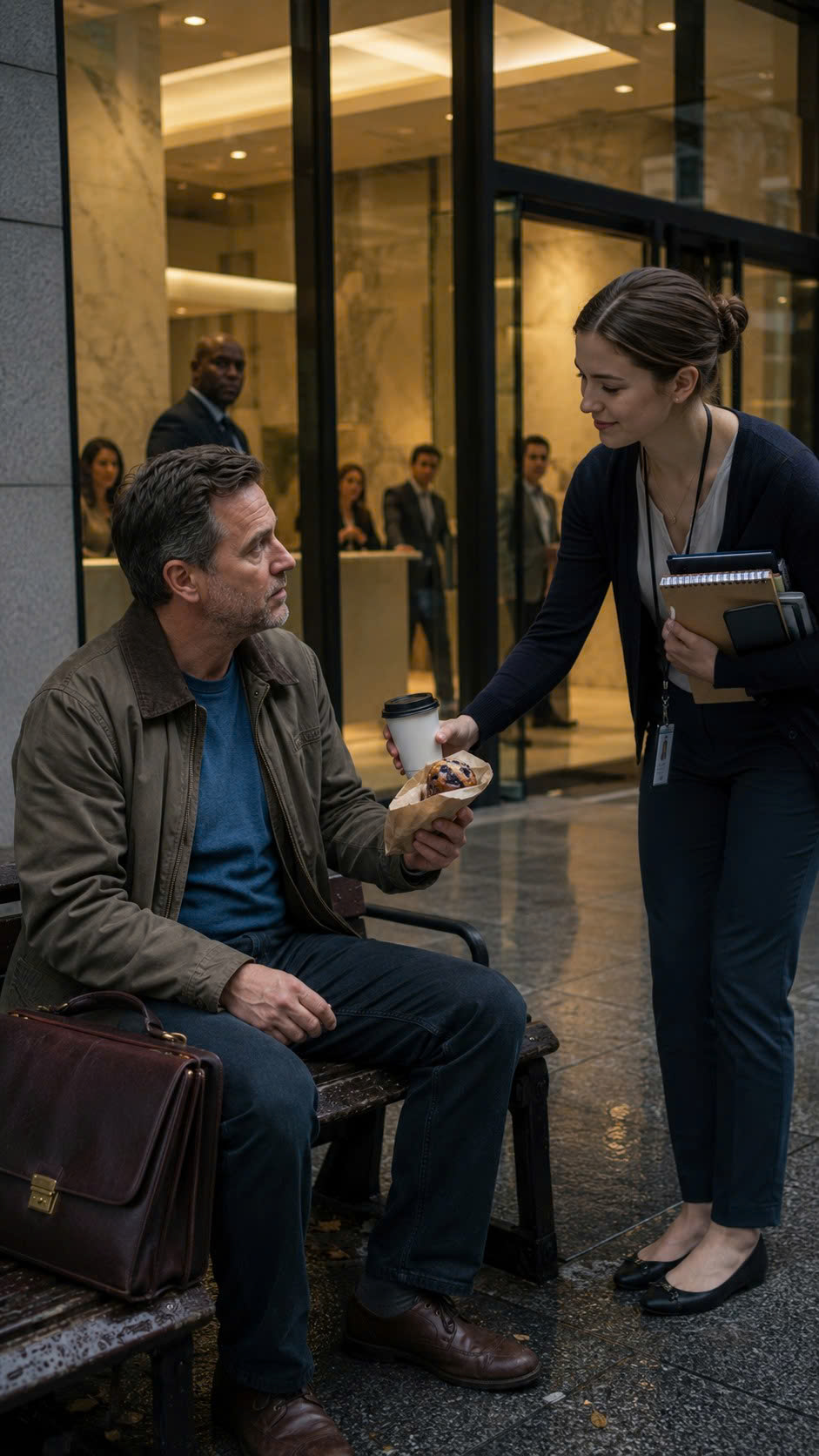
The same eyes.
The same face.
Only older, quieter, and standing directly in front of her.
Her lips parted.
“Mr. Brooks, I—”
Daniel did not raise his voice.
“You never asked my name.”
She went still.
“You decided I was not important before I had the chance to give it.”
Richard stepped closer.
“We’ll handle this immediately.”
Daniel looked through the lobby at the gathering employees.
“I believe I’ve already learned what I came here to find out.”
Then he turned toward Emma.
“Would you join us upstairs?”
Emma looked behind her, certain he meant someone else.
“Me?”
“Yes,” Daniel said. “Especially you.”
The walk to the boardroom felt longer than usual.
Senior managers entered in silence. The reception supervisor was summoned. The security manager was called. Department leaders who had witnessed the scene took seats along the wall.
Emma sat near the end of the table, still holding her notebook.
Daniel stood at the front of the room.
Behind him, the Brooks Technology Group logo filled an entire screen.
“When I founded this company,” he began, “we had four chairs, two working computers, and one client who frequently paid us late.”
A few longtime executives lowered their eyes.
“I did not build it because I wanted my name on a building. I built it because I believed people could create extraordinary things when they were respected.”
He placed his old briefcase on the table.
“This morning, I walked through our front doors. I smiled. I said good morning. I asked politely to wait inside.”
No one moved.
“I was ignored, interrupted, judged, and escorted out.”
The receptionist supervisor stared at the table.
Daniel continued.
“No one asked whether I needed help. No one asked why I had come. No one even asked my name before deciding I did not belong.”
He glanced around the room.
“And many of you walked past me.”
Several managers shifted in their seats.
“One of you called me a job applicant as though that were an insult. Another said I looked like I was in the wrong building. Someone called me a poor man and kept walking.”
A senior director’s face tightened.
Daniel rested his hand on the back of a chair.
“The issue is not that you failed to recognize the founder.”
He paused.
“The issue is that you believed kindness should depend on recognizing someone important.”
The silence deepened.
“That is not a reception problem. It is not a security problem. It is a leadership problem.”
He turned toward Emma.
“Except for one person.”
Every eye in the room followed him.
Emma looked up.
“She had been here for three weeks,” Daniel said. “She had the least authority in the building and, apparently, the clearest understanding of what authority is for.”
Emma’s eyes filled with tears.
“She asked whether I was cold. She bought me coffee. She brought me food. She sat beside someone everyone else had chosen not to see.”
Daniel looked at the executives.
“She did not know my name. She did not know my position. She expected nothing in return.”
He nodded toward her.
“That is leadership.”
The first person to clap was Richard.
Then another executive joined.
Within seconds, the room was filled with applause.
Emma covered her mouth, overwhelmed.
Daniel waited until the room quieted.
“This is not a story about revenge,” he said. “But accountability is not revenge.”
He opened a folder that had been placed beside him.
The reception manager had received multiple complaints during the previous six months. Visitors had reported being dismissed because of their clothing, accents, job titles, or perceived status.
Those complaints had been minimized.
Two senior managers had instructed staff to prioritize “high-value visitors” and avoid wasting time on people who did not appear connected to major accounts.
The morning had not created the problem.
It had exposed it.
The reception manager was dismissed that day.
The two senior managers responsible for reinforcing the behavior were removed from leadership positions pending further review.
The employees directly involved were required to complete customer care, professional conduct, and leadership training before returning to public-facing roles.
Daniel did not shout.
He did not humiliate anyone.
He simply read the findings, stated the standard, and enforced it.
Then he looked at Emma.
“Your internship was scheduled to end in two months.”
Emma nodded nervously.
“It will not.”
Her face fell for half a second.
Then Daniel smiled.
“I’m offering you a permanent position in our leadership development program, with full tuition support to complete your degree.”
Emma stared at him.
“I don’t know what to say.”
“Say you’ll call your father.”
A laugh moved through the room.
Emma wiped her cheeks.
“He’s never going to believe this.”
“Tell him his advice reached the top floor.”
In the weeks that followed, Daniel introduced a company-wide practice called the First Five Minutes.
The idea was simple.
During the first five minutes after any person entered a Brooks Technology building, someone had to acknowledge them, welcome them, and offer help.
Not only clients.
Not only executives.
Delivery drivers. Job applicants. Maintenance workers. Nervous parents. Lost visitors. People wearing tailored suits and people carrying worn briefcases.
Everyone.
Managers were expected to take turns in the lobby.
Executives attended service training alongside new employees.
Visitor satisfaction improved.
Employee complaints dropped.
The company’s internal culture scores rose higher than they had in years.
But the biggest change was harder to measure.
People began looking up.
They held doors.
They learned names.
They stopped trying to calculate someone’s importance before deciding how much respect to give them.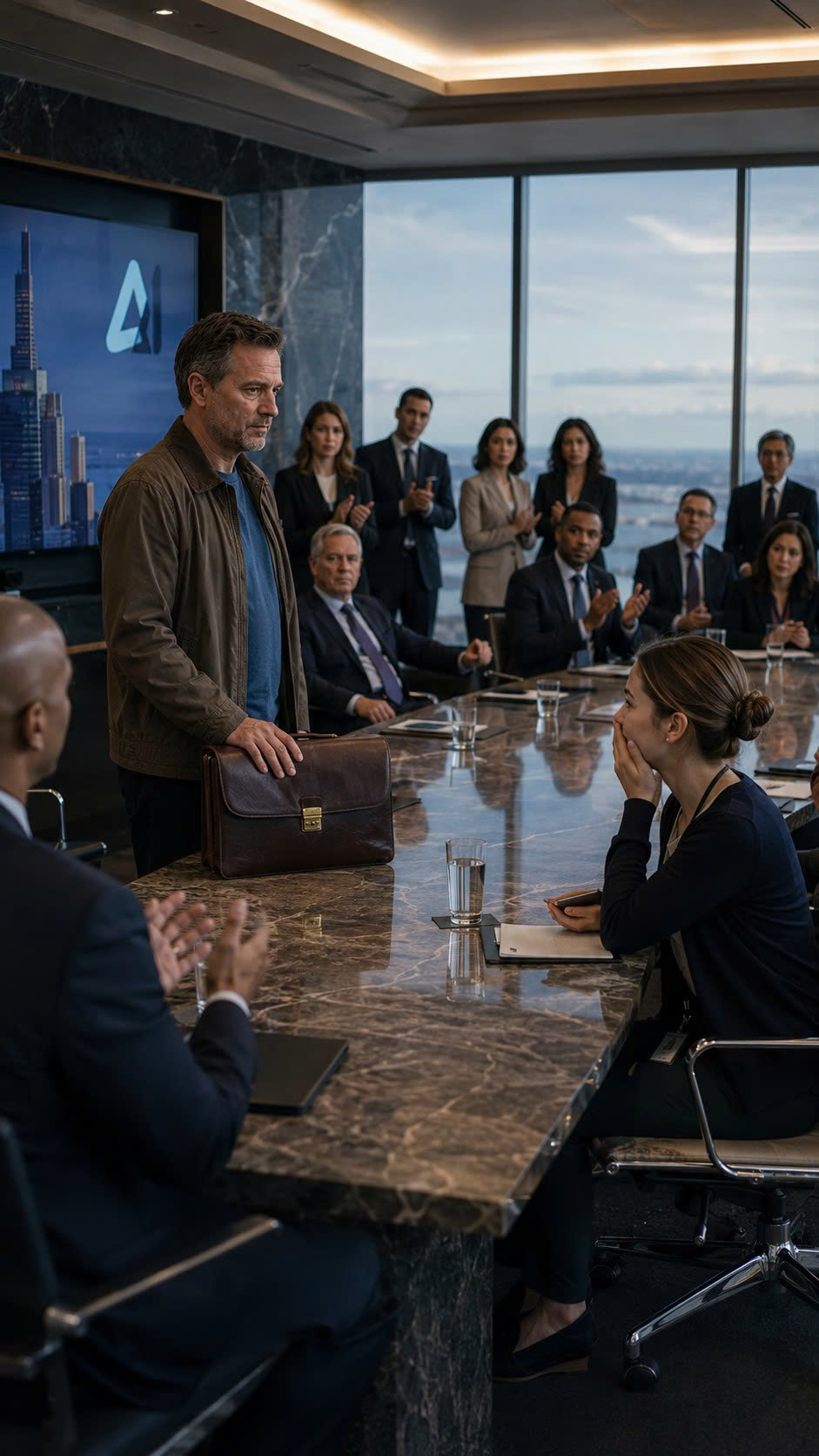
Several months later, Lily visited the office after school.
Daniel walked with her through the lobby.
A security guard greeted a delivery driver by name. A vice president helped an elderly visitor find the correct elevator. An intern offered water to a nervous job applicant.
Lily watched everything.
“People seem happier here,” she said.
Daniel looked across the lobby.
“They learned something important.”
“What?”
He adjusted the strap of her backpack.
“That kindness costs nothing.”
Lily nodded.
“That’s what you write in my lunch notes.”
“It’s still true.”
She slipped her hand into his.
Daniel looked toward the wooden bench outside the glass doors.
“And sometimes,” he said, “it can change someone’s entire day.”
Years later, employees still told the story of the single father who waited forty minutes outside the company he had built.
They did not tell it because several people lost their titles.
They told it because an intern with no power showed more leadership than an entire lobby full of people who thought they had it.
The person you ignore today may never become your boss, your customer, or someone who can reward you—and that is precisely why the way you treat them reveals who you truly are.