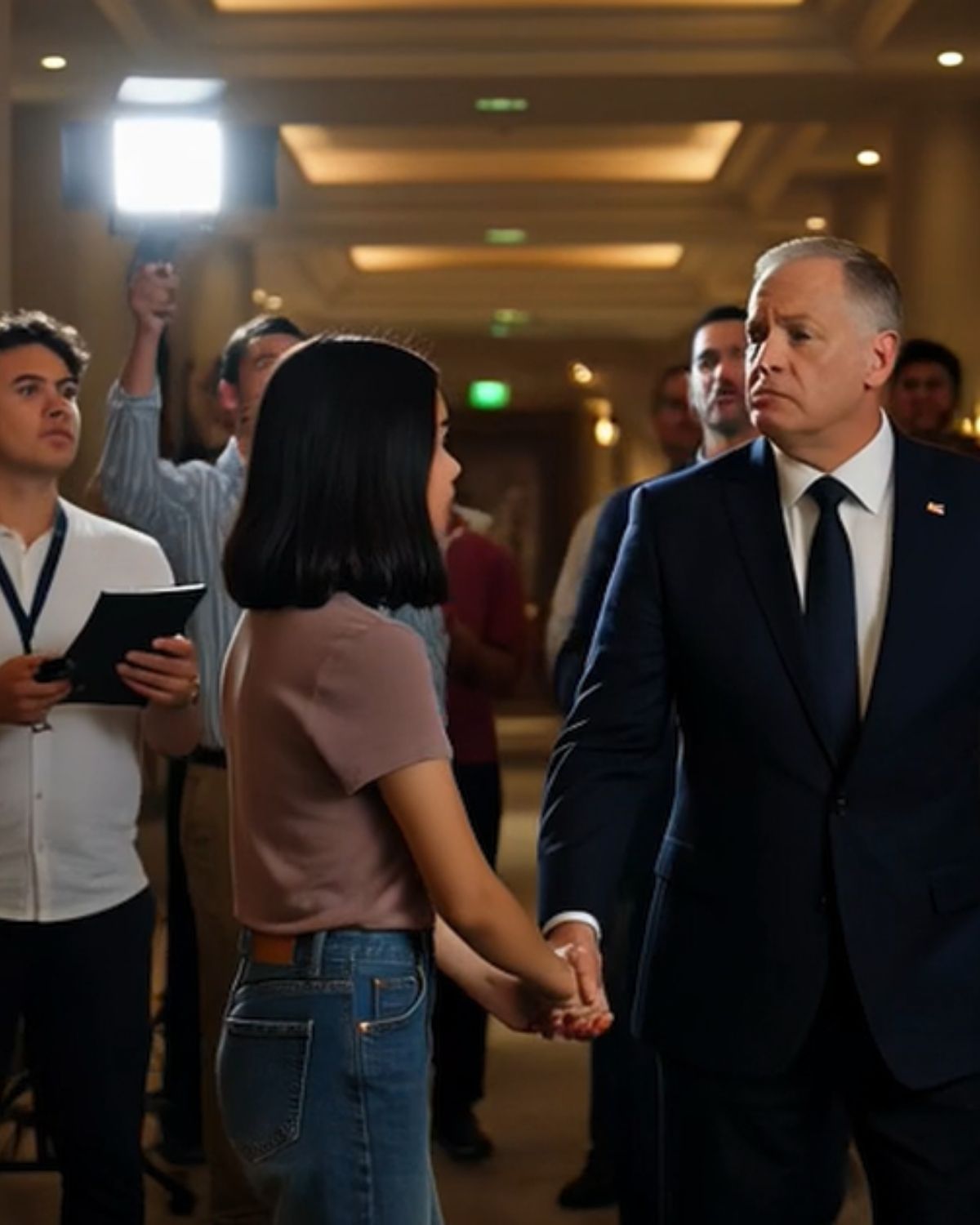
The first camera flash hit Elena Vale before both of her feet touched the pavement.
Then came twenty more.
White light exploded across the entrance of the Calderon Grand Hotel as photographers surged toward the black car. Security guards raised their arms, but the crowd pushed closer, shouting over one another.
“Elena! Look here!”
“One more photo!”
“Is it true you’re leaving the film?”
“Elena, take off the sunglasses!”
The actress stepped out wearing a silver evening dress, dark glasses, and the calm expression millions of people recognized from magazine covers.
But up close, the calmness was cracking.
Her hand gripped the car door so tightly that her knuckles turned pale. She looked toward the hotel entrance, but the red carpet had become a wall of cameras, microphones, and strangers reaching toward her.
A photographer stumbled past the barrier.
Another blocked her path.
Someone shouted a question about her recent divorce.
Elena froze.
For one second, the woman who had performed in front of sold-out theaters and accepted awards before millions of viewers looked as though she had forgotten how to breathe.
“Back up!” her security guard yelled.
Nobody did.
Across the driveway, sixteen-year-old Maya Torres stood beside a delivery cart, holding a paper bag containing two rolls and a carton of milk.
Her sneakers were worn thin at the toes. The sleeves of her secondhand jacket covered half her hands. She had been waiting for her mother, who worked the hotel’s night laundry shift, because the bus to their neighborhood stopped running early on Sundays.
Maya had seen celebrities arrive before.
Most walked quickly through the flashes without looking left or right.
But Elena was not walking.
She was trapped.
Maya noticed the actress press one hand against her chest. She noticed her eyes moving rapidly behind the sunglasses, searching for an exit that no one else seemed interested in giving her.
A hotel manager stood near the revolving doors, speaking into a radio.
“Keep her on the carpet,” he said. “The sponsors need the entrance photographs.”
Maya looked at him.
Then she looked at Elena.
Another wave of photographers closed in.
Maya dropped the paper bag onto the delivery cart and ran.
Near the side of the hotel entrance was a narrow gray door used by laundry workers and kitchen suppliers. Guests rarely noticed it. Maya knew it because she had brought her mother dinner through that door dozens of times.
She pulled it open and stepped into the chaos.
“Elena,” she called.
The actress turned, startled.
Maya pointed toward the door.
“Come this way.”
A security guard moved to stop her.
“Miss Vale stays on the approved route.”
Elena looked at the red carpet, then at the small open door.
Maya lowered her voice.
“You can hide in the linen hallway. They won’t see you from the street.”
Another flash exploded inches from Elena’s face.
That was enough.
She lifted the hem of her dress and moved toward Maya.
The photographers followed.
“Elena, where are you going?”
“Who is that girl?”
“Get the shot!”
Maya pulled Elena through the narrow doorway and slammed it shut.
The noise vanished.
For several seconds, all they could hear was Elena’s breathing and the distant hum of industrial washing machines.
The hallway was narrow and plain, with beige walls, exposed pipes, and stacks of folded towels on metal shelves. Nothing about it belonged in celebrity photographs.
Maya led Elena around two corners and opened a small storage room.
“Wait here.”
Elena stepped inside. Maya switched off the light and left the door open just enough for air to pass through.
Outside, footsteps thundered along the service corridor.
Two hotel employees rushed past.
“Check the kitchen exit,” one said. “The photographers think she went through the lobby.”
Maya stood beside a laundry cart, pretending to read a label.
A security guard appeared at the end of the hallway.
“Did someone come through here?”
Maya shook her head.
“Just the kitchen delivery.”
He looked at her old shoes, the paper bag under her arm, and the employee corridor behind her.
Then he walked away without another question.
Five minutes later, Maya opened the storage-room door.
Elena was sitting on an unopened box of hotel soap. Her sunglasses were in her lap. Without the red carpet lights and makeup cameras, she looked smaller than she did on screen.
“Are they gone?” she asked.
“Most of them went around front. Your security people are coming through the lobby.”
Elena nodded, but she did not stand immediately.
“Why did you help me?”
Maya glanced toward the hallway.
“Because you looked scared.”
The answer seemed to catch Elena off guard.
Not because it was dramatic.
Because it was not.
Maya had not mentioned money, photographs, autographs, or favors. She had not even asked for Elena’s phone number.
She had seen a frightened person and opened a door.
Elena looked at the paper bag in Maya’s hand.
“Were you waiting for someone?”
“My mother. She works downstairs.”
“Do you work here too?”
Maya shook her head.
“They don’t let family wait inside. I usually stay near the delivery entrance until her shift ends.”
Elena looked at the rolls crushed inside the bag.
“Was that your dinner?”
“One is for my mother.”
Before Elena could say anything, voices echoed from the corridor.
Her publicist, hotel security, and two event coordinators appeared around the corner.
“There you are,” her publicist said, rushing forward. “We’ve been searching everywhere.”
The hotel manager followed behind them. His eyes moved from Elena to Maya, then to the open storage room.
His jaw tightened.
“This area is restricted,” he said to Maya.
“She brought me here,” Elena replied.
The manager forced a polite smile.
“Yes, Miss Vale, but she should not have access to hotel service areas.”
Maya lowered her eyes.
The same manager who had ordered Elena to remain on the carpet now spoke as if Maya were the danger.
Elena stood.
“She helped me.”
“Of course,” he said quickly. “We appreciate that. Security will handle things from here.”
He turned to Maya.
“You need to leave.”
Maya looked down the hallway toward the laundry room.
“My mother’s shift ends at eleven.”
“You can wait outside.”
“It’s raining.”
“That isn’t the hotel’s responsibility.”
Elena opened her mouth, but her publicist gently touched her arm.
“We’re already late. The private elevator is ready.”
The manager stepped aside and gestured toward the corridor.
Maya picked up her paper bag.
As Elena was escorted away, she looked back.
Maya was walking alone toward the service exit.
No cameras followed her.
No one thanked her.
The next morning, the Calderon Grand lobby was transformed for a major media event.
Gold lights illuminated a stage beneath a banner that read:
THE VALE FOUNDATION — DIGNITY HAS NO ADDRESS
Elena had founded the organization three years earlier to fund temporary housing and school programs for low-income families. The hotel ballroom was filled with reporters, sponsors, executives, and influencers waiting for her announcement.
Rows of cameras faced the stage.
Hotel employees polished glass tables and adjusted velvet ropes.
Outside the main doors, Maya stood beneath the hotel awning.
She had returned because her mother had left her employee identification card at home. Without it, she could not enter the laundry level or receive her week’s wages.
Maya held the plastic card in one hand and a small envelope in the other.
Rain darkened the shoulders of her jacket.
She tried the side entrance, but a temporary security barrier blocked it. She walked to the lobby doors.
A staff member stepped in front of her.
“This entrance is closed for a private event.”
“I only need to give this to my mother. Her name is Rosa Torres. She works in laundry.”
“You can leave it with security.”
“I did last month. They lost it.”
The staff member looked at Maya’s clothes, then at the arriving guests behind her.
“You cannot stand here.”
“I’ll be two minutes.”
“You’re blocking the entrance.”
Maya stepped to the side.
“I’m not blocking anything.”
Inside, Elena stood near the media backdrop, answering questions about dignity, opportunity, and the importance of seeing people whom society often ignored.
Through the glass doors, she noticed a familiar gray jacket.
Maya.
Before Elena could move, the hotel manager from the previous evening appeared outside.
He spoke briefly to the staff member, then approached Maya.
“I told you yesterday that you cannot wait on hotel property.”
“My mother needs her card.”
“Give it to me.”
Maya tightened her grip.
“I’ll give it to her.”
The manager glanced toward the reporters gathering inside.
“Not today.”
He motioned to a security officer.
“Escort her away from the entrance.”
Several guests turned to watch.
Maya’s face burned, but she did not raise her voice.
“I’m not asking to attend your event.”
“You don’t belong here,” the manager said. “That should be clear.”
The words carried through the open lobby door.
Elena stopped in the middle of an interview.
A reporter was asking her how wealthy public figures could better understand people living in poverty.
Elena removed the microphone clipped to her dress.
Then she walked away from the media line.
Her publicist followed.
“Elena, the broadcast starts in ninety seconds.”
Elena did not slow down.
Outside, the security officer reached for Maya’s arm.
“Please don’t touch her,” Elena said.
Every nearby camera turned.
The manager’s posture changed instantly.
“Miss Vale, we’re simply protecting the event.”
“From what?”
He glanced at Maya.
“Unauthorized individuals.”
Elena stepped between Maya and the security officer.
“She protected me when none of your authorized employees did.”
The lobby fell silent.
The manager’s smile disappeared.
Elena turned toward Maya.
“You came back.”
“My mother forgot this.”
Maya held up the employee card.
Then she handed Elena the small envelope.
“And you dropped this last night.”
Elena opened it.
Inside was a diamond earring worth more than Maya’s family earned in several years.
The actress stared at it.
Her hand moved instinctively to her left ear.
She had noticed the earring missing after midnight. Her team had searched the car, the ballroom, the service elevator, and the hotel suite. The hotel had already prepared an insurance report.
“You found this?”
“It was near the side door.”
“Why didn’t you keep it?”
Maya looked confused by the question.
“Because it wasn’t mine.”
A ripple moved through the reporters.
Cameras lifted.
The manager looked at the diamond, then at Maya’s wet jacket.
For the first time, he seemed to realize that every camera in the lobby was no longer waiting for Elena’s foundation speech.
They were recording him.
But Elena had learned something else that morning.
Before the media event, she had asked the hotel to review the service-door footage so she could identify the girl who helped her. A junior security employee had quietly shown her the recording.
The video did more than reveal Maya’s name.
It showed the hotel manager standing safely inside the entrance while Elena struggled outside.
It recorded him telling the security team not to move her from the carpet until the sponsor photographs were complete.
It also showed Maya opening the side door, hiding Elena, finding the fallen earring, and carrying it directly to the night security desk.
The guard at the desk had waved her away.
“Lost property opens at nine,” he had said.
Maya had returned the next day because no one had been willing to accept something valuable from a girl they had already decided was worth nothing.
Elena turned toward the cameras.
“I was supposed to give a speech today about dignity,” she said. “But I think everyone here just watched the reason speeches are not enough.”
The manager stepped forward.
“Miss Vale, there has clearly been a misunderstanding.”
Elena looked at him.
“No. A misunderstanding happens when you lack information.”
She pointed toward Maya.
“You had all the information you needed. You saw a young girl bringing food to her mother. You saw her waiting in the rain. You heard her explain why she was here.”
The manager’s mouth opened, but no words came.
“You did not misunderstand her,” Elena continued. “You judged her.”
His eyes shifted toward the reporters.
The confidence left his face one piece at a time.
His shoulders dropped.
His hand tightened around his radio.
Behind him, two hotel executives whispered urgently. One checked a phone as messages began arriving from the company’s corporate office. Another stepped away from the manager as though distance could remove him from the recording.
Maya’s mother came running from the service elevator, still wearing her blue laundry uniform.
“Maya?”
She pushed through the crowd and wrapped both arms around her daughter.
The employee card fell to the floor between them.
“I told them she was my daughter,” Rosa said, looking at the manager. “I told them she waits for me because we cannot afford another taxi home.”
The manager stared at the carpet.
Elena picked up the employee card and handed it to Rosa.
Then she faced the hotel’s regional director.
“My foundation will not hold events at a property that treats employees’ families this way.”
The director nodded quickly.
“Miss Vale, we will investigate immediately.”
“No,” Elena said. “You will act immediately. The footage already shows what happened.”
The manager looked up.
His eyes met Elena’s for less than a second before dropping again.
There it was—the moment he understood.
The girl he had pushed toward the sidewalk had become the most important person in the building.
The cameras were no longer protecting his status.
They were documenting its collapse.
By noon, the hotel placed him on administrative leave. The security officer who refused to accept the earring was removed from guest services pending review. The company announced new policies allowing employees’ children to wait safely indoors during late shifts, with a staffed family room near the service entrance.
Rosa received a formal apology, payment for several hours that had been wrongly deducted from her wages, and a promotion to laundry supervisor.
But Elena was not finished.
She took Maya’s hand and led her through the lobby.
The velvet rope was lifted.
The same employees who had watched her stand outside now moved aside as she entered.
Onstage, Elena ignored the prepared speech glowing on the teleprompter.
She placed Maya beside her beneath the gold lights.
Reporters shouted questions.
“Maya, did you know how valuable the earring was?”
“Did Elena offer you a reward?”
“What will you do now?”
Maya looked at Elena, uncertain.
Elena leaned toward the microphone.
“Yesterday, when I was surrounded by hundreds of people, this young woman was the only person who noticed I was afraid.”
She paused.
“She had less power than anyone at that entrance, but she was the only one who used what she had.”
The room remained completely still.
Elena announced that the foundation would cover Maya’s remaining school expenses and create a scholarship in her name for children of hotel service workers.
Maya shook her head quickly.
“You don’t have to do that.”
“I know,” Elena said. “That’s why I want to.”
Then Elena turned toward the cameras.
“Yesterday, people knew my name and ignored hers.”
She placed one arm around Maya’s shoulders.
“Today, everyone should know her name.”
Flashes filled the room again.
But this time, Maya did not stand outside them.
She stood beside Elena, her mother in the front row, while reporters repeated her name across live broadcasts.
The diamond earring caught the light in Elena’s hand.
It was valuable because of what it was made from.
Maya’s kindness was valuable because no amount of poverty had been able to take it from her.
Status may decide who gets invited through the front door, but character is revealed by who opens a door when someone else is trapped outside.