
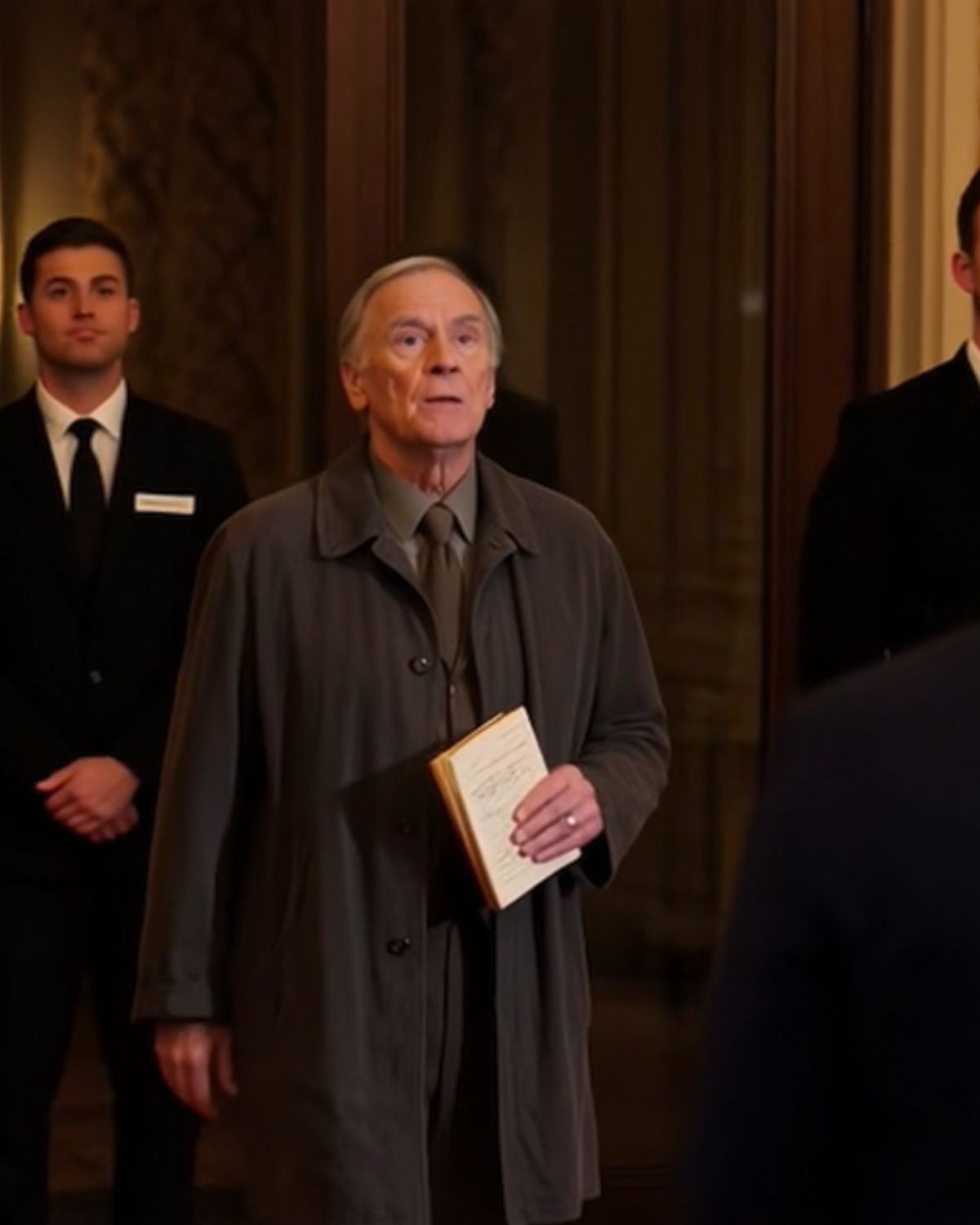
By the time the elderly man reached the ballroom doors, the celebration had already begun.
Inside the Grand Meridian Hotel, crystal chandeliers threw warm light across hundreds of guests. Executives in tailored suits raised champagne glasses beneath a forty-foot screen displaying the logo of Ardent Technologies.
The company had just completed the largest acquisition in its history.
Investors smiled for cameras.
Board members shook hands.
Onstage, a string quartet played while waiters moved between tables carrying silver trays.
Then the ballroom doors opened.
An elderly man stepped inside wearing a faded brown coat.
His shoes had been polished, but the leather was cracked at the sides. Rain darkened the shoulders of his coat, and in one hand he carried an old blue music notebook held together with a strip of clear tape.
He paused beneath the entrance lights.
Several guests turned.
Their eyes moved from his coat to his shoes, then quickly away.
A woman at the nearest VIP table leaned toward her husband.
“Is he part of the entertainment?”
Her husband looked over his shoulder.
“I doubt it.”
The man took another step into the ballroom.
A hotel staff member named Claire intercepted him before he reached the first row of tables.
“Sir, are you looking for someone?”
The elderly man nodded.
“I was invited.”
Claire glanced at the tablet in her hand.
“May I have your name?”
“Samuel Anderson.”
She typed it.
Nothing appeared.
“Could it be under another name?”
“No. Samuel Anderson.”
Claire searched again.
Behind her, two guests waiting to enter began whispering.
One of them looked at the old music notebook.
“Maybe he’s a retired musician hoping for work.”
The other smiled.
“At this event?”
Samuel heard them.
He lowered his eyes and carefully adjusted his grip on the notebook.
Claire’s voice remained polite, but it became firmer.
“I’m sorry, Mr. Anderson. I don’t see your name on the guest list.”
Samuel reached into his coat pocket and removed a folded envelope.
“The invitation came last week.”
Claire opened it.
The card was genuine. It carried the embossed Ardent Technologies logo and the signature of the company’s chief executive officer, Ethan Cole.
But the invitation had no table number.
No digital confirmation code.
No assistant’s contact details.
Only a handwritten sentence:
Please come. I have waited a long time for this night.
Claire studied it.
“Who gave this to you?”
“It arrived at my apartment.”
“Did you confirm your attendance?”
Samuel looked uncertain.
“There was a number on the outer envelope. My neighbor’s daughter called it for me.”
Claire checked the system again.
At the VIP registration desk, another staff member approached.
“What’s the issue?”
“He has an invitation, but he isn’t listed.”
The second employee examined Samuel’s coat and then the card.
“There have been people trying to get inside all evening.”
Samuel’s fingers tightened around the notebook.
“I am not trying to cause trouble.”
“Of course,” Claire said. “But this is a private corporate event.”
“I understand.”
He looked past her into the ballroom.
On the enormous screen, a video showed Ethan Cole visiting company offices around the world—Tokyo, Berlin, Singapore, Chicago.
Samuel watched silently.
The second staff member returned the invitation.
“You may wait in the lobby while we verify it.”
Samuel nodded.
“Thank you.”
But before he could turn, a group of executives entered behind him.
One man brushed against Samuel’s shoulder.
The blue notebook slipped from his hand and fell open on the marble floor.
Several pages scattered near the ballroom entrance.
Handwritten musical notes covered them.
There were scales, chord exercises, and comments written in red ink.
One page held the uneven handwriting of a child.
I will play this without stopping one day. — Ethan, age 11
Samuel moved quickly to gather the pages.
No one helped.
The executives stepped around him.
One of them glanced down.
“Careful, sir.”
Samuel knelt on the floor, pressing the pages together with trembling hands.
Claire hesitated.
Then she crouched beside him and picked up the last sheet.
“This looks very old,” she said.
“Forty-one years.”
“Were you a music teacher?”
Samuel smiled faintly.
“I still am, when someone needs one.”
Across the ballroom, the lights dimmed.
Applause rose as Ethan Cole walked onto the stage.
At fifty-two, Ethan was known as one of the most successful technology executives in the country. Business magazines described him as disciplined, private, and almost impossible to surprise.
He wore a black suit without a tie.
Behind him, the screen displayed photographs from Ardent’s early years: five employees, one rented office, and a borrowed conference table.
“Twenty-five years ago,” Ethan began, “this company had more unpaid bills than customers.”
The guests laughed.
He spoke about risk.
About loyalty.
About the people who stayed when success seemed unlikely.
At the ballroom entrance, Samuel remained standing beside Claire.
He could hear the speech, but he could not see the stage clearly.
The second staff member checked his watch.
“We’ll need to move him. The doors must remain clear.”
Claire lowered her voice.
“He has a personal invitation from Mr. Cole.”
“Then someone made a clerical mistake.”
“So we should verify it.”
“We are in the middle of the CEO’s speech.”
Samuel folded the invitation and returned it to his pocket.
“It’s all right,” he said. “I can leave.”
Claire looked at him.
“You came through the rain.”
“It was only two buses.”
“You should wait.”
Samuel glanced toward the stage again.
“I think he has enough people here.”
The second staff member gestured toward the lobby.
“This way, please.”
Samuel turned.
Onstage, Ethan reached the final section of his speech.
“Tonight, people will talk about this acquisition as if one decision built this company. But no life is built by one decision.”
He paused.
“No future is built by one person.”
The giant screen changed.
A photograph appeared behind him.
It showed a thin boy sitting at an upright piano in a small classroom. His hair was too long, his shirt was wrinkled, and one shoelace was untied.
Beside him stood a young teacher holding a blue notebook.
At the entrance, Claire looked down at the notebook in Samuel’s hands.
Then back at the screen.
Her face changed.
Ethan turned toward the photograph.
“For years, I have told people that my first office was a garage.”
He smiled slightly.
“That is not true.”
The room became quiet.
“My first office was a music room in a public school that no longer exists.”
Samuel stopped walking.
Ethan continued.
“When I was eleven, my father lost his job. We moved three times in one year. I stopped turning in assignments. I fought with other students. Most adults decided I was difficult.”
Several guests lowered their glasses.
“But one teacher noticed I always stayed near the piano after school.”
Ethan looked toward the ballroom entrance.
The doors were still open.
He saw the faded brown coat.
The old blue notebook.
And the man holding it.
Ethan stopped speaking.
For a moment, he did not move.
Hundreds of guests waited.
A board member looked toward the teleprompter, thinking perhaps the speech had malfunctioned.
Ethan’s hand slowly dropped from the lectern.
“Mr. Anderson…”
His voice was barely louder than a whisper, but the microphone carried it across the ballroom.
Samuel looked toward the stage.
Ethan stared at him as though the chandeliers, the executives, and the cameras had disappeared.
Then he stepped away from the lectern.
The event director moved toward him.
“Ethan, the live feed—”
Ethan walked past her.
He came down the stage steps and crossed the ballroom.
Guests turned in their chairs as the CEO moved between the VIP tables.
At the entrance, the second staff member stepped away from Samuel.
Claire remained beside him, holding one loose page from the notebook.
Ethan stopped several feet in front of his former teacher.
For a few seconds, neither man spoke.
Samuel looked older than Ethan remembered.
His shoulders were narrower.
His hands shook slightly.
But his eyes were the same.
“You came,” Ethan said.
Samuel lifted the invitation.
“You asked me to.”
Ethan looked toward the registration staff.
“Why was he standing outside?”
No one answered immediately.
Claire spoke first.
“His name was not in the system.”
“I put it there myself.”
The event director hurried forward and checked her tablet.
Then her face went pale.
“Mr. Anderson was listed under special guests, but the list was updated this afternoon. His entry was accidentally removed when the seating chart changed.”
The second staff member cleared his throat.
“We were trying to verify his invitation.”
Ethan looked at the blue notebook in Samuel’s hand.
Then at the ballroom full of people who had watched the old man kneel on the floor while they walked around him.
“He does not need to be verified,” Ethan said. “He is the reason I am standing here.”
The room became completely silent.
Samuel shook his head.
“No, Ethan.”
“Yes.”
Ethan took the notebook carefully.
The clear tape along its spine had yellowed. Several pages had torn loose. On the cover, beneath years of scratches, were two handwritten words:
Ethan Cole
Ethan opened it.
The first page contained a beginner’s exercise.
The second held a teacher’s note.
Good hands. Strong memory. Gives up too quickly.
A few guests smiled softly.
Ethan turned several pages.
Near the middle was a composition titled “City Lights,” written by a twelve-year-old boy.
The melody was simple.
The comments in red ink were not.
Don’t play what you think people expect. Play what you can hear.
Ethan looked up.
“You kept this?”
Samuel shrugged.
“You never came back for it.”
“I thought it was gone.”
“You had other things to carry.”
Ethan’s jaw tightened.
For years, he had told interviewers that music taught him discipline.
That was true.
But it was not the whole truth.
He looked toward the audience.
“When I was twelve, my mother told Mr. Anderson we could no longer afford piano lessons.”
Samuel lowered his gaze.
“He said I could stay anyway.”
Ethan’s voice became unsteady.
“He gave me lessons after school for three years. He paid for my bus pass when we moved outside the district. He found a used keyboard and carried it up four flights of stairs to our apartment.”
Samuel spoke quietly.
“It was not a good keyboard.”
“It was the first thing in that apartment that belonged to me.”
The guests remained still.
Ethan looked at his former teacher.
“You were the first person who believed I could succeed.”
Samuel’s mouth trembled into a small smile.
“I believed you could finish a song.”
“Before anyone knew my name, you gave me hope.”
Ethan turned toward the stage.
On the screen, the photograph of the young teacher and the angry eleven-year-old boy remained frozen.
But there was one part of the story Ethan had never told publicly.
Not to journalists.
Not to his board.
Not even to most of his family.
He opened the notebook to its final page.
A small envelope had been taped inside the back cover.
Ethan stared at it.
“You still have this too?”
Samuel nodded.
The envelope contained a faded receipt from the Midwestern Youth Music Competition.
The entry fee had been forty dollars.
To the guests in the ballroom, forty dollars was less than the cost of parking that evening.
To Ethan’s family at the time, it had been impossible.
Ethan held the receipt up.
“When I was fifteen, Mr. Anderson entered me into a state music competition.”
He looked at Samuel.
“You told me the school had paid the fee.”
Samuel said nothing.
“The school did not pay it.”
Samuel glanced around the room.
“This was supposed to be your celebration.”
Ethan stepped closer.
“You sold your violin.”
A murmur moved through the ballroom.
Samuel’s eyes lifted sharply.
He had never told Ethan.
For years, Ethan believed the old violin had been stolen from Mr. Anderson’s car.
He learned the truth only three weeks earlier, when an Ardent employee researching the company anniversary found a newspaper classified advertisement from 1989.
German student violin. Well maintained. Must sell quickly.
The phone number belonged to Samuel Anderson.
The advertisement had appeared two days before Ethan’s competition fee was due.
Ethan continued.
“You sold the violin your father gave you so I could enter.”
Samuel’s face lost its color.
“How did you find that?”
“It took me forty-one years to ask the right questions.”
The teacher looked down at his hands.
“The competition gave you something to work toward.”
“You lost something you loved.”
“I was a teacher.”
“That does not mean it cost you nothing.”
Samuel’s eyes filled, but he blinked the tears away.
“You won.”
“I came third.”
“You finished the piece.”
The answer struck Ethan harder than praise would have.
Samuel had never cared about the medal.
He had cared that a boy who abandoned everything had remained onstage until the final note.
Ethan reached for his teacher’s hand.
“Tonight, everyone should know who helped build my future.”
He led Samuel toward the stage.
This time, no one looked at the old coat.
Guests stood as the two men passed.
First the employees near the entrance.
Then the executives.
Then the investors at the VIP tables.
Within seconds, the entire ballroom was on its feet.
Samuel walked slowly beside the CEO, still holding the old notebook against his chest.
At the front row, a famous venture capitalist who had ignored him earlier began clapping.
The woman who had asked whether he was part of the entertainment lowered her eyes.
The second registration employee stood motionless near the doors, his face tight with embarrassment.
Claire was the last person Samuel looked back at.
She held up the loose notebook page she had rescued from the floor.
Samuel nodded his thanks.
Onstage, Ethan pulled out the chair beside his own.
Not near the back.
Not beside the staff entrance.
At the center of the head table.
The event director rushed forward with a microphone, but Ethan did not resume the prepared speech.
Instead, he turned to the string quartet.
“Do you know ‘City Lights’?”
The musicians looked at one another.
Their leader shook her head.
Samuel gave a quiet laugh.
“No one knows it.”
Ethan opened the old notebook to the handwritten composition.
“They do now.”
The quartet gathered around the pages.
The melody began carefully.
Four simple notes.
Then six.
Then a rising phrase written by a lonely twelve-year-old who had once believed no one expected anything from him.
Samuel listened with both hands resting on the table.
Ethan stood beside him.
As the music filled the ballroom, the giant screen changed again.
The company logo disappeared.
In its place was a new announcement:
THE SAMUEL ANDERSON MUSIC FUND
Ethan explained that the fund would provide instruments, transportation, and free lessons to students whose families could not afford them.
Ardent Technologies would finance the program for a minimum of ten years.
Samuel turned toward him.
“You planned this?”
“I invited you because I needed your permission to use your name.”
“You could have called.”
“I was afraid you would say no.”
Samuel looked around the room.
“That was possible.”
Laughter moved gently through the audience.
Then Ethan placed a small black case on the table.
He opened it.
Inside was a restored German violin.
The original violin.
Ethan had located it in the collection of a retired orchestra director in Ohio. The instrument had changed owners three times, but the serial number matched the receipt Samuel’s family had kept for decades.
Samuel stared at it.
He did not reach out.
His lower lip moved, but no words came.
The confidence he had carried quietly through years of underpaid lessons finally broke.
He touched the worn wood with two fingers.
“My father carved this mark,” he said.
Near the neck of the violin was a tiny star.
The room watched as Samuel lifted the instrument from its case.
His hands still trembled.
But when he placed the violin beneath his chin, they became steady.
The quartet stopped.
Samuel played the final phrase of “City Lights” alone.
The sound was thinner than it might have been forty years earlier.
It was also clear.
When the last note faded, the ballroom remained silent for one breath.
Then the applause came.
Not the polite applause given to sponsors.
Not the automatic applause given at corporate events.
People stood because they had finally understood what they were seeing.
A powerful man was not honoring someone famous.
He was honoring the person who had seen value in him when there was no reward for doing so.
The following morning, a photograph from the celebration appeared across newspapers and business websites.
It did not show the acquisition announcement.
It showed Ethan Cole standing beside an elderly man in a faded coat, both of them holding an old music notebook.
Ardent’s board approved the music fund unanimously.
The hotel formally apologized to Samuel and retrained its event staff on handling unlisted guests with verified invitations.
Claire received a commendation for refusing to send him away before the invitation could be checked.
Samuel returned to teaching the following Monday.
His classroom was still small.
The piano was still out of tune.
But a delivery truck arrived before noon carrying eight keyboards, twelve violins, music stands, and boxes of notebooks.
A handwritten card rested on top.
For the next student who needs someone to stay after school. — Ethan
Samuel placed the card inside the old blue notebook.
Then he opened the classroom door.
Three children were already waiting in the hallway.
That night in the ballroom, wealth decided where people sat, titles decided who was introduced, and clothing decided who was judged.
But when the CEO stood up, everyone learned the truth:
Success may put one person on the stage, but behind every life that rises is someone who believed in it before the applause began.


