They Called Her “Just Maintenance” — Until the A-10 Went Dark and She Said, “I Can Fly the Hog”
Chapter One
The Woman Beneath the Wing
The rocket arrived without a whistle.
One moment, Forward Operating Base Halcyon lay beneath the white furnace of the Syrian noon, its concrete barriers trembling in the heat. The next, the western wall lifted in a column of sand, black smoke, and pieces of somebody’s folding chair.
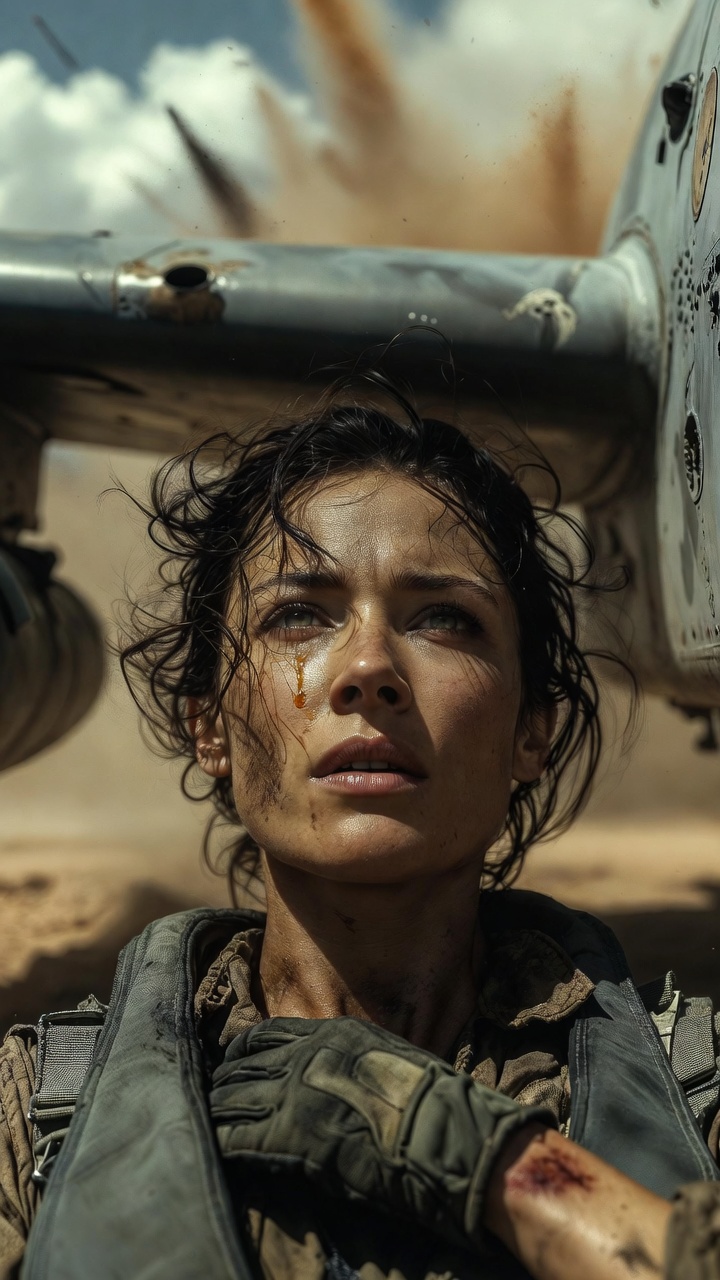
The concussion struck Mara Voss while she was lying beneath the right wing of an A-10C Thunderbolt II.
Her wrench jumped from her hand.
The aircraft rocked on its landing gear.
Dust rolled beneath the fuselage, swallowing her legs.
“Contact west!” someone shouted.
A siren began to howl.
Mara did not move.
Above her face, a thin ribbon of hydraulic fluid crept along a steel line. The liquid gathered at a coupling, swelled into a trembling amber bead, and dropped onto the bridge of her nose.
She wiped it away with one gloved finger.
Another rocket hit beyond the fuel bladders.
The ground punched her shoulder blades.
Boots thundered past the aircraft.
“Voss!” Staff Sergeant Lucas Boone appeared beside the landing gear, his rifle hanging across his chest. “You planning to die under there?”
Mara turned her wrench exactly one quarter rotation.
“Not today.”
“Then get to the bunker.”
“The return line is cracked.”
Boone stared at her through a curtain of blowing sand.
“Incoming rockets, Mara.”
“I heard them.”
“The plane isn’t going anywhere.”
“It will if I finish.”
Boone’s mouth tightened. He was thirty-two, sunburned beneath his eyes, with a grin that usually appeared two seconds before somebody else became the joke. For six months, he had called Mara Grease Rag, Toolbox, and Saint Snap-On.
Never by her first name unless something was on fire.
Now something was.
A third explosion rolled across the base.
A sheet-metal maintenance shed folded inward with the slow dignity of a dying animal.
Mara slid farther beneath the wing.
Boone grabbed her ankle.
She kicked free.
“Touch me again,” she said, “and I’ll break your thumb.”
“You can threaten me in the bunker.”
“Give me eighty seconds.”
“We may not have eighty seconds.”
Mara looked past him.
At the northern end of the runway, a second A-10 sat beneath a sun canopy, its gray skin streaked with oil and dust. Beyond it, an HH-60 rescue helicopter crouched behind blast walls while its rotors remained chained.
A wall of brown had swallowed the eastern horizon.
The sandstorm had come early.
It rose thousands of feet into the sky, moving toward Halcyon like the front of a collapsing continent.
Mara looked back at the hydraulic coupling.
“Seventy-five seconds.”
Boone swore and dropped beside the landing gear, raising his rifle toward the western wall.
“That’s why no one likes you.”
“People like me.”
“Name one.”
“You’re protecting me.”
“I’m protecting the aircraft.”
Mara almost smiled.
Then the radio clipped to Boone’s vest cracked alive.
“Halcyon, Halcyon, this is Kestrel Actual. Troops in contact. Grid follows.”
Boone’s expression changed.
The voice beneath the static belonged to Senior Chief Noah Talbot, leader of the SEAL element operating thirty miles south of the base.
Gunfire snapped behind his words.
“Kestrel Actual, say status,” the operations center replied.
“We have two critical, three ambulatory. Enemy force maneuvering north and west. Estimate forty-plus.”
A second voice shouted through Talbot’s transmission.
Then came the heavy, unmistakable hammering of a belt-fed machine gun.
Boone pressed a hand to his earpiece.
The maintenance crew had stopped running.
Even the men climbing into bunkers turned toward the radio speakers mounted outside the operations building.
“Air support?” Talbot asked.
The answer took too long.
“Negative at this time. Sand wall has grounded rotary assets.”
“What about the Hogs?”
Boone glanced at the aircraft above Mara.
The A-10 had landed twelve minutes earlier with holes in its left stabilizer, a failing hydraulic system, and a young pilot bleeding inside the cockpit.
The pilot was now in the medical bunker.
The other A-10 sat ready at the north end.
Its assigned pilot did not.
Captain Eli Mercer had departed before dawn on a transport flight to Al Asad after waking with blood in his urine and a fever of 104.
No replacement had arrived.
The radio hissed.
Talbot’s voice returned, quieter now.
“Halcyon, they’re bringing up mortars.”
Mara reached for the safety wire.
Her fingers stopped.
Through the open side of the aircraft shelter, she could see the operations center door burst outward.
Lieutenant Colonel Grant Mercer stepped into the sunlight.
He wore no helmet. His flight suit was zipped to the throat despite the heat. Gray threaded the hair above his ears, and a pale scar crossed his chin where a canopy rail had once struck him during an ejection.
He looked toward the storm.
Then toward the undamaged A-10.
The radio carried the first mortar impact near Kestrel’s position.
Mercer’s jaw hardened.
But he did not look at Mara.
To him, she was still beneath the wing.
Still holding a wrench.
Still maintenance.
Mara twisted the repaired line, tested the coupling, and slid out into the murderous light.
Thirty miles away, men were running out of time.
Above Halcyon, the sky was disappearing.
And the only aircraft capable of reaching them had no pilot.
Chapter Two
Protocol Is Written in Blood
The operations center smelled of hot electronics, coffee grounds, and men pretending they were not afraid.
Mara stood against the back wall while officers gathered around a digital map.
No one had invited her inside.
She had followed Boone through the door carrying a hydraulic pressure report, and no one had yet noticed she remained.
On the main screen, Kestrel Team’s position blinked inside a dry riverbed south of the village of Qarah. Red symbols converged from three directions.
The sandstorm had reached the outer surveillance cameras. One by one, their images dissolved into brown static.
Commander Ethan Ward, the SEAL task force commander, leaned over the table. He was forty-six, broad through the shoulders, with deep lines beside his mouth and a strip of silver in his beard.
“How long until the storm reaches them?” he asked.
The weather officer checked his screen.
“Twenty-seven minutes. Maybe less.”
“And when it does?”
“We lose drone coverage.”
Ward turned to the intelligence chief.
“How many enemy fighters?”
Cyrus Holt pushed his glasses higher on his nose.
“Forty to sixty. Possibly more. The force appears to be commanded by Farid Kassar.”
Silence settled across the room.
Kassar had once been an engineer responsible for irrigation projects along the Euphrates. After an airstrike killed his wife and two daughters in 2018, he disappeared.
Three years later, he returned as a battlefield organizer.
He was not the loudest insurgent commander in the region. He issued no theatrical videos, posed with no severed heads, and rarely threatened civilians.
He studied roads, fuel, weather, and response times.
Then he killed soldiers where rescue aircraft could not reach them.
Ward tapped Kestrel’s position.
“This was planned around the storm.”
Holt nodded.
“He lured them to the compound, collapsed their eastern route, and disabled both vehicles with buried charges. He knew our air window.”
“How?”
“We’re investigating.”
“Investigate faster.”
Lieutenant Colonel Mercer stood at the opposite end of the table, one palm resting beside the map.
“The remaining A-10 is ready,” Ward said.
“The aircraft is ready,” Mercer replied. “The pilot is not.”
“The injured pilot?”
“Lieutenant Pike has a fractured orbital socket, probable concussion, and impaired vision.”
“Can he sit in the cockpit?”
Mercer stared at Ward.
“He cannot see out of his left eye.”
“He only needs one eye to bring those men home.”
“He needs depth perception to avoid putting a thirty-millimeter round through them.”
Ward’s nostrils flared.
A radio operator lifted one finger.
“Kestrel is calling.”
The speakers came alive.
“Halcyon, enemy mortars walking toward our position. We have approximately three hundred rounds remaining for the heavy gun.”
Ward pressed the transmit key.
“Noah, can you move east?”
“Negative. Open ground. They’ve got two technicals covering it.”
“North?”
“Minefield.”
A pause followed.
Gunfire rattled across the transmission.
When Talbot spoke again, he sounded as if he were crouching beside Ward rather than thirty miles away.
“Sir, I need air.”
Ward looked at Mercer.
Mercer said nothing.
Mara watched the tendons flex in his neck.
Seven years earlier, Grant Mercer’s wife had died during a training flight at Nellis Air Force Base. An investigation found that a maintenance supervisor had approved a temporary repair outside the written procedure.
The repair had held for twenty-three minutes.
Then it had not.
Since that day, Mercer had treated every regulation as a headstone.
Ward switched off the transmitter.
“What would it take to put Pike in the air?”
Mercer’s hand flattened against the table.
“A different skull.”
“What about pilots on the transport ramp?”
“C-130 and rotary wing. No one current on the A-10.”
“Current,” Ward repeated. “That’s not the same as incapable.”
“It is when one mistake kills the team we’re trying to save.”
Someone shifted near the back wall.
Boone noticed Mara.
His eyes narrowed.
She held up the pressure report.
He motioned for her to leave.
Mara stayed where she was.
Ward pointed at the map.
“If Kestrel falls, Kassar gets seven bodies, classified communications equipment, and enough footage to recruit for five years.”
Holt cleared his throat.
“There is another consideration.”
Everyone looked toward him.
“The team carries a prototype burst transmitter. If compromised, it may expose the identities of local assets.”
Ward’s voice lowered.
“How many?”
“Twenty-six, including families.”
“Can we remotely wipe it?”
“Not after the antenna damage.”
Mercer looked toward the undamaged A-10 visible through the operations center window.
Its broad wings stretched beneath the deepening sky.
A machine designed to survive what should have killed it.
A machine built around a cannon.
Mara knew every scar on its fuselage.
She had replaced the left generator control unit three weeks earlier. She had recalibrated its angle-of-attack vane after a sand ingestion fault. She had spent two nights inside the avionics bay tracing a voltage fluctuation no diagnostic computer had been able to reproduce.
She also knew the cockpit.
The throttle resistance.
The position of the emergency hydraulic switch.
The weight of the control stick when the aircraft lost both primary systems and dropped into manual reversion.
Her left hand began to ache beneath the glove.
It always ached when she remembered the fire.
On the speaker, Talbot’s breathing grew louder.
“Halcyon, the mortar team has our range.”
An explosion consumed his next words.
The radio went dead.
Ward reached for the transmitter.
“Noah?”
Nothing.
“Noah, respond.”
Static.
Mara heard her own pulse.
Once, years ago, a radio had gone silent at fifteen thousand feet.
She had called her wingman eleven times.
For the rest of her life, she would remember the absence between the tenth call and the eleventh.
Ward struck the table.
Mercer closed his eyes for half a second.
Then Mara stepped away from the wall.
“I can fly it.”
The room did not react at first.
Her voice had been too calm.
Too ordinary.
Boone turned.
Ward looked over his shoulder.
Mercer’s eyes found her across the table.
“What did you say?”
Mara pulled off her right glove.
A white burn scar ran from the base of her thumb to her wrist.
“I said I can fly the Hog.”
Someone near the radios gave a short, disbelieving laugh.
Mercer did not.
His gaze dropped to the scar.
Then rose slowly to her face.
For the first time since Mara Voss arrived at Halcyon, the lieutenant colonel looked at her as if she were dangerous.
“Everyone except Commander Ward,” he said, “get out.”
Chapter Three
Major Voss
The operations center emptied reluctantly.
Boone remained near the door until Mercer pointed at the corridor.
“You too.”
“She repaired the jet,” Boone said.
“I’m aware of her job.”
“No, sir. I mean she repaired it while we were taking rockets.”
Mara looked at him.
Boone shrugged.
“I still think she’s insane.”
Mercer waited.
Boone left and closed the door.
Only Ward, Holt, Mercer, and Mara remained.
Outside, the siren continued to pulse beneath the rising wind.
Mercer stepped around the table.
“Full name.”
“Mara Elise Voss.”
“Rank.”
“Civilian.”
“Former rank.”
Mara said nothing.
Mercer stopped two feet from her.
He was taller than she remembered.
Or perhaps the last time she had seen him, she had been sitting before an inquiry board with bandages around both hands.
“Major,” Mercer said.
Ward’s head turned.
Holt removed his glasses.
Mercer continued.
“United States Air Force. Seventy-Fifth Fighter Squadron. One hundred twelve combat sorties in the A-10C. Two Distinguished Flying Crosses. Purple Heart.”
His eyes remained fixed on Mara.
“And one flight evaluation that ended her career.”
Ward looked from Mercer to Mara.
“You know her?”
“I helped ground her.”
The wind struck the building hard enough to rattle dust from the ceiling vents.
Mara folded her gloves and placed them on the table.
Mercer circled toward the map.
“Operation Lantern.”
Holt’s fingers paused over his keyboard.
“That file is restricted.”
“It should be buried,” Mara said.
Mercer turned on her.
“Captain James Keene died.”
“I know his name.”
“You stopped responding to your flight lead.”
“I was the flight lead.”
“You deviated from the attack plan.”
“There were civilians at the target.”
“The review found no civilian presence.”
“The review found what the camera could see through smoke.”
Mercer’s lips pressed into a thin line.
Ward lifted one hand.
“What happened?”
Mara’s eyes remained on Mercer.
“We were supporting a Ranger element pinned inside an industrial district. Our target was a warehouse being used as a firing point.”
“You were cleared hot?” Ward asked.
“Yes.”
“And you didn’t fire?”
“I saw movement in an alley beside the building. Small figures.”
“Children?”
“I could not confirm.”
Mercer’s voice cut across hers.
“She broke formation to make a lower pass.”
“My targeting pod was obscured.”
“Keene followed her down.”
“I ordered him to hold altitude.”
“He stayed with his lead.”
Mara’s scarred hand curled against the table.
The operations center vanished.
For one breath, she saw a city beneath her canopy. Smoke smeared the streets. Tracer fire climbed from rooftops. A row of children pressed against a wall, their shirts bright as torn flags.
Then a missile warning screamed.
James Keene’s voice filled her headset.
Break right, Mara.
White fire crossed behind her wing.
Keene’s aircraft rolled.
His cockpit became a brief orange flower.
She had called him eleven times.
He never answered.
Mercer stood in front of her now, his face harder than desert stone.
“You froze.”
“I verified the target.”
“You were unresponsive for nineteen seconds.”
“I was flying manually after taking damage.”
“You told investigators you could not remember those nineteen seconds.”
“I lied.”
The words changed the room.
Ward leaned forward.
Holt slowly put his glasses back on.
Mercer’s pupils narrowed.
“Why?”
Mara looked at the blinking red symbols surrounding Kestrel Team.
“Because the truth would have destroyed the JTAC.”
“What truth?”
“The target grid was wrong.”
No one spoke.
Mara touched the screen, selecting the warehouse.
“He had been awake for forty-one hours. His unit had lost eight men. He transposed two digits while under fire.”
Ward’s voice came quietly.
“And you knew?”
“After I made the low pass.”
“Why take the blame?”
“He had a wife. A new baby. He had already put a pistol in his mouth once after the mission.”
Mercer’s stare did not soften.
“Keene had a wife too.”
“I know.”
“And a six-year-old son.”
“I know.”
“Did you protect them?”
Mara flinched as though he had struck her.
The reaction lasted less than a second.
But Mercer saw it.
He stepped back.
Ward looked toward Holt.
“Can this be verified?”
Holt was already typing.
“The original Lantern records are compartmented. I may need authorization.”
“Take mine.”
“You don’t have sufficient clearance.”
“Then borrow his.”
Ward pointed at Mercer.
Mercer ignored them both.
“When did you last fly an A-10?”
“Seven years, four months, and twelve days ago.”
Ward exhaled through his nose.
Mercer gave a humorless laugh.
“You cannot be serious.”
“I have maintained current systems knowledge.”
“Systems knowledge does not keep you conscious at seven Gs.”
“The Hog will lose its wings before it gives me seven Gs today.”
“You haven’t flown.”
“I’ve run every control surface on that aircraft.”
“From the ground.”
“I know the emergency procedures.”
“From a manual.”
Mara stepped closer to him.
“No. From the day my right hydraulic system exploded over Mosul and I flew one hundred sixty miles in manual reversion with half my left elevator missing.”
Mercer’s scar twitched at his chin.
“You are not medically cleared.”
“The storm does not care.”
“You have no flight status.”
“Kestrel does not care.”
“You froze once.”
Mara’s voice dropped.
“So did you.”
Ward’s eyebrows rose.
Mercer became very still.
Mara pointed through the window at the A-10.
“You have spent twelve minutes looking at that aircraft, waiting for a regulation to climb into the cockpit.”
Mercer took one step toward her.
“You think this is fear?”
“I think you know exactly what happens if you let me fly and I die.”
“My responsibility is every person on this base.”
“No. Your responsibility is deciding which risk you can live with.”
The radios crackled.
Talbot’s voice broke through, buried beneath static.
“Halcyon… enemy inside the western ravine. We are moving the wounded.”
Ward lunged for the transmitter.
“Noah, we read you.”
“We have maybe fifteen minutes.”
A burst of gunfire followed.
Then another voice came across the channel.
It was not American.
The speaker’s English was careful, almost gentle.
“Commander Ward, the storm belongs to everyone. But today, we prepared for it.”
Farid Kassar.
Ward’s fingers tightened around the radio handset.
Kassar continued.
“Send no aircraft. Your men will die in the sand either way.”
The transmission ended.
On the main screen, Kestrel’s locator beacon began to move.
Not east.
Not west.
Straight toward the enemy.
Chapter Four
The Man Who Hated Aircraft
Farid Kassar watched the Americans through binoculars from the shell of an abandoned water station.
Wind tugged at his gray scarf.
Below him, seven figures moved through the dry riverbed. Four walked. Two carried a stretcher. One dragged his left leg while firing controlled bursts toward the ridge.
They did not panic.
Kassar respected that.
His younger fighters did not.
They shouted to one another, eager to close the distance before the storm erased the battlefield.
Kassar lowered his binoculars.
“Hold the northern group.”
His deputy, Samir, frowned.
“We can finish them now.”
“And lose twelve men crossing open ground.”
“They are trapped.”
“Trapped men shoot straighter.”
Samir looked toward the darkening sky.
“The aircraft cannot come.”
“No.”
Kassar’s eyes remained on the riverbed.
“Which is why they will try.”
He had been thirty-six when an American aircraft destroyed his home.
The official statement called the strike precise.
Kassar remembered precision differently.
One wall had remained standing.
A blue kitchen tile had clung to it.
His daughter Leila’s red cup survived beneath the rubble without a crack.
For six months, he carried that cup in his coat.
Then he buried it beside her.
He did not hate Americans because they were Americans.
He hated the distance from which they killed.
The clean screens.
The coordinates.
The language that turned a home into a structure and a child into collateral.
Today, he wanted them close enough to see.
“Prepare the missile team,” Kassar said.
Samir glanced toward a long crate beneath a camouflage net.
“You said to save it for the helicopter.”
“The helicopter will not come.”
“And if there is no aircraft?”
Kassar raised his binoculars again.
“Then the missile survives.”
A shadow moved through the distant haze.
Not an aircraft.
Only sand.
Still, Kassar smiled without pleasure.
“Americans trust machines more than they trust God. One will come.”
At Halcyon, Mara stood inside the medical bunker beside Lieutenant Daniel Pike.
The young pilot’s left eye had swollen shut. Purple bruising covered half his face. A bandage wrapped his forehead.
His right hand trembled against the blanket.
“You want my gear?” he asked.
“I need your helmet.”
“You need a time machine.”
Mara checked the oxygen connector.
Pike studied her with his one functioning eye.
“They said you flew Lantern.”
“People say many things.”
“They said you abandoned your wingman.”
Mara continued examining the helmet.
Pike’s good eye remained on her.
“I met Keene’s son once.”
Her hands stopped.
“He was at Moody for a memorial,” Pike said. “Kid must’ve been thirteen. He asked every pilot what it felt like to fire the gun.”
Mara placed the helmet on the bed.
“What did you tell him?”
“That it feels like the aircraft is trying to stop in midair.”
“No.”
Pike frowned.
“No?”
“It feels like you have made a decision that cannot be pulled back inside the aircraft.”
The young pilot’s mouth closed.
Outside, wind-driven sand rasped across the bunker door.
Pike looked toward it.
“Why did you come here?”
“To get your helmet.”
“Before Halcyon.”
Mara examined the visor.
“Work.”
“You could work anywhere.”
“So could you.”
“I came to kill people who plant bombs under roads.”
Mara looked at him.
Pike’s fingers stopped trembling.
“My older sister was on a bus in Baghdad,” he said. “Civilian contractor. She was twenty-nine.”
“I’m sorry.”
“I don’t need sorry.”
“No. You need the world to become simple enough that what happened to her makes sense.”
His jaw hardened.
“You always talk like that?”
“Only when people ask questions they don’t want answered.”
Pike let out a breath that might have been a laugh.
Then pain crossed his face.
“There’s a fault in the backup attitude display,” he said.
“I repaired it yesterday.”
“It flickered on final.”
“Loose ground wire behind panel seven.”
“You found it?”
“I found three.”
Pike watched her lift the helmet.
“You’re really going.”
“Mercer hasn’t approved it.”
“Then why take my helmet?”
Mara slid it beneath her arm.
“Because he’s almost finished pretending there is another choice.”
The medical bunker door opened.
Boone stood outside wearing goggles and a scarf over his mouth.
“Mercer wants you in the hangar.”
Mara walked past him.
Boone fell into step.
Sand moved over the ground in pale snakes.
“What did you do before you were maintenance?” he asked.
“You heard.”
“I heard Mercer call you major.”
“Then you know.”
“I know rank. I don’t know people.”
Mara leaned into the wind.
“Neither does rank.”
They reached the A-10 shelter.
Ground crews had gathered around the aircraft.
Some avoided Mara’s eyes.
Others stared openly.
The words were already moving through the base.
Former pilot.
Grounded.
Wingman killed.
Major Voss.
Lieutenant Colonel Mercer stood beneath the nose beside Commander Ward.
The cannon’s barrel cluster extended from the aircraft like the dark center of an eye.
Mercer held a printed sheet.
“Medical refuses to clear you.”
Mara stopped in front of him.
“Medical has not examined me.”
“They reviewed your history.”
“My history is not flying the aircraft.”
“It is relevant.”
“Is Kestrel still alive?”
Ward answered.
“Yes.”
“Then so am I.”
Mercer lifted the paper.
“Seven years without flight time. Untreated tremors documented after Lantern. Night terrors. Auditory episodes.”
Boone glanced at Mara.
She did not look at him.
Mercer continued.
“You heard Keene’s voice after his death.”
“For six months.”
“And now?”
“Only when radios go silent.”
The ground crew became motionless.
Mercer lowered the document.
“You think admitting that helps your case?”
“No. I think lying would make me the wrong person for the cockpit.”
Ward rubbed a hand over his beard.
“What are the odds?”
Mercer stared at the aircraft.
“In clear weather, with a checkout flight and an instructor? Maybe she gets it off the ground.”
“And in this?”
“The storm front is dropping visibility below two miles. Kassar likely has infrared-guided missiles. Kestrel is within danger-close range of multiple enemy positions.”
Mara looked toward the south, where the sky had turned the color of old blood.
“You forgot the runway.”
Mercer faced her.
“What about it?”
“The southern third took debris from the last rocket strike. We have forty-two hundred feet usable.”
The A-10 required less.
If the pilot knew the aircraft.
Mercer’s expression shifted.
Mara had not said we might have forty-two hundred feet.
She had said usable.
She had already calculated rotation speed, temperature, weight, wind, and stopping distance.
Ward saw it too.
“What do you need?” he asked her.
“Full gun. Two rocket pods. No bombs.”
Mercer shook his head.
“You’ll need guided weapons.”
“Not in that dust.”
“You will not see the target until you’re on top of it.”
“That is why I don’t want a bomb hanging under me.”
“Countermeasures?”
“Everything you have.”
Ward turned to Mercer.
“Grant.”
The lieutenant colonel looked beneath the aircraft.
At the repaired hydraulic line.
At Mara’s scarred hand.
At the helmet under her arm.
Protocol was written in blood.
He believed that with every bone in his body.
But so were exceptions.
Mercer signed the authorization sheet.
“One pass,” he said. “If the weather closes, you return.”
Mara took the paper.
“If Kestrel is still under fire, I stay.”
“That is not your decision.”
“It becomes my decision when the canopy closes.”
Mercer caught her arm as she passed.
For the first time, his anger slipped.
Something older showed beneath it.
Fear.
“Keene followed you because he trusted you.”
Mara looked down at his hand.
Mercer released her.
“Do not make another dead man trust you.”
Mara climbed the ladder.
The wind screamed through the shelter.
Ground crews pulled chocks and disconnected cables.
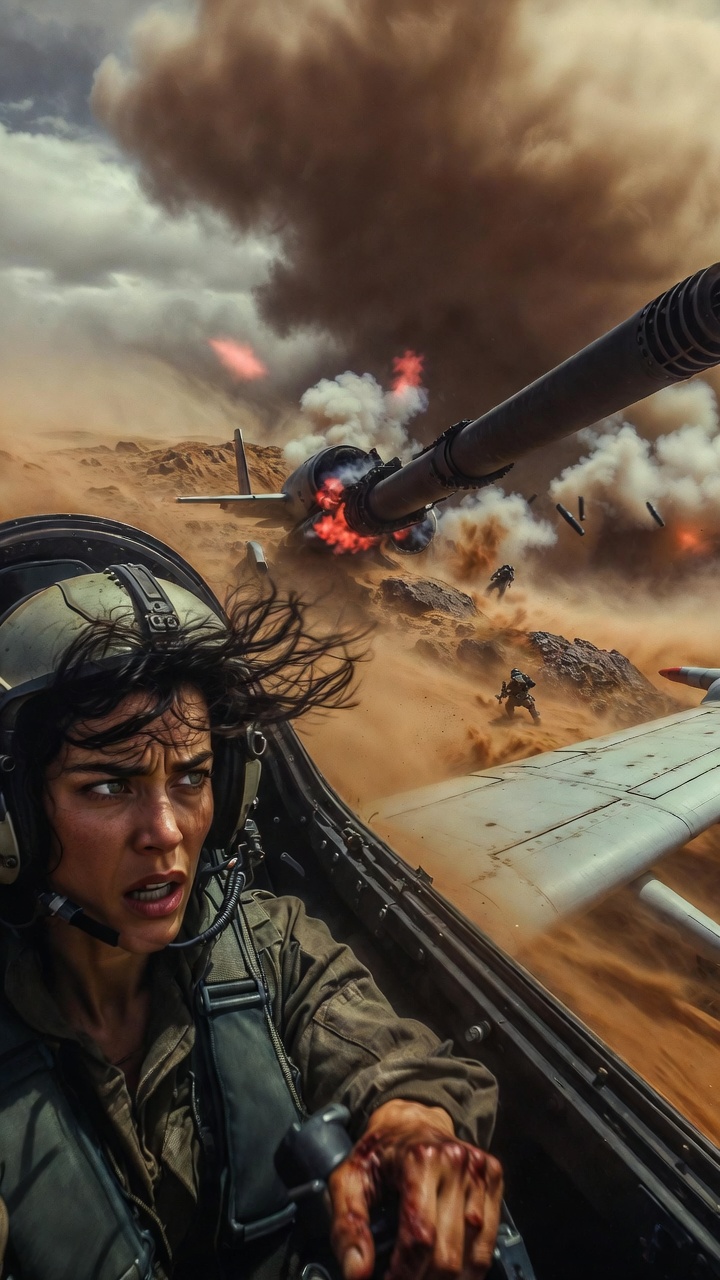
As she lowered herself into the cockpit, the world narrowed around her.
Seat.
Stick.
Throttle.
Pedals.
Screens.
The smell of canvas, metal, oxygen, and old sweat.
Her body remembered before her mind did.
Her right hand rested on the throttles.
Her left closed around the stick.
For seven years, she had dreamed of this moment.
In every dream, she could not remember how to start the engines.
Now her fingers moved across the switches without hesitation.
Battery.
Inverter.
Boost pumps.
APU.
The turbine whined behind her.
Then the radio went silent.
Not static.
Not interference.
Silence.
Mara’s hand froze above the engine start switch.
And inside the quiet cockpit, James Keene whispered her name.
Chapter Five
The Nineteen Seconds
Mara closed her eyes.
Not to escape the voice.
To place it.
Memory had weight. Direction. Temperature.
This voice came from behind her left shoulder, exactly where Keene’s aircraft had flown during the final seconds of Operation Lantern.
Mara.
The whisper sounded tired.
She opened her eyes.
The engine gauges waited.
Outside the canopy, Boone stood on the ladder platform, one hand gripping the rail. He could not hear what she heard, but he saw her fingers suspended above the switch.
His grin was gone.
He tapped the canopy.
Mara looked at him.
Boone raised two fingers, pointed at his own eyes, then at hers.
Stay here.
She drew one breath through her nose.
The oxygen mask smelled of rubber and dust.
Her hand descended.
Left engine start.
The fan rotated.
Temperature rose.
Oil pressure stabilized.
Right engine.
Generators online.
The cockpit displays awakened in green and amber.
Keene’s voice disappeared beneath the machinery.
Mara’s radio returned with a burst of static.
“Voss, comm check,” Mercer said.
“Loud and clear.”
A pause.
Then, “Call sign?”
Mara looked toward the runway.
Once, she had been Saint Two-One.
The name had been born after she brought a damaged aircraft home with a wounded crew chief riding in the empty survival compartment behind the seat during an evacuation exercise.
After Lantern, the squadron stopped using it.
She did not want it now.
“Hog One.”
Mercer did not argue.
“Hog One, taxi north. Winds two-six-zero at twenty-two, gusting thirty-five. Visibility one point eight miles and falling.”
Mara released the brakes.
The A-10 rolled from the shelter.
Every bump in the concrete traveled through the seat.
Men turned toward her as she passed.
Some saluted.
Others simply watched.
Boone ran beside the left wing until the aircraft gained speed, then stopped and raised one fist.
Mara taxied onto the runway.
Sand streamed across the pavement.
The far end had vanished.
“Hog One,” Mercer said, “you are cleared for takeoff.”
Mara advanced the throttles.
The engines rose to a twin howl.
The aircraft trembled, eager but not graceful.
An A-10 did nothing gracefully.
It endured.
It carried.
It remained when faster machines had already gone home.
Mara released the brakes.
The Hog surged forward.
The airspeed indicator climbed.
Fifty knots.
Seventy.
Ninety.
The debris field appeared through the sand.
A section of twisted roof lay across the runway farther ahead than the ground crew had reported.
Too large to straddle.
Too late to stop.
Mercer’s voice struck her headset.
“Hog One, abort!”
Mara’s hand tightened on the throttles.
One hundred knots.
The wreckage rushed toward her.
She pulled the stick back.
The nose lifted.
For one terrible instant, the aircraft refused to leave the ground.
Then the tires cleared the metal by less than three feet.
Halcyon dropped beneath her.
The Hog entered the storm.
Brown swallowed the canopy.
Mara’s body pressed into the seat as the aircraft bucked.
Warning lights flickered.
The attitude indicator rolled left, corrected, then rolled again.
She ignored the false motion and held the climb by backup instruments.
“Hog One, radar contact intermittent,” Mercer said.
“Copy.”
“Turn south heading one-eight-five.”
“Unable.”
“Hog One, say again.”
“If I climb into the strongest winds, I’ll be over the target blind.”
“What are you doing?”
“Going under.”
Mercer’s voice sharpened.
“Terrain south of the base rises eight hundred feet.”
“I know.”
“You do not have ground radar.”
“I have a map.”
“A map does not show rocks.”
“The rocks haven’t moved.”
Ward’s voice entered the channel.
“Mara, Kestrel has less than ten minutes.”
“I’ll be there in six.”
She pushed the nose down.
The altimeter unwound.
Two thousand feet.
Fifteen hundred.
One thousand.
The sand thinned near the ground, where broken ridges disrupted the storm.
Shapes emerged.
A road.
A dry canal.
The black skeleton of an electrical tower.
Mara banked between two hills.
The stick felt heavier than she remembered.
Her shoulders burned.
Sweat slid beneath her flight suit.
For seven years, people had told her the cockpit belonged to another version of herself.
Younger.
Cleaner.
Unbroken.
They had been wrong.
The aircraft did not ask who she had been.
It asked what she could do now.
“Hog One, this is Kestrel Actual.”
Talbot’s voice crackled in her headset.
Mara swallowed.
“Go ahead, Kestrel.”
“Good to hear you.”
“You don’t know me.”
“Anyone bringing that gun is family.”
Mara looked at the moving map.
“Mark your position.”
“Unable. Smoke canisters depleted. We are moving south through the ravine. Enemy on both rims.”
“Distance?”
“Thirty meters at closest.”
Danger close.
Closer than any written minimum she would accept under ordinary circumstances.
But nothing about the day remained ordinary.
“Describe the ravine.”
“Runs northeast to southwest. White rock on eastern rim. Burned truck at the southern mouth.”
Mara spotted the truck through the haze.
A dark rectangle beside a pale scar in the earth.
“Visual.”
Mercer cut in.
“Hog One, your countermeasure warning shows possible infrared search south of target.”
“Kassar’s missile team,” Holt said.
Mara flew lower.
The ground blurred beneath her wings.
“Talbot, when you hear the gun, stay down.”
“We were planning to.”
Mara rolled left over the ravine.
Figures appeared through the sand.
Some wore tan.
Some wore darker clothing.
Too close.
Too mixed.
Her targeting display painted no clean separation.
A muzzle flashed from the eastern rim.
Then another.
Mara selected rockets.
The pipper crossed the ridge.
Her thumb rested against the weapon release.
A small figure ran between the fighters.
Not a combatant.
A child.
Then another.
Three children crouched behind a broken wall near the enemy position.
Kassar had not placed them there.
They belonged to a shepherd family sheltering from the storm, trapped between the fighters and the Americans.
Mara’s breath stopped.
A warehouse.
An alley.
Bright shirts against smoke.
The cockpit filled with Lantern.
Mercer’s voice came from far away.
“Hog One, you are cleared hot.”
Her thumb remained still.
“Mara?” Ward said.
On the ground, Kestrel Team reached the southern mouth of the ravine.
Enemy fighters moved to cut them off.
“Hog One, fire.”
Mara saw Keene’s aircraft explode again.
Nineteen seconds.
The board had said she disappeared for nineteen seconds.
In truth, she had spent those seconds choosing which lives counted.
She had never stopped making that choice.
Mara lifted her thumb from the weapon release.
“Unable.”
Talbot’s voice broke through.
“Enemy closing!”
Mercer shouted.
“Take the shot!”
“Children on the ridge.”
“We have no confirmation.”
“I do.”
“The team will be overrun.”
“Not if they move.”
Mara keyed the radio.
“Talbot, turn east. Climb the white slope.”
“That puts us beneath the enemy.”
“Trust me.”
A beat of silence.
Then Talbot said, “Kestrel, east slope. Move.”
Mara pulled into a hard right bank.
The A-10 groaned.
The enemy missile warning suddenly screamed.
A tone filled the cockpit.
Kassar’s infrared missile had found her.
Chapter Six
The Sound of the Gun
“Missile launch!” Holt shouted over the radio.
Mara did not need him to say it.
She saw the white streak rise from the southern ridge.
Her left hand shoved the throttles forward.
Her right thumb released flares.
Brilliant points of light burst behind the aircraft.
She rolled toward the missile instead of away from it.
Mercer’s voice cracked.
“Hog One, break left!”
Mara held right.
The missile climbed.
For half a second, its nose tracked directly toward the right engine.
Then it turned toward the falling flares.
The detonation struck behind her.
The cockpit jumped.
Warning lights ignited across the panel.
Right engine temperature spiked.
Hydraulic pressure dropped.
Mara smelled hot insulation.
“Hog One, status?”
“Still flying.”
“That is not a status.”
“It’s the important part.”
She leveled fifty feet above the ravine.
Below, Talbot’s team scrambled up the eastern slope.
The enemy fighters shifted position to fire downward.
Exactly as Mara expected.
They left the children behind the stone wall.
For three seconds, the eastern rim held only armed men.
Mara lowered the nose.
The circular gun sight settled across the ridge.
Her index finger closed around the trigger.
The GAU-8/A Avenger fired.
The aircraft shook as though seized by an enormous hand.
Smoke streamed past the canopy.
The sound did not resemble a machine gun.
It came as one continuous tearing note, too deep and violent for individual shots.
The ridge erupted.
Rock, weapons, and soil lifted into the storm.
Mara released the trigger after less than two seconds.
Dozens of depleted-uranium rounds crossed the space where the enemy line had stood.
The eastern rim disappeared beneath dust.
Kestrel Team climbed through it.
Talbot’s voice filled her headset.
“Good hits! Good hits!”
A technical truck raced from the south, its heavy weapon turning toward the SEALs.
Mara banked.
The right engine coughed.
Temperature climbed again.
“Your engine is damaged,” Mercer said.
“I noticed.”
“Return to base.”
“Negative.”
“You made your pass.”
“There are two vehicles.”
“You do not have the power for another attack.”
Mara looked at the hydraulic gauge.
The right system had fallen below operating pressure.
The left was fluctuating.
The explosion had damaged more than the engine.
She selected rockets.
The technical turned into the ravine.
Mara approached from behind.
At the last moment, the truck swerved beside a group of mud-brick homes.
Women and children ran from a doorway.
The gunner fired upward.
Rounds crossed beneath Mara’s left wing.
She did not shoot.
Instead, she descended.
Lower.
Closer.
The A-10 passed over the truck at less than one hundred feet.
The roar of its engines and the bulk of its shadow sent the driver jerking toward the ditch.
The technical struck a stone wall.
Its weapon mount snapped sideways.
Kestrel Team fired from the slope.
The gunner fell.
The driver crawled from the cab and ran.
“Second vehicle?” Mara asked.
“Northwest rim,” Talbot replied. “Moving away.”
Not away, Mara realized.
Around.
Kassar was repositioning the last technical toward the route Kestrel would use back to Halcyon.
He was herding them.
On the ground, Farid Kassar watched the damaged A-10 rise through the sand.
His missile gunner stared at the empty launch tube.
“You missed,” Samir said.
The gunner lowered his eyes.
Kassar did not blame him.
The pilot had turned toward death.
That was difficult to predict.
“Move the reserve team to the salt road,” Kassar ordered.
Samir pointed toward the eastern ridge.
“Our men are still there.”
“Our men are dead.”
“And the Americans?”
“They will take the road north.”
“We can destroy them at the bridge.”
Kassar looked at the sky.
The A-10 emerged briefly as a dark cross in the storm.
One engine left a thin trail of smoke.
“Not while that remains above them.”
Samir’s face tightened.
“We have no second missile.”
Kassar picked up the radio taken from a dead local security officer.
“Then we speak to the pilot.”
Inside the cockpit, Mara heard the unfamiliar frequency break across her radio.
“Hog One.”
Kassar’s voice.
She checked her instruments.
“You have a damaged engine,” he continued. “Your hydraulic pressure is failing. You cannot remain.”
Mara looked down at the terrain.
“Yet here I am.”
“I know who you are.”
She said nothing.
“Major Mara Voss,” Kassar said. “The pilot who refused to fire.”
Mercer came over the channel.
“Do not engage him.”
Kassar’s voice continued beneath the static.
“The people in the warehouse survived because of you.”
Mara’s hand tightened on the stick.
“You were there,” she said.
“I arrived afterward.”
The digital map showed Kestrel moving north toward the salt road.
Mara turned to follow.
Kassar said, “Your commanders called the building empty. I found nine children inside.”
Mercer cut across him.
“He is manipulating you.”
“Two died later,” Kassar continued. “Seven lived.”
Mara’s throat went dry.
For seven years, she had not known.
The inquiry report listed no civilians because the strike had never occurred.
The children disappeared from the record.
But not from the world.
Kassar spoke almost gently.
“Your mercy saved them. Your machine killed my daughters one year later.”
The words landed without anger.
That made them heavier.
Mara looked toward the horizon.
“I didn’t kill your family.”
“No. A pilot who followed orders did.”
“Then why are you killing men who had nothing to do with it?”
“Because distance protects all of you from consequence.”
“You buried explosives beneath a road.”
“And your nation buried a bomb beneath my home.”
Mara saw movement below.
The second technical appeared near the salt bridge.
More fighters waited behind it.
Kestrel Team was heading directly toward the ambush.
“Talbot, stop.”
The SEALs halted.
Kassar’s voice remained in her ear.
“Land the aircraft.”
Mara almost laughed.
“Where?”
“The old road west of Qarah. Leave the cockpit and walk away. I will allow your men to return.”
Ward transmitted.
“He’s lying.”
Kassar heard him.
“I have no reason to lie. Destroying the aircraft is worth more than seven prisoners.”
Mara studied the route.
The old road ran west from the village.
Straight.
Wide enough for the A-10.
Barely.
“Hog One, do not consider it,” Mercer said.
Mara looked at the right engine temperature.
Redline.
At the hydraulic gauges.
Both falling.
At her remaining fuel.
Enough for twelve minutes.
Maybe fifteen.
“Kassar,” she said, “if I land, how do I know the team walks?”
“You do not.”
“Then we have no agreement.”
A warning horn sounded.
The right engine temperature exceeded its limit.
Flame flickered in the mirror behind her.
Mercer’s voice rose.
“Shut down the right engine now.”
Mara pulled the throttle to idle and cut fuel.
The flame disappeared.
The A-10 yawed.
She corrected with rudder.
One engine.
Failing hydraulics.
A sandstorm.
An enemy ambush blocking the only road home.
Kassar returned to the radio.
“You are running out of sky, Major.”
Mara looked down at the salt bridge.
Then she saw the dry irrigation channel beneath it.
A dark line twisting north.
Too narrow for a vehicle.
Wide enough for men on foot.
“Talbot,” she said, “take the canal.”
“Canal leads under the bridge.”
“I know.”
“They’re waiting above it.”
“I know that too.”
“What are you going to do?”
Mara rolled the crippled A-10 toward the bridge.
“Give them something else to watch.”
Chapter Seven
The Bridge
The first enemy rounds struck the A-10’s belly as Mara descended.
Small arms.
Then a heavier weapon opened from the technical.
Tracer fire reached upward in red arcs.
Mara’s left wing shuddered.
A caution light announced a fuel imbalance.
Another warned of flight-control degradation.
She held the aircraft steady with both hands.
Below, Kestrel Team entered the irrigation channel one man at a time.
Talbot went last, walking backward and firing toward the ridge.
The technical’s gun swung toward the canal.
Mara pushed the nose down.
The gun sight crossed the truck.
Behind it stood the bridge.
Beyond the bridge, three homes pressed close to the road.
She could destroy the vehicle.
The rounds might continue through it and strike the buildings.
She shifted the sight five yards left.
The bridge’s southern support filled the display.
Mercer understood first.
“Mara, don’t.”
She fired.
The Avenger roared.
Rounds cut through the stone support.
The bridge deck jumped.
Cracks raced across its surface.
The technical reversed, but its rear wheels dropped into the collapsing edge.
The bridge folded.
Truck, gun, and fighters disappeared into a storm of white dust.
The irrigation channel remained open beneath the northern arch.
Kestrel Team moved through.
Mara pulled back on the stick.
Nothing happened.
The control column felt anchored in concrete.
Both hydraulic systems had failed.
A red light illuminated.
MANUAL REVERSION.
Her body remembered.
She reached for the emergency control handle and pulled.
Mechanical cables connected the stick to small trim tabs on the control surfaces.
The aircraft responded slowly, heavily, as if every command had to be dragged through mud.
The nose began to rise.
Too late.
The ground filled the canopy.
Mara pulled with both hands.
Her scar tore open beneath the glove.
Blood made the stick slick.
The A-10 cleared the ridge by feet.
Stone flashed beneath the wings.
Then she was climbing on one engine with no hydraulic assistance.
“Hog One, report,” Mercer said.
Mara fought the aircraft level.
“Manual reversion.”
No one at Halcyon spoke for a moment.
Every A-10 pilot trained for it.
Few experienced it.
Fewer still entered it at low altitude during combat and survived.
Mercer’s voice returned, stripped of command.
“Mara, listen to me. Manual reversion response will degrade further as speed drops. You need to climb now.”
“Cannot climb.”
“You must.”
“Left engine is losing power.”
The throttle was already at maximum.
Exhaust temperature remained high.
RPM began to fluctuate.
Kestrel emerged from the northern canal.
A friendly armored vehicle had left Halcyon before the storm fully closed. It now waited five miles away on the opposite side of a rocky plain.
Five miles.
The SEALs could make it if no one followed.
Mara turned south.
Kassar’s remaining fighters moved from the village in pickup trucks and on motorcycles.
“Hog One,” Ward said, “Kestrel has a route. Come home.”
“They’re being pursued.”
“We’ll cover them with mortars once they’re in range.”
“They won’t reach range.”
Mara descended behind the pursuing vehicles.
She had rockets remaining.
Her aiming systems flickered, then failed.
No digital sight.
No stabilized target.
Only the fixed mark etched into the glass and the knowledge in her hands.
Mercer saw her weapon selection through the data link.
“You cannot fire rockets in manual reversion.”
“Watch me.”
“You have no computed impact point.”
“I flew before computers learned to draw circles.”
The first pair of rockets left the wings.
They struck wide, exploding in open ground beside the road.
The lead motorcycles scattered.
Mara fired a second pair.
Closer.
A pickup swerved into a ditch.
The pursuit slowed.
Not stopped.
Her left engine coughed again.
The radio dimmed.
The displays flickered.
Electrical output dropped.
Mara looked north.
Halcyon lay beyond a wall of sand.
The runway might as well have been on another planet.
Kassar came over the radio once more.
“You saved them.”
“Not yet.”
“You will not save yourself.”
Mara kept the aircraft between the pursuers and Kestrel Team.
“That wasn’t the assignment.”
“You believe dying will make Keene forgive you?”
Mara’s breathing stopped.
Kassar had read more than a public record.
Someone had given him details from the classified inquiry.
“How do you know his name?”
Kassar did not answer.
Holt’s voice entered the channel from Halcyon.
“We may have an internal compromise.”
Ward responded sharply.
“May?”
“The Lantern file was accessed from this base forty-eight hours ago.”
Mercer said, “By whom?”
Holt’s keyboard clicked.
“The authorization originated from your account.”
Silence.
Mara looked toward the invisible base.
Mercer’s voice hardened.
“I did not access that file.”
“Someone used your biometric token.”
Boone came onto the radio, breathless.
“Operations, we have shots near the communications bunker.”
The transmission filled with shouting.
A burst of gunfire sounded inside Halcyon.
Then the channel went dead.
Mara was alone again.
No base.
No commander.
No voice guiding her home.
Only static.
Keene whispered behind her left shoulder.
Mara.
The control stick trembled.
Ahead, Kestrel Team crossed the final mile toward the rescue vehicle.
Behind them, the enemy regrouped.
Below Mara’s cockpit, the last rockets waited beneath the wings.
She heard Keene again.
This time, his voice did not ask why she had let him die.
It said what he had said before the missile struck.
Break right.
Mara looked right.
Through the sand, a narrow canyon opened between two ridges.
The pursuit vehicles had not seen it.
But Farid Kassar had.
His command truck waited inside, hidden beneath camouflage netting.
Beside him stood a man in an American uniform.
And the man held a transmitter connected to Halcyon’s secure network.
Chapter Eight
The Distance Between Orders and Truth
Mara banked toward the canyon.
The movement dragged through the manual controls with painful slowness.
Her left forearm shook.
Blood ran from her glove to her sleeve.
The American beside Kassar looked up.
Even through the sand, Mara recognized his walk as he moved toward the command truck.
Chief Warrant Officer Peter Haines.
Halcyon’s communications security officer.
Quiet.
Helpful.
Fifty-one years old.
He repaired watches for men on the base and mailed the money to his disabled brother in Arizona.
Two months earlier, a rocket had killed Haines’s interpreter, a twenty-two-year-old named Rafi who had worked with him for three deployments.
The base report listed Rafi as local support personnel.
Haines had listed him as a son on the funeral request.
The request had been denied.
Mara understood before anyone explained it.
Haines had not joined Kassar for money.
He had joined him because grief needed a shape, and betrayal offered one.
Mara’s radio returned in fragments.
Boone’s voice.
“…Haines… escaped through east service gate…”
Then Mercer.
“…do not fire until identity confirmed…”
Haines raised the transmitter.
A signal appeared on Mara’s threat display.
He was feeding her location to the pursuit force.
Kassar stood beside him, one hand on the command truck.
Mara selected her final rockets.
The sight hovered over the canyon.
Haines did not run.
Kassar did not force him to stay.
The two men watched her approach.
A traitor and an enemy.
Labels.
Simple words used to flatten complicated human beings.
Mara’s thumb rested against the release.
She could kill them.
The rockets would destroy the truck, the transmitter, and the command element behind the pursuit.
The strike was justified.
Clear.
Necessary.
Then Haines stepped away from the vehicle.
He lifted both arms.
Not in surrender.
In warning.
Behind the truck, beneath the camouflage netting, sat six plastic drums marked with chemical hazard symbols.
Kassar shouted at him.
Haines pointed toward the village.
The drums were wired to explosives.
A blast inside the canyon would send toxic material into the wind, directly toward Qarah.
Kassar grabbed Haines’s shoulder.
The American knocked his hand away.
Mara flew past without firing.
Rounds climbed from the canyon.
One struck the canopy, leaving a white star near her right eye.
Another tore into the left engine housing.
The engine gave a deep metallic bang.
Power dropped.
Mara pulled the nose up with everything left in her arms.
The A-10 cleared the canyon and began to sink.
“Hog One,” Mercer said through heavy static, “we have you intermittent. State intentions.”
Mara looked north.
Kestrel had reached the rescue vehicle.
Seven figures climbed aboard.
Her mission was complete.
Behind them, the pursuit resumed.
Ahead of Mara, open desert stretched toward Halcyon.
The altimeter showed six hundred feet.
Then five hundred.
Left engine power continued falling.
“I’m not making the base,” she said.
Mercer’s response came immediately.
“You are.”
“Negative.”
“There is a dry lake bed three miles north of your position.”
“Too soft after last week’s rain.”
“Old highway west.”
“Power lines.”
A pause.
Then Boone’s voice entered.
“The road by Qarah.”
Mara looked left.
The road Kassar had offered.
Long.
Straight.
Wide enough.
But enemy fighters were already moving toward it.
Mercer said, “You cannot land there.”
“I don’t see another runway.”
“You’ll be captured.”
“Only if I stop.”
“It’s a landing, Mara. Stopping is generally involved.”
Despite everything, a laugh escaped her.
Short.
Painful.
Human.
She turned toward the road.
The A-10 descended through three hundred feet.
Manual controls grew heavier as speed fell.
Mara lowered the landing gear using the emergency system.
Three green lights appeared.
Flaps remained unavailable.
She would land fast.
Too fast.
“Hog One,” Mercer said, “listen carefully. You have twenty knots of tailwind.”
“I know.”
“Land the opposite direction.”
“Enemy convoy is approaching from the east.”
“You cannot land with that tailwind.”
“I cannot land through a convoy either.”
Mara aligned with the road.
Mud-brick houses passed beneath her left wing.
Civilians ran from the roadside.
She saw the three shepherd children from the ridge standing beside an older woman.
All alive.
The road rose toward her.
Mara pulled the throttles to idle.
The left engine died before she touched down.
Silence filled the cockpit.
The main wheels struck hard.
The aircraft bounced.
Mara pushed the nose down.
The tires hit again.
She applied wheel brakes.
Nothing.
Hydraulic failure.
Emergency brake.
Pressure dropped almost instantly.
The A-10 continued racing along the road.
Ahead, a burned bus blocked half the pavement.
Enemy trucks appeared behind her.
Mara steered with the last mechanical response in the rudders.
The right wing passed inches from the bus.
The left wheel dropped into sand.
The aircraft yawed.
Its nose gear collapsed.
The cannon housing struck the road.
Metal screamed.
The A-10 spun sideways and slid into a field of pale stones.
The right wing tore through a low wall.
The aircraft stopped.
Dust rolled over the canopy.
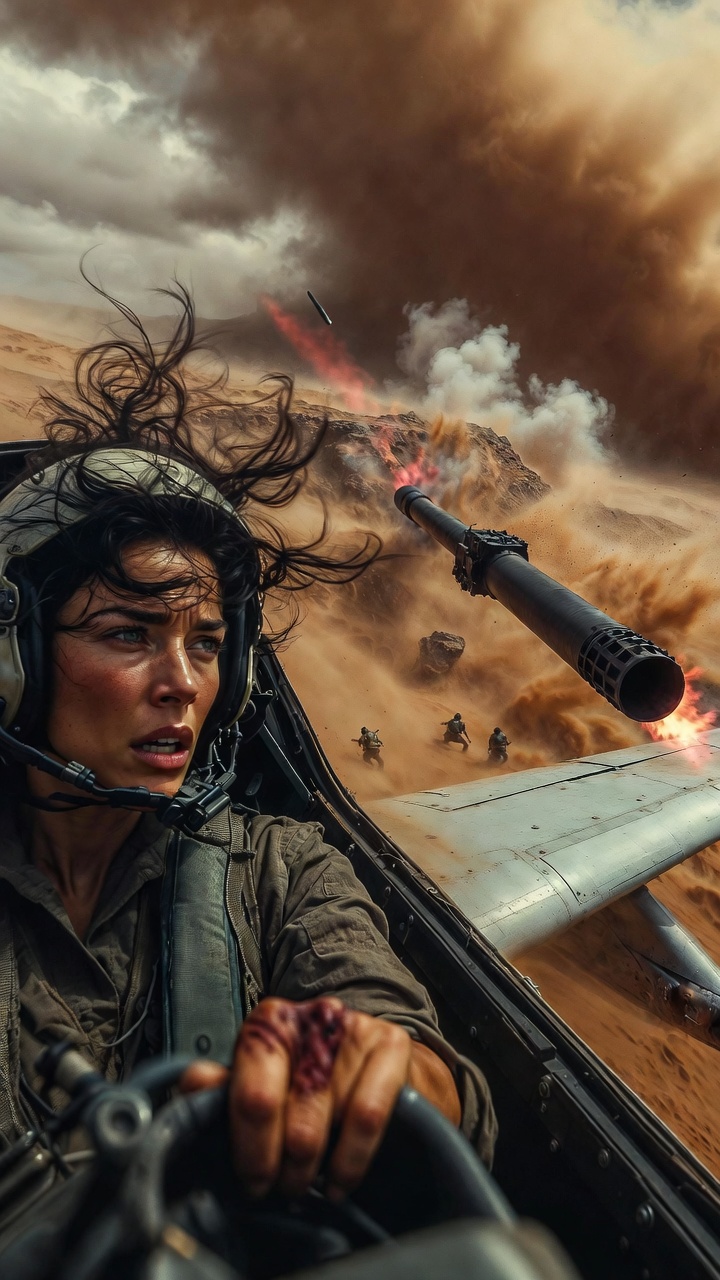
Mara hung against the harness.
For several seconds, she heard nothing.
Then pain arrived.
Shoulder.
Wrist.
Ribs.
She tasted blood.
The canopy release handle moved beneath her hand.
She pulled.
Nothing happened.
The frame had twisted.
Enemy engines approached from the road.
Mara reached for the emergency canopy breaker.
A shadow appeared outside.
Someone climbed onto the wing.
Farid Kassar looked through the cracked canopy.
He held a pistol.
Mara stared back at him.
Kassar raised the weapon.
Then turned and fired behind him.
An enemy fighter fell from the wing.
Kassar struck the canopy frame with the pistol.
“Open it.”
“It’s jammed.”
He holstered the weapon, wedged a rifle beneath the frame, and pulled.
The canopy shifted an inch.
Mara shoved from inside.
Together, they forced it open.
Kassar reached into the cockpit.
Mara did not take his hand.
“Why?” she asked.
He looked toward the village.
Wind carried black smoke from the canyon.
“Haines disabled the explosives.”
“Where is he?”
“Dead.”
Mara closed her eyes.
Kassar glanced toward the approaching pursuit vehicles.
“My men believe I have become weak.”
“Have you?”
“No.”
He reached into the cockpit again.
“I have become tired of watching grief choose my decisions.”
Mara took his hand.
He pulled her from the seat.
Her boots struck the wing.
Pain folded her at the waist.
Kassar caught her.
Gunfire erupted from the road.
He dragged her behind the aircraft.
The A-10’s armored cockpit absorbed the incoming rounds.
Mara drew Pike’s survival pistol from her vest.
Kassar noticed.
“Will you shoot me?”
“Are you going to shoot me?”
“I have not decided.”
“Then neither have I.”
A truck stopped beyond the wreckage.
Samir climbed out with six fighters.
His rifle pointed toward Kassar.
“You saved the pilot.”
“I saved the village.”
“You betrayed us.”
Kassar looked at the men around Samir.
Some shifted their feet.
Others avoided his eyes.
He had led them through winters, sieges, and funerals.
But power built on vengeance could not survive mercy.
Mara understood that before he did.
Samir raised his rifle.
The sky behind him began to thump.
Slow at first.
Then louder.
Rotor blades.
The sandstorm opened just enough for a black helicopter to appear low over the road.
The HH-60 from Halcyon swept across the field with door guns firing.
Enemy fighters scattered.
Samir turned.
Kassar shoved Mara down as bullets cut through the air.
The rescue helicopter flared beside the crashed A-10.
Boone leaned from the open door, waving.
“Voss!”
Mara looked at Kassar.
He lay beside her, one hand pressed against his abdomen.
Blood spread through his shirt.
She grabbed his arm.
“Move.”
He looked toward the village.
“If I leave, they will call me an American prisoner.”
“If you stay, Samir kills you.”
“Both are prisons.”
Mara pulled harder.
“Then choose the one with a door.”
Boone and two SEALs reached them.
One raised his rifle toward Kassar.
Mara stepped between them.
“He comes with us.”
Boone stared at the wounded enemy commander.
“You’re kidding.”
“Do I look humorous?”
“You look terrible.”
“Help him.”
The SEAL hesitated.
Then Talbot’s voice came from the helicopter.
“You heard her. Move.”
They carried Kassar aboard.
The helicopter lifted as the abandoned A-10 disappeared beneath swirling sand.
Mara sat against the cabin wall.
Across from her, Talbot held pressure against Kassar’s wound.
Boone crouched beside Mara and looked at her torn glove.
“So,” he shouted over the rotors, “you were a major.”
“Briefly.”
“You have two Distinguished Flying Crosses.”
“So I’m told.”
“You flew an aircraft with one engine and no hydraulics.”
“It had some hydraulics when I started.”
Boone shook his head.
“I called you Grease Rag.”
“I remember.”
“Toolbox.”
“I remember that too.”
“Just maintenance.”
Mara turned toward the open door.
Below them, the wrecked Hog rested beside the road, broad wings broken but still recognizable beneath the storm.
She looked back at Boone.
“There’s no such thing as just maintenance.”
Chapter Nine
What Came Home
The storm passed Halcyon shortly before midnight.
It left the base half buried.
Sand covered the runway in rippled sheets. Floodlights illuminated damaged shelters, torn fencing, and soldiers working in silence.
The helicopter landed beside the medical bunker.
Commander Ward waited on the pad.
Lieutenant Colonel Mercer stood beside him.
As the doors opened, Kestrel Team emerged first.
Two wounded men on stretchers.
Four walking.
Talbot last.
Ward counted them.
His lips moved with each man.
Seven.
All seven.
Only after the final SEAL stepped onto the concrete did Ward lower his head.
He touched his forehead to Talbot’s for one brief second.
No salute.
No speech.
Nothing that could contain what had nearly been lost.
Medics carried Kassar toward surgery under armed guard.
Mercer watched the enemy commander pass.
“Farid Kassar?”
Mara climbed from the helicopter with Boone’s help.
“He needs a surgeon.”
“He planned the attack.”
“He also stopped a chemical blast from reaching Qarah.”
Mercer looked toward Ward.
Ward nodded to the guards.
“Keep him alive.”
Mara’s knees buckled when her boots touched the ground.
Mercer caught her before she fell.
She looked at his hand around her arm.
“Careful,” she said. “People might think you approve of me.”
“I approved one flight.”
“It was a long flight.”
“You disobeyed nearly every instruction I gave.”
“Not every instruction.”
“Name one you followed.”
“You told me not to die.”
Mercer’s mouth twitched.
Then his face changed.
He looked older beneath the floodlights.
“Holt found the rest of the Lantern record.”
Mara straightened.
“Haines accessed it?”
“Yes.”
“Why?”
“He had been communicating with Kassar for three months. He believed the strike that killed Rafi had been covered up. He found references to Lantern while searching classified targeting reviews.”
“Was Rafi’s strike covered up?”
Mercer did not answer immediately.
That was answer enough.
Ward stepped closer.
“The target was approved using outdated imagery. The investigation remains open.”
“Meaning someone hopes it will remain open until everyone forgets,” Mara said.
Ward’s eyes hardened.
“Not this time.”
Mara looked toward the medical bunker where Kassar had disappeared.
“Haines warned me about the chemicals.”
“We recovered a message he transmitted before he died,” Ward said. “He gave us the location of Kassar’s network and evidence linking the Halcyon attack to three officials in the regional security force.”
“He changed his mind.”
“Too late for some people.”
“But not everyone.”
Ward studied her.
“No. Not everyone.”
Mercer held out a thin black folder.
Mara did not take it.
“What is that?”
“The corrected Lantern report.”
“There is no corrected report.”
“There is now.”
She opened the folder.
The first page carried the seal of the Department of the Air Force.
Below it, a paragraph stated that Major Mara Voss’s actions during Operation Lantern had prevented a strike on a location containing civilians.
The report confirmed that the target grid had been transmitted incorrectly.
It also stated that her deviation had been operationally justified.
Mara read the paragraph twice.
The words did not release anything inside her.
Paper could correct a record.
It could not bring an aircraft back into formation.
“Keene is still dead,” she said.
Mercer looked toward the dark runway.
“Yes.”
“Then this changes nothing.”
“It changes the lie.”
“I chose the lie.”
“And the rest of us allowed it because it was convenient.”
Mara closed the folder.
Mercer’s scar stood pale beneath the floodlights.
“I spoke to Keene’s wife after the investigation,” he said. “She asked whether he died because of you.”
Mara’s fingers tightened around the folder.
“What did you tell her?”
“That I didn’t know.”
“Do you now?”
Mercer met her eyes.
“He died because he stayed with his flight lead under fire.”
“That is a polished way to say it.”
“He trusted you.”
“And you told me not to make another dead man trust me.”
“I was wrong.”
Mara looked at him sharply.
Grant Mercer did not seem like a man who used those words often.
He continued.
“Dead men do not trust us. We use them to justify the choices we already want to make.”
The wind moved gently across the base now.
Somewhere near the hangars, a generator coughed and returned to life.
Mara looked down at the report.
“What did you want to justify?”
“Grounding you.”
“Why?”
Mercer’s jaw shifted.
“Because three months before Lantern, my wife died in an aircraft cleared by someone who believed his judgment mattered more than procedure. Then you came before the board and admitted you had ignored a strike order.”
“So you had already decided who I was.”
“Yes.”
The honesty struck harder than an excuse would have.
Mara closed the folder.
“My medical record was real.”
“Yes.”
“I heard voices.”
“Yes.”
“I lied during an investigation.”
“Yes.”
“You may still have made the correct decision.”
Mercer looked toward her.
“I made an understandable decision. That is not always the same thing.”
Boone emerged from the helicopter carrying Pike’s helmet.
He held it out to Mara.
A fresh scrape crossed the visor.
“You damaged government property.”
“Put it on my bill.”
“You’re a contractor. It’s already on your bill.”
Mara took the helmet.
Boone shifted his weight.
“Lieutenant Pike asked whether you fired the gun.”
“I did.”
“He wants to know how it felt.”
Mara looked at the dark barrel of the helmet microphone.
“Tell him it felt expensive.”
Boone laughed.
The sound carried across the floodlit pad.
Then a medical orderly ran from the bunker.
“Commander Ward!”
Ward turned.
The orderly stopped in front of him.
“The prisoner is conscious.”
“Kassar?”
“Yes, sir. He refuses pain medication.”
“That sounds like him.”
“He says he will provide the names of his remaining cells.”
Ward’s eyes narrowed.
“What does he want?”
The orderly glanced at Mara.
“He wants to speak with the pilot first.”
Inside the medical bunker, Farid Kassar lay handcuffed to a steel bed.
A dressing covered his abdomen.
His face had turned gray, but his eyes remained alert.
Two armed guards stood against the wall.
Mara entered alone.
Kassar looked at her flight suit.
“You returned.”
“So did you.”
“Your people will put me in a room without windows.”
“You buried explosives under a road.”
“And your people will continue dropping bombs.”
“Probably.”
Kassar studied her.
“You do not defend them.”
“I do not defend flags. I defend decisions.”
“Is that why they removed you from the sky?”
“They removed me because I forgot that institutions prefer simple stories.”
“And now?”
“Now the story is complicated again.”
A faint smile touched Kassar’s mouth.
He looked toward the guards.
“I will give your commander the names.”
“Why?”
“Samir will use the chemical drums. He believes fear is proof of strength.”
“And you no longer do?”
Kassar’s gaze moved to the ceiling.
“My daughter Leila once found a wounded bird. Its wing was broken. I told her it would die.”
“What did she do?”
“She fed it for twelve days.”
“Did it live?”
“No.”
Mara waited.
Kassar closed his eyes.
“But for twelve days, my daughter believed mercy was work worth doing.”
His breathing became shallow.
“I had forgotten her correctly.”
Mara looked through the narrow window.
Outside, mechanics crossed the pad carrying tools toward the damaged shelters.
“What do you want from me?”
“When they tell the story of today, they will call me a terrorist. They will call Haines a traitor. They will call you a hero.”
“They may call me unemployed.”
“Do not let the simple words become the entire truth.”
Mara thought of the children on the ridge.
Of Haines raising his arms beside the chemical drums.
Of Mercer signing an authorization he feared.
Of Boone guarding a woman he claimed not to like.
Of Keene following her down through smoke.
“I won’t,” she said.
Kassar opened his eyes.
“Then we understand each other.”
The heart monitor beside him continued its quiet rhythm.
Mara turned toward the door.
“Major Voss.”
She stopped.
Kassar’s voice weakened.
“The children at Lantern. Seven lived.”
Mara could not face him.
She placed one hand against the doorframe.
For seven years, she had imagined only the aircraft falling behind her.
She had never allowed herself to imagine the children walking out of the warehouse.
Now she saw them.
One by one.
Through smoke.
Into daylight.
Mara lowered her head.
When she stepped outside, Mercer was waiting in the corridor.
He did not ask what Kassar had said.
Mara appreciated him for that.
“Recovery team found the A-10,” he told her.
“How bad?”
“Right wing separated. Nose gear destroyed. Engine mounts cracked.”
“Cannon?”
“Intact.”
“Then it’s repairable.”
Mercer stared at her.
“The aircraft is in three pieces.”
“Large pieces.”
“You are impossible.”
“So I’ve heard.”
They walked outside.
Dawn had begun to soften the eastern sky.
The desert no longer looked hostile.
Only vast.
Mercer stopped beside the flight line.
“A transport arrives tomorrow.”
“For Kassar?”
“For you.”
Mara looked at him.
“Am I being removed?”
“That depends.”
“On what?”
He handed her another document.
Temporary flight evaluation orders.
Attached duty with the A-10 training unit at Davis-Monthan Air Force Base.
Mara read the first line.
Then the second.
Her hands remained steady.
“This is not reinstatement,” Mercer said.
“No.”
“It is an evaluation.”
“I can read.”
“You may fail.”
“I have failed before.”
“You may never fly combat again.”
Mara looked toward the empty shelter where the A-10 had stood.
“No aircraft stays in the air forever.”
“That is not an answer.”
“It’s the only one I have.”
Boone approached from the hangar carrying two coffees.
He gave one to Mercer and held the other toward Mara.
She took it.
He had added no sugar.
Correctly.
“Crew is taking bets,” Boone said.
“On what?”
“Whether you’ll go.”
Mara looked down at the evaluation orders.
“What did you bet?”
“That you’d complain about the aircraft before accepting.”
“The right aileron was three degrees out of tolerance.”
Boone turned to Mercer.
“I win.”
Mercer shook his head and walked away.
Mara stood beside the runway as sunlight touched the desert.
Aircraft had once been her escape from the ground.
Then they became the place where her guilt lived.
Now, for the first time, the sky looked like neither punishment nor salvation.
It was simply work waiting to be done.
Boone sipped his coffee.
“So what do I call you now?”
“Mara.”
“Not Major?”
“No.”
“Saint?”
Her eyes remained on the sunrise.
“Never.”
“Grease Rag?”
She looked at him.
Boone raised both hands.
“Had to ask.”
Behind them, a generator started.
Tools struck metal.
Men shouted measurements across the hangar.
Maintenance crews began repairing the base before the sand had finished settling.
Mara folded the flight orders and slipped them into her pocket.
Then she turned toward the sound of work.
Because aircraft did not return to the sky through courage alone.
Someone had to crawl beneath the wing.
Someone had to find the leak.
Someone had to tighten the coupling while rockets fell.
Someone had to believe that broken things were not finished merely because they had come apart.
And this time, when Mara Voss walked into the hangar, no one called her “just maintenance.”
They moved aside.
Not because she had once been a major.
Not because she had flown through a storm.
Not because she had brought seven SEALs home.
They moved because she had earned the one thing rank could never demand.
Trust.
Mara placed Pike’s damaged helmet on the workbench, picked up her wrench, and looked toward the eastern sky.
Far above the desert, the last edge of the storm broke apart in the morning light.
For a moment, it resembled two wings opening.