On January 30, 1933, Berlin burned with torchlight.
Crowds filled the streets. Nazi flags rose over the capital. Adolf Hitler had just been appointed Chancellor of Germany, and to many of his supporters, a new order had arrived.
But beneath that public spectacle, another world was holding its breath.
In Berlin’s bars, nightclubs, basements, private rooms, and hidden cafés, men who loved men had built something fragile but real. During the Weimar years, Germany had become one of the most visible centers of gay life in Europe. There were journals, meeting places, support networks, and even public campaigns to change the law.
That world existed under a shadow: Paragraph 175.
The law, created in 1871, criminalized sexual relations between men. But during the Weimar Republic, enforcement had softened in some places, especially in Berlin. People found space to organize, publish, love, and hope.
At the center of that hope stood Magnus Hirschfeld and his Institute for Sexual Science. His institute collected research, offered support, and fought for the decriminalization of homosexuality. It was not just a building. It was an archive of lives the world preferred to ignore.
The Nazis saw all of it as corruption.
To them, gay men were not only criminals. They were a threat to the racial future of Germany because they did not fit the regime’s obsession with reproduction, masculinity, and obedience.
The attack came quickly.
Gay bars were shut down. Clubs were raided. Publications were banned. Organizations were dissolved.
Then, in May 1933, Nazi students stormed Hirschfeld’s institute. Books, medical files, photographs, and research were dragged into the street and burned. Hirschfeld was abroad at the time. He never returned to Germany. He died in exile in France in 1935.
A community that had taken decades to build was being destroyed in months.
For a short time, one contradiction remained inside the Nazi system itself: Ernst Röhm.
Röhm, the powerful leader of the SA, was widely known to be homosexual. Hitler protected him while he was useful. But in 1934, during the Night of the Long Knives, Röhm and other SA leaders were murdered. Nazi propaganda then used his sexuality as a weapon, turning him into proof of the “degeneracy” the regime claimed it had to purge.
After Röhm’s death, nothing stood in the way.
In 1935, the Nazis expanded Paragraph 175. The law no longer required proof of a specific sexual act. Suspicion, gestures, letters, or accusations could be enough. Sentences became harsher, with some men facing up to ten years of hard labor.
In 1936, Heinrich Himmler created a special police office to combat homosexuality and abortion. The two were linked in Nazi ideology because both were seen as threats to population growth and racial control.
From there, persecution became systematic.
Police raided bars. Names were taken from address books. Files were built. Neighbors, coworkers, relatives, and former lovers denounced one another. Under brutal interrogation, men were pressured to name others, and one arrest could destroy an entire circle of friends.
Around 100,000 men were arrested under Paragraph 175 during the Nazi era. About half were convicted.
Some served prison sentences and were released into lives permanently marked by shame and surveillance.
Others were sent to concentration camps.
There, they were forced to wear the pink triangle.
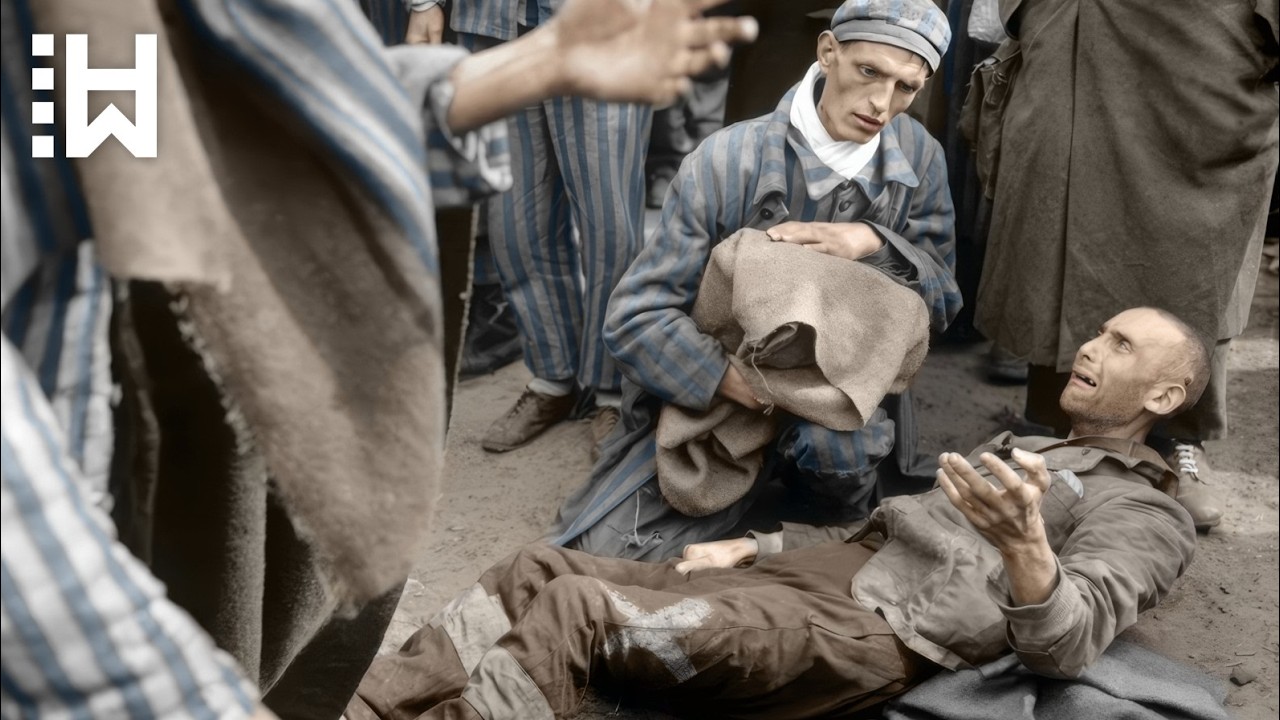
In the camps, the pink triangle became a target. Men marked with it were often placed near the bottom of the prisoner hierarchy. They were beaten, mocked, isolated, and assigned to punishing labor. Other prisoners sometimes avoided them out of fear that association could bring suspicion.
For many, the camp was not imprisonment.
It was slow destruction.
At Sachsenhausen, particularly in the brutal Klinkerwerk labor detail, prisoners were worked to exhaustion. The purpose was not only production, but breaking bodies. Men carried bricks, endured violence, starved, froze, and collapsed under labor designed to consume them.
One survivor, Joseph Kohout, later became one of the best-known voices of this persecution. Arrested in Austria in 1939 after a postcard to his lover was intercepted, he survived years in the camp system. His testimony revealed the terror of daily life: forced exposure to cold, beatings, humiliation, disease, and isolation.
Many did not survive.
Exact numbers remain uncertain, but death rates among pink triangle prisoners were extremely high. Some died from overwork, hunger, disease, cold, or beatings. Others were shot or used in medical experiments.
In Buchenwald, the Danish doctor Carl Værnet conducted experiments on gay prisoners under SS protection. He implanted devices meant to release testosterone, claiming he could “cure” homosexuality. The experiments were cruel, useless, and deadly. After the war, Værnet escaped prosecution and fled to Argentina, where he died in 1965.
The Nazis also used sterilization as another weapon. Some men were told they could be released if they agreed to be castrated or sterilized. On paper, it could be described as voluntary. In reality, the choice was made under fear, imprisonment, and coercion.
Friedrich Paul von Groszheim was one of the men trapped in this system. Arrested in Lübeck, imprisoned, tortured, and humiliated, he was eventually forced to accept castration as the price of release.
The regime did not only want to punish gay men.
It wanted to control their bodies, erase their dignity, and force them into silence.
Yet even under that terror, resistance existed.
Willem Arondeus, a gay Dutch artist, joined the resistance against Nazi occupation in the Netherlands. In March 1943, he helped attack the Amsterdam civil registry office to destroy records the Nazis used to identify Jews and others targeted for persecution.
The action succeeded only partly. The group was betrayed and arrested.
Arondeus took responsibility to protect others.
Before he was executed in July 1943, he left a sentence that became a symbol of defiance:
“Tell the people that homosexuals are not cowards.”
It was a final act of courage against a regime that had tried to turn identity into shame.
When the camps were liberated in 1945, many prisoners walked into a world that finally recognized their suffering.
But for pink triangle survivors, liberation was incomplete.
Paragraph 175 remained in force after the war. Some men who had been imprisoned by the Nazis were not treated as victims. They were still considered criminals. Some continued serving sentences. Others returned home unable to speak, because the society around them still condemned them.
Justice was delayed for decades.
East Germany decriminalized homosexuality in 1968. West Germany followed with reform in 1969. But Paragraph 175 was not fully removed until 1994.
Official recognition came painfully late. Germany did not fully acknowledge these men as victims for many years. Nazi-era convictions under Paragraph 175 were only annulled in 2002.
By then, most survivors were already gone.
The pink triangle, once stitched onto uniforms as a mark of humiliation, later became a symbol of memory, resistance, and pride. But that transformation came too late for many who lived and died in silence.
Their story is not only about Nazi cruelty.
It is about what happens when law becomes a weapon, when neighbors become informers, when a society decides that some lives are shameful enough to erase.
The Nazi regime was defeated in 1945.
But the prejudice that helped destroy these men survived much longer.
That is why remembering them matters.
Not only the dead.
But also the survivors who returned from the camps and were still denied justice.
The pink triangle began as a mark of persecution.
History turned it into a warning.


