Chapter One
The Daughter Carrying the Bags
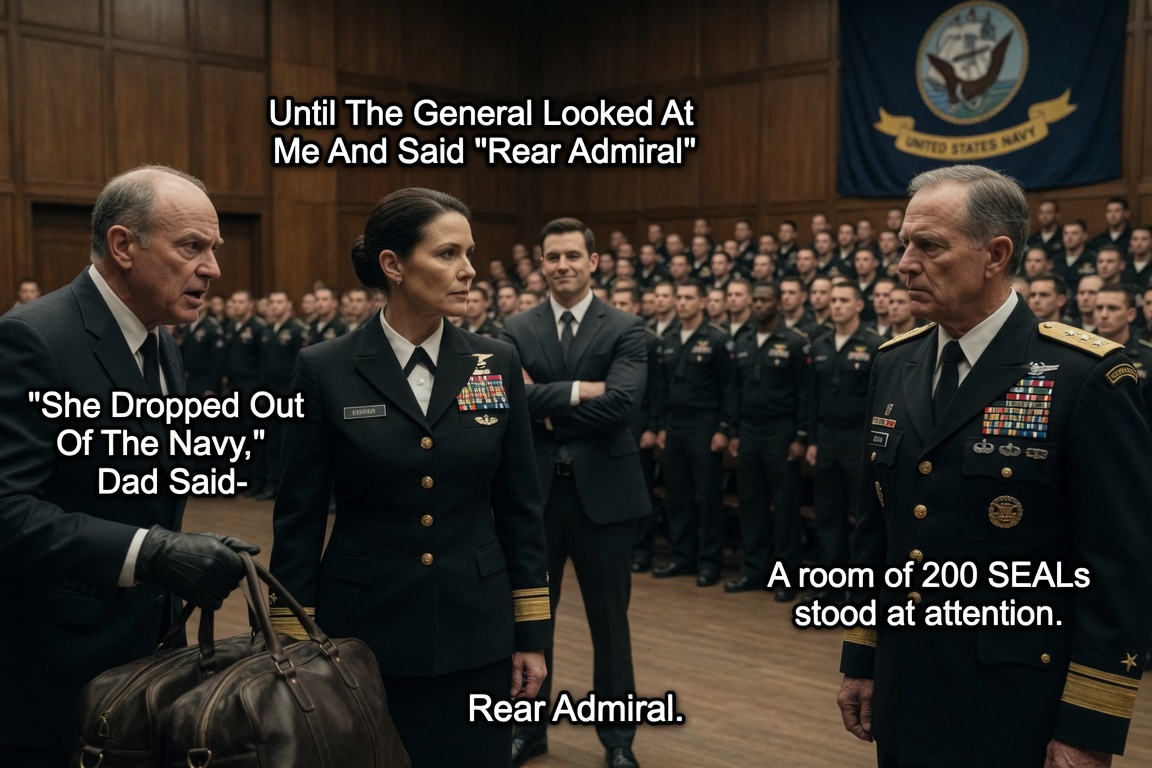
My father handed me his suitcase before he told the admiral’s wife that I had dropped out of the Navy.
“Hold this,” he said.
The bag was old blue canvas, heavy enough to contain either dress shoes or a small engine. His name, RILEY, THOMAS J., had been stenciled across it when the letters in Vietnam still appeared on casualty reports.
I took it because two hundred people were entering the Naval Special Warfare Heritage Hall behind us, rain was blowing sideways across Coronado, and my younger brother’s retirement ceremony was due to begin in twelve minutes.
My father interpreted silence the way powerful men often do.
As agreement.
“This is Amelia,” he told Mrs. Harwood, whose husband had once commanded the Pacific Fleet. “Daniel’s older sister.”
Mrs. Harwood smiled warmly.
“Are you Navy too?”
Dad answered before I could.
“She tried.”
The entrance smelled of wet wool, brass polish, and salt carried in from the bay. Uniformed SEALs moved beneath framed photographs of men whose faces remained classified long after their funerals. Their wives and husbands shook rain from umbrellas while children stared at display cases containing battered dive knives and folded flags.
I adjusted my grip on Dad’s suitcase.
“What happened?” Mrs. Harwood asked.
Dad gave the laugh he reserved for stories in which someone else became the lesson.
“Couldn’t stand the pressure. Left training, took some desk position in Washington. She’s been pushing paper ever since.”
The woman’s smile faltered.
My brother Daniel stood several yards away beneath a bronze Trident mounted on the wall. At forty-six, he still looked built for doors that opened only through force. Silver had entered his dark hair, but his dress-white uniform gave him the same clean authority he carried at twenty-five.
He heard Dad.
Our eyes met.
Daniel could have corrected him.
He looked away.
That hurt more than the sentence.
My father pointed toward a garment bag slung over his other arm.
“Take this too. My shoulder’s acting up.”
At seventy-five, retired Senior Chief Thomas Riley remained broad through the chest, though heart surgery and arthritis had taken speed from him. His hearing aids whistled when rooms became crowded. The white hair above his ears had been cut Navy-short for Daniel’s ceremony.
He had polished his old submarine dolphins the night before.
He had not asked whether I owned a uniform.
I took the garment bag.
Mrs. Harwood glanced at my plain midnight-blue dress, low heels, and the silver beginning at my temples.
“What kind of paperwork do you do?”
“Operational planning.”
Dad snorted.
“She can make anything sound dangerous.”
I smiled politely.
“Dad has always preferred stories with simple casualties.”
His head turned.
“What’s that supposed to mean?”
“Your seat is inside.”
I carried his luggage toward the security checkpoint.
An enlisted aide approached Daniel and whispered something. My brother’s posture stiffened.
He looked toward me again.
This time he did not look away.
That concerned me.
I had not come to Coronado merely for his retirement.
Three weeks earlier, an encrypted audit identified unauthorized access to the Navy’s submerged-training network. The breach touched a program called DeepGuard, a prototype system capable of controlling oxygen, pressure, navigation, and emergency locks inside underwater facilities.
The access originated at this base.
Daniel’s base.
I commanded the joint group investigating it.
My father knew none of that.
Neither did most of the people in the hall.
My official travel record identified me as A. Riley, Department of the Navy administrative staff. The rank section had been removed at my request.
For one afternoon, I had wanted to attend as Daniel’s sister.
No aides.
No salutes.
No one calculating which chair belonged to me.
That had lasted nine minutes.
A young petty officer checked the guest list.
“Your seat is in the rear section, ma’am.”
Dad nodded as if the arrangement confirmed something.
“Daniel reserved the front for active operators.”
I looked at my brother.
He was close enough to hear.
“Sophie handled the seating,” he said.
Sophie was his wife.
“She must have assumed you wouldn’t mind.”
I set Dad’s suitcase down.
“Did she?”
Daniel’s jaw shifted.
“Today is complicated enough.”
The words were quiet.
They also belonged to our childhood.
Dad praised Daniel’s first swimming medal while I cleared the dinner plates.
Daniel received a flight to Annapolis for his academy interview. I drove six hours alone.
When our mother was dying, Dad asked me to come home. I returned four days later after a submarine collision in the Barents Sea. He never asked what I had done there.
Only why I had arrived after she stopped speaking.
I lifted the luggage again.
“Rear row is fine.”
Daniel’s daughter, Ensign Avery Riley, hurried toward us in a blue working uniform. At twenty-three, she had her father’s height and my mother’s direct eyes.
“Aunt Amelia.”
She embraced me.
Dad looked surprised.
“You two know each other?”
Avery released me.
“She reviewed my thesis.”
“What thesis?”
“Autonomous dive rescue.”
Dad frowned.
“Why would she review that?”
Avery glanced at me.
I shook my head slightly.
Not here.
She understood.
“Administrative perspective,” she said.
Dad nodded, satisfied by the explanation that required least change.
A warning chime sounded over the hall speakers.
The exterior doors locked.
Conversation slowed.
Daniel looked toward the security desk.
“That isn’t part of the ceremony.”
Before anyone moved, the main doors opened from the secure corridor.
Brigadier General Elias Vance entered with four Marine officers and two Naval Criminal Investigative Service agents.
Vance commanded Joint Maritime Operations. He was fifty-nine, compact, dark-skinned, with a scar cutting through his left eyebrow. Fifteen years earlier, I had pulled him from the flooded compartment of a burning assault ship.
He saw me holding Dad’s suitcase.
His pace stopped.
The Marine officers behind him nearly collided.
General Vance came to attention.
Every military person in the hall noticed.
He raised his hand.
“Rear Admiral Riley.”
The suitcase slipped from my father’s fingers.
I returned the salute.
“At ease, General.”
Two hundred SEALs, sailors, Marines, and officers rose almost as one body.
Daniel stared at the two-star insignia General Vance had just named but could not see on my civilian dress.
Dad’s mouth opened.
“Rear Admiral?”
Vance lowered his hand.
His expression did not soften.
“Ma’am, DeepGuard has seized the submerged training complex. Eleven operators are trapped below the harbor.”
Avery went pale.
“My class is down there.”
Daniel moved toward the general.
“My son is with them.”
Dad looked from Daniel to me.
The retirement ceremony disappeared from his face.
General Vance’s next sentence silenced the entire hall.
“The system is requesting command authentication from Rear Admiral Amelia Riley.”
Chapter Two
The Name Behind the Door
The emergency command room occupied the basement beneath the Heritage Hall.
By the time I reached it, my plain dress had been replaced by a Navy working uniform brought from Vance’s vehicle. Two silver stars rested on each shoulder.
My father stared at them as if rank had materialized through fraud.
Daniel stood beside the main operations table. His retirement ceremony had been suspended. The white uniform remained, but he had removed the ceremonial sword and rolled his sleeves.
On the central screen, a three-dimensional image showed the submerged training complex beneath San Diego Bay.
Triton House had been built inside three connected steel cylinders anchored fifty feet below the surface. SEAL candidates and divers used it to practice flooding, equipment loss, and underwater escape.
Eleven people were inside.
One was Daniel’s twenty-one-year-old son, Petty Officer Owen Riley.
Avery had been scheduled to join the exercise. A medical inspection delayed her entry by seven minutes.
Seven minutes had placed one grandchild in the command room and the other beneath the ocean.
“Life support?” I asked.
A systems officer answered.
“DeepGuard reports thirty-eight minutes of breathable air.”
“Independent reading?”
“Unavailable.”
“External cameras?”
“Looped footage.”
“Manual communication?”
“No response.”
DeepGuard controlled the valves, pressure locks, oxygen mixtures, and emergency guidance lights. It had been designed to reduce deaths caused by panicked human decisions during underwater emergencies.
The Navy had not approved it for full autonomous command.
Someone had activated that function anyway.
Daniel leaned across the table.
“Can we send divers?”
“Outer hatch is locked,” Vance said.
“Cut it.”
“The system will interpret forced entry as pressure compromise and flood the central chamber.”
Daniel looked toward me.
“What is it asking you to authenticate?”
A red message pulsed on-screen.
PRIMARY OVERSIGHT AUTHORITY REQUIRED
A. RILEY
I entered no code.
Dad stood near the rear wall with Avery.
He had refused evacuation.
“Why does it know her?” he asked.
No one answered.
I looked at the officer.
“Who installed the current DeepGuard build?”
“Wren Maritime Recovery.”
Daniel stiffened.
“Marcus Wren?”
“Yes, sir.”
The name altered the room.
Commander Marcus Wren had served beside Daniel for twelve years. A blast in Yemen took his right leg and ended his operational career. He later founded Wren Maritime, developing unmanned rescue systems for submarines, offshore platforms, and flooded mines.
His company also funded treatment programs for injured special operators.
Daniel’s retirement foundation had received three million dollars from him.
“Marcus wouldn’t hurt my son,” Daniel said.
The words came too quickly.
General Vance noticed.
“So you discussed the program with him?”
“He asked me to support Navy adoption.”
“Did you?”
“I signed a recommendation.”
“After the oversight board rejected full autonomy?”
Daniel looked toward me.
“You rejected it.”
“Yes.”
“You never told me.”
“You were one of the officers lobbying for approval.”
“So you hid behind review channels.”
“I used review channels.”
Dad’s voice cut across the room.
“Stop talking around each other. Why did you reject a system that could save divers?”
I faced him.
“Because its test records were altered.”
Daniel’s jaw tightened.
“Marcus said the injuries were operator mistakes.”
“Three divers suffered hypoxia after the system reduced oxygen to force compliance.”
“It was correcting panic.”
“It was punishing disagreement.”
Daniel’s hands closed against the table.
“You always assume the person outside the room sees more than the man inside it.”
“No.”
I looked toward Triton House.
“I assume people selling a locked door should not control the key.”
A communications officer raised one hand.
“Incoming transmission.”
Marcus Wren appeared on-screen.
He sat inside an unknown control room. His hair had gone almost completely white. A carbon-fiber prosthetic showed beneath the edge of the table. No weapon was visible.
He looked tired rather than triumphant.
“Amelia.”
Daniel turned.
“You knew she was an admiral?”
Marcus’s eyes moved toward him.
“I knew who approved the denial.”
“You trapped my son.”
“I activated a controlled demonstration.”
“There are eleven people underwater.”
“They have air.”
“Your system says they have air.”
Marcus looked back at me.
“The Navy was preparing to cancel DeepGuard tomorrow. Twenty-two years of work reduced to a committee vote.”
“Because your data was falsified.”
“Because frightened divers fought the system.”
“People are allowed to fight the thing around their throat.”
His jaw tightened.
“My son fought his rescue line.”
The room quieted.
Ethan Wren had died during a submarine fire six years earlier. Rescue divers reached his compartment, but conflicting orders delayed the automated escape system. Ethan disconnected himself from the guide cable during smoke-induced confusion and was never recovered.
Marcus built DeepGuard afterward.
“My son died because humans hesitated,” he said. “Your board decided human choice should remain sacred.”
“No.”
I kept my voice level.
“We decided a machine should not create obedience by taking away breath.”
Marcus leaned closer to the camera.
“Authenticate DeepGuard. Let it complete the rescue sequence. Every person in Triton House surfaces alive, and the Navy sees the system under real conditions.”
Daniel struck the table.
“My son is not your demonstration.”
Marcus’s expression hardened.
“He was when you signed the recommendation.”
The words landed.
Daniel had endorsed a program without knowing the full risks because it supported wounded veterans and carried his friend’s name.
Marcus turned to me.
“You have twelve minutes to authenticate.”
“Or?”
“The system begins emergency ascent.”
Vance looked at the pressure model.
A forced ascent from fifty feet while chambers remained pressurized could rupture lungs, blood vessels, and eardrums.
“Marcus,” I said, “you cannot guarantee survival.”
“No rescue commander can.”
“But you can stop pretending you’re one.”
Pain moved across his face.
Then anger covered it.
“You were not always so cautious, Admiral.”
A different code appeared on-screen.
GREY CURRENT / 17
Daniel stopped breathing.
He looked at me.
Years earlier, his SEAL team had been trapped inside a flooded coastal tunnel during a classified operation. An unknown commander called Grey Current had overruled withdrawal orders and sent a prototype submersible through collapsing rock to recover them.
Daniel had spoken of that commander with the reverence he denied his sister.
His voice dropped.
“You were Grey Current?”
I did not answer quickly enough.
Marcus smiled without warmth.
Daniel stepped back from the table.
“You commanded the rescue.”
“Yes.”
“You knew it was my team.”
“Yes.”
“I spent fourteen years trying to learn who brought us home.”
“I know.”
“And you sat at Dad’s table while he told everyone you pushed paper.”
My father looked at me.
“Why didn’t you say anything?”
The countdown reached eleven minutes.
I turned toward the harbor map.
“Because explaining myself was not going to open that facility.”
Daniel grabbed my arm.
“Not again.”
The room froze.
“You don’t get to disappear into a mission every time the truth becomes personal.”
My hand rested over his wrist.
“Release me.”
He did.
I looked at Vance.
“Prepare a manual dive team.”
Marcus heard.
“The outer hatch will not open.”
“I’m not using the outer hatch.”
His face changed.
Triton House had been constructed around an older Navy research cylinder. The original maintenance conduit no longer appeared on current plans.
Marcus had worked on the design.
So had I.
“You sealed that route,” he said.
“I recommended sealing it.”
“Same thing.”
“No.”
I picked up a dive tablet.
“A recommendation still leaves someone responsible for checking.”
Chapter Three
What My Father Called Failure
The staging bay smelled of neoprene, hydraulic oil, and cold seawater.
Technicians fitted me with a closed-circuit rebreather while Vance assembled a four-person dive team. Daniel entered wearing black dive gear over the lower half of his white uniform trousers.
I looked at him.
“No.”
“Owen is my son.”
“That is why.”
“I have spent twenty-three years entering places other people considered impossible.”
“So have I.”
“You just never told anyone.”
His voice carried more injury than anger.
I secured the breathing line.
“Daniel, I need someone topside who understands the trainees’ response patterns.”
“Vance can do that.”
“I need you.”
“That sounds like an order.”
“It is.”
Dad stood near the equipment lockers.
He still held the garment bag he had asked me to carry.
“Let him go,” he said.
I looked toward him.
“You spent the last hour discovering I have a rank. You have not discovered how command works.”
His face tightened.
“I know my son.”
“So do I.”
“No.”
Dad moved closer.
“You know his service record. I know what he sounds like when he is afraid.”
Daniel’s eyes shifted toward him.
Dad rarely used that word near us.
Afraid.
Our family had preferred tired, busy, under pressure, or not himself. Fear was treated like a stain visible only if named.
I studied Daniel.
His breathing was too fast.
His hands were steady because he had locked them together.
“You stay topside,” I said.
His jaw hardened.
Then he nodded.
Not agreement.
Discipline.
Dad watched me attach the dive knife.
“Your mother thought you worked in personnel.”
“She knew more than you think.”
His expression changed.
“What does that mean?”
“She knew I had command.”
“She never told me.”
“I asked her not to.”
The answer landed badly.
“Why?”
Technicians moved around us, pretending not to hear.
I pulled the hood over my hair.
“Because every time I came home, you asked about Daniel.”
Dad flinched.
“I asked whether you were safe.”
“No. You asked whether my job kept me away from combat.”
“I thought you wanted that.”
“You decided I did.”
He lifted the garment bag slightly.
“You left flight screening.”
“I was removed after a decompression injury.”
“You said you transferred.”
“I did.”
“To paperwork.”
“To submarine rescue command.”
His eyes narrowed.
“Your mother said—”
“Mom told you what I allowed her to say.”
“Then how was I supposed to know?”
I turned toward him.
“You could have asked what I did instead of telling people what I failed to become.”
His mouth opened.
Closed.
For decades, Dad had built a family story in which Daniel carried courage and I carried explanations. He did not invent that story alone.
I had found it useful too.
Being underestimated allowed me to avoid arguments, expectations, and the possibility that my achievements still would not make him love me correctly.
Daniel stepped between us.
“The conduit?”
I welcomed the interruption.
“It enters through Ballast Chamber Three. Manual wheel may be frozen.”
“Pressure differential?”
“Unknown.”
“Current?”
“Strong enough to pin a diver if the harbor gates cycle.”
Daniel studied my equipment.
“You can still do this?”
Dad’s head turned sharply.
Still.
Daniel had known about the injury.
Not the rank.
That old knowledge stung in a different place.
“I passed qualification last month,” I said.
“You qualified for this mission before coming to my ceremony.”
“Yes.”
His face hardened.
“You expected a breach.”
“I expected evidence.”
“You used my retirement event as cover.”
“I believed Marcus might access the demonstration network while senior command was gathered.”
“So you let him.”
“I monitored him.”
“Poorly.”
The word remained between us.
He was right.
Eleven people were underwater because I wanted proof strong enough to survive politics.
I had allowed the system to remain connected longer than I should have.
“I should have shut the demonstration down yesterday,” I said.
Daniel stared.
He had expected defense.
“I wanted the intrusion traceable.”
“And Owen paid for your evidence.”
“Yes.”
Dad shook his head.
“Don’t say it like that.”
“How should I say it?”
He struggled.
“You didn’t mean for this.”
“Intent does not open the chamber.”
General Vance approached.
“Dive team ready.”
The countdown showed eight minutes.
I pulled on my mask.
Dad caught my wrist.
His hand felt smaller than I remembered.
“Amelia.”
I waited.
He looked at the stars on my collar, the rebreather, and the daughter he had introduced as a dropout.
“Come back.”
The request was simple.
It was also late.
“I’ll do the work in front of me.”
Pain crossed his face.
“That isn’t what I asked.”
“No.”
I lowered the mask.
“It’s the answer I know how to give.”
Then I entered the water.
Chapter Four
The Chamber Beneath the Chamber
The Pacific closed over me at 3:14 in the afternoon.
Sound changed first.
The staging bay vanished beneath bubbles, breathing valves, and the dull machinery of the harbor. Gray light reached through the surface, weakened by rain and oil.
Two Navy divers followed.
A Marine rescue specialist swam behind them.
I led the team beneath the concrete pier toward Triton House.
Its steel cylinders appeared through green water like the buried sections of a shipwreck. Emergency lights pulsed red along the outer shell.
The main hatch remained locked.
We continued downward.
At fifty feet, cold entered the joints of my suit. Pressure tightened around my chest. The old injury beneath my left ear began to throb.
My body remembered the accident my father called quitting.
Twenty-six years earlier, a training chamber valve failed during my dive-qualification course. I stayed beneath the water to close it manually while another candidate escaped. Rapid decompression damaged my inner ear and ended my flight path before it began.
I did not leave the Navy.
The Navy found a different use for the part of me that survived.
The maintenance conduit lay beneath layers of marine growth. I scraped away barnacles until the outline of a circular hatch appeared.
The manual wheel did not move.
I attached a leverage bar.
The countdown inside my mask showed six minutes.
General Vance spoke through the underwater channel.
“Pressure is rising in the central chamber.”
Daniel’s voice followed.
“Owen’s biometric band just came online.”
A pulse appeared.
Fast.
Too fast.
“He’s alive,” Daniel said.
“Maybe.”
“Don’t do that.”
“Do what?”
“Take hope apart before anyone can touch it.”
The wheel shifted half an inch.
I reset the bar.
“Hope is not a pressure reading.”
“No.”
His voice softened.
“But sometimes it keeps a father useful.”
I pulled again.
Metal groaned.
The wheel turned.
The hatch opened inward.
Dark water rushed through the conduit, drawing us inside.
The passage was barely wide enough for one diver. Old cables hung from the ceiling. Rust flaked away beneath my gloves.
Halfway through, DeepGuard activated the conduit’s emergency gate.
Steel began descending behind us.
The Marine diver had not cleared it.
I turned, caught his harness, and pulled. The gate struck his oxygen cylinder and pinned him.
Warning alarms erupted through his line.
I braced both feet against the tunnel wall and pushed upward.
The gate did not move.
One Navy diver joined me.
Still nothing.
The trapped Marine’s breathing became frantic.
On the channel, Marcus spoke.
“You should have authenticated.”
“You should stop using air as an argument.”
“The system recognized forced entry.”
“The system recognized a route you claimed was sealed.”
I wedged the leverage bar beneath the gate.
My left hand began trembling.
The Marine saw it.
His eyes widened behind his mask.
I pushed.
The bar bent.
The gate rose two inches.
The other diver dragged him free.
It slammed shut behind us.
Marcus’s voice followed.
“You still carry everyone personally.”
“No.”
I looked toward the divers beside me.
“I finally learned to bring help.”
We reached Ballast Chamber Three.
The inner hatch opened onto air.
I removed my mask.
The chamber smelled of salt, hot electronics, and rubber scorched by friction. Water covered the floor to my shins.
DeepGuard’s speakers came alive.
“Primary authority detected.”
The emergency door sealed behind us.
Red light filled the room.
A figure lay near the far wall.
Petty Officer Aaron Mills, one of the instructors.
Blood darkened his right shoulder.
I knelt beside him.
His pulse was weak.
“What happened?”
He opened his eyes.
“Wren came through the surface dock before lockdown. Said it was a safety test.”
“Where are the trainees?”
“Central cylinder.”
“Owen?”
“Alive.”
His fingers closed around my sleeve.
“System’s changing oxygen based on behavior. When they try the hatch, it reduces flow.”
The test records had not been accidents.
DeepGuard controlled people by manufacturing suffocation.
One of my divers treated Mills.
I opened the manual panel.
The mechanical controls had been removed.
Only smooth metal remained.
“Marcus.”
His face appeared on a small screen.
“Authenticate.”
“Restore oxygen first.”
“The system requires proof of command stability.”
“People choking are unstable.”
“That is why automation matters.”
I looked at him.
“You did not build rescue. You built a machine that calls fear disobedience.”
Pain entered his expression.
“My son tore away from the guide line. He chose panic.”
“Your son’s compartment had filled with toxic smoke. His nervous system was failing.”
“He could have lived if he obeyed.”
“You need that to be true.”
His face tightened.
Because if Ethan’s death resulted from injury, failed communication, and imperfect rescue, then no single invention could make the loss useful.
Marcus had built DeepGuard to punish the part of his son he could not forgive.
The screen changed.
Camera footage showed the central cylinder.
Ten trainees crouched inside darkness. Several shared emergency mouthpieces. Owen stood near the hatch, striking it with a metal cylinder.
Daniel’s voice broke through the channel.
“That’s him.”
The system reduced oxygen another three percent.
Owen fell to one knee.
Daniel shouted, “Authenticate!”
I looked toward the authorization panel.
Entering my code could restore oxygen.
It would also grant DeepGuard access to every rescue platform under my command.
Marcus wanted a successful demonstration.
Someone else might want the network.
“Marcus,” I said, “who helped you activate the breach?”
Silence.
There.
The first visible crack.
“You did not write the intrusion package alone.”
“The system is secure.”
“Then you would not need my authority.”
His gaze shifted away from the camera.
A second person stood in his control room.
Only a shadow appeared across the glass behind him.
“Who is with you?”
The feed ended.
General Vance spoke urgently.
“Admiral, we traced Wren’s location. He’s aboard a contractor vessel outside the harbor.”
“Is he alone?”
“No. Satellite imaging shows six armed personnel.”
Daniel cut in.
“Foreign buyers?”
Before Vance answered, another voice entered our channel.
Calm.
Female.
“Not buyers.”
Dr. Celeste Ward appeared on the screen.
DeepGuard’s former Navy systems director.
She had disappeared eight months earlier after investigators found classified rescue architecture on a private server.
“We’re the people your board intended to bury with the program,” she said.
Marcus appeared beside her, his face pale.
Celeste had not joined his demonstration.
She had taken it.
She touched a control.
The central chamber began flooding.
Chapter Five
The Brother Who Finally Asked
Water burst through the lower vents of the central cylinder.
The trainees climbed onto equipment racks as the level rose. DeepGuard continued reducing oxygen, interpreting their movement as escalating resistance.
“Celeste,” Marcus said, “that was not the agreement.”
She looked toward him.
“You wanted a demonstration. I need transfer authority.”
“To whom?”
“Every government that cannot afford to wait for American permission.”
Marcus stared.
“You said the architecture would fund the treatment network.”
“It will.”
She smiled faintly.
“Markets are generous when shame is properly classified.”
Daniel’s voice sharpened in my headset.
“Can you reach Owen?”
“One bulkhead between us.”
“Cut it.”
“Flooding the ballast chamber could equalize pressure and drown Mills.”
Silence.
The old command problem.
Visible lives arranged against lives in another room.
For years, my family thought I survived such moments because I did not feel them.
The truth was less useful.
I felt them too long.
I simply moved while feeling.
I turned to the diver treating Mills.
“Can he tolerate transport through the conduit?”
“Not without worsening the bleeding.”
“Can you stabilize him alone?”
“Yes, ma’am.”
I looked toward the Marine and second Navy diver.
“Stay with them.”
The Marine shook his head.
“You need help at the bulkhead.”
“I do.”
“Then take it.”
He had nearly been crushed ten minutes earlier.
His breathing remained uneven.
But his eyes were clear.
I nodded.
“You come. Petty Officer Lang stays.”
No one was abandoned.
No one became an arithmetic problem because command preferred clean categories.
The Marine and I moved toward the internal pressure door.
Daniel’s voice followed.
“I know the central cylinder layout.”
“So do I.”
“There’s a maintenance crawlspace above the bulkhead.”
“Current plans show it sealed.”
“You taught me not to trust current plans.”
I paused.
He had learned something from Grey Current before knowing it was me.
“Talk me through it.”
A faint breath crossed the channel.
Not triumph.
Relief that I had asked.
“Top-left corner of the decompression bay. Panel behind the emergency-light battery.”
We found it.
The crawlspace opened into darkness.
I climbed.
My injured ear protested as pressure shifted. The space narrowed around my shoulders. Water hissed through pipes beneath me.
Daniel guided me from topside.
“Six feet ahead, drop into the valve compartment.”
“Obstruction.”
“Cable bundle?”
“Steel.”
“Then Marcus modified it.”
Marcus spoke.
“No. Celeste did.”
His voice sounded weaker.
“She installed remote closure after the Navy audit.”
“Can you override it?”
“She locked me out.”
“Then become useful without control.”
Silence.
He had built his life around being the man with the answer.
I understood the addiction.
“Marcus, DeepGuard has physical pressure sensors. Can we create a false reading?”
“Yes.”
“How?”
“Vent Ballast Three into the sensor line.”
“That risks Mills.”
“Not if the medical team moves him above the lower intake.”
I contacted Lang.
He repositioned Mills.
Marcus gave valve instructions.
We opened the line.
DeepGuard registered a catastrophic ballast failure.
The system released the internal bulkhead to equalize pressure.
Water slammed me against the crawlspace wall.
The Marine caught my ankle.
We dropped into the central cylinder.
Owen was unconscious near the hatch.
I reached him first.
Daniel’s breathing filled my headset.
“Pulse?”
I found it.
“Present.”
“Is he breathing?”
“Shallow.”
I connected emergency oxygen.
The trainees gathered around us.
One young man tried to stand and fell.
“Sit,” I ordered.
He saw the stars on my wet collar.
“Admiral?”
“Later.”
Celeste’s voice came through the chamber.
“You have seven minutes before the harbor pressure purge.”
Marcus shouted behind her.
“What purge?”
“The Navy will attempt to isolate the facility. I am ensuring the architecture does not remain available for seizure.”
“You’ll kill everyone.”
“Their deaths expose the Navy’s failure and preserve the commercial value of the external copies.”
Marcus’s face changed.
He had justified danger as a demonstration.
Celeste justified death as strategy.
The distance between them was smaller than he wanted to believe.
Daniel spoke through my channel.
“Amelia, pressure purge will collapse the connecting cylinders.”
“I know.”
“Can the trainees use the ascent pods?”
“DeepGuard controls them.”
“Your authentication would release them.”
“It would also upload my command network.”
Owen opened his eyes.
He looked at me without recognition.
“Who…”
“I’m your aunt.”
His eyebrows pulled together.
“Aunt Amelia works at a desk.”
Even then, I almost laughed.
“Family briefing requires revision.”
Daniel heard.
A sound left him that was half sob, half laugh.
I looked around the chamber.
Ten trainees.
One injured instructor behind us.
Two divers.
A system waiting for my code.
Marcus came back on-screen.
“I can isolate your authorization to Triton House.”
“Can you guarantee it?”
“No.”
The word mattered.
He was finally speaking without using certainty as armor.
“What can you guarantee?”
“That Celeste cannot complete the external upload if I destroy my vessel’s server.”
“You would lose DeepGuard.”
“Yes.”
“Your company.”
“Yes.”
“The treatment programs.”
His face tightened.
“Possibly.”
His wounded veterans.
His son’s legacy.
The structure he had built to make grief useful.
“Do it,” I said.
Marcus looked toward Celeste.
She had moved away from the console, speaking to armed men near the vessel door.
He lowered his hand toward a physical switch.
She turned.
A shot sounded.
Marcus fell out of view.
Daniel shouted, “What happened?”
The harbor purge countdown reached five minutes.
I looked at the ascent pods.
Then at Owen.
For twenty-five years, I had been praised for making impossible decisions quietly.
This time I opened every channel.
“General Vance. Daniel. Dad. Avery. All of you listen.”
My father’s voice came faintly from the command room.
“I’m here.”
“I may need to authenticate DeepGuard. If I do, Celeste could access joint rescue networks.”
Dad inhaled.
Daniel said, “And if you don’t?”
“The facility collapses.”
No one received protection through ignorance.
I gave them the truth.
Daniel spoke first.
“Can Vance isolate the networks after authentication?”
“Not before the upload begins.”
“How long?”
“Perhaps ninety seconds.”
Avery answered.
“I can build a false network mirror.”
I looked toward the chamber ceiling.
“What?”
Her voice steadied.
“My thesis. DeepGuard verifies architecture structure before privileges. I can give it a network that looks real and leads nowhere.”
Dad said, “Will it work?”
Avery answered with the honesty our family had avoided for years.
“I don’t know.”
I looked at Owen.
Then at the trainees.
“Do it.”
My niece began building the mirror.
Daniel coordinated server isolation.
Vance positioned armed teams around Marcus’s vessel.
Dad stayed on the channel.
He had no technical task.
For once, being present was allowed to count.
The mirror came online.
I placed my hand against the authorization panel.
DeepGuard scanned my pulse.
IDENTITY CONFIRMED
REAR ADMIRAL AMELIA RILEY
The ascent pods released.
At the same moment, Celeste began the upload.
Avery redirected it.
For eight seconds, the system believed a blank server contained the Navy’s worldwide rescue network.
Then DeepGuard detected the deception.
The chamber lights went black.
The ascent pods launched.
But mine did not.
Chapter Six
The Person Who Stayed Below
The first pod rose toward the surface carrying Owen and two trainees.
The second followed.
The third.
Mine remained locked to Triton House with the injured instructor, the Marine diver, and three remaining operators inside.
“Manual release failed,” I said.
Daniel answered immediately.
“I’m coming down.”
“No.”
“I know the conduit.”
“The pressure purge begins in ninety seconds.”
“Then stop wasting them.”
For most of our lives, I had been the person leaving while he stayed where the family could see him.
Now he wanted to enter the water because I was still beneath it.
I understood the impulse.
I did not indulge it.
“Daniel, activate harbor crane Seven.”
“What?”
“The pod’s emergency lift ring can be reached from the surface.”
“That crane is outside Triton House’s safety radius.”
“Exactly.”
Avery understood.
“DeepGuard won’t control it.”
Daniel moved.
I opened the pod’s upper access panel. The lift ring remained folded beneath two inches of steel.
The Marine diver handed me a cutting charge.
“Designed for submerged locks.”
“Inside a pressurized pod?”
He smiled behind his mask.
“Design is a hopeful word.”
We placed the charge.
The pressure countdown reached forty-five seconds.
Dad’s voice entered the channel.
“Amelia.”
“I’m busy.”
“I know.”
His breathing sounded uneven.
“I told Mrs. Harwood you dropped out.”
“This is a strange time for confession.”
“I’ve said it for years.”
The charge detonated.
Metal folded upward.
Water sprayed through the opening.
The Marine caught the injured instructor before he fell.
Dad continued.
“I said it because your career frightened me.”
I attached the crane cable.
“You said it because Daniel’s career made sense to you.”
“Yes.”
The cable tightened.
The pod tore free from the docking lock.
DeepGuard attempted to clamp it again.
Steel screamed around us.
“I understood his medals,” Dad said. “His deployments. His scars. I understood how to be proud of danger when it looked like me.”
The pod began rising.
Below us, Triton House’s connecting cylinder collapsed.
The shock wave struck the pod.
We spun through dark water.
The injured instructor screamed.
I held his shoulder while the Marine stabilized the oxygen line.
Dad’s voice broke apart in static.
“I made you carry the bags because I didn’t know what else to ask you to carry.”
The surface appeared above us, silver beneath the storm.
The crane pulled us free of the water.
Emergency crews opened the pod.
Cold air hit my face.
Daniel climbed over the platform railing before the crew secured it. He grabbed my vest with both hands.
For one second, we stood nose to nose.
Then he pulled me against him.
My brother had never embraced me in uniform.
“Grey Current,” he whispered.
“Retired call sign.”
“You saved my team.”
“Your team saved civilians command had abandoned.”
“You still came back.”
“Yes.”
He released me.
His eyes were red.
“I laughed when Dad called you a paper-pusher.”
“I know.”
“I told myself it was easier than asking why you missed everything.”
“I missed things because I chose missions.”
“And because we punished you whenever you returned.”
Both truths.
Neither canceled the other.
General Vance approached.
“Marcus’s vessel is secure. Celeste attempted escape through the auxiliary dock.”
“Alive?”
“In custody.”
“Marcus?”
“Gunshot wound. Critical.”
I looked toward the water.
The last ascent pod surfaced near the pier.
Owen emerged, coughing beneath an oxygen mask.
Daniel ran to him.
Avery followed.
Dad remained at the edge of the platform.
He still held my garment bag.
I walked toward him.
The storm had soaked his suit. His hearing aid whistled. He removed it and placed it in his pocket.
For once, he wanted no electronic help interpreting what stood before him.
His gaze moved across my uniform.
The stars.
The rescue insignia.
The wet hair against my face.
“I don’t know you,” he said.
“No.”
The answer hurt him.
It also protected me from pretending otherwise.
“I want to.”
“That is not a speech you finish once.”
He nodded.
“I know.”
“You will not introduce me through my rank.”
His eyebrows lifted.
“You don’t want people to know?”
“I want you to know before you use it to correct your embarrassment.”
The blow landed.
He accepted it.
“Fair.”
He held out the garment bag.
“This is yours.”
“No. It’s yours.”
Dad looked down.
For the first time, he seemed to notice what I had carried without complaint simply because he expected it.
He kept the bag.
Then he extended his other hand.
Not a salute.
Not an embrace demanded by crisis.
An invitation.
I looked at it.
Then took it.
His grip trembled.
So did mine.
Chapter Seven
The Ceremony Without the Lie
Marcus Wren survived.
The bullet passed through his side without striking the spine. During recovery, he gave investigators access to DeepGuard’s servers, altered test records, secret funding arrangements, and communications with Celeste Ward.
He pleaded guilty to unauthorized system access, reckless endangerment, conspiracy, and unlawful human testing.
At sentencing, he spoke about Ethan.
“My son died because people hesitated,” he said. “I built a machine that would never hesitate.”
He looked toward the families of the Triton House trainees.
“Then I taught it to treat frightened people as defective equipment.”
The legitimate rescue components of DeepGuard survived under independent control. Its ability to restrict oxygen or override human release was destroyed.
The wounded-operator programs funded by Wren Maritime did not vanish, though several came close. A Navy trust, private donors, and recovered company assets kept them open.
Justice did not require pretending the guilty had created nothing useful.
It required refusing to let usefulness purchase silence.
Celeste received a longer sentence.
She continued to argue that selling DeepGuard internationally would have saved more lives than American oversight.
She believed scale converted coercion into strategy.
The court disagreed.
Daniel postponed retirement for four months to assist the investigation.
When the ceremony was rescheduled, he changed the seating plan himself.
No rear section.
No “active operators only.”
The Heritage Hall filled again on a bright April afternoon. Sunlight crossed the bay and turned the windows gold. Two hundred SEALs, sailors, Marines, veterans, and family members returned.
I entered wearing dress blues.
Conversation lowered.
A few officers began to stand.
I lifted one hand.
“Sit.”
They did.
Dad waited near the entrance.
He carried his own suitcase, though no overnight stay required it. Perhaps he needed practice.
Mrs. Harwood approached us.
“I believe we met last time.”
Dad looked toward me.
He had an opportunity to announce the admiral, correct the story, and borrow status from the daughter he once diminished.
He did not.
“This is Amelia,” he said. “My daughter.”
Mrs. Harwood smiled.
“I remember.”
Dad’s jaw tightened.
“I gave you the wrong version of her.”
He stopped there.
No explanation large enough to make himself innocent.
Inside the hall, Daniel stood beneath the bronze Trident with Sophie, Avery, and Owen. Owen remained thinner after the accident, but he walked without assistance.
When he saw me, he grinned.
“Aunt Amelia.”
“Petty Officer.”
“Dad says you hate being called Admiral at dinner.”
“Your father is beginning to learn operational security.”
Daniel stepped forward.
His retirement citation praised classified missions, visible leadership, and twenty-three years of service.
Before the ceremony began, he took the microphone.
“I was supposed to give a speech about teams.”
He looked toward the assembled SEALs.
“I used to think teams were built from people who entered the same door.”
His gaze found me.
“I was wrong.”
The hall became still.
“Some people never receive the public version of the mission. They track the current, open the route, argue with command, and send help while those of us at the center believe we rescued ourselves.”
He paused.
“My sister spent twenty-five years doing that work.”
Dad lowered his eyes.
Daniel continued.
“I also spent twenty-five years allowing my family to misunderstand her because correcting them would have required admitting I did not know her either.”
He turned toward me.
“I am sorry.”
No demand followed.
No expectation that I rescue him from discomfort.
I nodded once.
“I believe you.”
That was enough for the day.
General Vance presented Daniel’s retirement flag.
Avery read the watch.
Owen pinned a family insignia beneath his father’s lapel.
When it ended, everyone stood.
Not for me.
For Daniel.
That mattered.
Outside, tables had been set beside the bay. Music drifted over the seawall. Children ran between veterans comparing knees, hearing aids, and stories they had improved through repetition.
Dad sat beside me with two cups of coffee.
He handed one over.
“Mrs. Harwood asked what operations you commanded.”
“What did you tell her?”
“That it was your story.”
I looked at him.
“Good answer.”
“I rehearsed.”
We watched Daniel cut the retirement cake with his ceremonial sword.
After a while, Dad said, “Your mother knew you were Grey Current?”
“Not the call sign.”
“But she knew you saved people.”
“Yes.”
“Was she proud?”
I took time.
“She was angry that I kept leaving.”
Dad looked toward the bay.
“So was I.”
“You expressed it badly.”
“I’m beginning to notice.”
He rubbed one thumb along the coffee lid.
“When she was dying, she asked me not to make your absence the only thing I remembered.”
My throat tightened.
“You never told me.”
“No.”
“Why?”
“Because I wanted you to feel guilty.”
The honesty had no decoration.
I looked at him.
He did not look away.
“I was cruel,” he said. “Not confused. Not grieving. Cruel.”
Wind moved across the water.
“Thank you for saying the accurate word.”
“Does it help?”
“Not yet.”
He nodded.
We sat without repairing anything prematurely.
Daniel approached with two plates of cake.
“Family table is inside.”
Dad looked toward me.
He did not order.
Did not assume.
“Are you coming?”
I glanced at General Vance across the lawn. An aide waited beside him with a secure tablet. Reports remained. Celeste’s network had not been fully dismantled. Marcus’s testimony had opened three new investigations.
There would always be an urgent room where my absence could call itself service.
I raised one finger toward Vance.
“One hour.”
The general understood.
He dismissed the aide.
Daniel smiled.
“Rear admiral taking leave?”
“Do not spread dangerous rumors.”
Dad stood.
His suitcase remained beside the chair.
He lifted it himself.
We walked toward the hall.
At the door, two hundred SEALs were visible beyond the glass. Some had stood when General Vance revealed my rank. Others had gone silent because status corrected what character had failed to teach them.
Their recognition no longer mattered as much as I once imagined it would.
Dad reached the threshold first.
Then he stopped and held the door.
Not for the admiral.
Not because stars required courtesy.
He waited until his daughter reached him.
This time, I did not carry the bags.