Chapter One
Seat 34C
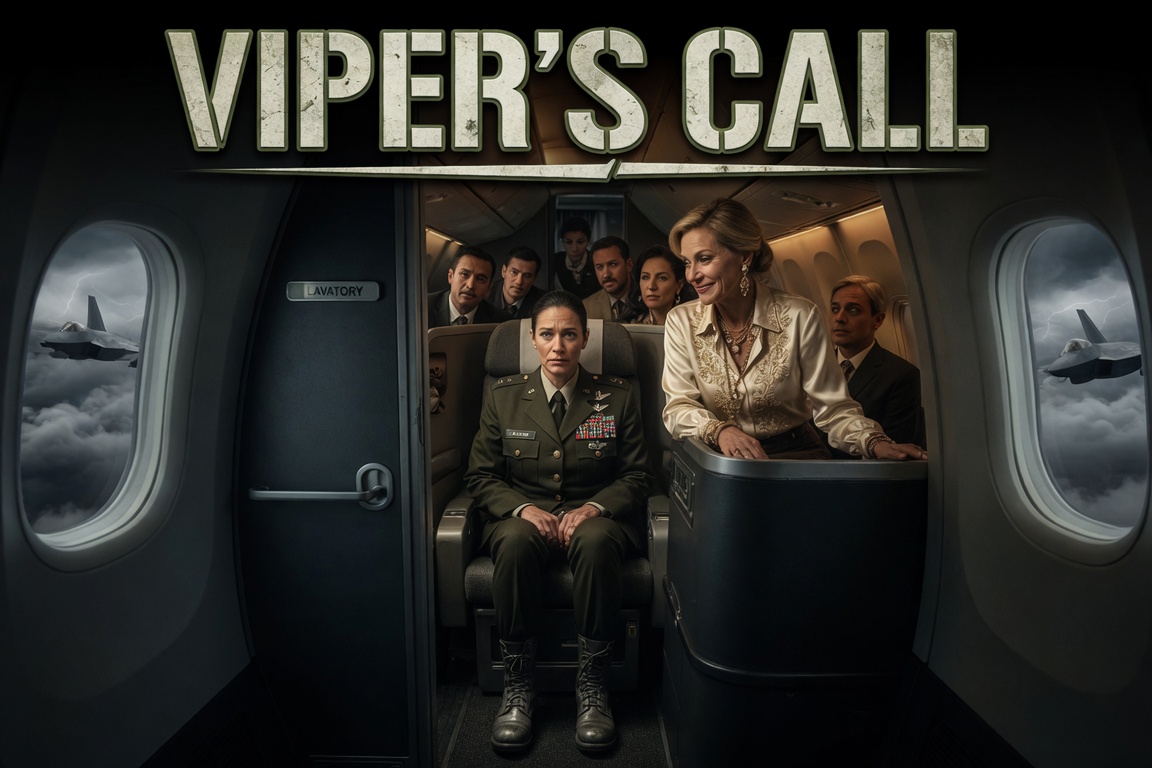
My sister took my first-class seat before she told the cabin that my Air Force uniform did not make me special.
Flight 417 had already begun boarding when Clarissa Vale swept through the gate with three assistants, two garment bags, a camera operator, and a green leather case she would not allow anyone else to touch.
Her company logo glowed across all of it.
VERDE HALO
A gold leaf inside a white circle.
The same symbol appeared on airport screens behind her, where a silent advertisement showed women walking through sunlit fields while Clarissa’s voice promised purity, balance, and “a life untouched by compromise.”
I stood near the jet bridge in service dress, holding my boarding pass.
Seat 2A.
Clarissa glanced at it.
“That’s mine.”
“No. Yours is 3D.”
“I need the window for the arrival footage.”
“You’re filming a landing?”
“My team is.”
Her camera operator raised his equipment as if the conversation had already become content.
Our father stood beside Clarissa in a new navy blazer. At seventy-four, Martin Vale still possessed the broad chest and hard posture of the high school football coach who had spent thirty years teaching boys to confuse pain with character.
He looked at my uniform.
“You’re traveling alone. Let her have the window.”
“I’m traveling for work.”
Clarissa smiled.
“She’s always traveling for work.”
Her assistant laughed too quickly.
I looked toward Dad.
He avoided my eyes.
We were all flying from Denver to Washington for the National Wellness Leadership Awards, where Clarissa would receive a humanitarian prize for funding rural clinics and veteran recovery programs.
I had not been invited to the ceremony.
I was scheduled to testify before the Senate Armed Services Committee the following morning.
My family did not know that.
They believed I was attending because Dad had written one sentence beneath Clarissa’s invitation:
It would mean something if the whole family showed up for once.
I had shown up.
The meaning had apparently changed at the gate.
Clarissa slipped the 2A boarding pass from my fingers.
“Take my seat.”
“Where is it?”
She handed me a new pass.
34C.
Last row.
Aisle beside the lavatory.
“You changed it already.”
“I asked the airline to fix the booking.”
The gate agent looked uncomfortable.
Clarissa’s company had purchased thirty-two seats on the flight for staff, influencers, and donors. The airline had assigned a private coordinator to keep the group happy.
Clarissa was accustomed to organizations rearranging themselves around her discomfort.
“You could have asked me,” I said.
“I’m asking now.”
“No. You’re reporting a decision.”
Her smile held.
The camera kept filming.
Dad stepped between us.
“Tessa, don’t turn a seat into a military operation.”
My fingers tightened around the handle of the black case at my feet.
The motion sent a dull electric ache through my left wrist. Eleven years earlier, a cargo hatch had closed on it during an aerial recovery mission above the Arctic. Surgeons saved the hand. They did not save every nerve.
Clarissa noticed the tremor.
She always noticed weakness when she could name it first.
“Look, I know the uniform gets you upgrades,” she said, loud enough for the passengers around us. “But this trip is about people who actually built something.”
A man in a business suit looked away.
Two teenagers near the charging station watched openly.
Clarissa tapped one finger against the silver eagle on each of my shoulders.
“Not everyone in a uniform is special.”
My father’s mouth tightened.
He did not stop her.
I looked at the camera operator.
“Turn that off.”
Clarissa laughed.
“You command the airport too?”
“No.”
I met his eyes.
“But filming a military identification badge for promotional use creates paperwork you will not enjoy.”
The camera lowered.
Clarissa’s smile disappeared.
I took the economy boarding pass.
Not because she had won.
Because an argument at the gate would not return the years our family had spent speaking through locked doors.
The black case remained with me.
That mattered more than the seat.
Dad exhaled as if I had finally behaved.
“Thank you.”
Gratitude would have required him to see the cost.
This was relief.
We boarded.
Clarissa settled into 2A beneath warm lighting and accepted champagne before the remaining passengers reached their rows. Dad sat across the aisle. Her assistants arranged product samples in the overhead bins while the camera operator captured her looking through the window with rehearsed thoughtfulness.
At the rear, Seat 34C had half a recline and a permanent relationship with the lavatory door.
A retired schoolteacher occupied the window seat. Her name was June. She wore a purple cardigan and carried a plastic container of homemade cookies for a grandson at Georgetown.
The middle seat belonged to a young Army private named Luis Ortega, traveling home after his first deployment.
He looked at my shoulder insignia, then stood too quickly.
“Ma’am.”
“Sit before you injure somebody.”
His face reddened.
“Yes, ma’am.”
I placed the black case beneath the seat in front of me and sat.
The case contained no weapon.
Inside rested an encrypted flight-control module recovered from a compromised test aircraft in Nevada. The device had been removed after software began broadcasting authentication requests to civilian communications networks.
My group had spent six months tracing the breach.
The trail led through a private cold-chain shipping company used by Verde Halo.
That was why I had accepted Dad’s invitation.
Clarissa’s company appeared in twelve classified freight transfers.
I had told myself I wanted to speak with her privately before investigators arrived.
The truth was less generous.
I wanted to see whether she would lie while looking at me.
The aircraft door closed.
Clarissa’s voice carried from the forward cabin.
“Some people collect medals. Some of us create jobs.”
Her staff laughed.
Luis stared at his knees.
June opened her cookie container and offered me one.
“Chocolate chip?”
“Thank you.”
“You’re taking this better than I would.”
I looked toward the curtain separating first class.
“I’ve had longer practice.”
The plane taxied through a sky the color of dull steel. Snow pressed against the edges of the runway. Engine noise deepened beneath our feet.
As we climbed, Denver vanished under cloud.
At twenty thousand feet, the seat-belt sign turned off.
At twenty-eight thousand, Clarissa began a livestream from first class despite the flight attendant asking her to remain quiet.
At thirty-one thousand, every screen in the cabin went black.
The engines continued.
The lights remained on.
But the moving map disappeared, followed by the entertainment system, Wi-Fi, and the soft electronic chime that had been playing beneath Clarissa’s voice.
The aircraft banked sharply right.
A glass fell in first class.
Passengers murmured.
Luis looked toward me.
“Normal?”
“No.”
The captain’s voice entered through the speakers.
“Ladies and gentlemen, please return to your seats and fasten your seat belts immediately.”
Not when convenient.
Immediately.
Flight attendants moved through the aisle with the controlled speed of people trying not to loan their fear to strangers.
I looked through June’s window.
Clouds had broken beneath us.
Far below, the plains spread white and empty.
Something gray moved above the left wing.
Too fast for another airliner.
The shape dropped lower.
Angular wings.
Twin tail fins.
An F-22 Raptor settled beside us, close enough that I could see the pilot’s helmet turn toward our windows.
A woman screamed three rows ahead.
Luis whispered, “Why would a fighter intercept a passenger jet?”
A second F-22 appeared on the opposite side.
Both aircraft held formation.
My phone vibrated despite the dead network.
The secure device concealed inside its case had received a military burst transmission.
Three words appeared:
ASTER ONE CONFIRM
I closed my eyes.
Aster One had been my operational call sign before promotion removed me from regular cockpit duty.
Very few people knew it.
The left F-22 moved slightly ahead.
Its right wing dipped.
Then rose.
A deliberate wing rock.
The second jet repeated it.
Luis stared.
“Are they saluting?”
The aircraft speakers clicked.
The captain’s voice sounded strained.
“Colonel Tessa Vale, United States Air Force, please identify yourself to a flight attendant immediately.”
Every head in the rear cabin turned toward me.
The lavatory door opened behind my shoulder.
A man stepped out and froze.
June looked at the silver eagles on my uniform.
Then toward the fighters outside.
“Is that you?”
I unfastened my seat belt.
“Yes.”
Ahead of us, the first-class curtain had been pulled open.
Clarissa stood in the aisle.
Her face had lost all color.
Chapter Two
Aster One
The lead flight attendant met me halfway to the cockpit.
Her name tag read MELANIE. She was perhaps fifty, with silver-blond hair and the steady expression of someone who had managed medical emergencies, drunken arguments, and turbulence without confusing calm with passivity.
“The captain says the Air Force is asking for your call sign.”
“Aster One.”
Her eyes sharpened.
“Please come with me.”
Passengers watched as I walked forward.
Clarissa remained beside Seat 2A.
Her champagne had spilled across the tray table.
“What is happening?” she demanded.
“I don’t know yet.”
“Those jets dipped their wings at you.”
“They acknowledged identification.”
Dad stood.
“Why would fighter pilots know you?”
“This is not the moment.”
His jaw hardened at the familiar answer.
Clarissa pointed toward my black case, which Luis was carrying behind me under my instruction.
“Is this because of her classified luggage?”
Melanie blocked Clarissa from stepping into the aisle.
“Ma’am, return to your seat.”
Clarissa laughed once.
“You know who I am?”
“Yes.”
The flight attendant’s face remained neutral.
“Passenger 2A.”
Clarissa sat.
The cockpit door opened.
Inside, warning lights painted the pilots’ faces red and amber. The captain, Robert Chen, kept both hands near the controls. First Officer Malik Evans monitored a secondary navigation display running on emergency software.
“Colonel,” Chen said, “our transponder began broadcasting a military distress code eleven minutes ago. We lost satellite communications and part of the flight-management network.”
“Aircraft control?”
“Stable. Autopilot is disconnected.”
“Navigation?”
“Internal inertial reference and analog backup. The fighters are providing vectors.”
Evans pointed toward a line of symbols on one display.
“We’re transmitting as a compromised military aircraft.”
“This plane has no military identification hardware.”
“It does now.”
He looked toward the cabin.
“The Air Force says the signal is originating on board.”
Luis handed me the black case.
I placed my thumb against the reader.
The locks opened.
Inside, the recovered flight-control module rested within gray protective foam.
Its indicator remained dark.
I connected a diagnostic strip.
No transmission.
“This device is clean,” I said.
Captain Chen looked through the left window.
The F-22 pilot lifted one gloved hand.
My secure phone received another burst message.
SIGNAL FORWARD CABIN. FREQUENCY STRATOS-9.
I knew the frequency.
Stratos-9 belonged to an authentication beacon used in Air Force recovery aircraft. During crashes or hostile interference, it allowed fighters to locate a compromised platform without relying on civilian transponders.
The beacons were not sold commercially.
One had disappeared from a Nevada storage site three months earlier.
“Do you have access to the baggage map?” I asked.
Evans opened the load manifest.
Clarissa’s group had checked twenty-seven cases.
Nineteen carried Verde Halo wellness products.
Six were marked event displays.
Two were described as temperature-sensitive medical equipment.
“What is in the cabin?” I asked.
Melanie answered from the doorway.
“One large product case in first class. Ms. Vale’s team refused to gate-check it.”
“Color?”
“Green leather.”
The case Clarissa would not allow anyone else to touch.
I returned to the cabin with Melanie and Luis.
Clarissa saw us coming.
“No.”
I stopped beside her seat.
“I have not asked a question.”
“You’re looking at the prototype case.”
“What prototype?”
She folded both arms.
“Verde Halo AirPure. It’s a personal atmospheric wellness system.”
Dad leaned toward her.
“The one launching tomorrow?”
“Yes.”
I looked at the case under the seat.
Its gold latches had begun to vibrate.
A faint blue light leaked through the seam.
“Who built it?”
“Our engineering division.”
“Name.”
“Owen Blake.”
I knew him.
Former Air Force avionics engineer.
Honorably discharged after a training crash left his son with permanent brain damage. Blake later became Clarissa’s chief operating officer and the architect of Verde Halo’s military wellness contracts.
“Open the case,” I said.
Clarissa gripped the handle.
“No.”
The F-22 outside moved closer.
Passengers pressed toward windows.
I lowered my voice.
“That case is broadcasting a restricted Air Force distress signal.”
“It purifies cabin air.”
“It is telling two armed fighters that this aircraft has been captured.”
Her fingers loosened.
Dad stared at her.
“Clarissa?”
She looked toward her assistants.
None met her eyes.
“I was told the core used aviation-grade sensors.”
“Open it.”
She pressed the latches.
Nothing happened.
The blue light brightened.
Melanie crouched beside us.
“The case is hot.”
Clarissa touched the side and pulled her hand away.
A chemical smell entered the cabin.
Sharp.
Metallic.
Not smoke yet.
The nearest passengers began coughing.
“Clear first class,” I ordered.
Melanie activated the interphone.
Flight attendants moved people toward the rear. Oxygen masks remained overhead, but emergency equipment came out of the forward galley.
Clarissa refused to release the handle.
“My launch unit is inside.”
I looked at her.
“So is something stolen from the United States Air Force.”
The sentence reached every passenger close enough to hear.
Her camera operator lowered his phone.
Clarissa’s mouth tightened.
“I did not steal anything.”
“Then step away.”
She did.
I pulled the case into the galley and opened its emergency hinge with a tool from the cockpit kit.
Inside sat a polished white device shaped like a small tower. Green glass panels surrounded a silver core.
Beautiful.
Expensive.
Built to be photographed.
Beneath the decorative housing, I found the unmistakable black casing of a Stratos beacon.
Its military serial number had been partially removed.
A cable connected it to the AirPure processor.
I turned the unit.
A digital display came alive.
AUTHORITY CERTIFICATE VERIFIED
COL. TESSA VALE
The cabin seemed to contract around me.
Clarissa looked over my shoulder.
“What does that mean?”
I faced her.
“It means this device is using my identity.”
Dad shook his head.
“That’s impossible.”
“No.”
I watched Clarissa.
“It is forgery.”
Her face changed.
Not surprise.
Recognition.
There it was.
The answer I had crossed half the country hoping not to find.
“You knew,” I said.
Clarissa looked toward the passengers.
“Not about the beacon.”
“That was not what I asked.”
Her voice dropped.
“The military partnership required an Air Force adviser.”
“You listed me?”
“Only on preliminary paperwork.”
“My service certificate is embedded in stolen hardware.”
“I never approved hardware.”
“You approved my name.”
Her jaw tightened.
“The company needed credibility.”
“Then earn it.”
“You think everyone receives twenty-seven years of government funding and a pension?”
My father stepped between us.
“Tessa, whatever document she signed, we can handle it after landing.”
I looked at him.
“The fighters outside are handling it now.”
An alarm sounded from the white device.
Temperature rose across the display.
The beacon began forcing a software handshake with the aircraft’s communication network.
Captain Chen’s voice came over the interphone.
“Colonel, we are receiving false navigation instructions. The system is attempting to redirect us north.”
“Disconnect external data.”
“We did. It’s inside our local bus.”
Clarissa stared at her AirPure prototype.
“Can it control the plane?”
“Not directly.”
“What does that mean?”
“It can make the cockpit believe the wrong information.”
Outside, the left F-22 banked.
My secure phone flashed:
FALSE TERRAIN FEED. DESCENT COMMAND IN 90 SEC.
I looked at Clarissa.
“Where is Owen Blake?”
Her gaze moved toward the first-class lavatory.
The door was locked.
Chapter Three
The Man in the Lavatory
Owen Blake opened the lavatory door before anyone forced it.
He stepped out with both hands visible.
Fifty-six.
Lean.
Gray at the temples.
He wore an expensive charcoal suit, but his military posture had survived civilian success. A white scar crossed the knuckles of his right hand.
He looked at me, then at the open AirPure case.
“Colonel.”
“Mr. Blake.”
Clarissa stared at him.
“You told me the core came from licensed surplus.”
“It did.”
“That is an active military beacon.”
“Yes.”
Her face tightened.
“You said it was a navigation stabilizer.”
“I said it stabilized secure communications.”
“You used my product.”
“You used her identity.”
He nodded toward me.
The blow landed.
Clarissa had expected loyalty from the man she had allowed to misuse my name.
He had simply continued the logic.
I asked, “Who is receiving the signal?”
“No one now.”
“Incorrect.”
Blake looked through the window at the F-22.
“The response was faster than projected.”
“You planned the intercept?”
“I planned a military detection event.”
Passengers nearby stared.
Clarissa’s voice became thin.
“For publicity?”
“No.”
He looked almost insulted.
“To expose the vulnerability.”
Captain Chen came over the interphone.
“We have sixty seconds before the false descent command enters the backup system.”
I removed the AirPure’s outer panel.
Blake watched.
“You cannot disconnect the beacon without triggering its containment protocol.”
“What does containment do?”
“Erases the certificate and overloads the power cell.”
Clarissa looked at the heat display.
“Overloads?”
“Controlled burn.”
“We are in an airplane.”
“The unit was supposed to remain in shielded freight.”
“You told me to carry it on.”
Blake’s face hardened.
“Because your launch team changed the shipping plan.”
One of Clarissa’s assistants spoke from the aisle.
“The event venue refused late cargo.”
Clarissa turned.
“Stop talking.”
“No,” I said.
“Everyone stops protecting the version that makes them least responsible.”
The cabin lights flickered.
Captain Chen called again.
“Thirty seconds.”
I looked at Blake.
“What does the beacon want?”
“My authorization.”
“You no longer hold active credentials.”
“It is not using mine.”
His eyes moved toward Clarissa.
She went still.
Blake had built the device around my forged certificate, but Verde Halo’s chief executive retained the commercial activation key.
Clarissa’s hand rose toward the gold bracelet at her wrist.
A wellness tracker.
Or something disguised as one.
“Take it off,” I said.
She covered it.
“It controls the prototype.”
“It is also authenticating the beacon.”
Blake stepped toward her.
“If she removes it now, the unit enters burn mode.”
“What happens if she keeps it on?”
“The false descent executes.”
Clarissa’s breath quickened.
For years, she had told audiences that wellness began with conscious choices.
Now every available choice carried a consequence she had helped create.
My father looked at me.
“Tell her what to do.”
I hated the request.
Not because I lacked an answer.
Because our family had always arranged difficult moments until one daughter carried the decision and the others judged the result.
I turned toward Clarissa.
“You choose whether to remove it.”
Her eyes widened.
“What?”
“I will tell you the risks. You choose.”
“You are the military expert.”
“It is your device and your authorization.”
Her mouth opened.
No words came.
I continued.
“Keep the bracelet connected, and the aircraft receives a false descent route toward restricted terrain. Remove it, and the AirPure power cell overheats. We may contain the heat in the galley fire bag, but I cannot guarantee it.”
“What would you do?”
“I would remove it.”
“Because you think you can save everyone.”
“No.”
I looked at the passengers gathering behind the curtain.
“Because the pilots can fly without corrupted data. They cannot fly if the system keeps lying to them.”
Clarissa closed her eyes.
Then pulled off the bracelet.
The AirPure screamed.
Heat surged through the casing.
Melanie and another flight attendant opened the fire-containment bag. I lifted the device with insulated gloves and placed it inside.
The power cell flashed white through the fabric.
Smoke filled the galley.
Luis and two passengers helped move people farther back. June passed wet napkins down the aisle. No one asked who had the most important job. They simply took the next useful one.
In the cockpit, false data disappeared.
The aircraft rolled hard left as Captain Chen corrected manually.
The F-22s moved with us.
The containment bag swelled.
Blake stood beside the lavatory, watching twenty years of design turn into smoke.
Clarissa grabbed his sleeve.
“Why?”
He looked at her.
“My son waited forty-six minutes for an evacuation aircraft after his crash.”
Her anger faltered.
She knew the story.
Blake’s son, Caleb, lived in a long-term care center funded by Verde Halo.
“Air Force dispatch had three available crews,” Blake said. “They spent fourteen minutes verifying a corrupted authentication code. Fourteen minutes deciding whether the rescue request was real.”
His voice remained steady.
Only his fingers betrayed him, opening and closing at his side.
“Caleb’s brain went without oxygen while people protected procedure.”
“So you stole the beacon,” I said.
“I improved it.”
“You put a passenger aircraft at risk.”
“I created a controlled demonstration showing the military that civilian systems could enter its authentication network.”
“Controlled by whom?”
His jaw tightened.
“Me.”
I pointed toward the containment bag.
“That is not control.”
He looked away.
Clarissa released his sleeve.
“You used my company.”
Blake faced her.
“You needed the federal contracts.”
“I needed access to military wellness programs.”
“You needed the contracts.”
His voice sharpened.
“You changed organic test results to keep store shelves full. You relabeled imported ingredients after the drought. You used your sister’s service record to enter defense logistics.”
Passengers began filming again.
Clarissa saw.
Her public face rose instinctively.
“Those were emergency decisions during a supply crisis.”
Blake almost smiled.
“That is what everyone calls the first compromise.”
Dad stepped forward.
“My daughter created six hundred jobs.”
Blake looked toward him.
“And Colonel Vale commands people whose funerals do not appear in advertisements.”
The cabin went quiet.
My father turned toward me.
“Commands what?”
I had wanted to tell him someday without crisis standing nearby.
Crisis had other plans.
“I command the Air Force’s Seventy-Third Airborne Recovery Group.”
“What does that mean?”
“We recover aircraft, crews, and sensitive systems when ordinary routes fail.”
Clarissa stared.
“You said you worked in readiness policy.”
“I do.”
“You fly?”
“Not regularly anymore.”
Blake looked toward my damaged wrist.
“Not since Kestrel Ridge.”
Dad heard.
“What is Kestrel Ridge?”
I did not answer.
Blake did.
“The reason those F-22 pilots dipped their wings.”
He faced the windows.
“Six years ago, a training formation lost navigation and fuel control over Alaska. Colonel Vale flew an untested tanker through an ice storm and brought five pilots home.”
My father looked at me as if the cabin had become too small to contain the person he had dismissed at the gate.
“How do you know?”
Blake’s expression hardened.
“I helped design the software that failed them.”
Before anyone could respond, the aircraft interphone sounded again.
Captain Chen’s voice carried urgency.
“Colonel Vale, we have a second transmitter.”
Blake closed his eyes.
I looked toward him.
“Where?”
He remained silent.
Clarissa whispered, “Owen.”
The captain continued.
“The F-22s detect it beneath the cabin. Cargo hold.”
Blake looked at the floor.
The first device had been a demonstration.
The second was the real transfer.
Chapter Four
Thirty-One Thousand Feet
The cargo transmitter began sending control instructions to the F-22s.
The fighters rejected them, but every failed attempt revealed more about their encryption. Somewhere outside the aircraft, a receiver was collecting the responses.
Blake had turned the passenger jet into a moving laboratory.
General Vance at Air Defense Command opened a secure voice channel through the lead Raptor.
His words entered the cockpit speakers.
“Aster One, hostile collection node is believed to be on the ground near Valentine, Nebraska. Your aircraft is acting as relay.”
“What is the nearest safe field?” I asked.
“Offutt is available, but the signal is pushing your civilian navigation south of the approved route.”
Captain Chen looked at his analog instruments.
“Forty minutes to Offutt under escort.”
“Fuel?”
“Enough.”
“Weather?”
“Freezing rain near Omaha.”
“We can work with weather.”
General Vance continued.
“The cargo unit may contain a Stratos root module. If it finishes mapping the fighters’ response, the attacker could imitate rescue authentication across multiple platforms.”
Clarissa sat behind the cockpit door, hearing every word.
Her company name appeared on the cargo manifest.
Even if she had not understood the technology, her forged contract had opened the route.
“What do you need from us?” I asked.
“Break the relay without accessing the cargo hold in flight.”
“Can we shield the cabin transmitter?”
“It is already contained.”
“Then interrupt the aircraft’s external relay physically.”
Captain Chen looked toward the communications panel.
“We can shut down the primary antennas, but we lose normal radio.”
“The Raptors can guide you visually.”
He looked at me.
“Can we land that way?”
“Yes.”
“How sure are you?”
I appreciated the question.
“Not completely.”
He nodded.
“Good.”
Certainty would have been less useful than honesty.
We powered down the civilian communications array.
Every cabin screen went dark again.
The captain made one final announcement before normal radio disappeared.
“We are diverting to Offutt Air Force Base due to a technical security issue. Two United States Air Force aircraft will remain beside us. Please follow all crew instructions.”
Passengers moved toward the windows.
The left F-22 came closer.
Its pilot’s helmet turned.
My secure device received a short message.
MAJOR MAYA NGUYEN. SABER ONE. GLAD YOU’RE HERE, MA’AM.
I remembered Maya at twenty-six, strapped inside a damaged fighter above the Alaskan coast, oxygen icing along her mask while I talked her through a dead-stick approach toward a runway she could not see.
The second message came from the other jet.
CAPT. ELLIS COLE. SABER TWO. KESTREL FIVE. STILL OWE YOU DINNER.
A warmth moved through me that had nothing to do with rank.
These were not strangers saluting a title.
They were people whose fear I had once heard over a radio.
I replied:
GET US HOME. DINNER LATER.
Saber One rolled slightly left, dipping her wing toward our cabin.
Saber Two mirrored the gesture from the opposite side.
Passengers gasped.
Luis smiled before remembering he was frightened.
June looked from the fighters to me.
“That looked personal.”
“It was acknowledgment.”
“For what?”
“For work already done.”
In first class, Clarissa watched the F-22s.
Her face reflected faintly in the window, layered over the gray fighter beyond it.
For decades, she had accused me of choosing distance over family.
Now distance itself had come close enough for her to see what lived there.
Dad sat beside her.
He did not speak.
Blake remained under the supervision of two off-duty federal officers who had identified themselves after the crisis began.
One was a Treasury investigator.
He had been traveling to Clarissa’s award ceremony.
That detail was not accidental.
The government had already been looking at Verde Halo.
Clarissa understood.
“You knew investigators were on this flight,” she said to me.
“I knew one was.”
“You used the trip.”
“I carried evidence. I did not create the beacon.”
“You came expecting me to be guilty.”
“I came hoping you would explain the shipping records.”
“You could have called.”
“I did.”
Her jaw tightened.
“When?”
“Four times over three months.”
“You called from secure numbers. My assistant screens them.”
“You returned Dad’s calls.”
“That is different.”
“Yes.”
The word struck.
Our family had built entire walls from what counted as different.
Clarissa looked toward the rear cabin where her employees sat among strangers.
“What happens to them?”
“The employees?”
“My company.”
“You asked about the company first.”
Her eyes flashed.
“The company pays them.”
“So preserve them separately.”
“Easy for you to say. The government pays your salary whether a quarter goes badly.”
“My pilots do not become collateral when my reputation is threatened.”
“No. They become medals.”
Dad looked between us.
“Stop.”
Neither of us did.
Clarissa leaned closer.
“You missed Mom’s final week.”
“I know.”
“You missed my first store opening, my divorce hearing, and the night Dad had heart surgery.”
“I know.”
“You sent flowers with military cards that told us nothing.”
“I know.”
Her voice broke.
“And then you appear in a perfect uniform while everyone discovers you’re some secret hero?”
“No.”
I kept my voice low.
“I appeared because your company used my name.”
She looked away.
The cruelty left her face. Grief remained.
“I stayed,” she whispered.
“Yes.”
“I held Mom’s hand while she forgot who I was.”
“I know.”
“You were above an ocean somewhere.”
“Over Greenland.”
“Doing what?”
I had never told her.
The mission had been classified for nine years and publicly summarized in a single sentence afterward.
“An aircraft carrying forty-three schoolchildren lost pressure and navigation during a volcanic ash event. We guided it to a military runway.”
Clarissa stared.
“Children?”
“Yes.”
“Mom was dying.”
“Yes.”
“You chose them.”
I felt the old wound open without drama.
“I chose the plane in front of me.”
“And left us.”
“Yes.”
The cabin vibrated through light turbulence.
“I hated you,” she said.
“I know.”
“I built Verde Halo because Mom spent years taking pills filled with things no one could explain. I wanted clean products. Honest labels.”
I looked toward the smoking containment bag in the galley.
“What happened?”
“Honest labels became expensive.”
Her eyes filled.
“The drought ruined two suppliers. Stores threatened to drop us. The veteran clinics were already open. Six hundred families depended on payroll.”
“So you relabeled ingredients.”
“Temporarily.”
“You forged my certification.”
“To qualify for military distribution.”
“You used my name because asking risked hearing no.”
Her face tightened.
“Yes.”
There it was.
Not innocence.
Not a monster.
A woman who began with care and taught herself that care made permission unnecessary.
I had seen the same corruption in commanders.
Dad took her hand.
“She did it for people.”
I looked at him.
“That explains it.”
“Then help her.”
“It does not excuse it.”
His mouth tightened.
“You always loved rules more than family.”
“No.”
I pointed toward Blake.
“I love family enough not to let it become the word we use when consent is inconvenient.”
Before Dad could answer, the aircraft dropped sharply.
People cried out.
The seat-belt sign had remained on, but luggage shifted inside overhead bins.
Captain Chen’s voice came through the open cockpit door.
“False altitude warning. Backup system contaminated.”
I moved forward.
Below us, clouds covered Nebraska.
The F-22s repositioned, one high and one low.
Captain Chen had analog altitude, airspeed, engine instruments, and little else. The corrupted cargo module fed false terrain information into every digital display it could reach.
First Officer Evans pointed toward the screen.
“It says we’re two thousand feet lower than our pressure altitude.”
“Trust pressure and the fighters,” I said.
“What if the static source is wrong?”
“Then compare three imperfect sources instead of worshipping one.”
Saber One moved ahead and descended slightly.
Her wing position became a visual command.
Captain Chen followed.
In the cabin, Blake unfastened his seat belt.
The Treasury officer stopped him.
“I need the AirPure bracelet,” Blake said.
Clarissa looked up.
“Why?”
“The cargo module will continue transmitting until it receives executive cancellation.”
“You said removing it triggered burn mode.”
“For the cabin unit.”
“And the cargo?”
“It requires her voice.”
Clarissa stared.
Blake had built two systems.
One weaponized her authorization.
The other required her cooperation.
“Cancellation phrase?” I asked.
He answered.
“Verde Halo returns to source.”
Clarissa laughed bitterly.
“My brand slogan.”
“You wanted every system to reflect the company.”
She looked toward the floor beneath us.
If she spoke, the cargo module might shut down.
Or Blake might be using her again.
“What if it triggers something else?” she asked.
He did not answer quickly enough.
I turned toward him.
“What does the second phrase do?”
His shoulders lowered.
“Uploads the collected data.”
Clarissa went still.
“You expected me to say it during an emergency.”
“Yes.”
“Why?”
“Because frightened executives protect brands.”
He had studied her as carefully as he studied machines.
He believed he knew which choice she would make.
Clarissa stood.
The Treasury officer allowed it but remained close.
She faced the floor.
Then she spoke clearly.
“Verde Halo is not the source.”
Blake’s eyes narrowed.
“That isn’t the phrase.”
“No.”
She looked at him.
“It’s the truth.”
Clarissa removed her company badge and broke it against the armrest.
Inside, a small wireless chip flashed.
Blake lunged.
Luis and the Treasury officer restrained him before he reached her.
The chip had been the cargo module’s secondary relay.
Clarissa crushed it beneath her heel.
The false altitude warning disappeared.
Outside, Saber One dipped her wing toward the runway emerging through freezing rain.
Offutt Air Force Base waited below.
Chapter Five
The Landing
The landing gear lowered through gray cloud.
No one spoke above a whisper.
The two F-22s remained beside us until the runway came into view, then climbed away in opposite directions, guarding the approach from above.
Flight 417 touched down hard.
The right wheels struck first.
The cabin shook.
A child began crying three rows behind first class.
Then the left wheels settled, reverse thrust roared, and the aircraft slowed beneath flashing emergency lights.
Applause erupted.
Captain Chen did not deserve applause merely for surviving.
He deserved recognition for refusing false information while carrying two hundred lives.
There was a difference.
The plane stopped on a remote section of the base.
Military fire crews surrounded us. Security vehicles blocked every taxiway. A hazmat team approached the cargo hold.
No one was allowed to leave immediately.
The first person to board wore four stars.
General Ruth Vance, commander of Air Combat Command, entered with two security officers and removed her cap beneath the cabin ceiling.
She saw me near the cockpit.
“Colonel Vale.”
I came to attention.
“Ma’am.”
She saluted.
I returned it.
Passengers became silent again.
General Vance lowered her hand.
“Aster One, the fighters report outstanding visual coordination.”
“They did the work.”
“That sounds like you.”
She looked toward Clarissa.
“And this is Ms. Vale?”
Clarissa had built a career speaking to audiences of thousands.
Now she could not find her voice.
“Yes, ma’am,” she managed.
Vance turned toward Blake.
“Owen Blake, you are being detained under federal authority.”
Security officers secured his wrists.
He did not resist.
“General,” he said, “the vulnerability is real.”
“I know.”
“The military ignored it.”
“We will investigate it.”
“That takes years.”
“Yes.”
“People die while institutions investigate.”
Vance’s face remained hard.
“People also die when one grieving engineer decides every stranger belongs inside his demonstration.”
Blake looked toward the window.
Outside, the F-22s taxied toward a secure ramp.
Major Maya Nguyen climbed from Saber One.
Captain Ellis Cole emerged from the second jet.
After the cabin was cleared, they approached the aircraft stairs.
Maya saw me at the door and smiled beneath the freezing rain.
Then both pilots came to attention and saluted.
“Ma’am,” Maya said.
“Major.”
She glanced toward the cabin.
“We assumed you’d take the first-class seat.”
“Operational error.”
Ellis looked over my shoulder.
Clarissa stood behind Dad.
She heard him say, “Kestrel Ridge still owes you five pilots.”
My father’s face folded slightly.
Not with pride.
With the weight of learning that his private judgment had existed beside an entirely different record.
The passengers began leaving in groups.
June stopped beside me.
She placed the remaining cookies in my hands.
“For the pilots.”
I smiled.
“They’ll appreciate them.”
Luis saluted.
His hand shook.
I returned it.
“Keep your feet under you, Private.”
“Yes, ma’am.”
Clarissa waited until her staff had deplaned.
Federal investigators took her electronic devices but did not arrest her.
Not then.
She stepped onto the wet tarmac without the green case, company badge, cameras, or assistants.
Dad followed.
The cold caught him immediately. I gave him my overcoat.
He stared at it.
“I don’t deserve this.”
“It is a coat.”
“That is not what I meant.”
“I know.”
He put it on.
Clarissa looked toward the fighters.
“They really dipped their wings for you.”
“Yes.”
“Did everyone know except us?”
“No.”
“Who knew?”
“The people who needed to.”
Her jaw tightened.
“That was always your answer.”
“Yes.”
“And you still think our silence was worse than yours.”
“No.”
I looked toward the investigators opening Verde Halo’s cargo containers.
“I think silence becomes dangerous when we use it to control what other people are allowed to choose.”
She understood.
My secrecy had protected missions.
It had also protected me from discovering whether my family could love the real shape of my life.
Her secrecy had protected a company.
It had also stolen my identity and placed strangers inside risk they never approved.
Both truths could stand without becoming equal.
Dad touched the silver eagle on my shoulder.
“You’re a full colonel.”
“Yes.”
“How long?”
“Six years.”
“And you command fighter pilots?”
“Recovery operations. Some pilots.”
“You never told me.”
“I corrected you repeatedly when you called me a clerk.”
“That is not the same as telling me.”
“No.”
I met his eyes.
“It is not.”
The admission surprised him.
It surprised Clarissa too.
I continued.
“You did not ask. I also stopped offering.”
Dad looked down.
“Because we didn’t deserve it?”
“Because every time I came home, I felt twelve years old again.”
His face changed.
There were no regulations in that sentence.
No classified mission to blame.
Only a daughter admitting that command did not protect her at the family table.
Clarissa wrapped both arms around herself.
“What happens to Verde Halo?”
“An independent receiver will separate payroll, clinics, and legitimate operations from the fraud investigation.”
“You arranged that?”
“The government began arranging it before this flight.”
“You knew.”
“I knew investigators were ready.”
“Why didn’t you warn me?”
“Because warning you could have allowed evidence destruction.”
She looked wounded.
Then angry.
Then tired.
“Do you believe I would destroy evidence?”
“You relabeled ingredients, forged my approval, and carried undeclared equipment onto a passenger aircraft.”
Her eyes closed.
“No.”
I softened nothing.
“But I believe you may still choose not to.”
She opened her eyes.
The difference mattered.
A federal agent approached.
“Ms. Vale, we need your statement.”
Clarissa nodded.
Before following, she looked at me.
“Will you come?”
Not save me.
Not fix it.
Come.
“I’ll sit outside the interview room.”
“Not inside?”
“No.”
She accepted the boundary.
It was the first honest agreement we had made in years.
Chapter Six
The Cost of Purity
The investigation lasted sixteen months.
Television made it appear faster.
Clarissa’s award ceremony was canceled before we left Offutt.
By morning, footage of the F-22 escort had spread across every news network. So had a video from the gate showing Clarissa touching my rank insignia and saying I was not special.
Millions watched the moment without knowing what followed.
The internet delivered the punishment it preferred.
Fast.
Public.
Without proportion.
Commenters called her a fraud, a parasite, a criminal, a narcissist, and several things no person should be called by strangers before trial.
Clarissa’s face disappeared from Verde Halo advertising within forty-eight hours.
Retailers removed products.
Three lenders froze accounts.
The company might have collapsed completely if investigators had not separated its legitimate operations first.
Four hundred and eighty-one employees kept their jobs.
The veteran clinics moved into an independent charitable trust.
Two product lines survived after full testing.
Nine were withdrawn.
Clarissa pleaded guilty to wire fraud, false statements, identity theft, and violating federal ingredient-labeling requirements.
She had not known Blake intended to collect military encryption data.
She had known the supply chain was fraudulent.
She had known my signature was false.
Those choices belonged to her.
She received eighteen months in a minimum-security federal facility, followed by restitution and a ten-year prohibition against serving as a corporate officer.
Owen Blake received a much longer sentence.
At trial, he spoke about Caleb.
His son sat in the courtroom in a motorized chair, unable to speak.
Blake looked at him while admitting what he had done.
“I believed one preventable delay gave me the right to remove delay from everyone else’s life.”
The prosecutor asked, “Even by removing their choice?”
Blake’s fingers tightened.
“Yes.”
The word did not make him simple.
It made him responsible.
The Air Force investigation found that the authentication vulnerability had been reported twice and dismissed because correcting it would have delayed deployment of rescue systems.
Three officers retired.
Two contractors lost clearances.
The Stratos network was rebuilt with physical isolation, multiple human verification channels, and a requirement that disagreement could not be classified as compromise without independent review.
Major Nguyen sent me a photograph of the new cockpit warning.
CONFIDENCE IS NOT AUTHORITY.
She had taped it above the display.
My father blamed me for Clarissa’s sentence during the first month.
He blamed Blake in the second.
He blamed the company’s lawyers in the third.
Then a therapist asked him why every explanation protected his image of Clarissa as the child who stayed.
He stopped attending therapy for six weeks.
When he returned, he brought the old family calendar from the year our mother died.
My missed visits had been marked in red.
Clarissa’s appointments appeared in blue.
Nothing recorded the missions I could not describe.
Nothing recorded the nights Clarissa slept in hospital chairs.
The calendar was accurate.
It was not complete.
Dad placed it between us.
“I made attendance the only form of love I could measure.”
I looked at the red marks.
“You had a right to be angry.”
“I enjoyed being angry.”
The sentence came reluctantly.
“It gave me someone to punish for losing your mother.”
He rubbed both palms against his knees.
“Clarissa stayed. So I turned staying into goodness.”
“And leaving into failure.”
“Yes.”
The word sounded older than he did.
“I’m sorry.”
I believed him.
Belief did not create immediate closeness.
It created a place where closeness might eventually stand.
Clarissa wrote from prison.
Her first letters described appeals, unfair coverage, and employees who abandoned her.
I answered only factual questions.
After four months, the letters changed.
She wrote about the women who packed Verde Halo orders at night.
The veterans who received treatment through clinics funded partly by fraud.
The farmers who had supplied honest ingredients before she replaced them with cheaper imports and kept their faces in advertisements.
One line remained with me:
I thought helping people meant I deserved to decide what they could afford not to know.
I wrote back:
I have made a quieter version of the same mistake.
She replied:
That is not the same as what I did.
I answered:
No. But accountability does not require pretending we share no wound.
When she was released, I did not meet her at the gate.
Dad did.
That was his choice.
I saw her three weeks later at an employee-owned packaging cooperative that had purchased Verde Halo’s surviving product lines.
Clarissa wore jeans, work boots, and no makeup.
Her hair had gone gray near the temples.
No camera followed.
She stood beside a pallet of plain brown boxes with complete ingredient labels printed in black.
Nothing about purity.
Nothing about perfection.
Only what was inside.
“You came,” she said.
“Yes.”
“Dad said you might.”
“He is learning not to speak for me.”
She smiled faintly.
“So am I.”
We walked through the warehouse.
Former Verde Halo employees greeted her carefully. Some hugged her. Others did not.
She thanked both.
Near the shipping station, a framed photograph showed a rural clinic that remained open under independent management.
Clarissa touched the edge.
“I did build some good things.”
“Yes.”
“I used that to excuse the rest.”
“Yes.”
She glanced at me.
“You still say yes like a door closing.”
“Sometimes it is a doorframe.”
“That sounds like something an admiral would say.”
“Colonel.”
Her eyebrows rose.
“You turned down the star?”
“I delayed consideration.”
“Why?”
I looked through the warehouse windows where late sunlight crossed rows of ordinary vehicles.
“For most of my career, the next assignment answered every personal question for me.”
“And now?”
“Now I am learning to remain after the emergency.”
Clarissa looked down.
“I don’t know how to be your sister without competing.”
“Then do not perform sisterhood.”
“What do we do?”
“Coffee.”
She stared.
“That’s all?”
“For forty minutes.”
“And after?”
“We decide whether there is another coffee.”
A year earlier, she would have called the offer insulting.
Now she nodded.
“Forty minutes.”
Chapter Seven
No Wingman Required
Two years after Flight 417, Dad asked to visit my base.
He had never seen where I worked.
Not once.
He arrived at Nellis on a clear Nevada morning carrying a paper bag of sandwiches and wearing the old Air Force cap I sent him from my first assignment.
The cap had remained in a drawer for twenty-six years.
Now the bill had been carefully reshaped.
Clarissa came too.
Her probation officer had approved the trip.
She carried no branded luggage.
We stood beside a hangar as two F-22s returned from training. Heat shimmered above the runway. Engines rolled through the concrete and into the bones.
Major Maya Nguyen climbed down from the first aircraft.
Captain Ellis Cole exited the second.
They approached in flight suits.
Dad straightened.
Clarissa looked nervous.
Maya saluted.
I returned it.
Then she smiled.
“Ma’am, we heard there are sandwiches.”
Dad lifted the paper bag.
“Turkey.”
“Operationally significant.”
Ellis looked toward Clarissa.
“We met through a window.”
She nodded.
“I had a bad seat.”
He glanced at me.
“So did the colonel.”
Clarissa accepted the joke.
That mattered.
We ate at a metal table inside the hangar. Pilots, maintainers, intelligence officers, and young airmen moved around us. Some called me Colonel. Some called me ma’am. One chief called me Tessa when he thought rank was interfering with useful disagreement.
Dad watched all of it.
“You know their names,” he said.
“Most.”
“Even the mechanics?”
“Especially the maintainers.”
He nodded slowly.
My father had spent his life believing leadership meant being the most visible person in the room.
Here, he saw people enter quietly, correct one another, and disappear beneath aircraft before anyone applauded.
Clarissa looked toward Maya.
“Were you one of the pilots who dipped her wings?”
“Yes.”
“Was it a salute?”
Maya considered.
“It was partly identification.”
Clarissa smiled.
“Tessa said acknowledgment.”
“That too.”
“What were you acknowledging?”
Maya looked at me.
“Kestrel Ridge.”
Dad waited.
This time, he did not ask Maya to tell my story.
He turned toward me.
“What happened?”
The question contained no accusation.
No demand for proof.
I told them.
Not every classified detail.
Enough.
Five fighters had lost navigation during an Arctic exercise after corrupted software pushed them toward open ocean. A tanker crew and I entered weather no one had cleared. One pilot ran out of fuel above the runway and landed without power.
Maya interrupted twice to correct my habit of reducing my role.
Ellis corrected her corrections.
Dad listened.
Clarissa did too.
When the story ended, Dad looked toward the fighters.
“And you never told us.”
“No.”
“Were you forbidden?”
“For three years.”
“And after?”
I took time.
“Afterward, I liked knowing something you could not diminish.”
The hangar noise continued around us.
Clarissa looked down.
Dad closed his eyes.
“That is difficult to hear.”
“It was difficult to become.”
He nodded.
No defense followed.
Maya stood.
“We have another sortie.”
Clarissa glanced toward the aircraft.
“Do you ever get used to those?”
“No,” Maya said. “That is why we inspect them.”
The pilots left.
Dad gathered the sandwich wrappers.
Clarissa helped.
No one assigned the task according to rank.
Before leaving the hangar, we passed a framed photograph of Saber One and Saber Two beside Flight 417 after landing.
The caption described an air-defense escort and successful diversion.
My name appeared once in the final sentence.
Clarissa stopped.
“The internet made the jets the whole story.”
“It likes pictures.”
“And me mocking you.”
“It likes villains too.”
She looked at the photograph.
“Were you happy when they dipped their wings?”
“Yes.”
The same answer I had given Dad.
“It felt like someone had finally corrected the room.”
“And then?”
“Then the device started burning.”
She laughed softly.
The sound held regret but no collapse.
We walked outside.
The desert sun struck hard after the hangar shade.
Dad carried the empty paper bag.
Clarissa carried the cooler.
I carried nothing.
At the parking lot, a young lieutenant approached.
“Colonel Vale, General Vance needs your signature before departure.”
He held out a secure tablet.
Old instinct rose.
Urgency.
Authority.
The clean refuge of being needed somewhere else.
I looked at Dad and Clarissa.
Our forty-minute coffees had become lunch once a month.
Some ended badly.
None ended with forged documents, public humiliation, or someone deciding silence was simpler.
I signed the tablet and handed it back.
“Tell the general I’ll review the full package tomorrow.”
The lieutenant blinked.
“Tomorrow, ma’am?”
“Yes.”
He left.
Clarissa opened the passenger door.
“Dinner?”
Dad looked at me but did not answer for me.
“Dinner,” I said.
We climbed into the car.
Above the runway, two F-22s lifted into the blue and turned east.
Neither dipped a wing.
No one needed them to.
My sister already knew who sat beside her.
More importantly, she had stopped using my silence to decide who I was.