Part 1 — The Empty Seat Beside the Aisle
“Go home, Dad.”
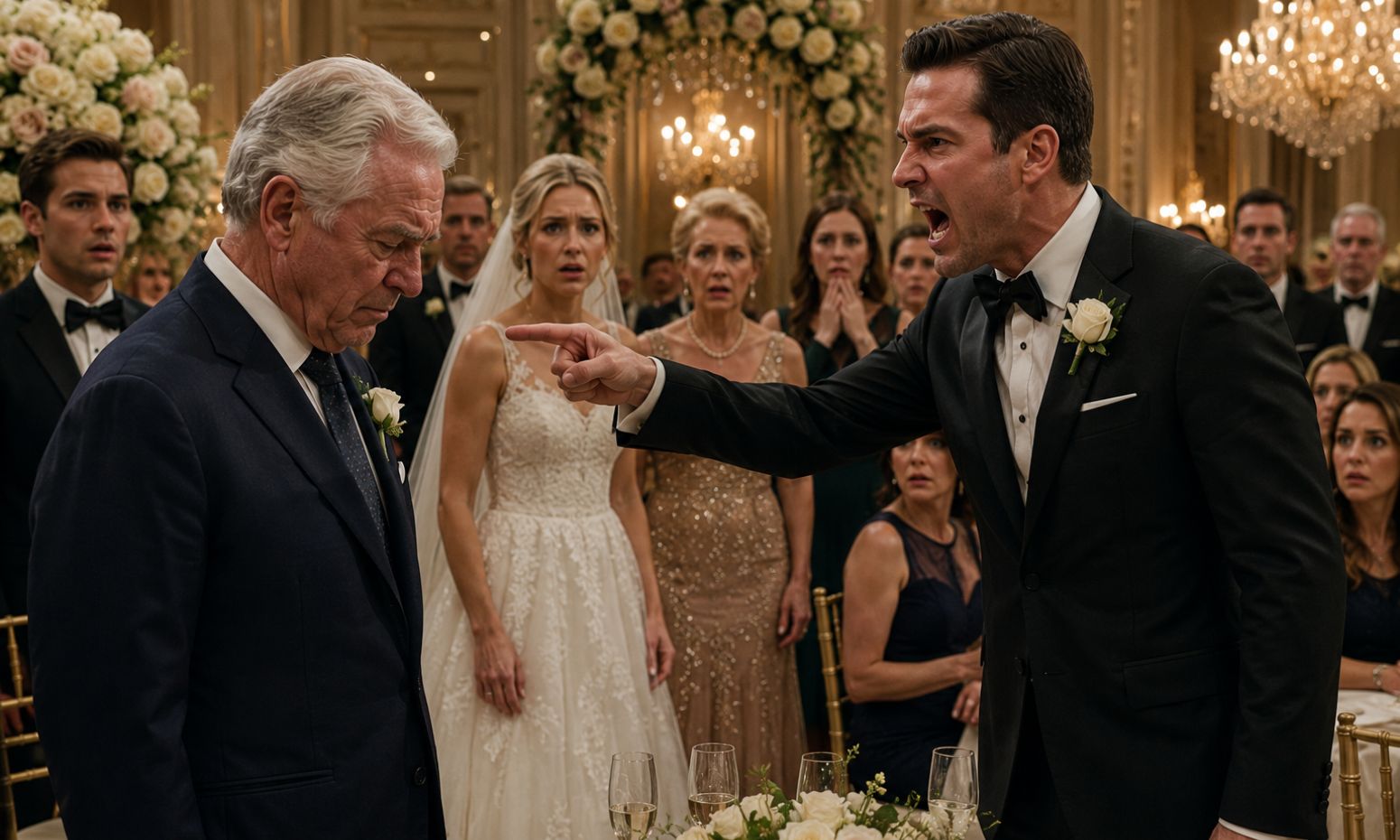
My son said it quietly.
That almost made it worse.
He didn’t shout. He didn’t lose control. He didn’t make a scene in the way people later claimed he did.
He simply leaned down beside my chair, smiled for the photographer standing ten feet away, and said through his teeth, “You’ve already embarrassed this family enough.”
I was seventy-one years old, sitting in the second row at my granddaughter’s wedding, wearing the same navy suit I had worn to my wife’s funeral three years earlier.
It was the only good suit I owned.
And until that moment, I thought it was good enough.
My name is Thomas Whitaker.
For forty-three years, I was a maintenance supervisor at Halden Paper Mill in northern Ohio. I wasn’t an executive. I didn’t have a corner office. I didn’t travel for conferences or carry business cards in a silver case.
I fixed things.
Boilers. Conveyor belts. Jammed cutters. Broken loading doors. Anything loud, heavy, and dangerous enough that most people stayed away from it, I walked toward.
That was how I raised my family.
My wife, Elaine, used to say I came home smelling like machine oil and rain, even on sunny days. She never complained. She would just meet me at the back door with a towel and say, “Shoes off, Tom. I just mopped.”
We had one son, Richard.
Elaine called him Richie until the day he asked everyone to stop. He was twelve then, standing in our kitchen with a report card full of A’s and the serious expression of a boy who had already decided he was meant for rooms bigger than ours.
And he was.
Richard was smart. Sharper than me in ways I could never pretend to be. He read thick books, spoke carefully, and learned early that the right clothes and the right words could open doors I had never even noticed were closed.
I was proud of him.
Maybe too proud.
When he got into Ashford University, I worked double shifts for six months to help cover the gap his scholarship didn’t reach. Elaine took a weekend job at a bakery. We didn’t tell him at first. We didn’t want him carrying the weight of it.
Parents do that sometimes.
We hide the cost so our children can believe their wings were free.
Richard graduated, joined a consulting firm in Chicago, and slowly became someone who corrected waiters when they mispronounced wine names.
He married a woman named Celeste, whose family owned lake property and used the word “summer” as a verb.
Elaine tried hard with them.
She bought nicer plates before they visited. She practiced saying “charcuterie” because Celeste once laughed when she called it a meat board. She wore perfume that made her sneeze because she wanted to seem elegant around people who never had to try.
I noticed.
Richard didn’t.
Or maybe he did and looked away because noticing would have required gratitude.
After our granddaughter Lily was born, Elaine and I became the backup plan for everything.
Sick days.
School pickups.
Ballet rehearsals.
Emergency babysitting when Richard and Celeste had “non-refundable reservations.”
I didn’t mind.
Lily was sunshine with ponytails.
She had Elaine’s eyes and my stubbornness. When she was little, she used to sit beside me in the garage while I repaired lawn equipment and ask questions about every wrench in the drawer.
“What does that one do, Grandpa?”
“That one,” I’d say, holding it up like a royal instrument, “fixes things people gave up on.”
She remembered that.
Years later, when she was fourteen and her parents were fighting so loudly in the driveway that the neighbors closed their blinds, she called me from her bedroom closet and whispered, “Grandpa, can you come fix something?”
I drove forty minutes in the rain.
I didn’t ask questions when she got in my truck.
I just took her home to Elaine, who made grilled cheese and pretended not to see Lily crying into the sleeves of her school hoodie.
That was the part nobody talked about at the wedding.
Nobody mentioned the nights Lily slept in our guest room.
Nobody mentioned the tuition checks Elaine and I quietly covered for her summer program after Richard said art was “a hobby, not an investment.”
Nobody mentioned that when Elaine got sick, Lily was the one who came over after class to help fold blankets and read to her on the porch.
Richard visited when he could.
That was how he phrased it.
When he could.
After Elaine passed, something between my son and me hardened completely.
At the funeral, Richard gave a polished speech about his mother’s kindness. People cried. Even I cried, though not for the speech.
I cried because he called her “the heart of our family,” and then left before the chairs were stacked.
Lily stayed.
She helped me carry flowers to the car. She sat with me in the silent house afterward and made tea neither of us drank.
A year later, when Lily got engaged to a young architect named Daniel Price, she came to tell me in person.
She didn’t text.
She didn’t call.
She drove to my little house on Maple Street, walked into the garage where I was fixing an old snowblower, and held out her hand.
The ring caught the light.
For a moment, I saw Elaine in her smile.
“Grandpa,” she said, “I want you in the second row. Right by the aisle.”
I cleared my throat and nodded like it was no big thing.
But after she left, I sat on the workbench for almost twenty minutes, staring at nothing.
Because when you get old, invitations start feeling like proof.
Proof that you still belong somewhere.
The wedding took place at the Bellmont Estate, a restored mansion with marble steps, glass chandeliers, and staff members who wore black gloves to move chairs.
Everything looked expensive enough to make me afraid to touch it.
The guests arrived in tailored suits and silk dresses. I recognized almost no one. Richard’s business partners were there, along with Celeste’s relatives, people who kissed cheeks without actually touching anyone.
I arrived early.
That is what working men do. We arrive early because being late feels disrespectful.
At the entrance, a young woman with a headset searched the seating chart and hesitated when I gave my name.
“Thomas Whitaker?”
“Yes, ma’am.”
Her finger stopped near the bottom of the page.
Then she looked past me, toward the side lawn where the service vehicles were parked.
Before she could speak, Lily appeared in her white robe, hair pinned halfway up, barefoot under the hem.
“Grandpa!”
She crossed the stone path faster than anyone in a wedding dress should move and wrapped both arms around me.
For one second, the whole place disappeared.
Then Celeste called from behind her, sharp and low.
“Lily. Photos.”
Lily pulled back, smiled, and squeezed my hand. “Second row, aisle seat. Don’t let anyone move you.”
She said it lightly.
But I saw her glance at the coordinator.
I should have understood then.
The ceremony was beautiful.
Lily walked down the aisle with Richard, but when she passed me, her eyes filled with tears. She reached out just enough for her fingers to brush my shoulder.
A small thing.
Enough to carry me through the vows.
After the ceremony, guests moved into the reception hall. I found my place card at Table 14, near the back, beside two distant cousins and a man who spent ten minutes explaining yacht insurance to nobody in particular.
I didn’t care.
I had seen my granddaughter happy.
That was enough.
Then, during dinner, Richard came to my table.
He placed one hand on the back of my chair and leaned close like a loving son checking on his elderly father.
The photographer turned toward us.
Richard smiled.
And said, “Go home, Dad.”
I looked up at him, not understanding at first.
He kept smiling.
“You look out of place. Celeste is upset. Some people are asking questions.”
“What questions?”
His eyes flicked down to my suit.
“To start with, why you came dressed like that.”
The table went quiet.
The yacht insurance man suddenly became fascinated with his salad.
I felt heat rise into my face, the old kind of shame I thought age had burned out of me.
“It’s the only suit I have,” I said.
Richard’s smile tightened.
“That’s exactly the problem.”
For a moment, I couldn’t speak.
Then he bent lower.
“You need to leave before the speeches. I won’t have you turning Lily’s wedding into one of your sad little moments.”
Behind him, Celeste stood near the bar, watching.
Not embarrassed.
Approving.
I slowly pushed my chair back.
My knees hurt when I stood, but I made sure not to reach for the table.
A few guests looked over.
Richard stepped aside, satisfied.
He thought I would leave quietly.
He thought I would do what I had always done.
Absorb the insult.
Protect the family image.
Disappear before anyone important noticed.
And maybe I would have.
But as I reached into my coat pocket for my car keys, my fingers brushed against the sealed envelope Lily had asked me to bring that morning.
The envelope Richard didn’t know existed.
The one Elaine had prepared before she died.
And on the front, in my wife’s handwriting, were six words:
For Lily, before the first dance.
That was the mistake my son made.
He humiliated me before the speeches.
But he had no idea I was carrying the one thing that could change the entire room.
[Confirm to continue Part 2]