Tesla Cybercab Enters a New Era: Elon Musk’s Driverless Robotaxi Moves Closer to Mass Production

For years, Elon Musk’s vision of a fully autonomous vehicle has been one of Tesla’s most ambitious promises. A car with no steering wheel, no pedals, and no human driver once sounded like a futuristic concept. But Tesla’s Cybercab project is now moving closer to becoming a real transportation platform, with new production activity and testing suggesting that the company is preparing for a major expansion of autonomous mobility.
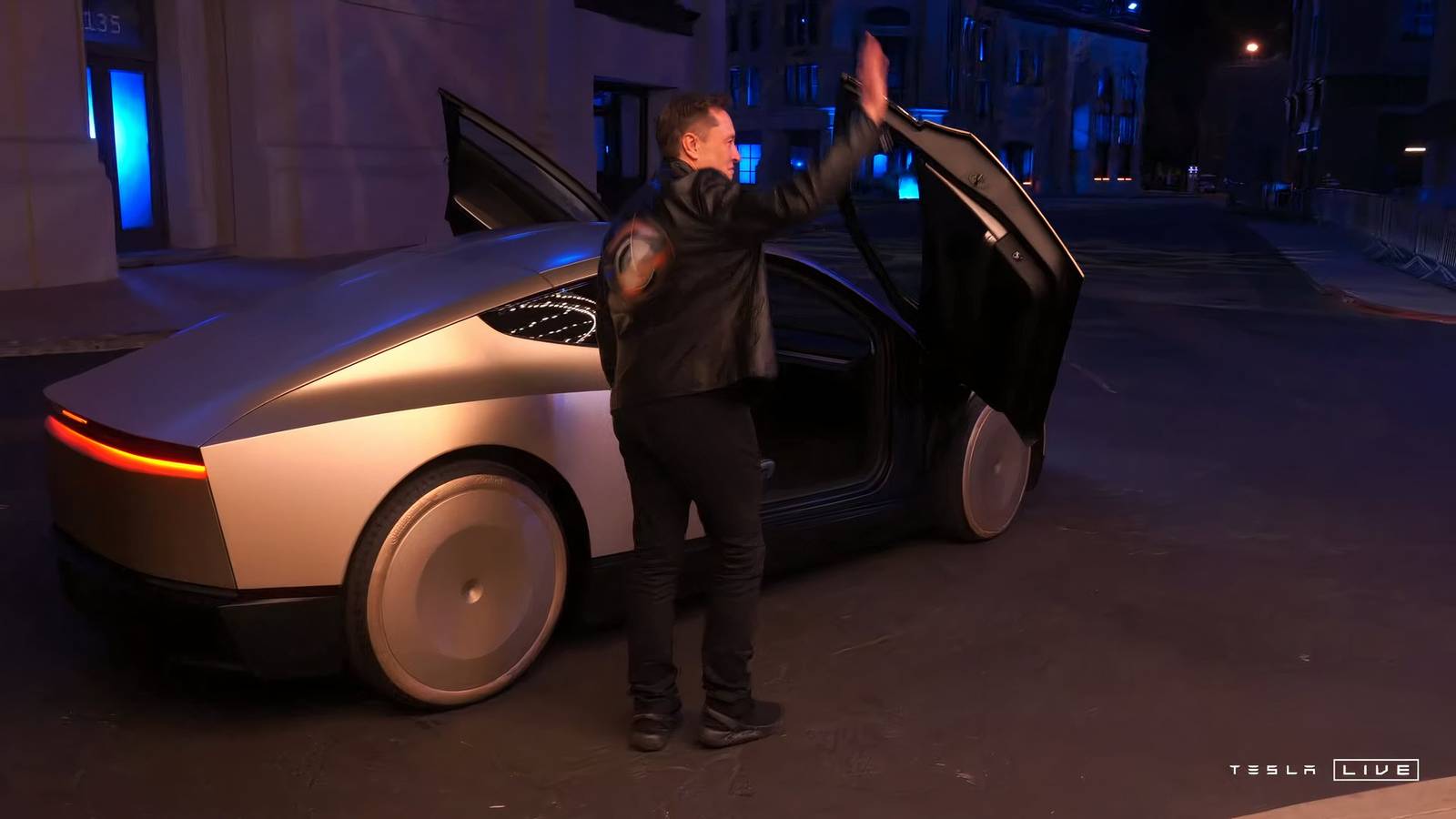
The Tesla Cybercab is not simply another electric vehicle. Unlike traditional cars that are designed around a human driver, the Cybercab was created from the beginning as a purpose-built robotaxi. Its entire design philosophy focuses on one question: what would a vehicle look like if the driver was no longer needed?
Recent reports and footage from Tesla’s Gigafactory Texas have sparked renewed attention after large numbers of Cybercab units were reportedly spotted at the facility. The sight of multiple vehicles lined up has fueled speculation that Tesla is moving beyond early prototypes and entering a new stage of testing and production preparation.
The biggest difference between the Cybercab and traditional vehicles is immediately visible: there is no steering wheel, no accelerator pedal, and no brake pedal. Instead, the vehicle is designed around autonomous operation, where passengers simply enter, choose their destination, and allow Tesla’s technology to handle the journey.
The experience Tesla is aiming for is radically different from today’s transportation model. A passenger steps inside, the doors close automatically, the screen activates, and the vehicle begins moving without any human touching the controls. The car must recognize pedestrians, understand traffic conditions, select routes, and safely complete the trip entirely through software and sensors.
This vision represents one of Tesla’s biggest bets: transforming the automobile from a product people own into a transportation service people use.
A New Manufacturing Strategy

The Cybercab is expected to play a key role in Tesla’s next-generation vehicle platform. Instead of adapting an existing car design, Tesla has approached the project from the ground up, removing components that are unnecessary in an autonomous vehicle.
Traditional vehicles require systems built around human control, including steering mechanisms, pedals, driver displays, and other mechanical components. By eliminating these elements, Tesla believes it can simplify production, reduce costs, lower maintenance requirements, and create a more efficient vehicle.
The company’s long-term goal is not just to build autonomous cars, but to create a scalable robotaxi network capable of operating continuously with minimal human involvement.
Efficiency Designed for Robotaxi Operations
One of the Cybercab’s biggest advantages is efficiency. Unlike personal vehicles, which often spend most of their time parked, robotaxis are designed to operate for many hours each day.
A vehicle used as a transportation service does not need excessive range for occasional road trips. Instead, it needs optimized energy use, predictable charging schedules, and low operating costs.
The Cybercab’s lightweight design, smaller battery approach, and aerodynamic structure are intended to maximize efficiency. This could allow Tesla to reduce manufacturing expenses while improving the economics of large-scale autonomous fleets.
For a robotaxi business, even small improvements in energy consumption can create major financial advantages when multiplied across thousands or millions of miles.
The Biggest Challenge: Trusting a Driverless Car
While hardware development is advancing, Tesla faces a much larger challenge: convincing the public to trust a vehicle with no human driver.
A normal car can rely on a person to take over when something unexpected happens. A fully autonomous robotaxi cannot. It must handle every situation safely, consistently, and without human intervention.
That means Tesla’s greatest challenge may not be building the vehicle itself, but proving that the software is reliable enough for everyday use.
The company has continued testing autonomous driving technology and collecting real-world data, hoping to improve decision-making and create a system that can adapt to different driving environments.
More Than a Car: Tesla’s Future Transportation Vision

The Cybercab represents a major shift in how Tesla views the future of mobility. It is not designed only as a personal vehicle but as part of a larger ecosystem involving artificial intelligence, autonomous software, and transportation services.
If successful, Tesla’s robotaxi network could change how people think about car ownership. Instead of buying a vehicle, customers could simply request transportation when needed, while autonomous fleets operate continuously.
This model could dramatically change urban transportation, reduce costs, and create a new category of mobility.
A High-Risk, High-Reward Bet
The Cybercab remains one of Tesla’s most ambitious projects. Supporters believe it could become a breakthrough product that reshapes transportation in the same way Tesla helped accelerate electric vehicle adoption.
Critics argue that autonomous driving has proven more difficult than early predictions suggested, and that achieving safe, large-scale deployment remains a major challenge.
Regardless of the outcome, the Cybercab has already become one of the most closely watched vehicles in the automotive industry.
For Elon Musk, the project represents another attempt to challenge traditional assumptions — not just about cars, but about how humans move through the world.
The question now is no longer whether Tesla can create a futuristic-looking vehicle.
The real question is whether the Cybercab can transform that futuristic vision into a practical transportation system used by millions of people every day.