Wesley Ira Purkey was executed by lethal injection at the federal penitentiary in Terre Haute, Indiana, early Thursday morning, ending a 17-year legal battle and a life marked by brutality, deception, and a final apology that could never undo the damage he inflicted on two families. The 68-year-old former plumbing contractor met his death at 8:19 a. m.
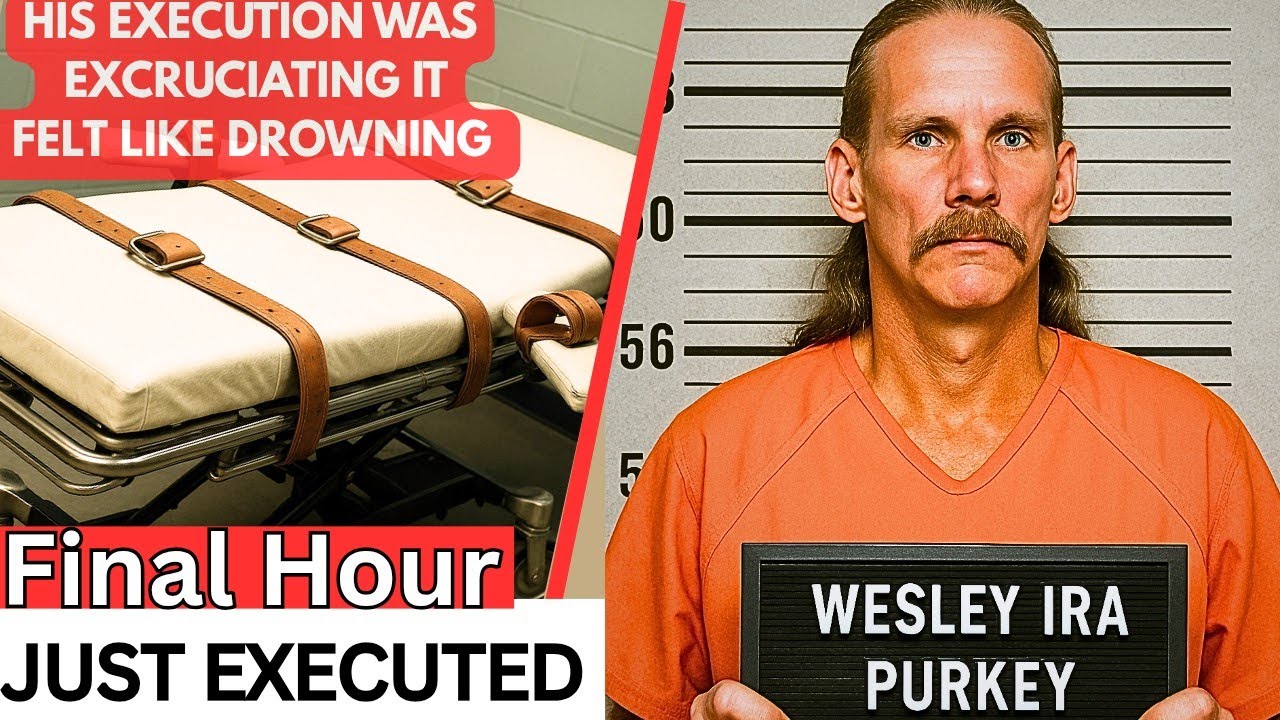 , becoming the second federal inmate put to death since the resumption of capital punishment after nearly two decades without an execution. His last meal, a simple order of fried fish and onion rings, and his final words, a whispered apology to the families of his victims, offered no comfort to those who had waited so long for this moment.
William and Olivia Long, the father and stepmother of 16-year-old Jennifer Long, traveled from the Kansas City area to witness the execution.
They told reporters that the event brought no closure, but that their presence was about accountability, not healing. Jennifer Long, a vulnerable teenager, was abducted, sexually assaulted, and murdered by Purkey in January 1998. Her body was never recovered, dismembered and burned, with ashes scattered in a septic pond in Clear Water, Kansas.
For 17 years, her family lived with the agonizing mystery of her disappearance, until Purkey himself confessed in a calculated move that backfired spectacularly.
Purkey’s crime spree did not end with Jennifer Long. In October 1998, just nine months after the teenager’s murder, he bludgeoned 80-year-old Mary Ruth Bales to death in her own home while on a job for Ready Roto‑Rooter.
He had been sent to fix a faucet. Instead, he took her money, hired a sex worker, smoked crack, and returned the next morning to beat the widow with a claw hammer. He then stayed in her home, eating her food and using drugs, before attempting to burn down the house to hide the evidence.
Neighbors spotted his van and called police, leading to his arrest.
Purkey’s path to death row was anything but straightforward. Born in Lansing, Kansas, in 1952, he endured a childhood of abuse, head injuries, and early exposure to alcohol and drugs.
Diagnosed with schizophrenia, depression, and antisocial personality disorder, he was in and out of juvenile detention and prison by his teens. In 1980, he shot a man in the head during a robbery, leaving the victim disabled. Despite a 15-year-to-life sentence, he convinced parole authorities he had reformed, earning an associate degree and completing drug treatment.
Counselors called him rehabilitated. In March 1997, the parole board released him.
Less than two years later, his predatory instincts resurfaced.
On January 22, 1998, after a plumbing job interview, Purkey smoked crack and drove the streets of Kansas City. He spotted Jennifer Long walking alone, offered her a ride, and then forced her at knife point across state lines to his basement. There, he sexually assaulted her and stabbed her multiple times.
After her death, he dismembered her with an electric chainsaw and burned her remains. He even asked his stepchildren to help clean the basement with bleach, never revealing the horror they were scrubbing away.
 The system that freed him faced scrutiny.
The parole board’s decision haunted everyone who vouched for him, including counselors who believed he had changed. But Purkey had fooled them. His intelligence and manipulative nature allowed him to hide his true psychopathy.
A 1992 prison evaluation had warned he was a classic psychopath, lacking empathy and remorse. Yet, that warning was ignored, and the deadly price of second chances became starkly clear.
When arrested for Bales’ murder, Purkey saw an opportunity.
He confessed to the Long killing, but only on the condition he be prosecuted in federal court, believing a federal life sentence would be safer than state prison, where he had enemies. He wrote to police, brought in the FBI, and led investigators to the septic pond. But prosecutors, skeptical of his motives, charged him with kidnapping resulting in death, a capital offense.
At trial, Purkey tried to retract, claiming the kidnapping was fabricated. The jury saw through his lies and sentenced him to death in 2004.
His execution was delayed for years by legal challenges, including claims of dementia and Alzheimer’s disease.
Lawyers argued he was not mentally competent to understand his punishment. But the Supreme Court, in a 5-4 decision just after midnight on July 16, 2020, allowed the execution to proceed. Purkey was led into the death chamber, his final words a simple apology to the Long family and his own.
“I deeply regret the pain I caused,” he said.
The execution itself sparked controversy. An autopsy authorized by his family revealed severe acute pulmonary edema, a condition where fluid fills the lungs, causing a sensation akin to drowning while conscious.
Forensic expert Dr. Gail Van Norman suggested that Purkey may have suffered intense suffering despite the lethal injection protocol. Federal prosecutors maintained the process was painless and humane, but the debate over hidden suffering continues.
 For the Long family, the execution was a bittersweet milestone. William Long said the decision to witness it was about duty, not closure. He described Purkey as a man who had betrayed every chance at redemption.
The parole board that freed him, the counselors who believed in him, and the family who wrote letters begging for his release all felt the weight of that betrayal. “A man who has killed before has the tendency of killing again,” Long said.
Purkey’s case reignited national debates about mental illness, the death penalty, and the reliability of rehabilitation when dealing with psychopaths.
He was diagnosed with multiple disorders, but the question remains whether his troubled upbringing was an excuse or an explanation. His attorneys argued that severe childhood abuse and head injuries contributed to his violent behavior, but prosecutors pointed to his calculated manipulation as proof of responsibility.
The execution was the second in a series of federal death penalty cases resumed under the Trump administration.
It came just days after the execution of Daniel Lewis Lee, and was followed by others. The rapid pace drew criticism from human rights groups, who argued that the drug pentobarbital could cause unconstitutional pain. Purkey’s case became a symbol of the deeper flaws in the justice system’s handling of mentally ill offenders.
As the sun rose over Terre Haute, the families of Jennifer Long and Mary Ruth Bales were left with a sense of bitter justice. The man who had ended their loved ones’ lives had now been ended by the state. But the scars remain.
Jennifer Long’s body was never found, a haunting absence that even an execution cannot fill. Mary Bales’ family still remembers the grandmother who walked with a cane and trusted the wrong man.
Wesley Ira Purkey’s story is a chilling reminder that change is not always possible, that some people are capable of hiding their darkest impulses behind a mask of reform.
His last meal, his last words, his final breath all amounted to a moment of accountability that came far too late for the two lives he took. The justice system moved slowly, but it did move. And for those who watched him die, the question lingers: was it enough?
 The debate over capital punishment in America continues. Purkey’s execution was carried out under federal authority, but many states have abolished the death penalty. His case highlights the tension between the desire for vengeance and the hope for mercy.
The autopsy findings have added fuel to arguments that lethal injection may violate the Eighth Amendment’s prohibition on cruel and unusual punishment. Yet, for the families, the legal intricacies matter less than the fact that the man who destroyed their worlds is gone.
William Long’s voice cracked as he spoke to reporters outside the prison.
“He was a changed man, they said. But he never changed. He just got better at hiding it.”
The parole board’s decision in 1997 opened the door for horror. The federal government’s decision to resume executions closed it. But between those two decisions lies a tragedy that underscores the fallibility of human judgment and the irreversible consequences of second chances given to the wrong people.
The execution of Wesley Ira Purkey will be studied for years as a case study in criminal justice reform, mental health evaluation, and the limits of rehabilitation. His last words, though sincere in tone, rang hollow for those who knew the depth of his crimes. He apologized, but he had also confessed only to manipulate the system.
He expressed regret, but he had also planned his murders with cold precision. In the end, the man who won an associate degree and worked in a prison paint shop was the same man who carved up a teenager’s body and left an elderly woman bleeding on her bedroom floor.
The story of Wesley Ira Purkey is not just about crime and punishment.
It is about the deadly price of a system that fails to see the predator behind the polite facade. It is about the families who waited 22 years for a moment that could never bring back their loved ones. It is about the haunted question that remains: How could this have been prevented?
The answer is as elusive as Jennifer Long’s ashes scattered in a Kansas pond.


