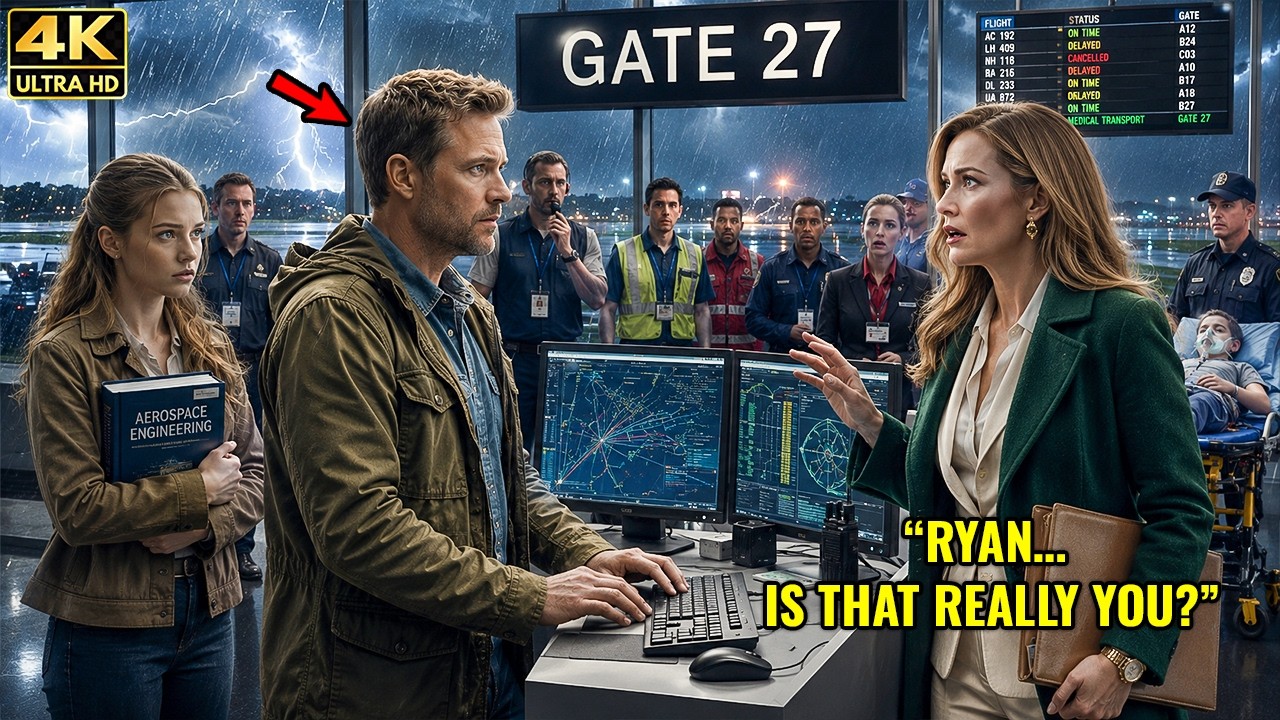
The first thing Diana Monroe noticed at Gate 27 was not the lightning.
It was the silence.
For nearly forty seconds, every departure board in Concourse C froze at once. The blue rows of cities—Denver, Phoenix, Tokyo, Anchorage—stopped moving. Then they flickered, went black, and returned with different gate assignments.
Passengers looked up from their phones.
Agents reached for radios that answered with static.
Outside the glass, November rain swept sideways across the runway at Seattle-Tacoma International Airport, driven by winds strong enough to shake the jet bridges.
Then a warning tone began pulsing behind the Gate 27 desk.
Not loud.
Not dramatic.
Just steady enough to make every airport employee nearby understand that something had gone wrong deeper than a delayed flight.
Diana stood twenty yards away, one hand wrapped around the handle of a black carry-on.
She had spent most of her adult life training herself not to react before other people did.
At fifty-two, she was the CEO of Monroe Aerotech, the woman business magazines described as precise, disciplined, and impossible to intimidate. Her company’s systems supported flight-routing infrastructure across North America. She had testified before Congress, negotiated with defense ministries, and survived three boardroom attempts to remove her.
But when the Gate 27 display began flashing a secondary-routing failure code, the color left her face.
She knew that code.
More importantly, she knew what sat beneath it.
“Ma’am, you need to step away from the desk,” a gate agent said.
Diana barely heard her.
A second screen lit up with a cascading cluster error. Flights assigned to adjacent corridors were no longer receiving clean handshakes from the backup network. The airport’s primary routing system was still operational, but the secondary layer was generating conflicting data.
In clear weather, it would have been inconvenient.
In a storm, it could become dangerous.
Two technicians rushed through the concourse, followed by an operations supervisor speaking rapidly into a headset.
“Do not reboot the entire cluster,” Diana said.
The supervisor turned.
“Excuse me?”
“I’m Diana Monroe. Monroe Aerotech built part of the routing architecture you’re using. A full reboot could spread the synchronization fault.”
Recognition moved across his face. So did panic.
Before he could answer, a man sitting near the windows stood up.
He wore a faded navy jacket and carried no briefcase, only a canvas backpack with a repaired strap. Beside him sat a young woman in her early twenties, dark-haired and observant, her boarding pass folded between her fingers.
The man looked at the warning screen for less than five seconds.
“Your backup frequency cluster is binding to the wrong handshake table,” he said.
The operations supervisor frowned. “Who are you?”
The man ignored the question.
“The sequence was probably swapped during the last software push. Your primary layer is rejecting the secondary validation, so the secondary layer keeps retrying and multiplying the error.”
One of the technicians shook his head. “We checked the deployment package.”
“You checked the package,” the man said calmly. “You didn’t check the live bind.”
The technician stared at him.
The man stepped closer but stopped before crossing into the restricted workspace.
“Open the manual frequency map. Look at clusters seven and nine.”
The supervisor hesitated.
Another warning tone sounded.
Three more gates dropped from the board.
“Do it,” Diana said.
The technician opened the map.
His expression changed.
“Seven is tagged to nine.”
“And nine is tagged to seven,” the man said. “Do not restart the network. Rebind them manually, clear only the retry queue, then force a fresh handshake through the low-priority channel.”
The technician looked at Diana.
She nodded once.
They followed the instructions.
For twelve seconds, nothing happened.
Then the alarm stopped.
Gate 27 came back first.
The boarding display stabilized. The radio behind the desk crackled, then filled with voices. One by one, the neighboring gates reappeared on the operations screen.
The supervisor released a breath.
Passengers began murmuring. A few clapped, assuming the danger had passed because someone important had fixed it.
But Diana was no longer watching the monitors.
She was looking at the man in the navy jacket.
He had turned back toward the young woman and picked up his backpack. His hair was grayer than she remembered. His shoulders were broader. The lines around his eyes belonged to someone who had spent years waking before sunrise and solving problems no one else could see.
Still, she might have convinced herself she was mistaken.
Then the boarding pass slipped from his hand.
It landed face-up near Diana’s shoe.
RYAN BENNETT.
For a moment, the terminal disappeared.
No rain.
No passengers.
No blinking screens.
Just a polished office tower in Chicago fifteen years earlier, a little girl asleep beneath a desk, and a signature Diana had spent more than a decade pretending had not changed three lives.
Ryan bent to retrieve the pass.
When he stood, his eyes met hers.
There was no surprise in them.
Only recognition.
“You finally made it back to Gate 27,” he said.
His voice was quiet enough that no one else reacted.
Diana felt the air leave her lungs.
Fifteen years earlier, Monroe Aerotech had occupied nine floors of a steel-and-glass tower near O’Hare International Airport.
The company was growing faster than its systems could support, which meant everyone worked late and no one admitted fear.
The corridors smelled of coffee, printer toner, and ambition.
Ryan Bennett had arrived there without the credentials executives respected.
No famous university.
No family connections.
No polished way of describing his own brilliance.
He had paid for community college by repairing industrial control boards, earned a scholarship to finish an engineering degree, and spent years moving through internships where other people presented solutions he had built.
But Ryan understood systems the way some people understood faces.
He could look at thousands of lines of code and notice the one command behaving like a person telling a lie.
Diana noticed him six months after he joined Monroe Aerotech.
At the time, she was thirty-seven and the company’s youngest vice president. Every meeting required her to be twice as prepared as the older men around the table and half as emotional.
If she spoke firmly, she was difficult.
If she hesitated, she was unqualified.
If she won, someone asked who had helped her.
She had learned to enter rooms with answers before anyone had finished asking questions.
Ryan was one of the few people who did not seem impressed by that.
He was never disrespectful. He simply cared more about whether a system worked than who held the highest title.
Their first real conversation happened during a crisis.
Monroe Aerotech was weeks away from closing a $240 million international contract when the client’s aircraft-tracking network began dropping synchronization during high-traffic simulations.
The vendor blamed Monroe.
Monroe blamed the vendor.
Executives held meetings.
Lawyers drafted language.
Ryan stayed at his desk.
At 2:07 in the morning, Diana found him in the systems lab surrounded by empty coffee cups and printed logs.
A little girl was asleep under the desk with a winter coat folded beneath her head.
Diana stopped.
Ryan looked embarrassed for the first time she had ever seen.
“My sitter canceled,” he said. “Madison had a fever yesterday. I couldn’t leave her with anyone.”
Diana looked at the sleeping child.
“How old is she?”
“Five.”
“And her mother?”
Ryan’s eyes returned to the screen.
“Died two years ago.”
There was no invitation for sympathy in his voice.
Only information.
Diana sat down beside him.
“What did you find?”
He pointed to a timing sequence buried deep in the synchronization logic.
“The system isn’t losing the signal. It’s receiving two valid timestamps and trusting the wrong one.”
The error came from a conflict that occurred only under a specific combination of traffic density, weather interference, and vendor latency.
No one had tested all three conditions together.
Ryan had.
By sunrise, he had written a correction.
By noon, the simulation passed.
The contract was saved.
At the executive briefing, the engineering director presented the solution as a team achievement.
Ryan said nothing.
Later, Diana found him heating soup for Madison in the break room.
“You should have taken credit,” she said.
“The system works.”
“That wasn’t my point.”
“It was mine.”
That answer stayed with her.
So did the way Madison, still half asleep, wrapped both arms around her father’s waist while he stirred the soup.
Over the following year, Diana and Ryan worked together often.
He spoke honestly when everyone else told her what they thought she wanted to hear. She defended his budgets. He quietly repaired plans that senior executives had approved too quickly.
Some nights, they were the last two people on the floor.
They talked about architecture, weather, and the strange loneliness of being depended on by people who rarely asked whether you were tired.
Neither of them named the closeness growing between them.
Perhaps because Ryan was still grieving.
Perhaps because Diana had made ambition the only relationship she trusted.
Then Ryan showed her SkyBridge.
He had developed it after hours on an isolated test environment.
The aviation industry had long struggled with a specific problem: when primary navigation signals degraded while multiple secondary sources delivered incomplete or conflicting data, conventional systems became cautious, slow, and sometimes blind.
SkyBridge did something different.
Instead of relying on one dominant backup source, it gathered fragments from distributed low-priority signals and reconstructed a reliable position model in real time.
It was elegant.
Resilient.
Years ahead of anything Monroe Aerotech officially possessed.
Diana stared at the simulation as it recovered from four simultaneous failures without losing route integrity.
“Who else has seen this?” she asked.
“No one.”
“Does it belong to the company?”
Ryan leaned back.
“I developed parts of it on company equipment. So legally, they’ll argue yes.”
“And technically?”
His mouth tightened.
“Technically, it exists because every official proposal I submitted was rejected.”
Diana knew immediately what SkyBridge could become.
A new industry standard.
A government platform.
The achievement that could move Monroe Aerotech from a respected contractor to a dominant infrastructure company.
She also knew it was Ryan’s work.
“Let me protect this,” she told him.
Ryan studied her face.
Then he nodded.
That was the moment he trusted her.
And the moment she began to betray him.
Owen Price, Monroe Aerotech’s chief operating officer, learned about SkyBridge three weeks later.
Owen was silver-haired, calm, and never visibly angry. He did not understand complex systems, but he understood ownership, timing, and fear.
He knew which board member wanted expansion.
Which regulator wanted reassurance.
Which executive could be made obedient with praise.
When Diana demonstrated SkyBridge privately, Owen asked only one question.
“How controllable is Bennett?”
“He’s not a problem.”
“That wasn’t my question.”
“He cares about the work.”
Owen smiled.
“People who care only about the work are often the hardest to control. They mistake being right for being safe.”
Soon, concerns began appearing.
A safety assessment questioned whether SkyBridge’s distributed inputs could create false confidence during catastrophic signal loss.
A memo suggested Ryan had bypassed documentation protocols.
Test results were reorganized to make stable anomalies look unpredictable.
None of the documents openly accused him of misconduct.
They did something more effective.
They made him look brilliant but reckless.
Owen used the same phrase repeatedly.
“An asset, certainly. But potentially a liability.”
Diana challenged some of the reports.
Not all of them.
At first, she told herself she was waiting for more evidence.
Then she told herself the board would never approve SkyBridge unless its risks appeared professionally managed.
Then she told herself she could restore Ryan’s credit after the project succeeded.
Each excuse required only one small silence.
Together, those silences became a wall.
The public demonstration took place in March.
Board members sat in the first row. Aviation safety officials occupied the second. International clients and trade reporters filled the back of the room.
Ryan had prepared for six weeks.
Madison, now six, waited in the corridor with a coloring book and a juice box because her school had closed unexpectedly.
The first three failure sequences performed perfectly.
During the fourth, the system accepted a corrupted source and shifted the test aircraft’s simulated position by nearly two miles.
Ryan stood immediately.
“Stop the demonstration.”
Owen remained seated.
“Continue the sequence.”
“No,” Ryan said. “That input was not part of the approved package. Freeze the environment and preserve the logs.”
The room grew still.
Diana saw Owen glance toward the board chairman.
It was subtle.
Almost invisible.
But she understood.
This was not an accident.
Ryan moved toward the control station. A security officer blocked him.
“What are you doing?” Ryan asked.
Owen stood slowly.
“We have been made aware of irregularities in your development process.”
Ryan stared at him.
Then at Diana.
She had the power to stop what came next.
She could have ordered the logs secured.
She could have postponed the hearing.
She could have told the board that Owen’s assessments were compromised.
Instead, she saw the chairman’s expression.
She thought about the years she had spent fighting for her position. The whispers that she was too young. Too ambitious. Too personally invested in an engineer whose work could now embarrass the company.
Owen placed a suspension authorization in front of her.
“Until we understand the full extent of the risk,” he said.
Ryan did not look at the paper.
He looked at Diana.
“Check the logs.”
Three words.
No pleading.
No anger.
Just trust, giving her one final chance to deserve it.
Diana signed.
Something changed in Ryan’s face.
Not dramatically.
His jaw did not fall open. He did not raise his voice.
The hope simply left his eyes.
Outside the room, Madison stood when she saw him.
“Daddy, are we going home?”
Ryan looked back once.
Diana remained at the conference table with the pen still in her hand.
“Yes,” he told his daughter. “We’re going home.”
“Is your machine broken?”
He knelt and zipped her coat.
“No. Sometimes people call something broken when they don’t understand how it works.”
By evening, Monroe Aerotech’s press office had issued a statement.
Ryan was suspended pending an internal safety review.
Within a month, he was terminated.
Within six months, his name appeared in private risk reports shared across the industry.
No formal accusation was ever proven.
It did not need to be.
He could not afford the legal fight required to clear his name. Every appeal led to another committee, another delay, another invoice.
Ryan left Chicago with Madison and moved to Renton, Washington.
He repaired navigation equipment at small airfields.
He rebuilt communication systems for charter operators.
He helped private pilots diagnose failures larger firms considered too minor to bother with.
The work carried no prestige.
But it was honest.
He never told Madison that Diana Monroe had destroyed his career.
He never taught his daughter to inherit his resentment.
When she asked why he no longer designed major systems, he said, “Life rerouted us.”
Madison grew up watching him solve impossible problems in drafty hangars while wealthy clients forgot to thank him.
She studied aerospace engineering.
Ryan helped her with calculus at the kitchen table and pretended not to notice when she discovered old articles about SkyBridge.
Meanwhile, Diana rose.
The board promoted her.
Owen repositioned SkyBridge under a new name and presented himself as its strategic architect. The system became the foundation for several profitable platforms.
Diana signed the documents.
She accepted the awards.
She learned to live with the weight by refusing to name it.
Gate 27 became a private superstition.
The original SkyBridge demonstration had been scheduled beside a conference center entrance marked 27. Ryan had once joked that if the project succeeded, they should meet at an airport gate with the same number and fly somewhere without laptops.
After his termination, Diana passed through Gate 27 at O’Hare and remembered the joke.
She changed her flight.
Years later, she still avoided the number when she could.
Her assistant, Ella Brooks, noticed.
She noticed that Diana never discussed Ryan Bennett.
She noticed that references to early SkyBridge development vanished from presentations.
She noticed the CEO’s silence whenever Owen Price received credit for architecture he could not explain.
But Ella did not know the whole story.
Not until the storm in Seattle.
At Gate 27, Ryan picked up his boarding pass and placed it in his jacket pocket.
Madison stood beside him.
Diana could see Ryan’s eyes in hers.
“Ryan,” Diana said.
He waited.
“I need to speak with you.”
“We’re boarding soon.”
“The failure tonight came from the Apex Corridor platform.”
“I know.”
Diana glanced at Madison.
Apex was Monroe Aerotech’s newest routing system. It was scheduled for federal expansion within months.
Its core logic had evolved from SkyBridge.
“You recognized the architecture,” Diana said.
Ryan gave a tired smile.
“I recognized my architecture.”
The operations supervisor approached them.
“Mr. Bennett, airport command wants to thank you. They also need a statement about how you identified the fault.”
Ryan nodded toward Madison.
“She identified the first anomaly.”
Diana looked at her.
Madison held up her phone.
“I’m part of an independent validation team contracted to review Apex next month,” she said. “I noticed the gate assignments were changing in a pattern inconsistent with weather disruption.”
Diana’s pulse quickened.
“Which firm?”
“Northwest Aviation Integrity.”
Diana knew the name.
They had been hired by federal regulators—not Monroe Aerotech.
Madison continued.
“My father confirmed the fault because he wrote the original recovery model.”
A silence opened around them.
Ella, who had just arrived from another concourse, stopped behind Diana.
The operations supervisor looked from Ryan to the CEO.
Diana lowered her voice.
“What exactly have you found?”
Madison unlocked a folder on her phone.
“Tonight’s bind error wasn’t random. Apex has been applying an undocumented compatibility patch to preserve legacy routing behavior.”
Ryan’s expression remained calm.
“The patch compensates for changes Owen’s team made after they removed my attribution,” he said. “They never fully understood the distributed recovery layer, so they built workarounds around it.”
Diana felt the full shape of the disaster.
“How long have you known?”
“About the structural weakness?” Ryan asked. “Years.”
“Why didn’t you come forward?”
“I did.”
He reached into his backpack and removed a thin file.
Copies of letters.
Emails.
Certified delivery receipts.
Safety notifications submitted over twelve years.
Some addressed to Monroe Aerotech.
Several addressed directly to Diana’s office.
Her name appeared on every envelope.
Diana looked at Ella.
Ella’s face had gone pale.
“I’ve never seen these,” Diana said.
Ryan did not accuse her of lying.
That made it worse.
Ella took one document and studied the routing code stamped at the bottom.
“This executive correspondence channel was controlled by the COO’s office until last year,” she said.
Diana looked at her.
“Owen.”
Ryan’s gaze never left Diana.
“The logs from the original demonstration were altered before the test,” he said. “The corrupted source was inserted through an administrative account linked to Owen’s security team.”
Diana’s hands began to tremble.
“You have proof?”
Madison answered.
“We recovered the archived access records from a regulatory backup. My review team received them last week.”
That was the twist Diana had never allowed herself to imagine.
Ryan had not merely been innocent.
He had been warning her company for years.
And someone had made sure she never heard him.
But even that did not free her.
Owen had created the trap.
Diana had signed the order.
She had chosen her career over the man who trusted her.
The operations supervisor looked uncomfortable.
“Ms. Monroe, federal aviation officials are joining the incident call. They’re asking whether Apex should be suspended nationwide.”
Passengers nearby had begun listening.
Phones were out.
A reporter stranded near the gate moved closer.
Diana saw the moment clearly.
She could control the narrative again.
Blame Owen.
Call the original incident an internal failure.
Protect the company.
Protect herself.
Fifteen years earlier, she had been given the same kind of choice.
This time, Ryan did not ask her to check the logs.
He simply waited.
Diana turned to Ella.
“Call the board.”
“Tonight?”
“Now.”
Then she faced the operations supervisor.
“Tell federal command Monroe Aerotech recommends an immediate temporary suspension of every Apex deployment until an independent review is complete.”
The supervisor stared.
“That could ground—”
“I understand.”
She looked toward the reporter.
“And prepare a public statement. It will include the original name of the architecture, its actual inventor, the falsified demonstration, and my decision to suspend Ryan Bennett without reviewing the system logs.”
Ella stepped closer.
“Diana, legal counsel will advise—”
“I know what legal counsel will advise.”
Her voice broke slightly, but she did not lower it.
“For fifteen years, this company has profited from work taken from him. That ends tonight.”
Ryan watched her.
For the first time, something shifted in his expression.
Not forgiveness.
Not yet.
But the absence of contempt.
Three days later, Owen Price was removed from Monroe Aerotech’s board pending investigation.
Within two weeks, archived records confirmed that his office had manipulated the SkyBridge demonstration, suppressed Ryan’s safety complaints, and reassigned authorship through internal patent filings.
The story became national news.
Diana testified before regulators.
She did not minimize her role.
She described the pressure.
Then she said pressure was not an excuse.
Monroe Aerotech restored Ryan’s name to every patent and technical record connected to SkyBridge. The company paid a settlement large enough to compensate him for fifteen years of lost earnings and unauthorized use.
Ryan accepted the correction.
He refused a ceremonial executive position.
Instead, he negotiated funding for an independent aviation safety institute led by engineers with authority to challenge corporate decisions without retaliation.
Madison became one of its first research fellows.
Diana resigned as CEO.
Months later, she returned to Seattle for the institute’s opening.
The event was held in a renovated hangar.
There were no marble walls, no executive floor, and no carefully staged applause.
Ryan stood near an old navigation console explaining a signal map to a group of young engineers.
Diana waited until he finished.
“I used to think one bad decision destroyed everything,” she said.
Ryan looked at her.
“One decision rarely does.”
She nodded.
“It’s the decisions after it.”
“Yes.”
“I’m sorry.”
He had heard the words publicly in hearings and interviews.
This was the first time she said them without witnesses.
Ryan looked across the hangar at Madison.
“You can’t give me back those years.”
“I know.”
“You can’t undo what she watched me lose.”
“I know.”
He studied Diana’s face for a long moment.
Then he said, “But you told the truth when it finally cost you something.”
It was not absolution.
It was more honest than absolution.
Outside, an aircraft lifted through the low Seattle clouds, guided by a routing model that finally carried the right name.
Diana watched it disappear.
Fifteen years earlier, she had believed power meant controlling what people remembered.
At Gate 27, she learned the opposite.
Power reveals character most clearly when telling the truth costs more than keeping the lie.
And justice does not begin when the guilty are exposed.
It begins when the people who stayed silent finally decide that their comfort is no longer worth someone else’s life.