My sister didn’t know the camera was still recording when she said it.
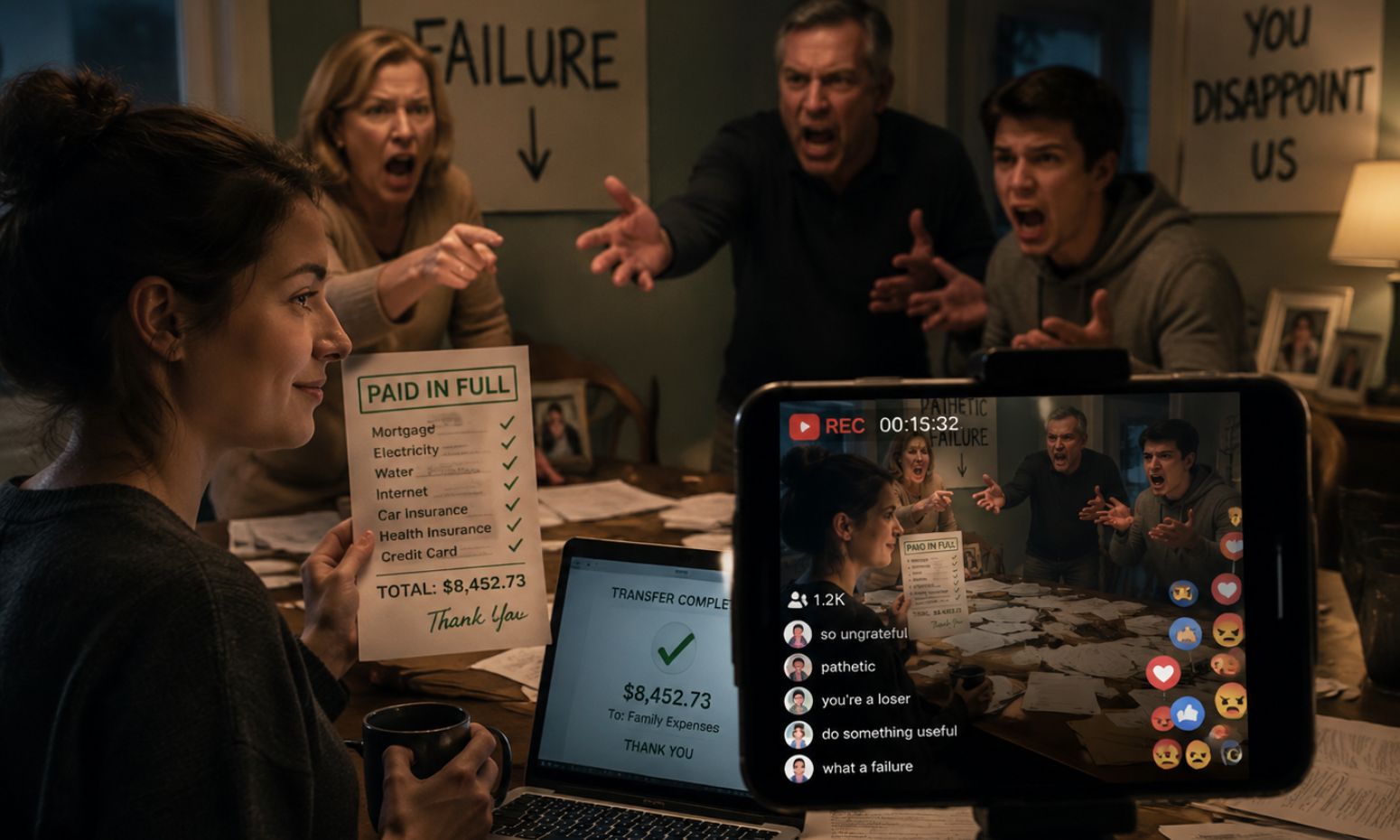
That was the part I kept replaying later.
Not the laughter. Not my father’s tired little shake of the head. Not my mother covering her mouth like she was embarrassed to be related to me. Those parts hurt, but they were familiar.
It was the way my sister leaned closer to the phone, smiled as if she was sharing a private joke with the internet, and said, “Honestly, he’s a pathetic failure. At this point, we don’t even expect anything from him.”
Then everyone laughed.
I was sitting in my apartment when I saw it.
A one-bedroom place above a laundromat on West 38th Street, with a radiator that hissed like it was angry at the building and a kitchen table I used as my desk, dining room, and sometimes, when invoices piled up, a pillow for my forehead.
It was 11:46 p.m.
I remember the time because I had just approved another automatic payment.
Eight hundred and seventy dollars toward my parents’ mortgage.
Three hundred and twenty for my younger brother’s car insurance.
One hundred and forty-nine for my mother’s medication plan.
And a little over two thousand dollars to keep my sister’s boutique from going into collections.
Then my phone buzzed.
A cousin had sent me a video with a single message:
“Bro… did you see this?”
The thumbnail showed my family in my parents’ living room. My sister, Claire, was in the center wearing a cream sweater and that perfect soft smile she used whenever she wanted people to think she was generous. My father sat beside her in his recliner. My mother was on the sofa, holding a glass of wine. My brother Ethan was half in frame, scrolling through his phone.
It looked harmless.
A family livestream.
Claire had started doing those over the past year after her boutique developed a small online following. She sold handmade candles, linen dresses, and the kind of inspirational quotes people bought when their lives were falling apart but their shelves still needed decoration.
That night, apparently, she had been talking about “family values.”
I tapped play.
At first, it was ordinary. Claire thanking customers. My mother waving. Ethan making a joke about shipping boxes. My father saying he was proud of “how far the family had come.”
Then someone in the comments must have asked about me.
Claire looked off camera.
“Oh, Daniel?” she said.
My stomach tightened before anything else happened.
There are names that can sound like home from the right mouth and a warning from another.
Mine, coming from Claire, usually meant a performance was beginning.
She tilted her head, pretending to choose her words carefully.
“Daniel is… doing his own thing.”
My mother made a small noise. Not quite a laugh. Not quite pity.
Ethan didn’t look up from his phone. “That means broke.”
The room laughed.
My father sighed. “He’s never really found his path.”
Claire smiled wider.
And then came the sentence.
“Honestly, he’s a pathetic failure. At this point, we don’t even expect anything from him.”
The comments began floating across the screen.
LOL.
Every family has one.
Poor guy.
Claire quickly reached toward the phone, probably thinking she had ended the livestream.
But the video kept going.
That was when the real conversation started.
My mother took a sip of wine and said, “You shouldn’t have said it that directly.”
Claire shrugged. “It’s true.”
My father rubbed his forehead. “Still. He’s sensitive.”
Ethan laughed. “Sensitive? He lives like a ghost. He doesn’t show up to anything. Doesn’t bring anyone. Doesn’t talk about work. He probably works in some basement call center.”
I sat there in my apartment, my hand still on the mouse, the bank confirmation glowing on my laptop behind the phone.
Payment successful.
That was the strange thing about humiliation.
Sometimes it didn’t arrive like fire.
Sometimes it arrived quietly, while you were sitting alone in a room you paid for with money nobody knew you had, watching people you loved turn you into a punchline.
I didn’t pause the video.
I should have.
But some part of me needed to hear all of it.
My mother looked toward the hallway, lowering her voice even though hundreds of people had already watched them laugh.
“At least he doesn’t ask us for money.”
Claire rolled her eyes. “Because he knows we don’t have any to give.”
That was the first lie.
My parents had money to give Claire when she wanted a launch party for her boutique. They had money to give Ethan when he “needed space” after quitting his third job in two years. They had money for vacations they posted online, dinners where they toasted “resilience,” and birthday gifts wrapped with ribbons thick enough to pay someone’s electric bill.
They just didn’t know where that money came from.
Or maybe they had chosen not to ask.
For five years, I had been paying pieces of their lives from the shadows.
It started after my father’s construction company collapsed.
He was proud, and proud men have a way of bleeding quietly until someone else finds the stain. My mother called me one night, voice shaking, saying the bank had sent another notice. She didn’t ask directly. She just kept saying, “Your father can’t know I told you.”
So I paid it.
Just that once, I told myself.
Then my mother’s prescriptions increased. Then Ethan got into an accident and his insurance threatened to cancel. Then Claire’s first boutique loan came due after she spent the inventory budget on branding photos and a launch dinner.
One emergency became two.
Two became a pattern.
Eventually, I stopped waiting for them to ask.
I built systems instead.
Automatic transfers. Anonymous payments through the family accountant. “Adjusted vendor credits” for Claire’s store. “Administrative corrections” on my parents’ mortgage account. I told myself dignity mattered more than credit.
Besides, I didn’t need applause.
I had work.
Real work.
The kind that didn’t look impressive at Thanksgiving because I didn’t wear a suit with a logo on it or announce new titles over dessert. I handled restructuring for small businesses that were about to lose everything. Restaurants. Clinics. family shops. Contractors. People who had ten days left before payroll collapsed and no idea how to tell their employees.
I was good at it.
Not loud-good.
Not LinkedIn-post-good.
Useful-good.
The kind of good that meant when someone’s business was drowning, they called me before they called a lawyer.
But to my family, I was still the quiet son who left early, skipped photos, drove an old gray Honda, and rented instead of buying.
A man without obvious success is easy to dismiss.
Especially by people living off success they never see.
On the video, Claire stood and began gathering empty glasses.
“You know what’s sad?” she said. “He actually thinks being humble makes him noble.”
Ethan finally looked up. “No, he thinks being invisible makes him mysterious.”
My father gave a tired laugh. “He was always like that. Smart, but no ambition.”
That one landed hardest.
Because my father had taught me ambition.
Not with speeches.
With cracked hands. With six-day weeks. With the way he used to fall asleep at the kitchen table and wake up apologizing for resting. When I was a kid, I thought he was the strongest man alive.
Now he was sitting under a roof I had quietly helped him keep, calling me ambitionless.
I closed the video.
For a moment, the apartment was so quiet I could hear the laundromat machines shaking beneath the floor.
Then another notification appeared.
Claire had tagged me in a new post.
A smiling family photo from earlier that night. Everyone looked warm, polished, connected.
The caption read:
“Grateful for family, hard work, and the people who show up.”
I stared at those words for a long time.
Then I opened my banking dashboard.
There were fourteen scheduled payments connected to my family.
Fourteen.
Mortgage. Insurance. Medical. Business loan. Utilities. Credit card minimums. Supplier balances. Property tax installment. Even my father’s old truck, the one he claimed he had “finally managed to pay off.”
My cursor hovered over the first automatic payment.
Cancel.
I didn’t click it.
Not yet.
Because anger makes you want to burn the house down, but discipline teaches you to check who is still inside.
Instead, I opened a folder on my laptop labeled “Family Support.”
Inside were receipts, emails, transaction confirmations, signed repayment agreements they had never read, messages from accountants, bank notices, and one document that could change everything Claire thought she owned.
I had kept records for practical reasons.
Tax reasons.
Legal reasons.
Emotional survival reasons.
But that night, for the first time, I understood what the records really were.
They were not proof that I was kind.
They were proof that I was not powerless.
The next morning, my mother called three times before 8 a.m.
I didn’t answer.
Then Claire texted.
“Heyyy. Weird question. Did you see the livestream? People are being dramatic. Call me.”
I looked at the message while standing in line at a coffee shop near the courthouse, wearing the same navy jacket I wore to client meetings and carrying a folder thick enough to make a banker nervous.
Behind me, two attorneys were discussing bankruptcy filings.
In front of me, a young woman was crying softly into her phone, saying, “Please, I just need until Friday.”
The world was full of people asking for more time.
My family had had five years.
At 9:12 a.m., I received one more text.
This one was from my father.
“Your mother is upset. Be the bigger person.”
I almost laughed.
Not because it was funny.
Because for years, I had been the bigger person so quietly that they had mistaken my silence for failure.
I put the phone back in my pocket, picked up my coffee, and walked toward the elevator.
At 10 a.m., Claire had a meeting with her lender.
She didn’t know I would be there.
And she definitely didn’t know whose name was on the document keeping her boutique alive.
[Confirm to continue Part 2]