The inhaler hit the bottom of the trash bag with a soft plastic click.
For half a second, no one moved.
Then seventeen-year-old Nia Bennett lunged across the aisle.
“That’s my rescue inhaler.”
Her voice was low, almost swallowed by the mechanical hum rolling through the cabin of Flight 472.
The flight attendant tightened her grip on the black trash bag and stepped backward. Her name tag read MARLA KENT—SENIOR CABIN CREW. Her blond hair was twisted into a bun so severe it seemed to pull the expression from her face.
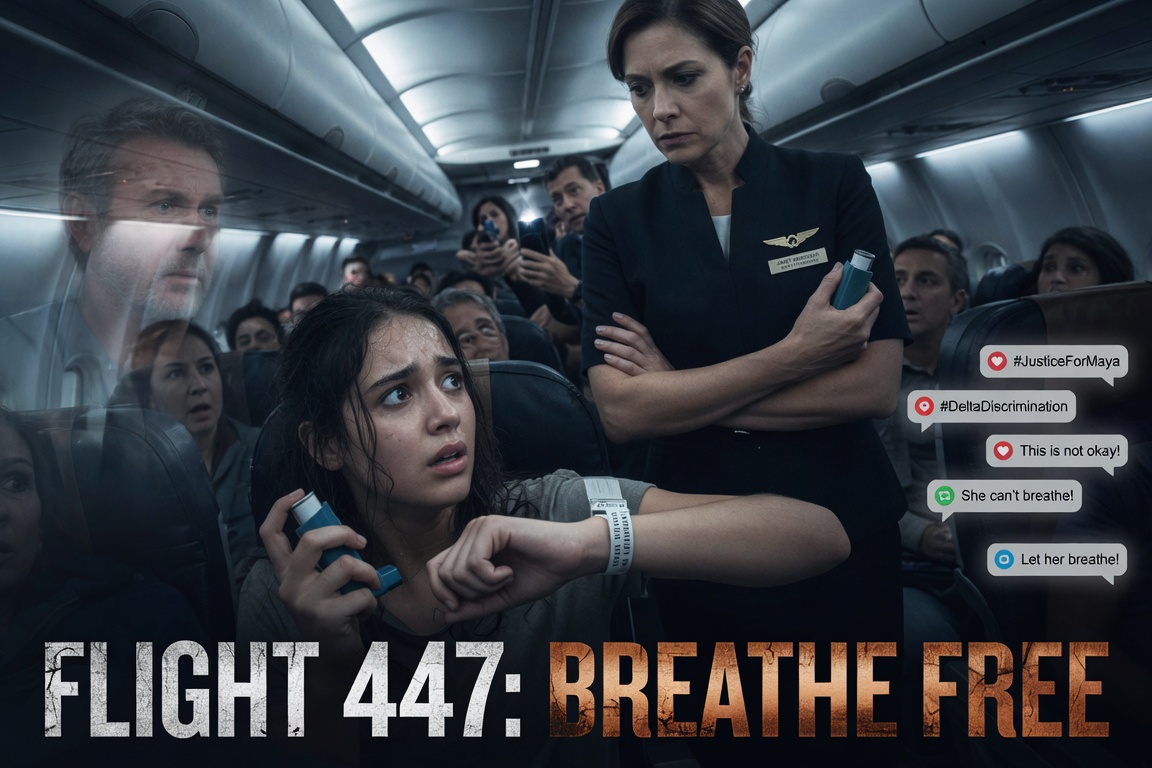
“I told you twice,” Marla said. “Unlabeled medical items cannot remain loose during departure.”
“It was in my hand.”
“And now it has been disposed of.”
Nia stared at her.
The air inside the narrow-body jet smelled of coffee, disinfectant, warm upholstery, and the faint electrical heat of a cabin already sealed against the July sun outside. Passengers were still wrestling bags into overhead compartments. Seat belts clicked. A baby cried three rows back.
No one understood yet that the plastic tube inside Marla’s trash bag was the only thing standing between Nia and a medical emergency.
No one except Nia.
Her fingers closed around the edge of the armrest.
“Please take it out.”
Marla’s mouth thinned.
“Sit down.”
The man beside Nia stopped typing.
He was in his early fifties, broad-shouldered, dressed in a charcoal suit with no tie. A silver watch rested against his dark wrist. Until that moment, he had been studying a spreadsheet on his tablet while speaking quietly through a wireless earpiece.
He ended the call without looking away from Marla.
“My daughter asked you to return her medication.”
Marla glanced at him, then at Nia, then back at him.
There was no recognition in her eyes.
Only irritation.
“Sir, I’m handling a compliance issue.”
The man folded the tablet case shut.
“No. You created a medical one.”
Across the aisle, a woman in a navy cardigan looked up from her paperback. Two college students stopped whispering. A businessman in the row ahead turned halfway around, careful not to appear interested.
Marla lifted her chin.
“The passenger refused repeated instructions.”
“I was using it,” Nia said.
Marla ignored her.
“Her attitude has been escalating since boarding.”
Nia’s face changed.
Not dramatically. She did not shout or cry.
Her eyes simply hardened in a way her father recognized.
He had seen that expression when she was eight and a teacher accused her of cheating because she finished a math test before everyone else. He had seen it when she was fourteen and a department-store clerk followed her through three aisles, then apologized only after discovering her father’s name.
It was the look Nia wore when she understood she was not being treated as a child who had made a mistake.
She was being treated as a threat.
“Nia,” her father said quietly, “how is your breathing?”
“I’m fine.”
It was the answer she always gave when she was not fine.
He leaned closer.
Her nostrils were flaring.
Only slightly.
But he noticed.
Marla did not.
She shoved the trash bag into the galley cart and snapped the lid closed.
“We are pushing back in three minutes. Both of you need to be seated.”
Nia’s father rose.
The top of his head nearly brushed the closed overhead bin.
The cabin seemed to contract around him.
“Open the cart.”
Marla gave a short laugh of disbelief.
“Sir, if you continue interfering with cabin operations, I will have you removed.”
“Open the cart.”
Her cheeks flushed.
She reached for the interphone.
And that was when Nia coughed.
It was not a large cough.
It was dry and sharp, like paper tearing.
Her father turned immediately.
Nia pressed one hand to her chest.
“Dad.”
The single word carried no panic.
That frightened him more.
He crouched beside her.
“Look at me.”
She did.
“Slow breath.”
Nia pulled air in through her nose.
It stopped halfway.
Her shoulders rose.
The woman across the aisle closed her book.
“Is she having an asthma attack?”
Marla lowered the interphone.
“She was breathing normally thirty seconds ago.”
Nia’s father looked up.
His voice had changed.
The politeness was gone.
“My daughter has brittle asthma. She was using albuterol because she felt chest tightness after boarding. You removed it from her hand and threw it away.”
A murmur spread through the cabin.
Marla’s face flickered.
Not fear.
Calculation.
“I was not informed of any condition.”
“You did not ask.”
“She should have declared it.”
“She did.”
“I did,” Nia whispered.
Marla looked at her.
For the first time, uncertainty crossed the flight attendant’s face.
But it vanished just as quickly.
The aircraft door was closed. The cabin crew had a departure window. The gate agent had already warned them that a ground stop might hit the airport within minutes. If they missed pushback, the airline could lose the slot.
Marla had been flying for twenty-three years.
She knew delays became reports.
Reports became reviews.
Reviews became questions about whether a fifty-six-year-old senior flight attendant was still “adaptable” enough for premium routes.
She also knew that the man in front of her had challenged her authority in a full cabin.
And authority, once publicly questioned, was difficult to reclaim.
“Sir,” she said, “I need you in your seat.”
Nia’s father stood slowly.
“My name is Marcus Bennett.”
The name meant nothing to most of the passengers.
It meant something to the first officer.
From the cockpit doorway, he froze.
Marla did not notice.
Marcus continued.
“You have ten seconds to retrieve my daughter’s inhaler.”
Marla stared at him.
“Or what?”
The first officer stepped into the cabin.
“Ms. Kent,” he said, “open the cart.”
She turned.
His face had gone pale.
“David, we are cleared for pushback.”
“Open it.”
She looked from him to Marcus.
Something in the first officer’s expression finally reached her.
But she had gone too far to retreat gracefully.
“We cannot remove contaminated items from a waste receptacle and return them to a passenger.”
Marcus glanced at the cart.
“Then find another inhaler.”
“We don’t carry prescription medication.”
“Ask the passengers.”
Marla hesitated.
The first officer grabbed the interphone.
“Ladies and gentlemen, does anyone aboard have an albuterol rescue inhaler?”
Hands moved. Heads turned. Bags unzipped.
Nothing.
Nia bent forward.
A faint whistle escaped her lungs.
Marcus’s hand tightened around the seatback.
He had spent thirty years making decisions worth hundreds of millions of dollars. He had sat through federal hearings, labor disputes, hostile negotiations, and the night his wife died while surgeons worked behind a pair of locked doors.
None of it had prepared him for the sound of his daughter failing to breathe.
“Nia,” he said, forcing calm into his voice, “stay with me.”
She nodded.
Her lips were losing color.
The woman across the aisle unbuckled her seat belt.
“I’m a nurse.”
Marla blocked her with one arm.
“Ma’am, remain seated.”
The nurse stared at her.
“She needs help.”
“We cannot have passengers moving during—”
“We are still at the gate,” the nurse snapped.
A man in 4C pulled out his phone.
Marla pointed at him.
“No recording.”
He kept recording.
Within seconds, four more phones rose.
The atmosphere shifted.
Marla was no longer managing a cabin.
She was standing in the center of a public accusation.
The nurse knelt beside Nia and placed two fingers against her wrist.
“What’s your name, sweetheart?”
“Nia.”
“Can you tell me where your inhaler was?”
Nia pointed weakly toward the galley.
The nurse looked up at Marla.
“You threw away an active rescue medication?”
Marla’s jaw tightened.
“I removed an unsecured object after repeated noncompliance.”
The nurse’s expression sharpened.
“That is not an unsecured object. It is a bronchodilator.”
The first officer stepped back toward the cockpit.
“I’m calling paramedics.”
Marla moved after him.
“We will lose the slot.”
He stopped.
A strange silence fell.
Even the baby had stopped crying.
The first officer looked at Marla as though seeing her for the first time.
“There is a child in respiratory distress.”
“She is seventeen.”
Marcus turned his head.
Slowly.
The temperature of the cabin seemed to drop.
“What did you say?”
Marla swallowed.
“I said she is not a child.”
Marcus’s face remained still.
But the tendons along his neck stood out.
Nia’s hand found his wrist.
“Dad.”
He looked down.
Her eyes were wide now.
Fear had finally broken through.
And with it came a memory he had spent nine years trying to bury.
A hospital room.
His wife, Simone, sitting beside Nia’s bed after their daughter’s first severe asthma attack.
Simone’s hand wrapped around his.
Her voice barely above a whisper.
Promise me you will never let anyone make her doubt what her body is telling her.
At the time, he had thought she meant doctors.
He understood now that she meant the world.
Marcus straightened.
He took out his phone and dialed a number from memory.
The call connected almost immediately.
“This is Bennett,” he said. “Suspend Flight 472.”
Marla stared at him.
The first officer’s eyes closed briefly.
The passengers began looking at one another.
On the phone, a voice answered too faintly to hear.
Marcus did not raise his own.
“I said suspend the aircraft. No tug. No bridge release. Lock the departure record and notify airport operations that there is an onboard medical incident caused by crew interference with medication.”
Marla’s face drained.
“You cannot do that.”
Marcus looked at her.
“Yes,” he said. “I can.”
Outside the window, the tug vehicle that had just rolled toward the nose gear stopped.
Its amber light continued spinning.
The engine hum remained steady, but the plane did not move.
A minute later, the jet bridge began extending back toward the aircraft.
And Marla Kent finally understood that the man she had threatened to remove had just grounded the entire flight with one phone call.
But she still did not know why.
The paramedics entered fast.
Two men in navy uniforms pushed through the reopened aircraft door carrying a medical case and an oxygen cylinder. Behind them came an airport police officer, the gate supervisor, and a woman in a red blazer with an airline badge clipped to her lapel.
Nia was moved into the aisle.
The oxygen mask covered half her face.
One paramedic listened to her lungs while the other prepared a nebulizer.
“Diminished breath sounds,” he said. “Severe wheezing.”
Marcus crouched beside her, one hand on her shoulder.
“Stay with me.”
Nia blinked once.
The medication mist filled the clear mask.
Across the cabin, no one spoke.
The phones kept recording.
Marla stood inside the galley, arms folded tightly across her chest.
The gate supervisor opened the trash cart and removed the black liner. After several seconds, she found the inhaler lodged beneath a coffee cup and two crumpled napkins.
She held it up.
The inhaler had a printed pharmacy label wrapped around the metal canister.
NIA BENNETT.
ALBUTEROL SULFATE.
The gate supervisor stared at Marla.
“You said it was unlabeled.”
Marla looked at the medication.
Her lips parted.
She had seen the label.
Marcus knew it.
So did the nurse.
So did the camera in 4C.
Marla lowered her voice.
“The label wasn’t visible when she was holding it.”
Nia pulled the oxygen mask slightly away from her mouth.
“It was.”
The paramedic guided it back into place.
“Keep the mask on.”
The woman in the red blazer stepped forward.
She was in her early forties, with a short natural haircut and the measured expression of someone accustomed to entering rooms after things had gone wrong.
“Mr. Bennett,” she said, “I’m Lena Ortiz, regional vice president of airport operations.”
Marcus did not look away from his daughter.
“I know who you are.”
Lena paused.
Of course he did.
Nearly everyone in the airline’s executive division knew Marcus Bennett by name, even if many had never met him.
Marla did not.
That fact was becoming increasingly dangerous.
Lena glanced toward the passengers.
“We are arranging medical transport and a replacement aircraft.”
“No,” Marcus said.
“Sir?”
“This aircraft is not moving until evidence is preserved.”
Marla stepped out of the galley.
“Evidence?”
Marcus finally looked at her.
The nebulizer hissed between them.
“You removed medication from a passenger experiencing respiratory symptoms. You discarded it. You refused to retrieve it. You delayed medical assistance. Then you attempted to characterize her distress as misconduct.”
“That is not what happened.”
“Then the recordings will protect you.”
Marla glanced at the phones.
Her face tightened.
Lena raised one hand.
“Everyone, please remain calm.”
A man near the rear called out, “She was calm. The flight attendant wasn’t.”
Several passengers murmured agreement.
Marla’s eyes moved across the cabin.
For years, passengers had looked at her with impatience, gratitude, annoyance, or indifference.
She had learned to survive all of it.
What she saw now was different.
Judgment.
She turned back to Lena.
“The girl was confrontational before boarding.”
Nia’s head shifted against the seat cushion.
Marcus noticed.
“What happened before boarding?”
Marla hesitated.
The gate supervisor looked down.
Lena’s gaze sharpened.
“Marla?”
“She attempted to board outside her group.”
“I was Group Two,” Nia said through the mask.
“You were standing with Group One.”
“My father was Group One.”
“You were not on the same boarding designation.”
Marcus removed his wallet and took out two paper boarding passes.
He handed them to Lena.
Both were marked Priority One.
Lena studied them.
Marla did not move.
Marcus said, “The gate scanner malfunctioned. The agent reprinted Nia’s pass. You were standing beside the podium.”
The gate supervisor spoke quietly.
“That’s correct.”
Marla looked at her.
“You told me there was an issue.”
“I said the printer jammed.”
“You said she had the wrong group.”
“I said the group number printed wrong.”
The difference hung in the air.
Small.
Technical.
Devastating.
Nia closed her eyes.
Marcus looked at the paramedic.
“How is she?”
“Improving, but she needs evaluation at the hospital.”
Nia opened her eyes again.
“No hospital.”
Marcus frowned.
“Nia.”
“I’m presenting tomorrow.”
The words came out thin beneath the mask.
Marcus’s face softened.
“At the youth summit?”
She nodded.
For eight months, Nia had been preparing to present a low-cost asthma monitoring device she had developed with two classmates. It was designed for schools where nurses shared coverage between buildings and students often went untreated because symptoms were missed.
The prototype looked like a thick black wristband.
It was currently inside her backpack under the seat.
Nia had spent most of her childhood furious at asthma.
At sixteen, she decided to study it.
At seventeen, she had built something that could help children survive it.
And now she was sitting on the floor of an airplane because an adult had taken away the medication that kept her alive.
“You’re going to the hospital,” Marcus said.
“I’ll miss registration.”
“You will be alive to complain about it.”
Her eyes flashed.
“I’m fine.”
The nurse across the aisle spoke gently.
“You are better. That is not the same thing.”
Nia looked away.
Marcus knew what was beneath her resistance.
Hospitals meant her mother.
White rooms.
Machines.
A final night when Nia had sat in a hallway and watched her father return without Simone.
Nia had been eight.
She had never entered an emergency room without trembling since.
Marcus lowered his voice.
“I’ll stay beside you the whole time.”
Her throat worked.
Then she nodded.
The paramedics lifted her onto a transport chair.
As they rolled her toward the front door, Nia looked back at Marla.
The flight attendant was standing perfectly still.
Their eyes met.
There was no triumph in Nia’s expression.
Only disbelief.
That hurt more.
Marla looked down.
The paramedics carried Nia onto the jet bridge.
Marcus followed, then stopped at the threshold and turned toward Lena.
“I want the cabin videos preserved, the galley cart sealed, the crew removed from duty pending review, and every passenger given a direct line to submit statements.”
Lena nodded.
“It’s already being arranged.”
Marcus’s gaze shifted to Marla.
She had wrapped one hand around the opposite wrist.
The posture was defensive.
Almost childlike.
“You also need to pull the boarding-area cameras,” he said.
Marla’s head lifted.
For the first time, genuine fear entered her eyes.
Marcus noticed.
“What happened at the gate?”
“No more than I told you.”
But her voice had changed.
And Marcus knew then that the inhaler was not the beginning of the story.
It was only the part that happened in front of witnesses.
Three hours later, Nia sat in a hospital bed near the airport, wrapped in a blue blanket with adhesive monitors across her chest.
Rain hammered the darkened window.
The summer storm that had threatened the runway finally arrived, turning the parking lot lights into blurred gold circles.
Marcus stood beside the window, speaking with a physician.
“She responded well to treatment,” the doctor said. “Her oxygen saturation is stable. She can likely be discharged tonight, but she needs rest.”
Nia looked up from her phone.
“How much rest?”
The doctor smiled.
“Enough that presenting to a conference tomorrow would be a bad idea.”
Nia sank back against the pillow.
Marcus thanked the doctor and waited until the door closed.
Then he turned.
“You heard her.”
“I heard ‘likely discharged tonight.’”
“You also heard ‘rest.’”
“My presentation is at ten.”
Marcus pulled the visitor’s chair closer.
“Your lungs do not care about your schedule.”
“My team is counting on me.”
“Your team will understand.”
“You don’t know that.”
“I know more about disappointed teams than most people.”
Nia gave him a flat look.
“You own the teams.”
“Not all of them.”
“Enough of them.”
Despite herself, she smiled.
It lasted only a second.
Then her eyes lowered.
“I should have put the inhaler away.”
Marcus’s face changed.
“No.”
“She told me to.”
“You were using it.”
“I could have explained better.”
“You did explain.”
“I sounded annoyed.”
“You were being denied medication.”
Nia picked at the blanket.
The rain thickened against the glass.
Marcus waited.
He had learned that silence, when used with care, could become a doorway.
Finally, Nia said, “I knew what she thought when she looked at me.”
Marcus’s chest tightened.
“What did she think?”
“That I was trying to get away with something.”
The room seemed smaller.
“She didn’t know you,” Marcus said.
“She didn’t need to.”
Nia turned her phone screen toward him.
A video from the airplane was already circulating online.
The caption read:
FLIGHT ATTENDANT THROWS BLACK TEEN’S INHALER IN TRASH WHILE FATHER BEGS FOR HELP.
The video had been posted less than two hours earlier.
It had 1.8 million views.
Comments raced beneath it.
Some demanded Marla’s arrest.
Others accused Nia of provoking the incident.
A few wrote that teenagers often exaggerated medical problems to avoid rules.
Marcus reached for the phone.
Nia pulled it back.
“I’m reading.”
“Don’t.”
“They’re talking about me.”
“They don’t know you.”
“That never stops people.”
He leaned back.
On the screen, the frozen image showed Nia bent forward while Marla stood above her with one hand raised.
The angle made Marla look crueler than Marcus remembered.
It also made Nia look smaller.
“Your name isn’t public,” he said.
“It will be.”
“We can keep it out.”
“Dad.”
He knew that tone.
“No.”
“I didn’t ask yet.”
“You are about to.”
She sat straighter.
“I want to speak tomorrow.”
“You are not turning this into a media event.”
“It already is one.”
“You need to recover.”
“I need to finish what I started.”
Marcus stood and walked toward the sink.
He turned on the faucet though he did not need water.
The man in the airplane had known exactly what to do.
Stop the aircraft.
Call paramedics.
Secure evidence.
The father in the hospital was less certain.
He wanted to protect his daughter by building a wall around her.
Nia wanted to walk directly into the storm.
His phone buzzed.
Lena Ortiz.
Marcus answered.
“What did the footage show?”
Lena was silent for a moment.
Then she said, “More than we expected.”
Marcus looked at Nia.
“Tell me.”
“At the gate, Nia asked the agent whether she could preboard because strong chemical scents sometimes trigger her asthma. The agent approved it.”
Marcus’s eyes narrowed.
Lena continued.
“Marla overruled the agent.”
“On what basis?”
“She said Nia did not appear disabled.”
The faucet continued running.
Nia watched her father’s face.
“What else?”
“After Nia stepped aside, Marla made a phone call from the service desk. Audio is limited, but the gate microphone picked up part of it.”
Marcus turned off the water.
“What did she say?”
“She said, ‘I’m not letting another entitled kid game the system on my flight.’”
Nia’s expression did not change.
That made the words land harder.
Marcus stared at the blank wall above the sink.
“Another?”
“We’re reviewing her incident history.”
“Send me the full record.”
“I can’t do that yet.”
Marcus’s voice cooled.
“You can.”
“Not without contaminating the investigation. You are board chair.”
“And her father.”
“That is precisely the problem.”
The room went still.
Nia looked between them, hearing only his side.
Marcus rubbed his forehead.
Lena spoke more quietly.
“There is something else. Marla filed a preliminary report before the paramedics arrived.”
“What did it say?”
“She reported Nia for aggressive conduct and suspected drug use.”
Marcus’s hand dropped.
The rain filled the silence.
Nia watched him carefully.
“What?”
Marcus did not answer.
She swung her legs off the bed.
“Dad, what did she write?”
He looked at her.
Nia’s face was pale beneath the hospital lights, but her gaze was steady.
“She claimed the inhaler might have contained an unauthorized substance.”
Nia stopped moving.
For a few seconds, nothing changed.
Then her mouth opened slightly.
A soundless breath.
It was not asthma this time.
It was shock.
“She thought my inhaler was drugs?”
Marcus said nothing.
Nia looked toward the dark window.
Her reflection stared back at her: hospital gown, braided hair, oxygen tubing, seventeen years old.
“She knew it had my prescription label.”
“Yes.”
“And she still wrote that?”
“Yes.”
Nia’s eyes filled.
She blinked hard.
The tears did not fall.
Marcus moved toward her.
She raised one hand.
“Don’t.”
He stopped.
Nia swallowed.
“She was building a reason.”
Marcus understood immediately.
The disposal of the inhaler had not been a split-second lapse.
The report had been protection.
Marla had realized what she had done and started constructing a version in which Nia was dangerous enough to justify it.
The cabin incident was not simply about authority.
It was about controlling the story before anyone else could tell it.
Nia looked at her father.
“I’m going tomorrow.”
Marcus shook his head.
“I need them to see me standing.”
“Nia—”
“She wrote that because she thought nobody would ask what actually happened.”
“You don’t owe the public your pain.”
“No. But I owe the truth my voice.”
Marcus looked at her for a long moment.
Then his phone buzzed again.
This time it was a message from the airline’s general counsel.
URGENT: Preliminary search shows six prior passenger complaints involving confiscated medical items or disability disputes. Three complainants were minors. Five were passengers of color. All cases closed internally.
Marcus read the message twice.
The hospital room seemed to tilt.
Nia watched his eyes move across the screen.
“What is it?”
He handed her the phone.
She read.
Her face went still.
Six prior complaints.
Three minors.
Five passengers of color.
All closed.
Nia looked up.
“This wasn’t the first time.”
“No.”
“Did you know?”
The question hit him with more force than anything Marla had said.
Marcus opened his mouth.
Nothing came out.
Nia’s expression changed.
Not anger.
Something worse.
Recognition.
“You didn’t know,” she said. “But your company did.”
Marcus looked toward the rain-streaked window.
The reflection staring back at him was not a father.
It was the chairman of an airline that had taught itself how to lose complaints quietly.
And for the first time that night, he understood that grounding one flight would not be enough.
Because the person who had failed Nia was standing in a galley.
But the system that protected her had been built in boardrooms Marcus Bennett controlled.
At 9:40 the next morning, the Grand Meridian Hotel ballroom was already full.
Three hundred students, teachers, nonprofit leaders, investors, and reporters sat beneath chandeliers shaped like falling glass.
The annual Future Health Summit had been designed to showcase young inventors solving public-health problems. On the stage, a white screen displayed the name of Nia’s team:
BREATHLINK: EARLY ASTHMA DISTRESS DETECTION FOR SCHOOLS
Nia stood behind the curtain in a dark green blazer and white sneakers.
Her hospital bracelet was still around her wrist.
Marcus noticed it as he adjusted the microphone cable near her collar.
“You can still change your mind.”
Nia looked through the gap in the curtains.
Camera lights glowed near the back wall.
The airplane video had reached twenty-two million views overnight.
Her name was now public.
So was Marcus’s.
News outlets had identified him as chairman and majority shareholder of Meridian Air, one of the country’s largest privately held regional carriers.
Online, the story had become simpler than reality.
A racist flight attendant.
A powerful Black father.
A grounded plane.
People liked clean stories.
Clean stories were easy to share.
The truth was harder.
The truth included Marla Kent’s twenty-three years of service, her exemplary emergency record, her recent disciplinary warnings for delayed departures, and a company culture that punished hesitation while preaching safety.
The truth included a teenage girl who had been profiled.
It also included a father whose own executive incentives may have helped create the pressure that made employees fear delays more than bad judgment.
Nia smoothed the front of her blazer.
“I’m not changing my mind.”
Marcus nodded.
He had expected that.
A conference producer approached.
“Two minutes.”
She glanced nervously at Marcus.
“Sir, our legal team wants confirmation that Nia will not identify the employee by name.”
Nia answered before he could.
“I won’t.”
The producer exhaled.
“Thank you.”
“I’m identifying the company.”
The producer’s relief vanished.
Marcus looked at his daughter.
She met his eyes.
“This is not revenge,” she said. “It’s accountability.”
He almost smiled.
“That sounds like something your mother would say.”
Nia’s expression softened.
“She’d be mad at you.”
“For what?”
“For waiting until this happened to me.”
The words were quiet.
They cut cleanly.
Marcus looked toward the stage.
He had spent the night reviewing the six prior complaints.
A diabetic passenger whose insulin bag had been placed in an overheated cargo hold.
A veteran whose service dog had been challenged despite proper documentation.
A twelve-year-old with epilepsy whose medication pouch had been removed during boarding and returned only after her mother threatened to call police.
Each case had been reclassified.
Miscommunication.
Policy confusion.
Passenger noncompliance.
No systemic findings.
Marcus had signed quarterly reports that summarized customer-safety complaints in percentages.
Not names.
Not faces.
Not consequences.
Nia touched his sleeve.
“You okay?”
He looked at her.
For one impossible second, he saw Simone at seventeen.
The same direct eyes.
The same refusal to accept comfort in place of truth.
“No,” he said. “But I will be honest.”
The producer lifted a hand.
“Thirty seconds.”
Onstage, the moderator introduced BreathLink.
Applause filled the ballroom.
Nia took one breath.
Then another.
Marcus watched her shoulders.
Steady.
She walked into the light.
The applause grew louder as people recognized her.
Nia reached the center of the stage and stood behind the clear lectern.
For several seconds, she said nothing.
The room quieted.
Her face appeared on two enormous screens.
The hospital bracelet showed beneath her sleeve.
“My name is Nia Bennett,” she began, “and yesterday a flight attendant threw away my rescue inhaler while I was having trouble breathing.”
The room tightened around the words.
Nia continued.
“But I didn’t come here to talk about a video.”
She clicked the remote.
A photograph appeared behind her.
It showed an elementary-school classroom with twenty-eight desks and a locked nurse’s office at the end of an empty hall.
“I came here to talk about the eleven million school-age children in America who live with asthma, and the minutes that disappear when adults don’t believe them.”
Another slide appeared.
A black wristband.
BreathLink.
Nia explained how the device tracked respiratory rate, oxygen trends, and motion patterns associated with distress. She showed how alerts could be sent to school staff and parents before a child lost the ability to speak clearly.
Her voice steadied as she spoke.
She was no longer the girl in the airplane aisle.
She was an inventor.
A researcher.
A young woman who had built an answer to a problem adults kept mishandling.
Then she stopped the presentation.
The next slide did not show the device.
It showed six red circles.
One for each prior complaint at Meridian Air.
“I learned last night that six other passengers reported similar incidents involving medical needs or disabilities.”
The audience shifted.
Marcus stood in the wings.
He had not seen this slide.
Nia looked toward him.
Then back at the crowd.
“My father is the chairman of Meridian Air.”
A wave of murmurs moved through the ballroom.
“He grounded my flight yesterday. People online are calling him a hero.”
Marcus’s jaw tightened.
Nia held the silence.
“But he should not have needed to be my father for someone to listen.”
The words struck the room with more force than a shout.
Camera shutters snapped.
Nia’s eyes moved across the audience.
“If I had been traveling alone, I might have been removed from the plane as a disruptive passenger. If no one had recorded what happened, the written report would have said I was aggressive and possibly using drugs. If my father had not had the authority to stop that aircraft, the plane might have left while I was struggling to breathe.”
She clicked again.
The six circles became six names, used with permission from the complainants.
“This is not one employee’s bad day. This is what happens when a system trusts reports more than people, authority more than evidence, and speed more than safety.”
In the wings, Marcus lowered his head.
The room was utterly silent.
Nia turned slightly.
“My father asked to speak after me.”
Marcus looked up.
That had not been the plan.
Nia waited.
The audience followed her gaze.
For the first time in decades, Marcus Bennett felt afraid to walk onto a stage.
He had testified before Congress.
Negotiated with unions.
Raised billions in financing.
But this was different.
There would be no polished defense.
No communications team.
No safe language.
Nia stepped away from the lectern.
Marcus walked into the light.
Applause began somewhere near the back.
He raised one hand.
It stopped.
He stood beside his daughter.
For a moment, he looked at the six names on the screen.
Then he faced the audience.
“My daughter is right.”
No notes.
No teleprompter.
Only the truth.
“I did not know about those complaints.”
He paused.
“That is not a defense.”
The camera lights brightened.
“I lead a company that had the information and failed to put it in front of the people with the power to act. Complaints were categorized, reduced, and closed. The language became cleaner as the harm became harder to see.”
He looked at Nia.
“Yesterday, I watched that system attempt to do the same thing to my child.”
The room held its breath.
“I grounded one flight because my daughter could not breathe. Today, I am grounding every aircraft in our fleet for a two-hour systemwide safety stand-down.”
The audience erupted.
Gasps.
Voices.
Reporters lifting phones.
Nia turned sharply toward him.
Marcus continued.
“Every Meridian Air crew will receive an immediate medical-access briefing before returning to service. All disability and medication complaints from the last five years will be independently reviewed. Passenger incident reports will require corroborating evidence before allegations of criminal conduct can be entered into a customer record.”
The ballroom had become electric.
“And effective today, executive performance bonuses will no longer include departure-time targets unless safety and disability-access benchmarks are met first.”
That was the line that would cost the company millions.
It was also the line Marcus knew mattered most.
He stepped away from the lectern.
“One employee made the decision you saw on that video. But she made it inside a culture we built.”
He looked directly into the main camera.
“I am responsible for changing that culture.”
This time, the applause began in the front row.
Then it spread.
People rose.
Nia did not.
She watched her father’s face.
There was no triumph in it.
Only grief.
And something close to relief.
When they left the stage, Lena Ortiz was waiting behind the curtain.
Her phone was pressed to her ear.
She ended the call.
“The board is furious.”
Marcus nodded.
“They should be.”
“They’re calling an emergency session.”
“I’ll attend.”
“They may move to remove you as chair.”
Nia looked at him.
Marcus met her eyes.
“So be it.”
Lena studied him.
“There’s more.”
She handed him a tablet.
A personnel file filled the screen.
Marla Kent.
Twenty-three years of service.
Four commendations.
Two emergency evacuations.
One passenger resuscitation.
A husband with advanced Parkinson’s disease.
A son who had died from an opioid overdose six years earlier.
Nia read the last line.
Her expression shifted.
Lena spoke quietly.
“After her son died, Marla became unusually rigid about unidentified medications. She filed several internal requests for better training on distinguishing medical devices from prohibited substances.”
Marcus scrolled.
The requests had been denied.
Budget constraints.
Low operational priority.
Nia looked at Lena.
“Did she think my inhaler was drugs because of her son?”
“Possibly,” Lena said. “But that does not explain why she ignored the label or why she described you as aggressive.”
“No,” Nia said. “It doesn’t.”
Marcus continued reading.
Marla had also received two recent warnings for departure delays caused by extended passenger assistance. One more delay could have cost her preferred route and seniority benefits.
The picture became more complicated.
Not cleaner.
Marla had been afraid.
Afraid of losing income.
Afraid of medications she did not understand.
Afraid of appearing weak in front of passengers.
She had taken those fears and placed them on Nia.
Then she had used power to make them real.
Lena folded her arms.
“She has asked to speak with both of you.”
Marcus shook his head.
“No.”
Nia looked at him.
“Yes.”
“Nia.”
“I want to hear what she says when she can’t hide behind a report.”
Marcus studied his daughter.
Her face was calm.
Too calm.
“She may try to excuse it.”
“Then I’ll know.”
Lena glanced between them.
“She’s in a conference room upstairs.”
Marcus exhaled slowly.
“Fine.”
They took the private elevator to the ninth floor.
No cameras.
No audience.
No applause.
The conference room was small, cold, and windowless.
Marla sat alone at the far end of the table.
She was no longer in uniform.
She wore a gray cardigan over a plain blue blouse. Without the bun and name tag, she looked older.
Smaller.
A paper cup of water sat untouched in front of her.
When Nia entered, Marla stood too quickly and bumped the table.
Water spilled across the polished wood.
She grabbed a napkin.
Her hands were trembling.
Marcus noticed the moment of recognition.
Not the earlier fear of his title.
Not the fear of discipline.
This was different.
Marla looked at the hospital bracelet around Nia’s wrist.
Then at the slight red mark the oxygen mask had left across her cheek.
Her eyes stopped there.
The color drained from her face.
She lowered herself back into the chair.
For several seconds, no one spoke.
The air-conditioning rattled above them.
Marla folded the wet napkin into smaller and smaller squares.
Finally, she said, “I am sorry.”
Nia remained standing.
“For what?”
Marla’s fingers stopped.
“For taking your inhaler.”
“That’s what you did. What are you sorry for?”
Marla looked down.
Marcus said nothing.
This was Nia’s room now.
Marla tried again.
“I thought you were refusing instructions.”
“I was.”
Marla looked up, startled.
Nia pulled out the chair opposite her and sat.
“I refused because you told me to stop using medicine while I couldn’t breathe.”
Marla’s mouth tightened.
“Yes.”
“You wrote that I might be using drugs.”
Marla’s eyes filled.
“My son died from fentanyl.”
Nia did not move.
“I know.”
Marla flinched.
Nia continued.
“I’m sorry your son died.”
The kindness in her voice made Marla’s face crumple.
“But I wasn’t your son.”
“No.”
“And my inhaler wasn’t fentanyl.”
“No.”
“And you saw my name on the label.”
Marla pressed her lips together.
A tear slipped down one cheek.
“Yes.”
Marcus’s gaze hardened.
Nia leaned forward.
“Then why did you write that?”
Marla stared at the folded napkin.
“Because the moment I heard you wheeze, I knew I had made a mistake.”
Her voice cracked.
“And I knew the report would ask why I had taken it.”
The room went still.
Nia’s eyes did not leave her.
“So you made me the mistake.”
Marla covered her mouth.
A broken sound escaped her.
“Yes.”
Marcus turned toward the wall.
His jaw flexed.
Marla wiped her face.
“I told myself you were disrespectful. I told myself you were trying to embarrass me. I told myself you looked fine when you boarded.”
Nia’s voice was quiet.
“What does asthma look like?”
Marla closed her eyes.
“I don’t know.”
“That didn’t stop you from deciding what it didn’t look like.”
Marla nodded once.
The movement was almost invisible.
“No.”
Nia sat back.
Marla looked at Marcus.
“I know I’m being terminated.”
Marcus’s expression gave nothing away.
“This meeting is not about your employment.”
“It’s over anyway.”
“That will be decided through the review process.”
Marla laughed bitterly.
“We both know what happens after twenty million people watch you nearly kill a teenager.”
Nia’s gaze sharpened.
“You didn’t nearly kill me because people watched.”
Marla stopped.
“You nearly killed me before anyone knew my name.”
The words settled into the room.
Marla looked at her hands.
“I don’t expect forgiveness.”
“Good,” Nia said.
Marcus glanced at his daughter.
Nia’s voice did not rise.
“Because forgiveness is not the first thing you ask from the person you harmed. The first thing you do is tell the truth where it costs you something.”
Marla’s eyes lifted.
“What do you want me to do?”
“Correct the report.”
“I already did.”
“Publicly.”
Marla’s face tightened.
“My lawyer told me not to speak.”
“Then decide what matters more. Protecting yourself or undoing the lie.”
Marla looked toward Marcus.
He said, “Do not look at me.”
She turned back to Nia.
For a long time, the only sound was the air-conditioning.
Then Marla reached for her phone.
She opened the recording app and placed it on the table.
“My name is Marla Kent,” she said.
Her voice shook.
“Yesterday, aboard Meridian Air Flight 472, I removed a prescribed rescue inhaler from a passenger named Nia Bennett. The inhaler was labeled. She told me she needed it. I chose not to believe her.”
She stopped.
Her hand hovered over the screen.
Nia waited.
Marla continued.
“When she began having difficulty breathing, I wrote a report suggesting her medication might contain an illegal substance. I did that to protect myself from the consequences of my own decision.”
Tears ran freely down her face now.
“Nia did not threaten me. She did not use drugs. She did not create the emergency. I did.”
She ended the recording.
No one moved.
Marla pushed the phone across the table.
Nia did not take it.
“Send it to the airline investigators,” she said. “And to the people who received your first report.”
Marla nodded.
Nia stood.
At the door, Marla spoke again.
“I am sorry.”
Nia paused.
She looked back.
“I believe you.”
Hope flickered across Marla’s face.
Nia continued.
“But believing you are sorry is not the same as making what you did smaller.”
The hope disappeared.
In its place came understanding.
Raw.
Undeniable.
Marla lowered her eyes.
“I know.”
That was the moment.
Not when Marcus grounded the plane.
Not when cameras surrounded the stage.
Not when the board called an emergency meeting.
This was the moment the balance of power changed.
Marla no longer controlled the report.
Marcus no longer controlled the story.
Nia did.
And she chose truth over humiliation.
The board voted that evening.
Marcus remained chairman by one vote.
Three directors resigned within the week.
The airline’s stock partners threatened legal action. Operational costs rose. Thousands of flights were delayed during the safety stand-down. Cable-news hosts argued about whether Marcus had overreacted.
Then the independent review began.
Investigators uncovered forty-one mishandled medical-access complaints across five years.
Not all involved discrimination.
Some involved poor training.
Some involved rushed decisions.
Some involved passengers who had been rude, frightened, confused, or uncooperative.
But beneath the differences was one consistent failure:
Employees had been trained to control disruption before understanding distress.
Meridian Air changed that.
Not through a slogan.
Through policy.
Every aircraft received sealed emergency inhalers and epinephrine under physician-approved protocols. Cabin crews completed scenario-based disability training led by patients and medical professionals. Passenger incident reports could no longer be closed without independent review when medication or disability access was involved.
Most importantly, the company created a rule Marcus later called the Nia Standard:
When a passenger says they cannot breathe, the first response is medical—not disciplinary.
Marla Kent was terminated for falsifying the incident report.
But Nia asked the company not to erase her twenty-three years of service from the public record.
“She did something terrible,” Nia told the review panel. “That does not mean every good thing she did before it became fake.”
Marla later accepted a position with a patient-safety nonprofit, where she spoke to transportation workers about fear, bias, and the decisions people make when protecting their pride.
Some people said she did not deserve that opportunity.
Others said accountability without the possibility of change was only another form of punishment.
Nia never joined the debate.
She had work to do.
BreathLink won the summit’s innovation award.
Within eighteen months, the device entered pilot programs in forty-two public schools across three states. The first documented alert occurred in a middle-school gym in Ohio, where a thirteen-year-old boy’s breathing changed before he recognized the danger himself.
A nurse reached him in under two minutes.
He went home that afternoon.
The report arrived on Nia’s nineteenth birthday.
She read it twice, then carried it into her father’s office.
Marcus was at his desk, surrounded by quarterly projections and safety-review binders.
She placed the report in front of him.
He read the final line.
Student recovered fully. No hospitalization required.
Marcus looked up.
Nia was smiling.
Not the polite smile she used for interviews.
Her mother’s smile.
Bright.
Unprotected.
Marcus stood and pulled her into his arms.
For a while, neither spoke.
On the wall behind them hung a framed photograph of Simone sitting beside eight-year-old Nia in a hospital bed. Both were laughing at something outside the frame.
Marcus had once believed his job was to build enough power that no one could hurt the people he loved.
Nia taught him something harder.
Power does not prove its value by protecting only the people whose names open doors.
It proves its value when it makes sure the next frightened child does not need an important father to be believed.
And that is why the most important person on Flight 472 was never the man who grounded the plane.
It was the girl who stood up afterward—and forced an entire system to breathe differently.