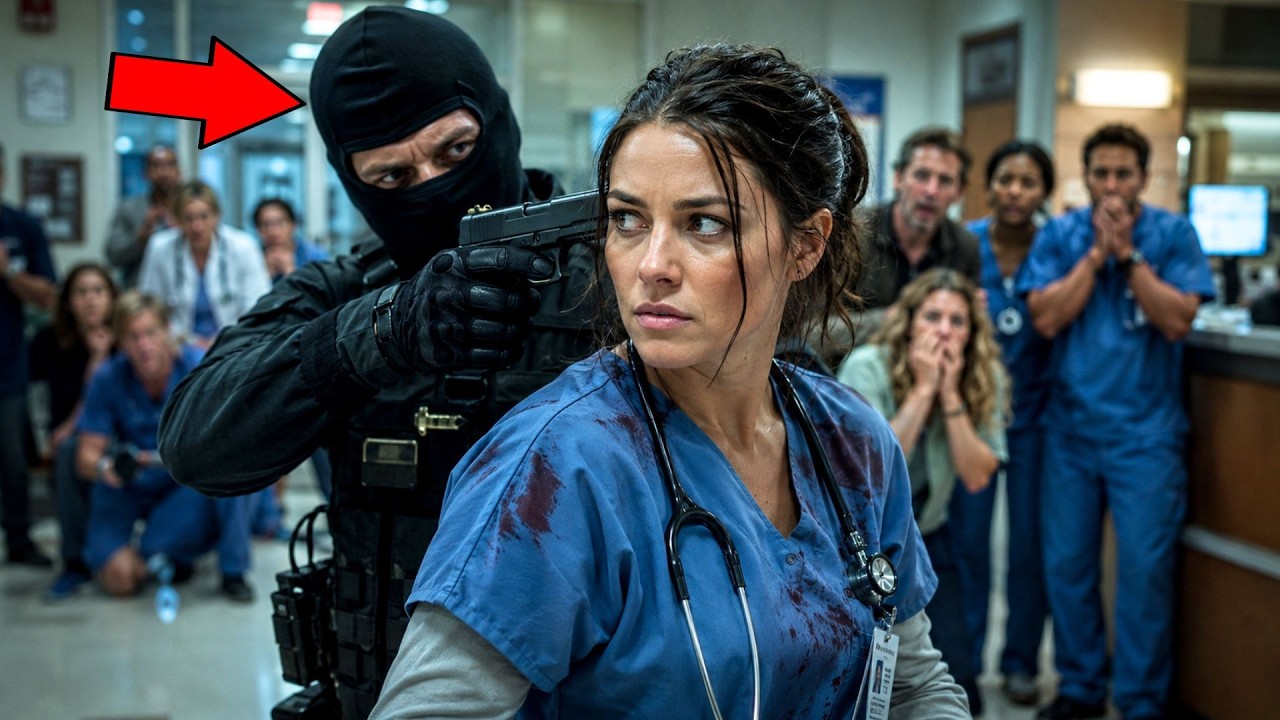
The man with the gun pushed through the emergency room doors at 9:17 on a Tuesday morning.
He fired one shot into the ceiling.
Ceiling tiles exploded over the reception desk. Patients screamed. A security guard reached for his radio, but the gunman swung the weapon toward him.
“Hands where I can see them.”
The guard froze.
The man grabbed the nearest hospital employee—a nurse standing beside a medication cart—and dragged her against his chest.
“Everybody on the floor,” he shouted. “Now.”
Within seconds, twenty-three people were crouched between chairs, stretchers, and overturned equipment.
The gunman tightened his arm around the nurse’s neck.
She was in her early forties, with dark hair tied neatly behind her head. Her badge read:
MARA VANCE — REGISTERED NURSE
She did not scream.
She did not beg.
She simply looked at the gun in his right hand, then at his shoes, his breathing, and the slight tremor in his left wrist.
He had chosen the quietest person in the room.
He had no idea why she was so quiet.
The gunman’s name was Daniel Rusk.
Three months earlier, his younger brother had died at St. Catherine’s Medical Center after a late-night car accident. Daniel believed the hospital had ignored him. He had sent angry emails, called administrators, and demanded the name of the surgeon who had treated his brother.
The hospital’s legal department had responded with formal letters.
The trauma team had documented everything.
Daniel had stopped listening.
By Tuesday morning, grief had turned into rage, and rage had brought him through the emergency department with a stolen pistol, two loaded magazines, and a list of names folded inside his jacket.
His plan was simple.
Find the doctor he blamed.
Force the hospital to confess.
Make someone pay.
Mara Vance was not on his list.
She had only stepped into the waiting area because an elderly patient needed help adjusting his oxygen tube.
Now Daniel pressed the pistol against her ribs.
“You work here?” he asked.
“Yes.”
“Then you’re going to help me.”
Mara’s voice remained steady.
“What do you need?”
The question seemed to surprise him.
Most people facing a weapon asked not to be hurt.
Mara asked what he needed.
Daniel dragged her toward the reception desk and ordered everyone else into a corner. A receptionist named Helen crawled beside a frightened mother and covered the woman’s little boy with her body.
The security guard lowered himself slowly to the floor.
Daniel pointed toward the hallway.
“Lock those doors.”
Mara looked at him.
“If I lock the internal doors, some of them will seal automatically.”
“Then do it.”
“There are patients on ventilators behind those doors.”
“I said do it.”
Mara hesitated just long enough to make him impatient, but not long enough to make him suspicious.
Then she moved.
As she crossed behind the reception desk, she passed a wall panel used for emergency alerts. Her hand brushed beneath the counter for less than a second.
Daniel did not notice.
A silent alarm began transmitting to hospital security.
Mara returned with a ring of keys.
Daniel forced her into the main treatment corridor, taking six hostages with them: Helen the receptionist, the security guard, an elderly man named Mr. Alvarez, a pregnant woman waiting for test results, a young paramedic, and a hospital administrator named Paul Hendricks.
Paul wore a tailored suit and the expression of a man unused to being powerless.
“You’re making a mistake,” Paul told Daniel. “The police will already be outside.”
Daniel struck him across the face with the pistol.
Paul collapsed against a supply cabinet.
Mara immediately stepped between them.
“He can’t help you if he’s unconscious.”
Daniel stared at her.
“You trying to be a hero?”
“No.”
Her answer came without emotion.
“I’m trying to keep everyone useful.”
The paramedic looked at her.
Something about the wording caught his attention.
Useful.
Not safe.
Not calm.
Useful.
Daniel ordered the group into Trauma Room Three. It had one entrance, no windows, and enough medical equipment to block the door.
He made the security guard drag a crash cart against it.
Then he forced everyone to surrender their phones.
Mara placed hers on the floor with the others.
Daniel crushed it beneath his boot.
“You’re going to call Dr. Malcolm Reyes,” he told Paul. “You’re going to bring him here.”
Paul wiped blood from his mouth.
“Dr. Reyes isn’t in the hospital.”
Daniel’s jaw tightened.
“Don’t lie to me.”
“He transferred to another facility two months ago.”
Daniel pressed the pistol beneath Paul’s chin.
“Call him.”
Paul looked toward Mara.
Mara gave the smallest shake of her head.
Daniel saw it.
“What was that?”
“Nothing,” Paul said.
Daniel turned the weapon toward Mara.
“You know where Reyes is?”
“I know he doesn’t work here anymore.”
“You know what he did?”
“I know your brother died.”
For the first time, Daniel’s expression changed.
“Don’t say his name.”
“I didn’t.”
“You people killed him.”
The room became silent except for the electronic pulse of a heart monitor that was not connected to anyone.
Mara studied Daniel’s face.
His pupils were uneven. Sweat had collected above his lip despite the cold room. His grip was too tight. His breathing came in short bursts.
He was furious, but the anger was not stable.
It was covering panic.
That made him more dangerous.
Daniel forced Paul to call the hospital switchboard. He demanded Dr. Reyes, the chief medical officer, and a live television crew.
When the operator tried to stall him, he fired a second shot into a cabinet.
The pregnant woman screamed.
Mr. Alvarez clutched his chest.
Mara moved instantly.
“He needs to sit down.”
“No one moves.”
“He has a cardiac condition.”
“I said no one moves.”
Mara turned her body slightly toward Daniel, keeping her hands visible.
“If he dies, you lose control of the room.”
Daniel’s eyes narrowed.
“You think I don’t have control?”
“I think you came here because no one listened to you.”
The words landed harder than a threat.
Daniel stared at her.
Mara continued carefully.
“If someone dies before you say what you came to say, no one will remember your brother. They’ll only remember this.”
For several seconds, no one moved.
Then Daniel pointed the gun toward Mr. Alvarez.
“Help him.”
Mara lowered the elderly man onto a chair and checked his pulse.
As she knelt, the paramedic leaned closer.
“Are you police?” he whispered.
Mara did not look at him.
“No.”
It was technically true.
Outside the hospital, patrol cars had surrounded the building.
A tactical team assembled behind armored vehicles. Negotiators studied Daniel’s history. Hospital security pulled camera feeds from the emergency department.
On one screen, they could see Trauma Room Three’s hallway.
The door was blocked.
The room itself had no active camera.
Then a hospital security officer named Brent Cole noticed something unusual.
A light on the emergency control panel was blinking in a repeating pattern.
Three short flashes.
Two long.
Three short.
He watched it twice.
Then he called the tactical commander.
“Someone inside is signaling.”
Inside the room, Mara kept Daniel talking.
He told her about his brother, Ethan.
Ethan had been twenty-six. A delivery driver. A new father. He had arrived at St. Catherine’s after being struck by a drunk driver. Daniel claimed the surgeons had waited too long to operate.
Mara listened without interrupting.
Paul did not.
“That isn’t what happened,” he said.
Mara’s head turned sharply.
Daniel looked at Paul.
“What did you say?”
Paul swallowed.
“The review found no delay.”
Daniel walked toward him.
“The review?”
“The internal review.”
“You investigated yourselves.”
“It was also examined by the state board.”
“And you all protected each other.”
Daniel lifted the gun.
Mara stepped between them again.
This time, Daniel shoved her hard against the wall.
The back of her head struck a cabinet.
Helen gasped.
Mara slowly straightened.
A thin line of blood appeared near her hairline.
Daniel expected fear.
Instead, Mara looked at his feet.
His right heel was raised.
His weight was forward.
His elbow was locked.
He was standing too close.
For less than half a second, something changed in her face.
Not anger.
Calculation.
Then it disappeared.
Daniel grabbed her uniform and pulled her forward.
“You keep looking at me like you know something.”
“I know you haven’t decided how this ends.”
“I decide everything in this room.”
“No,” Mara said quietly. “You’re reacting to everything in this room.”
The gunman’s face hardened.
The security guard held his breath.
Paul stared at Mara as though she had lost her mind.
Daniel pressed the pistol beneath her jaw.
“You think you’re smarter than me?”
Mara met his eyes.
“I think you’re tired.”
A phone rang on the floor.
Daniel flinched.
That tiny reaction told Mara more than anything he had said.
He was not trained.
He was not experienced.
And he was nearing the point where fear would overpower his plan.
Daniel picked up Paul’s phone.
A police negotiator introduced herself as Lieutenant Ava Chen.
Daniel began shouting demands.
He wanted Dr. Reyes brought back to the hospital. He wanted the medical files released publicly. He wanted the hospital to admit that Ethan Rusk had died because no one cared.
Lieutenant Chen kept her voice measured.
“I can help you get answers, Daniel, but I need something from you first.”
“You get nothing.”
“I need to know the people inside are alive.”
Daniel looked around the room.
Then he handed the phone to Mara.
“Tell her.”
Mara took it.
“This is Mara Vance. Seven hostages. One gunman. Two magazines visible. One firearm. No confirmed explosives.”
Daniel ripped the phone from her hand.
Everyone in the room went still.
Lieutenant Chen went silent on the other end.
Daniel’s face drained of color.
“What did you just say?”
Mara looked at him calmly.
“You asked me to tell her.”
“How do you know I have two magazines?”
“One in the weapon. One in your jacket.”
Daniel touched his jacket instinctively.
That movement confirmed it.
The young paramedic stared at Mara.
The security guard’s eyes widened.
Daniel stepped closer.
“Who are you?”
“A nurse.”
“Don’t lie to me.”
“I am a nurse.”
“What kind of nurse counts ammunition?”
“The kind standing next to a man with a gun.”
Daniel raised the pistol.
Paul suddenly pointed toward Mara’s wrist.
“What is that?”
Her sleeve had pulled back when Daniel shoved her.
A faded black tattoo was visible near the inside of her forearm.
A winged dagger surrounded by a circle.
The tactical commander watching from outside recognized it from Mara’s personnel file.
Five years earlier, St. Catherine’s had hired Mara Vance as a trauma nurse after she completed a civilian nursing program.
The application listed prior government service.
It did not list the details.
The details were sealed.
Before Mara ever wore hospital scrubs, she had served twelve years as a medical specialist attached to a special operations unit.
She had treated casualties under fire.
She had survived two helicopter crashes.
She had completed advanced close-quarters training because her team’s medics were expected to defend patients when no one else could.
She had left the military after an explosion damaged the hearing in her left ear.
At St. Catherine’s, she never mentioned any of it.
To her colleagues, Mara was simply the nurse who stayed late, remembered patients’ names, and never seemed shaken during emergencies.
Daniel had not taken an ordinary nurse hostage.
He had trapped himself in a room with someone trained to wait for exactly one mistake.
Outside, the tactical commander spoke into the negotiator’s headset.
“Keep him focused on the call. Vance is inside.”
Lieutenant Chen paused.
“You know her?” she whispered.
“I know enough.”
Inside the trauma room, Daniel ordered Mara to remove the tattoo from view.
She pulled down her sleeve.
His breathing grew faster.
“Were you military?”
“Yes.”
“What did you do?”
“I kept people alive.”
“That’s not what I asked.”
“It’s the only answer that matters.”
Daniel backed away from her.
For the first time since entering the hospital, he increased the distance between himself and a hostage.
That was when the power in the room shifted.
Everyone felt it.
Helen stopped crying.
The paramedic straightened slightly.
Even Paul, who had spent the morning issuing orders to everyone around him, looked toward Mara and waited.
Daniel saw it happen.
The hostages were no longer watching the gun.
They were watching her.
“Get on your knees,” he told Mara.
She lowered herself slowly.
“Hands behind your head.”
She obeyed.
Daniel moved behind her, keeping the pistol aimed downward.
Then Paul made the worst possible decision.
He lunged for the door.
Daniel spun.
His finger tightened.
Mara moved before the gun aligned.
She drove backward into Daniel’s knees.
His balance broke.
Her left hand trapped his wrist while her right forearm struck above his elbow. The pistol fired into the floor.
The sound was deafening.
Mara twisted, turned under his arm, and drove him face-first against the crash cart.
The weapon fell.
The security guard kicked it across the room.
Daniel reached for the spare magazine inside his jacket, forgetting that he no longer had a gun to load.
Mara caught his arm, forced it behind his back, and pinned him to the floor with her knee between his shoulders.
The entire struggle lasted less than four seconds.
Daniel screamed and tried to rise.
He could not move.
“Stop fighting,” Mara said.
Her voice was the same calm voice she had used when checking Mr. Alvarez’s pulse.
Daniel looked toward the gun lying several feet away.
Then he looked around the room.
Helen was holding the phone.
The security guard had secured the weapon.
The paramedic had moved the pregnant woman behind a gurney.
Paul stood frozen beside the door, his face pale.
No one was afraid of Daniel anymore.
That was the moment he understood.
His eyes moved back to Mara’s face.
The rage disappeared first.
Then the confidence.
Then whatever story he had told himself about being the most powerful person in the room.
His mouth opened, but no words came out.
The silence around him was heavier than the gunfire had been.
Mara leaned closer.
“It’s over.”
Outside, the tactical team heard Helen shouting through the phone.
“The gun is down! The gun is down!”
The door opened less than a minute later.
Officers entered with shields raised and rifles ready. They found Daniel restrained on the floor with a blood pressure cuff wrapped around his wrists because Mara had refused to risk moving him toward the handcuffs in his jacket.
Every hostage walked out alive.
Mr. Alvarez was treated for chest pain and released that afternoon.
The pregnant woman gave birth three weeks later and named her daughter Mara.
Daniel Rusk survived the incident and was charged with armed kidnapping, aggravated assault, unlawful discharge of a firearm, and multiple weapons offenses.
But the investigation did not end with his arrest.
The files he had demanded were reviewed again—this time by an independent medical panel.
The findings were painful, but clear.
Dr. Reyes had not delayed Ethan’s surgery.
The trauma team had begun operating within minutes of his arrival.
Ethan’s injuries had been catastrophic.
There was no secret cover-up.
No ignored treatment.
No single person responsible for his death except the drunk driver who had caused the crash.
Daniel learned the truth while sitting behind reinforced glass in a county detention center.
His lawyer placed the report in front of him.
For a long time, Daniel said nothing.
Then he asked one question.
“Did the nurse know?”
The lawyer nodded.
“She had read the summary while you were talking.”
Daniel lowered his eyes.
Mara could have humiliated him in the room.
She could have told him immediately that he was wrong.
Instead, she had kept him talking because she understood something Daniel did not.
Truth delivered at the wrong moment can become another weapon.
Weeks later, the hospital held a private ceremony to honor Mara.
Executives praised her courage. Local officials offered awards. Reporters waited outside for interviews.
Mara declined all of them.
When Paul Hendricks asked why, she looked through the glass doors of the recovery ward.
“Because the story isn’t that I stopped him,” she said.
Paul waited.
“The story is that everyone went home.”
Then she returned to her shift.
By the end of the afternoon, Mara was helping an elderly patient open a cup of applesauce. Her uniform had been replaced. The cut near her hairline was covered by a small bandage.
A new nurse approached her quietly.
“Is it true?” she asked.
“Is what true?”
“That you were special operations.”
Mara peeled the foil lid from the cup.
“I was a medic.”
“You saved all those people.”
Mara handed the applesauce to the patient.
“People are saved by teams.”
The new nurse looked toward the busy hallway.
“But you weren’t afraid?”
Mara paused.
“I was afraid from the moment he came through the door.”
The young nurse seemed surprised.
Mara gave her a tired smile.
“Courage isn’t the absence of fear. It’s knowing fear doesn’t get to make the next decision.”
Then she walked into the next patient’s room.
Daniel Rusk entered St. Catherine’s believing a gun would make people listen to him.
Instead, the person he considered weakest took away his weapon, his control, and the lie that had brought him there.
He chose a nurse because he thought she would be easy to intimidate.
He learned too late that the quietest person in the room is sometimes quiet because they already know exactly what to do.