She fell in the dust, and no one came fast enough.
Her body shook once, then went still, and the small metal bowl of water she had been carrying rolled away into the gutter.
Mama Ouko screamed for help, dropping the peppers she was grinding. Three neighbors rushed from their rooms and found the old woman lying on the narrow street like a forgotten sack of rags.
Everyone in the settlement knew her simply as Ya.
She was the quiet woman who swept her doorstep before sunrise, fed stray cats from the little food she had, and never raised her voice even when the landlord insulted her for paying rent late.
She spoke little of her past.
No one ever pressed her.
That afternoon, they carried her into her one-room home and laid her on the thin mattress beside the wall. Her breathing was shallow. Her skin felt cold.
“Search for a relative,” someone said.
Mama Ouko looked around the tiny room.
There was almost nothing to search.
A cracked stool. Two faded dresses hanging from a nail. A cooking pot blackened by years of charcoal smoke. A wooden box containing old medicine packets, loose buttons, and three coins.
Then Mama Ouko reached beneath the pillow.
Her fingers touched something hard.
It was a small brass locket, darkened with age.
Inside was a faded photograph of a young boy with serious eyes. He stood barefoot beside a younger version of Ya, who had one hand resting protectively on his shoulder.
On the back, written in careful blue ink, were the words:
“My son, Kessiana. May he never know hunger again.”
The room became silent.
Everyone in the city knew that name.
Kessiana Mbare was not just rich. He was one of the wealthiest men in the country.
His face appeared on billboards, business magazines, charity banners, and television interviews. He owned construction companies, hotels, logistics firms, and a private foundation that funded schools for disadvantaged children.
People said he had built himself from nothing.
People said he had no family.
And now, lying unconscious on a thin mattress in a crowded settlement, was a woman carrying proof that she might be his mother.
Mama Ouko looked down at Ya’s face.
“Get the wheelbarrow,” she said.
The nearest public clinic had no doctor on duty. The nurse checked Ya’s pulse, gave her fluids, and said she needed better care immediately.
“She is severely malnourished,” the nurse warned. “Her blood pressure is dangerously low. She may have an infection. Take her to the general hospital.”
But the neighbors did not have money for an ambulance.
Mama Ouko looked at the photograph again.
“No,” she said. “We are taking her to her son.”
They placed folded blankets inside a wheelbarrow, laid Ya carefully on top, and covered her with a thin sheet.
Mama Ouko pushed from the front.
A mechanic named Biko steadied the handles.
Two children followed behind, carrying Ya’s small wooden box and the locket.
The journey took nearly three hours.
They walked from the settlement through crowded markets, past bus stations, office buildings, and neighborhoods where the roads grew wider and the walls taller.
By the time they reached the hill where Kessiana lived, their clothes were coated in dust.
His mansion stood behind towering black gates topped with gold-colored spikes. Security cameras turned silently above the walls. A stone driveway curved through gardens so large that the entire settlement could have fit inside them.
A guard stepped from the security booth.
He looked at the wheelbarrow, then at Mama Ouko.
“What do you want?”
“We have brought Mr. Kessiana’s mother.”
The guard stared at her.
Then he laughed.
Not a surprised laugh.
A cruel one.
“His mother?”
Mama Ouko held up the brass locket.
“She has his photograph.”
“Every beggar in this city has seen his photograph.”
“This one was taken when he was a child.”
The guard did not examine it.
He waved his hand toward the road.
“Move away from the gate.”
“She is dying.”
“Then take her to a hospital.”
“She is his mother.”
“And I am the president.”
The second guard smirked.
Biko tightened his grip on the wheelbarrow.
“We have walked for hours.”
“That was your choice.”
Mama Ouko stepped closer.
“Call him. Let him decide.”
The guard’s face hardened.
“Do you think a man like Mr. Mbare has time for this nonsense?”
He reached for the wheelbarrow.
“Move.”
Ya’s head rolled weakly to one side.
A sound escaped her lips.
It was barely more than a breath.
“Kessi.”
Mama Ouko leaned down.
“What did you say?”
Ya’s eyes remained closed.
“Kessi,” she whispered again.
The guards exchanged a glance.
Then a small voice came from behind the gate.
“Who is Kessi?”
A boy of about seven stood several steps up the driveway.
He wore a white shirt, dark shorts, and no shoes. A toy airplane hung loosely from one hand.
The first guard turned sharply.
“Master Eli, please go back inside.”
But the boy had already moved closer.
He peered through the bars at the old woman in the wheelbarrow.
Then he looked at the faded photograph in Mama Ouko’s hand.
His eyes widened.
He pointed to the boy in the picture.
“That is Grandpa’s secret photo.”
The guard froze.
Mama Ouko stared at him.
“What?”
The child came closer to the gate.
“My father keeps the same picture in his office. He thinks I don’t know, but I saw him holding it once. He was crying.”
The second guard stopped smiling.
The boy looked again at Ya.
Then he whispered, “She has the same eyes as my father.”
For the first time, the guards seemed uncertain.
The first one lifted his radio.
Before he could speak, the front door of the mansion opened.
A woman stepped onto the terrace.
She was tall, elegant, and dressed in a cream silk outfit. Gold bracelets circled her wrist. Her dark hair was pulled into a perfect knot.
Her name was Celestine Mbare.
Kessiana’s wife.
“What is happening at the gate?” she called.
The guard straightened.
“Madam, these people claim the old woman is Mr. Mbare’s mother.”
Celestine descended the steps slowly.
Her expression did not change.
But when she reached the gate and saw the brass locket, something flickered across her face.
It vanished almost immediately.
She looked at Ya for no more than two seconds.
Then she turned to the guard.
“Send them away.”
Mama Ouko stared at her.
“Madam, please. The boy says—”
“I heard what the boy said.”
Celestine’s voice was calm.
Too calm.
She looked at Eli.
“Go inside.”
“But Mama—”
“Now.”
The boy hesitated.
Celestine’s eyes sharpened.
Eli lowered his head and walked toward the house, glancing back twice.
Mama Ouko held the locket through the bars.
“Look at the photograph.”
“I do not need to.”
“Then call your husband.”
“He is in a board meeting.”
“His mother may die before the meeting ends.”
Celestine stepped closer.
“You have come to the wrong house.”
Ya stirred again.
Her lips moved.
This time, she said a full name.
“Kesiena… my child.”
Celestine’s jaw tightened.
Mama Ouko noticed.
It was small, but unmistakable.
Recognition.
“You know her,” Mama Ouko said.
Celestine’s eyes snapped toward her.
“I said leave.”
Biko stepped forward.
“You recognized the name.”
The guard put a hand against his chest.
“Back up.”
A black vehicle turned onto the road before the argument could continue.
Then another.
Then a third.
The gates opened automatically.
The guards moved the wheelbarrow aside as the convoy entered.
In the back seat of the second vehicle sat Kessiana Mbare.
He was speaking on the phone when he looked through the window.
At first, he saw only a group of poorly dressed people gathered near his gate.
Then he saw the wheelbarrow.
Then the old woman.
His phone slipped from his hand.
The vehicle stopped so suddenly that the car behind nearly struck it.
Kessiana opened the door before his driver could come around.
He walked toward the gate slowly.
Not with the confidence seen on television.
Not like the man whose employees rose when he entered a room.
He walked like someone approaching a ghost.
Mama Ouko watched the color drain from his face.
His eyes moved from Ya’s cheekbones to her hands, then to the brass locket.
“No,” he whispered.
The first guard swallowed.
“Sir, they claimed—”
Kessiana raised one hand.
The guard fell silent.
Kessiana stepped closer to the wheelbarrow.
The old woman’s face was thinner, older, and scarred by years he had never witnessed. But beneath the lines and the dust, he saw the face that had once bent over him in a room lit by a kerosene lamp.
He saw the woman who had carried him across flooded roads.
The woman who had gone without food so he could eat.
The woman whose lullaby had stayed buried in his memory for thirty-three years.
He dropped to his knees in the dust.
“Mama?”
Ya did not respond.
His hand trembled as he touched her forehead.
“Mama, open your eyes.”
Nothing.
Kessiana looked at Mama Ouko.
“Where did you find her?”
“She is our neighbor.”
“How long has she been like this?”
“She collapsed today, but she has been weak for months.”
“Why wasn’t she taken to a hospital?”
“We tried. We had no money.”
Kessiana turned toward his driver.
“Call Dr. Nduli. Tell him to meet us at Saint Catherine’s immediately.”
He reached beneath Ya’s shoulders and knees.
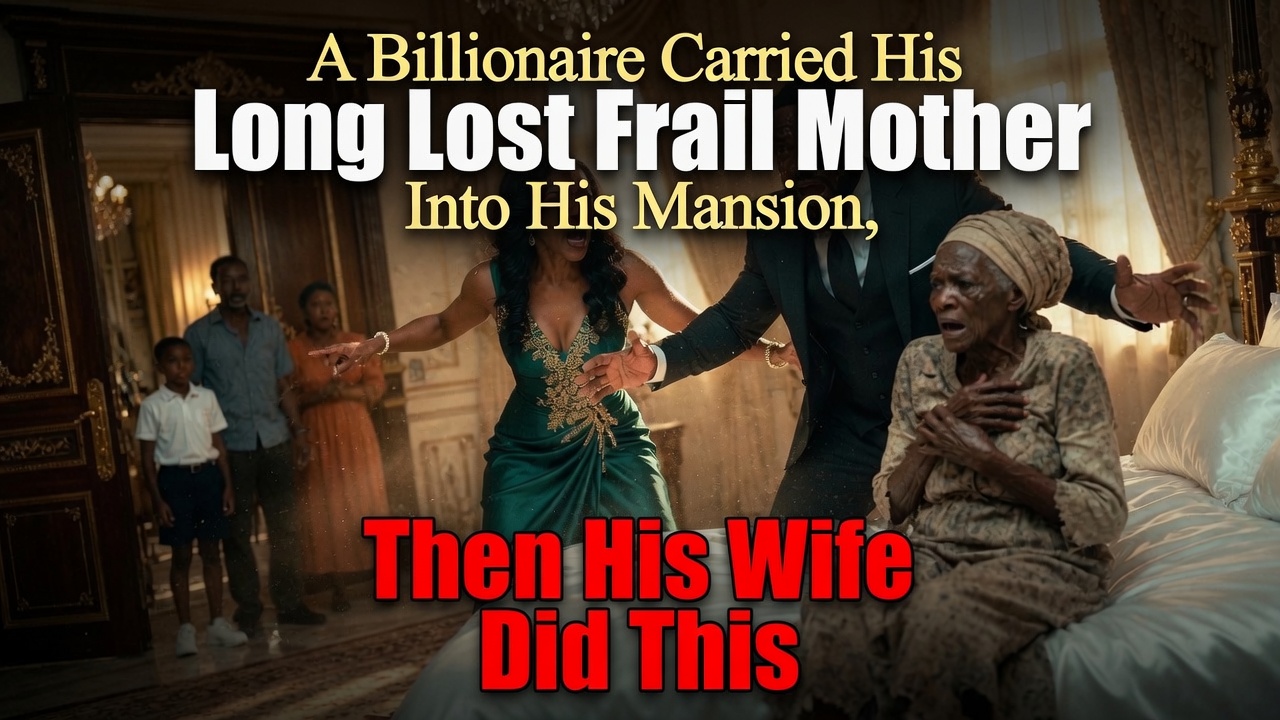
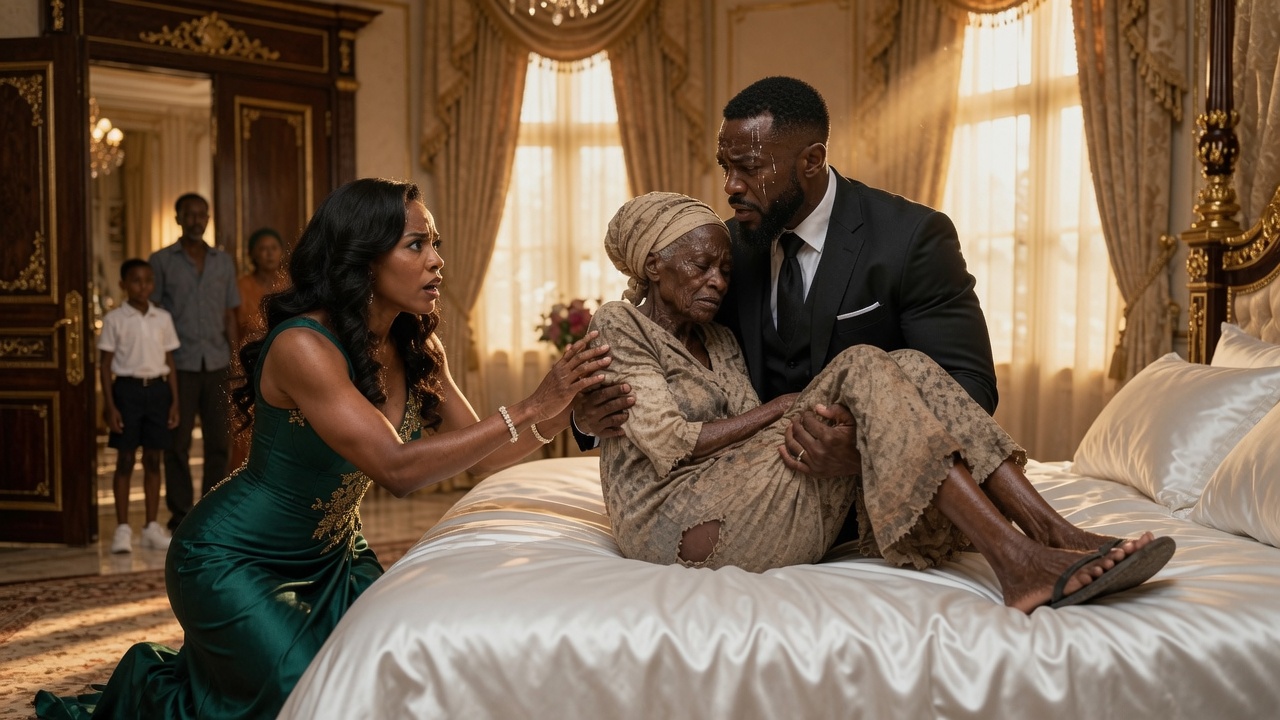
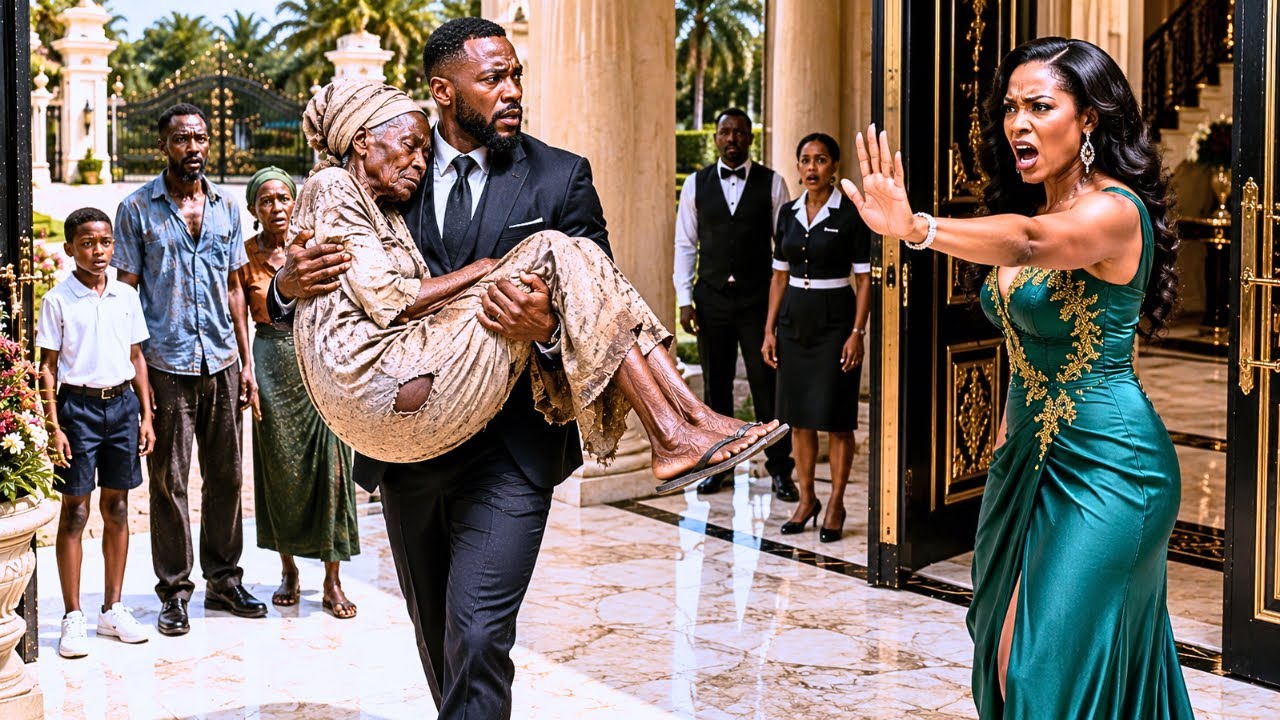
Then, in front of his guards, his wife, his staff, and the neighbors who had pushed her across the city, the billionaire lifted the frail old woman from the wheelbarrow.
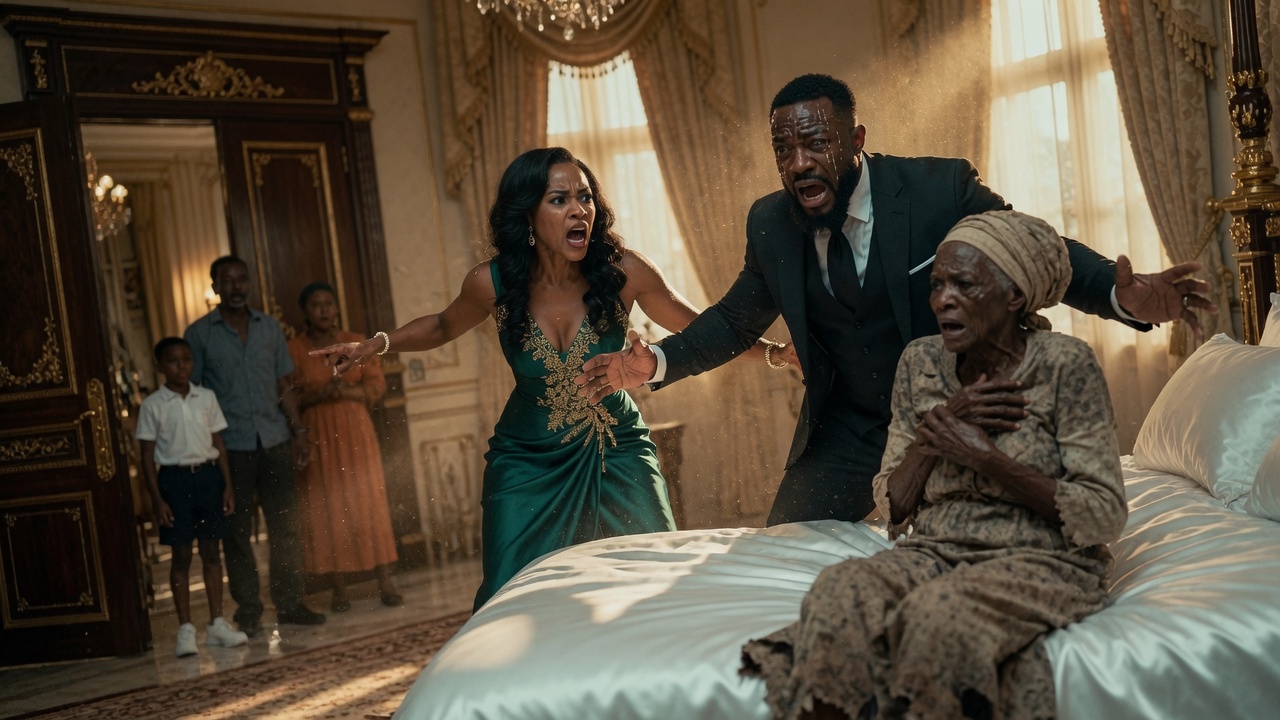
Her body seemed weightless in his arms.
He held her against his chest.
The smell of dust and illness clung to her clothes.
Kessiana did not care.
Tears rolled down his face as he carried her through the gates.
Celestine stood motionless.
“Kessiana,” she said, “we should verify this before bringing her inside.”
He stopped.
Slowly, he turned.
“Verify what?”
Celestine lowered her voice.
“We do not know who these people are.”
Kessiana looked down at the old woman’s face.
Then back at his wife.
“I know who she is.”
“You have not seen her since you were a child.”
“I know my mother.”
“The press may hear about this.”
“My mother is unconscious in my arms.”
“I am thinking about the family.”
“So am I.”
Celestine’s lips pressed into a thin line.
Kessiana carried Ya into the mansion.
The neighbors followed until the guards blocked them.
“No,” Kessiana said without turning. “Let them in.”
The guards stepped aside.
Inside, the marble floors gleamed beneath crystal chandeliers. Paintings taller than the rooms in the settlement covered the walls. A floral arrangement stood on a table large enough to feed twenty families.
Mama Ouko glanced at Ya’s cracked heels hanging below the edge of Kessiana’s jacket.
The contrast made her chest ache.
A medical team arrived within fifteen minutes.
They examined Ya in a guest bedroom while Kessiana paced outside.
Dr. Nduli eventually emerged.
“She is alive, but her condition is serious. Severe dehydration, prolonged nutritional deficiency, respiratory infection, and possible heart complications. We need to admit her immediately.”
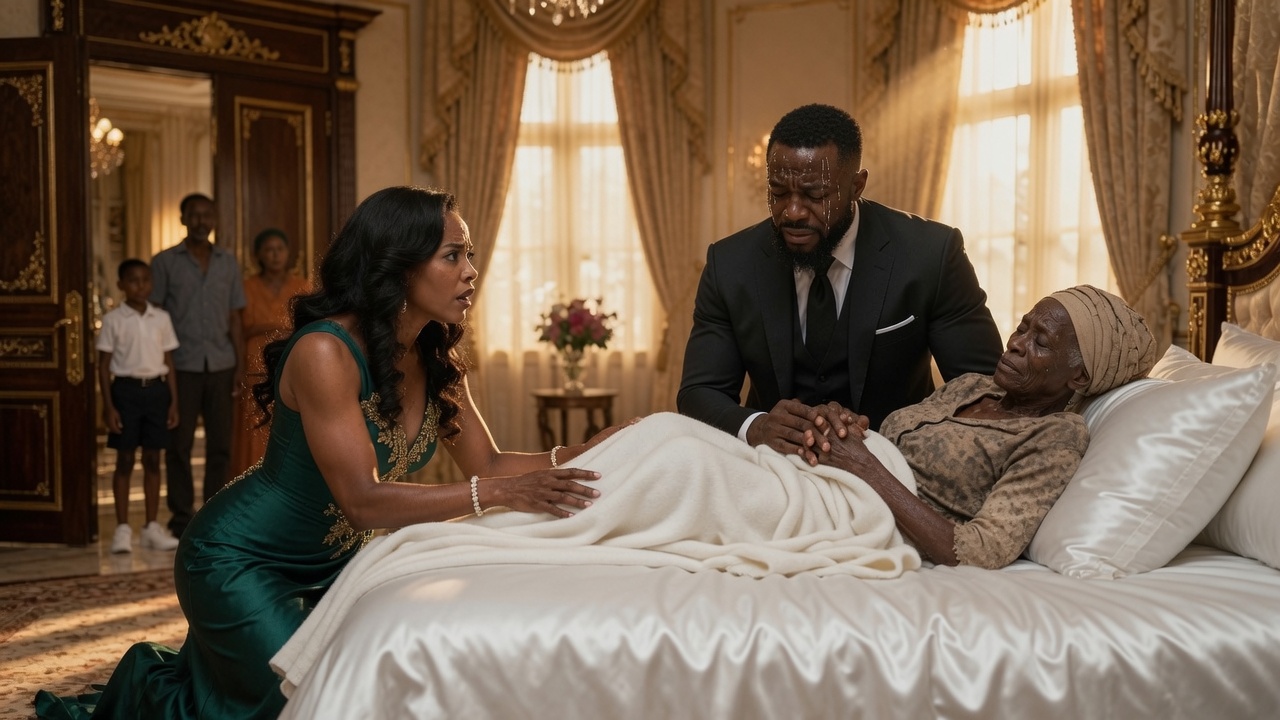
Kessiana nodded.
“Do everything.”
“We also need her medical history.”
Kessiana looked down.
“I don’t know it.”
The shame in his voice filled the hallway.
Mama Ouko stepped forward.
“I have some of her clinic papers in the wooden box.”
Celestine looked at the box as though it were dirty.
A housekeeper took it.
Dr. Nduli glanced through the papers.
“These help.”
Ya was transferred into a private ambulance.
Kessiana rode beside her.
Before leaving, he turned to Mama Ouko and Biko.
“Come with us.”
Celestine interrupted.
“They do not all need to come.”
Kessiana looked at her.
“They brought my mother here when no one else did.”
He climbed into the ambulance.
Mama Ouko followed.
Celestine remained in the driveway, watching the doors close.
Her face was unreadable.
But Eli, standing behind an upstairs curtain, saw his mother grip the balcony rail until her knuckles turned white.
At Saint Catherine’s Hospital, Ya was taken into intensive care.
Kessiana sat outside the unit for six hours.
He canceled two meetings, ignored dozens of calls, and refused to leave even when his assistant reminded him that foreign investors were waiting.
Celestine arrived later with a change of clothes for him.
“You cannot sit here indefinitely,” she said.
He stared through the glass window.
“When I was nine, she sat beside me for three days when I had malaria.”
“You were a child.”
“She sold her wedding ring to buy my medicine.”
Celestine placed the clothes beside him.
“You do not know if this woman is the same person you remember.”
Kessiana looked at her.
“What are you saying?”
“I am saying people change.”
“She is my mother.”
“Then where has she been for thirty-three years?”
The question struck him.
Celestine sat beside him.
“You spent your life believing she was dead.”
“I was told she died.”
“By whom?”
“My uncle.”
“And your uncle is dead. There is no one to confirm anything she may tell you.”
Kessiana leaned forward, pressing his hands together.
“I searched for her.”
“You searched when you were young. You found nothing.”
“I found nothing because I was looking for a grave.”
Celestine was quiet for a moment.
Then she touched his arm.
“Be careful. That is all I am asking.”
Kessiana pulled his arm away.
For the first time in their twelve-year marriage, he noticed how little compassion there was in her voice.
Ya opened her eyes the next morning.
Kessiana was sitting beside her bed.
For several seconds, she stared at the ceiling.
Then her gaze moved toward him.
He leaned closer.
“Mama?”
Her eyes filled with tears.
She studied his face as if trying to find the child inside the man.
“Kessi?”
His mouth shook.
Only one person had ever called him that.
He bowed his head and pressed her hand against his forehead.
“I thought you were dead.”
Ya’s fingers moved weakly through his hair.
“I thought you had forgotten me.”
He began to cry.
Not quietly.
Not carefully.
He cried with the helplessness of a boy who had waited thirty-three years to hear his mother say his name.
Ya cried too.
Their hands stayed locked together.
Neither noticed Celestine standing outside the half-open door.
Over the next four days, Ya’s strength slowly returned.
She told Kessiana fragments of what had happened.
After his father died, poverty had swallowed them. Ya worked in kitchens and washed clothes to keep him in school. Kessiana’s uncle, Orano, offered to take the boy to the city for “a better life.”
Ya resisted.
But Orano promised education, safety, and regular visits.
At first, he sent letters.
Then the letters stopped.
When Ya traveled to the city, Orano had moved.
Years later, she learned that Kessiana had been placed in a boarding school under a shortened family name. By the time she found the school, he had graduated.
“I searched everywhere,” Ya said. “But people do not listen to women who arrive barefoot.”
Kessiana squeezed her hand.
“Uncle Orano told me you died from fever.”
Ya closed her eyes.
“He always wanted your father’s land.”
“What land?”
“Our family land near the eastern lake.”
Kessiana frowned.
He had never heard of it.
Ya looked toward the window.
“Orano sold it after taking you away.”
The story made sense, but it also opened wounds Kessiana had buried beneath work, ambition, and wealth.
He blamed his uncle.
He blamed poverty.
Most of all, he blamed himself.
“How did you live all these years?”
Ya smiled faintly.
“As people live. One day after another.”
“Why didn’t you come to my office when you saw me on television?”
Her smile disappeared.
“I did.”
Kessiana went still.
“When?”
“Many times.”
The room seemed to tighten around him.
“You came to my office?”
Ya nodded.
“The first time was nine years ago. A woman at the market showed me your picture in a newspaper. I walked to the city.”
“What happened?”
“The receptionist said I needed an appointment.”
“And after that?”
“I returned with the photograph. Security removed me.”
Kessiana stared at her.
“I tried again when your foundation opened the school in Kitala.”
His foundation.
His charity.
An event attended by politicians, cameras, and wealthy donors.
Ya’s voice grew quieter.
“I stood behind the barrier. I called your name, but the music was loud.”
Kessiana remembered that day.
He remembered greeting hundreds of people.
He remembered a disturbance near the back of the crowd.
Security had escorted an old woman away.
He had not even turned to look.
His stomach twisted.
“Why did you stop trying?”
Ya looked at her hands.
“I did not stop.”
The door opened.
Celestine entered carrying flowers.
Ya’s eyes moved toward her.
Her entire body stiffened.
Kessiana noticed.
“Mama?”
Celestine placed the flowers on the table.
“How are you feeling today?”
Ya did not answer.
Celestine smiled politely.
“I am Celestine. Kessiana’s wife.”
“I know.”
The two words came out dry and cold.
Kessiana looked between them.
“You know her?”
Ya turned her face toward the window.
Celestine adjusted the flowers.
“She may have seen me in magazines.”
But Ya’s breathing had changed.
Her fingers tightened around the blanket.
Kessiana leaned closer.
“Mama, what is wrong?”
“Nothing.”
The answer came too quickly.
Celestine remained for less than five minutes.
After she left, Ya refused to discuss her.
Kessiana assumed she was overwhelmed.
But Mama Ouko, who had spent years reading people because survival depended on it, saw something else.
Fear.
When Ya was discharged, Kessiana insisted she come to the mansion.
Celestine objected privately.
“She should recover in a medical facility.”
“She wants to be with her family.”
“She barely knows us.”
“She is my mother.”
“We have a child in the house.”
Kessiana stared at her.
“What does that mean?”
“It means we must consider Eli’s safety.”
“My mother is not a threat to our son.”
“We know almost nothing about her life.”
Kessiana stepped closer.
“We know she was starving while we hosted dinners that cost more than her entire neighborhood.”
“That is not my fault.”
“I did not say it was.”
“But you are looking at me as though it is.”
Kessiana’s voice lowered.
“I am looking at you as though my mother lay outside our gates and your first instruction was to send her away.”
Celestine crossed her arms.
“I was protecting this family from a stranger.”
“You saw the photograph.”
“A photograph proves a connection, not an intention.”
Kessiana shook his head.
“Sometimes I wonder whether you hear yourself.”
Ya moved into a bedroom overlooking the garden.
The mansion staff treated her carefully, though some whispered when they thought she could not hear.
She owned no proper luggage.
Her clothes fit inside the same wooden box.
She ate slowly, saving small pieces of bread in napkins.
She apologized whenever someone brought her tea.
She refused to ring the bell beside her bed because she did not want to trouble anyone.
Eli became attached to her almost immediately.
He sat beside her each afternoon and asked endless questions.
“Did Papa cry when he was a baby?”
“All babies cry.”
“Was he naughty?”
“He once hid a goat inside our kitchen.”
Eli laughed so loudly that a housekeeper came to check on them.
“Did Papa always want to be rich?”
Ya thought for a moment.
“No. He wanted to become a teacher.”
That evening, Eli asked his father why he had never become one.
Kessiana looked across the dinner table at Ya.
“I think I forgot.”
Celestine placed down her glass.
“You built schools. That is close enough.”
Ya looked at her.
“Building a school is not the same as seeing the children inside it.”
The table fell silent.
Celestine smiled.
“No, I suppose it is not.”
A week passed.
Then another.
Ya regained enough strength to walk through the garden with a cane.
Kessiana began coming home earlier.
He sat with her in the evenings, listening to stories about his father and the village he barely remembered.
For the first time in years, he missed meetings without feeling guilty.
He laughed more.
Eli noticed.
The staff noticed.
Celestine noticed most of all.
One morning, Kessiana announced that he planned to take Ya to the eastern lake to visit the place where their old family home had stood.
Celestine nearly dropped her coffee.
“When?”
“Next weekend.”
“You have the infrastructure summit.”
“I canceled.”
“You are the keynote speaker.”
“They can find another speaker.”
Celestine stared at him.
“You have changed every schedule in this house since she arrived.”
“She has been here for two weeks.”
“And in those two weeks, you have missed meetings, delayed the Singapore agreement, and invited journalists to interview her.”
“I did not invite anyone.”
“Your staff leaked the reunion.”
“Then speak to my staff.”
“The board is concerned.”
Kessiana leaned back.
“The board is concerned that I found my mother?”
“The board is concerned that private family matters are affecting your judgment.”
Ya entered the room during the final sentence.
She stopped near the doorway.
Celestine did not apologize.
Instead, she folded the newspaper on the table. Ya and Kessiana’s reunion photograph was printed on the front page.
“Your story is becoming a spectacle,” she said.
Ya lowered her eyes.
“I can return to my room.”
Kessiana stood.
“No, Mama. Stay.”
Celestine pushed back her chair.
“I have a foundation meeting.”
After she left, Ya looked toward the closed door.
“You should not fight with your wife because of me.”
“We are not fighting because of you.”
Ya studied him.
Kessiana tried to smile.
She did not believe him.
That afternoon, Celestine visited Ya’s room.
She closed the door behind her.
Ya was seated by the window, repairing the hem of an old dress.
“You should not sew that,” Celestine said. “The staff can replace it.”
Ya continued threading the needle.
“Some things should be repaired before they are replaced.”
Celestine walked closer.
“How much do you want?”
Ya’s hands stopped.
Celestine placed an envelope on the table.
“There is enough money here for a home, medical treatment, and staff for the rest of your life.”
Ya looked at the envelope.
Then at Celestine.
“You offered me money before.”
The room went silent.
Celestine’s face hardened.
“You are confused.”
“No.”
“You have been ill.”
“I was not ill eight years ago.”
Celestine stepped closer.
“You need to be very careful about what you claim.”
Ya’s voice remained soft.
“I came to this house eight years ago.”
Celestine glanced toward the door.
“You never entered this house.”
“No. You met me at the gate.”
“I had never seen you before last week.”
“You wore a red dress. You were leaving for a charity dinner. I showed you the locket.”
Celestine’s eyes became cold.
“You are mistaken.”
“You read the words on the photograph.”
“Stop.”
“You asked how much I wanted.”
Celestine leaned over her.
“And what answer did you give?”
Ya held her gaze.
“I said I wanted my son.”
For several seconds, neither woman moved.
Then Celestine pushed the envelope closer.
“You cannot give him back the years he lost. Neither can you explain why you disappeared. But you can destroy the life he built.”
“I did not disappear.”
“That is what he believes happened.”
“Not anymore.”
“You think he will keep choosing you?”
Ya looked toward the garden where Eli was playing.
“He should not have to choose.”
Celestine’s mouth curved into a humorless smile.
“In this house, everyone chooses eventually.”
She left the envelope behind.
Ya did not touch it.
But someone else had heard the conversation.
Eli had come to show his grandmother a drawing.
He stood in the hallway, hidden behind the half-open service door, holding a picture of three people beneath a yellow sun.
That night, he asked his father an unusual question.
“Papa, can grown-ups stop someone from finding you?”
Kessiana looked up from his laptop.
“What do you mean?”
Eli rubbed the edge of the paper.
“Like if someone comes to the gate.”
“Who told you that?”
“No one.”
Kessiana closed the laptop.
“Did something happen?”
Eli looked toward the staircase.
Then Celestine entered the room.
“There you are,” she said. “It is past your bedtime.”
Eli lowered his head.
Celestine placed a hand on his shoulder.
“Come.”
The boy glanced back at his father.
He said nothing more.
The following morning, Ya was gone.
Her bed was made.
The wooden box had disappeared.
The brass locket remained on the pillow.
Kessiana searched the house himself.
He checked the garden, the kitchen, the guest rooms, and the security office.
No one claimed to know when she had left.
The night guard said he had seen a hired car near the side entrance just before dawn.
Security footage from that section of the property had been erased.
Kessiana stood in front of the monitor.
“Erased by whom?”
The head of security avoided his eyes.
“We are checking the system.”
“Who has authorization?”
“Senior security staff. Your office. Madam’s office.”
Kessiana turned slowly.
Celestine stood near the doorway.
“Do not look at me like that.”
“Did you speak to her yesterday?”
“I greeted her at lunch.”
“Did you go to her room?”
“No.”
Eli was standing on the staircase.
His face was pale.
Kessiana noticed him.
“Eli?”
Celestine turned sharply.
“Go upstairs.”
The boy did not move.
“Eli,” Kessiana said gently, “did you see Grandmother leave?”
His eyes filled with tears.
Celestine’s voice became firm.
“Do not involve a child in this.”
But Eli looked at his father.
“Mama gave her money.”
The room went still.
Celestine stared at him.
“What did you say?”
“I heard you.”
“Eli, you misunderstood.”
“You told Grandma everyone has to choose.”
Celestine’s face lost color.
Kessiana looked at his wife.
“Is that true?”
Celestine recovered quickly.
“I offered to help her.”
“You said you did not go to her room.”
“I forgot.”
“You forgot?”
“It was a brief conversation.”
“Did you arrange the car?”
“No.”
“Did you erase the footage?”
“Of course not.”
Kessiana walked toward the security chief.
“Restore it.”
“Sir, if the files were permanently overwritten—”
“Restore it.”
Then he turned to his assistant.
“Find my mother.”
They found Ya six hours later.
She had returned to the settlement.
Mama Ouko discovered her sitting on the floor of her old room beside the empty wooden box.
“You should not have come back here,” Mama Ouko said.
Ya looked exhausted.
“I was causing trouble.”
“Your son is looking for you.”
“He has a family.”
“You are his family.”
Ya touched the wall beside her.
“Some doors open only to show you that you do not belong inside.”
Before Mama Ouko could answer, vehicles crowded the narrow street.
Kessiana emerged from the first one.
He entered Ya’s room without cameras, assistants, or guards.
For a moment, he simply looked at her.
“Why did you leave?”
Ya did not answer.
He saw the envelope on the floor.
He picked it up.
Inside were bank documents, cash, and a letter offering Ya a private residence in exchange for signing a confidentiality agreement.
The agreement prohibited her from discussing any prior contact with the Mbare family.
Kessiana read it twice.
His face changed.
Not with anger at first.
With disbelief.
Then he reached the final page.
The document had been prepared eight years earlier.
The date was clearly printed at the top.
His hands began to shake.
“Mama,” he said, “what happened eight years ago?”
Ya closed her eyes.
Kessiana knelt in front of her.
“Please.”
She told him everything.
After recognizing him in the newspaper, she had traveled to the mansion.
Celestine had met her at the gate.
Ya showed her the childhood photograph, the locket, and a letter written by Kessiana’s father.
Celestine took copies of the documents.
She told Ya that Kessiana had built a new life and that the sudden appearance of an impoverished mother would humiliate him in front of investors and political leaders.
Ya refused to leave.
So Celestine promised to arrange a private meeting.
The meeting never happened.
Instead, a lawyer visited Ya in the settlement.
He offered money in exchange for silence.
Ya refused again.
Then the threats began.
Someone told her that Kessiana’s companies were being investigated and that any scandal involving his family could send him to prison.
Another person warned that approaching him could cause the collapse of his business and leave thousands unemployed.
Ya did not understand corporations, legal systems, or publicity.
But she understood danger.
She believed that staying away was the only way to protect her son.
Kessiana sat in silence.
The story was terrible.
But what made it worse was the precision.
The confidentiality agreement was real.
The law firm still existed.
The name on the document belonged to one of Celestine’s longtime legal advisers.
Kessiana stood.
“Come home with me.”
Ya shook her head.
“I will not return to that house.”
“Then I will not return either.”
She looked up.
He placed the documents inside the envelope.
“You searched for me for thirty-three years. I will not lose you again because someone decided you were inconvenient.”
Back at the mansion, Celestine was waiting in the library.
She stood beside the fireplace with her arms crossed.
Eli was upstairs with the nanny.
Kessiana entered alone.
He placed the envelope on the desk.
Celestine looked at it.
Her expression barely changed.
“You went through her belongings?”
“This agreement was prepared eight years ago.”
She said nothing.
“You knew my mother was alive.”
Celestine looked toward the window.
“You knew.”
“I knew someone was claiming to be your mother.”
“She had my childhood photograph.”
“That could have been stolen.”
“She had my father’s letter.”
“Documents can be forged.”
“The lawyer who prepared this worked for you.”
Celestine’s face tightened.
“I was trying to protect you.”
“From my mother?”
“From scandal.”
“What scandal?”
“You were negotiating the largest deal of your career. Your public image mattered. Investors believed you came from a disciplined, respectable background.”
“I came from poverty.”
“They did not need to see it standing at the gate.”
The words landed like a slap.
Kessiana stared at her.
Celestine continued, her voice rising now that the truth had broken through.
“You think I enjoyed it? I handled the things you were too naïve to handle. I built relationships while you worked. I hosted ministers, investors, and board members. I made sure no one saw weakness around you.”
“My mother was not weakness.”
“She was a risk.”
“She was hungry.”
“She was unpredictable.”
“She wanted to see her son.”
“And what would have happened after that? Interviews? Questions about your uncle? Questions about land fraud? Questions about why the great Kessiana Mbare allowed his own mother to live in a slum?”
“I did not know she was alive.”
“But the public would not care.”
Kessiana’s face went still.
“You cared more about what strangers might think than whether my mother lived or died.”
“I cared about everything we built.”
“No. You cared about how it looked.”
Celestine stepped closer.
“Do not pretend you are innocent. You loved the image too. The self-made orphan. The man with no past. It made you powerful.”
Kessiana flinched.
There was enough truth in the accusation to hurt.
But not enough to excuse her.
“You watched me visit her grave every year.”
Celestine said nothing.
“You stood beside me while I placed flowers on an empty grave.”
Her eyes moved away.
“You knew she was alive.”
“I suspected.”
“You knew.”
Silence filled the library.
Then the door opened.
The board chairman, two company lawyers, and the head of security entered.
Celestine looked startled.
Kessiana had called them before returning.
He picked up a remote and turned on the large screen behind the desk.
Restored security footage appeared.
The video showed Celestine entering Ya’s room.
There was no sound, but her gestures were clear.
The envelope.
The warning finger.
The way she leaned over the old woman.
Then another clip played.
At 4:11 in the morning, Celestine’s personal assistant escorted Ya through the side entrance.
A hired car waited outside.
The security chief looked down.
Kessiana turned to him.
“Who deleted the footage?”
The man hesitated.
“Madam instructed us to remove it.”
Celestine’s composure cracked.
“You cannot conduct a trial in our home.”
“This is not a trial.”
Kessiana looked at the lawyers.
“It is a record.”
The lead lawyer placed several files on the table.
“We reviewed the archived payments connected to the confidentiality agreement.”
Celestine’s breathing changed.
The lawyer continued.
“The payments were made through a private trust controlled by Mrs. Mbare. There were also transfers to individuals who visited Mrs. Ya’s neighborhood over several years.”
Kessiana looked at his wife.
“You kept watching her.”
Celestine said nothing.
“You knew where she lived.”
Still nothing.
“You knew she was sick.”
Celestine finally spoke.
“I was informed that her condition was worsening.”
The chairman’s face tightened.
Kessiana stepped back as though physically struck.
“You knew.”
“I planned to move her to a private facility.”
“When?”
Celestine’s eyes glistened.
“When the timing was manageable.”
Kessiana stared at her.
“The timing?”
She reached for his arm.
He moved away.
“You left my mother to die while waiting for a convenient time.”
“I made a mistake.”
“No.”
His voice was calm now.
That frightened her more than shouting would have.
“A mistake is forgetting a birthday. A mistake is sending a letter to the wrong address. You made the same choice every day for eight years.”
Celestine looked around the room.
The chairman would not meet her eyes.
The lawyers remained silent.
The security chief stood rigidly by the door.
Her authority was draining from the room, and she could feel it.
“Kessiana,” she said softly, “we can resolve this privately.”
The words revealed that she still did not understand.
For her, the greatest danger had always been exposure.
For him, the greatest loss had already happened.
“You will leave this house today,” he said.
Her face went blank.
“You cannot throw me out of my own home.”
“The house is held by the family trust.”
“I am your wife.”
“You used my name, my staff, my lawyers, and my home to keep my mother away from me.”
“Think about Eli.”
“I am.”
Celestine’s eyes shifted toward the doorway.
Eli stood there.
No one had heard him come downstairs.
He looked at his mother with an expression no child should have to wear.
Disappointment.
Fear.
Recognition.
Celestine’s mouth opened.
“Eli, sweetheart—”
He stepped behind his father.
That small movement broke something in her face.
Her shoulders lowered.
The confidence left her eyes.
For the first time, she saw herself as everyone else in the room now saw her.
Not as the protector of a powerful family.
Not as the elegant woman who had managed reputations and controlled rooms.
But as the person who had looked at a sick old mother and decided she was an embarrassment.
No one spoke.
The silence was complete.
Celestine looked at Kessiana.
Then at Eli.
Then at the frozen image on the screen showing her standing over Ya’s bed with money in her hand.
Her lips trembled.
She had spent years avoiding public humiliation.
Now the truth stood around her in the faces of the people whose respect she had assumed would always remain.
Kessiana instructed the lawyers to begin formal separation proceedings.
He dismissed the security chief and Celestine’s personal assistant.
The law firm involved in the agreement was reported to the professional authorities.
The men who had intimidated Ya were investigated.
Several had been paid from accounts linked to Celestine’s trust.
The story reached the press within days.
Kessiana did not hide it.
He held a public conference and stood beside Mama Ouko, Biko, and the nurse from the clinic.
Ya refused to sit on the stage.
She remained behind the curtain, holding Eli’s hand.
Kessiana faced the cameras.
“For years, I allowed systems around me to become so strong that ordinary people could not reach me,” he said. “My own mother came to my office, my charity event, and my home. Each time, people decided on my behalf that she did not belong near me.”
He paused.
“I blamed security. I blamed deception. I blamed the people who lied to me. But I must also accept this: I built a life where access to me depended on clothing, status, appointments, and appearance.”
Reporters stopped writing.
“I created a foundation to help poor families, but I did not notice the poor woman calling my name outside the barrier.”
His voice cracked.
“She was my mother.”
The video spread across the country.
Some praised him.
Others criticized him.
Kessiana accepted both.
He did not turn the reunion into an advertising campaign.
Instead, he quietly made changes.
Every office in his company received a new policy for handling vulnerable visitors and family claims.
Independent social workers were hired at his foundation.
The guards at his home were retrained, though the first guard who had laughed at Mama Ouko was dismissed.
Kessiana personally visited the settlement where Ya had lived.
He did not arrive with music or banners.
He sat beneath a patched sheet of metal while residents told him about broken drainage, missing medical services, unsafe electricity, and landlords who collected rent for rooms with leaking roofs.
His company later funded a community clinic and water system.
But Ya insisted the projects be managed by local residents.
“Do not build something people cannot control,” she told him. “That is another kind of gate.”
He listened.
Mama Ouko became chairperson of the community board.
Biko received a contract to train young mechanics.
The nurse who had helped Ya was appointed to oversee the new clinic.
Months later, Ya returned to the mansion.
Not because Kessiana persuaded her.
Because Eli asked.
“I miss your stories,” he told her.
She agreed on one condition.
“No locked gates between me and the road.”
Kessiana smiled.
A smaller house was built on the edge of the estate, close enough for Eli to run there after school and simple enough for Ya to feel at home.
She planted vegetables beside the wall.
She kept feeding stray cats.
She still saved bread in napkins, though there was always more food in the kitchen.
One evening, Kessiana found her sitting outside beneath the fading light.
He lowered himself into the chair beside her.
For a while, neither spoke.
Then he placed the brass locket in her hand.
“I should have found you.”
Ya closed her fingers around it.
“You were a child when they took you.”
“I was not a child for all thirty-three years.”
“No.”
He looked at her.
She continued.
“But shame can make a person walk past the road that leads home.”
Kessiana lowered his eyes.
“I thought becoming powerful meant no one could ever take anything from me again.”
Ya touched his hand.
“And yet they took your past.”
He nodded.
Across the garden, Eli was chasing a cat between the trees.
His laughter carried through the evening air.
Kessiana watched him.
“I almost taught him the same life.”
“What life?”
“To believe that comfort means safety. That gates keep out only bad people.”
Ya looked toward the black entrance in the distance.
“Gates do not know the difference.”
A year after Ya’s collapse, Kessiana returned to the narrow street where she had fallen.
The gutter had been covered.
Clean water flowed from a public tap.
A brass plaque stood outside the clinic, but it did not carry Kessiana’s name.
It read:
THE YA MBARE COMMUNITY HEALTH CENTRE
No one should be too poor to be heard.
Ya stood beside Mama Ouko during the opening.
She wore a simple blue dress.
No diamonds.
No designer shoes.
Just the brass locket around her neck.
When people applauded, she looked uncomfortable and stepped slightly behind her son.
Kessiana reached for her hand.
This time, he did not let anyone place a barrier between them.
Celestine did not attend.
She had moved abroad during the separation proceedings. Several charities removed her from their boards after the investigation became public.
She retained wealth.
She retained property.
But the influence she had protected at all costs disappeared.
The photographs of her at galas were replaced by one image captured from the restored security footage: Celestine standing over a frail old woman, offering money to make her leave.
It followed her more faithfully than any carefully managed reputation ever had.
At the clinic opening, a reporter asked Ya whether she had forgiven her.
Ya was silent for a moment.
Then she said, “Forgiveness does not remove consequences. It only prevents another person’s cruelty from living inside you.”
The reporter asked whether she regretted not fighting harder to reach her son.
Ya looked at Kessiana.
“I knocked,” she said. “But powerful houses often teach people inside them not to hear.”
Kessiana’s eyes filled.
He lifted her hand and kissed it.
The crowd grew quiet.
Many had come expecting to see a billionaire opening a clinic.
Instead, they saw a son standing beside the mother the world had nearly erased.
Later that evening, Kessiana carried Ya up the steps when her legs became tired.
She protested.
“I can walk.”
“I know.”
“Then put me down.”
“Not today.”
People smiled as he carried her through the clinic entrance.
It was the same way he had carried her into his mansion a year earlier.
But everything was different now.
That day, he had carried a stranger from his past.
Now he carried the woman who had given him a future.
And the gates behind them were open.
Because wealth can build walls, hire guards, silence questions, and hide uncomfortable truths for years.
But the moment a powerful man finally recognizes the person the world taught him to overlook, every locked door begins to reveal who it was truly designed to keep out.