Just a Quiet Veteran Janitor at the SEAL Gym — Until the Commander Spotted the Tattoo on His Neck
The steel weight plate struck the concrete floor hard enough to silence the entire gym.
It bounced once, spun on its edge, then flattened with a metallic crash that rolled through the building like distant artillery.
Every head turned.
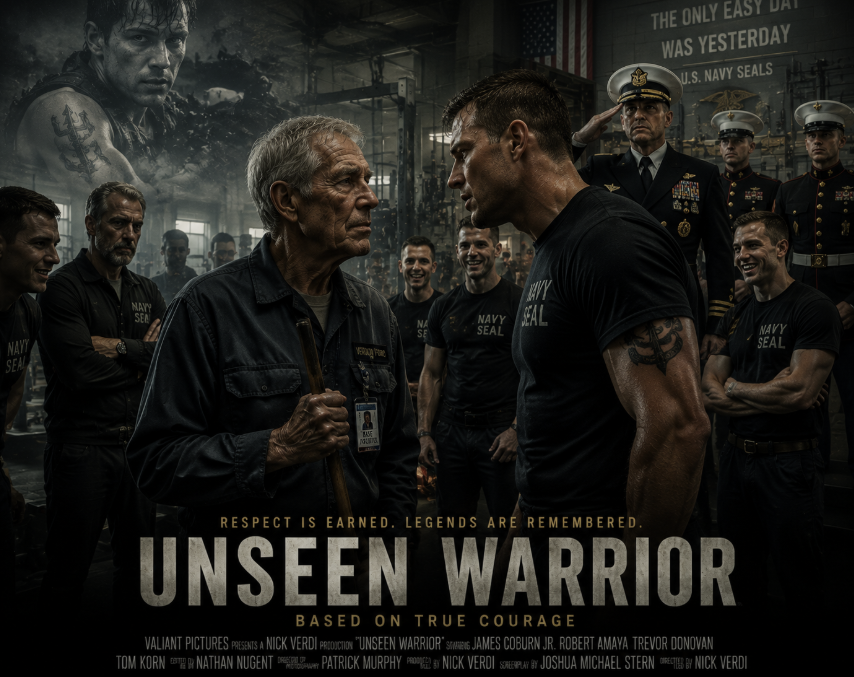
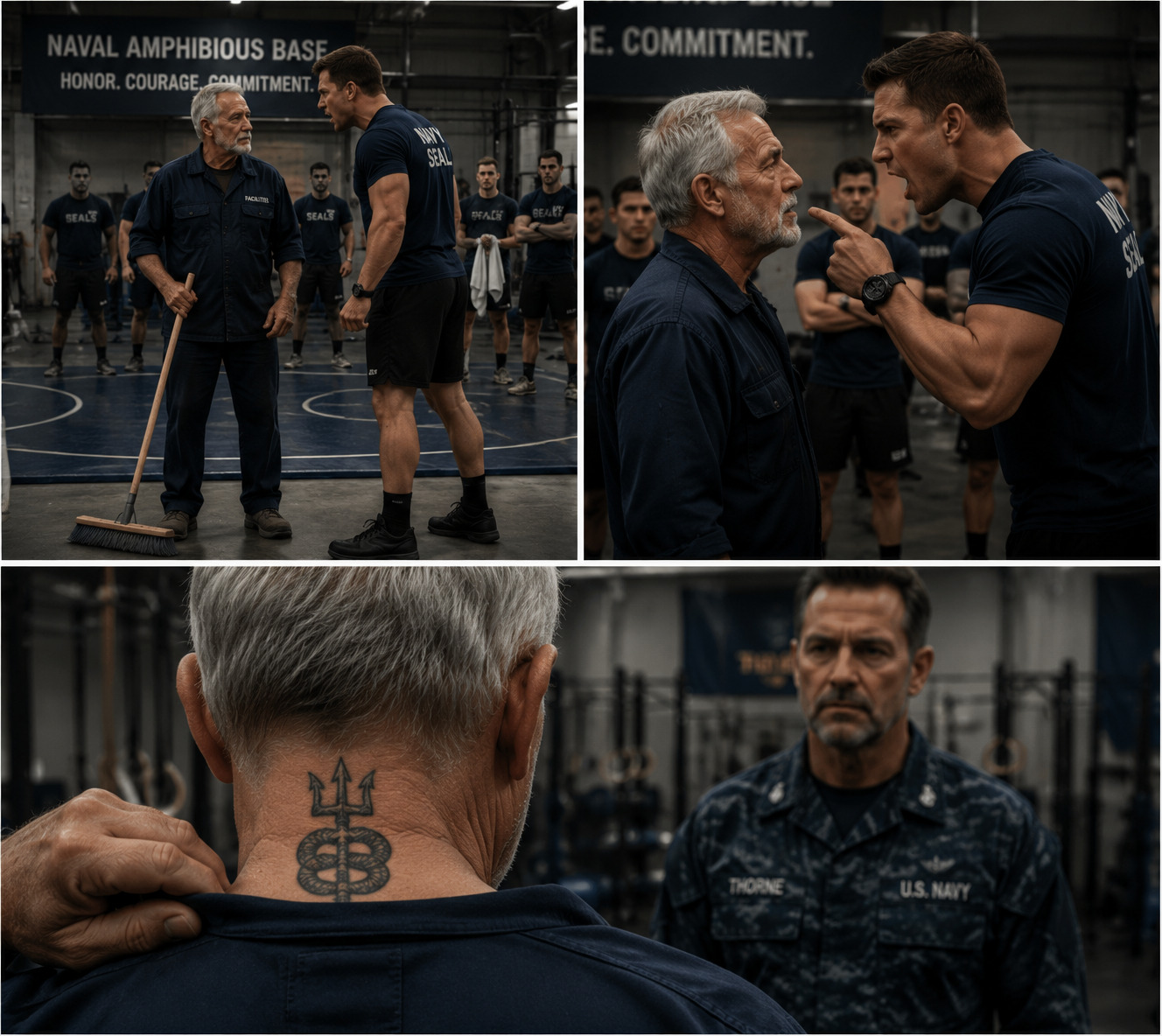
Petty Officer First Class Ryan Mercer stood beside the squat rack, bare arms powdered with chalk, sweat shining across the hard planes of his shoulders. At twenty-nine, Mercer looked like the kind of man recruiting posters were designed around—six feet two, broad-backed, sharp-jawed, with a fresh gold Trident pinned over his heart and the permanent tension of someone waiting for the world to doubt him.
At his feet lay a yellow mop bucket tipped on its side.
Gray water spread across the rubber flooring.
And holding the bent handle of the mop was an old janitor named Elias Kane.
Elias was seventy-two, lean rather than frail, with close-cropped silver hair and a narrow face weathered by salt, sun, and years no one on the base had bothered to ask about. His navy-blue maintenance shirt hung loosely from his shoulders. A ring of keys rested against his hip. His left knee did not fully straighten when he walked.
Mercer pointed at the spreading water.
“You trying to get somebody killed?”
Elias looked down at the puddle, then at the barbell Mercer had dropped outside the marked lifting platform.
“I was cleaning around your equipment,” he said.
His voice was low. Calm. Almost gentle.
That calm irritated Mercer more than an apology would have.
“You were in my lane.”
The other SEALs had stopped lifting. A few exchanged glances. Most said nothing.
They knew Mercer’s moods.
That morning’s selection-prep session had gone badly. He had missed a target time during the pool evolution, then watched Lieutenant Graham Holt write something on a clipboard without expression. Mercer had carried the humiliation into the gym like a live grenade.
Now Elias had stepped within reach of the blast.
Elias set the mop upright.
“The safety lane needs to stay clear.”
Mercer laughed once.
There was no humor in it.
“You giving safety lectures now?”
A few younger sailors smiled carefully, unsure whether they were expected to join in.
Elias did not answer.
Mercer stepped closer.
The old man smelled faintly of industrial soap, coffee, and the rain that had blown in from the Pacific before dawn.
“You know what we do here?” Mercer asked.
Elias glanced around the gym.
Racks of iron. Climbing ropes. Sandbags. Pull-up bars polished dark by thousands of hands. Framed photographs of fallen operators lined the far wall beneath the words:
THE ONLY EASY DAY WAS YESTERDAY.
“I have a general idea,” Elias said.
A snort came from somewhere near the dumbbell rack.
Mercer’s eyes narrowed.
“That supposed to be funny?”
“No.”
“Because this isn’t a retirement center. Men train here to carry other men out of bad places.”
Elias’s fingers tightened once around the mop handle.
It was a small movement.
No one noticed.
No one except Chief Nolan Avery, who stood near the rowing machines with a towel across his shoulders.
Avery had been in the Teams for nineteen years. He had learned to recognize the movements people made when a sentence found an old wound.
“Mercer,” Avery said.
One word.
A warning.
Mercer ignored him.
He looked Elias up and down, taking in the worn work boots, the faded shirt, the slight bend in the knee.
“People like you need to understand something,” Mercer said. “When we’re training, you stay out of the way.”
Elias looked at the water spreading toward an electrical outlet.
“Then let me finish cleaning it.”
He bent to lift the bucket.
Mercer caught the mop handle and shoved it aside.
The movement was not strong enough to knock Elias down.
It was strong enough to make him stumble.
His right hand struck the squat rack. His shoulder twisted. The collar of his maintenance shirt pulled sideways.
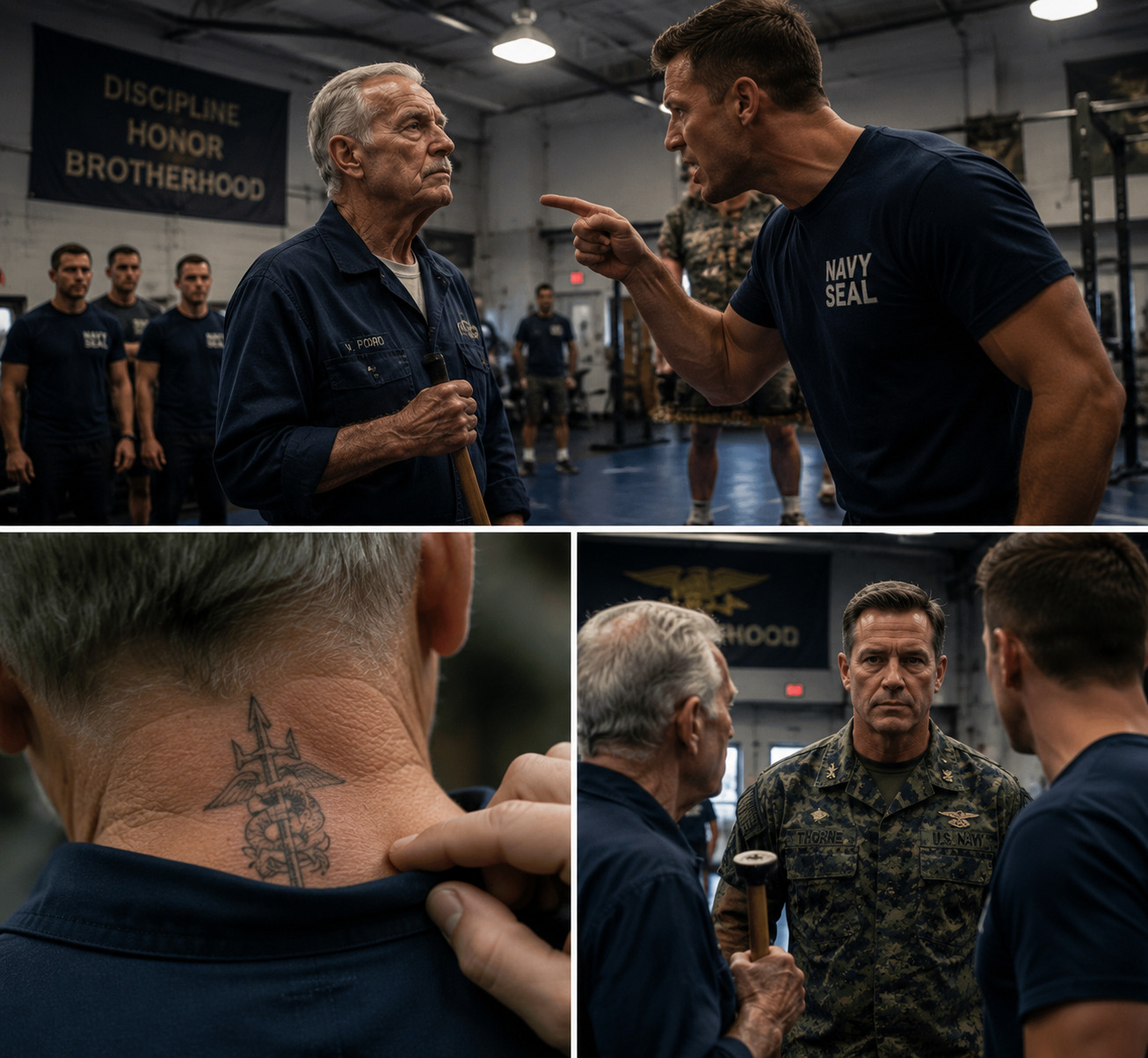
For one second, a patch of faded ink appeared beneath the left side of his neck.
A dark, weathered shape.
Then the fabric slipped back into place.
No one in the gym understood what they had seen.
Not yet.
Mercer leaned closer.
“You deaf, old man?”
The door behind him opened.
The room changed before anyone spoke.
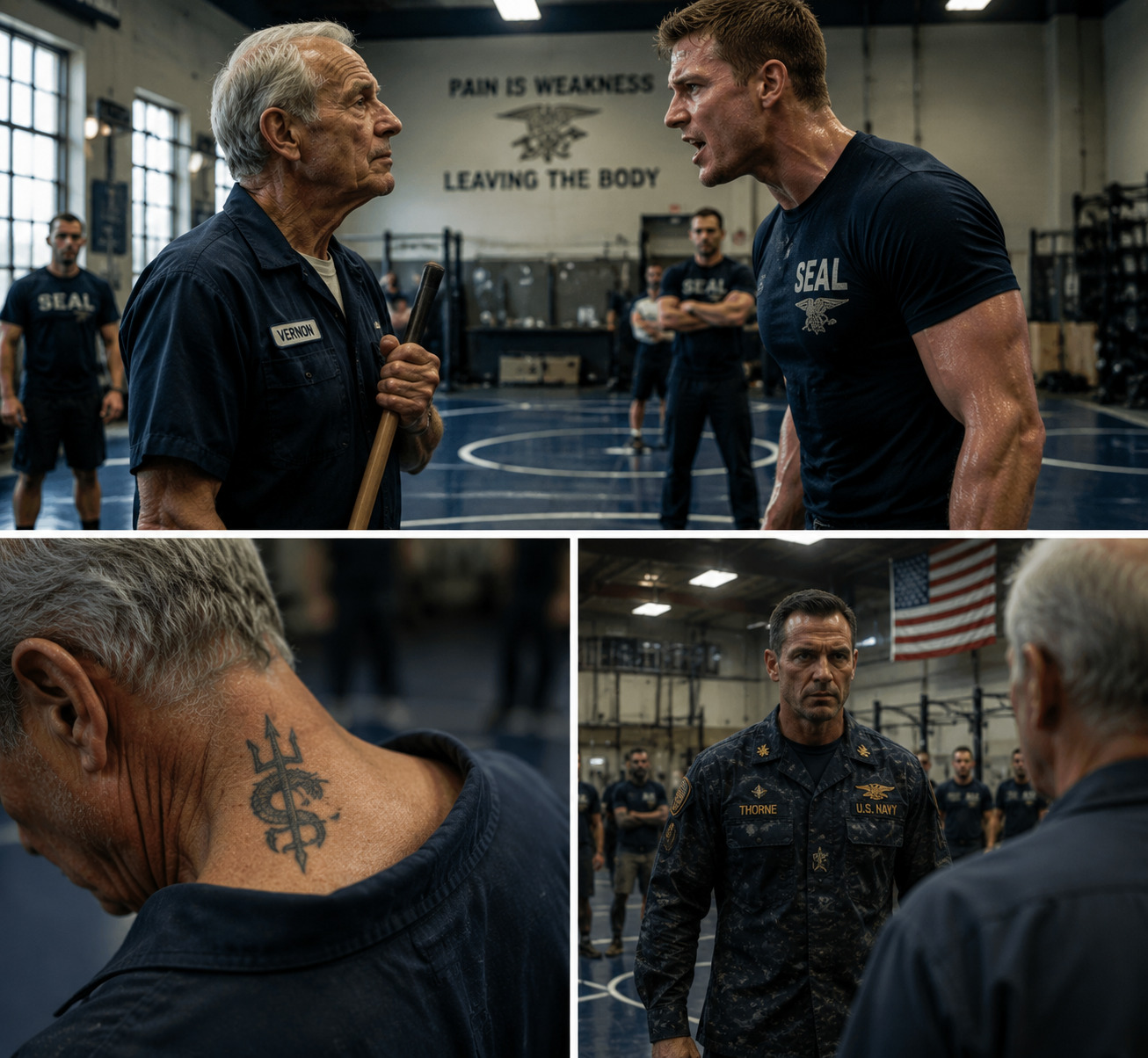
Rear Admiral Daniel Voss entered with two visiting officers and the base command master chief. He wore the Navy Working Uniform, sleeves crisp, silver stars subdued against the camouflage. At fifty-eight, Voss had a face that revealed almost nothing and eyes that missed almost nothing.
The admiral had come to inspect the renovated training facility.
Instead, he found one of his SEALs gripping a mop handle while an elderly janitor steadied himself against a rack.
Voss stopped.
Mercer released the mop so quickly it clattered to the floor.
“Attention on deck!”
Bodies snapped upright.
Elias did not move.
His shirt collar was still pulled slightly open.
Admiral Voss looked at him.
Then he looked again.
The color left his face.
For several seconds, the only sound in the gym was rain tapping against the high windows.
Voss took one slow step forward.
His eyes were fixed on the fragment of tattoo visible above Elias’s collar.
A black trident.
But not the modern insignia every man in the room wore with pride.
This one was narrower. Rougher. Hand-inked. The three points curved upward around a small number almost erased by time.
Voss stopped three feet from the janitor.
When he spoke, his voice had changed.
“Mr. Kane?”
Elias’s expression tightened.
Not fear.
Recognition.
Voss’s gaze lowered to the old man’s damaged knee.
Then to his hands.
Then back to the tattoo.
The admiral came to attention.
Every operator in the room stared as a two-star commander raised his right hand and saluted the man holding the mop.
“Chief Kane,” Voss said quietly. “I thought you were dead.”
And suddenly Ryan Mercer understood that whatever had happened in the gym was no longer a small mistake.
It was about to become the worst moment of his career.
1
No one returned the salute.
No one knew whether they were supposed to.
Elias looked at Admiral Voss for a long moment, his face giving away nothing. Then he set the mop against the wall.
“You don’t have to do that, Daniel.”
The use of the admiral’s first name landed harder than the dropped weight plate.
Voss lowered his hand.
“I do.”
Mercer stood rigid beside the squat rack. Sweat cooled across his back.
He had heard admirals addressed as “sir,” “Admiral,” and once, during a closed briefing, as “Commander.” He had never heard a janitor call one Daniel.
The visiting officers looked from Elias to Voss.
Command Master Chief Larkin’s jaw had gone still.
Chief Avery slowly removed the towel from his shoulders.
Voss looked at the overturned bucket and the water spreading across the floor.
“What happened?”
Elias reached for the bucket.
“Nothing worth interrupting an inspection.”
Voss’s eyes moved to Mercer.
“Petty Officer?”
Mercer swallowed.
“Sir, the custodian entered an active training area. There was a safety concern.”
Avery’s head turned toward him.
Custodian.
Not Mr. Kane.
Not the old man.
Not even the janitor.
The word was an attempt to reduce Elias to a job title small enough for Mercer to survive.
Voss studied the room.
“Did Mr. Kane enter your training area, Chief Avery?”
Avery looked at Elias.
The old man gave the faintest shake of his head.
It was not a plea.
It was permission to let the matter die.
Avery had spent too many years burying good men to mistake silence for peace.
“The safety lane was marked for cleaning at zero seven hundred,” he said. “The posted schedule was visible. Petty Officer Mercer moved his bar outside the lifting platform.”
Mercer’s face hardened.
Voss turned to him.
“Did you touch Mr. Kane?”
Mercer hesitated.
That hesitation answered the question.
“His equipment was obstructing—”
“Did you touch him?”
“Yes, sir.”
“How?”
Mercer’s lips parted.
Elias stepped in.
“He moved the mop.”
Avery looked at the old man.
Elias met his eyes.
There was warning in that look now.
Not for Mercer.
For Avery.
Do not turn this into something larger.
The warning came too late.
A young logistics specialist near the doorway lifted her hand.
Everyone looked at her.
She was barely twenty-two. Her name tape read PARK.
“Sir,” she said, voice trembling, “Petty Officer Mercer shoved him.”
Mercer turned toward her.
That was the second mistake everyone would remember.
Not the shove.
The look.
It lasted less than a second, but it carried a threat sharpened by rank, reputation, and belonging.
Park almost lowered her eyes.
Then Elias spoke.
“Keep looking forward, sailor.”
His voice was soft.
Park straightened.
Mercer saw the admiral notice
Voss’s expression remained controlled, but a muscle moved near his temple.
“Petty Officer Mercer,” he said, “you will report to my conference room at thirteen hundred. Dress uniform.”
“Yes, sir.”
“You will not contact Specialist Park before then.”
Mercer’s nostrils flared.
“Yes, sir.”
Voss turned back to Elias.
“May we speak privately?”
Elias glanced toward the puddle.
“I’ve got a floor to finish.”
Command Master Chief Larkin bent down and lifted the bucket.
“Not anymore, Chief.”
Elias looked at him.
Larkin was a decorated operator with thirty-two years of service. He had stood beside flag-draped coffins without flinching. Now he held a dirty mop bucket as if it were ceremonial equipment.
Elias exhaled through his nose.
“I stopped being a chief a long time ago.”
“No,” Voss said. “You stopped wearing the uniform.”
The gym had never been so quiet.
Elias’s eyes moved to the photographs on the far wall.
There were thirty-six men in those frames.
He knew eleven of their fathers.
He had trained four.
One had been his son.
“Different thing,” he said.
He pulled his collar closed, hiding the old tattoo.
Then he limped toward the door.
As he passed Mercer, he stopped.
The young SEAL’s shoulders were squared, but the confidence had gone out of his face.
Elias did not threaten him.
He did not insult him.
He simply leaned down, righted the fallen weight plate, and rolled it back inside the marked platform.
“Details matter,” he said.
Then he walked out beside the admiral.
Behind him, Mercer stared at the wet floor and realized that every man in the room had stepped away from him.
Elias refused the conference room.
He refused the admiral’s office.
He refused coffee from the aide who hurried ahead of them.
Instead, he led Voss across the base toward a maintenance shed behind the old combat swimmer pool.
The rain had thinned to cold mist. Aircraft engines rumbled beyond the hangars. Somewhere near the waterfront, metal struck metal in a steady rhythm as deck crews prepared a training craft.
Elias unlocked the shed.
Inside were shelves of cleaning chemicals, boxes of filters, spare light fixtures, and a wooden chair polished by years of use. A small coffee maker sat on a filing cabinet beside a chipped ceramic mug.
Voss closed the door behind them.
For several seconds, neither man spoke.
Then Voss said, “Why didn’t you tell me?”
Elias poured yesterday’s coffee into the sink.
“About the job?”
“About being here.”
“You would have tried to stop it.”
“Yes.”
“That’s why.”
Voss removed his cover and set it on a shelf.
Without the formal posture, he looked older.
“You disappeared after the funeral.”
“I retired.”
“You vanished.”
Elias rinsed the pot.
“There’s a difference.”
“Not to the people who spent two years trying to find you.”
Elias turned on the coffee maker.
The machine coughed and began to drip.
Voss looked around the shed.
“You clean the training buildings?”
“And the pool deck. Some offices.”
“Why?”
“Because they needed someone.”
“That is not an answer.”
“It’s the only one I have.”
Voss stepped closer.
“You built half the training doctrine those men use. You ran underwater demolition evolutions before Mercer’s father graduated high school. You advised the first West Coast counterterror teams. There are men teaching your methods right now who don’t know your name.”
“That was intentional.”
“Why?”
Elias’s hand stopped on the coffee pot.
For the first time, Voss saw something break through the old man’s composure.
Not anger.
Weariness.
“My name got my son killed.”
The words sat between them.
Outside, rain tapped the sheet-metal roof.
Voss lowered his voice.
“Tom was killed by an improvised explosive device.”
“Tom volunteered for a mission he wasn’t ready for because he thought he had to earn the name Kane.”
“That wasn’t your fault.”
Elias poured coffee into the chipped mug.
“No father gets to decide that for himself.”
Voss looked at the limp Elias could no longer hide.
“And your knee?”
“Still attached.”
“I read the sealed report.”
Elias’s eyes lifted.
“Then you know enough.”
“I know you went back into a burning aircraft three times.”
“Twice.”
“The report says three.”
“The third time, the fire came to me.”
Voss almost smiled.
It vanished before reaching his eyes.
“Seven men survived because of you.”
“One didn’t.”
“There is always one with you, isn’t there?”
Elias stared into the coffee.
Voss regretted the words immediately.
The one who did not come home.
The one order that arrived too late.
The one face in the final photograph.
The one son lowered beneath the earth while officers spoke about honor and sacrifice.
Elias set the mug down.
“Why are you really here, Daniel?”
Voss looked toward the maintenance shed door.
“Because Ryan Mercer is scheduled to lead the next advanced maritime assault course.”
Elias said nothing.
“He’s good,” Voss continued. “Fast. Aggressive. Technically gifted. His evaluations are exceptional.”
“But?”
“He thinks skill is proof of character.”
Elias picked up the mug.
“Most young men do.”
“Not like this.”
“Then remove him.”
“I may.”
“That should be simple for an admiral.”
“It would be.”
Elias studied him.
“And you don’t want simple.”
“I want to know whether he can be corrected.”
Elias took a sip of coffee and grimaced at the taste.
“You want me to decide.”
“I want you to observe the course.”
“No.”
“Elias—”
“No.”
“Mercer humiliated you in front of his unit.”
“That is precisely why I shouldn’t judge him.”
Voss stepped nearer.
“You think this is about punishment?”
“I think you came into my shed carrying a problem and hoping an old man would make it disappear.”
“I came because the man Mercer disrespected happens to understand better than anyone what arrogance costs in this community.”
Elias’s eyes sharpened.
Voss knew he had touched the hidden nerve.
Arrogance did not merely bruise feelings in their world.
It sank boats.
It broke formations.
It turned incomplete information into body bags.
Still, Elias shook his head.
“I’m done shaping warriors.”
“You clean their floors.”
“That’s different.”
“Is it?”
Voss looked at the shelves, the carefully labeled supplies, the spare bolts sorted by size.
“You walk through their spaces before they wake up. You see what they leave behind. You know who returns equipment, who hides damage, who trains alone after everyone leaves. You have been evaluating them every day.”
Elias’s expression closed.
Voss picked up his cover.
“The course begins tomorrow at zero four thirty.”
“I said no.”
“I heard you.”
Voss opened the door.
Cold air pushed into the shed.
At the threshold, he looked back.
“For what it’s worth, Mercer requested the leadership slot because his father is dying.”
Elias did not move.
“Lung cancer,” Voss said. “Former boatswain’s mate. Mercer believes becoming the youngest assault-course leader in the command will prove the family produced something important before his father goes.”
“That explains him.”
“It does not excuse him.”
“No.”
Voss placed his cover on his head.
“But it makes the question harder,” he said. “Those are usually the questions you were best at.”
Then he stepped into the rain.
Elias stood alone in the maintenance shed, listening to the coffee maker click itself off.
On the wall beside him hung tomorrow’s cleaning schedule.
Advanced Maritime Assault Facility — 0430.
He stared at it for a long time.
Then he took out a pencil and drew a line through the assignment.
Above it, in small block letters, he wrote:
OBSERVE.
2
At thirteen hundred, Ryan Mercer stood at attention in Admiral Voss’s conference room wearing his dress blues.
The uniform fit perfectly.
His career no longer did.
Voss sat at the head of the table. Command Master Chief Larkin stood near the window. Chief Avery occupied the chair to Mercer’s left.
Specialist Park was not present.
Mercer had expected a formal reprimand.
Instead, Voss slid a tablet across the table.
Security footage filled the screen.
There was no audio.
There did not need to be.
Mercer watched himself drop the weight plate outside the marked zone. He watched Elias angle the mop around him. He watched his own hand seize the handle.
Then came the shove.
On video, it looked smaller than Mercer remembered.
That made it worse.
There was no confusion. No dangerous movement. No accident.
Just a strong man deciding a weaker-looking man could be moved.
Voss froze the image.
Mercer’s palm was against Elias’s shoulder.
“Describe what you see,” the admiral said.
Mercer’s throat tightened.
“A lapse in judgment, sir.”
“That is a conclusion. Describe the image.”
Mercer stared at the screen.
“My hand is on the civilian employee.”
“Why?”
“He was obstructing the area.”
Chief Avery leaned back.
Voss did not blink.
“Try again.”
Mercer felt heat climb his neck.
“I was frustrated.”
“Why?”
“I had a poor training evolution.”
“And?”
Mercer’s jaw shifted.
“My father received a terminal prognosis last week.”
The room remained silent.
He hated them for that silence.
He had offered pain, and no one rushed to comfort him.
Voss folded his hands.
“Did Mr. Kane give your father cancer?”
“No, sir.”
“Did Specialist Park cause your poor performance?”
“No, sir.”
“Then why did you look at her as if she had betrayed you?”
Mercer glanced toward Avery.
The chief’s face was unreadable.
“I don’t know, sir.”
“Yes, you do.”
Mercer’s fingers curled along the seams of his trousers.
He had grown up in a narrow house outside Bakersfield with a father who believed respect could be beaten into a boy and failure could be shouted out of him. By twelve, Ryan knew how to change a tire, throw a punch, and hide a bruise beneath a football jersey.
By seventeen, he knew his father bragged about him to strangers.
By twenty-nine, he still could not tell whether the old man loved him or merely needed him to win.
“I thought she was making me look weak,” Mercer said.
Voss nodded once.
It was the first honest thing Mercer had said.
“Your concern is not weakness,” the admiral replied. “Your concern is being seen accurately.”
Mercer’s eyes lifted.
The words struck deep enough to hurt.
Voss continued.
“Your assault-course leadership appointment is suspended.”
Mercer’s breath stopped.
“Sir—”
“You will remain enrolled as a trainee pending review.”
“Admiral, with respect, I earned that slot.”
“You earned consideration for that slot.”
“My evaluations—”
“Measure your ability to perform tasks.”
Voss tapped the frozen image on the screen.
“This measures what you do with power when you believe no one important is watching.”
Mercer looked at Elias on the monitor.
A maintenance shirt.
A bent knee.
A mop.
He suddenly understood the shape of the trap around him.
“If he were an ordinary janitor,” Mercer said, “would this meeting still be happening?”
Avery’s head turned.
Larkin’s eyes narrowed.
Voss remained still.
Mercer knew he should stop.
He could not.
“Sir, I was wrong to touch him. I accept that. But everyone’s reacting because of who he used to be.”
Voss studied him for several seconds.
Then he leaned forward.
“No, Petty Officer. Everyone is reacting because you just described a man who cleans your waste, repairs your drains, and keeps your training spaces safe as ordinary—as if dignity must be earned through classified service.”
Mercer’s face tightened.
“You do not need to know a man’s history before treating him like a man.”
The room went quiet.
Voss slid a folder across the table.
“You will report tomorrow at zero four hundred to Building Seven.”
Mercer opened it.
The first page bore the title:
FACILITY SANITATION AND SAFETY ASSIGNMENT.
He stared at it.
“Sir?”
“For fourteen days, outside training hours, you will work under Mr. Kane.”
Mercer’s ears rang.
Avery looked at the admiral, surprised.
Mercer’s shame turned hot and immediate.
“You want me cleaning toilets.”
“I want you following lawful instructions from a man you decided was beneath you.”
“Sir, that will become public.”
Voss’s gaze did not move.
“It became public when you performed it in front of twenty witnesses.”
Mercer closed the folder.
His face had gone pale.
“Will this appear in my permanent record?”
“That depends on what happens next.”
Mercer looked down at the assignment.
“What happens next?”
Voss’s expression revealed nothing.
“That is no longer my decision.”
Elias was repairing a broken locker hinge when Mercer found him.
Building Seven smelled of bleach, wet canvas, and old concrete. Fluorescent lights hummed overhead. The corridor walls were covered with decades of paint, each new layer failing to hide the scars beneath.
Mercer stood in the doorway wearing blue coveralls from base maintenance.
The name patch had been removed.
Elias glanced at the wall clock.
3:58 a.m.
“You’re early.”
“Two minutes.”
“That qualifies.”
Mercer looked at the tool cart.
“Where do we start?”
Elias pointed to a pair of gloves.
“Drain traps in the west showers.”
Mercer’s mouth tightened.
“I’m scheduled for maritime drills at zero six.”
“Then you have one hour and fifty-seven minutes.”
The showers were clogged with hair, sand, tape, and the gray residue of men who trained until their skin opened.
Mercer knelt on cold tile and unscrewed the first drain cap.
The smell rose immediately.
He gagged.
Elias handed him a bucket.
“No medal for breathing through your mouth.”
Mercer looked up.
Was that a joke?
Elias had already moved away.
For the next ninety minutes, the old man barely spoke.
He showed Mercer how to remove the traps without stripping the threads. How to inspect the seals. How to recognize the dark, oily residue that meant a pipe farther down was beginning to fail.
Mercer worked in silence.
At 5:31, Elias looked at his watch.
“Clean your tools.”
“I have training.”
“Dirty tools become damaged tools.”
“I’ll do it later.”
Elias leaned against the tiled wall.
“What happens if your weapon jams because the last man said that?”
Mercer stared at him.
“This isn’t a weapon.”
“No. It’s a wrench.”
Elias nodded toward the tool.
“It still belongs to the next man.”
Mercer scrubbed the wrench.
At 5:43, he sprinted toward the waterfront.
He arrived at formation with seventeen seconds to spare.
Lieutenant Holt glanced at his wet sleeves and said nothing.
The men beside him did.
“Smell something, Mercer?”
“New cologne?”
“Eau de urinal cake.”
Mercer fixed his eyes forward.
Across the yard, Elias pushed his cart toward the pool building without looking back.
The humiliation spread by lunchtime.
By dinner, someone had taped a miniature broom to Mercer’s locker.
By evening, a photograph of him carrying trash bags had circulated through three units.
No caption was needed.
Mercer tore the broom down and snapped it in half.
Chief Avery watched from the opposite end of the locker room.
“You planning to fight the whole base?”
Mercer shoved the broken pieces into a bin.
“I made one mistake.”
“No. You made several.”
“I touched the janitor.”
“You blamed the lane. Then the cleaning schedule. Then your father. Then Park. Then everyone who reacted.”
Mercer turned.
“What do you want from me, Chief?”
Avery stepped closer.
“For you to stop confusing humiliation with accountability.”
Mercer’s laugh was bitter.
“Easy for you to say.”
“No. It isn’t.”
Avery unbuttoned the cuff of his right sleeve and pulled it back.
A long burn scar wrapped around his forearm.
“Second deployment,” he said. “I ignored a local mechanic who warned us the road surface had been disturbed. Thought he wanted money. Thought he was afraid. Thought I understood the area better because I had a rifle and he had grease under his nails.”
Mercer looked at the scar.
“Vehicle hit a pressure plate,” Avery said. “Driver lost both legs.”
The locker room had emptied around them.
Avery rolled down his sleeve.
“Embarrassment is cheap. Some lessons cost more.”
Mercer looked away.
Avery moved toward the door.
“Be grateful yours came with a mop.”
3
For six mornings, Mercer worked beside Elias.
He cleaned shower drains, replaced cracked tiles, scrubbed blood from the combatives room, and learned that the gym floor required a different disinfectant than the pool deck because the wrong chemical made rubber slick under wet boots.
Elias never mentioned the shove.
That made it impossible for Mercer to apologize casually and move on.
The old man worked with quiet precision. He inspected every hinge twice. He returned screws to labeled compartments. He knew which ceiling panel rattled when the wind came from the west and which sauna bench concealed a split that could cut a man’s hand.
The base began to look different through Mercer’s eyes.
Not as a collection of heroic spaces, but as an organism kept alive by people no one saluted.
At 4:20 on the seventh morning, Elias found Mercer standing before the memorial wall in Building Seven.
A framed photograph showed a young SEAL with Elias’s eyes and a wider smile.
LIEUTENANT THOMAS KANE
1981–2012
Mercer heard the cart wheels behind him.
He turned.
Elias’s gaze settled on the photograph.
“Your son?”
“Yes.”
Mercer looked back at the image.
“He looks like you.”
“No. He looked like his mother. That’s why people trusted him.”
Mercer almost smiled.
It faded when he saw the date.
“I’m sorry.”
Elias moved toward the supply closet.
“So am I.”
Mercer followed.
“How did he die?”
The cart stopped.
For the first time all week, Elias looked angry.
Not visibly, not in the way Mercer understood anger. His voice did not rise. His fists did not close.
His stillness sharpened.
“You don’t earn a man’s dead by asking about them.”
Mercer’s face warmed.
“I didn’t mean—”
“I know what you meant.”
Elias opened the closet.
“You saw a photograph. You felt entitled to the story.”
Mercer stood in the corridor.
The rebuke struck with the clean force of a blade.
Elias removed two boxes of filters.
Then he paused.
“My son died because a team leader changed the extraction route without telling air support.”
Mercer looked up.
“The new route seemed faster,” Elias said. “It also crossed a valley the reconnaissance officer had marked unstable. The leader knew that. He decided the warning was overly cautious.”
“What happened to him?”
“The team leader?”
Mercer nodded.
“He survived.”
There was no hatred in Elias’s voice.
That was worse.
“He came to the funeral,” Elias continued. “Stood ten feet from my wife and told me Tom had died doing what he loved.”
Mercer’s eyes dropped.
“What did you say?”
“I asked whether he had read the route assessment.”
“And?”
“He had.”
Mercer waited.
Elias placed the filters on the cart.
“That was the moment his career ended. Not when I reported him. Not when the investigation concluded. It ended when he looked at my son’s coffin and realized the warning had come from someone he considered too junior to challenge him.”
Mercer stared at the floor.
Elias pushed the cart forward.
“Men rarely collapse under the weight of one mistake,” he said. “They collapse under all the excuses they stack on top of it.”
The words followed Mercer through the rest of the morning.
At zero six, the advanced maritime assault course began its live evaluation.
The objective was straightforward on paper: approach a mock coastal facility by rigid-hull inflatable boat, insert a team through a submerged access channel, secure a target room, and extract with a simulated casualty.
The Pacific made nothing straightforward.
Wind drove whitecaps across the training basin. Rain blurred the floodlights. The water temperature hovered just above fifty degrees.
Mercer’s team boarded the boats.
Lieutenant Holt assigned leadership to Petty Officer Cole Bennett, a competent operator with less raw ability than Mercer and far better judgment.
Mercer hated the decision.
He hated that the others knew he hated it.
But he followed orders.
The first phase went cleanly.
The second did not.
During the submerged channel transit, Bennett’s team encountered a jammed underwater gate. The training staff had designed the obstruction to test alternate-route planning.
Bennett signaled a withdrawal.
Mercer saw another option.
A narrow maintenance gap ran beneath the gate frame. It was unmarked, difficult, but passable for a diver without a large air rig.
He caught Bennett’s arm and pointed.
Bennett shook his head.
Mercer signaled again.
FASTER.
Bennett responded:
NO. WITHDRAW.
Mercer’s chest tightened.
He could already imagine Holt’s evaluation.
Slow adaptation. Failed penetration. Missed objective.
His father’s voice rose from memory.
You either find a way through, or you admit you’re not the man they thought you were.
Mercer turned toward the maintenance gap.
Bennett grabbed his fin.
Mercer kicked free.
Then the lights went out.
The underwater channel vanished into blackness.
Mercer felt the current change.
A heavy vibration moved through the gate.
Somewhere above, an emergency alarm began to pulse.
This was not part of the scenario.
Mercer reached for the frame.
The gate shifted downward.
His air hose snagged.
He pulled once.
It held.
He pulled again.
The hose tightened around a steel bracket.
Through the darkness, Bennett’s hand found his shoulder.
Mercer shoved it away and reached for the trapped line.
The gate dropped another inch.
A steel edge pressed across Mercer’s tank.
His breathing accelerated.
Air roared in his mask.
Too fast.
Bennett tried to cut the hose free, but the angle was wrong.
Mercer’s gauge flashed in the dark.
Pressure falling.
Above them, emergency lights flickered red.
Then another diver entered the channel from the far side.
The figure moved without wasted motion.
No modern rebreather.
No team markings.
Just a compact emergency tank and an old black mask.
The diver reached Mercer, examined the trap, and did something no current instructor had taught him.
He disconnected Mercer’s primary line at the valve, twisted the hose around itself, and used the pressure release to blow sediment from beneath the bracket.
The hose came free.
The gate dropped.
The old diver shoved Mercer through the maintenance gap half a second before the steel slammed into the frame.
Mercer hit the other side hard.
His mask filled with bubbles.
The diver caught him by the harness and pulled him upward through a vertical service shaft.
They broke the surface inside a dark equipment chamber.
Mercer tore off his mask.
Bennett surfaced beside him, gasping.
Red emergency lights rotated along the walls.
The old diver removed his mask.
Silver hair lay flat against his skull.
Water streamed down the scarred side of his neck, exposing the full tattoo beneath his collarbone.
The primitive trident.
The faded number.
And beneath it, three small letters:
UDT.
Mercer stared.
“Mr. Kane?”
Elias shoved the emergency tank toward him.
“Breathe slower.”
“What are you doing here?”
“Saving time.”
A siren howled overhead.
Bennett coughed.
“The gate malfunctioned.”
“No,” Elias said.
He looked toward the wall.
A deep grinding vibration moved through the concrete.
“The intake system did.”
He stood.
Water was rising around their knees.
“If the primary valve fails, this chamber floods in four minutes.”
Mercer looked toward the sealed access hatch.
It had no interior handle.
“How do we get out?”
Elias turned toward the submerged shaft.
“The way the first teams did.”
Then the emergency lights failed.
4
In total darkness, Elias’s voice became the only fixed point.
“Hands on the wall.”
Mercer pressed his palm against wet concrete.
“Bennett?”
“Here.”
“You injured?”
“Shoulder. Still works.”
Elias found the emergency tank by touch.
“One tank. Three men. The exit shaft runs twenty-eight feet, then turns east. There’s a manual grate at the end.”
Mercer heard the rising water slap against metal shelving.
“How do you know?”
“I built the shaft.”
Mercer thought he had misheard.
“You built it?”
“With men better than me.”
Elias’s hand found Mercer’s harness.
“You go first.”
“No. You know the route.”
“That’s why I go last.”
Mercer felt the mouthpiece pushed into his hand.
“Take three breaths. Pass it to Bennett. Move only when you feel my hand on your ankle.”
“Mr. Kane—”
“Three breaths.”
The water reached Mercer’s waist.
He placed the regulator between his teeth.
Air entered his lungs.
Cold. Mechanical. Precious.
He passed it to Bennett.
They submerged.
The shaft narrowed immediately.
Mercer pulled himself forward by the wall brackets. Behind him, Bennett’s fin struck his leg. Farther back, Elias moved through darkness without touching either wall.
The regulator returned.
Three breaths.
Pass it back.
The shaft turned.
Mercer’s shoulder scraped concrete.
His chest tightened.
The darkness pressed against his mask with physical weight.
He imagined the gate closing behind them. He imagined running out of air twenty feet from daylight. He imagined his father receiving the call and turning Mercer’s death into one final story about toughness.
A hand closed around his ankle.
Move.
Mercer pulled forward.
His helmet struck steel.
The grate.
He found the latch.
It did not move.
He pulled harder.
Nothing.
The regulator arrived.
He took two breaths and passed it back.
Bennett reached beside him, searching for the release.
There was none.
Mercer kicked the grate.
Steel shuddered.
Did not open.
Behind them, Elias took the regulator.
Mercer felt movement at his side.
The old man squeezed past in a space barely wide enough for one.
Elias placed Mercer’s hand against a recessed bolt.
Then against a second.
Two points.
Twist together.
Mercer understood.
He and Bennett braced their feet against opposite walls. Each gripped a bolt. They turned.
The mechanism resisted.
Mercer’s arms shook.
His lungs began to burn.
He remembered the wrench in the shower room.
Dirty tools become damaged tools.
He adjusted his grip.
Not force.
Alignment.
The first bolt shifted.
The second followed.
The grate swung outward.
Gray daylight flooded the water.
Mercer kicked through and surfaced in the open training basin.
Rain struck his face.
Bennett emerged beside him.
Mercer turned back.
No Elias.
He inhaled once and dove.
The old man was still inside the shaft.
His damaged knee had become trapped between the grate hinge and the wall.
Mercer reached him.
Elias shoved at his chest.
Go.
Mercer shook his head.
He pulled at the trapped leg.
It would not move.
Elias’s face remained unnervingly calm behind the mask.
He pointed to the hinge.
Mercer wedged both hands beneath it and lifted.
Pain tore through his lower back.
The hinge shifted less than an inch.
Not enough.
Bennett appeared beside him.
Together, they lifted.
Elias pulled his knee free.
They rose toward the surface.
Halfway up, Elias went limp.
Mercer caught him.
The old man’s regulator slipped from his mouth.
Mercer held it in place and kicked upward until his legs felt detached from his body.
They broke the surface beside the concrete wall.
Rescue personnel ran along the edge.
Hands reached down.
Mercer refused to release Elias until three corpsmen had him on the deck.
The old man’s face was gray.
No breath.
No movement.
A corpsman began compressions.
Mercer knelt in the rain, still wearing his mask around his neck.
He watched Elias’s chest collapse beneath each push.
Once.
Twice.
Three times.
The whole training basin seemed to narrow around the old man’s motionless body.
“Come on,” Mercer whispered.
A corpsman sealed a bag valve over Elias’s mouth.
Air entered his lungs.
Nothing.
Mercer moved closer.
“Come on, Chief.”
The title escaped before he could stop it.
Elias coughed.
Water spilled from his mouth.
The corpsmen rolled him onto his side.
He dragged in one ragged breath.
Then another.
Mercer bowed his head.
His hands shook violently.
Elias opened one eye.
“Your route selection,” he rasped, “was terrible.”
A sound came out of Mercer.
Half laugh.
Half sob.
Around them, no one smiled.
Admiral Voss stood beneath the control tower awning, rain blowing across his uniform.
He had watched the entire rescue.
So had Chief Avery.
So had Specialist Park.
So had thirty operators who had once laughed at a broom taped to Mercer’s locker.
As the corpsmen lifted Elias onto a stretcher, his maintenance shirt tore further at the collar.
The tattoo was fully visible now.
The old UDT trident surrounded by a ring of small notches.
Avery stepped closer.
He counted them.
His expression changed.
“Admiral,” he said.
Voss already knew.
Each notch represented a recovered man.
Not a confirmed kill.
A life brought home.
There were nineteen.
5
The base hospital kept Elias overnight.
He hated every minute of it.
He objected to the gown, the heart monitor, the blood-pressure cuff, and the nurse who called him “young man” while tightening it around his arm.
At 2100, Mercer stood outside his room holding a folded maintenance shirt.
He had washed it himself.
The stain around the collar had not come out.
Elias saw him through the open door.
“You planning to enter?”
Mercer stepped inside.
His right hand was bandaged from the gate mechanism. A bruise darkened his cheek.
He set the folded shirt on a chair.
“They said your knee needs surgery.”
“They’ve said that since 1987.”
Mercer remained standing.
Elias looked toward the second chair.
“Sit down before your posture becomes an emergency.”
Mercer sat.
For several seconds, neither spoke.
A television mounted in the corner showed a baseball game with the sound muted.
Finally, Mercer said, “Why were you at the course?”
“Admiral Voss asked me to observe.”
“Me?”
“The course.”
Mercer looked at him.
“You were observing me.”
“Among others.”
Mercer nodded slowly.
“Did he tell you about my father?”
“Yes.”
A muscle moved in Mercer’s jaw.
“He thinks it explains what I did.”
“No. He thinks it complicates what you did.”
Mercer looked down at his bandaged hand.
“I called him this afternoon.”
“Your father?”
“He asked about the leadership appointment.”
“What did you say?”
“That I lost it.”
Elias waited.
Mercer stared at the floor tiles.
“I almost told him the commander changed the schedule. Or that another guy had political support. I had the lie ready.”
“But?”
“I told him I shoved an old janitor.”
Elias’s eyebrow lifted.
“You made me sound fragile.”
Mercer gave a short, humorless laugh.
“He was quiet for a long time. Then he said, ‘Sounds like you finally met somebody who didn’t care who you thought you were.’”
“What did you say?”
“Nothing.”
Mercer leaned back.
“He used to hit me.”
Elias did not react visibly.
Mercer seemed grateful for that.
“Not every day,” he continued. “Not like the stories people tell when they want sympathy. He worked. He paid the bills. He taught me how to swim. Sat through every wrestling match.”
Mercer’s eyes stayed on the floor.
“But if I lost, he made me explain why in the garage. If the explanation sounded weak, he used his belt. Said pain helped memory.”
Elias looked toward the rain-blackened window.
“And did it?”
“It helped me remember to win.”
“That wasn’t my question.”
Mercer’s mouth tightened.
“No.”
The monitor beside Elias’s bed pulsed steadily.
Mercer rubbed his thumb along the edge of the bandage.
“When they gave me the Trident, he cried. First time I ever saw him do it. I thought…” He stopped.
Elias waited.
“I thought maybe I had finally become enough that he could stop being disappointed.”
Elias’s gaze settled on the young man’s face.
“Did he?”
“No.”
There it was.
The wound beneath the arrogance.
Not a monster.
A frightened boy who had built himself into a weapon and discovered weapons were only praised while useful.
Mercer leaned forward, elbows on his knees.
“When the gate jammed, Bennett ordered us back.”
“Yes.”
“I saw the maintenance gap.”
“Yes.”
“I thought I could save the evolution.”
“You thought you could save your image.”
Mercer closed his eyes.
“Yes.”
The word barely reached the air.
Elias looked at the gold Trident over Mercer’s heart.
“You know why the early teams distrusted men who wanted the insignia too much?”
Mercer shook his head.
“Because symbols are dangerous. A man starts by wearing one. Then he believes the symbol belongs to him. Eventually, he thinks everyone without it matters less.”
Elias touched the old tattoo on his neck.
“This meant we were responsible for one another. Not superior to anyone.”
Mercer looked at the faded ink.
“Nineteen marks.”
Elias’s hand dropped.
“Who told you?”
“Chief Avery.”
“He counts too much.”
“Were they all rescues?”
“Some were recoveries.”
Mercer understood the distinction.
His face changed.
“How did you get the tattoo?”
“A medic on a ship near Da Nang had a bottle of ink and no artistic ability.”
“The number?”
“Class number.”
“The Trident looks different.”
“It was different.”
Mercer hesitated.
“They said you helped design the modern training program.”
“Men say many things when an old fool survives long enough.”
“Admiral Voss saluted you.”
“Daniel has always been dramatic.”
Mercer almost smiled.
Then his expression turned serious.
“Why become a janitor?”
Elias looked at the folded shirt on the chair.
“After my wife died, the house became too quiet.”
“I’m sorry.”
“She would have hated you.”
Mercer blinked.
Elias continued.
“She disliked loud men with polished boots.”
A reluctant laugh escaped Mercer.
It surprised both of them.
Elias’s face softened.
“I came back because this place was the last place Tom was alive before deployment. At first, I thought being near it would make the grief smaller.”
“Did it?”
“No.”
“What did?”
Elias looked through the doorway where a night-shift corpsman pushed an empty wheelchair down the hall.
“Nothing makes grief smaller. Your life has to become larger around it.”
Mercer sat with that.
After a moment, he stood.
“I owe you an apology.”
“You owe several.”
“Yes.”
Mercer drew a breath.
“I used my position to humiliate you because I believed your work made you less important than me. When Park told the truth, I tried to frighten her. When I was confronted, I blamed everyone except myself.”
Elias watched him carefully.
“I was wrong,” Mercer said. “Not because of who you used to be. Because of who I chose to be.”
The room remained silent.
Mercer did not ask for forgiveness.
That was the first sign the apology might be real.
Elias nodded toward the folded shirt.
“You missed a stain.”
Mercer glanced at it.
“I washed it twice.”
“Then you used hot water first.”
“Yes.”
“Set the stain.”
Mercer exhaled.
“I’ll replace it.”
“No.”
“Why?”
Elias picked up the shirt.
The torn collar exposed the faint outline of old ink beneath his hospital gown.
“Some damage should stay visible.”
6
The investigation into the training-gate failure revealed a corroded intake actuator missed during two previous inspections.
The contractor blamed salt exposure.
Maintenance records showed the corrosion had been reported three months earlier by a civilian technician.
The warning had been downgraded because the actuator had passed a limited function test.
A familiar pattern emerged.
A warning from someone considered unimportant.
A decision made by someone eager to preserve a schedule.
A danger hidden beneath confidence.
Admiral Voss ordered the entire facility closed.
Then he scheduled an all-hands assembly.
Rumors spread across the base.
Some said Mercer would lose his Trident.
Others said Elias Kane would receive a medal.
A few claimed the old janitor had once killed thirty men with a diving knife, which would have amused Elias if he had heard it.
At 0900 on Friday, nearly eight hundred sailors, officers, civilian employees, and operators gathered inside Hangar Four.
Cold morning light poured through the high windows. Rows of folding chairs covered the concrete floor. The smell of hydraulic fluid lingered beneath fresh coffee.
A stage stood at the front beneath an American flag and the Naval Special Warfare insignia.
Mercer sat in the first row wearing dress blues.
Specialist Park sat four seats away.
She had not spoken to him since the gym.
Elias stood behind the stage curtain wearing his old maintenance uniform.
The torn collar had been neatly repaired.
Admiral Voss found him there.
“You could wear civilian clothes.”
“This is civilian clothing.”
“You know what I mean.”
“I usually do.”
Voss held a velvet presentation case.
Elias looked at it.
“No.”
“You haven’t opened it.”
“I know the shape.”
“It isn’t a decoration.”
“Then it’s probably worse.”
Voss handed him the case.
Inside rested a blackened metal object no larger than a man’s palm.
A broken section of the failed underwater gate.
Mounted across it was a narrow silver plate engraved with nineteen names.
Elias’s face went still.
“These are the men connected to the marks,” Voss said.
“You found all of them?”
“Eighteen.”
Elias’s thumb touched the final name.
THOMAS KANE.
Voss lowered his voice.
“The nineteenth was yours.”
Elias stared at the plate.
For years, he had considered his son the one man he failed to bring home.
The command had counted differently.
“You should not have done this,” he said.
“Probably.”
Elias closed the case.
“What are you planning?”
“A correction.”
Voss stepped toward the stage.
Elias caught his arm.
“Do not destroy Mercer to honor me.”
The admiral looked back.
“He placed lives at risk.”
“So did half the men we eventually trusted.”
“He threatened a junior sailor.”
“And she stood her ground. Let that matter.”
Voss studied him.
“You believe he can change?”
“I believe he has begun.”
“That isn’t the same thing.”
“No.”
Elias released his arm.
“But if you make humiliation the lesson, he will learn only to hide his failures better.”
Voss looked toward the curtain.
On the other side, the crowd quieted.
“What would you do?”
Elias handed him the velvet case.
“Make him tell the truth.”
Admiral Voss walked onto the stage.
The room came to attention.
He ordered them seated.
His speech lasted less than two minutes.
He did not begin with Elias.
He began with the gate.
He described the ignored maintenance warning, the failed actuator, and the decision to keep the facility operational.
Then he described the gym incident without naming Mercer.
“A command does not fail only when an operation collapses,” Voss said. “It fails each time a person believes rank, qualification, or reputation places him beyond correction.”
No one moved.
Voss looked across the rows.
“We praise decisive action. We should. But decisiveness without humility is simply speed moving toward disaster.”
He turned toward the first row.
“Petty Officer Mercer.”
Mercer stood.
“Come forward.”
A current passed through the hangar.
Mercer walked to the stage.
Every step echoed.
He stopped beside the podium.
For the first time, he saw Elias behind the curtain.
The old man gave him no signal.
No reassurance.
No rescue.
Voss stepped away from the microphone.
Mercer faced eight hundred people.
The crowd included men he admired, sailors he had mocked, officers who controlled his future, and civilian workers who emptied bins after he left.
His father was watching through a secure video link from a hospital room in California.
Mercer had requested it.
His mouth went dry.
He looked at Specialist Park.
Then at Elias.
Then at the gold Trident reflected faintly in the polished wood of the podium.
“My name is Petty Officer First Class Ryan Mercer,” he began.
His voice carried clearly through the hangar.
“Last week, I assaulted a civilian employee in the training gym.”
A murmur moved through the back rows.
Mercer continued.
“I told myself I had been distracted. I told myself the training area was unsafe. I told myself I was under pressure because my father is ill.”
He paused.
“All of those things were true.”
His hands tightened against the podium.
“None of them caused what I did.”
The hangar became still.
“I did it because I believed the person in front of me could not cost me anything.”
Elias watched from the shadows.
Mercer’s voice roughened.
“I believed his job made him powerless. I believed the witnesses would protect my reputation because I wore the same insignia they did.”
He turned toward Park.
“Specialist Park told the truth. I tried to silence her without saying a word.”
Park’s eyes shone, but she held his gaze.
“I am sorry.”
Mercer looked back at the crowd.
“Later, during a training emergency, I ignored a direct order because I was more afraid of looking unsuccessful than I was of making a dangerous choice.”
His father’s face appeared on a monitor near the side wall.
Thin. Pale. Oxygen tube beneath his nose.
Mercer saw him.
His voice faltered for half a second.
Then steadied.
“A man I had treated as invisible entered that water and saved my life.”
Behind the curtain, Elias lowered his eyes.
Mercer continued.
“But that is not why he deserved my respect.”
The words landed with greater force than any confession before them.
“He deserved it before I knew his name.”
Silence filled the hangar.
Not the tense silence of judgment.
The deeper silence of recognition.
Mercer stepped back from the podium.
Admiral Voss approached.
“Petty Officer Mercer, your assault-course leadership appointment is revoked.”
Mercer’s face remained forward.
“You will be removed from operational rotation for ninety days. During that period, you will complete retraining, serve under base facilities and safety personnel, and undergo leadership review.”
A few men in the crowd shifted.
It was not career execution.
It was not mercy.
It was work.
“Your Trident will not be revoked at this time,” Voss continued. “Not because your conduct was acceptable. Because an insignia is not proof that transformation is complete.”
He moved closer.
“It is a promise that the work will continue.”
Mercer swallowed.
“Yes, sir.”
Voss turned toward the curtain.
“Mr. Kane.”
Elias closed his eyes briefly.
Then he walked onto the stage.
At first, the crowd saw only the janitor.
A narrow old man in a navy maintenance shirt.
A limp.
A key ring.
Work boots polished but worn pale at the toes.
Then Command Master Chief Larkin called the room to attention.
Eight hundred people stood.
Elias stopped.
The force of the movement seemed to pass through him.
Voss opened the velvet case and displayed the broken gate section engraved with nineteen names.
He spoke of Elias Kane’s service in Underwater Demolition Team Twelve. Of classified rescue missions. Of training methods that became foundational doctrine. Of a fire aboard a transport aircraft and seven men carried from the wreckage.
He spoke of the son Elias lost.
He spoke of the years Elias spent maintaining the same facilities used by men who never knew his history.
Then Voss said, “Valor is often loud only in memory. In the moment, it usually looks like someone doing the necessary thing while others are still deciding who matters.”
Elias looked toward Mercer.
The young SEAL stood rigid, eyes wet, chin trembling once before he controlled it.
That was the moment of recognition.
Not when the admiral saluted.
Not when Elias saved him underwater.
Not when the crowd learned the janitor had been a legend.
It came when Mercer looked across the stage and finally understood the truth that would follow him for the rest of his life:
Elias Kane’s worth had never increased.
Only Mercer’s vision had.
Voss lifted the plaque.
“This command wishes to name the maritime rescue training wing in Chief Kane’s honor.”
Applause began somewhere in the back.
Then spread.
Operators struck their palms together. Officers joined them. Civilian workers stood on chairs to see. The sound filled the hangar, rose into the steel rafters, and came back louder.
Elias did not smile.
He looked overwhelmed by something close to pain.
He raised one hand.
The applause faded.
“I don’t want my name on the building,” he said.
Voss leaned toward him.
“Elias—”
“The men who train there shouldn’t be thinking about me.”
He took the plaque from the admiral and looked at the names.
“They should be thinking about the person beside them. The technician who reports the fault. The sailor who notices the weather change. The junior man who says the plan is wrong. The civilian who keeps the door working.”
His gaze moved over the crowd.
“If you need a legend before you listen, you have already waited too long.”
No one breathed.
Elias held the broken piece of gate against his chest.
“Name the wing for the nineteen.”
Voss looked at him.
“The nineteen?”
“The men brought home. And the ones we could not.”
The admiral nodded.
“Then that is what we will do.”
Mercer stepped forward.
He did not salute.
He did not offer his hand.
He simply stood beside Elias, close enough for the old man to lean on him if needed, far enough not to presume.
Elias glanced at him.
“You still owe me a shirt.”
Mercer’s mouth tightened against a smile.
“Yes, Chief.”
“And the west shower drains.”
“Yes, Chief.”
“Zero four hundred.”
“I’ll be early.”
For the first time, Elias smiled.
“Two minutes doesn’t count anymore.”
7
Ninety days later, the maritime facility reopened.
The plaque beside the entrance did not bear Elias Kane’s name.
It read:
THE NINETEEN WING
IN HONOR OF THOSE BROUGHT HOME,
AND THOSE WHO TAUGHT US TO KEEP LOOKING.
Below it was a smaller line:
DETAILS MATTER. PEOPLE MATTER MORE.
Mercer arrived at 3:52 a.m. carrying two coffees and a new maintenance shirt.
Elias stood beside the open supply closet, inspecting a row of wrenches.
His knee surgery had been scheduled and canceled twice.
He claimed the hospital had misplaced his sense of urgency.
Mercer held up the shirt.
“Cold wash. Enzyme treatment. Air-dried.”
Elias examined it.
The collar had been reinforced.
On the left chest, where a name patch would normally sit, Mercer had sewn a plain strip of navy fabric.
No rank.
No insignia.
Just one word:
KANE.
Elias ran his thumb across the stitching.
“You do this yourself?”
“Specialist Park helped.”
“Then it might hold.”
Mercer handed him a coffee.
They walked through the empty corridor.
Mercer’s operational suspension had ended. His evaluations had recovered. He had not been restored to the leadership slot, and he no longer asked when he might be.
Instead, he spent two evenings a week teaching new trainees how to inspect the same gate mechanism that nearly killed him.
He began every class by showing them the original maintenance warning.
The technician who filed it now taught part of the session.
No one called him ordinary.
At the pool entrance, Elias stopped.
Through the glass, a new class stood on the deck beneath white lights.
Young men and women adjusted masks, checked straps, rolled their shoulders against the cold.
One trainee laughed at a facilities worker dragging a hose across the far lane.
Mercer saw it.
He opened the door.
“Hold.”
The class turned.
Mercer pointed toward the worker.
“What’s his name?”
No one answered.
Mercer waited.
Water lapped against the pool edge.
The trainee who had laughed shifted his weight.
Mercer looked at him.
“You’ll trust the oxygen system he inspected. You’ll trust the bolts he tightened. You’ll trust the floor he kept from becoming slick. But you don’t know his name.”
The trainee lowered his eyes.
Mercer’s voice stayed calm.
“Find out.”
The trainee walked across the deck and introduced himself to the worker.
Elias watched through the glass.
There was no applause.
No admiral.
No ceremony.
Just one young warrior crossing a room to correct a small failure before it became a larger one.
Elias took a sip of coffee.
“Careful,” he said. “You’re beginning to sound respectable.”
Mercer looked at him.
“My father died last night.”
Elias’s smile disappeared.
The sounds from the pool seemed to recede.
“I’m sorry.”
Mercer nodded.
“He watched the assembly recording again before he went.”
Elias waited.
“He said he had spent his whole life teaching me never to let anyone see me bend.”
Mercer looked through the glass at the training class.
“Then he said, ‘Turns out a man who can’t bend eventually breaks everything around him.’”
Elias lowered his coffee.
Mercer drew a slow breath.
“I told him I forgave him.”
“Did you?”
“I’m working on it.”
Elias nodded.
“That counts.”
They stood together beneath the plaque.
An old janitor with a damaged knee.
A young SEAL with a damaged certainty.
Neither man fully healed.
Neither man beyond repair.
Inside the pool, the trainee returned to formation and quietly repeated the facilities worker’s name to the others.
Mr. Alvarez.
One by one, they nodded.
Elias heard it through the open door.
He looked down at the broom resting against the wall, then at the gold Trident above Mercer’s heart.
The two objects no longer seemed to belong to different worlds.
Both were tools.
Their value depended entirely on the hands holding them.
And from that day forward, every new operator who entered the Nineteen Wing learned the lesson Ryan Mercer had nearly drowned before understanding:
Never wait for a man’s hidden history before deciding he deserves your respect—because the person you dismiss today may be the one who built the ground beneath your feet.