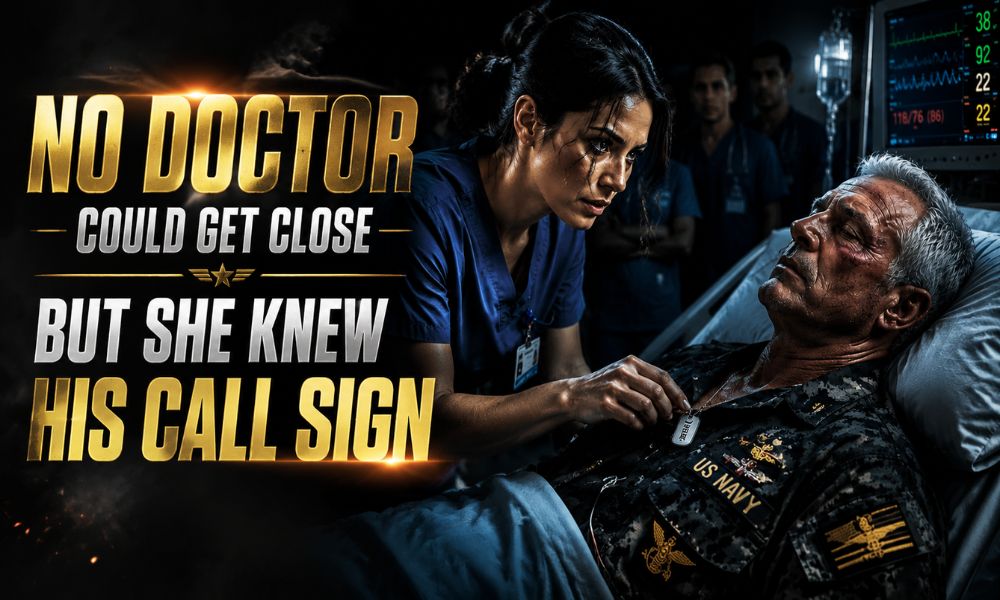
The first doctor who tried to examine Admiral Thomas Mercer left the room with blood running from his lip.
The second made it only two steps past the door before the seventy-two-year-old patient ripped the heart monitor from his chest and swung the cable like a weapon.
By midnight, hospital security was stationed outside Room 814.
Inside, one of the most decorated naval officers in the country was dying alone.
His lungs were filling with fluid. His blood pressure was collapsing. A severe infection had spread faster than the antibiotics could stop it.
Yet every time someone approached his bed, the admiral’s eyes snapped open.
He did not see nurses.
He did not see doctors.
He saw enemies moving through the dark.
“Stay behind the line,” he rasped, gripping the bedrail so tightly that his knuckles turned white. “Nobody crosses the line.”
The hospital staff had treated violent patients before.
But Thomas Mercer was different.
Even weakened by fever, he moved with frightening precision. He watched reflections in the window. He tracked footsteps in the hallway. He noticed when someone entered his blind spot.
Dr. Leonard Price, the attending physician, stood outside the room studying the latest scans.
“At this rate, he won’t make it until morning,” he said.
A nurse beside him lowered her voice.
“Can’t we sedate him?”
“We have to get close enough to administer it.”
“What about restraints?”
Dr. Price looked through the glass.
The admiral was sitting upright despite barely being able to breathe. His gray hair was damp with sweat. One hand rested over his ribs. The other held a broken plastic clip he had sharpened against the metal bedframe.
“Anyone who walks in there with restraints,” Dr. Price said, “is going to convince him he’s being captured.”
Nobody answered.
Down the corridor, the elevator doors opened.
A young nurse stepped out carrying a paper cup of coffee and a canvas backpack.
Her name was Elena Reyes.
She had transferred from the emergency department that morning and had spent most of her first shift completing orientation forms, learning supply codes, and being corrected by senior nurses who had already forgotten what it felt like to be new.
She was twenty-nine years old.
Quiet.
Observant.
And, according to the charge nurse, far too inexperienced to be anywhere near Room 814.
Elena stopped when she saw security.
“What happened?”
The charge nurse, Denise Holloway, barely looked up from her tablet.
“Combative terminal patient.”
“Confused?”
“Extremely.”
“Family?”
“None present.”
Elena glanced through the window.
The patient’s name was printed on the board beside the door.
MERCER, THOMAS J.
Her expression changed.
Not dramatically.
Just enough for Denise to notice.
“You know him?”
Elena looked again at the man in the bed.
“No,” she said. “But I know the name.”
Dr. Price stepped out of the consultation room.
“We need another set of vitals and access to his IV line. Security will accompany whoever goes in.”
Denise shook her head.
“He nearly broke Marcus’s wrist.”
“I’m aware.”
Elena placed her coffee on the counter.
“I’ll go.”
Every person at the nurses’ station turned toward her.
Denise gave a short laugh, thinking she had misunderstood.
“You started here today.”
“I know.”
“That man spent thirty years in special operations.”
“I know.”
“He thinks we’re trying to kill him.”
Elena’s eyes remained on the room.
“No,” she said softly. “He thinks he failed to protect someone.”
Dr. Price frowned.
“What makes you say that?”
Before Elena could answer, a crash came from inside Room 814.

The admiral had knocked the bedside table over.
“Lights out!” he shouted. “They can see us!”
Security moved toward the door.
Elena raised one hand.
“Please don’t rush him.”
Denise stared at her.
“And what exactly do you suggest?”
Elena removed her hospital badge and placed it beside her coffee. Then she tied back her dark hair, took off her watch, and emptied her pockets.
“No equipment,” she said. “No needles. No gloves.”
Dr. Price stepped in front of her.
“This is not a test of courage, Nurse Reyes.”
“It isn’t courage.”
“Then what is it?”
Elena looked through the glass again.
“Recognition.”
She walked to the door before anyone could stop her.
The room smelled of antiseptic, sweat, and the metallic edge of oxygen.
Admiral Mercer turned toward her immediately.
“Stop.”
Elena stopped.
She was still six feet from the bed.
The sharpened plastic clip was hidden against his forearm, but she had already seen it.
“Who sent you?” he demanded.
“No one.”
“Wrong answer.”
His voice was weak, but the command behind it was not.
Elena lowered herself slowly into the visitor’s chair near the door.
She did not move closer.
She did not call him Admiral.
She simply sat with her hands visible.
For almost a minute, neither of them spoke.
Outside the room, Dr. Price watched through the glass.
“What is she doing?” Denise whispered.
“Nothing,” he replied.
Inside, Mercer’s breathing grew harsher.
“You’re too young,” he muttered.
“For what?”
“To be here.”
Elena leaned back slightly.
“My father used to say the same thing.”
The admiral’s gaze sharpened.
“What unit?”
Elena did not answer.
His fingers tightened around the piece of plastic.
“What unit?” he repeated.
Elena looked directly into his eyes.
Then she said two words no one at the nurses’ station understood.
“Night Harbor.”
The change was immediate.
The admiral stopped moving.
His face did not relax, but the confusion in his eyes broke apart for a single second.
He stared at her as if she had opened a door that had been sealed for decades.
“Say again,” he whispered.
“Night Harbor.”
His lower lip trembled.
“That operation never existed.”
“I know.”
“Those words aren’t in any file.”
“I know.”
“Who are you?”
Elena stood, but she did not approach.
“My name is Elena Reyes.”
The piece of plastic slipped from the admiral’s hand and landed on the blanket.
Outside the room, the security officers looked at one another.
Mercer repeated her last name.
“Reyes?”
“Yes.”
His breathing caught painfully.
“Daniel Reyes?”
“My father.”
The admiral looked toward the window, then back at her.
“No.”
Elena took one step closer.
Mercer pressed himself against the raised bed.
“No,” he said again. “Daniel died.”
“That’s what you were told.”
“I saw the building collapse.”
“You saw part of it collapse.”
“We searched for two days.”
“You were ordered to evacuate.”
“I left him there.”
The final sentence did not sound like an admiral speaking.
It sounded like an exhausted young man confessing something he had carried for forty years.

Elena moved another step closer.
“You didn’t leave him.”
Mercer’s eyes filled with anger.
“Don’t lie to me.”
“I’m not.”
“I heard him on the radio.”
Elena’s voice remained calm.
“What did he say?”
The admiral closed his eyes.
For a moment, the hospital room disappeared for him.
He was back in a coastal city whose name had never appeared in public records. Back inside a damaged embassy compound with smoke covering the streets. Back with a six-man team ordered to extract an intelligence officer before hostile forces reached the building.
Daniel Reyes had been the team’s medic.
Thomas Mercer had been its youngest officer.
The operation had gone wrong before their helicopter touched the ground.
The team reached the intelligence officer, but an explosion split the building in two. Daniel pushed Mercer and two others behind a concrete wall seconds before the ceiling came down.
When Mercer regained consciousness, Daniel was gone.
His voice came through the radio once.
Broken.
Faint.
“Take them home, Harbor.”
Harbor had been Mercer’s call sign.
Only five men had known it.
Three were dead.
One had refused to speak about the mission again.
And Daniel Reyes had vanished beneath hundreds of tons of concrete.
Elena moved beside the bed.
“My father survived the collapse,” she said.
Mercer opened his eyes.
For the first time that night, he looked fully awake.
“That’s impossible.”
“He was trapped in a service tunnel beneath the east side of the building. A local family found him three days later.”
Mercer shook his head.
“We monitored every border.”
“They didn’t take him to a border. They hid him.”
“Why didn’t he contact us?”
“He couldn’t remember his own name for almost a year.”
The admiral stared at her.
Elena pulled the visitor’s chair closer and sat down.
“He had a fractured skull, burns, and damage to his left leg. The family that found him moved him between villages because armed groups were searching for survivors.”
Mercer’s face had gone pale beneath the fever.
“When did he come home?”
“Six years later.”
The admiral looked toward the ceiling.
Six years.
Six years during which Thomas Mercer had been promoted, married, divorced, and awarded a medal for bringing four men out of a failed operation.
Six years during which he had woken almost every night hearing Daniel’s final radio transmission.
“Why didn’t he find me?” Mercer asked.
“He tried.”
“No.”
“He wrote to the Navy. He wrote to the Department of Defense. Most of the letters disappeared because the operation was classified. When someone finally contacted him, they made him sign documents and told him never to speak about what happened.”
“He could have called me.”
“He did.”
The admiral looked at her.
Elena’s voice softened.
“Your aide told him you refused contact.”
Mercer’s expression hardened.
“I never received a message.”
“I know.”
“How?”
“Because years later, my father met that aide.”
Silence filled the room.
Outside, Dr. Price quietly told security to step back.
Elena continued.
“The aide admitted that senior officials were afraid of what my father’s survival would reveal. Reports had been written. Medals had been approved. Careers had been built around the official version of Night Harbor.”
Mercer’s eyes moved slowly toward her.
“They buried him.”
“Yes.”
“And told him I wouldn’t speak to him.”
“Yes.”
The admiral’s jaw tightened.
“Name.”
“Rear Admiral Stephen Cole.”
Mercer’s face changed.
Stephen Cole had been Thomas Mercer’s closest friend for more than twenty years.
He had served as best man at Mercer’s wedding.
He had stood beside him at retirement ceremonies.
He had visited him every Christmas after his divorce.
And he had been the officer responsible for controlling communications connected to Night Harbor.
“He told me Daniel was confirmed dead,” Mercer said.
Elena nodded.
“He told my father that you blamed him for the failed extraction.”
Mercer looked as if he had been struck.
“Daniel saved the entire team.”
“He never knew you said that.”
The room became very still.
For decades, two men had lived less than three hundred miles apart.
One believed he had abandoned his closest friend beneath a collapsed building.
The other believed that friend had survived, risen through the ranks, and chosen to erase him.
A single lie had punished them both.
“Where is your father?” Mercer asked.
Elena looked down at her hands.
“He died eleven months ago.”
The admiral’s shoulders sank.
Not from fever.
Not from infection.
From the weight of arriving too late.
Elena reached into the canvas backpack she had carried into the hospital. She removed a worn envelope and placed it on the table.
The handwriting on the front was unsteady.
For Harbor.
Mercer stared at it.
“He wrote that three days before he died,” Elena said. “He made me promise I would deliver it myself.”
“How did you know I was here?”
“I didn’t. Not until tonight.”
Mercer looked at her uniform.
“You transferred here because of me?”
“No. I transferred because my mother moved nearby after Dad died. Seeing your name on the door was an accident.”
The admiral gave a faint, broken laugh.
Daniel Reyes had survived an explosion, six missing years, and forty years of silence.
Yet the message he wanted delivered reached Thomas Mercer only because his daughter had picked up an extra hospital shift.
Elena slid the letter closer.
Mercer did not touch it.
“I can’t read it,” he whispered.
“You don’t have to.”
“I left him.”
“No.”
“I followed the evacuation order.”
“You carried four wounded men to the extraction point.”
“I should have gone back.”
“You tried. My father knew you tried.”
Mercer’s eyes lifted.
Elena nodded toward the envelope.
“He wrote it in the letter.”
The admiral’s face tightened.
For the first time since hospital staff had entered his room, he released the bedrail.
Elena placed her fingers lightly against his wrist.
He did not pull away.
Outside the door, Denise covered her mouth.
Dr. Price entered slowly with a syringe, but Elena raised her hand without looking at him.
“Give us one minute.”
To everyone’s surprise, the doctor obeyed.
Elena opened the envelope.
The paper inside had been folded twice. She smoothed it carefully across her knee.
Then she read.
“Harbor, if this reaches you, it means Elena kept her promise.”
Mercer closed his eyes.
“She always does.”
Elena paused, swallowed, and continued.
“You were never the man who left me behind. You were the man who wanted to stay when staying would have killed everyone.”
The admiral’s breathing became uneven.
“I heard you arguing over the radio. I heard them order you onto the helicopter. I knew what that order cost you.”
A tear moved from the corner of Mercer’s eye into his gray hair.
“I spent years angry because anger was easier than grief. Later, I learned the truth. By then, too much time had passed, and I was ashamed that I had believed the worst of you.”
Elena’s voice began to shake, but she kept reading.
“You carried the others home. That was the mission I gave you.”
Mercer opened his eyes.
“And you completed it.”
The final paragraph was only two lines.
“If we meet again, you owe me a cup of coffee. Until then, stand down, Harbor.
Bluebird is secure.”
The admiral’s mouth opened, but no sound came out.
Elena folded the letter.
For several seconds, he simply stared at her.
Then his gaze moved past her to the doctors, nurses, and security officers gathered outside the room.
The sharpened piece of plastic lay untouched on the blanket.
The fight had left his body.
Not because he had surrendered.
Because after forty years, someone had finally told him the mission was over.
“Bluebird was Daniel,” Mercer whispered.
Elena nodded.
“He used to call himself that when the nightmares got bad. He said it reminded him that he made it out.”
Mercer looked at the letter again.
Then he noticed Dr. Price standing near the door.
The doctor did not move until the admiral gave a faint nod.
“Let him work,” Mercer said.
Dr. Price approached carefully.
This time, the admiral did not resist when the IV was replaced.
He did not pull away when the oxygen mask was adjusted.
He allowed the nurses to lower the bed and place warm blankets over him.
Elena stayed beside him.
At 2:17 a.m., Dr. Price contacted the intensive care team and began a procedure he had believed would be impossible an hour earlier.
By sunrise, Thomas Mercer was still alive.
Barely.
But alive.
Three days later, his infection began responding to treatment.
Two weeks later, he left intensive care.
And six weeks after that, Admiral Mercer walked into a federal oversight hearing carrying Daniel Reyes’s letter inside the breast pocket of his uniform.
Stephen Cole sat at the opposite table.
He was eighty years old now, his back slightly curved, his white hair combed neatly across his scalp. He had arrived with two attorneys and the calm expression of a man who believed classified history could never be challenged.
Then Elena Reyes entered the room.
She placed her father’s medical records, photographs, correspondence, and recorded testimony on the evidence table.
Cole’s confidence disappeared one detail at a time.
First, his eyes settled on Daniel’s handwriting.
Then on a photograph taken after his rescue.
Then on a copy of a letter stamped by Cole’s own office.
Finally, Thomas Mercer stood.
Cole looked up at him.
The two men stared at each other across the room.
For years, Cole had been protected by rank, secrecy, and the belief that the dead could not contradict official reports.
But Daniel Reyes had not died in that building.
And his daughter had kept everything.
Cole’s face drained of color.
His attorneys leaned toward him, whispering urgently, but he did not appear to hear them.
He was watching Mercer remove an old envelope from his pocket.
That was the moment he understood.
The lie he had buried had found its way back into the room.
The hearing led to a formal investigation.
Records were unsealed.
Witnesses were interviewed.
Daniel Reyes’s service record was corrected, and his family received the honors and benefits they had been denied for decades.
Stephen Cole lost his ceremonial positions, his military consulting contracts, and the reputation he had spent a lifetime protecting.
But for Thomas Mercer, the most important consequence happened away from cameras.
On the anniversary of Daniel’s death, he visited a small cemetery outside San Diego.
Elena was waiting beside her father’s grave with two paper cups.
She handed one to Mercer.
“He said you owed him coffee.”
The admiral sat slowly on the bench.
He placed the second cup beside Daniel’s headstone.
For a long time, neither of them spoke.
Then Mercer reached into his coat and took out the letter.
The paper was soft now from being unfolded so many times.
“I spent forty years thinking his last words were an order I failed to obey,” he said.
Elena looked at the cup beside the grave.
“They weren’t his last words.”
Mercer nodded.
That was the gift she had given him in Room 814.
Not more time.
Not forgiveness he had demanded.
The truth.
A dying man had fought every doctor who came near him because part of him was still trapped inside a mission that had never ended.
It took a new nurse, an old call sign, and a letter written four decades too late to finally bring him home.
Because sometimes the deepest wounds are not caused by what happened.
They are caused by the lie that someone powerful forced everyone to believe.
And no rank, title, or classified file can bury the truth forever when one person is brave enough to carry it into the room.