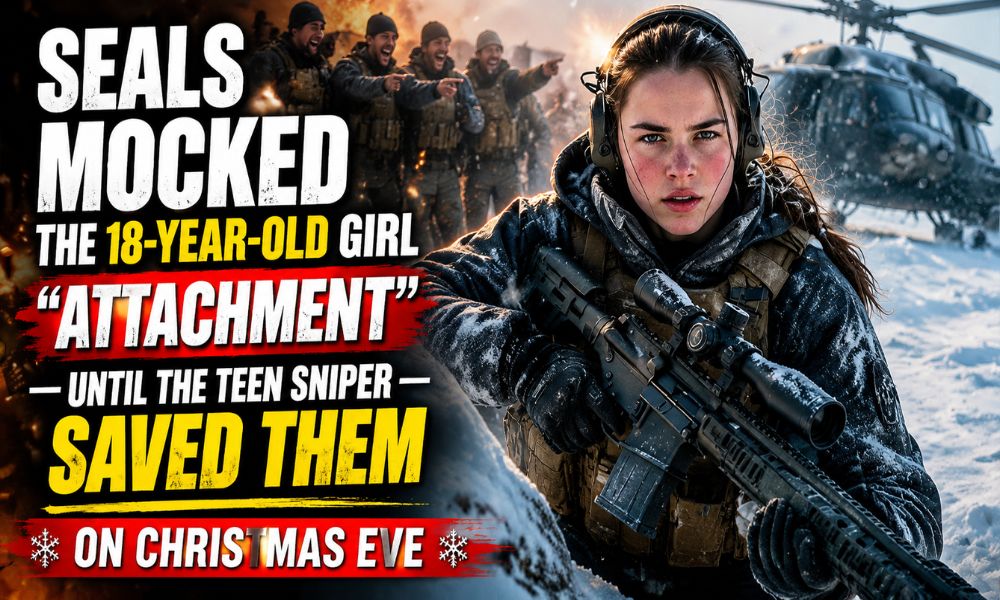
The first time Chief Daniel Mercer saw the girl assigned to his SEAL team, he thought someone at headquarters had made a clerical error.
She was standing beside a battered transport truck at a remote coalition base in northern Syria, holding a rifle case almost as tall as she was.
Eighteen years old.
Five-foot-four, maybe.
A narrow face, dark hair tied beneath a tan cap, and no visible unit patch on her jacket.
Mercer looked at the operations officer, then back at the girl.
“This is the attachment?”
The word came out sharper than he intended.
Lieutenant Aaron Pike, Mercer’s second-in-command, leaned against a concrete barrier and laughed.
“I’ve seen high school interns who looked more dangerous.”
Two other SEALs exchanged glances.
The girl heard them. Everyone knew she heard them.
But she did not react.
She simply placed the rifle case on a wooden table, unclipped both locks, and checked the weapon inside with slow, practiced movements.
No trembling hands.
No defensive smile.
No attempt to prove anything.
That irritated Mercer more than an argument would have.
It was December 24, 2016, and his eight-man team had been ordered to escort a humanitarian intelligence officer into the village of Al-Rashid before nightfall. A local doctor claimed to have information about a captured coalition pilot.
The operation was supposed to be simple.
Drive in under cover of a medical convoy.
Meet the source.
Confirm the pilot’s location.
Leave before sundown.
Then a message had arrived from regional command.

Additional personnel assigned: Specialist Emily Carter. Precision support. Temporary attachment.
Mercer had reread the message three times.
“Specialist?” he asked. “What branch?”
The operations officer avoided his eyes.
“Joint program.”
“What program?”
“Compartmented.”
Mercer hated that word. It usually meant someone important had made a decision without consulting the people who would have to survive it.
He pointed toward Emily.
“She doesn’t look old enough to rent a car.”
“She’s cleared.”
“I didn’t ask if she was cleared.”
The officer lowered his voice.
“You were ordered to take her.”
That ended the official conversation.
It did not end the team’s opinion.
As the men loaded equipment, Pike walked past Emily’s table and glanced at the long rifle inside the case.
“Nice piece,” he said. “They teach you to use that at summer camp?”
Emily closed the bolt, checked the chamber again, and answered without looking up.
“No, sir.”
Pike waited.
That was all she said.
He smiled at the others.
“Quiet one.”
Petty Officer Mason Cole placed a red-and-white Santa hat over his helmet.
“Maybe she’s our Christmas present.”
A few men laughed.
Mercer did not.
Not because he respected her.
Because he did not have time for distractions.
He walked to the table and studied her equipment. The rifle was a modified Mk 13 precision system. The scope had been carefully wrapped. Her data book was full of handwritten calculations, wind observations, temperature notes, and distances.
The pages looked used.
Very used.
Still, Mercer remained unconvinced.
“Carter.”
She looked up.
Her eyes were gray and strangely calm.
“You stay close to the convoy. You do not separate from the team unless I order it. You do not take a shot unless I authorize it. Understood?”
“Yes, Chief.”
“You have combat experience?”
A pause.
“Yes, Chief.”
Pike coughed theatrically.
Mercer ignored him.

“How much?”
“Enough to follow orders.”
It was not the answer Mercer expected.
He stepped closer.
“Let’s be clear. Whatever classified classroom put you here, this is my team. Out there, nobody cares about your test scores, your recommendations, or who signed your paperwork. If you freeze, someone dies.”
Emily held his gaze.
“I understand.”
Mercer waited for fear.
He saw none.
That should have reassured him.
Instead, it felt like a warning he did not yet understand.
The convoy left the base at 2:10 that afternoon.
Two armored vehicles led the way, followed by a white medical truck carrying antibiotics, blankets, and food. Mercer’s team rode in the final vehicle with Emily seated near the rear door.
Christmas music played quietly through someone’s headset.
Cole tapped his Santa hat and passed around a bag of crushed peppermint candy.
“For morale,” he said.
Pike took a piece and nodded toward Emily.
“Better give the kid two.”
Emily declined.
Outside, the land stretched in gray-brown waves beneath a pale winter sky. Abandoned farmhouses stood beside the road. Telephone poles leaned at awkward angles. In the distance, smoke rose from somewhere behind the hills.
Mercer watched Emily through the reflection in the armored window.
She was not staring nervously at the landscape like a newcomer.
She was studying it.
Rooflines.
Dry riverbeds.
Tree clusters.
Elevation changes.
Possible firing positions.
Every few minutes, she looked down and wrote something in her notebook.
Pike noticed too.
“What are you writing, Carter?”
“Distances.”
“To what?”
“Places someone might shoot from.”
Pike glanced out the window.
“We’re moving.”
“Yes, sir.”
“And you’re estimating range from a moving vehicle?”
“Yes, sir.”
He smirked.
“What’s that water tower?”
Emily looked once.
“Eight hundred and sixty meters.”
Cole lifted a rangefinder, checked, then frowned.
“Eight fifty-four.”
The vehicle went quiet for half a second.
Pike shrugged.
“Lucky.”
Emily returned to her notebook.
The village of Al-Rashid appeared just after 3:00 p.m.
It was smaller than Mercer expected. A collection of stone houses, narrow roads, two ruined shops, and a mosque with a cracked minaret. Children gathered around the medical truck as soon as it stopped.
The men spread out.
Mercer sent Pike and two others to secure the northern road. Cole and Ramos watched the south. The humanitarian officer, Dr. Nathan Bell, entered a low building with a local interpreter.
Emily remained near the convoy as ordered.
For the first fifteen minutes, nothing happened.
Women collected blankets.
An elderly man received insulin.
A little boy stared at Cole’s Santa hat until Cole finally took it off and placed it on the child’s head.
Then Emily spoke over the radio.
“Chief, possible observer. East ridge. Gray structure beside the dead orchard.”
Mercer turned casually but did not raise his weapon.

“What did you see?”
“Movement behind the upper window.”
“Weapon?”
“Couldn’t confirm.”
Pike’s voice came through.
“Probably a goat.”
Emily did not answer.
Mercer scanned the building through his optic. It stood roughly nine hundred meters away. One wall had collapsed, but the upper room was still intact.
No visible movement.
“Continue observation,” Mercer said.
Five minutes later, Emily spoke again.
“Same structure. Glass reflection. Third opening from the left.”
Mercer looked.
Nothing.
Pike sighed over the radio.
“Carter, people in villages sometimes own windows.”
“Not that type of glass.”
“What type is it?”
“Coated optic.”
The amusement in Pike’s voice disappeared for a moment.
Mercer studied the opening more carefully.
Still nothing.
“Can you confirm?”
“Negative.”
“Then hold.”
“Yes, Chief.”
Dr. Bell emerged from the building twenty minutes later.
His expression had changed.
Mercer met him beside the medical truck.
“The pilot is alive,” Bell said quietly. “Held at a farm compound eleven kilometers north. The doctor claims they’ll move him tonight.”
“How many guards?”
“Maybe twelve.”
“Maybe?”
“The source is terrified.”
Mercer looked toward the roads.
The sun was already lowering.
Their orders were to collect intelligence, not launch a rescue. But if the pilot was being moved, the information would be useless by morning.
He contacted command.
Static answered.
He tried again.
Nothing.
Ramos reported interference on the secondary channel.
Then Emily’s voice cut through.
“Chief, the observer moved.”
“Direction?”
“Unknown. But he left equipment behind.”
“What equipment?”
“Tripod silhouette.”
Mercer’s stomach tightened.
A surveillance team would not abandon a tripod unless its job was finished.
“Everyone mount up,” he ordered.
The villagers were pushed gently away from the vehicles. The humanitarian workers closed the truck. Engines started.
Pike jogged back from the northern road.
“You think we’ve been compromised?”
“I think we’re leaving.”
“What about the pilot?”
“We report from outside the interference zone.”
The first explosion struck before Pike reached the vehicle.
The medical truck lifted off the ground, turned sideways, and crashed into a stone wall.
Windows shattered across the village.
Children screamed.
Mercer hit the dirt as automatic fire tore through the street.
Bullets sparked against the armored vehicles.
“Contact east!”
“Contact north!”
“RPG!”
The second explosion struck the lead vehicle, blowing off one of its wheels and filling the road with black smoke.
The team returned fire.
Mercer crawled behind a low wall and counted muzzle flashes.
Too many.
At least twenty fighters had moved into prepared positions around the village.
This had not been an ambush assembled in minutes.
They had been expected.
Pike slid beside him.
“Medical truck is down. Driver’s alive. Bell’s wounded.”
“North route?”
“Blocked.”
“South?”
“Machine gun covering it.”
A burst of fire shattered the wall above them.
Mercer pressed his radio.
“Carter, status.”
No answer.
He tried again.
“Carter.”
Static.
Pike looked toward the convoy.
“Told you she’d freeze.”
Then a single rifle shot cracked from somewhere behind the western buildings.
The machine gun covering the south road stopped.
One shot.
One sudden silence.
Ramos called over the radio.
“South gunner is down.”
Mercer looked toward the rear of the village.
A second shot echoed.
The fighter carrying an RPG on the eastern roof fell backward before he could shoulder the launcher.
A third shot.
Another man collapsed behind a window.
Pike stared.
Emily’s voice returned, controlled and quiet.
“Chief, I relocated to the grain house. Western side. Elevated position.”
“You left the convoy.”
“It was taking direct fire.”
“You had no authorization.”
“No, Chief.”
A bullet struck the wall near Mercer’s face.
He lowered his head.
Emily continued.
“I have visibility on the south road. It’s open for approximately forty meters, then blocked by a disabled truck.”
“How many shooters?”
“Eleven confirmed. Possibly more behind the mosque.”
Pike keyed his radio.
“You counted eleven?”
“I counted the ones carrying weapons.”
Mercer made a decision.
“Keep the south road suppressed. Team, move wounded into the second vehicle.”
The village became a maze of smoke, shouting, and gunfire.
Cole dragged Dr. Bell across the road while Ramos covered him. Pike ran to the medical truck and pulled the injured driver through a broken window. Mercer fired toward the mosque as two fighters attempted to advance.
Each time an enemy gunner rose high enough to aim, Emily’s rifle answered.
She did not fire rapidly.
She fired only when necessary.
One shot from the grain house.
Then silence.
A pause.
Another shot.
Each round changed the battlefield.
Within three minutes, the team had moved all surviving personnel into the remaining vehicles.
But the escape route was worse than expected.
The south road narrowed between two rows of buildings before reaching open ground. A disabled cargo truck blocked most of the passage, leaving only enough space for one vehicle to squeeze through.
Mercer looked at the damaged lead vehicle.
It would never make it.
“Abandon One,” he ordered. “Transfer ammunition.”
Pike glanced toward the western grain house.
“What about the attachment?”
Mercer pressed the radio.
“Carter, return to convoy.”
“No clear route.”
“We leave in ninety seconds.”
A pause.
“Understood.”
Mercer waited.
Nothing moved near the grain house.
Enemy fire increased from the east. The fighters had realized where the sniper was positioned.
Rounds chewed through the upper windows.
“Carter, move now.”
“I’m pinned.”
Pike grabbed Mercer’s arm.
“We can’t lose the whole team for one shooter.”
Mercer looked at the wounded men in the vehicle.
Bell was losing blood.
The driver was barely conscious.
More fighters were arriving.
He hated the calculation because Pike was right.
Then Emily spoke.
“Chief, leave without me.”
Mercer froze.
“I can cover the road.”
“That is not an option.”
“It may be the only one.”
Her voice did not tremble.
Mercer could hear rounds striking stone near her position.
Emily continued.
“The enemy is repositioning toward your east side. In thirty seconds, they’ll have an angle on the vehicle. Move south now.”
Pike climbed into the driver’s seat.
“Chief!”
Mercer fired one final burst and entered the vehicle.
“Go.”
They accelerated into the narrow road.
Enemy fighters emerged behind them.
Emily fired.
One dropped.
The vehicle scraped against the disabled truck, tearing armor panels from its side. Pike forced it through and accelerated toward open ground.
Behind them, the grain house disappeared in smoke.
Mercer kept calling Emily.
No answer.
For nearly a minute, the only sounds were the engine, the wounded men, and gunfire fading behind them.
Then Emily’s voice returned.
“Convoy, continue south for four hundred meters. Stop behind the ridge.”
Mercer almost shouted.
“Where are you?”
“Moving.”
“How?”
“West side drainage channel.”
Pike looked at Mercer.
“There’s no drainage channel on the map.”
Emily heard him.
“It isn’t on the map.”
They reached the ridge and stopped.
Mercer sent Cole and Ramos to cover the rear.
Seconds passed.
Then a small figure appeared from a dry streambed, rifle across her chest, running low through the dust.
Emily reached the vehicle with blood along one sleeve.
Cole pulled her inside.
“You hit?”
“Grazed.”
Pike stared at her.
She did not look at him.
Mercer ordered the convoy to move.
For the next thirty minutes, they drove south while enemy vehicles searched the roads behind them. Communications remained blocked.
The sun dropped lower.
Christmas Eve darkness began spreading over the hills.
Inside the vehicle, Emily wrapped her arm with gauze.
Cole leaned toward her.
“How many?”
She looked up.
“How many what?”
“How many did you hit?”
“I didn’t count.”
Pike gave a quiet laugh, but there was no humor in it.
“Snipers always count.”
Emily tightened the bandage.
“People who want stories count. People trying to get home don’t.”
No one answered.
They reached an abandoned cement plant shortly before 5:00 p.m.
The wounded could not continue without treatment. Dr. Bell had a bullet lodged near his hip. The driver had lost too much blood. The vehicle’s engine temperature was rising after damage sustained in the ambush.
Mercer established a temporary perimeter inside the plant.
It was a terrible position.
Broken walls.
Multiple entrances.
No reliable communications.
Night approaching.
And somewhere north of them, the captured pilot would soon be moved.
Mercer entered an empty office where Bell lay on the floor.
“What happened in that village?” Mercer asked.
Bell’s face was pale.
“The doctor said only three people knew about our meeting.”
“One of them talked.”
“Or someone intercepted the message.”
Mercer crouched.
“Did the doctor give you anything else?”
Bell nodded toward his coat.
“There’s a photograph.”
Mercer removed a folded piece of paper.
It showed a farm compound surrounded by low walls. A handwritten note listed vehicle movements, guard changes, and a time.
22:30 — transfer.
Less than six hours.
Pike entered the room.
“We need extraction.”
“We need communications.”
“Ramos is working on it.”
Mercer handed him the photograph.
Pike studied it.
“We’re in no condition to rescue anyone.”
“If they move the pilot, we lose him.”
“We already have two critical wounded.”
“I know.”
Pike looked toward the doorway.
“And now we have a teenager with a scratched arm.”
Emily was standing outside.
Again, she had heard him.
Again, she said nothing.
Mercer stepped into the main factory room.
“Carter.”
“Yes, Chief.”
“You recognized the surveillance position before the ambush.”
“Yes.”
“How?”
“The optic reflection was too high for a rifle scope. It was likely a long-range camera or spotting system.”
“And the interference?”
“Portable jammer. Probably vehicle-mounted.”
Pike folded his arms.
“You seem to know a lot about their equipment.”
Emily met his eyes.
“I’ve seen it before.”
“Where?”
She looked at Mercer.
“Classified.”
Pike shook his head.
“Of course it is.”
Mercer felt his patience thinning.
“Enough. Carter, find high ground and see if you can identify enemy movement. Cole goes with you.”
Emily glanced toward the darkening sky.
“There’s an old loading tower on the west side.”
Mercer looked through the broken wall. The tower rose above the factory, its upper platform exposed.
“You’ll be visible.”
“So will they.”
She picked up her rifle case.
Cole followed.
Pike watched them leave.
“You trust her now?”
Mercer stared at the photograph of the farm compound.
“I trust results.”
“That’s not what I asked.”
“It’s all that matters tonight.”
From the loading tower, Emily could see the road leading north.
Cole positioned himself beside a rusted support beam and watched through binoculars.
For several minutes, neither spoke.
Then Cole said, “You really eighteen?”
“Yes.”
“When’s your birthday?”
“February.”
“So you’re not even nineteen for two months.”
“That’s how birthdays work.”
Cole smiled.
It was the first time anyone on the team had heard her make a joke.
He adjusted the binoculars.
“Why are you here?”
“Orders.”
“No. Why are you really here?”
Emily did not answer.
Cole looked at her rifle.
“People don’t get that good by accident.”
She pressed one eye to the scope.
“My father taught me.”
“Military?”
“Army.”
“Sniper?”
“Observer.”
Cole waited.
Emily added nothing.
Below them, Pike and Ramos worked on the radio. Mercer examined maps by red light. Christmas music had stopped hours ago. Cole’s Santa hat was still inside the vehicle, stained with dust and blood.
At 5:47 p.m., Emily whispered, “Movement.”
Cole raised his binoculars.
Three pickup trucks drove along a distant road without headlights.
“Range?”
“Two thousand one hundred meters.”
“You can see people at that distance?”
“I can see heat differences and vehicle shapes.”
“What are they doing?”
“Searching.”
“For us?”
“Probably.”
The trucks stopped near an intersection.
Men dismounted.
Emily watched for another thirty seconds.
“They know we went south.”
“How?”
“One of them is checking tire marks.”
Cole pressed the radio.
“Chief, three enemy vehicles north-northeast. Two klicks. Dismounting.”
Mercer’s voice responded.
“Can they see the plant?”
“Not yet.”
Emily studied the landscape.
“They will.”
Cole looked at her.
“How long?”
“Twenty minutes if they move carefully. Ten if they don’t.”
Mercer ordered them down.
Inside the plant, the team prepared for another fight.
Ammunition was distributed.
Entrances were blocked with debris.
The wounded were moved into a concrete storage room.
Ramos finally managed to send a weak burst transmission, but there was no confirmation it had reached command.
“No aircraft,” Pike said. “No extraction. No guarantee anyone heard us.”
Mercer looked around at his team.
“We move before they surround the plant.”
Bell tried to sit up.
“I can’t travel.”
“You won’t be walking.”
“The driver won’t survive another hour in that vehicle.”
Mercer knew it was true.
Emily entered carrying her rifle.
“The enemy trucks split up.”
“How many coming here?”
“Two.”
“The third?”
“Northwest.”
Pike looked at the map.
“Toward the farm compound.”
The room fell silent.
Emily stepped closer.
“They may be preparing the prisoner transfer.”
Mercer studied the map again.
The farm was sixteen kilometers from the cement plant by road.
Less than ten across the hills.
Pike saw what he was thinking.
“No.”
“We can move the wounded to the caves south of here. Ramos stays with them and keeps trying the radio.”
“No,” Pike repeated. “We are not launching a rescue with five mobile operators, no air support, no communications, and an eighteen-year-old attachment.”
Emily’s expression did not change.
Mercer looked at Pike.
“You have a better plan?”
“Yes. Survive until morning.”
“And let them move the pilot?”
“Our mission was intelligence.”
“Our mission changed when we learned he was alive.”
Pike stepped closer.
“You don’t know who this girl is. You don’t know who sent her. She broke formation, disobeyed your order, and now she’s feeding us information that pushes us straight toward a compound full of armed men.”
Every face turned toward Emily.
Pike pointed at her.
“How do we know she isn’t the reason the village was compromised?”
Cole frowned.
“Come on.”
“Think about it,” Pike said. “Compartmented program. No unit history. No proper introduction. She arrives the morning of the mission, and suddenly the enemy knows exactly where we’ll be.”
Emily remained still.
But Mercer saw the change in her eyes.
Not fear.
Recognition.
As if she had expected this accusation eventually.
Mercer spoke carefully.
“Carter, open your jacket.”
Cole looked at him.
“Chief—”
“Now.”
Emily placed the rifle on a crate and unzipped her jacket.
No transmitter.
No unusual equipment.
Only body armor, ammunition, a medical pouch, and a thin silver chain around her neck.
Pike reached toward the chain.
Emily caught his wrist.
The movement was fast enough to surprise everyone.
Pike’s face hardened.
“Let go.”
Emily released him.
Mercer pointed to the chain.
“What is it?”
She pulled out a small metal identification tag.
Not standard military issue.
It carried a name.
MICHAEL CARTER
Below it was a date.
24 DEC 2014
Mercer looked at her.
“Your father?”
“Yes.”
“What happened?”
Emily closed her hand around the tag.
“He was killed on Christmas Eve.”
“Where?”
Her gaze shifted toward the map.
“Near that farm.”
Nobody spoke.
Pike stared at her.
“You’ve been here before.”
“No.”
“But your father was.”
“Yes.”
Mercer felt the room tighten around them.
“What was his mission?”
Emily hesitated.
Then she reached into the inner lining of her rifle case and removed a sealed plastic envelope.
She handed it to Mercer.
Inside was a satellite image of the farm compound.
The same farm.
But the image was two years old.
It contained handwritten markings showing firing lanes, guard towers, underground rooms, and an escape tunnel leading west.
At the bottom was a signature.
M. Carter
Mercer looked up slowly.
Emily’s voice was quiet.
“My father was part of the reconnaissance team that first identified the compound. He was killed before the rescue operation could be approved.”
“The rescue of who?” Cole asked.
“A captured intelligence officer.”
Pike’s eyes narrowed.
“And now another coalition pilot is being held in the same place?”
“Yes.”
“That’s a remarkable coincidence.”
“It isn’t a coincidence.”
The room went still.
Emily pointed at the image.
“The group that controls the farm specializes in holding high-value prisoners. They move them across the border through underground routes. My father documented the network. Most of his report was buried because the operation that followed failed.”
Mercer looked at the signature again.
“Why weren’t we briefed?”
“Because the network was believed inactive.”
“And you?”
“I was assigned because I studied his files.”
Pike laughed once in disbelief.
“You studied your father’s files, so they sent you into combat?”
Emily looked at him.
“No. They sent me because I found the mistake that got him killed.”
That silenced even Pike.
Mercer unfolded the satellite image across a crate.
“What mistake?”
“The original team believed the western tunnel was an escape route for prisoners. It wasn’t.”
She pointed to a narrow line.
“It was a firing corridor.”
Mercer leaned closer.
“The tunnel exit is here?”
“According to my father’s notes.”
“Then why call it a firing corridor?”
“Because the exit opens beneath a rocky shelf overlooking the entire southern approach. A sniper positioned there can control the road, the main gate, and the eastern tower without being visible from the compound.”
Pike stared at the image.
“And your father never used it?”
“He tried.”
Emily’s hand tightened around the metal tag.
“He was ordered to hold position while the assault team approached from the south. The enemy saw them. My father broke cover to warn the team.”
Her voice remained level, but the effort behind that calm was visible now.
“He was hit before he reached the tunnel.”
Mercer looked again at the handwritten markings.
Every detail she had noticed that day suddenly made sense.
The ranges from the moving vehicle.
The hidden drainage channel.
The enemy’s surveillance equipment.
The way she had recognized the tactics before any of them.
She had not been assigned to learn from Mercer’s team.
She had been assigned because she knew the battlefield better than they did.
Pike was slower to accept it.
“You’re telling us command sent the daughter of a dead observer back to the place where he was killed.”
“No,” Emily said. “I requested the assignment.”
“Why?”
She looked directly at him.
“To make sure the same mistake didn’t happen again.”
Outside, an engine growled in the distance.
The enemy search team was approaching.
Mercer made his decision.
“We move the wounded into the southern caves. Ramos stays with them. Cole, Pike, Bennett, Carter, with me.”
Pike’s jaw tightened.
“We’re going to the farm?”
“We’re going through the western tunnel.”
Emily corrected him.
“We’re going to the firing corridor.”
Mercer folded the map.
“And this time, we use it.”
They left the cement plant under darkness.
Ramos remained behind with Bell and the injured driver. Before the team departed, Cole retrieved his battered Santa hat from the vehicle and stuffed it into his vest.
“For luck,” he said.
No one laughed.
Emily led them west through dry gullies, avoiding the main roads. The temperature dropped quickly after sunset. Frost formed on exposed metal. Somewhere far away, artillery rumbled.
For nearly two hours, they moved without lights.
Emily navigated from memory and her father’s notes.
At one point, Pike whispered, “You’re sure about this route?”
Emily pointed to three pale stones beside the path.
“My father marked it.”
Mercer crouched.
The stones looked natural until he noticed they had been arranged in a straight line.
A field sign.
Small enough to be missed by anyone not searching for it.
They continued.
At 8:42 p.m., they reached the rocky shelf west of the farm.
Below them, the compound glowed under scattered lights.
Two pickup trucks stood near the front gate.
Armed men moved between buildings.
Mercer counted fourteen.
Emily counted nineteen.
“Where are the others?” he asked.
“Inside. Or below ground.”
Through binoculars, they saw a man pulled briefly across a courtyard.
His hands were bound.
His head was covered.
He wore part of a flight suit.
The pilot.
Alive.
Pike exhaled.
“Transfer vehicle isn’t here yet.”
Emily checked the wind.
“It will come from the northeast.”
“How do you know?”
“Main road from the border.”
Mercer divided the team.
Pike and Bennett would enter through the tunnel.
Cole would cover the western exit.
Mercer would approach the northern wall and prepare an escape vehicle.
Emily would remain in the firing corridor.
Pike looked at her position.
“You can cover us from there?”
“Yes.”
“All of us?”
“If you stay inside the marked lanes.”
He studied her face.
For the first time that day, there was no mockery in his expression.
Only uncertainty.
“Do not miss.”
Emily settled behind the rifle.
“I won’t.”
The tunnel entrance was hidden beneath loose stones and thorn bushes.
Bennett found the metal hatch exactly where the map indicated.
It had rusted nearly shut.
Pike opened it carefully.
A cold draft rose from the darkness.
Before entering, he looked back toward Emily.
She was almost invisible beneath the rocky shelf.
Only the outline of her rifle could be seen.
Pike pressed his radio.
“You have visual?”
Her voice answered in his ear.
“I have you.”
Mercer moved north.
Cole took position near the escape route.
Pike and Bennett entered the tunnel.
For twelve minutes, the operation unfolded perfectly.
The tunnel led beneath the western storage building.
Emily tracked guards through narrow openings in the rock.
One guard walked toward the tunnel exit.
She whispered, “Hold.”
Pike froze below ground.
The guard stopped less than five meters from the hidden hatch, lit a cigarette, and looked toward the hills.
Emily kept him centered in her scope.
She did not fire.
A suppressed shot, even a quiet one, could alert the compound.
Thirty seconds passed.
Then the guard turned away.
“Move,” she whispered.
Pike climbed into the storage building.
Bennett followed.
They crossed the interior hall and located the underground cell.
The pilot was conscious but weak.
His name was Captain James Holloway.
Pike cut his restraints.
“You able to walk?”
Holloway nodded.
Then engines approached from the northeast.
Emily saw headlights beyond the ridge.
“Transfer vehicle arriving. Two trucks. Possibly eight additional fighters.”
Mercer’s voice came over the radio.
“Accelerate.”
Pike helped Holloway toward the tunnel.
A guard entered the hallway unexpectedly.
Bennett caught him before he could shout.
But the man’s rifle struck the floor.
The sound echoed through the building.
A door opened in the courtyard.
Then another.
The compound erupted.
“Compromised,” Pike said.
Emily fired her first shot.
The man running toward the alarm panel fell before his hand reached the switch.
Second shot.
The guard in the eastern tower dropped behind the wall.
Third shot.
A fighter raising a machine gun near the courtyard collapsed across the weapon.
The incoming trucks accelerated.
Mercer reached the northern vehicle and shot the driver through the side window.
Cole opened fire from the west.
Pike and Bennett dragged Holloway into the tunnel.
Enemy fighters converged on the storage building.
Emily shifted targets faster.
One at the doorway.
One behind a fuel barrel.
One moving toward the roof.
Each fell at the exact moment he became a threat to the men below.
Then the lights went out.
The entire compound dropped into darkness.
Pike’s voice came over the radio.
“Night optics.”
Emily lowered her head to the thermal scope.
Heat signatures appeared across the compound.
Too many.
The transfer trucks stopped outside the gate. Armed men poured out.
Mercer had reached the captured vehicle, but the engine would not start.
“Battery’s cut,” he said. “Need alternate extraction.”
Cole reported movement from the south.
Pike and Bennett emerged from the tunnel with Holloway between them.
Enemy fighters were closing from three sides.
Emily looked across the battlefield and saw the pattern.
The enemy was not trying to kill the escaping team.
They were pushing them.
Every burst of gunfire forced Pike and Bennett farther south.
Toward the exposed road.
Toward the same approach where her father’s team had been trapped two years earlier.
The same mistake.
The same kill zone.
“Pike, stop moving south.”
“We’re taking fire!”
“They’re herding you.”
A burst struck the rocks beside him.
“We don’t have another direction.”
“Yes, you do. Go east, through the courtyard.”
“That puts us in the open.”
“For six seconds.”
“Six seconds is enough to die.”
Emily scanned the rooftops.
A machine gun team was moving into position above the main building. Another fighter carried an RPG toward the eastern wall. A third group was circling behind Mercer.
She understood the full trap now.
The south road was not the enemy’s strongest position.
It was bait.
The attackers were meant to choose it because it looked safer than the open courtyard.
Her father’s team had chosen it.
The enemy had been using the same tactic for years.
Emily pressed the radio.
“Chief, the eastern courtyard leads to an irrigation channel outside the wall.”
Mercer looked at the old map under red light.
“No channel marked.”
“It was added after my father’s reconnaissance. I saw the drainage pattern from the village road.”
Pike’s breathing was heavy.
“You’re guessing.”
“No.”
Bullets struck the wall behind him.
Emily’s voice became harder.
“Lieutenant, listen to me. The south road is covered by three positions you cannot see. If you take another ten steps, all three will have you.”
Pike looked toward the darkness ahead.
For a moment, nobody moved.
Then a red laser appeared on the ground near his boot.
Another appeared on Holloway’s chest.
Pike’s face changed.
Even through Emily’s thermal scope, she could see the moment recognition reached him.
His mouth opened slightly.
His shoulders lowered.
The confidence that had carried him through the day vanished in a single breath.
He finally understood.
She had not been following his team as a child protected by professionals.
She had been reading the battlefield they had failed to see.
“East,” Pike said. “We go east.”
Emily fired.
The first machine gunner dropped.
She cycled the bolt and fired again.
The RPG carrier spun backward.
“Move!”
Pike, Bennett, and Holloway sprinted across the courtyard.
Five seconds.
Six.
Enemy rounds followed them.
Emily shifted right and hit the fighter closest to their path.
A second man appeared behind a wall.
Her rifle clicked.
Empty.
She reached for another magazine.
Too slow.
The fighter raised his weapon toward Pike.
Cole fired from nearly three hundred meters away, striking the man in the shoulder.
Pike dragged Holloway through the eastern gate.
Bennett followed.
They dropped into the irrigation channel.
“Channel confirmed,” Pike said, breathless.
Mercer reached them seconds later.
But the enemy was recovering.
At least a dozen fighters moved toward the eastern wall. The transfer trucks turned, preparing to cut off the channel farther down.
Emily loaded a fresh magazine.
“Follow the channel north for one hundred meters, then exit right.”
Mercer answered.
“What about you?”
“I’ll cover.”
“Negative. Break position.”
“I can’t yet.”
The enemy had located her.
Rounds struck the rocky shelf.
Fragments cut her cheek.
She lowered herself, adjusted two clicks, and fired at the driver of the first transfer truck. The truck veered into the second vehicle, blocking the road.
The channel remained open.
“Now, Carter,” Mercer ordered.
Emily began packing the rifle.
Then a voice came through a loudspeaker inside the compound.
English.
“Emily Carter.”
Her hands stopped.
The voice repeated her name.
“You came back for your father.”
Mercer heard it.
“So did Pike.”
Emily looked toward the main building.
A man stood in the courtyard holding a radio and wearing a long dark coat.
Older.
Bearded.
A pale scar crossed one side of his face.
She had seen him before.
Not in person.
In her father’s final surveillance photograph.
Khalid Rahman.
The commander believed responsible for Michael Carter’s death.
Intelligence reports had listed him as killed in an airstrike eighteen months earlier.
He was alive.
And smiling toward the rocky shelf.
“You have his rifle,” Rahman called. “I remember that sound.”
Emily looked down.
The rifle had belonged to her father.
That was why the stock was worn near the cheek rest.
That was why the notebook contained calculations in two different handwritings.
That was why she never spoke about how many people she had shot.
The weapon was not a trophy.
It was unfinished work.
Rahman stepped farther into the open.
“Your father also thought he could save them.”
Mercer’s voice came through.
“Carter, do not engage. Break contact.”
Emily placed her eye behind the scope.
Rahman remained partially protected by two armed men and a concrete pillar.
No clear shot.
“He died calling for help,” Rahman said.
Emily’s breathing changed.
For the first time that night, her rifle moved slightly.
Pike heard it over the radio.
He was inside the irrigation channel, supporting the injured pilot.
Hours earlier, he would have assumed she was frightened.
Now he knew better.
“Emily,” he said.
It was the first time he had used her first name.
“Don’t let him choose the shot.”
She closed her eyes for half a second.
Then opened them.
Rahman was trying to keep her in place.
Trying to make her angry.
Trying to delay her until his men surrounded the ridge.
The revenge shot was bait.
Just like the south road.
Emily moved the crosshairs away from him.
She aimed at the compound’s fuel generator instead.
One round shattered the pressure line.
A second struck the hot exhaust housing.
Flames spread across the courtyard.
Rahman’s men scattered.
Smoke blocked their view of the eastern escape route.
Emily folded the rifle’s bipod.
“Leaving position.”
Rahman shouted her name again.
She ignored him.
She slid down the back of the ridge as bullets struck the rocks above.
For the next fifteen minutes, the team moved through the irrigation channel while the compound burned behind them.
Holloway stumbled twice.
Bennett had been hit in the leg.
Mercer carried most of his weight.
The enemy followed, but slowly. The damaged trucks could not pass the blocked road, and the fire had divided their forces.
At 10:58 p.m., the team reached a cluster of abandoned houses.
Ramos’s voice finally came through the radio.
“Chief, command received the burst. Rescue aircraft inbound. Twelve minutes.”
Mercer looked at his watch.
Christmas Eve had sixty-two minutes left.
They established a perimeter around a small courtyard.
Cole sat Holloway against a wall and pulled the crushed Santa hat from his vest.
The pilot stared at it.
“Is that for me?”
Cole placed it on his head.
“Medical requirement.”
Even Pike laughed.
It lasted only a moment.
Then Emily noticed movement on the ridge.
“Contact.”
Rahman’s men had followed them.
Muzzle flashes appeared above the houses.
The team returned fire.
They were low on ammunition and carrying three wounded men.
Extraction helicopters announced themselves in the distance, but the enemy heard them too.
Rahman’s fighters rushed downhill in one final attempt to reach the courtyard before the aircraft arrived.
Emily climbed to the roof of the nearest house.
Mercer followed.
“You have a shot on Rahman?”
She scanned the ridge.
“No.”
“Then focus on the advance.”
She fired twice.
Two fighters dropped behind a wall.
Pike positioned himself below her and called targets.
For the first time, he was not questioning her range estimates or her judgment.
“Left side, near the tree.”
“I see him.”
“Two crossing behind the white wall.”
“Hold.”
“Why?”
“Civilian heat signature behind them.”
Pike checked through his optic.
She was right.
A family had been hiding inside the house beyond the wall.
Emily waited until the fighters cleared the building.
Then she fired.
The helicopters came closer.
Enemy rounds struck the courtyard.
Cole shielded Holloway with his body.
Bennett returned fire from the ground.
Mercer saw a figure moving along the ridge line.
Dark coat.
Scarred face.
Rahman.
He carried a rifle now.
And he was looking directly toward Emily’s rooftop.
“Carter, down!”
Rahman fired.
The round struck the roof inches from Emily’s head.
She rolled behind a low chimney.
Pike raised his weapon, but Rahman disappeared behind stone.
“Lost him.”
Emily adjusted her position.
The helicopters were less than three minutes away.
Rahman appeared again, farther left.
This time he was moving toward a group of fleeing civilians.
A woman and two children had emerged from one of the houses, terrified by the gunfire.
Rahman seized the woman and pulled her in front of him.
Pike saw it.
“No shot.”
Emily steadied her breathing.
Rahman backed toward cover, using the woman as a shield.
One child clung to her dress.
The other stood frozen in the open.
Mercer watched Emily.
“What do you see?”
“Partial shoulder. Four centimeters beside the hostage’s head.”
“Range?”
“Six hundred eighty.”
“Wind?”
“Crosswind. Seven kilometers.”
Pike looked at her.
“That’s too close.”
Emily did not answer.
Rahman raised his weapon around the woman’s body and fired toward the courtyard.
The child beside her screamed.
The helicopter lights appeared over the southern ridge.
Dust lifted from the ground.
Rahman began dragging the hostage toward a stone building.
In three steps, he would disappear.
Emily touched the metal identification tag beneath her jacket.
Then she removed her hand.
She did not think about revenge.
She thought about the woman’s face.
The child holding her dress.
The pilot wearing a dirty Santa hat below.
The father who had died trying to warn a team that would not listen.
She exhaled.
The rifle fired.
Rahman stopped.
For a fraction of a second, he remained standing behind the hostage.
His weapon fell first.
Then his knees folded.
The woman broke free and pulled both children behind the wall.
Rahman collapsed into the dust.
Pike stared through his optic.
The bullet had passed beside the woman’s head and struck Rahman just above the bridge of his nose.
He looked up at Emily.
She had already moved to another target.
No celebration.
No smile.
No words.
The helicopters descended into the courtyard at 11:07 p.m.
Door gunners suppressed the ridge while the team loaded the wounded.
Mercer entered last.
Emily sat near the open door with her rifle across her knees.
Pike lowered himself onto the seat opposite her.
For several seconds, he said nothing.
His face was gray with exhaustion. Dust covered his uniform. A thin line of blood ran from his temple.
Then he removed his headset.
“I was wrong.”
Emily looked at him.
The helicopter lifted.
Below them, the abandoned houses disappeared into darkness.
Pike tried again.
“I treated you like someone we had to carry.”
No one interrupted.
Cole watched from beside the rescued pilot.
Mercer stood near the cockpit, listening.
Pike’s eyes dropped toward the rifle.
“You carried all of us.”
Emily did not rescue him from the discomfort.
She let the silence remain.
It was not cruel.
It was honest.
Finally, she said, “You changed direction when it mattered.”
Pike looked up.
“That doesn’t erase what I said.”
“No.”
The answer struck harder than anger would have.
His jaw tightened.
Then he nodded.
“No, it doesn’t.”
At 11:54 p.m., the helicopter landed at the coalition base.
Medical teams rushed Holloway, Bell, Bennett, and the driver toward the field hospital.
Officers gathered around Mercer, demanding a report.
Someone handed the team paper cups of hot coffee.
Christmas lights hung across the entrance to the command building. One strand flickered beneath a handwritten sign that read:
PEACE ON EARTH
The words looked almost absurd after the night they had survived.
Cole recovered his Santa hat from Holloway before the pilot was taken inside.
The fabric was torn and stained beyond repair.
He placed it on Emily’s head.
This time, she did not refuse it.
A senior intelligence officer arrived minutes later. Colonel Stephen Ward stepped from a black vehicle carrying a folder marked with classification tape.
His eyes found Emily immediately.
“You confirmed Rahman?”
“Yes, sir.”
“Positive identification?”
“Facial scar, voice recognition, historical imagery. Body remains at the final contact site.”
Ward nodded.
Then he noticed the rifle.
“Your father’s?”
“Yes, sir.”
Mercer looked between them.
“You knew Rahman was alive.”
Ward’s expression hardened.
“We had indications.”
“You sent her without telling us.”
“We could not compromise the source.”
“You nearly compromised my entire team.”
The colonel lowered his voice.
“Chief, the purpose of Carter’s attachment was to verify whether the old network had reactivated. Her familiarity with Michael Carter’s reconnaissance made her uniquely qualified.”
“She’s eighteen.”
“She also finished at the top of a precision-observation program designed for personnel with exceptional spatial and ballistic aptitude.”
Pike stepped forward.
“That’s your explanation?”
Ward looked at him.
“It’s the operational reality.”
“No,” Pike said. “The operational reality is that you sent her into a battlefield where her father died, withheld the reason from the team responsible for her, and expected everyone to follow orders without context.”
Emily looked at Pike.
Hours earlier, he had been the loudest voice mocking her presence.
Now he stood between her and a colonel.
Ward closed the folder.
“The mission recovered Captain Holloway, identified the network, and removed Rahman.”
“That doesn’t make your decision right.”
Ward’s eyes narrowed.
“Lieutenant—”
Mercer interrupted.
“He’s right.”
The colonel looked around.
Cole stood beside Pike.
Bennett’s blood remained on Mercer’s gloves.
Even Ramos, who had just arrived with the second evacuation team, said nothing in Ward’s defense.
The power in the room shifted.
Not dramatically.
No one shouted.
No one needed to.
Ward realized the men were no longer looking at Emily as an attachment.
They were looking at her as one of their own.
And they were looking at him as the man who had risked her without trusting them with the truth.
His shoulders lowered slightly.
The folder in his hand suddenly seemed less like authority and more like evidence.
“We’ll review the briefing procedure,” he said.
Mercer held his gaze.
“You’ll do more than review it.”
Ward did not answer.
He turned and walked toward the command building.
The team remained outside beneath the flickering Christmas lights.
At midnight, the base loudspeaker played a recording of church bells.
No one had planned it around their return.
It was simply a tradition at the outpost.
For sixty seconds, the sounds of bells drifted across concrete barriers, armored vehicles, antennas, and sandbag walls.
Cole lifted his paper cup.
“Merry Christmas.”
The others repeated it.
Pike looked toward Emily.
“Specialist Carter.”
She turned.
He held out his hand.
Not casually.
Not like an officer congratulating a subordinate.
Like a man acknowledging someone who had earned the right to stand beside him.
She shook it.
The rescued pilot survived.
So did Dr. Bell, the convoy driver, and Bennett.
The intelligence recovered from the compound led to the discovery of two additional holding sites and the release of three local prisoners whose families had believed they were dead.
The official report described the operation with sterile language.
Enemy ambush.
Tactical withdrawal.
Recovery of captured personnel.
Precision fire support proved decisive.
It did not mention the jokes made beside the transport truck.
It did not mention the way Pike’s face changed when the laser appeared on Holloway’s chest.
It did not mention Emily choosing to shoot the generator instead of the man who killed her father.
It did not mention a torn Santa hat placed on the head of a rescued pilot.
Official reports rarely include the moments that change people.
Three months later, Mercer’s team assembled in a training facility in Virginia.
A new group of operators had arrived for a joint exercise. Among them was a young communications specialist who looked barely old enough to shave.
One of the SEALs glanced at the newcomer and whispered, “That’s our attachment?”
Pike heard him.
The old version of Aaron Pike might have laughed.
Instead, he turned slowly.
The room became quiet.
“You see the patch?” Pike asked.
The operator looked at the specialist’s uniform.
“Yes, sir.”
“You see the clearance badge?”
“Yes, sir.”
“Then somebody decided he belongs in this room.”
The operator nodded.
Pike looked toward the range outside.
“Your job is not to guess his value before the work starts. Your job is to make sure your arrogance doesn’t get in the way when his value becomes the reason you survive.”
Across the room, Emily Carter checked the scope on her rifle.
She was no longer introduced as a temporary attachment.
No one called her the kid.
No one asked whether she could keep up.
Her father’s identification tag still hung beneath her uniform, but she no longer carried it as a promise of revenge.
She carried it as a reminder.
The most dangerous mistake on a battlefield is not misjudging the enemy.
It is deciding what an ally is capable of before giving them the chance to show you.
Because sometimes the person everyone treats like extra weight is the only one who can see the trap.
And sometimes, on the darkest night of the year, the person you mocked as a child becomes the reason everyone makes it home.