By the time Marcus Whitfield entered the lobby of the Aldridge Grand, his left shoulder had gone numb.
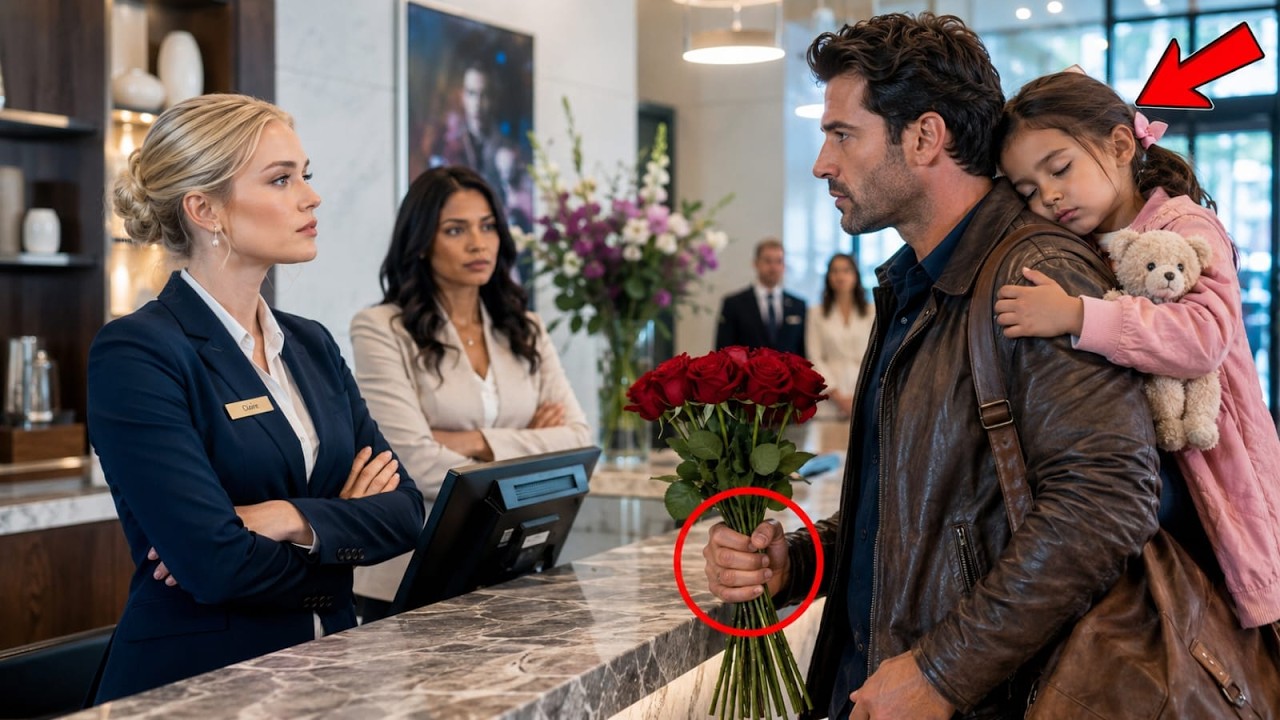
It was the particular kind of pain that came from carrying a sleeping child for too long and refusing to shift her because even the smallest movement might wake her.
Sophie lay against him with complete trust, her cheek pressed into the worn leather of his jacket. One pink sleeve had twisted beneath her body, one braid had nearly come undone, and her small hand still clutched a stuffed bear missing half of one ear.
Marcus carried her backpack over his other shoulder. It was filled with crayons, juice boxes, a change of clothes, a paperback about sea turtles, two plastic dinosaurs and several objects he had been unable to identify while packing that morning.
In his right hand, he held a bouquet of red roses bought at the airport.
One stem had bent during the flight.
Tomorrow would mark three years since Sophie’s mother had died.
Every year, Marcus and Sophie bought roses, placed them beside a photograph and told one story each about Anna. Some stories were funny. Some made Sophie ask questions Marcus did not know how to answer. Most ended with both of them sitting quietly together.
The Aldridge Grand lobby was crowded that Thursday evening.
A corporate reception occupied the central lounge. Men in tailored suits stood beneath crystal chandeliers, speaking over soft piano music and the constant clinking of glasses. Hotel staff moved quickly through the room carrying trays of champagne.
Marcus had spent most of the day traveling.
He did not want attention.
He wanted a room, a bed for Sophie and enough silence to prepare himself for the following morning.
He approached the front desk.
Two women stood behind it.
The taller one wore a fitted navy jacket and a name badge that read CLAIRE. Her blond hair was pinned into a smooth knot, and her expression suggested that every guest was an interruption until proven otherwise.
Beside her stood Renata, a dark-haired woman in a cream-colored uniform. Renata was not openly rude, but there was something guarded in the way she watched Marcus approach, as if she had already decided he did not belong there.
Marcus waited while Claire finished typing.
She looked up briefly.

“Yes?”
“I have a reservation. Marcus Whitfield.”
Claire glanced at Sophie, then at the old jacket, the roses and the overstuffed child’s backpack.
“Identification.”
Marcus shifted Sophie carefully and reached for his wallet.
Claire entered the name.
Her fingers moved across the keyboard for several seconds.
Then she stopped.
“There’s no reservation under that name.”
“There should be.”
Claire typed again, this time with exaggerated patience.
“No. Nothing.”
Marcus looked toward the screen, though he could not see it from where he stood.
“It may be under a company booking.”
“What company?”
“Whitfield Hospitality Group.”
Claire’s eyes flickered, but only for a moment.
“If it were a corporate reservation, it would appear here.”
“Could you check again?”
“I already did.”
Sophie moved slightly against his shoulder.
Marcus tightened his arm around her.
“I received a confirmation this morning.”
Claire looked past him toward the busy lobby.

“We are fully booked tonight.”
Marcus waited.
Claire did not continue.
“Then what do you suggest?”
“There’s a Marriott two blocks away.”
Her tone was flat, almost casual.
Marcus looked at her for a long second.
He had spent two decades in hospitality. He understood mistakes. Systems failed. Reservations were misplaced. Staff became overwhelmed.
But there was a difference between an error and a decision not to care.
“My daughter is asleep,” he said. “We have just come from the airport. I would appreciate it if you checked the secondary corporate reservations.”
Claire’s expression hardened.
“I have checked the system.”
“May I speak with the manager?”
“The manager is occupied with the event upstairs.”
“I can wait.”
“There is no point. The hotel is full.”
Renata leaned slightly toward Claire and whispered something.
Claire gave a small smile.
Marcus saw it.
Neither woman offered a chair.
Neither suggested storing the luggage.
Neither asked for the confirmation number.
They had made a judgment about him within seconds and were now defending it.
Marcus shifted his weight again.
The roses brushed against the counter, bending the damaged stem further.
That was when a woman in a burgundy vest crossed the lobby carrying a stack of folded sheets.
She was in her late fifties, perhaps early sixties, with salt-and-pepper hair tied behind her head. Her badge read DOLORES MENDOZA, HOUSEKEEPING SUPERVISOR.
She passed the desk, then slowed.
Marcus noticed the moment she understood that something was wrong.
She looked at Sophie.
Then at the roses.
Then at Marcus’s strained shoulder.
Dolores placed the sheets on a nearby luggage cart.
“Is everything all right?”
Claire answered before Marcus could.
“There’s no reservation, and we’re fully booked.”
Dolores looked at the screen.
“Did you check the secondary corporate tab?”
Claire’s jaw tightened.
“Yes.”
Dolores stepped closer.
“Show me.”
The lobby noise continued around them, but the space near the desk seemed to grow still.
Claire clicked through several screens.
Dolores pointed.
“That tab.”
Claire opened it.
Marcus watched her face change.
A reservation appeared.
A ninth-floor suite.
Marcus Whitfield.
Corporate authorization attached.
Claire stared at the screen.
Renata looked away.
Dolores turned toward Marcus.
“I’m sorry, sir. Your room is here.”
Marcus said nothing for a moment.
Claire began typing quickly.
“It was entered under a different category.”
“You said it wasn’t there,” Marcus replied.
Claire did not look at him.
“It did not appear in the primary search.”
Dolores took the room key from the printer and placed it on the counter.
“You’ve been standing too long. Let’s get you checked in.”
Her voice was not dramatic.
That was what made it powerful.
She noticed the roses.
“Anniversary?”
Marcus looked down at them.
“Memorial.”
Dolores’s expression softened.
“My wife died three years ago. Tomorrow.”
For the first time, Claire stopped typing.
Dolores reached across the counter and gently straightened the bent stem.
“My daughter and I bring roses every year,” Marcus continued. “It was her favorite flower.”
Dolores adjusted the paper around the bouquet.
“I’ll find you a vase before you go upstairs.”
“That isn’t necessary.”
“It is now.”
She turned toward Claire and spoke clearly enough for everyone behind the desk to hear.
“It’s the least this place can do after keeping you standing here so long.”
Marcus had been in the lobby for less than fifteen minutes.
But Dolores was the first person who had actually seen him.
Not the jacket.
Not the beard.
Not the exhausted father carrying a child who might cause trouble.
Him.
Within minutes, a bellman arrived for the bags. Dolores returned with a clear glass vase, filled halfway with water.
She placed the roses inside and adjusted the damaged stem so it rested among the others.
Sophie opened one eye.
She looked at Dolores.
Then she closed it again, pretending to be asleep.
Dolores smiled.
Marcus accepted the key.
Before walking toward the elevators, he turned back.
“I would still like to speak with the general manager.”
Claire looked suddenly alert.
“The manager is very busy.”
Marcus ignored her.
“Please ask Gregory Sandoval to meet me in the ninth-floor lounge in ten minutes.”
Renata looked at him more carefully.
Dolores said nothing, but Marcus saw curiosity in her expression.
He carried Sophie upstairs.
The suite was quiet, warm and prepared exactly according to the standards Marcus’s company had established years earlier.
He laid Sophie on the bed and removed her shoes. She barely moved.
He placed the one-eared bear beside her, covered her with a blanket and set the roses on the table near the window.
A few minutes later, someone knocked.
Gregory Sandoval entered.
He was a polished man in his early fifties, wearing a dark suit and a silver tie. His concerned expression became alarm when he recognized Marcus.
“Mr. Whitfield.”
“Gregory.”
“I didn’t know you were arriving tonight.”
“That was intentional.”
Marcus often visited his hotels without notice.
The Aldridge Grand was one of seven properties owned by Whitfield Hospitality Group. Marcus had inherited the first from his father but had built the others himself. He believed scheduled inspections revealed only what managers wanted executives to see.
Unannounced visits revealed how a hotel treated people who seemed unimportant.
Gregory glanced toward the sleeping child.
“Is everything satisfactory with the room?”
“The room is fine.”
Marcus gestured toward a chair.
“Sit down.”
Gregory did.
Marcus remained standing near the window.
“I arrived twenty minutes ago with my daughter asleep in my arms. Claire searched only the primary reservation screen, told me there was no booking and suggested I walk to another hotel.”
Gregory’s face tightened.
“She refused to check the corporate tab?”
“Until Dolores asked her to.”
“Renata was present?”
“Yes.”
“I’m very sorry.”
“I’m not looking for an apology.”
Gregory stopped.
Marcus spoke without anger.
“That is important. I am not asking you to fire anyone tonight. I do not want an emotional reaction because the owner was treated poorly.”
Gregory nodded carefully.
“Then what would you like me to do?”
“I want you to examine what kind of hotel we are operating.”
Marcus glanced at the roses.
“A housekeeping supervisor saw a tired man, a sleeping child and a damaged bouquet. She did not know who I was. She had no authority over the desk. She still stopped, checked the system, solved the problem and found a vase.”
He turned back toward Gregory.
“Meanwhile, the employees whose job was to welcome guests decided I was not worth the effort.”
Gregory lowered his eyes.
Marcus continued.
“If the person responsible for linens understands hospitality better than the people at reception, we do not have a front-desk problem. We have a culture problem.”
The words remained in the room.
Marcus’s voice stayed calm.
“That is what I want you to investigate.”
Gregory left with a promise to review the incident, previous complaints and staff performance records.
Marcus did not think about Claire or Renata again that night.
Sophie woke briefly around midnight.
“Are we at the hotel?”
“Yes.”
“Did we get the roses?”
“They’re by the window.”
She looked toward them.
“One is crooked.”
“It had a difficult trip.”
“Like us?”
Marcus smiled.
“Exactly like us.”
Sophie fell asleep again.
The following morning, they placed the roses beside a framed photograph of Anna that Marcus carried during the trip.
Sophie told a story about her mother singing the wrong words to a children’s song.
Marcus told a story about Anna insisting that every hotel room needed a comfortable reading chair, even if no one else cared.
They cried a little.
Then they ate pancakes.
Over the next week, Gregory conducted the review Marcus had requested.
The lobby incident was not isolated.
There had been four previous complaints about Claire’s dismissive behavior. Two guests reported being told rooms were unavailable even though reservations were later found. A family traveling with a disabled teenager had complained that Renata refused to contact a supervisor after an accessibility request was overlooked.
Each complaint had been handled separately.
Each had been explained away as stress, misunderstanding or difficult guests.
Together, they showed a pattern.
Both employees were dismissed the following week, not because they had failed to recognize the owner, but because they had repeatedly failed to treat ordinary guests with care.
Marcus considered that distinction essential.
No one should be punished for failing to flatter a powerful person.
They should be held accountable for consistently disregarding people they believed had no power.
Two days after arriving, Marcus prepared to check out.
Before leaving, he asked a staff member where Dolores was.
He found her in the employee break room, sitting at a small table with a cup of tea and a container of sliced fruit.
She stood immediately when he entered.
“Mr. Whitfield.”
“So you know who I am now.”
“The whole hotel knows.”
She looked uncomfortable.
“I hope I didn’t overstep the other night.”
“You didn’t.”
Dolores folded her hands.
“I was only trying to help.”
“That is why I’m here.”
Marcus sat across from her.
Dolores remained standing until he gestured toward the chair.
“I’m restructuring our regional training program,” he said. “Customer experience, guest recovery and staff leadership.”
Dolores looked puzzled.
“That sounds important.”
“It is.”
“I work in housekeeping.”
“I know.”
She gave a nervous laugh.
“Then I’m not sure why you’re telling me.”
Marcus leaned forward.
“You saw a man who was exhausted, a child who needed a bed and a flower stem that had been crushed.”
Dolores looked toward the table.
“You fixed all three in about ninety seconds, without being asked.”
“I found a reservation and a vase.”
“No. You recognized what mattered.”
She looked up.
“That is not a small skill. That is the entire skill.”
Dolores did not speak.
Marcus continued.
“I want you to help build the training program and coordinate it across all seven hotels.”
Her eyes widened.
“I’ve never done corporate training.”
“You have trained people for years.”
“Housekeepers.”
“Employees.”
“I don’t have a degree.”
“I’m not offering you the job because of a degree.”
Dolores looked overwhelmed.
Marcus softened his tone.
“You do not have to answer today.”
She took a breath.
“Why me?”
“Because hospitality is not a script.”
Marcus glanced toward the hallway.
“It is noticing what another person needs before they are forced to ask. Most companies teach language, procedure and presentation. I need someone who can teach attention.”
Dolores looked down at her tea.
“My husband died when our youngest was five.”
Marcus waited.
“I raised three children alone,” she said. “I worked mornings, nights, whatever I could get. There were days when I carried one child while holding groceries and dragging another by the hand.”
Her voice became quieter.
“When I saw you, I knew that kind of tired.”
Marcus nodded.
“That is exactly why you saw what the others didn’t.”
Dolores asked for several days to think.
Marcus agreed.
Five days later, after a long telephone conversation with her eldest daughter, Dolores accepted.
The position did not exist before her.
Marcus created it around what she already knew how to do.
Regional Customer Experience Training Coordinator.
The title sounded formal.
Dolores’s method was not.
She began every training session with one question.
“What did you notice before the guest spoke?”
At first, employees gave procedural answers.
Luggage.
Reservation status.
Room number.
Over time, Dolores taught them to look further.
A parent carrying too much.
A couple speaking too quietly.
A child afraid of the elevator.
A guest staring at signs because they could not read the language.
An elderly man pretending not to need help.
A woman holding flowers carefully because they meant something.
Dolores never told employees to perform kindness.
She taught them to pay attention.
Months later, Marcus visited her new office.
It was small but bright, with training schedules pinned across one wall. On another hung a framed photograph.
Inside the frame was the clear glass vase from the Aldridge Grand.
The red roses were slightly bruised, one stem still bent.
Beneath the photograph was the note Marcus had sent her.
Thank you for seeing us when it would have been so easy not to.
Years passed.
Sophie remembered little about the Aldridge Grand.
She remembered the chandeliers.
She remembered waking in a strange bed.
She vaguely remembered a woman with salt-and-pepper hair fixing the flowers while smiling at her.
When Sophie was older, she asked Marcus why he still talked about that night.
“Was it because the front-desk women didn’t know you owned the hotel?”
“No.”
“Was it because they were fired?”
“No.”
“Then why?”
Marcus thought about the answer.
They were sitting together in the garden behind their home. A vase of red roses stood on the table between them.
“It was the night I learned something again,” he said.
“What?”
“That kindness rarely arrives with a speech.”
Sophie waited.
“It usually arrives quietly. Someone notices a bent flower, a tired shoulder or a child who needs a bed. They fix what they can, even when no one important is watching.”
Sophie looked at the roses.
“And Dolores was important?”
“She was.”
Marcus smiled.
“She just didn’t have the title yet.”
The cruelty of that evening faded quickly.
Years later, Marcus could barely remember Claire’s exact words or the expression on Renata’s face.
But he remembered Dolores putting down the sheets.
He remembered her straightening the damaged rose.
He remembered the way she looked at Sophie as if a sleeping child mattered more than a crowded lobby.
That was the strange truth about difficult moments.
People often believed the insult would remain forever.
Usually, it did not.
What remained was the person who stepped closer.
The person who looked carefully.
The person who offered dignity when it would have been easier to walk past.
Not every exhaustion that enters a room is noticed.
Not every quiet grief is understood.
But when kindness appears in the most ordinary moment, freely given and expecting nothing in return, it becomes the part we carry longest.
Sometimes for the rest of our lives.