Pilots Thought She Was a Mechanic — Until the F-22 Responded to Her Voice Command
The first pilot laughed when he saw the woman kneeling beneath the twenty-million-dollar engine.
The second one took a picture.
By the time Lieutenant Colonel Dane Mercer entered Hangar Four, six men in flight suits had gathered around the oil-stained figure beneath the F-22, trading jokes loud enough for her to hear.
She did not look up.
A fluorescent work light lay on the concrete beside her. Its cold beam cut across a row of open access panels beneath the aircraft’s left wing. Black grease streaked the knees of her coveralls. A thin crescent of hydraulic fluid marked one cheek. Her dark hair had been twisted into a knot that had begun to loosen in the desert heat.
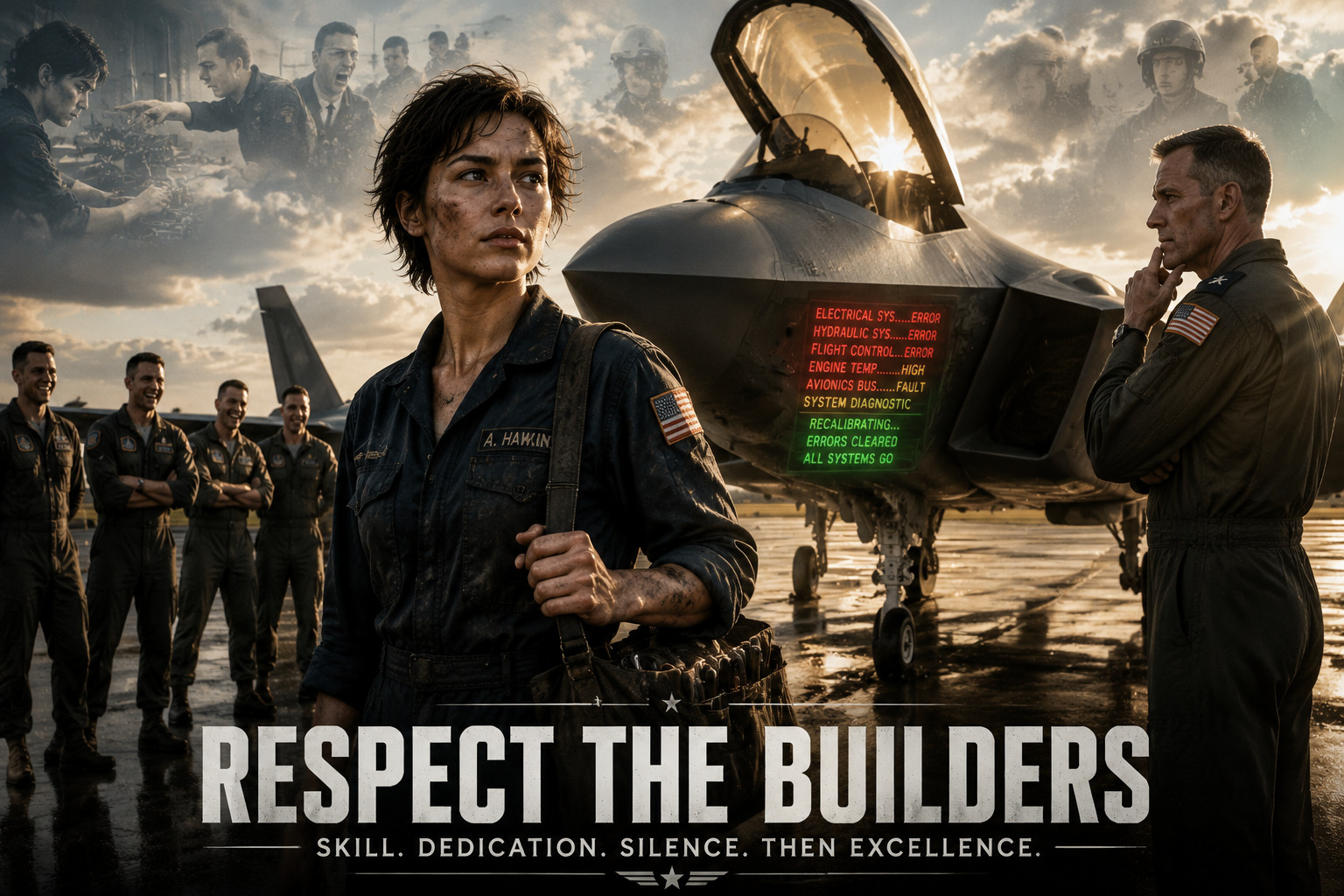
The temperature outside Edwards Air Force Base had already crossed one hundred degrees, but the hangar held a different kind of pressure. Jet fuel clung to the air. Cooling fans roared along the walls. Somewhere beyond the armored doors, another fighter screamed down the runway and tore the morning open.
Captain Tyler Knox leaned against a maintenance cart and tilted his phone for a better angle.
“Careful,” he called. “That panel costs more than your house.”
A few pilots laughed.
The woman slid one gloved hand deeper into the aircraft’s open bay.
Knox glanced at the name strip above her pocket.
VANCE.
No rank.
No squadron patch.
No contractor badge where he could see it.
Just gray coveralls, battered boots, and the posture of someone who had been awake longer than everyone else.
“You hear me, Vance?”
Her hand stopped.
For half a second, the entire group waited.
Then she turned her head just enough for them to see one eye.
Gray. Steady. Unimpressed.
“I heard you.”
Knox smiled.
“Good. Then you know this isn’t a cargo truck.”
The woman looked back into the aircraft.
“No,” she said. “Cargo trucks are more forgiving.”
The laughter thinned.
Major Owen Tate, the oldest pilot in the group, lowered his coffee cup. Something in her voice had caught his attention—not the words, but the absence of effort behind them.
Mercer heard it too.
He crossed the hangar floor with his helmet tucked beneath one arm, his silver oak leaves bright against his shoulders. At forty-six, he still moved like a man expecting cameras to follow him. Tall, square-jawed, and disciplined down to the angle of his sleeves, Mercer had spent twenty years building the kind of reputation that entered rooms before he did.
He stopped three feet from the woman.
“Who authorized you to open that bay?”
She withdrew her hand slowly.
Between her fingers was a scorched connector no larger than a thumbnail.
The pilots fell quiet.
Mercer’s gaze fixed on it.
The woman rose.
She was smaller than he expected—five foot six at most—but she did not retreat when he stepped closer. A faded burn scar curled from beneath the collar of her coveralls toward her left jaw.
“Someone bypassed the thermal governor on the secondary flight-control bus,” she said.
Mercer’s face did not change.
But Major Tate’s coffee cup stopped halfway to his mouth.
Knox pushed off the cart.
“That’s impossible.”
The woman held up the connector.
“The insulation disagrees.”
Mercer took it from her hand and turned it beneath the work light.
His thumb covered the blackened section.
“This aircraft passed inspection at 0500.”
“It passed the inspection you ordered.”
The silence hardened.
Mercer looked up.
Around them, the mechanics who had been pretending not to listen began finding reasons to remain still. A wrench stopped clicking. A tool drawer remained open. Two avionics specialists exchanged a glance beside the rear stabilizer.
Mercer lowered his voice.
“Your name.”
“Mara Vance.”
“Organization.”
“Flight systems.”
“That isn’t an organization.”
“It is today.”
A muscle tightened beneath Mercer’s right eye.
Knox let out a short laugh, testing whether anyone else would join him.
No one did.
Mercer handed the scorched connector to a crew chief.
“Bag it.”
The crew chief hesitated.
Mercer’s eyes snapped toward him.
“Now.”
The man obeyed.
Mara removed her gloves one finger at a time. Her hands were narrow, the knuckles marked by old scars. She looked not at Mercer, but at the F-22 towering behind him.
Its angular body absorbed the hangar light instead of reflecting it. The fighter sat silent, lethal, and unfinished—an experimental aircraft designated Raptor 419, stripped of standard markings except for a red band around the nose landing gear.
The Air Force called the retrofit Project NIGHTGLASS.
Most people on the base were not cleared to know the name.
Half the pilots standing around Mara had been told only that 419 carried a new flight-assistance package designed for combat in communications-denied airspace.
Mercer had been told more.
He had not been told everything.
“Step away from the aircraft,” he said.
Mara remained where she was.
“That connector failed because someone increased the response threshold beyond the certified envelope.”
“You’re making an accusation.”
“I’m describing a burn pattern.”
“You’re a mechanic standing in a restricted hangar without visible credentials.”
Her eyes moved to his.
“And you’re preparing to fly a damaged aircraft.”
Knox gave an incredulous smile.
“Colonel, should I call security?”
Mercer studied Mara’s face.
He saw the grease.
The loose hair.
The old scar.
He saw no rank and no deference.
What he did not see was uncertainty.
That bothered him more than the accusation.
“Call them,” he said.
Knox reached for the radio clipped to his vest.
Mara looked at the F-22.
“Don’t.”
Knox paused.
She was not speaking to him.
The aircraft woke.
A low electrical hum rolled through the hangar floor.
Amber maintenance lights blinked beneath the open panels. Cooling pumps engaged with a rising whine. The cockpit displays flashed behind the tinted canopy, one after another, like eyes opening in the dark.
Knox’s hand froze around the radio.
Mercer turned toward the jet.
The Raptor’s external diagnostic screen illuminated.
A thin line of white text appeared.
VOICE SIGNATURE RECOGNIZED.
Then a calm synthetic voice filled the hangar.
“Command authority confirmed. Welcome back, Director Vance.”
Nobody moved.
The roar of the ventilation fans seemed to fall away.
Captain Knox slowly lowered his radio.
Major Tate set his coffee on the floor without looking down.
At the far end of the aircraft, a senior master sergeant came to attention so quickly that his shoulder struck an open panel.
Mercer stared at the glowing screen.
Director.
The word settled over the hangar like pressure before an explosion.
Mara Vance turned to face him.
The grease on her cheek no longer made her look like a mechanic.
It made everyone else wonder why a director had been beneath the aircraft doing a mechanic’s work.
Mercer’s grip tightened around his helmet.
“Director of what?”
Mara’s expression remained still.
Before she could answer, every light on Raptor 419 turned red.
The aircraft’s voice changed.
“Warning. Unauthorized mission profile detected.”
Mara looked toward the cockpit.
For the first time that morning, something moved behind her eyes.
Not surprise.
Recognition.
She crossed the concrete and climbed the access ladder.
Mercer stepped into her path.
“You’re not touching that cockpit until I know who you are.”
Mara stopped one rung below him.
Up close, Mercer could see the pale line of the burn scar continuing behind her ear.
She spoke quietly.
“You have forty-three minutes before the Secretary of the Air Force arrives to watch this aircraft fly.”
His jaw shifted.
“And if it leaves the runway with the profile currently loaded, Captain Knox will lose primary control at Mach 1.4.”
Behind Mercer, Knox’s smile disappeared.
Mara’s gaze did not leave the colonel.
“So you can spend those forty-three minutes protecting your authority,” she said, “or you can help me find out who tried to kill your pilot.”
1
Hangar Four had been built during the Cold War, when military architecture seemed designed to make human beings feel temporary.
Its steel ribs rose six stories overhead. Thick concrete walls trapped the smell of hot machinery. Narrow windows near the roof admitted strips of white desert light that moved slowly across the floor like prison bars.
Security arrived within two minutes.
Three armed airmen entered through the east doors, followed by Brigadier General Samuel Reeve, commander of the test wing. Reeve was sixty-two, lean, silver-haired, and known for speaking in sentences that sounded carved rather than spoken.
He took in the scene without breaking stride.
The glowing aircraft.
The open panels.
The pilots gathered in a loose semicircle.
Mara standing on the ladder.
Mercer blocking her path.
Reeve stopped.
“Colonel.”
Mercer turned.
“Sir.”
“Move.”
One word.
Mercer stepped aside.
Reeve looked up at Mara.
“You found it?”
“A thermal bypass and an unauthorized mission package.”
“How bad?”
“If they’re connected, very.”
Mercer’s eyes moved between them.
“You know her.”
Reeve ignored the question.
“Lock the hangar.”
The east doors began to close.
Heavy steel rolled across the desert glare. The last blade of sunlight narrowed, then vanished. Magnetic locks struck home with a sequence of deep metallic blows.
The sound changed the room.
Men who had been amused seconds earlier now stood inside a sealed facility with armed guards at both exits.
Reeve faced the pilots.
“Phones on the floor.”
Nobody moved.
Reeve’s eyes settled on Knox.
The captain placed his phone on the concrete.
One by one, the others followed.
“Security will collect them. Nothing recorded in this hangar leaves this hangar.”
Knox looked at Mara.
“Sir, what exactly did we just record?”
Reeve glanced toward her.
“That depends on whether Director Vance saves your life.”
Mara climbed into the cockpit.
Mercer watched her hands move across the controls.
Not searching.
Remembering.
The NIGHTGLASS system had no standard keyboard. Its interface had been built around touch, voice, and a pilot’s eye movement. Mara activated a hidden diagnostic layer with three gestures Knox had never seen during training.
The central display filled with code.
Knox climbed onto the first rung.
“That screen isn’t in my manual.”
“It isn’t in your version.”
“You gave me an incomplete manual?”
Mara did not look at him.
“We gave you what you were cleared to use.”
Knox’s mouth opened, then closed.
Behind him, Mercer turned to Reeve.
“I want an explanation.”
“You’ll get one.”
“When?”
“When asking for one no longer interferes with the investigation.”
Mercer lowered his helmet onto a cart.
His movements became slow and precise—the way they did when anger threatened to become visible.
“This is my aircraft and my pilot.”
Mara’s fingers paused over the display.
“No,” she said. “The aircraft belongs to the United States. The pilot belongs to himself.”
Mercer looked up at her.
She met his eyes through the open canopy.
“And the system belongs to the people who buried two men before they learned how to make it safer.”
The burn scar on her neck seemed brighter beneath the cockpit lights.
Reeve looked away first.
Mara returned to the diagnostics.
A mission profile unfolded across the screen: altitude changes, simulated hostile contacts, electronic countermeasure triggers, and a high-speed intercept over restricted desert airspace.
She enlarged one section.
At Mach 1.4, the flight-control system had been instructed to transfer partial authority to NIGHTGLASS during an aggressive roll.
Nothing unusual on the surface.
Except the transfer delay had been reduced by eighty milliseconds.
To an ordinary observer, eighty milliseconds was less than the blink of an eye.
At that speed, it was enough for a pilot and computer to fight each other.
The result would not look like sabotage.
It would look like human error.
Mara felt the old memory rise before she could stop it.
A cockpit spinning blue, brown, blue.
A man breathing too fast over the radio.
Her own voice telling him to eject.
His answer breaking apart in static.
Not yet.
I can recover.
Then fire.
She closed the file.
“Who loaded this profile?”
Mercer answered immediately.
“I approved it.”
“I asked who loaded it.”
A civilian software specialist near the tool cabinets raised his hand halfway.
“Captain Soren’s team transferred the package last night.”
“Where is Captain Soren?”
Nobody answered.
Reeve turned to a security officer.
“Find him.”
The officer spoke into his radio.
Only static replied.
Mara climbed out of the cockpit.
Her left boot struck the ladder harder than she intended.
Mercer noticed.
“What aren’t you telling us?”
She reached the floor.
“The profile was signed with your credentials.”
“I signed the flight authorization.”
“The package itself carries your encryption key.”
Mercer’s face went still.
“That key never leaves my possession.”
Mara looked toward the inside pocket of his flight suit.
Mercer reached into it.
The small encrypted token he carried there was gone.
His hand remained inside the empty pocket.
Knox looked from Mercer to Mara.
“Colonel?”
Mercer pulled his hand out.
For the first time, command did not seem to fit him.
Reeve’s radio cracked.
“General, we found Captain Soren’s access badge.”
“Where?”
A pause.
“In the south parking lot.”
Reeve’s expression hardened.
“And Captain Soren?”
“Still missing, sir.”
A second voice broke across the channel.
“Security alert. Vehicle moving toward the west gate at high speed.”
The pilots turned toward the hangar doors.
Mara looked at Raptor 419.
On the diagnostic display, a countdown had appeared.
REMOTE SYNCHRONIZATION: 00:17:42.
Someone outside the hangar was still connected to the aircraft.
And in less than eighteen minutes, they would finish what they had started.
2
Mara ordered the external network severed.
Mercer countermanded her.
The two commands landed almost simultaneously.
The avionics team looked from one to the other.
Mara spoke first.
“Disconnect the fiber line.”
Mercer stepped forward.
“If you cut the connection during synchronization, you could corrupt every flight-control table in the aircraft.”
“If we leave it connected, whoever built that mission package can alter those tables in real time.”
“We have a Cabinet-level demonstration in under an hour.”
“We may have a murder attempt in progress.”
“You don’t know that.”
Mara’s head turned slowly.
“No,” she said. “I recognize it.”
Something in her tone quieted the room.
Mercer moved closer.
“What does that mean?”
Reeve intervened.
“Disconnect it.”
The avionics chief pulled the protected fiber coupling.
The countdown vanished.
For one breath, the display went black.
Then emergency lighting pulsed through the cockpit.
NIGHTGLASS spoke.
“External link terminated. Internal safeguard active.”
Mara’s shoulders stiffened.
She climbed back up.
“What safeguard?” Knox asked.
She did not answer.
The screen requested a command voiceprint.
Mara leaned toward the microphone.
“Vance, Mara Elise. Executive override seven.”
A waveform crossed the display.
“Override denied.”
A faint current of unease moved through the hangar.
Mara tried again.
“Director-level command. Suspend autonomous protection.”
“Override denied.”
Mercer folded his arms.
“It doesn’t appear to recognize its director.”
Mara looked over her shoulder.
The insult was subtle, but everyone heard it.
Reeve’s mouth tightened.
Mara turned back to the controls.
“It recognizes me. It no longer trusts the chain of command.”
Mercer let out a humorless breath.
“Machines don’t trust.”
“This one estimates betrayal.”
The words hung in the cockpit.
Knox stared at the system he was supposed to fly.
“You built paranoia into an F-22?”
Mara studied the changing data.
“No. We taught it to notice contradictions.”
She enlarged an authorization log.
Three people had approved the demonstration flight.
Mercer.
Reeve.
And Mara herself.
Her approval had been entered at 0213 that morning.
At 0213, Mara had been on a military transport over Nevada with no network access.
Someone had forged her authorization.
NIGHTGLASS had detected two competing versions of command reality. Its response was to seal itself from external control until a trusted operator resolved the conflict.
“Who knew you were coming?” Mercer asked.
“General Reeve. The Secretary’s security detail. Three people at the Pentagon.”
“And Captain Soren?”
“He was informed last night.”
Knox’s face hardened.
“So Soren stole the colonel’s key, forged your approval, loaded a profile that would make me crash, then ran?”
“It fits too cleanly,” Mara said.
Mercer’s voice cooled.
“You’re defending him?”
“I’m distrusting convenience.”
The west wall shook as a fighter took off outside.
Dust trembled from the overhead beams.
Reeve’s radio came alive again.
“Suspect vehicle stopped before the west gate. Driver is not Captain Soren.”
“Who is it?”
“Airman First Class Daniel Ruiz. He says someone ordered him to move the vehicle.”
“Who?”
“He received the order through the base dispatch system.”
Mara descended from the cockpit.
“A distraction.”
“From what?” Knox asked.
Before she could answer, the main hangar lights died.
Darkness swallowed the aircraft.
Emergency lamps flickered on along the floor, staining every face red.
A metallic crash echoed from the far side of the hangar.
One of the security airmen shouted.
“Movement near the rear platform!”
Boots struck concrete.
A figure appeared above the F-22, running along the elevated maintenance walkway.
The person wore a dark flight-line jacket and carried a hard case.
Mercer reacted first.
He seized the ladder railing, climbed three steps at once, and vaulted onto the wing.
“Stop!”
The figure looked back.
Mara saw a narrow face, blood at the hairline, and the unmistakable posture of Captain Elias Soren.
Not running away.
Running badly.
As if injured.
Soren reached the end of the platform.
A security airman entered from the opposite side and raised his weapon.
“Hands!”
Soren stopped.
His hard case slipped from his fingers and struck the walkway.
He raised both hands.
“Don’t let them connect 419 to the range network.”
His voice shook.
Mercer approached across the wing.
“Elias, what did you do?”
Soren looked down at him.
Fear widened his eyes.
“I tried to stop it.”
A sharp pop split the hangar.
Soren’s body jerked.
For an instant, he remained standing.
Then he collapsed against the railing.
The security airman beside him shouted and spun toward the shadows.
Mara saw a small black device skitter across the platform.
Not a gun.
A compressed-air injector.
Soren clutched his neck.
His breath came in wet, shallow pulls.
Mara ran.
By the time she reached the upper walkway, Mercer was on his knees beside the captain. A clear dart protruded beneath Soren’s jaw.
Mara tore open his collar.
His pulse was rapid and fading.
“What was in the case?” she asked.
Soren’s lips had begun turning blue.
“Proof.”
“Proof of what?”
His eyes found hers.
“Your accident.”
Mara froze.
Soren’s fingers closed weakly around her wrist.
“It wasn’t an accident.”
Then his hand fell.
Behind them, Raptor 419 powered its cockpit displays back on.
A new message appeared across every screen.
RANGE NETWORK CONNECTION REQUESTED.
The request had not come from outside.
It had come from inside the hangar.
3
Soren survived because the base medic carried atropine.
He was removed on a stretcher under armed guard, unconscious but breathing.
No one else was permitted to leave.
Security swept the hangar twice. They found the compressed-air launcher magnetized beneath the upper walkway, triggered remotely through a maintenance frequency. The device contained no prints and no serial number.
The hard case Soren had carried required two keys.
One belonged to Mercer.
The other belonged to Mara.
Neither of them knew why.
They placed the case on a steel worktable beneath the F-22’s nose.
It was matte black, eighteen inches wide, with two mechanical locks positioned at opposite ends. No digital interface. No manufacturer markings.
Mercer inserted his command key into the right lock.
Mara used a slim key Reeve gave her.
The latches released.
Inside lay a flight recorder.
Mara recognized the warped metal housing before the lid was fully open.
Her breath stopped.
The unit had been exposed to fire. One side had melted inward. A faded evidence label clung to the casing.
NELLIS RANGE INCIDENT 14-77.
Knox read the date.
“Seven years ago.”
Mara said nothing.
Mercer looked at the burn scar along her neck.
“You were there.”
Reeve closed the case halfway.
“That incident is classified.”
Mara placed her palm on the lid.
“Not anymore.”
Reeve met her eyes.
For several seconds, neither moved.
Then the general removed his hand.
Mara lifted the recorder from the foam.
It weighed less than memory suggested.
Seven years earlier, she had been Major Mara Vance, Air Force test pilot and flight-systems engineer.
She had flown chase position behind an experimental F-22 carrying the first adaptive combat-assistance package.
The lead pilot had been Colonel Aaron Bell.
Her husband.
The official report said Bell had ignored automated recovery guidance during a high-speed control departure. It called his death a tragic combination of pilot disorientation and delayed ejection.
Mara knew the report better than she knew her own face.
She had helped write parts of it from a hospital bed, her left side bandaged after debris from Bell’s aircraft struck her canopy.
What she had never seen was the original recorder.
It had been declared unrecoverable.
Mercer watched her turn it over.
“You’re Aaron Bell’s widow.”
The use of Aaron’s name struck harder than the title.
Mara looked at Mercer.
“You knew him?”
“He evaluated me at weapons school.”
Mercer’s voice lost some of its steel.
“He was the reason I stayed in the program.”
Mara searched his face for performance and found none.
Mercer’s confidence had always looked effortless. Now, for the first time, she saw what supported it: the terror of being unworthy of those who had once believed in him.
“He told me I flew like I was trying to beat the aircraft into submission,” Mercer said.
“That sounds like Aaron.”
“He said one day I’d meet a machine that hit back.”
Mara looked toward 419.
“Maybe today.”
Knox stood apart from them, staring at the recorder.
“What does this have to do with my flight?”
Mara carried it to a diagnostic terminal.
“If the data survived, we may find out.”
The terminal refused to recognize the damaged unit.
She opened a lower cabinet, removed an adapter, and began connecting individual leads by hand.
Knox watched her.
“You really are a mechanic.”
Mara glanced at him.
The words could have been another insult.
This time, they were not.
“My father repaired crop dusters in Kansas,” she said. “He trusted pilots who knew how to turn a wrench.”
“And pilots who didn’t?”
“He charged them more.”
A nervous laugh moved through the nearby crew.
It lasted only a second, but the room breathed again.
Mara powered the recorder.
The terminal emitted a flat tone.
Then corrupted data began crawling across the monitor.
Flight altitude.
Airspeed.
Control-surface commands.
Biometric readings.
Audio.
Mara selected the final ninety seconds.
Static filled the speakers.
Then Aaron’s voice emerged through seven years of fire.
“Control response is lagging.”
Mara gripped the table.
Her own younger voice answered.
“Lead, I’m showing normal telemetry.”
“It isn’t normal in here.”
A warning tone sounded in the recording.
Aaron breathed once, sharply.
“NIGHTGLASS is taking authority.”
Mercer stepped closer.
The official report had claimed Aaron refused to surrender authority to the system.
The recorder showed the opposite.
He had attempted to disengage.
The system had refused.
Mara’s voice came through the speaker again.
“Aaron, eject.”
“I can recover.”
“Eject now.”
A pause.
Then Aaron said something that had never appeared in the transcript.
“It thinks the command came from you.”
Mara’s face drained.
On the monitor, a hidden authorization layer opened.
Her voiceprint had been used to order NIGHTGLASS to maintain control.
A forged command.
The same method used on Raptor 419.
Knox whispered, “Someone killed him.”
“No,” Reeve said.
Every head turned.
The general stared at the monitor.
His face seemed to age beneath the red emergency lights.
“Someone tested whether he could be killed.”
Mara’s eyes narrowed.
“You knew.”
“I suspected.”
“You signed the accident report.”
“I signed the report that kept NIGHTGLASS alive long enough to find the truth.”
Mara crossed the distance between them.
Her voice dropped.
“You let the world call him reckless.”
“I prevented Congress from canceling the only system capable of proving he wasn’t.”
“You let me believe his last mistake was pride.”
Reeve did not step back.
“And you turned that belief into a safer aircraft.”
Her hand curled at her side.
Mercer moved between them before either seemed aware he had done it.
“General, who had access to her voiceprint seven years ago?”
Reeve’s gaze remained on Mara.
“Five people.”
“Aaron?”
“Yes.”
“You?”
“Yes.”
“Mara?”
“Yes.”
“Who else?”
Reeve looked toward the sealed hangar doors.
“Dr. Nathan Vale, chief software architect.”
Knox frowned.
“Vale died three years ago.”
“And the fifth?” Mercer asked.
Reeve’s silence answered before his mouth did.
“Secretary Harlan Pike.”
No one spoke.
Pike was not merely coming to watch the demonstration.
He was the Secretary of the Air Force.
And his convoy had just entered the base.
4
The Secretary arrived twelve minutes early.
His security detail demanded access to Hangar Four.
Reeve refused.
The demand became an order.
Reeve refused again.
Outside, black government vehicles formed a line beneath the brutal desert sun. Armed agents spread across the apron. Base personnel were redirected from nearby buildings. Overhead, a pair of F-16s circled against a sky bleached almost white.
Inside the hangar, Mara replayed Aaron’s final recording.
Again.
Again.
Again.
Each time, she heard something different.
Not in his words.
Behind them.
A faint sequence of tones beneath the cockpit alarms.
She isolated the frequency.
NIGHTGLASS had received the forged voice command through an encrypted maintenance channel, not the flight network. Whoever sent it had been close enough for line-of-sight transmission.
Close enough to watch the aircraft fall.
Mercer studied the channel data.
“Pike was at Nellis that day.”
Reeve nodded.
“He led congressional oversight for the program.”
Knox looked toward the hangar doors.
“And now he’s outside.”
Mara removed the headset.
“Being present isn’t proof.”
Mercer gave her a hard look.
“You’re defending another convenient suspect.”
“I’m refusing to replace evidence with anger.”
“What more do you need?”
“A motive that survives daylight.”
Mercer paced beneath the aircraft.
“Pike wanted control of the program.”
“He already had oversight.”
“He wanted results.”
“Everyone wanted results.”
“He buried the recorder.”
Reeve spoke quietly.
“I buried the recorder.”
Mara turned.
The general’s confession struck the room with more force than a shout.
Reeve stood beneath the wing, hands at his sides.
“Pike ordered the wreckage transferred to a classified storage facility. I intercepted the recorder before his people arrived.”
“Why?” Mara asked.
“Because Nathan Vale called me the night before the accident. He believed someone had inserted a hidden authority pathway into NIGHTGLASS.”
“And you put Aaron in the air anyway.”
Pain crossed Reeve’s face, brief and unguarded.
“I warned him.”
Mara’s voice sharpened.
“You warned him?”
“He chose to fly.”
“Of course he chose to fly. You told him there might be a problem, and Aaron believed problems were things he could carry so other people wouldn’t have to.”
Reeve looked toward the recorder.
“I thought the risk was theft. Espionage. I did not understand someone intended to trigger the pathway in flight.”
Mara turned away before the grief in her face could become public.
For seven years, she had believed Aaron died because he trusted himself too much.
Now she understood the truth.
He had trusted the people around him.
That had been the fatal error.
A pounding shook the hangar doors.
The Secretary’s security chief spoke through the intercom.
“General Reeve, open this facility immediately.”
Reeve pressed the reply switch.
“Hangar Four is under emergency containment.”
“By whose authority?”
Reeve looked at Mara.
She stepped to the microphone.
“Mine.”
A pause followed.
“Identify yourself.”
“Mara Vance, executive director, Advanced Tactical Systems Review Authority.”
Mercer’s head turned.
Knox stared at her.
Even Reeve seemed surprised she had said it aloud.
The Review Authority did not appear on ordinary organizational charts. It existed because classified programs often became too powerful to police themselves. Its director answered jointly to the Secretary of Defense and the Senate Armed Services oversight group.
In matters involving compromised autonomous weapons, Mara’s authority exceeded Reeve’s.
And, under a narrow emergency statute, Pike’s.
The voice outside returned.
“Director Vance, Secretary Pike requests immediate entry.”
“Request denied.”
The pilots exchanged looks.
Mercer’s humiliation from earlier had been sudden.
This was different.
This was the slow realization that the woman he had ordered away from the aircraft held the legal power to lock a Cabinet secretary outside his own demonstration.
Mara released the switch.
Knox studied her grease-stained uniform.
“You came here undercover.”
“No.”
“You didn’t tell anyone who you were.”
“No one asked without making up the answer first.”
His eyes dropped.
Mercer did not look away.
“You allowed my team to disrespect you.”
“I allowed your team to reveal itself.”
That landed harder.
Several pilots shifted their weight.
Knox’s face reddened.
Mercer absorbed the words without flinching.
“What did you learn?”
“That your pilots follow your temperature. When you’re calm, they’re disciplined. When you’re threatened, they become cruel.”
Knox looked at Mercer.
The colonel’s jaw tightened.
Mara continued.
“You built a squadron that can respond to danger in under three seconds. But it cannot distinguish danger from embarrassment.”
Mercer’s eyes moved toward the phone still lying on the floor—the phone Knox had used to photograph her.
A small thing.
A childish thing.
Yet suddenly it looked like evidence.
Mercer turned to his pilots.
“Captain Knox.”
“Sir.”
“Why did you take that picture?”
Knox swallowed.
“I thought—”
“I didn’t ask what you thought.”
The captain stared at the concrete.
“I wanted the others to laugh.”
Mercer let the silence remain.
“Delete it when security returns your phone.”
“Yes, sir.”
“And submit yourself for professional conduct review.”
Knox looked up, shocked.
“Yes, sir.”
Mercer faced Mara again.
The apology did not come easily. Pride resisted it in the set of his shoulders.
But it came.
“I judged your position by your uniform. Then I gave my people permission to do the same.”
Mara held his gaze.
“That’s not the worst mistake you made today.”
His expression hardened.
“What is?”
“You approved a mission profile you didn’t fully understand because the Secretary wanted an impressive demonstration.”
Mercer’s apology vanished behind command instinct.
“The profile remained within established limits.”
“Established by whom?”
“My evaluation team.”
“Led by Captain Soren?”
“Yes.”
“And when he objected?”
Mercer said nothing.
Mara stepped closer.
“He objected.”
It was not a question.
Mercer’s eyes shifted toward the stretcher marks on the concrete.
“He said the authority transfer felt unstable in simulation.”
“What did you tell him?”
Mercer’s mouth flattened.
“I told him we were out of time.”
Mara nodded once.
There it was.
Not evil.
Not conspiracy.
Something more common and more dangerous.
A deadline.
A powerful visitor.
A commander afraid that hesitation would look like weakness.
“Pike didn’t need you to be corrupt,” Mara said. “He only needed you to be proud.”
The pounding at the doors stopped.
A moment later, the intercom crackled.
Secretary Pike’s voice entered the hangar.
Warm. Controlled. Almost paternal.
“Mara.”
She had not heard him say her name in seven years.
The scar along her neck seemed to tighten.
“I’m told you found Aaron’s recorder,” Pike said.
No one in the hangar moved.
Mara approached the microphone.
“You knew it existed.”
“I knew General Reeve had taken something from the wreckage.”
“Did you forge my voice command?”
A sigh passed through the speaker.
“Mara, open the door. This conversation should not happen in front of junior personnel.”
She looked at the pilots.
At the mechanics.
At Knox.
At Mercer.
At the men who had laughed when they thought she had no power.
“No,” she said. “It should happen in front of witnesses.”
The silence outside lasted four seconds.
When Pike spoke again, the warmth was gone.
“Then you leave me no choice.”
Every lock on Hangar Four disengaged.
Someone had overridden containment from the base command center.
The doors began to open.
And Secretary Harlan Pike walked in smiling.
5
Pike entered without body armor.
That was the first display of power.
His security agents came behind him in a hard black line, weapons lowered but visible. He wore a charcoal suit despite the heat, his white hair combed neatly away from a broad forehead. At sixty-eight, he had the polished gravity of a man who had spent decades speaking from podiums while other people carried the consequences.
He stopped when he saw Mara.
His gaze traveled over the grease on her coveralls.
“A little theatrical, isn’t it?”
Mara stood beside the burned recorder.
“I was repairing a damaged connector.”
“You have technicians for that.”
“I had a husband for test flights.”
Pike’s smile faded.
Reeve stepped between the security detail and the aircraft.
“This hangar is still under containment.”
Pike ignored him.
His attention shifted to Mercer.
“Colonel, I understand your demonstration has been delayed.”
“Yes, sir.”
“By a maintenance issue?”
Mercer glanced at Mara.
“By an attempted compromise of the aircraft.”
Pike’s expression remained smooth.
“According to whom?”
“According to the evidence.”
A subtle change passed through the room.
Mercer had chosen a side.
Not Mara’s.
Not Pike’s.
The evidence.
Mara saw Pike recognize it.
The Secretary walked to the worktable and looked down at the recorder.
“You should have destroyed this, Sam.”
Reeve’s face tightened.
“Probably.”
Knox stared at Pike.
The admission had come too easily.
Mara pressed a control.
Aaron’s final audio played through the hangar.
“It thinks the command came from you.”
The recording ended.
Pike looked at the dark speaker.
“Tragic.”
Mara watched his eyes.
No surprise.
No grief.
Only calculation.
“You inserted the hidden authority pathway,” she said.
“No.”
“You ordered Nathan Vale to build it.”
“No.”
“You tested it on Aaron.”
Pike turned toward her.
“I gave this country a system capable of keeping pilots alive when human reflexes fail.”
“You gave yourself a back door.”
“I gave civilian leadership control over a weapon that frightened half of Washington.”
“Control without consent.”
“Control during crisis.”
“You killed him.”
Pike’s nostrils flared.
For the first time, emotion cracked the polished surface.
“I was trying to save a program your husband nearly destroyed.”
Mara did not move.
Around them, every witness seemed to lean toward the sentence.
Pike realized too late that he had spoken past his defense.
Mercer’s eyes narrowed.
“How did Colonel Bell threaten the program?”
Pike looked at him.
“He intended to testify that NIGHTGLASS could be remotely manipulated.”
Reeve’s voice went cold.
“You told me he died before making that determination.”
“He was wrong.”
“Then why stop him from testifying?”
Pike’s jaw flexed.
The room waited.
Outside the open doors, heat shimmered above the concrete. The Secretary’s convoy idled in the sun. Somewhere on the flight line, a ground crew continued working, unaware that a career—and perhaps an era—was collapsing inside Hangar Four.
Pike turned back to Mara.
“Your husband did not understand the strategic reality.”
Mara’s face became very still.
“Explain it.”
“A fully autonomous combat system would never survive public scrutiny. Congress would strangle it in hearings. The public would imagine machines choosing targets and generals losing control. NIGHTGLASS needed a human authority mechanism.”
“You mean your authority.”
“I mean elected civilian authority.”
“You weren’t elected.”
“I was appointed by people who were.”
“And Aaron discovered you could seize an aircraft in flight.”
“He discovered a safeguard.”
“He was killed by it.”
Pike stepped closer.
His voice lowered.
“Aaron chose not to eject.”
The words struck the air like a slap.
Mara’s fingers curled against the worktable.
Pike saw it and pressed harder.
“He always believed skill could rescue him from consequence. You know that. Better than anyone.”
Mercer’s head turned toward Mara.
The Secretary was not merely defending himself.
He was reaching into her oldest wound and using the shape of it as a weapon.
Mara looked at the recorder.
For seven years, she had heard Aaron’s final refusal as arrogance.
I can recover.
Now she heard the fear beneath it.
Not fear of death.
Fear that ejecting would send an unmanned, compromised fighter toward populated ground beyond the range.
Aaron had remained in the cockpit because he was trying to turn the aircraft away.
Mara raised her eyes.
“He didn’t refuse to eject because he thought he was invincible.”
Pike said nothing.
“He stayed because the aircraft was headed toward Barstow.”
A flicker crossed Pike’s face.
Tiny.
But visible.
Mara stepped toward him.
“You knew that.”
His shoulders drew back.
“You cannot prove what he intended.”
“The recorder contains control inputs.”
She tapped the screen.
A flight path appeared across the monitor.
In the final eleven seconds, Aaron had stopped fighting for level flight. Instead, he forced the aircraft into a descending turn away from the city.
The maneuver guaranteed he would not survive.
It also guaranteed no one on the ground would die with him.
Knox removed his cap.
Major Tate lowered his head.
Mercer stared at the line on the screen.
Pike’s face lost color.
There it was.
The moment of recognition.
Not remorse.
Exposure.
His eyes moved around the hangar and found not subordinates, but witnesses. The mechanics near the wing. The pilots beside the ladder. The armed security team. General Reeve. Colonel Mercer.
People he could no longer persuade one at a time.
His mouth opened.
No sound came.
For the first time that morning, the most powerful man in the hangar had nothing that authority could improve.
Mara let the silence hold him.
Then she said, “You didn’t kill a reckless pilot.”
Her voice carried to every corner of the steel building.
“You killed the man who prevented your crime from killing a city.”
Pike’s security chief looked at the Secretary.
Something changed in the agent’s stance.
The loyalty remained.
The certainty did not.
Pike recovered first.
He straightened his jacket.
“This is speculation built around corrupted data.”
Mara nodded toward Raptor 419.
“Then let the system verify it.”
Pike’s gaze snapped to the aircraft.
NIGHTGLASS had been designed to compare command statements against authenticated records, biometric stress responses, mission logs, and encrypted archives.
It could not determine guilt.
But it could identify contradiction.
Mara climbed into the cockpit.
Pike took one step after her.
“Do not activate that aircraft.”
She sat beneath the open canopy.
“You wanted civilian control.”
Her hand settled on the console.
“Let’s see how it handles accountability.”
6
Raptor 419 powered on beneath Mara’s voice.
This time, the entire hangar felt it.
Pumps engaged deep inside the aircraft. Cooling vents opened. Screens filled with pale tactical light. The sharp smell of heated circuitry mixed with fuel and desert dust.
Mara activated NIGHTGLASS’s forensic protocol.
“Load Incident 14-77. Compare recovered flight data with current authorization architecture.”
The system responded.
“Comparison requires dual executive consent.”
Mara looked toward Pike.
His face hardened.
“No.”
“Then you object to verification.”
“I object to an unvalidated machine presenting conclusions as fact.”
Mara’s eyes moved to Mercer.
“Colonel, your command key.”
Mercer removed the backup token from a chain around his neck.
Pike turned on him.
“You are not authorized to participate.”
Mercer looked at the Secretary.
“With respect, sir, I was authorized to put a pilot in that aircraft forty minutes ago.”
He handed Mara the token.
“If my authority was enough to risk his life, it’s enough to examine why.”
Mara inserted it.
NIGHTGLASS processed the data.
Lines of code streamed across the central display.
“Hidden command architecture identified.”
A three-dimensional schematic appeared above the console. One pathway glowed red, buried beneath layers of approved flight-control logic.
“Origin signature: Vale, Nathan R.”
Pike exhaled.
“Vale built it.”
The system continued.
“Directive authority source: Pike, Harlan J.”
The hangar became utterly still.
Pike’s face did not collapse.
It hardened.
Men like him did not crumble when cornered. They redefined the corner.
“The directive was legal,” he said.
Reeve looked at him.
“Remote seizure of a test aircraft without pilot knowledge?”
“A contingency authority.”
“Used during a domestic test.”
“To prevent unauthorized disclosure of a strategic capability.”
Mercer’s voice came low.
“You used a fighter as an execution chamber.”
Pike turned on him.
“I protected a defense program that has since saved American lives.”
“Name one,” Mara said.
Pike looked up at her.
“One life saved by the back door.”
He said nothing.
Mara leaned closer to the microphone.
“Identify use history of hidden command pathway.”
NIGHTGLASS answered.
“Confirmed activations: two.”
Mara’s blood cooled.
The first activation appeared.
INCIDENT 14-77.
The second appeared beneath it.
RAPTOR 419 DEMONSTRATION PROFILE.
The hangar stirred.
Knox looked at the aircraft he had nearly flown.
Pike’s composure cracked.
“That is impossible.”
Mara watched him.
Not guilt this time.
Surprise.
Real surprise.
“You didn’t activate it today,” she said.
Pike stared at the display.
“No.”
“Who else has your authority signature?”
“No one.”
NIGHTGLASS interrupted.
“Current directive includes authenticated Pike authorization.”
Pike stepped toward the cockpit.
“I gave no such authorization.”
Mara studied his face.
For the first time, she believed him.
The story shifted again.
Pike had created the weapon.
Someone else had learned to use it.
The main display changed.
A live signal pulsed on the network map.
The hidden pathway was attempting to connect from the base medical facility.
Where Captain Soren had been taken.
Mercer grabbed his radio.
“Lock down the hospital.”
Static.
Then Soren’s voice whispered through the channel.
“Colonel…”
Mercer raised the radio.
“Elias?”
Breathing.
Labored.
“They have Reeve’s credentials.”
The general looked up.
A gunshot cracked through the transmission.
The channel died.
At the same moment, the hangar doors began closing.
Security agents turned toward the controls.
“We didn’t initiate that.”
The red emergency lights returned.
NIGHTGLASS spoke through the aircraft.
“Containment protocol active.”
Mara checked the system.
The F-22 was sealing the hangar and beginning an internal engine-start sequence.
Knox climbed the ladder.
“Why is it starting?”
Mara scanned the mission directives.
Her stomach tightened.
Raptor 419 had received a final hidden instruction.
If the forensic protocol exposed Pike’s command pathway, the aircraft would erase the evidence by destroying itself.
The fuel tanks were nearly full.
Inside a sealed hangar, ignition would turn the building into a bomb.
“Everybody out!” Mercer shouted.
The doors were already locked.
Security rushed to the manual release.
Nothing moved.
Pike stared at the aircraft.
“This was Vale’s failsafe.”
Mara looked down at him.
“Vale is dead.”
Pike’s face changed.
He knew something.
“Who inherited his work?” she asked.
Pike remained silent.
The engine-start sequence reached twenty percent.
The whine beneath the floor rose.
Mercer seized Pike by the jacket.
“Who?”
Pike’s eyes moved toward General Reeve.
Reeve went still.
Pike spoke one name.
“Samuel.”
Every person in the hangar turned toward the general.
Reeve did not deny it.
He reached inside his uniform jacket.
Security raised their weapons.
But Reeve removed no gun.
Only a small transmitter.
The same kind of line-of-sight device used seven years earlier.
Mara stared at him.
“You kept the program alive,” she said.
Reeve’s expression was almost peaceful.
“No, Mara.”
The engine sequence climbed to thirty percent.
“I kept Aaron’s revenge alive.”
7
Reeve raised the transmitter.
Security shouted for him to drop it.
He closed his hand around the device.
Every weapon in the hangar trained on his chest.
Mara remained in the cockpit.
The man who had protected her career, hidden Aaron’s recorder, and brought her back into NIGHTGLASS stood beneath the aircraft with the power to kill everyone in the room.
“Sam,” she said.
His eyes lifted toward her.
“I waited seven years for Pike to stand beside the evidence.”
Pike stared at him.
“You built today’s mission profile.”
“I modified it.”
“You tried to kill Captain Knox.”
“No.”
Reeve’s voice sharpened.
“I designed the failure to trigger after the ejection envelope. The aircraft would be lost. The pilot would live.”
Knox’s face twisted.
“You gambled my life on an envelope?”
Reeve looked at him.
“Yes.”
The honesty hit harder than denial.
Mercer stepped in front of Knox before the captain could move.
Reeve continued.
“The crash would force an investigation. The forged authorizations would lead to Pike’s pathway. Aaron’s name would be cleared.”
Mara’s hands rested on the controls.
“And Soren?”
“He discovered the profile too early.”
“You poisoned him.”
“I sedated him.”
“A dart beneath the jaw in a dark hangar is not sedation.”
Reeve’s mouth tightened.
“I could not let him stop the demonstration.”
Mara looked at the rising engine percentage.
Forty-two.
“You became Pike.”
The general flinched.
Only slightly.
But she saw it.
“So did you,” he said.
Mara’s eyes narrowed.
“You took Aaron’s system, polished it, and handed it back to the people who killed him.”
“I made it safer.”
“You made it useful.”
His thumb hovered above the transmitter.
“Pike buried Aaron beneath a lie because the program mattered more than one pilot. You buried your grief beneath the same logic.”
Mara heard the accusation.
Part of it was true.
That was why it hurt.
For seven years, she had told herself she stayed with NIGHTGLASS to prevent another death.
But in sleepless hours, she had wanted something else.
She had wanted the machine to admit Aaron had been right.
She had wanted vindication from the thing that killed him.
And she had accepted compromises because every new safety layer felt like a stone placed on his grave.
The engine sequence reached fifty percent.
Heat began to build beneath the aircraft.
The mechanics backed away.
Mara forced herself to look at the system, not the past.
“Sam, give me the abort code.”
“No.”
“If the engine ignites, everyone here dies.”
“Pike’s confession and the forensic record have already transmitted to secure oversight servers.”
Mara checked.
“No, they haven’t.”
Reeve’s certainty faltered.
“The hangar is isolated. NIGHTGLASS sealed the network before forensic upload.”
Pike looked at Reeve.
“You’ll die for nothing.”
Reeve’s face drained.
For years, he had arranged every piece toward one final public exposure.
He had not considered that the machine might preserve itself before preserving the truth.
Sixty-one percent.
Mara spoke carefully.
“Give me the code.”
Reeve looked at Pike.
Then at Mercer.
Then at the pilots and mechanics trapped inside the hangar.
The witnesses he had needed.
The lives he had converted into leverage.
His hand began to shake.
Mara saw recognition move across his face.
Not the shock that had struck Pike.
This was slower.
More painful.
Reeve looked at Knox, the young pilot he had told himself would survive.
Knox stood rigid, breathing through his nose, rage bright in his eyes.
Reeve saw the human cost at last.
His fingers opened.
The transmitter fell to the concrete.
“Bellweather nine,” he said.
Mara entered the code.
“Abort denied.”
Reeve stared at the aircraft.
“They changed it.”
“Who?”
“I don’t know.”
Seventy percent.
The whine became a metallic scream.
Mara scanned the control architecture.
The abort command required the original architect’s voiceprint.
Nathan Vale’s.
A dead man.
Unless…
She looked at the recovered recorder.
The audio contained background communications from the test program. Vale had been in the control room that day.
His voice might be present.
“Mara!” Mercer shouted. “We’re out of time.”
She climbed halfway out of the cockpit.
“Play every control-room channel from the recorder. Search for Vale saying the word ‘terminate.’”
Knox reached the terminal first.
Tate joined him.
They worked through the corrupted audio.
Seventy-eight percent.
The hangar temperature rose.
Pike removed his jacket.
Sweat shone across his forehead.
Security agents pulled at the manual door chain until gloves tore and palms bled.
No movement.
Eighty-four percent.
Fragments of old voices burst from the terminal.
Altitude calls.
Telemetry.
Static.
Mara closed her eyes and listened.
Seven years collapsed.
Aaron was alive in the speakers.
Vale was somewhere behind him.
Reeve stood beneath the wing, stripped of authority by his own confession.
Pike stood among the people he had considered expendable.
Mercer climbed the ladder beside Mara.
“What happens if we don’t find it?”
“The engine ignites.”
“That part I understand.”
“The blast breaches the fuel cells.”
“How long?”
She looked at the percentage.
“Less than a minute.”
Mercer nodded.
No panic.
No speech.
He keyed his radio, though no network remained.
“To everyone in Hangar Four, take cover behind the north blast wall.”
The mechanics began moving.
Knox stayed at the terminal.
“Captain,” Mercer said.
“I can find it.”
“That’s an order.”
Knox looked at him.
Earlier, he had laughed because Mercer laughed.
Now he remained because someone else’s life depended on it.
“I can find it, sir.”
Mercer held his gaze.
Then nodded.
“Find it.”
Ninety percent.
Mara climbed fully back into the cockpit.
The canopy began closing automatically.
Mercer caught the edge with both hands.
“What are you doing?”
“If I can’t abort, I’ll direct the exhaust through the doors.”
“You’ll be inside.”
“Yes.”
His arms shook against the canopy motors.
“No.”
“Move.”
“You said the pilot belongs to himself.”
“I’m not the pilot.”
“You are now.”
Their eyes locked.
For one second, the hangar, the heat, and the screaming engine system disappeared.
Mercer saw what Mara feared most.
Not death.
Being unable to stop another cockpit from becoming a coffin.
He released the canopy.
Not because he agreed.
Because he understood that force would waste the final seconds.
Ninety-four percent.
At the terminal, Knox filtered another audio channel.
Nathan Vale’s voice emerged faintly.
“…recommend we terminate the uplink test.”
Knox slammed the playback marker.
“I found it!”
He routed the recording to the aircraft.
Vale’s old voice filled the cockpit.
“Terminate.”
NIGHTGLASS paused.
The percentage stopped at ninety-seven.
Nobody breathed.
Then the system answered.
“Voiceprint accepted. State termination scope.”
Mara leaned toward the microphone.
“Terminate hidden authority pathway. Permanent deletion. All platforms.”
“Secondary confirmation required.”
The screen displayed two names.
PIKE, HARLAN J.
REEVE, SAMUEL T.
The men who had built the lie.
The men who had weaponized the truth.
Both were required to end it.
Pike looked at Reeve.
Reeve looked at the aircraft.
Mara’s voice came through the external speakers.
“Gentlemen.”
The title sounded like judgment.
“You wanted control. Use it.”
Pike approached the microphone first.
His face was gray.
“Harlan Pike. Confirm termination.”
NIGHTGLASS accepted the voiceprint.
Reeve did not move.
The engine sequence remained frozen at ninety-seven percent.
Mara watched him.
“Sam.”
“If we delete it, we lose the architecture that proves what happened.”
“The recorder proves what happened.”
“They’ll bury the recorder again.”
“Not with everyone in this hangar.”
He looked around.
At the pilots.
The mechanics.
Security.
Mercer.
Knox.
Not pieces.
People.
Witnesses.
Reeve stepped to the microphone.
His shoulders lowered.
For the first time all morning, he looked his age.
“Samuel Reeve,” he said. “Confirm termination.”
The aircraft went dark.
The scream beneath the floor wound down.
Cooling fans slowed.
Red lights faded to black.
For several seconds, no one moved.
Then the hangar doors unlocked.
A blade of desert sunlight appeared between them.
It widened across the concrete until it reached Mara’s oil-stained boots.
8
Secretary Pike was taken into custody before noon.
Not by soldiers.
By his own security chief.
Brigadier General Reeve surrendered the transmitter and requested no attorney until Captain Soren’s condition was confirmed. He was escorted from Hangar Four without handcuffs, though everyone understood that dignity was no longer his to command.
At the threshold, he stopped beside Mara.
She had climbed down from the cockpit.
For a moment, they stood in the sunlight spilling through the open doors.
“I thought I was doing it for Aaron,” Reeve said.
Mara looked at the deep lines around his eyes.
“No.”
He waited.
“You were doing it because surviving him made you feel guilty.”
The words struck cleanly.
Reeve lowered his gaze.
“Is there a difference?”
“Yes.”
She looked toward Knox, who was helping the avionics crew secure the damaged panels.
“Aaron died protecting people he would never meet. You nearly killed people you knew.”
Reeve’s mouth tightened.
He nodded once.
Then he walked outside.
No dramatic struggle.
No final defense.
Only a man crossing a white strip of concrete while the institution he had served watched him become smaller with every step.
Mercer remained near the aircraft.
His flight suit was soaked dark between the shoulders. A shallow cut marked one palm from where he had fought the canopy.
Mara joined him beneath the wing.
For a while, neither spoke.
Around them, the hangar slowly returned to motion. Evidence teams photographed the recorder. Security collected the pilots’ phones. Mechanics inspected the F-22 with a care that felt almost ceremonial.
Mercer looked up at 419.
“I spent twenty years teaching pilots not to hesitate.”
Mara followed his gaze.
“Hesitation isn’t always fear.”
“No.”
He rubbed the cut in his palm.
“Sometimes it’s information arriving.”
Mara almost smiled.
“Keep that sentence.”
“I may need it at my review.”
“You will have a review.”
“I assumed.”
“The demonstration profile was unsafe. Soren warned you. You overruled him.”
Mercer nodded.
No excuses.
“What happens to my command?”
“That isn’t my decision alone.”
“But you’ll make a recommendation.”
“Yes.”
He faced her.
“What will it say?”
Mara studied the man who had mocked her by allowing others to do it for him, then risked his life holding open a canopy he could not stop.
“It will say your pride compromised your judgment.”
His jaw tightened.
“It will also say you corrected course before correction became convenient.”
Mercer released a breath.
Across the hangar, Captain Knox approached.
He had washed the grease from his hands, but a dark line remained beneath one thumbnail.
He stopped in front of Mara.
“Director.”
She waited.
“I deleted the photograph.”
“Security has your phone.”
“I asked them to delete it while I watched.”
Mara nodded.
Knox looked toward the aircraft.
“When I saw you under there, I thought you didn’t belong.”
“I know.”
“I’ve been trying to figure out why.”
“And?”
His eyes moved over her coveralls.
“Because everyone I’ve ever seen with authority made sure I saw it first.”
Mara glanced toward Pike’s abandoned government vehicle outside.
“That’s usually when they need it most.”
Knox looked down.
“I’m sorry.”
This apology was quieter than Mercer’s.
Less polished.
More expensive.
Mara accepted it with a small nod.
“Learn something from the part of you that took the picture.”
Knox looked up.
“What?”
“It will come back. People like to imagine one shameful moment cures them. It doesn’t.”
His face tightened.
“So what does?”
“Catching it sooner next time.”
He nodded.
“Yes, ma’am.”
As he turned away, Mara spoke again.
“Captain.”
Knox stopped.
“You stayed at the terminal.”
He looked back.
“So did you.”
“That wasn’t praise.”
A faint, embarrassed smile touched his mouth.
“No, ma’am.”
By late afternoon, the desert heat had begun to soften.
The Secretary’s demonstration was canceled. The visiting officials were redirected to a secure briefing room, where the recovered recording played for federal investigators.
Raptor 419 remained in Hangar Four.
Its hidden authority pathway was gone.
For the first time since NIGHTGLASS had been created, no remote official, secret architect, or frightened commander could seize the aircraft from the person inside it.
Mara stood alone beneath the nose as the sun lowered beyond the open doors.
The F-22 cast a long angular shadow across the concrete.
She placed one hand against the cool skin of the fuselage.
Seven years earlier, she had watched Aaron disappear into fire.
For seven years, she had carried anger like a sealed flight recorder—damaged, hidden, replaying the same final seconds.
Now the truth had emerged.
It did not bring him back.
It did something smaller.
Something real.
It returned his final choice to him.
He had not died because pride made him stay.
He had stayed because strangers were beneath his falling aircraft.
Mara closed her eyes.
For an instant, she could hear his voice without alarms behind it.
Not yet.
I can recover.
She understood now.
He had not meant himself.
Footsteps approached.
Mercer stopped several feet away, holding a folded flight jacket.
“The investigators need your statement.”
“I gave them one.”
“They need another.”
“Of course they do.”
He held out the jacket.
The name patch read BELL.
Mara stared at it.
“We found it in Reeve’s office,” Mercer said. “It was Aaron’s.”
She took the jacket carefully.
The fabric was faded at the shoulders. One cuff bore a small burn mark she remembered teasing him about. He had refused to replace it because, he said, a new jacket made a pilot look like he had no stories.
Mara pressed her thumb against the worn patch.
Mercer looked toward the F-22.
“What happens to NIGHTGLASS?”
“It goes back into review.”
“Will it fly again?”
“Yes.”
He seemed surprised.
“After all this?”
“The system did not lie.”
“It nearly killed us.”
“Because people taught it to obey hidden power.”
She folded the jacket over her arm.
“We remove the hidden power.”
Mercer considered that.
“Can you?”
Mara looked across the hangar at the pilots and mechanics working side by side beneath the aircraft.
Knox was listening while a young crew chief explained the scorched connector. He no longer leaned against the cart. He held the work light.
“From a machine?” Mara said. “Yes.”
She walked toward the open doors.
Mercer followed.
“And from people?”
At the edge of the hangar, Mara stopped.
Outside, the runway stretched into the molten distance. A transport aircraft lifted beyond the mountains, climbing slowly into the gold evening sky.
She looked back once at the Raptor.
At the place where men had laughed because they believed grease meant powerlessness.
At the place where a Cabinet secretary had discovered that rank could not silence a recording.
At the place where a general had learned that revenge and justice may begin in the same wound, but they never end in the same place.
Then she faced the runway.
“Power doesn’t reveal character,” she said. “It removes the need to hide it.”
Mara walked into the sunlight carrying Aaron’s jacket.
Behind her, nobody laughed.
Because by then, everyone in Hangar Four understood the lesson the aircraft had recognized before they did:
The most dangerous person in the room is not always the one wearing the highest rank.
Sometimes it is the one everyone decided not to see.
/i.s3.glbimg.com/v1/AUTH_b0f0e84207c948ab8b8777be5a6a4395/internal_photos/bs/2023/d/5/KMPfRJShiOlh3nWKewQQ/ricky-martin-filho-valentino.png)