Cop Laughs at Black Girl for Saying Her Mom’s in Special Forces—Until She Walks Onto the Scene
The first laugh came from the man wearing the badge.
It was not loud.
It was worse than loud.
It was the kind of laugh meant to stay between adults—the low, knowing sound people made when a child said something too ridiculous to deserve a serious answer.
Twelve-year-old Nia Carter heard it anyway.
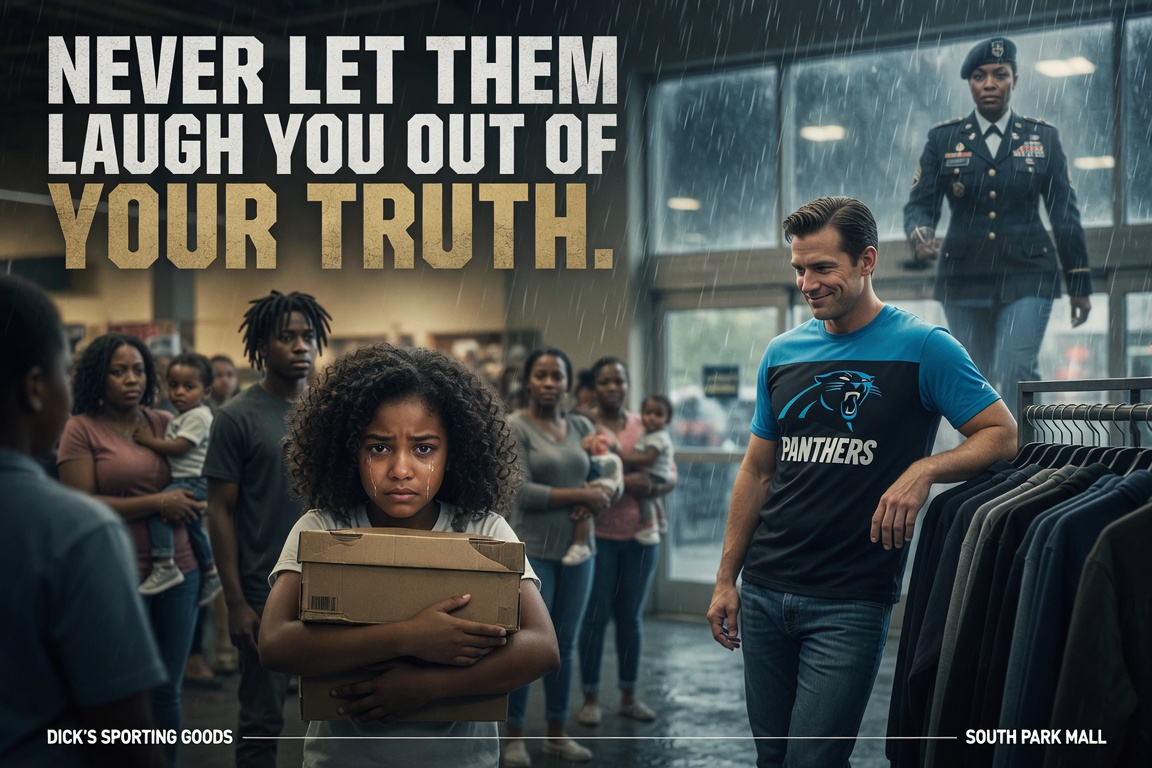
She stood beneath the white glare of the Briarwood Mall atrium, one hand wrapped around the strap of her backpack, the other holding a paper shopping bag against her chest. Around her, Saturday traffic moved in restless currents. Sneakers squeaked against polished tile. A blender screamed from the smoothie kiosk. Somewhere above, a toddler cried beside the glass railing while music from three stores collided in the open air.
Outside, August heat pressed against the building like a glass hand.
Inside, Nia’s cheeks burned hotter.
The man leaning against the security counter was broad through the shoulders and soft around the middle, with a shaved head, a gray police department T-shirt, and a gold shield clipped to his belt. His name, embroidered above his chest, read HOLLIS.
He was off duty.
But he carried himself as if the entire mall were still his jurisdiction.
“You said your mother does what?” he asked.
Nia lifted her chin.
“She’s in Special Forces.”
Officer Daniel Hollis looked at the mall security guard beside him. The guard’s mouth twitched.
“Special Forces,” Hollis repeated. “Your mom.”
Nia’s fingers tightened on the bag.
“Yes, sir.”
“Army?”
“Yes.”
“What unit?”
The question came quickly, sharpened like a trap.
Nia knew better than to answer questions her mother had taught her not to answer. That lesson had been repeated in kitchens, airport parking lots, and whispered phone calls that ended with the same three words.
Don’t volunteer details.
So she said, “I’m not supposed to talk about her unit.”
Hollis nodded slowly, as if she had confirmed something.
“There it is.”
A few shoppers had stopped.
Not many. Just enough.
A middle-aged woman holding a pretzel glanced over her shoulder. Two teenage boys near the escalator lowered their voices. A father with a stroller slowed but did not stop.
Nia saw all of them.
She also saw the phone in Hollis’s hand.
He had not been holding it when he first confronted her.
Now the camera lens pointed casually in her direction.
“Sir,” Nia said, “can I please go? My aunt is waiting for me downstairs.”
Hollis’s smile disappeared.
“Your aunt wasn’t with you when store security stopped you.”
“They didn’t stop me.”
“Then why were you running?”
“I wasn’t running.”
The mall guard beside him shifted.
“She was moving pretty fast.”
“I was trying to get to the elevator.”
“With unpaid merchandise?”
The paper bag crackled against Nia’s chest.
“I paid for it.”
“Receipt?”
Nia looked down at the bag.
She had shown the receipt twice already.
Once to the sales associate at Bell & Finch, who had chased her into the corridor after the store alarm chirped.
Once to mall security, who had compared every item in the bag to the list and found nothing missing.
The alarm had gone off because the cashier had failed to remove a security tag from a navy-blue scarf.
A scarf Nia had purchased for her mother’s birthday.
A scarf her mother would probably never wear because she preferred old field jackets and plain black hoodies, but Nia had chosen it because the blue matched the evening sky in the one photograph she kept beside her bed.
The one where her mother was smiling.
The one taken before the scar.
“The receipt is inside,” Nia said.
Hollis held out his hand.
“Let’s see it.”
The security guard spoke carefully. “Officer, we already verified—”
“I’m talking to her.”
The words landed flat.
The guard looked away.
Nia reached into the bag.
Her hand trembled, and she hated that it trembled.
Her mother always said fear was a message, not a command.
Listen to it. Then decide.
Nia found the receipt and handed it over.
Hollis unfolded it.
“Forty-eight dollars for a scarf.”
“It was on sale.”
“Expensive gift for a twelve-year-old.”
“I saved.”
“From what?”
“Birthday money. Chores.”
“And your aunt let you walk around alone with that much cash?”
“I used my debit card.”
Hollis looked up.
“A debit card.”
“Yes, sir.”
“At twelve.”
“Yes.”
The two teenage boys near the escalator snickered.
Nia felt the room contract around her.
She wished Aunt Renee would come up the escalator. She wished her phone had not died. She wished she had stayed inside Bell & Finch and waited while the cashier fixed the tag.
Most of all, she wished her mother were not three hours late.
The digital clock above the directory changed from 3:17 to 3:18.
Her mother had promised to be there at noon.
Nia had spent the first hour pretending not to worry.
By the second, she had stopped checking the entrance.
By the third, she had started wondering whether the promise had been a mistake.
Promises were dangerous things in the Carter house.
They created shapes in empty chairs.
Hollis handed the receipt back.
“Your name?”
“Nia Carter.”
“Address?”
She hesitated.
His eyebrows rose.
“You understand that hesitation makes people suspicious?”
“My mom told me not to give our address to strangers.”
The mall guard inhaled sharply through his nose.
Hollis’s face changed.
Not much.
Just enough.
“I’m not a stranger.”
“You are to me.”
The words escaped before Nia could pull them back.
A murmur moved through the small crowd.
Hollis straightened from the counter.
He was forty-six years old, though he looked older beneath the atrium lights. A pale groove ran around the ring finger of his left hand. His eyes carried the red rims of someone who had not slept enough in years.
Six months earlier, his wife had moved out.
Four months earlier, his son had stopped answering calls.
Two weeks earlier, Hollis had been passed over for sergeant for the third time.
He told himself none of those things mattered now.
He told himself he was doing what people paid police officers to do.
Notice inconsistencies.
Ask questions.
Prevent small problems from becoming large ones.
He had been a cop for twenty-two years. He had watched smiling teenagers hide stolen electronics beneath infant blankets. He had seen children coached to distract clerks while adults emptied shelves. He had learned that confidence could be rehearsed and innocence could be weaponized.
He had also learned that people lied about military service more often than most civilians realized.
His own older brother had served eight years in the Army and come home with two fused vertebrae and no patience for men who bought camouflage jackets and called themselves warriors.
Women in Special Forces, Hollis thought.
Possible now, technically.
But rare.
A Black woman, according to this child, serving in some unnamed unit she could not discuss, while leaving her daughter wandering unattended in a mall?
It sounded constructed.
He had seen lies built from less.
“Your mother’s full name?” he asked.
Nia stared at him.
“Why?”
“Because I asked.”
“That’s not a reason.”
The father with the stroller stopped now.
The woman holding the pretzel lowered it.
Hollis glanced at the growing audience, then back at Nia.
He could feel the situation moving beyond him.
That feeling frightened him more than he would admit.
“Listen,” he said. “You may think talking back makes you look brave. It doesn’t. It makes you look like a child who hasn’t learned how the real world works.”
Nia’s lips pressed together.
She heard her mother’s voice.
Never argue with someone who has already decided what you are. Make them state their decision clearly.
“What do you think I did?” Nia asked.
Hollis blinked.
“I think there are questions.”
“What questions?”
“Where your guardian is. Why you were leaving a store when the alarm sounded. Why your story keeps getting bigger.”
“My story didn’t get bigger.”
“First your aunt is downstairs. Then your mother is in Special Forces. What comes next? Your father works for the CIA?”
A laugh burst from one of the teenagers.
This time several people smiled.
Nia did not.
Her father had been dead for nine years.
An eighteen-wheeler had crossed the center line outside Macon, Georgia, in rain so heavy that witnesses said the road disappeared.
Nia remembered almost nothing about him.
Only the smell of peppermint gum.
A hand large enough to cover the back of her head.
A voice singing the wrong words to every song on the radio.
Her mother never corrected people when they assumed he had abandoned them. She simply watched their faces and remembered.
Nia had inherited that habit.
“My father is dead,” she said.
The teenage laughter stopped.
Hollis’s jaw tightened.
He had not meant to step there.
But retreat, in his experience, looked too much like weakness.
“I’m sorry to hear that,” he said. “That doesn’t answer my question.”
Nia looked at the gold shield clipped to his belt.
Then at the camera in his hand.
“Are you recording me?”
“I’m documenting an interaction.”
“You’re off duty.”
“I’m still a police officer.”
“Then turn on your body camera.”
The crowd went quiet.
Hollis’s thumb froze against the edge of his phone.
Nia had not raised her voice.
That made it worse.
The mall guard looked at the floor.
Hollis slipped the phone into his pocket.
“You watch too many videos online.”
“My mom teaches me what to do around police.”
“And what does your Special Forces mother teach you?”
There it was again.
Not disbelief this time.
Mockery.
Nia’s throat tightened.
She looked toward the main entrance beneath the glass dome.
Every time the doors opened, sunlight spilled across the tile and carved the arriving shoppers into silhouettes.
None of them were her mother.
Hollis followed her eyes.
“She coming to rescue you?”
Nia said nothing.
He leaned closer.
“Because if she really does what you say she does, she should have taught you not to lie about service.”
The words struck harder than the accusation of theft.
Nia’s mother had missed birthdays.
Recitals.
A science fair where Nia’s model bridge held forty pounds and won first place.
She had vanished for weeks and returned thinner, quieter, sometimes with new bruises that she called training accidents.
There were nights when she woke screaming in a language Nia did not understand.
Mornings when she stood in the kitchen, staring through steam rising from coffee as if someone were standing on the other side.
Her service had cost them both.
And this man wore disbelief like a grin.
Nia stepped forward.
“My mother doesn’t lie.”
Hollis folded his arms.
“Everybody lies.”
“She doesn’t.”
“You’re twelve. You don’t know what adults tell you to protect you.”
Nia’s eyes shone, but no tears fell.
“You don’t know her.”
“No,” Hollis said. “And I’m starting to think you don’t either.”
The woman with the pretzel whispered, “That’s enough.”
Hollis heard her.
His face reddened.
He turned toward the crowd.
“Everyone can keep moving. This is a security matter.”
“No, it isn’t,” said a new voice.
Aunt Renee stepped off the escalator.
She was thirty-nine, short, and moving fast enough that her copper bracelets struck together at her wrist. She wore hospital scrubs beneath a raincoat even though there had been no rain for days. A visitor badge from St. Catherine’s Medical Center still hung from her collar.
She took in the scene in one sweep.
Nia against the counter.
The shoppers.
The off-duty cop.
The mall guard holding the tagged scarf.
Renee’s face hardened.
“What happened?”
Nia opened her mouth, but Hollis answered first.
“Are you her guardian?”
“I’m her aunt.”
“You left a minor unsupervised.”
“She had permission to shop in one store while I picked up a prescription downstairs.”
“She triggered an alarm.”
“Because the cashier left a tag on something she paid for.”
“That’s still being investigated.”
The mall guard cleared his throat.
“No, sir. The receipt checked out.”
Renee looked at Hollis.
“So why is she still here?”
“Because her behavior raised concerns.”
“What behavior?”
“She was evasive.”
“She’s twelve.”
“She gave an implausible account about her mother’s occupation.”
Renee’s expression did not change.
“What did she say?”
Hollis almost smiled.
“That her mother is Army Special Forces.”
Renee stared at him.
For one long second, the only sound was the mechanical hum of the escalator.
Then she looked at Nia.
“Did you tell him anything specific?”
“No, ma’am.”
“Unit?”
“No.”
“Location?”
“No.”
“Good.”
The single word fell with quiet weight.
Hollis uncrossed his arms.
Renee turned back to him.
“You questioned a child about restricted military information because you didn’t believe her?”
“I questioned a minor connected to a retail alarm.”
“That issue was resolved.”
“It led to other concerns.”
“No,” Renee said. “It led to your curiosity.”
A few people in the crowd nodded.
Hollis saw them.
He felt the pressure of their attention against his skin.
“You need to lower your voice.”
Renee had not raised it.
She stepped between him and Nia.
“I need your name and badge number.”
“My name is right here.”
“I want the number.”
“For what purpose?”
“For the complaint.”
Hollis laughed once, but the sound came out dry.
“You think threatening me changes what happened?”
“No. I think documentation changes what happens next.”
Nia looked past her aunt toward the entrance again.
Still nothing.
That hurt more now.
Her mother had promised.
Not maybe.
Not if I can.
She had knelt in front of Nia three weeks earlier, pressed both hands around hers, and said, “No matter what happens with the return flight, I will be there.”
Nia had known better than to believe her completely.
She had believed her anyway.
Hollis looked at Renee’s hospital badge.
“Are you suggesting I can’t ask questions because her mother is military?”
“I’m suggesting you decided she was lying before you asked the first one.”
“You don’t know what I decided.”
Renee’s gaze shifted to the phone in his pocket.
“Were you recording her?”
Hollis did not answer.
That was answer enough.
Renee took out her own phone.
“Fine.”
She tapped the screen.
“Now we all record.”
The crowd stirred.
Phones appeared.
One in the hand of the father with the stroller. Another held by the pretzel woman. The teenagers lifted theirs, no longer amused.
Hollis felt the ground tilt.
He had handled armed men with steadier nerves than he felt in that moment.
A public scene was dangerous.
Not physically.
Professionally.
A clipped video could erase context. A headline could outrun facts. He had watched officers become national villains in thirty seconds and spend three years proving what happened before the camera started.
He should have ended it there.
He knew that.
He could have handed over the receipt, apologized for the delay, and walked away.
But humiliation is rarely born from ignorance alone.
More often, it comes from knowing the right exit and refusing to take it because too many people are watching.
Hollis pointed at Renee’s phone.
“Do not obstruct my investigation.”
“What investigation?”
“Possible neglect.”
Renee’s eyebrows lifted.
“Neglect?”
“You left a child alone in a crowded commercial property.”
“For eleven minutes.”
“Anything can happen in eleven minutes.”
“Yes,” Renee said, looking at Nia. “Apparently it can.”
A ripple moved through the onlookers.
Hollis’s face darkened.
“Ma’am, I’m going to need identification.”
“Am I being detained?”
“I didn’t say that.”
“Then you don’t need it.”
“You really want to teach this child that authority is optional?”
Renee lowered her phone.
“No. I want to teach her that authority is accountable.”
Hollis’s hand moved toward his belt.
Not his weapon.
His badge.
He unhooked it and raised it slightly, as if gold could settle an argument.
“This means I have obligations you may not understand.”
Nia stared at the shield.
A memory returned—not of her mother, but of a morning two years earlier.
Three men had come to their house in dress uniforms.
One carried a folded flag.
Nia had watched from the staircase as her mother stood in the foyer, both hands at her sides, her face unreadable.
The flag belonged to Sergeant First Class Owen Beckett, a man Nia had met twice. He had brought cinnamon rolls on Christmas and called her “Professor” because she corrected his math.
After the men left, Nia found her mother sitting on the kitchen floor with the flag across her knees.
“Is a uniform supposed to make people good?” Nia had asked.
Her mother looked at her for a long time.
“No,” she said. “It’s supposed to remind them what good costs.”
Now Nia looked at Hollis.
“My mom says a badge doesn’t make you right.”
Hollis turned toward her.
“What did you say?”
Renee placed an arm in front of Nia.
“She’s done talking to you.”
But Nia stepped around it.
Her fear had changed shape.
It was no longer something pressing her backward.
It had become a wire pulled tight through her chest.
“She says authority is a responsibility,” Nia continued. “Not proof that you’re better than somebody.”
The father with the stroller murmured, “Smart kid.”
Hollis heard that too.
His eyes sharpened.
“Your mother fill your head with this?”
“She taught me to recognize bullies.”
The silence after that was immediate.
Hollis moved before he thought.
One step.
Only one.
But it closed the space between them too quickly.
Renee shoved Nia behind her.
The mall guard raised both hands.
“Okay. Everybody needs to calm down.”
“I am calm,” Hollis said.
He was not.
The tendons stood out in his neck.
His right hand opened and closed.
His breathing had shortened.
Renee saw it.
So did every camera.
“You need to step back,” she said.
Hollis looked at the crowd, then at Nia peering around her aunt’s shoulder.
In her expression he saw no surrender.
Only judgment.
It reminded him of his son.
The final night in the old house, nineteen-year-old Tyler Hollis had stood in the kitchen while Daniel shouted about discipline, gratitude, and respect.
Tyler had waited until Daniel finished.
Then he said, “You don’t want respect. You want nobody to tell you when you’re wrong.”
Daniel slapped him.
Not hard enough to knock him down.
Hard enough to end something.
His son had packed a duffel bag before sunrise.
Daniel had spent six months telling himself the boy would come back when pride wore off.
He had never considered whose pride needed to wear off.
Now, beneath the mall’s merciless white light, Nia’s face carried the same expression.
Hollis hated her for making him remember it.
“You think this is funny?” he asked.
Nia shook her head.
“I think it’s sad.”
That was the moment he lost control of the scene.
Not because he shouted.
He did not.
Not because he touched her.
He never got the chance.
He reached for the shopping bag.
Perhaps he intended to inspect it again.
Perhaps he meant only to take it from her hands.
Later, under oath, he would say he could not remember.
Renee pulled the bag away.
Hollis caught her wrist.
The crowd erupted.
“Hey!”
“Let her go!”
“Officer, stop!”
The mall guard grabbed Hollis’s forearm.
Hollis shoved him back.
The guard struck the security counter, sending a plastic display crashing to the floor.
Nia stumbled sideways.
The paper bag tore.
The navy scarf spilled onto the tile.
So did the small black box hidden beneath it.
The box slid across the floor and stopped against Hollis’s shoe.
Its lid had opened.
Inside, cushioned in white cotton, lay a silver medallion no larger than a half-dollar.
On one side was an engraved horse and rider beneath a parachute canopy.
On the other were three words.
DE OPPRESSO LIBER.
Hollis stared down.
He recognized the insignia.
His brother had shown him a similar coin years ago, though never one with a serial number engraved along the rim.
Renee’s face changed.
“Nia,” she whispered. “Where did you get that?”
Nia stared at the open box.
“It came in the mail.”
“When?”
“Yesterday.”
“Did you open the letter?”
Nia shook her head.
“I thought it was for Mom’s birthday.”
Renee bent to pick it up.
Hollis reached first.
“Don’t touch that,” Renee said.
He lifted the medallion between two fingers.
The metal caught the atrium light.
A challenge coin.
Not the mass-produced kind sold online.
This one bore scratches along the edge and a dark stain embedded in the engraving.
Hollis looked at Nia.
“Where did you steal this?”
The accusation hit the crowd like a slap.
Renee surged forward.
“You put that down.”
“You expect me to believe this was mailed to a child?”
“It was addressed to my house,” Nia said.
“By who?”
“I don’t know.”
Hollis turned the coin over.
There was an inscription beneath the serial number.
FOR M. CARTER—NO ONE LEFT BEHIND.
Something shifted in Renee’s eyes.
Fear.
Nia saw it.
“Aunt Renee?”
Renee looked toward the mall entrance.
The automatic doors opened.
Four people walked inside.
The first was a man in a dark suit with an earpiece, his gaze moving across the atrium before his feet cleared the threshold.
The second and third wore civilian clothes but carried themselves with the squared posture of soldiers—one woman with close-cropped gray hair, one broad man with a prosthetic left hand.
The fourth entered last.
She wore a sand-colored Army combat uniform with no cap.
Her sleeves were down despite the heat.
Her boots were dusty.
A canvas medical sling crossed her chest, holding her left arm tight against her ribs.
She was tall—five feet ten—with a lean build and skin several shades darker than Nia’s. Her hair was braided close to her scalp. A fresh line of stitches cut from the edge of her right eyebrow into her temple, and an older scar disappeared beneath her collar.
She took three steps into the mall.
Then stopped.
Major Maya Carter saw her daughter surrounded by strangers.
She saw her sister standing between Nia and an off-duty police officer.
She saw the security guard rubbing his shoulder.
She saw phones raised.
She saw the torn shopping bag.
And she saw the coin in Hollis’s hand.
The entire mall seemed to inhale at once.
Nia did not move.
For three hours, she had imagined this moment.
She had imagined running.
Crying.
Making her mother apologize in front of everyone for being late.
Instead, she stood frozen beside the fallen scarf.
Maya crossed the atrium.
She did not hurry.
That made people move faster.
Shoppers stepped aside before she reached them. Conversations died as she passed. The woman with gray hair followed two paces behind. The man with the prosthetic hand watched Hollis without blinking.
Hollis looked from Maya’s uniform to Nia.
Then back again.
His grip on the coin tightened.
Maya stopped six feet away.
Her eyes went first to Nia.
“Are you hurt?”
Nia shook her head.
Maya studied her face long enough to verify the answer for herself.
Then she looked at Renee.
“My wrist,” Renee said. “Nothing broken.”
Maya’s gaze moved to the mall guard.
“He shoved me,” the guard said.
Only then did she look at Hollis.
“What is in your hand?”
Hollis swallowed.
“A piece of military property found in the child’s possession.”
Maya’s expression remained still.
“Give it to me.”
“I need to establish ownership.”
“You have.”
“Ma’am, I don’t know who you are.”
The woman with gray hair stepped forward.
“Colonel Evelyn Shaw, United States Army Special Operations Command.”
She opened a leather credential wallet.
The broad man beside her did the same.
“Master Sergeant Gabriel Ruiz.”
Hollis looked at the credentials.
His face lost color.
Maya held out her uninjured hand.
“The coin.”
He placed it in her palm.
Not because she had raised her voice.
Because the possibility that she might do so had become unbearable.
Maya studied the inscription.
Her thumb moved once across the scratched metal.
Something flickered behind her eyes, there and gone.
She closed her fingers around it.
“Where did you get this?” she asked Nia.
“It came yesterday. I thought it was a present.”
Maya looked at Renee.
Renee shook her head. “I didn’t know.”
Colonel Shaw’s eyes rested on the coin.
“We sent it ahead with the notification packet.”
“What notification?” Nia asked.
No one answered.
The mall noise had returned in fragments, but inside the circle around them, the air remained motionless.
Maya crouched in front of her daughter.
The sling made the movement awkward. Pain tightened one side of her mouth, but she lowered herself until their eyes were level.
“I’m sorry I was late.”
Nia’s lower lip trembled.
“You promised.”
“I know.”
“You always say not to promise what you can’t control.”
“I do.”
“Then why did you?”
Maya looked down.
For the first time since entering the mall, the authority around her seemed to fall away.
What remained was a forty-one-year-old mother with blood dried beneath one cuff and guilt carved into every line of her face.
“Because I wanted one promise to be stronger than my job,” she said.
Nia’s eyes filled.
“Was it?”
Maya glanced toward the coin in her hand.
“No.”
The honesty hurt more than an excuse would have.
Nia looked away.
Maya did not reach for her.
She understood that love was not permission.
Behind them, Hollis shifted.
The sound of his shoe against tile pulled Maya’s attention back.
She stood.
“What happened here?”
Hollis lifted his chin.
“There was a retail alarm. The girl became uncooperative.”
“She had a receipt,” Renee said.
“The theft issue was resolved.”
“Then why did you detain her?”
“I did not formally detain anyone.”
“You blocked her from leaving,” said the father with the stroller.
Hollis turned.
“You need to stay out of this.”
The man raised his phone.
“I have the whole thing.”
“So do I,” said the pretzel woman.
“And me,” one of the teenagers added.
Maya looked around the crowd.
“How long?”
The security guard answered.
“Almost twenty minutes.”
Maya’s gaze returned to Hollis.
“You questioned my daughter for twenty minutes after confirming she had paid?”
“I was concerned about her story.”
“What story?”
“That her mother served in Special Forces.”
Colonel Shaw folded her hands behind her back.
Hollis saw the movement.
He saw Ruiz glance down.
He understood, too late, that every word he spoke was placing another round into a weapon aimed at his own career.
“I had reason to doubt it,” he continued. “The claim was unusual.”
Maya’s eyes narrowed.
“Unusual.”
“Yes.”
“Why?”
Hollis opened his mouth.
Nothing safe came out.
Maya waited.
The silence widened.
The crowd watched him search for an answer that did not reveal the answer.
He looked at Nia.
At her braids.
At Maya’s face.
At the phones recording him.
His shoulders lowered by less than an inch.
But everyone saw it.
This was the moment.
The moment the story inside his head collapsed.
Not when he saw the uniform.
Not when Colonel Shaw showed her credentials.
Not even when he returned the coin.
It happened when he realized there was no neutral explanation for why the child’s claim had sounded impossible to him.
His eyes moved toward the floor.
For a man who had spent twenty-two years demanding eye contact, the surrender was unmistakable.
Maya spoke softly.
“You laughed at her.”
Hollis looked up.
“I reacted poorly.”
“That is not what I said.”
His face tightened.
“Yes.”
“You accused her of lying about me.”
“Yes.”
“You asked for restricted unit information.”
“I asked questions.”
“You recorded a minor on your personal phone.”
His hand moved unconsciously toward his pocket.
“You grabbed my sister.”
“She interfered.”
“And you shoved that security officer.”
Hollis looked at the guard.
A red mark had formed along the man’s jaw.
Maya stepped closer.
The crowd leaned in.
Her voice did not rise.
“That is the problem with people who mistake authority for ownership. Every boundary feels like interference.”
Hollis’s jaw worked.
“You don’t know what police work requires.”
“No,” Maya said. “I know what force requires.”
Her eyes dropped to his hands.
“When someone carries force on behalf of the public, discipline matters more than certainty. Restraint matters more than pride. The moment your ego becomes more important than the civilian in front of you, you are no longer controlling the situation.”
She looked toward Nia.
“The situation is controlling you.”
No one spoke.
Hollis’s face shone beneath the lights.
He could hear his own breathing.
He wanted to argue.
He wanted to name every shoplifting crew he had caught, every domestic call he had survived, every stranger whose blood had dried on his uniform while people with cameras judged his tone.
He wanted to tell them about his brother.
About Tyler.
About the night his wife said she was tired of living inside a house where every disagreement became a command.
Instead, he looked at Nia and saw that she was no longer afraid of him.
That frightened him more than anger.
A uniformed city police lieutenant pushed through the crowd with two officers behind her.
She was a compact woman in her fifties named Lena Brooks. Her silver hair was pulled into a tight bun, and irritation arrived before she did.
“Hollis,” she said.
His eyes closed for half a second.
Lieutenant Brooks looked at the phones, the Army officers, the injured mall guard, and Renee rubbing her wrist.
“What did you do?”
Hollis straightened.
“Lieutenant, I can explain.”
“Take your badge off.”
The order was so immediate that several people gasped.
Hollis stared at her.
“I’m off duty.”
“I know.”
“I was acting in good faith.”
“Take it off.”
His hand moved to the shield.
For years, the motion had been automatic.
Clip it on.
Clip it off.
But now his fingers fumbled at the clasp.
The badge slipped.
He caught it before it hit the tile.
The gesture drew no laughter.
That would have been easier.
Instead, the crowd watched in complete silence as he placed the shield in Brooks’s open palm.
Maya did not smile.
Nia noticed.
She had expected victory to look louder.
She had expected her mother to crush him with one sentence and leave the crowd cheering.
But Maya’s face held no pleasure.
Only exhaustion.
Lieutenant Brooks turned to Renee.
“Ma’am, do you need medical attention?”
“I work in an emergency room. I’ll get it checked.”
“Would you like to file charges?”
Hollis looked at her.
For the first time, the confidence was gone.
Not replaced by remorse yet.
Only fear.
Renee saw it.
So did Nia.
Renee glanced at Maya.
Maya said nothing.
This was not hers to decide.
“Yes,” Renee said.
Hollis flinched.
Lieutenant Brooks nodded to one of the officers.
“Get statements. Preserve every video. Contact mall management and the store.”
Then she faced Hollis.
“You are relieved pending investigation. Do not access department systems. Do not contact witnesses. Do not delete anything from your phone.”
“I wouldn’t.”
Brooks’s eyes hardened.
“You already recorded a child to win an argument. I’m not making assumptions about what you wouldn’t do.”
The words struck him visibly.
His shoulders folded inward.
The officer beside him gestured toward a bench.
Hollis sat.
He looked smaller there.
Not innocent.
Not harmless.
Simply human.
A man trapped beneath the wreckage of decisions he had made one after another because stopping would have required admitting the first one was wrong.
Nia picked up the scarf.
The fabric had collected dust along one edge.
“I bought this for you,” she told Maya.
Maya stared at it.
“For my birthday?”
Nia nodded.
“You hate scarves.”
“I don’t hate scarves.”
“You said they get caught on things.”
“In the field.”
“You wear hoodies everywhere else.”
“That is not the same as hating scarves.”
Nia held it out.
Maya took the navy fabric with her good hand.
Her fingers moved across it carefully, as if it were fragile equipment.
“It’s beautiful,” she said.
“You don’t have to lie.”
“I’m not.”
Nia looked at the old scar beneath her mother’s collar.
“Did something happen?”
Maya glanced at Colonel Shaw.
The colonel gave one small nod.
Maya opened her fist and showed Nia the coin.
“This belonged to Sergeant Owen Beckett.”
Nia’s eyes widened.
“Cinnamon Roll Owen?”
A faint smile touched Maya’s mouth.
“Yes.”
“I thought his wife had his things.”
“She does. This coin was with me.”
“Where?”
Maya looked toward the windows above the atrium.
Sunlight had begun to shift, turning the upper glass amber.
“On the last mission Owen and I ran together, he gave it to me before we separated. He told me to return it when we got home.”
“But he didn’t come home.”
“No.”
Nia looked at the scratched metal.
“Why did they mail it?”
Maya’s voice lowered.
“Because three nights ago, a team recovered the pack I lost during the mission where Owen died.”
Colonel Shaw stepped closer.
“Your mother volunteered to assist in the recovery.”
Renee stared at Maya’s sling.
“You told me you were at training.”
“I couldn’t tell you.”
“You could have told me you were injured.”
“Not until the families were notified.”
Renee looked away, furious and frightened in equal measure.
Maya continued.
“The pack contained documents that cleared Owen’s name.”
Nia frowned.
“Cleared him of what?”
For years, the official report had carried an implication no memorial speech mentioned.
A compromised position.
A delayed extraction.
An unauthorized change in route.
Someone had leaked coordinates.
Someone had been blamed.
Owen, dead and unable to answer, became the easiest explanation.
Maya had spent nine years refusing to believe it.
The coin had been inside the pack beside a damaged recorder containing the final radio traffic.
Owen had not betrayed the team.
He had discovered the betrayal.
And stayed behind to buy them time.
“The report was wrong,” Maya said. “He saved us.”
Nia looked at the coin again.
“Did you know?”
“I believed.”
“That’s not the same.”
“No,” Maya said. “It isn’t.”
Nia studied her mother’s face.
The stitches.
The purple shadow beneath one eye.
The exhaustion.
“You went back for proof.”
Maya nodded.
“You could have died.”
“Yes.”
“And you still promised you’d be here.”
Maya’s voice broke.
“Yes.”
“Why?”
“Because every time I left, I told myself I was protecting you.”
Maya swallowed.
“But protection can become an excuse people use when they are afraid to admit what they are losing.”
Nia’s eyes filled again.
Maya knelt despite the pain.
“This time, I was afraid you would stop waiting for me.”
The mall had become a distant blur around them.
Nia looked at the woman everyone else now watched with awe.
The major.
The Special Forces officer.
The wounded soldier surrounded by command staff.
Nia saw none of those things.
She saw her mother.
Late again.
Bleeding again.
Trying again.
“I almost did,” Nia whispered.
Maya nodded.
“I know.”
Nia stepped forward.
The hug was careful at first because of the sling.
Then Maya wrapped her good arm around her daughter and held on.
The crowd did not cheer.
It would have cheapened the moment.
People lowered their phones.
The woman with the pretzel wiped her eyes with a napkin.
The father turned the stroller away, giving them privacy in the only way available.
On the bench, Daniel Hollis watched.
His gaze fell to the phone in his hand.
The recording was still running.
Thirty-two minutes and fourteen seconds.
He stopped it.
Then, with Lieutenant Brooks watching, he set the phone on the bench beside him.
“Lieutenant,” he said.
Brooks looked over.
“I need to add something to my statement.”
“What?”
He looked at Nia.
“I was wrong before she said anything about her mother.”
Brooks said nothing.
Hollis drew a breath.
“I saw a Black kid leaving an expensive store after an alarm went off. I decided what that meant. Everything after that was me trying to prove myself right.”
The confession moved through the remaining crowd more quietly than any accusation.
Renee watched him.
“You expect that to fix this?”
“No.”
“Good.”
He nodded.
“I don’t.”
Nia turned from her mother.
Hollis rose slowly.
The officer beside him tensed, but he did not approach.
He kept both hands visible.
“I owe you an apology,” he said.
Nia looked at Maya.
Maya’s face told her the choice belonged to her.
Nia faced him.
Hollis’s voice shook.
“I treated you like your word had less value than my suspicion. I made fun of your mother because believing you would have meant questioning myself.”
He glanced toward Renee and the mall guard.
“I used my position to keep control after I had no lawful reason to do so. I am sorry.”
Nia held his gaze.
The entire mall seemed to wait for her answer.
She thought of every movie where the bad man apologized and the good person forgave him before the music rose.
She thought of her mother’s kitchen-floor lesson.
A uniform did not make someone good.
Neither did an apology.
An apology was not goodness.
It was only a door.
The person still had to walk through it.
“I heard you,” Nia said.
Hollis nodded once.
It was not forgiveness.
He understood that.
For the first time that afternoon, he accepted an answer he did not like without trying to change it.
Lieutenant Brooks escorted him toward the service corridor.
No handcuffs.
No spectacle.
Only the absence of the badge and the weight of every camera following him.
At the corridor entrance, Hollis stopped.
His son stood near the vending machines.
Tyler Hollis had arrived ten minutes earlier after someone sent him the livestream. He wore a mechanic’s shirt with his name stitched above the pocket. Grease darkened his fingers.
Daniel stared at him.
Tyler’s face carried no triumph.
Only a tired recognition.
Daniel opened his mouth.
Tyler raised one hand.
“Not here.”
Daniel nodded.
It was a small thing.
But he nodded.
Then he disappeared through the door.
Three months later, the city released its findings.
Daniel Hollis had violated department policy by conducting off-duty enforcement without necessity, recording a minor on a personal device, escalating a resolved retail matter, using unauthorized physical force, and failing to identify the role bias played in his decisions.
He was suspended without pay and later resigned before the disciplinary hearing concluded.
The mall guard received a written apology and a settlement for his injuries.
Renee’s wrist healed.
Bell & Finch changed its alarm-response policy and required employees to verify purchases before following customers into public areas.
The two teenage boys posted their footage online with a caption that admitted they had laughed.
Their video received millions of views.
What people remembered most was not Maya’s uniform.
It was the second when Hollis looked at Nia and realized the person he had treated as powerless had understood power better than he did.
Major Maya Carter did wear the scarf.
Not often.
Only on days when she was home.
She attended counseling twice a week. She taught a leadership course at Fort Liberty while recovering from her injuries. She learned to say “I don’t know when I’ll be back” instead of making promises no soldier could control.
Colonel Shaw presented Owen Beckett’s family with a corrected citation.
His widow invited Nia to the ceremony.
Nia carried the coin in a velvet box and placed it in the hands of Owen’s sixteen-year-old son.
“He wanted your dad blamed because your dad couldn’t argue back,” Nia told him afterward.
The boy closed his fingers around the coin.
“My dad used to say the truth has bad timing.”
Nia looked across the room at her mother.
“Sometimes it arrives exactly when people need to see it.”
As for Daniel Hollis, the investigation did not transform him into a better man overnight.
Real change rarely arrives with applause.
He attended court-ordered counseling.
He joined no speaking tours.
He gave no television interviews.
He sold his house, moved into a small apartment, and began repairing the relationship with his son one awkward breakfast at a time.
Some mornings, Tyler came.
Some mornings, he did not.
Daniel learned not to demand an explanation.
A year after the incident, Nia received a plain envelope with no return address.
Inside was a single sheet of paper.
No excuses.
No request for forgiveness.
Only four handwritten lines.
I thought respect was something people owed the badge.
I know now it is something the person wearing it must earn.
You understood that at twelve.
I hope I spend the rest of my life understanding it too.
Nia read the letter twice.
Then she placed it in the drawer beneath her father’s photograph.
She did not answer.
Some lessons did not require a response.
They required a witness.
And that was why people shared the video long after the outrage faded—not because a powerful soldier entered a mall, but because a child without a uniform stood her ground until everyone else was forced to see who had truly been strong from the beginning.