The first sound in Courtroom 4B was not the judge’s gavel.
It was the metal tip of Captain Elena Brooks’s cane striking the marble floor.
Click.
Pause.
Click.
Pause.
Every step carried a fraction of her weight and all of the room’s attention.
Elena moved through the double doors beneath the carved state seal, her left leg braced from ankle to thigh under a dark blue trouser leg. Rainwater gleamed on the shoulders of her dress uniform. A thin scar crossed the right side of her jaw, pale against brown skin.
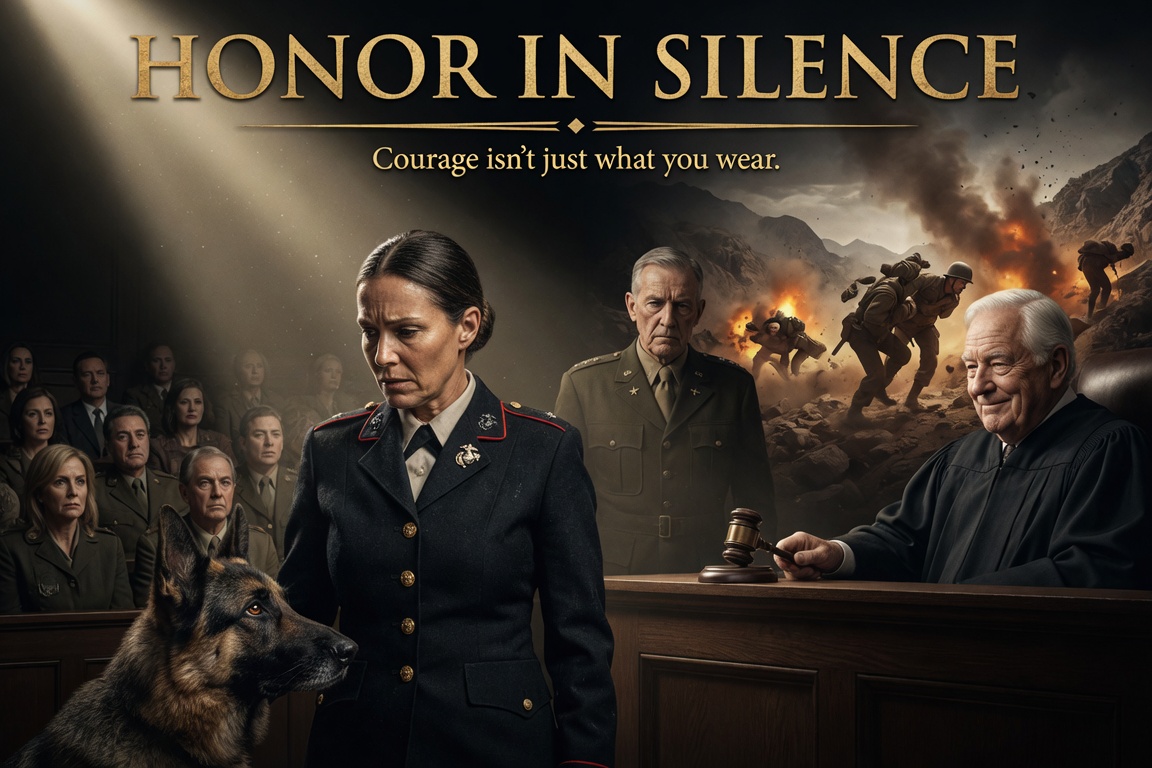
Pinned above her heart was the Navy Cross.
The ribbon was small.
The silence around it was not.
A bailiff looked up from his clipboard. Two attorneys stopped whispering. A woman in the gallery nudged her husband, and his eyes dropped instinctively toward the medal.
At the bench, Superior Court Judge Conrad Vale watched Elena approach with the expression of a man observing a stain spreading across an expensive rug.
He was sixty-two, silver-haired, broad-shouldered, and famous in Charleston County for running his courtroom like a warship.
No phones.
No lateness.
No excuses.
His rulings were quoted in law journals. His charity galas appeared in society magazines. Young prosecutors studied his cadence. Older defense attorneys studied his moods.
And everyone who entered Courtroom 4B learned the same lesson within five minutes.
Conrad Vale did not merely expect respect.
He expected submission.
Elena stopped beside the defense table.
Her attorney, Miriam Cole, rose quickly.
“Captain Brooks,” Miriam whispered, “I asked you to wear civilian clothes.”
Elena’s eyes remained on the bench.
“You asked,” she said.
Miriam exhaled through her nose. She was forty-seven, precise, sharp, and dressed in a charcoal suit that seemed designed to discourage unnecessary conversation. She had spent twenty years defending whistleblowers, police officers, and federal employees who had discovered that institutions protected themselves more aggressively than they protected people.
Still, when she saw the medal on Elena’s chest that morning, even she had gone quiet.
“You know what he’s like,” Miriam said.
“I do.”
“He’ll make this personal.”
“He already did.”
Judge Vale lifted his gavel.
“Counsel.”
His voice cut through the room with the polished force of a closing door.
Miriam straightened.
“Good morning, Your Honor.”
Vale did not answer. His gaze remained on Elena.
“This court has rules regarding attire.”
Elena stood still.
“Yes, Your Honor.”
“Military decoration is not appropriate in a civilian proceeding.”
A faint murmur moved through the gallery.
Miriam stepped forward. “Your Honor, Captain Brooks is appearing in regulation uniform at the request of the state licensing board, which questioned her service history in its filing.”
Vale’s eyes shifted to her.
“I did not ask for an explanation, Ms. Cole.”
Miriam’s lips pressed together.
Vale turned back to Elena.
“You will remove the decoration.”
Elena’s fingers tightened once around the handle of her cane.
The movement was small enough that most people missed it.
Miriam did not.
“Your Honor,” she said, “the medal is part of the uniform.”
“I am aware of what it is supposed to represent.”
The words hung there.
Supposed to.
Elena saw the court reporter’s hands stop above the keys for half a second.
At the prosecution table, Assistant Attorney General Nathan Pryce lowered his eyes toward his notes. He was thirty-nine, ambitious, and careful with his face. He had built his career by recognizing when powerful men wanted silence and providing it before they had to ask.
Judge Vale leaned back.
“This hearing concerns allegations of professional misconduct, fraudulent representation, and unauthorized access to sealed county records. It is not a parade. It is not a recruitment ceremony. And it will not be turned into theater.”
Elena looked at him.
The overhead lights reflected in his black robe. Behind him, the state flag hung motionless in air chilled by aggressive ventilation.
“Remove it,” he said.
Miriam placed one hand on Elena’s forearm.
“Don’t,” she whispered.
It was unclear whether she meant don’t comply or don’t fight.
Elena slowly set her cane against the table.
Then she raised both hands toward the Navy Cross.
Her right hand worked normally.
Her left did not.
The fingers had been rebuilt after a blast had severed tendons and burned the nerves. They closed stiffly around the clasp behind the medal.
The courtroom watched her struggle.
Vale watched too.
He did not offer a recess.
He did not look away.
After several seconds, the clasp gave.
The medal came free.
Elena held it in her palm.
For one impossible moment, she was back in a concrete stairwell outside Marjah, kneeling in dust so thick it had turned the blood on her hands black.
A radio screaming.
A corpsman crying for morphine.
A young lance corporal named Henry Torres asking whether his mother would know he had been brave.
Elena had lied to him.
She had told him he was going home.
He had died with his hand wrapped around two fingers of hers.
The Navy Cross had been presented to Elena three years later after an investigation concluded that she had held a collapsing aid station for forty-seven minutes, organized an evacuation under machine-gun fire, and returned twice for wounded Marines after being ordered to withdraw.
She never wore it unless duty required.
She hated the weight of it.
She hated the applause.
She hated that Henry Torres’s mother had stood in the second row during the ceremony and smiled through tears because she believed her son had been part of something noble.
Now the medal lay in Elena’s damaged palm beneath fluorescent courtroom lights.
Judge Vale pointed to the defense table.
“Place it there.”
Elena’s eyes stayed on his.
“Your Honor,” she said softly, “before I do, I’d like the record to reflect that the court ordered its removal.”
The judge’s jaw shifted.
“The court reporter records everything said in this room.”
“I’d like a direct acknowledgment.”
Nathan Pryce looked up.
Miriam’s hand tightened around the edge of the table.
Vale stared at Elena for several seconds.
Then he leaned toward the microphone.
“The record will reflect that Captain Elena Brooks was ordered to remove a military decoration that the court considers prejudicial and irrelevant to these proceedings.”
Elena nodded once.
“Thank you.”
She placed the Navy Cross on the polished wood.
Then she sat.
The judge struck the gavel.
“Let us begin.”
No one in Courtroom 4B understood yet that Conrad Vale had just authenticated the first piece of evidence against himself.
Not even Conrad Vale.
But Elena did.
And beneath the table, hidden by the fall of her uniform jacket, her hand rested on a sealed black envelope marked:
AUTHORIZED RELEASE UPON JUDICIAL TRIGGER.
The hearing began with a lie.
Nathan Pryce stood before the bench and described Elena as a decorated veteran whose “tragic injuries” had perhaps impaired her judgment.
He said it gently.
That made it worse.
“Captain Brooks was entrusted with the security architecture of the Charleston County Veterans Recovery Network,” he said. “A position that gave her access to confidential medical files, financial records, and internal communications.”
Elena listened without moving.
Pryce continued.
“The state alleges that she exceeded that access, copied protected records, and threatened to release them after her consulting contract was terminated.”
On the wall clock, the second hand moved with an audible tick.
Each accusation had been written carefully enough to sound devastating without being entirely false.
Elena had accessed records.
She had copied them.
She had warned county officials that the files would not remain buried.
What Pryce did not mention was why.
The Charleston County Veterans Recovery Network had been created after a series of suicides among veterans waiting for psychiatric care. Publicly, it was Judge Vale’s proudest accomplishment.
His foundation had raised $18 million.
The county had contributed another $11 million.
Vale appeared in television advertisements beside amputees and Gold Star families. He spoke about duty, sacrifice, and “the sacred promise owed to those who wore the uniform.”
Elena had believed him.
That was the part she hated most.
Two years earlier, after leaving active duty, she had accepted a position as director of security compliance for the network. The job offered structure, purpose, and fewer nights alone in her apartment listening to the phantom echo of rotor blades.
She built the access controls.
She designed the audit system.
She trained the staff.
Six months later, she found forty-three patient files that had been opened by users with no clinical role.
Then she found altered billing records.
Then veteran housing grants paid to shell companies.
Then a list of names tagged “nonviable.”
Veterans with traumatic brain injuries.
Veterans with addiction histories.
Veterans without families likely to complain.
Their applications had been delayed, redirected, or quietly denied while the network reported successful placement rates to donors and regulators.
One of those veterans was Staff Sergeant Malcolm Reed.
Malcolm had survived two deployments and a roadside bomb that left fragments lodged near his spine. He slept in his truck for four months while the network claimed it had placed him in transitional housing.
He froze to death in a grocery store parking lot three days before Christmas.
Elena had found his file on December 29.
Beside his name was a note from an administrator.
LOW REPUTATIONAL VALUE.
She had stared at those three words until the screen blurred.
Then she began copying everything.
Pryce turned toward Elena.
“Captain Brooks believed she had discovered wrongdoing. Rather than report her concerns through authorized channels, she took possession of sensitive materials and attempted to coerce county officials.”
Miriam rose.
“Objection. Characterization.”
“Sustained,” Vale said.
But the damage was already in the room.
Pryce nodded apologetically, as if he had accidentally spilled water.
“I’ll rephrase. Captain Brooks sent an email stating, and I quote, ‘If the board does not notify federal authorities within seventy-two hours, I will ensure the evidence reaches someone who cannot be pressured into silence.’”
He looked at the gallery.
“That is not a report. That is a threat.”
Miriam stood again.
“It was sent after three internal reports disappeared.”
Vale’s gavel came down.
“Ms. Cole, you will have your turn.”
Miriam sat.
Elena watched the judge.
He had not looked at the evidence once.
His eyes kept moving instead toward the black envelope near Elena’s hand.
He knew something was inside it.
He just did not know what.
That uncertainty bothered him.
Good.
Pryce called the first witness, Dr. Leonard Fisk, executive director of the recovery network.
Fisk was fifty-five, narrow-faced, and perpetually damp around the temples. He had the uneasy posture of a man who spent his life entering rooms where someone wealthier had arrived first.
Under questioning, he testified that Elena had become “increasingly unstable” during the months before her dismissal.
“She was confrontational,” he said.
“How so?” Pryce asked.
“She challenged administrative decisions outside her area.”
“Did she raise her voice?”
“Frequently.”
Elena looked at Miriam.
Miriam wrote one word on her legal pad.
Liar.
Pryce continued. “Were you aware of Captain Brooks’s medical history?”
Miriam stood.
“Objection.”
Pryce lifted both hands. “I’m establishing the witness’s basis for concern.”
“Her combat injuries are not evidence of instability.”
Vale’s eyes narrowed.
“The door was opened by the defense’s emphasis on her military status.”
Miriam turned toward the bench. “We didn’t emphasize it. You ordered her to remove it.”
A few people in the gallery inhaled sharply.
Vale’s face became very still.
“Careful, counsel.”
Miriam held his gaze for one beat, then sat.
Fisk adjusted his tie.
Pryce softened his voice.
“Doctor, were you aware that Captain Brooks received treatment for post-traumatic stress?”
“Yes.”
“Did that concern you?”
Elena’s right thumb moved over the scar tissue in her left palm.
Fisk looked toward her, then away.
“It did after her behavior changed.”
“How did it change?”
“She became suspicious. Fixated. She seemed convinced that everyone was part of a conspiracy.”
“Was there a conspiracy?”
A few nervous smiles appeared in the gallery.
Fisk almost smiled too.
“No.”
Elena felt something cold settle behind her ribs.
Not anger.
Anger was hot and careless.
This was older.
Cleaner.
The same thing she had felt in the stairwell in Marjah when the radio operator told her the extraction route had collapsed.
The moment when fear had no remaining purpose.
Miriam’s cross-examination began quietly.
“Dr. Fisk, how much does the network pay you annually?”
Pryce objected.
Vale overruled.
Fisk cleared his throat.
“My base salary is $312,000.”
“And bonuses?”
“They vary.”
“Last year?”
“Approximately eighty thousand.”
“More precisely?”
Fisk looked at Pryce.
Pryce did not return the glance.
“Eighty-seven thousand.”
“So nearly $400,000.”
“That compensation reflects my responsibilities.”
“I’m sure it does.”
Miriam walked to the evidence monitor.
“Do those responsibilities include reviewing housing approvals?”
“Not individually.”
“Do they include supervising those who do?”
“Yes.”
She displayed Malcolm Reed’s application.
His military photograph appeared beside the form.
Broad face.
Crooked grin.
A small daughter on his shoulders.
“Do you recognize Staff Sergeant Reed?”
Fisk’s mouth tightened.
“I recognize the name.”
“This application was marked nonviable.”
“I don’t personally use that designation.”
“Someone did.”
“I can’t speak to that.”
Miriam clicked.
The metadata appeared.
Created by: LFISK-ADMIN.
The courtroom shifted.
Fisk stared at the screen.
“That account was used by multiple staff members.”
“Under your credentials?”
“Yes, occasionally.”
“Against security policy?”
“I’m not a technical person.”
A laugh escaped somewhere in the back row.
Vale looked toward the sound, and the room went silent.
Miriam moved closer to the witness stand.
“Captain Brooks reported unauthorized use of your account, correct?”
“She raised concerns.”
“And you suspended her access the same day.”
“Because she was exceeding her authority.”
“She discovered your credentials had been used to alter veteran records.”
“That was never proven.”
“She produced an access log.”
“A log she controlled.”
There it was.
The accusation beneath all the others.
Elena had built the system, so anything the system revealed could be blamed on her.
Miriam changed the display.
An email appeared from Fisk to Judge Vale.
Need EB contained before audit window. She is not responding to pressure.
The air in the room changed.
Fisk’s face drained of color.
Pryce stood. “Objection. This document was not authenticated.”
Miriam did not look away from Fisk.
“Dr. Fisk, is that your email address?”
“I’d need to examine—”
“Is that your email address?”
“Yes.”
“Is ‘EB’ Elena Brooks?”
“I don’t recall.”
“Is Judge Vale the recipient?”
Pryce’s voice sharpened. “Your Honor, I object.”
Vale leaned forward.
“Ms. Cole, approach.”
Miriam did not move.
“Your Honor, the witness can answer.”
“Approach the bench.”
The word came harder.
Miriam glanced at Elena, then walked forward.
The white-noise machine activated, filling the courtroom with static while the attorneys leaned toward the judge.
Elena could not hear their words.
She did not need to.
Vale’s neck reddened above his collar.
Pryce spoke rapidly, one hand covering the microphone.
Miriam stood with her shoulders squared.
Then Vale looked directly at Elena.
For the first time that morning, his confidence had cracked.
Only slightly.
A hairline fracture.
But Elena saw it.
So did the court reporter.
So did a reporter named Simon Graves sitting near the aisle with a notebook closed on his lap.
Graves had covered Vale for twelve years.
He knew the judge’s public smile, his private contempt, and the precise angle at which Vale lowered his chin before destroying someone.
But now the judge was not preparing to strike.
He was calculating escape.
The white noise stopped.
Vale spoke from the bench.
“The email is excluded pending authentication.”
Miriam returned to the table.
“You expected that?” Elena whispered.
“I expected worse.”
Vale called a fifteen-minute recess.
The gavel fell.
People rose in a wave of whispers.
Elena remained seated.
Across the aisle, Simon Graves watched her.
He was fifty-eight, thin, rumpled, and carried the stale scent of coffee no matter the hour. Years earlier, he had won awards for exposing corruption in the port authority. Then his editor killed an investigation involving one of the newspaper’s largest advertisers.
Graves had stayed at the paper.
That decision had hollowed something out of him.
Now he approached the defense table.
“Captain Brooks.”
Miriam stepped between them. “No interviews.”
“I’m not asking for one.”
His eyes dropped to the Navy Cross lying on the table.
“I was at the courthouse when Vale announced the veterans network,” he said. “He gave a speech about honor.”
Elena said nothing.
Graves lowered his voice.
“Three years later, my brother applied for addiction treatment through that program. They told him there was a nine-month wait.”
Something flickered in his face.
“He died in six.”
Miriam’s expression softened, but only slightly.
“I’m sorry,” Elena said.
Graves looked toward the bench.
“Was his file in what you found?”
“I can’t discuss sealed evidence.”
“His name was Peter Graves.”
Elena’s jaw tightened.
That was enough.
The reporter saw it.
His eyes closed for a moment.
When they opened, the shame was gone.
“What do you need?” he asked.
Miriam shook her head. “This is not the place.”
Elena studied Graves.
His shirt collar was frayed. Rain darkened one shoulder of his jacket. He looked like a man who had spent too many years believing access to powerful people was the same thing as truth.
She slid a blank sheet of paper toward him.
Then she wrote four words.
CHECK THE FOUNDATION FLIGHTS.
Graves read them.
His gaze lifted.
Elena folded the paper twice, tore it into quarters, and placed the pieces in her water glass.
“Recess ends in twelve minutes,” she said.
Graves walked away without another word.
Miriam stared at her.
“You just gave a reporter a lead.”
“I gave a grieving brother a direction.”
“Those are not legally different.”
“They are to him.”
Miriam leaned closer.
“You are already accused of leaking protected information.”
“I didn’t leak anything.”
“You pointed.”
“Good reporters dislike being pushed.”
Miriam looked toward the hallway where Graves had disappeared.
“That man hasn’t been a good reporter in years.”
“Maybe he’s tired of that.”
At the bench, Judge Vale’s clerk hurried through a side door carrying a phone.
The judge followed her a moment later.
He did not look at Elena.
But his right hand was clenched.
The hearing resumed at 10:43 a.m.
By 11:07, Conrad Vale had abandoned restraint.
He ruled against nearly every defense objection. He allowed Pryce to introduce portions of Elena’s therapy records while excluding internal emails that connected Vale to the network’s administrators.
He permitted testimony about Elena’s nightmares.
Her pain medication.
Her divorce.
The panic attack she had suffered inside a parking garage when a truck backfired three levels below.
Each fact was technically true.
Together, they were arranged into a portrait of a woman too damaged to trust.
Elena sat through it.
When Pryce displayed a photograph of her collapsed against the garage wall, oxygen mask over her face, someone in the gallery whispered, “Jesus.”
The photograph had come from an emergency response report.
It should never have been in the state’s possession.
Miriam stood.
“Your Honor, we move to strike and request an inquiry into how opposing counsel obtained sealed medical material.”
Vale did not hesitate.
“Denied.”
“On what basis?”
“The photograph speaks to the respondent’s state of mind.”
“It was taken eighteen months before the alleged access violation.”
“It establishes history.”
“It establishes that she was injured.”
Vale’s eyes hardened.
“Sit down, Ms. Cole.”
Miriam remained standing.
“Someone broke the law to obtain this.”
The gavel cracked against wood.
“I said sit down.”
Elena touched Miriam’s wrist.
Slowly, Miriam lowered herself into the chair.
Across the table, Nathan Pryce avoided their eyes.
He had not expected the photograph.
That mattered.
Elena filed it away.
Pryce called his final witness shortly before noon.
Deputy Marshal Aaron Pike entered through the side door in a dark uniform.
Elena knew him.
Pike had served in the Marine Corps eight years earlier. He had recognized her the first day she entered the courthouse during a preliminary hearing, though he never acknowledged it in front of Vale.
Now he took the oath and sat.
Pryce approached.
“Deputy Pike, were you present on March 14 when Captain Brooks attempted to enter the records annex?”
“Yes.”
“Was she authorized?”
“Her access badge had been deactivated.”
“Did she become aggressive?”
Pike’s eyes flicked toward Elena.
“No.”
Pryce paused.
“Did she refuse to leave?”
“She asked to speak with the county auditor.”
“Did you order her from the building?”
“Yes.”
“Did she comply?”
“Eventually.”
Vale’s fingers tapped once on the bench.
Pryce glanced up.
Then back at Pike.
“Deputy, did Captain Brooks threaten you?”
“No.”
“Did she place her hand on your weapon?”
“No.”
A murmur spread through the room.
Pryce’s face tightened.
“Let me remind you that you are under oath.”
Pike turned his head.
“So are you.”
The courtroom went dead silent.
Vale’s voice dropped.
“Deputy Pike.”
Pike faced the bench.
“Yes, Your Honor.”
“Answer counsel’s questions without commentary.”
“Yes, Your Honor.”
Pryce walked closer.
“Did Captain Brooks say, ‘You have no idea what you’re standing in front of’?”
“Yes.”
Pryce turned toward the jury box, though there was no jury.
“And how did you interpret that statement?”
Pike looked at Elena again.
This time, he did not look away.
“I thought she was warning me that the building contained evidence.”
“Not threatening your position?”
“No.”
“Not invoking her rank?”
“No.”
“Not suggesting she had powerful connections?”
Pike’s mouth twitched.
“Captain Brooks does not talk about powerful connections.”
Pryce’s voice sharpened.
“You seem familiar with her.”
“I knew who she was.”
“Because of her medal?”
“Because of what she did.”
Judge Vale moved in his chair.
Pryce stopped.
Pike continued before anyone asked him to.
“My unit received the after-action report from Marjah. Every Marine in the regiment knew her name.”
The judge struck the gavel.
“The witness will confine himself to the incident in question.”
Pike looked at the Navy Cross on the defense table.
Then at Vale.
“Yes, Your Honor.”
His voice had changed.
The deference remained.
The respect did not.
Miriam rose for cross-examination.
“Deputy Pike, was Captain Brooks searched on March 14?”
“Yes.”
“Were any weapons found?”
“No.”
“Any stolen documents?”
“No.”
“Any recording equipment?”
“No.”
“Why was she detained for four hours?”
Pike looked toward Vale.
Pryce stood. “Objection.”
“Overruled,” Vale said quickly.
Too quickly.
Pike’s brow furrowed.
“I was told there was an emergency judicial authorization.”
“Signed by whom?”
Silence.
The rain clicked against the high courtroom windows.
Pike’s eyes moved from Miriam to Judge Vale.
“Answer,” Miriam said.
Pike swallowed.
“Judge Vale.”
A sound passed through the gallery like a sudden wind.
Miriam turned toward the bench.
“Your Honor personally authorized the detention of the woman now appearing before him in a case involving his foundation?”
Vale’s face darkened.
“This line of questioning is improper.”
Miriam’s voice remained calm.
“It is the center of the case.”
“I will determine what is central.”
“And who will determine whether you should have recused yourself?”
The gavel came down hard enough to split the silence.
“Ms. Cole, one more outburst and I will hold you in contempt.”
Miriam stepped back.
Elena looked at the judge.
His breathing had changed.
Shallower.
Faster.
Not because the facts surprised him.
Because they were no longer staying buried.
Vale adjourned for lunch.
He ordered both parties not to speak to the press.
In the corridor, cameras waited behind a brass railing.
Reporters shouted as Elena emerged.
“Captain Brooks, did Judge Vale order your detention?”
“Is the Navy Cross authentic?”
“Are you accusing the foundation of stealing federal funds?”
Elena moved through them slowly, cane striking tile.
Click.
Pause.
Click.
Pause.
A young reporter thrust a microphone too close to her face.
“Did combat trauma cause you to hack county records?”
Elena stopped.
The hallway compressed around her.
Miriam whispered, “Keep moving.”
Elena looked at the reporter.
He was perhaps twenty-six. Expensive haircut. Eager eyes. He had asked the question with the excitement of someone who had never seen trauma except as a headline.
Elena unpinned nothing.
She had nothing left on her chest.
“You should ask who gave the attorney general’s office a sealed photograph of me receiving emergency medical care,” she said.
Then she continued walking.
Behind her, the corridor erupted.
By 12:34 p.m., the photograph was on television.
By 12:51, so was the clip of Vale ordering her to remove the Navy Cross.
Someone in the gallery had recorded it before the bailiff confiscated their phone.
The video lasted thirty-eight seconds.
It showed Elena struggling with the clasp.
It showed Vale waiting.
It showed her asking that the order be placed on the record.
It did not show what happened afterward.
The absence made the clip more powerful.
Veterans began sharing it.
Then military spouses.
Then two retired generals.
At 1:06 p.m., the phrase REMOVE HER NAVY CROSS trended across three platforms.
At 1:12, Judge Vale learned about it.
Elena was in a courthouse conference room eating half a turkey sandwich when shouting sounded through the wall.
Miriam looked up.
“That will be him.”
Elena checked her watch.
“He found out faster than I expected.”
“You planned for the video?”
“No.”
Miriam gave her a look.
Elena took another bite.
“I planned for him to behave like himself.”
“That’s not the same thing.”
“It usually is.”
Miriam set down her coffee.
“What exactly is in the black envelope?”
Elena finished chewing.
“A release authorization.”
“For what?”
“The complete audit.”
Miriam stared at her.
“You told me the federal investigators refused it.”
“They didn’t refuse it.”
“You said they couldn’t act.”
“They couldn’t act openly.”
Miriam’s chair creaked as she leaned back.
“Elena.”
The room’s fluorescent light hummed above them.
Elena touched the edge of the envelope.
“Six months ago, I sent an encrypted package to the Office of Inspector General. Two weeks later, a man named Daniel Cho met me at a diner outside Savannah.”
“Federal investigator?”
“Not exactly.”
“What does that mean?”
“It means he carried no badge, gave me no business card, and knew details from classified operations that were not in my public record.”
Miriam’s eyes narrowed.
“What did he want?”
“To know whether the network’s financial system had been used for anything besides fraud.”
“And had it?”
Elena looked toward the closed door.
“The foundation paid for thirty-one private flights over four years. Most were listed as veteran transport. No veterans were aboard.”
Miriam’s face changed.
“Who was?”
“Judges. Contractors. Two state senators. A defense lobbyist. And a man under federal investigation for trafficking military procurement data.”
For several seconds, only the ventilation system spoke.
Miriam looked at the envelope.
“That audit isn’t evidence in a county corruption case.”
“No.”
“It’s counterintelligence.”
“Partly.”
“And Judge Vale?”
“His foundation financed the travel.”
“Did he know?”
“That’s the question Daniel Cho wanted answered.”
Miriam stood and walked to the far wall.
“You let me walk into this hearing without knowing we were sitting on a federal operation.”
“You needed clean hands.”
“I needed informed consent.”
“You would have withdrawn.”
“I might have.”
“That’s why.”
Miriam turned.
There was real anger in her now.
Not theatrical anger.
Not courtroom anger.
The anger of someone who had spent her career defending clients from institutions that withheld truth “for their protection.”
“You don’t get to decide what risks I take,” she said.
Elena lowered her eyes.
“No.”
“Look at me.”
Elena did.
Miriam’s face had gone pale beneath her makeup.
“What is the trigger?”
“The order.”
“What order?”
“The judge had to take an overt action demonstrating retaliatory bias in open court.”
Miriam glanced toward the wall, as if she could see Vale through it.
“The medal.”
“Yes.”
“You wore it because you knew he would react.”
“I suspected.”
“You used yourself as bait.”
Elena’s left hand stiffened.
“I used the only thing he could not tolerate.”
“What?”
“A symbol of service he didn’t control.”
Miriam said nothing.
Elena slid the envelope toward her.
“I needed his bias on the record. He gave it to us.”
“And now?”
“Now the release is valid.”
“To whom?”
Before Elena could answer, someone knocked.
Three sharp taps.
The door opened.
Daniel Cho entered wearing a navy suit and carrying no briefcase.
He was in his early fifties, compact, clean-shaven, with the unreadable expression of a man who had spent decades allowing others to underestimate him.
Behind him stood two federal agents.
Miriam stared.
Cho closed the door.
“Captain.”
“Mr. Cho.”
His gaze dropped briefly to the empty place above Elena’s heart.
“I saw the video.”
“So did everyone.”
“Not everyone understood it.”
He looked at Miriam.
“You must be Ms. Cole.”
“And you must be the reason my client thinks attorney-client communication is optional.”
Cho accepted that without reaction.
“The inspector general signed the release at 1:18 p.m. The task force is moving.”
Miriam folded her arms.
“Which task force?”
Cho placed a document on the table.
At the top were the seals of the Department of Justice, the Department of Defense Inspector General, and the Treasury Department.
Miriam read the first page.
Then the second.
By the third, she pulled out a chair and sat.
“This is bigger than Vale.”
“Yes,” Cho said.
“How much bigger?”
“Seven arrests if no one runs. More if they do.”
Elena looked at him.
“Fisk?”
“Cooperating as of eleven minutes ago.”
That surprised her.
“Since when?”
“Since he saw the email on the courtroom monitor and realized Vale’s people planned to blame everything on him.”
Miriam looked up.
“The email the judge excluded?”
Cho’s expression almost became a smile.
“Exclusion does not erase a federal warrant.”
Outside, a roar rose from the courthouse steps where protesters had begun to gather.
Cho looked toward the sound.
“Judge Vale’s chambers contacted the governor’s office twice during lunch. He also called the chief justice and a number registered to Halberd Strategic.”
Elena knew the name.
The defense lobbying firm tied to the flights.
“Did they answer?” she asked.
“The first two did.”
“And Halberd?”
“No.”
“Why not?”
Cho’s eyes settled on her.
“Because federal agents entered their office at 12:58.”
For the first time that day, Elena allowed herself a full breath.
Miriam turned another page.
“What happens in court?”
Cho looked at the black envelope.
“You finish what he started.”
Courtroom 4B was full when the afternoon session began.
People stood along the back wall. Deputies lined the doors. Reporters filled every available seat, notebooks open, phones surrendered reluctantly outside.
Judge Vale entered six minutes late.
His robe sat crooked on one shoulder.
The silver hair above his temples was damp.
He took the bench without looking at the gallery.
“All parties are reminded that this remains a court of law, not a media spectacle.”
His eyes found Elena.
She had repinned the Navy Cross to her uniform.
Vale froze.
A visible pulse beat in his neck.
“Captain Brooks.”
Elena rose with the help of her cane.
“Yes, Your Honor.”
“I ordered that decoration removed.”
“Yes, Your Honor.”
“And yet you have chosen to defy that order.”
“I have chosen to preserve it as evidence.”
A whisper moved through the room.
Vale’s face tightened.
“Evidence of what?”
“Retaliatory bias.”
The judge’s hand closed around the gavel.
“Remove it now, or I will hold you in contempt.”
Miriam stood.
“Before the court does so, the defense moves for immediate recusal and submits notice of federal intervention.”
Nathan Pryce turned toward her.
“What intervention?”
Miriam handed a document to the clerk.
The clerk read the first lines.
Her face lost its color.
She walked it to the bench.
Vale scanned the page.
For several seconds, nothing moved except his eyes.
Then he looked up.
“This is not properly before the court.”
Miriam’s voice remained level.
“It is a notice that evidence in this proceeding falls within an active federal investigation.”
“I can read.”
“Then you’ve seen the conflict.”
“I have seen an attempt to intimidate this court.”
Elena watched his left hand slide beneath the bench.
Toward the phone.
He did not pick it up.
Perhaps he remembered the cameras outside.
Perhaps he realized every call was already being monitored.
Miriam continued.
“The investigation includes unauthorized access to Captain Brooks’s medical records, misuse of federal veteran funds, obstruction, retaliatory detention, and financial transactions conducted through the Vale Public Service Foundation.”
A woman in the gallery gasped.
Vale’s gaze snapped toward the sound.
“Clear the courtroom.”
The bailiff hesitated.
It lasted less than a second.
But everyone saw it.
Vale struck the gavel.
“I said clear the courtroom.”
Deputy Pike stepped forward.
“Your Honor, federal agents have requested the room remain secured.”
Vale stared at him.
“You take orders from this bench.”
“Not when they conflict with a federal preservation order.”
That was the moment.
Not the arrest.
Not the headlines.
Not the agents waiting beyond the doors.
That was the moment Conrad Vale first understood that the power had moved.
His eyes traveled across the room.
To the clerk, who would not meet them.
To Nathan Pryce, whose chair had shifted six inches away from the prosecution table.
To Dr. Fisk’s empty seat.
To the deputies standing at the doors with their hands folded in front of them.
Then to Elena.
The woman he had made remove her medal.
She stood calmly beside the defense table, one hand on her cane, the other resting near the Navy Cross.
Vale’s mouth opened.
No sound came.
The courtroom watched his certainty drain away one silent degree at a time.
His shoulders lowered.
His face seemed to age beneath the lights.
“Captain Brooks,” he said at last, and his voice no longer filled the room, “what have you done?”
Elena looked at him.
The question carried no authority now.
Only disbelief.
“You gave me what I needed,” she said.
The doors opened.
Daniel Cho entered with four federal agents.
No one announced them.
No one needed to.
Cho approached the bench and handed a packet to the bailiff.
“Conrad Elias Vale,” he said, “these are federal warrants authorizing the seizure of records, devices, and communications in your chambers, residence, foundation offices, and related properties.”
Vale did not take the packet.
The bailiff placed it on the bench.
The judge stared down at his own name.
“This is political,” he said.
Cho’s expression did not change.
“The warrants were signed by judges in two jurisdictions.”
“I know people in Washington.”
“I’m sure you do.”
Vale looked toward the gallery.
Several cameras would have been raised if phones had been allowed.
Without them, the witnesses were forced to see him directly.
That made it worse.
“You cannot do this in my courtroom.”
Cho glanced around.
“Today, it’s an evidence location.”
Vale’s fingers trembled.
He curled them inward.
“This woman stole classified files.”
Elena’s voice was quiet.
“I secured copies of records you ordered destroyed.”
“I never ordered anything destroyed.”
Cho lifted one page from the packet.
“At 8:17 p.m. on February 6, you wrote to Leonard Fisk: ‘Purge the dead cases before Brooks manufactures a scandal.’”
Vale’s face went white.
Pryce closed his eyes.
Cho continued.
“At 8:22, Dr. Fisk replied, ‘Some are under federal retention.’ You answered, ‘Then make the failure look technical.’”
The room seemed to contract around the judge.
Vale looked at Fisk’s empty chair again.
“He fabricated that.”
“His devices were imaged this morning.”
Vale’s lips parted.
The recognition came slowly, then all at once.
Fisk had turned.
The man Vale had treated as disposable had protected himself.
The judge gripped the bench.
“You offered him immunity.”
“Limited cooperation consideration,” Cho said. “No promises.”
“He is the architect of the network.”
“He says you were.”
“He’s lying.”
“Then the records will help us decide.”
Vale looked toward Nathan Pryce.
“Say something.”
Pryce remained seated.
His face had the gray stillness of wet concrete.
Vale’s voice sharpened.
“Nathan.”
Pryce looked up.
There was fear in his eyes.
And beneath it, something like disgust.
Not at Elena.
At himself.
“The photograph,” Pryce said.
Vale stopped.
Pryce’s throat moved.
“You had it delivered to my office this morning.”
Miriam turned.
Pryce continued, words gathering force as they left him.
“You said it came from a lawful source.”
Vale’s eyes narrowed.
“Be very careful.”
Pryce looked at the federal agents.
Then at Elena.
“I did not know it was stolen from a sealed emergency file.”
The courtroom erupted.
Vale struck the gavel repeatedly.
“Order. Order.”
No one obeyed.
His gavel sounded small now.
Wood striking wood.
A noise without power.
Cho raised one hand.
The room quieted.
Pryce’s breathing was visible beneath his suit.
“I received a folder at 7:40 this morning,” he said. “It contained the photograph, therapy excerpts, and a note instructing me to establish that Captain Brooks was mentally unstable.”
Elena stared at him.
“Whose handwriting?” Miriam asked.
Pryce looked at Vale.
The judge’s face collapsed inward.
“His clerk’s,” Pryce said.
The clerk covered her mouth.
Vale turned on her.
“You said those materials were cleared.”
Tears rose in her eyes.
“You told me the attorney general approved them.”
“I said legal had approved them.”
“You said—”
“Enough.”
His shout cracked across the room.
The clerk flinched.
Something in Elena’s chest tightened.
She had seen that pattern before.
A commander blaming the radio operator.
An executive blaming the assistant.
A powerful man reaching for the nearest human shield.
Vale pushed back from the bench.
“This proceeding is adjourned.”
“No,” Cho said.
Vale stared at him.
“You have no authority to stop me from leaving.”
“You are correct.”
Vale stood.
For a moment, hope flashed across his face.
Then Cho added, “But the state judicial conduct commission does.”
The side door opened.
Chief Justice Margaret Harlan entered with two commission officers.
She was seventy, small, and walked without hurry. She had sworn Vale into office fourteen years earlier.
He looked at her as if seeing a ghost.
“Margaret.”
Her face remained composed.
“Judge Vale, effective immediately, you are suspended from judicial duties pending formal proceedings.”
His hand found the back of his chair.
“On the basis of an internet video?”
“On the basis of evidence presented under seal at 1:32 this afternoon.”
“You did this without hearing from me.”
“I have been hearing from you for fourteen years.”
The words landed harder than any shout.
Harlan stepped closer.
“The commission has also received sworn statements concerning retaliatory rulings, undisclosed financial conflicts, improper detention orders, and coercion of court personnel.”
Vale looked around the room.
The same people who had risen when he entered were still seated.
Not one stood for him now.
His gaze returned to Elena.
The hate had vanished.
So had the arrogance.
What remained was naked confusion.
He had lived so long inside obedience that resistance felt to him like treason.
“You planned this,” he said.
Elena’s eyes did not leave his.
“I documented it.”
“You walked in here wearing that medal to provoke me.”
“I walked in wearing it because the state questioned whether I had earned the rank listed in its own filings.”
“You knew I would order you to remove it.”
“I knew you might.”
“You wanted to humiliate me.”
At that, Elena’s expression changed.
Not much.
A slight narrowing of the eyes.
A breath through the nose.
“No,” she said. “I wanted you to stop humiliating people who couldn’t fight back.”
Vale looked as if she had struck him.
Behind Elena, someone began to clap.
One pair of hands.
Slow.
The sound came from Deputy Pike.
Another person joined.
Then another.
Miriam did not.
Neither did Elena.
Within seconds, half the courtroom was standing.
Veterans in the gallery.
Court staff.
Reporters.
The mother of a former network patient.
A man wearing a Vietnam campaign cap.
The applause filled the chamber, rising toward the high ceiling Vale had once believed belonged to him.
Chief Justice Harlan raised a hand, and it faded.
“This is still a courtroom,” she said.
Then she looked at Elena.
“Captain Brooks, you may retain your decoration.”
Elena’s fingers touched the ribbon.
“Respectfully, Chief Justice, I never needed permission.”
Harlan held her gaze.
Then nodded.
“No,” she said. “You did not.”
Federal agents escorted Vale through the same side door he had used every morning for fourteen years.
They did not handcuff him.
Not yet.
That almost made the image more brutal.
Without the robe, he might have looked like any aging man leaving work early.
But he was still wearing it.
The black fabric dragged behind him as he walked.
At the threshold, he stopped and turned.
His eyes found the seal above the bench.
Then the empty chair beneath it.
For years, he had mistaken the chair for power.
Now he saw what it had always been.
Borrowed authority.
Nothing more.
He left without speaking.
The investigation lasted eleven months.
Conrad Vale resigned before the judicial conduct hearing could remove him, but resignation did not end the federal case.
Prosecutors charged him with conspiracy, wire fraud, obstruction of justice, unlawful disclosure of protected medical information, and misuse of federal program funds.
Leonard Fisk pleaded guilty to three counts and testified.
Nathan Pryce received no immunity, but investigators concluded he had not known the full scope of the conspiracy. He resigned from the attorney general’s office and later testified before the state legislature about political pressure inside public corruption cases.
The clerk, Dana Ruiz, turned over fourteen years of archived instructions Vale had ordered her to keep off official systems.
Those records reopened six cases.
Two men were released from prison.
A whistleblower received the pension Vale had blocked.
The network’s board was dissolved.
Its properties were transferred to a nonprofit consortium with federal oversight.
Investigators recovered $9.4 million through frozen accounts and asset seizures.
None of it brought Malcolm Reed back.
None of it gave Peter Graves another chance at treatment.
Justice was not resurrection.
Elena understood that better than most.
Six months after the hearing, she stood beneath a white tent in the parking lot of a converted naval warehouse.
The air smelled of salt, fresh paint, and diesel from the harbor.
A new sign had been mounted above the entrance.
REED-GRAVES VETERANS RESOURCE CENTER.
Malcolm Reed’s daughter, Kayla, cut the ribbon.
She was fourteen and wore her father’s dog tags under a yellow dress.
Simon Graves stood nearby with his hands in his pockets. He had published the investigation that traced the foundation’s flights, shell companies, and political payments.
The story won awards.
He kept none of the plaques in his office.
Instead, he framed a photograph of his brother.
Miriam stood beside Elena near the back of the crowd.
“You could be on the stage,” she said.
Elena adjusted her grip on the cane.
“No.”
“You helped build the case.”
“A lot of people did.”
“You were the reason it survived.”
Elena watched Kayla Reed laugh as the ribbon fell.
Across the lot, veterans moved through the center’s glass doors. No speeches blocked them. No donors’ names covered the walls.
The building had private counseling rooms, emergency housing offices, a legal clinic, and twenty-four-hour intake.
A former Army medic greeted each person at the entrance.
Miriam glanced at the Navy Cross on Elena’s dark blazer.
“You wear it more often now.”
Elena looked down.
“Kayla asked me to.”
“What did you tell her?”
“That medals make people look at the wrong survivor.”
Miriam waited.
“And?”
Elena’s fingers moved over the ribbon.
“She said sometimes the right survivor has to stand where everyone can see her.”
On the stage, Kayla took the microphone.
“My dad used to say the worst kind of locked door is the one with a welcome sign on it.”
The crowd grew still.
“This place is going to keep the sign honest.”
Elena lowered her eyes.
For one brief second, the warehouse dissolved.
She saw Henry Torres in the stairwell again.
Dust on his lashes.
Blood between his teeth.
His hand around her fingers.
Will my mom know?
Elena had spent years believing the medal belonged to the dead.
Maybe part of it always would.
But as the crowd entered the building, she understood something she had resisted since the day it was pinned to her uniform.
Honor was not a reward for surviving.
It was a debt.
One that had to be paid forward, usually when paying it cost the most.
A boy near the entrance stared at her brace.
He looked about nine.
His father stood beside him in a wheelchair.
The boy pointed at the Navy Cross.
“Did you win that?”
His father touched his shoulder.
“Don’t point.”
“It’s all right,” Elena said.
The boy looked embarrassed.
“What did you do?”
Elena considered the question.
In the past, she would have changed the subject.
She would have said the medal belonged to her unit.
She would have offered the safe answer.
Instead, she looked through the glass doors at the counselors, caseworkers, veterans, and families filling the center.
“I refused to leave people behind,” she said.
The boy nodded as if this made perfect sense.
Then he pushed open the door for his father.
Elena watched them enter.
Behind her, the harbor wind lifted the edge of the ribbon-cutting banner.
Judge Vale had believed dignity was something he could order a person to remove.
He learned too late that real honor is not pinned to a uniform.
It is revealed by what a person refuses to surrender when the whole room demands that they bow.